REVIEW 2 major objections 4 minor 75 references
Monoclinic BiVO4 is stabilized by oxygen-site charge transfer that only hybrid DFT plus spin-orbit coupling can capture correctly.
Reviewed by Pith at T0; open to challenge. T0 means a machine referee read the full paper against a public rubric. the ladder, T0–T4 →
T0 review · grok-4.5
2026-07-10 09:19 UTC pith:32XEHWF7
load-bearing objection Solid resolution of the BiVO4 ground-state problem: moderate exact exchange plus SOC fixes the structure, and the same setup gives usable band edges and optical gaps. the 2 major comments →
Interplay between Electronic Structure, Chemical Bonding, and Lattice Symmetry in Bismuth Vanadate
The pith
A machine-rendered reading of the paper's core claim, the machinery that carries it, and where it could break.
Core claim
The monoclinic ground-state distortion of BiVO4 is caused by charge transfer between two inequivalent oxygen sites; this localization is suppressed by self-interaction error in semi-local DFT and is recovered only when a hybrid functional (alpha approximately 0.25) is combined with spin-orbit coupling. That same functional then places the valence- and conduction-band edges far from high-symmetry paths and, after excitonic and thermal corrections, predicts an optical gap in quantitative agreement with experiment.
What carries the argument
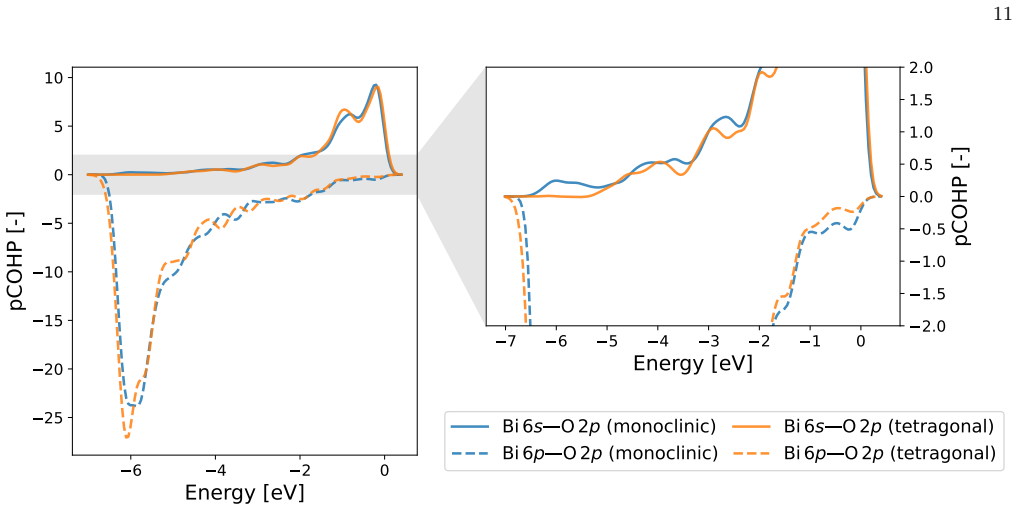
Charge transfer between non-equivalent oxygen sites (O1 versus O2) that lowers on-site energies on the shorter Bi–O bonds while enabling Bi 6s–6p hybridization; the transfer is quantified by Bader charges and pCOHP and is restored only when exact exchange removes self-interaction error.
Load-bearing premise
The temperature-induced band-gap shift calculated for the monoclinic phase can be copied unchanged onto the dynamically unstable tetragonal phase even though anharmonic effects are ignored.
What would settle it
A hybrid-DFT plus SOC calculation that correctly localizes charge on the O1 sites yet still relaxes into the tetragonal structure, or an optical-gap measurement on pure monoclinic BiVO4 that remains more than 0.2 eV away from the predicted 2.60 eV after the same excitonic and thermal corrections.
Editorial analysis
A structured set of objections, weighed in public.
Referee Report
Summary. The manuscript resolves long-standing discrepancies in the theoretical description of BiVO4 by showing that a hybrid functional with α ≈ 0.25 plus spin-orbit coupling correctly stabilizes the monoclinic scheelite ground state, whereas semi-local DFT relaxes to the tetragonal structure. Systematic scans of exact-exchange fraction (with and without SOC) are used to match experimental lattice metrics (a/b, γ, bond-length MSD). With this functional the authors locate the VBM and CBM by dense Brillouin-zone sampling, compute full effective-mass tensors, evaluate excitonic corrections via linear-scaling Wannier BSE and thermal gap renormalization via harmonic Monte-Carlo sampling, and obtain optical gaps in good agreement with experiment. Bonding analysis (pCOHP, Bader charges, simplified TB diagram) identifies charge transfer between non-equivalent oxygen sites as the microscopic driver of the monoclinic distortion, suppressed by self-interaction error in semi-local DFT.
Significance. If the results hold, the work supplies a physically justified computational protocol for BiVO4 that simultaneously recovers the correct ground-state structure, band-edge locations, effective masses and optical gap. The explicit link between charge localization, exact exchange and lattice symmetry is transferable to other complex oxides that exhibit soft modes or charge-driven distortions. Strengths include the systematic functional scan (Fig. 1), dense k-space search for band extrema, full effective-mass tensors (Table II), and open data deposition. The optical-gap prediction is not fitted to experiment but follows from a structure-tuned functional plus independent excitonic and thermal corrections.
major comments (2)
- Methods §II.C and Results §III.C: the temperature-induced gap correction computed for monoclinic BiVO4 (harmonic Monte-Carlo, 96-atom supercell) is transferred unchanged to the tetragonal phase, which is dynamically unstable. While this assumption affects only the small 0.09 eV optical-gap difference and not the structural/bonding mechanism, a short sensitivity estimate or explicit caveat quantifying the possible error would strengthen the optical comparison.
- Methods §II.C: a single scalar dielectric constant (5.35) is used to screen the Coulomb interaction in the BSE, despite the strong anisotropy of the dielectric tensor shown in Fig. 3b. The authors note that bound excitons persist for several values, yet a brief check with direction-dependent screening (or a statement of the residual uncertainty) would make the excitonic binding energies more robust.
minor comments (4)
- Fig. 2: the constant-energy isosurfaces are informative but the caption and main text could more clearly state the energy window (±kBT) and the origin of the cylindrical feature above the monoclinic CBM.
- Table II: the symmetry-averaging formula for tetragonal effective masses is given only in a footnote; moving a short statement into the main text would improve readability.
- Bonding-diagram construction (Methods §II.D): the clustering parameters γ = 0.1 and dcut = 0.3 are stated without a short sensitivity check; a sentence confirming that qualitative conclusions are stable would help.
- A few typographical inconsistencies appear (e.g., “Resul ts”, occasional missing spaces around units); a light copy-edit pass is recommended.
Circularity Check
No significant circularity: functional selection against structure is independent of the subsequent gap and bonding predictions.
full rationale
The paper’s load-bearing chain is: (i) scan hybrid exact-exchange fraction α (and SOC) against experimental lattice metrics (a/b, γ, bond-length MSD) to identify HSE06+SOC with α=0.25 as the functional that stabilizes the monoclinic ground state; (ii) with that fixed functional, densely sample the Brillouin zone for VBM/CBM locations and effective-mass tensors, compute BSE excitonic corrections and harmonic Monte-Carlo thermal renormalization, and obtain optical gaps that match experiment; (iii) interpret the monoclinic distortion via Bader charge transfer between non-equivalent O sites, pCOHP, and a projected tight-binding bonding diagram. Step (i) is ordinary functional selection against an external structural benchmark; the gap, masses, and charge-transfer analysis are independent observables computed after the functional is fixed, not quantities that enter the choice of α. No parameter is fitted to the gap and then re-reported as a prediction; no uniqueness theorem or ansatz is imported from overlapping-author prior work to force the result; self-citations (e.g., Wannier-Optics methodology) supply computational tools, not the physical claim. The transfer of the monoclinic thermal correction to the tetragonal phase is an explicit modeling assumption, not a circular reduction. The derivation is therefore self-contained against external benchmarks.
Axiom & Free-Parameter Ledger
free parameters (4)
- exact-exchange fraction α =
0.25 (with SOC)
- static dielectric constant for BSE screening =
5.35
- clustering parameters γ and d_cut for bonding diagram =
γ=0.1, d_cut=0.3
- scissor shift aligning PBE-based BSE to HSE06+SOC gap =
difference of fundamental gaps
axioms (4)
- domain assumption Hybrid DFT (HSE06/PBE0-like) with a fixed global or range-separated exact-exchange fraction plus SOC is a sufficiently accurate generalized Kohn-Sham starting point for both geometry and electronic structure of BiVO4.
- domain assumption Tamm-Dancoff approximation and static scalar screening are adequate for the lowest excitons in BiVO4.
- domain assumption Harmonic Monte-Carlo sampling of a 96-atom supercell captures the dominant zero-point and room-temperature band-gap renormalization; the same correction applies to the (dynamically unstable) tetragonal phase.
- domain assumption pCOHP and Bader analyses performed without SOC (on HSE06 α=0.4 geometries) remain qualitatively valid for the bonding mechanism.
read the original abstract
Bismuth vanadate (BiVO$_4$) is a prototypical oxide photocatalyst that occurs in both tetragonal and monoclinic scheelite phases with markedly different photocatalytic and photoelectrochemical activities. Accurately identifying the monoclinic phase as the ground state and explaining the origin of its symmetry-breaking distortion are unusually challenging from a theoretical perspective, with various levels of theory and associated physical interpretations for this behaviour reported in the literature. Here, we resolve these discrepancies by systematically assessing the role of exact exchange with and without spin-orbit coupling, demonstrating that an accurate treatment of electronic localization is essential to stabilize the monoclinic scheelite structure. Using this framework, we compute the electronic band structure through dense sampling of the Brillouin zone and show that the band edges in monoclinic and tetragonal BiVO$_4$ lie far from conventional high-symmetry paths, leading to substantial differences in band gaps and carrier effective masses. Choosing the exchange-correlation functional that best reproduces the crystal structure leads to excellent predictions of the band gap once excitonic and thermal effects are taken into account. In addition, we show that the monoclinic distortion is driven by charge transfer between non-equivalent oxygen sites, which breaks the lattice symmetry and is suppressed by self-interaction errors when using semi-local DFT. These results establish a direct connection between the exchange-correlation functional, electronic localization, chemical bonding, and structural stability in BiVO$_4$, providing a foundation for robust ab initio descriptions of phase stability and optoelectronic properties in such complex oxides.
Figures



Reference graph
Works this paper leans on
-
[1]
Park, Y.; McDonald, K. J.; Choi, K.-S. Progress in bis- muth vanadate photoanodes for use in solar water oxida- tion.Chem. Soc. Rev.2013,42, 2321–2337
work page 2013
-
[2]
Sharp, I. D.; Cooper, J. K.; Toma, F. M.; Buonsanti, R. Bismuth Vanadate as a Platform for Accelerating Discov- ery and Development of Complex Transition-Metal Oxide Photoanodes.ACS Energy Lett.2017,2, 139–150
work page 2017
-
[3]
Abdi, F. F.; Han, L.; Smets, A. H.; Zeman, M.; Dam, B.; Van De Krol, R. Efficient solar water splitting by en- hanced charge separation in a bismuth vanadate-silicon tandem photoelectrode.Nat. Commun.2013,4, 2195
work page 2013
-
[4]
Qi, Y.; Zhang, J.; Kong, Y.; Zhao, Y.; Chen, S.; Li, D.; Liu, W.; Chen, Y.; Xie, T.; Cui, J.; Li, C.; Domen, K.; Zhang, F. Unraveling of cocatalysts photodeposited selec- tively on facets of BiVO 4 to boost solar water splitting. Nat. Commun.2022,13, 484
work page 2022
-
[5]
G.; Lin, C.; Liu, T.-K.; Wang, Z.; Miao, J.; Oh, S
Lu, Y.; Lee, B. G.; Lin, C.; Liu, T.-K.; Wang, Z.; Miao, J.; Oh, S. H.; Kim, K. C.; Zhang, K.; Park, J. H. Solar-driven highly selective conversion of glycerol to di- hydroxyacetone using surface atom engineered BiVO 4 photoanodes.Nat. Commun.2024,15, 5475
work page 2024
-
[6]
C.; Lemperle, A.; Rieth, T.; Men- gel, L.; Gao, J.; Tschurl, M.; Heiz, U.; Sharp, I
Zhou, G.; Aletsee, C. C.; Lemperle, A.; Rieth, T.; Men- gel, L.; Gao, J.; Tschurl, M.; Heiz, U.; Sharp, I. D. Water Oxidation and Degradation Mechanisms of BiVO 4 Pho- toanodes in Bicarbonate Electrolytes.ACS Catal.2025, 15, 13048–13058
work page 2025
-
[7]
Kweon, K. E.; Hwang, G. S.; Kim, J.; Kim, S.; Kim, S. Electron small polarons and their transport in bismuth vanadate: a first principles study.Phys. Chem. Chem. Phys.2015,17, 256–260
work page 2015
-
[8]
Kweon, K. E.; Hwang, G. S. Structural phase-dependent hole localization and transport in bismuth vanadate. Phys. Rev. B2013,87, 205202
-
[9]
Kweon, K. E.; Hwang, G. S. Surface structure and hole localization in bismuth vanadate: A first principles study. Appl. Phys. Lett.2013,103, 131603
work page 2013
-
[10]
Hole Polaron Transport in Bismuth Vanadate BiVO4 from Hybrid Density Func- tional Theory.J
Liu, T.; Cui, M.; Dupuis, M. Hole Polaron Transport in Bismuth Vanadate BiVO4 from Hybrid Density Func- tional Theory.J. Phys. Chem. C2020,124, 23038– 23044
-
[11]
Energet- ics of bismuth vanadate.J
Nagabhushana, G.; Tavakoli, A.; Navrotsky, A. Energet- ics of bismuth vanadate.J. Solid State Chem.2015,225, 187–192
work page 2015
-
[12]
Kudo, A.; Omori, K.; Kato, H. A Novel Aqueous Process for Preparation of Crystal Form-Controlled and Highly Crystalline BiVO 4 Powder from Layered Vanadates at Room Temperature and Its Photocatalytic and Pho- tophysical Properties.J. Am. Chem. Soc.1999,121, 11459–11467
work page 1999
-
[13]
Chen, H.; Ferretti, A.; Cox, D
Sleight, A.; y. Chen, H.; Ferretti, A.; Cox, D. Crystal growth and structure of BiVO 4.Mater. Res. Bull.1979, 14, 1571–1581
work page 1979
-
[14]
Tokunaga, S.; Kato, H.; Kudo, A. Selective Prepara- tion of Monoclinic and Tetragonal BiVO 4 with Scheel- ite Structure and Their Photocatalytic Properties.Chem. Mater.2001,13, 4624–4628
work page 2001
-
[15]
Iwase, A.; Kudo, A. Photoelectrochemical water split- ting using visible-light-responsive BiVO 4 fine particles prepared in an aqueous acetic acid solution.J. Mater. Chem.2010,20, 7536–7542
work page 2010
-
[16]
Walsh, A.; Yan, Y.; Huda, M. N.; Al-Jassim, M. M.; Wei, S.-H. Band Edge Electronic Structure of BiVO 4: Elucidating the Role of the Bi s and V d Orbitals.Chem. Mater.2009,21, 547–551
work page 2009
-
[17]
Kweon, K. E.; Hwang, G. S. Hybrid density functional study of the structural, bonding, and electronic proper- ties of bismuth vanadate.Phys. Rev. B2012,86, 165209
-
[18]
Liu, T.; Zhang, X.; Guan, J.; Catlow, C. R. A.; Walsh, A.; Sokol, A. A.; Buckeridge, J. Insight into the Fergu- sonite–Scheelite Phase Transition of ABO 4-Type Oxides by Density Functional Theory: A Case Study of the Subtleties of the Ground State of BiVO 4.Chem. Mater. 15 2022,34, 5334–5343
work page 2022
-
[19]
Perdew, J. P.; Ernzerhof, M.; Burke, K. Rationale for mixing exact exchange with density functional approxi- mations.J. Chem. Phys.1996,105, 9982–9985
work page 1996
-
[20]
Ernzerhof, M.; Scuseria, G. E. Assessment of the Perdew–Burke–Ernzerhof exchange-correlation func- tional.J. Chem. Phys.1999,110, 5029–5036
work page 1999
-
[21]
Toward reliable density functional methods without adjustable parameters: The PBE0 model.J
Adamo, C.; Barone, V. Toward reliable density functional methods without adjustable parameters: The PBE0 model.J. Chem. Phys.1999,110, 6158–6170
work page 1999
-
[22]
Heyd, J.; Scuseria, G. E.; Ernzerhof, M. Hybrid func- tionals based on a screened Coulomb potential.J. Chem. Phys.2003,118, 8207–8215
work page 2003
-
[23]
Krukau, A. V.; Vydrov, O. A.; Izmaylov, A. F.; Scuse- ria, G. E. Influence of the exchange screening parame- ter on the performance of screened hybrid functionals.J. Chem. Phys.2006,125, 224106
work page 2006
-
[24]
Ohad, G.; Gant, S. E.; Wing, D.; Haber, J. B.; Camarasa- G´ omez, M.; Sagredo, F.; Filip, M. R.; Neaton, J. B.; Kro- nik, L. Optical absorption spectra of metal oxides from time-dependent density functional theory and many- body perturbation theory based on optimally-tuned hy- brid functionals.Phys. Rev. Mater.2023,7, 123803
work page 2023
-
[25]
Wadnerkar, N.; English, N. J. Density functional the- ory investigations of bismuth vanadate: Effect of hybrid functionals.Comput. Mater. Sci.2013,74, 33–39
work page 2013
-
[26]
Comprehensive modeling of the band gap and absorption spectrum of BiVO 4.Phys
Wiktor, J.; Reshetnyak, I.; Ambrosio, F.; Pasquarello, A. Comprehensive modeling of the band gap and absorption spectrum of BiVO 4.Phys. Rev. Mater.2017,1, 022401
work page 2017
-
[27]
Pasumarthi, V.; Liu, T.; Dupuis, M.; Li, C. Charge car- rier transport dynamics in W/Mo-doped BiVO 4: first principles-based mesoscale characterization.J. Mater. Chem. A2019,7, 3054–3065
-
[28]
Stoughton, S.; Showak, M.; Mao, Q.; Koirala, P.; Hills- berry, D. A.; Sallis, S.; Kourkoutis, L. F.; Nguyen, K.; Piper, L. F. J.; Tenne, D. A.; Podraza, N. J.; Muller, D. A.; Adamo, C.; Schlom, D. G. Adsorption- controlled growth of BiVO 4 by molecular-beam epitaxy. APL Mater.2013,1, 042112
work page 2013
-
[29]
Ding, K.; Chen, B.; Fang, Z.; Zhang, Y. Density Func- tional Theory Study on the Electronic and Optical Prop- erties of Three Crystalline Phases of BiVO4.Theor. Chem. Acc.2013,132, 1352
work page 2013
-
[30]
The role of the isolated 6s states in BiVO4 on the electronic and atomic structures.Appl
Ma, J.; Wang, L.-W. The role of the isolated 6s states in BiVO4 on the electronic and atomic structures.Appl. Phys. Lett.2014,105, 172102
work page 2014
-
[31]
Cooper, J. K.; Gul, S.; Toma, F. M.; Chen, L.; Liu, Y.- S.; Guo, J.; Ager, J. W.; Yano, J.; Sharp, I. D. Indirect Bandgap and Optical Properties of Monoclinic Bismuth Vanadate.J. Phys. Chem. C2015,119, 2969–2974
-
[32]
Density functional the- ory study of doping effects in monoclinic clinobisvanite BiVO4.Phys
Zhao, Z.; Luo, W.; Li, Z.; Zou, Z. Density functional the- ory study of doping effects in monoclinic clinobisvanite BiVO4.Phys. Lett. A2010,374, 4919–4927
-
[33]
Electronic structure and opti- cal properties of monoclinic clinobisvanite BiVO 4.Phys
Zhao, Z.; Li, Z.; Zou, Z. Electronic structure and opti- cal properties of monoclinic clinobisvanite BiVO 4.Phys. Chem. Chem. Phys.2011,13, 4746–4753
work page 2011
-
[34]
Lardhi, S.; Cavallo, L.; Harb, M. Determination of the Intrinsic Defect at the Origin of Poor H2 Evolution Per- formance of the Monoclinic BiVO 4 Photocatalyst Using Density Functional Theory.J. Phys. Chem. C2018,122, 18204–18211
-
[35]
Ghule, B. G.; Gyeong, S. G.; Jang, J.-H. Charge trans- port and trap state engineering in transition metal-doped bismuth vanadate photoanodes: a DFT study.Nanoscale 2026,18, 4973–4987
work page 2026
-
[36]
F.; Guevarra, D.; Umehara, M.; Reyes- Lillo, S
Newhouse, P. F.; Guevarra, D.; Umehara, M.; Reyes- Lillo, S. E.; Zhou, L.; Boyd, D. A.; Suram, S. K.; Cooper, J. K.; Haber, J. A.; Neaton, J. B.; Gre- goire, J. M. Combinatorial alloying improves bismuth vanadate photoanodes via reduced monoclinic distortion. Energy Environ. Sci.2018,11, 2444–2457
work page 2018
-
[37]
Role of Po- larons in Water Splitting: The Case of BiVO 4.ACS En- ergy Lett.2018,3, 1693–1697
Wiktor, J.; Ambrosio, F.; Pasquarello, A. Role of Po- larons in Water Splitting: The Case of BiVO 4.ACS En- ergy Lett.2018,3, 1693–1697
work page 2018
-
[38]
Liu, T.; Zhao, Q.; Li, C.; Lyu, Y.; Dupuis, M. Photocat- alytic Facet Selectivity in BiVO4 Nanoparticles: Polaron Electronic Structure and Thermodynamic Stability Con- siderations for Photocatalysis.J. Phys. Chem. C2019, 123, 20142–20151
-
[39]
Quasi-Large Hole Polarons in BiVO4-Implications for Photocatalysis and Solar Energy Conversion
Hao, Z.; Liu, T. Quasi-Large Hole Polarons in BiVO 4- Implications for Photocatalysis and Solar Energy Con- version. 2025; DOI: 10.48550/arXiv.2502.10622
work page internal anchor Pith review Pith/arXiv arXiv doi:10.48550/arxiv.2502.10622 2025
-
[40]
Ab initio molecular dynamics for liquid metals.Phys
Kresse, G.; Hafner, J. Ab initio molecular dynamics for liquid metals.Phys. Rev. B1993,47, 558–561
-
[41]
Kresse, G.; Furthm¨ uller, J. Efficiency of ab-initio total energy calculations for metals and semiconductors using a plane-wave basis set.Comput. Mater. Sci.1996,6, 15– 50
work page 1996
-
[42]
Kresse, G.; Furthm¨ uller, J. Efficient iterative schemes for ab initio total-energy calculations using a plane-wave ba- sis set.Phys. Rev. B1996,54, 11169–11186
-
[43]
Bl¨ ochl, P. E. Projector augmented-wave method.Phys. Rev. B1994,50, 17953–17979
-
[44]
Monkhorst, H. J.; Pack, J. D. Special points for Brillouin- zone integrations.Phys. Rev. B1976,13, 5188–5192
-
[45]
Adaptively Compressed Exchange Operator.J
Lin, L. Adaptively Compressed Exchange Operator.J. Chem. Theory Comput.2016,12, 2242–2249, PMID: 27045571
work page 2016
-
[46]
Buˇ cko, T.; Hafner, J.; ´Angy´ an, J. G. Geometry opti- mization of periodic systems using internal coordinates. J. Chem. Phys.2005,122, 124508
work page 2005
-
[47]
Wang, V.; Xu, N.; Liu, J.-C.; Tang, G.; Geng, W.- T. VASPKIT: A user-friendly interface facilitating high- throughput computing and analysis using VASP code. Comput. Phys. Commun.2021,267, 108033
work page 2021
-
[48]
Fonari, A.; Sutton, C. Effective Mass Calculator. 2012; https://github.com/afonari/emc
work page 2012
-
[49]
M.; Searle, A.; Jain, A.; Griffin, S
Ganose, A. M.; Searle, A.; Jain, A.; Griffin, S. M. IFermi: A python library for Fermi surface generation and anal- ysis.J. Open Source Softw.2021,6, 3089
work page 2021
-
[50]
Linear scaling approach for op- tical excitations using maximally localized Wannier func- tions.J
Merkel, K.; Ortmann, F. Linear scaling approach for op- tical excitations using maximally localized Wannier func- tions.J. Phys. Mater.2024,7, 015001
work page 2024
-
[51]
Wannier-Optics.https:// github.com/ortmann-lab/wannier-optics, n.d
Merkel, K.; Ortmann, F. Wannier-Optics.https:// github.com/ortmann-lab/wannier-optics, n.d
-
[52]
Maximally localized general- ized Wannier functions for composite energy bands.Phys
Marzari, N.; Vanderbilt, D. Maximally localized general- ized Wannier functions for composite energy bands.Phys. Rev. B1997,56, 12847–12865
-
[53]
Marzari, N.; Mostofi, A. A.; Yates, J. R.; Souza, I.; Van- derbilt, D. Maximally localized Wannier functions: The- ory and applications.Rev. Mod. Phys.2012,84, 1419– 1475
work page 2012
-
[54]
Pizzi, G. et al. Wannier90 as a community code: new fea- tures and applications.J. Phys.: Condens. Matter2020, 32, 165902
-
[55]
First-Principles Ap- proach to Insulators in Finite Electric Fields.Phys
Souza, I.; ´I˜ niguez, J.; Vanderbilt, D. First-Principles Ap- proach to Insulators in Finite Electric Fields.Phys. Rev. Lett.2002,89, 117602. 16
work page 2002
-
[56]
Zacharias, M.; Giustino, F. One-shot calculation of temperature-dependent optical spectra and phonon- induced band-gap renormalization.Phys. Rev. B2016, 94, 075125
-
[57]
Deringer, V. L.; Tchougr´ eeff, A. L.; Dronskowski, R. Crystal Orbital Hamilton Population (COHP) Analy- sis As Projected from Plane-Wave Basis Sets.J. Phys. Chem. A2011,115, 5461–5466, PMID: 21548594
-
[58]
Maintz, S.; Deringer, V. L.; Tchougr´ eeff, A. L.; Dron- skowski, R. Analytic projection from plane-wave and PAW wavefunctions and application to chemical-bonding analysis in solids.J. Comput. Chem.2013,34, 2557– 2567
work page 2013
-
[59]
Maintz, S.; Deringer, V. L.; Tchougr´ eeff, A. L.; Dron- skowski, R. LOBSTER: A tool to extract chemical bond- ing from plane-wave based DFT.J. Comput. Chem. 2016,37, 1030–1035
work page 2016
-
[60]
Oliphant, E.; Kioupakis, E.; Sun, W. Crystal Orbital Guided Iteration to Atomic Orbitals: A Pathway to Chemically Adaptive Atomic Orbitals from DFT. 2026; DOI: 10.48550/arXiv.2511.19725
work page internal anchor Pith review Pith/arXiv arXiv doi:10.48550/arxiv.2511.19725 2026
-
[61]
Modern hierarchical, agglomerative clustering algorithms
M¨ ullner, D. Modern hierarchical, agglomerative cluster- ing algorithms. 2011; DOI: 10.48550/arXiv.1109.2378
work page internal anchor Pith review Pith/arXiv arXiv doi:10.48550/arxiv.1109.2378 2011
-
[62]
E.; others SciPy 1.0: Fundamental Algorithms for Scientific Computing in Python.Nat
Virtanen, P.; Gommers, R.; Oliphant, T. E.; others SciPy 1.0: Fundamental Algorithms for Scientific Computing in Python.Nat. Methods2020,17, 261–272
-
[63]
A fast and robust algorithm for Bader decomposition of charge den- sity.Comput
Henkelman, G.; Arnaldsson, A.; J´ onsson, H. A fast and robust algorithm for Bader decomposition of charge den- sity.Comput. Mater. Sci.2006,36, 354–360
work page 2006
-
[64]
A grid-based Bader analysis algorithm without lattice bias.J
Tang, W.; Sanville, E.; Henkelman, G. A grid-based Bader analysis algorithm without lattice bias.J. Phys.: Condens. Matter2009,21, 084204
-
[65]
Sanville, E.; Kenny, S. D.; Smith, R.; Henkelman, G. Im- proved grid-based algorithm for Bader charge allocation. J. Comput. Chem.2007,28, 899–908
work page 2007
-
[66]
Yu, M.; Trinkle, D. R. Accurate and efficient algorithm for Bader charge integration.J. Chem. Phys.2011,134, 064111
work page 2011
-
[67]
F.; Jiang, C.-M.; Ihrke, I.; Sirotti, E.; Rieth, T.; Henning, A.; Eichhorn, J.; Sharp, I
Kunzelmann, V. F.; Jiang, C.-M.; Ihrke, I.; Sirotti, E.; Rieth, T.; Henning, A.; Eichhorn, J.; Sharp, I. D. Solution-based synthesis of wafer-scale epitaxial BiVO 4 thin films exhibiting high structural and optoelectronic quality.J. Mater. Chem. A2022,10, 12026–12034
-
[68]
Ultrafast Spontaneous Exciton Dissociation via Phonon Emission in BiVO$_4$
Gant, S. E.; Alvertis, A. M.; Coveney, C. J. N.; Haber, J. B.; Filip, M. R.; Neaton, J. B. Ultrafast Spon- taneous Exciton Dissociation via Phonon Emission in BiVO4. 2025; DOI: 10.48550/arXiv.2504.00110
work page internal anchor Pith review Pith/arXiv arXiv doi:10.48550/arxiv.2504.00110 2025
-
[69]
David, W. I. F.; Wood, I. G. Ferroelastic phase transition in BiVO4: V. Temperature dependence of Bi 3+ displace- ment and spontaneous strains.J. Phys. C: Solid State Phys.1983,16, 5127
work page 1983
-
[70]
Payne, D. J.; Robinson, M. D. M.; Egdell, R. G.; Walsh, A.; McNulty, J.; Smith, K. E.; Piper, L. F. J. The nature of electron lone pairs in BiVO 4.Appl. Phys. Lett.2011,98, 212110
work page 2011
-
[71]
Cooper, J. K.; Gul, S.; Toma, F. M.; Chen, L.; Glans, P.- A.; Guo, J.; Ager, J. W.; Yano, J.; Sharp, I. D. Electronic Structure of Monoclinic BiVO4.Chem. Mater.2014,26, 5365–5373
work page 2014
-
[72]
Influence of spin-orbit coupling on chemical bonding
Gulans, A.; Draxl, C. Influence of spin-orbit coupling on chemical bonding. 2022; DOI: 10.48550/arXiv.2204.02751
work page internal anchor Pith review Pith/arXiv arXiv doi:10.48550/arxiv.2204.02751 2022
-
[73]
In this work, we use the term ’self-interaction errors’ to refer to both the one-electron self-interaction error, as well as the many-electron self-interaction error stem- ming from deviations from piecewise linearity in semi- local DFT as described in ref. [75]
-
[74]
Verdi, C.; Ranalli, L.; Franchini, C.; Kresse, G. Quantum paraelectricity and structural phase transitions in stron- tium titanate beyond density functional theory.Phys. Rev. Mater.2023,7, L030801
work page 2023
-
[75]
Kronik, L.; K¨ ummel, S. Piecewise linearity, freedom from self-interaction, and a Coulomb asymptotic potential: three related yet inequivalent properties of the exact density functional.Phys. Chem. Chem. Phys.2020,22, 16467–16481
work page 2020
discussion (0)
Sign in with ORCID, Apple, or X to comment. Anyone can read and Pith papers without signing in.