REVIEW 2 major objections 4 minor 36 references
A rotatable antenna array on a UAV, jointly optimized with beamforming, raises multiuser sum-rate under QoS limits far above a fixed array.
Reviewed by Pith at T0; open to challenge. T0 means a machine referee read the full paper against a public rubric. the ladder, T0–T4 →
T0 review · grok-4.5
2026-07-10 07:42 UTC pith:TLV4553P
load-bearing objection Solid systems paper: QoS-constrained RAA orientation+beamforming with a careful PDD solver and a practical two-module GNN that actually addresses the gradient-scale problem; gains over FAA are clear under the stated LoS model. the 2 major comments →
Optimization and Deep Learning based Resource Allocation for UAV-Aided Wireless Communication with Rotatable Antenna Array
The pith
A machine-rendered reading of the paper's core claim, the machinery that carries it, and where it could break.
Core claim
Jointly designing the three-dimensional orientation of a rotatable antenna array and the multiuser beamforming vectors yields significantly higher sum-rate and higher probability of meeting per-user rate constraints than the same design performed with a fixed antenna array, under pure line-of-sight channels whose geometry is known to the UAV.
What carries the argument
Penalty dual decomposition (PDD) that introduces auxiliary variables for the effective channel products and the orientation orthogonality constraint, then alternates closed-form beamforming, majorization-minimization SINR updates, and Riemannian conjugate-gradient orientation updates; and a two-module GNN that first predicts orientation (pre-trained on channel-correlation loss) and then beamforming, trained unsupervised with a Lagrangian QoS penalty.
Load-bearing premise
Every user is assumed to have a pure line-of-sight link whose gain and phase are completely determined by known geometry, and the UAV is assumed to know those positions accurately enough to compute orientation and beams.
What would settle it
In a controlled outdoor UAV trial with measured multipath or deliberate localization error of a few meters, check whether the rotatable-array sum-rate and QoS feasibility still exceed those of an identical fixed array by the margins reported in the paper's Figures 6–9.
Editorial analysis
A structured set of objections, weighed in public.
Referee Report
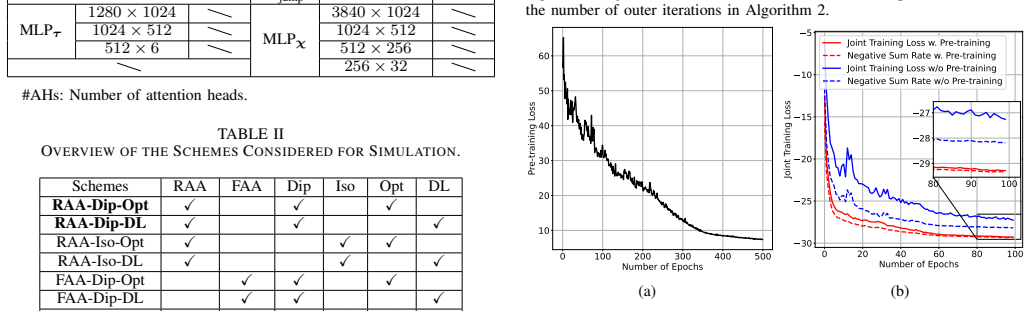
Summary. The paper equips a hovering multi-antenna UAV with a rotatable antenna array (RAA) whose 3D orientation can be adjusted by a gimbal. It jointly optimizes RAA orientation vectors (ra, rd) and the beamforming matrix W to maximize multiuser sum-rate subject to a total power constraint and per-user minimum-rate (QoS) constraints. The nonconvex problem is first reformulated with auxiliary variables X = H^H W and solved by a double-loop PDD algorithm that yields closed-form updates for W and X (Theorems 1–2) and Riemannian conjugate-gradient steps for the orientations on the unit sphere; the algorithm is claimed to reach a KKT point under mild conditions. A complementary unsupervised GNN framework with two serially connected modules (orientation then beamforming), graph-level pooling, Gram–Schmidt orthogonalization, and a two-stage pre-training/joint-training strategy is introduced to mitigate gradient imbalance and enable fast inference. Extensive simulations under pure LoS geometry compare RAA versus fixed arrays (dipole/isotropic) and optimization versus DL, showing large gains in sum-rate and feasibility, complementary reliability-versus-speed trade-offs, and DL robustness to bounded position errors.
Significance. If the results hold under the stated model, the work supplies a concrete, SWAP-friendly mechanism (simple gimbal rotation of a rigid array) that simultaneously improves multiuser interference management and antenna-element gain alignment for UAV platforms. The dual algorithmic contribution—PDD with closed-form subproblems plus a carefully engineered two-module GNN that preserves permutation equivariance—is technically solid and directly addresses the strong coupling that defeats naïve BCD. The complementary strengths (PDD reliability under stringent QoS, GNN speed and robustness) together with the systematic ablation over N, K, rate thresholds and position-error radius make the paper useful for both offline design and real-time UAV resource allocation. Prior RAA literature is extended by the fairness-aware sum-rate objective rather than pure SE maximization or power minimization.
major comments (2)
- [II-A / Remark 1 / Fig. 9] Section II-A, Eqs. (1)–(4) and Remark 1: The entire performance claim rests on pure LoS channels whose steering vectors and element factors are completely determined by known geometry. While bounded position error is examined in Fig. 9, no sensitivity to Rician K-factor, multipath clusters or blockage is provided. Because the claimed RAA gains (high-gain alignment and angular decorrelation) vanish or reverse under rich scattering, a short numerical study with a Rician or geometry-based stochastic model would make the central claim more robust.
- [V-B / Fig. 6] Section V-B and the note preceding Fig. 6: Setting the sum-rate of every infeasible realization to zero is transparent for feasibility comparison, yet for high Rk the large Opt–DL gap is driven almost entirely by the feasibility-ratio difference rather than by the rates of the feasible instances. Explicitly reporting (or plotting) the conditional average sum-rate over only the feasible realizations would cleanly separate the two effects and avoid overstating the performance gap.
minor comments (4)
- [III-B / Theorem 1] Proof of Theorem 1 is omitted “due to limited space.” A short sketch or an explicit pointer to the identical steps in the cited reference would improve reproducibility.
- [Table III] Table III reports wall-clock times on a specific workstation; stating the number of Monte-Carlo trials and whether GPU acceleration was used for the GNN inference would make the speed-up claim fully reproducible.
- [III-C / Algorithm 2] Notation for the dual variables and penalty parameters is dense; a short table summarizing the PDD schedule (initial ρ, reduction factors c1/c2, tolerances) would help readers implement Algorithm 2.
- [throughout] A few typographical inconsistencies appear (e.g., “UA V” vs. “UAV”, occasional missing spaces around math operators). A careful proof-reading pass is recommended.
Circularity Check
No significant circularity: objective/constraints are independent of the solvers; PDD subproblem solutions and unsupervised GNN losses do not redefine the metric as a fit or self-citation.
full rationale
The paper formulates sum-rate maximization under power, orthonormal orientation, and per-user SINR/QoS constraints (P1/C1–C6) from a standard LoS dipole channel model (1)–(4) that is fixed a priori by geometry. The PDD reformulation (fP1)–(P2) introduces auxiliary variables and AL penalties solely to decouple the same constraints; closed-form updates for W (11), X (Theorems 1–2 via MM/KKT), and manifold RCG for ra/rd (17)–(20) are standard first-order/KKT manipulations of those subproblems and do not redefine the objective. The GNN architecture (OM+BM, message passing (23)–(32), Gram–Schmidt/normalization) and two-stage unsupervised loss (P10)–(P11) with LDM duals likewise optimize the original sum-rate + ReLU QoS penalty; no labels or fitted parameters are re-used as “predictions.” Prior RAA citations [11]–[16] (overlapping authors) address distinct objectives (power, SE, EE, completion time, ISAC) and supply only motivational context, not load-bearing uniqueness or ansatz that forces the present sum-rate claim. Simulation comparisons (Figs. 5–9, Table III) evaluate the solvers on independent random user realizations under the stated model. No step reduces a claimed prediction or first-principles result to its own inputs by construction.
Axiom & Free-Parameter Ledger
free parameters (4)
- PDD penalty/dual schedule (ρ1, ρ2, c1, c2, ε tolerances, Tmax)
- GNN architecture widths, attention heads, L1/L2 depth, learning rate, μ step size, E1/E2 epochs
- Simulation scenario (N=16, K=4, Rk=4 nat/s/Hz, P=1 W, hover height 40 m, 100×100 m area)
- Path-loss constants in βk (140.7 + 36.7 log10(Dk/1000))
axioms (5)
- domain assumption UAV–user channels are pure LoS with known geometry-determined steering vectors and dipole element factors (Eqs. (1)–(4)).
- domain assumption RAA orientation is fully described by two orthonormal unit vectors ra, rd with free 3D rotation (C2–C4).
- standard math PDD double-loop converges to a KKT point of (P1)/(P2) when constraint violations are driven small enough ([17]–[19]).
- standard math Strong duality / KKT sufficiency for the W and per-user X quadratic subproblems (Slater, [29]).
- ad hoc to paper Unsupervised Lagrangian penalty on ReLU(γk−γk) plus two-stage training adequately enforces QoS for the GNN.
invented entities (2)
-
Two-module GNN (OM then BM) with graph-level orientation head, Gram–Schmidt, and two-stage pretrain/joint train
no independent evidence
-
PDD splitting of joint RAA orientation–beamforming with auxiliary X and AL penalties on C4/C8
no independent evidence
read the original abstract
Multi-antenna unmanned aerial vehicle (UAV)-aided communication presents a promising solution to increase the system capacity and improve the quality of service (QoS) of the future wireless networks. In this paper, we equip a UAV platform with a rotatable antenna array (RAA), which can be rotated flexibly in three-dimensional (3D) space via an onboard gimbal, enabling additional spatial degrees of freedom (DoFs) for improving multiuser signal transmission and interference management. Compared with a conventional fixed antenna array (FAA), the RAA can proactively align users with the high-gain region of its antenna elements and reduce the spatial channel correlations among users. To demonstrate the advantages of RAA, we jointly design the RAA orientation and beamforming to maximize the sum-rate of multiple users subject to per-user QoS constraints. The formulated problem is highly nonconvex and exhibits strong coupling between the RAA orientation and beamforming variables. To solve this challenging problem, we propose first an optimization framework based on the penalty dual decomposition (PDD) method to iteratively optimize RAA orientation and beamforming. While the optimization framework yields high reliability in QoS satisfaction and favorable sum-rate performance, its iterative nature may hinder real-time deployment. To accelerate the joint design and preserve a high-quality solution, we further propose a deep learning (DL) framework based on graph neural networks (GNNs). Simulation results demonstrate that RAAs significantly outperform FAAs in UAV-aided communication. Additionally, the proposed optimization framework is capable of satisfying stringent QoS requirements with high reliability, while the proposed DL framework attains comparable sum-rate performance with substantially reduced computation time and exhibits robustness to user position information errors.
Figures




Reference graph
Works this paper leans on
-
[1]
A Survey on Millimeter-Wave Beamforming Enabled UA V Communications and Networking,
Z. Xiao et al., “A Survey on Millimeter-Wave Beamforming Enabled UA V Communications and Networking,”IEEE Commun. Surveys Tuts., vol. 24, no. 1, pp. 557-610, 2022
work page 2022
-
[2]
A Tutorial on UA Vs for Wireless Networks: Applications, Challenges, and Open Problems,
M. Mozaffari et al., “A Tutorial on UA Vs for Wireless Networks: Applications, Challenges, and Open Problems,”IEEE Commun. Surveys Tuts., vol. 21, no. 3, pp. 2334-2360, 2019
work page 2019
-
[3]
Noncooperative Cellular Wireless with Unlimited Num- bers of Base Station Antennas,
T. L. Marzetta, “Noncooperative Cellular Wireless with Unlimited Num- bers of Base Station Antennas,”IEEE Trans. Wireless Commun., vol. 9, no. 11, pp. 3590-3600, Nov. 2010
work page 2010
-
[4]
A Comprehensive Overview on 5G-and-beyond Networks with UA Vs,
Q. Wu, et al., “A Comprehensive Overview on 5G-and-beyond Networks with UA Vs,”IEEE J. Sel. Areas Commun., vol. 39, no. 10, pp. 2912-2945, Oct. 2021
work page 2021
-
[5]
Joint Maneuver and Beamforming Design for UA V-enabled Integrated Sensing and Communication,
Z. Lyu, G. Zhu and J. Xu, “Joint Maneuver and Beamforming Design for UA V-enabled Integrated Sensing and Communication,”IEEE Trans. Wireless Commun., vol. 22, no. 4, pp. 2424-2440, Apr. 2023
work page 2023
-
[6]
Y . K. Tun et al., “Joint Beamforming and Trajectory Optimization for Multi-UA V-Assisted Integrated Sensing and Communication Systems,” IEEE Trans. Veh. Technol
-
[7]
Rotatable Antenna Enabled Wireless Communication and Sensing: Opportunities and Challenges,
B. Zheng et al., “Rotatable Antenna Enabled Wireless Communication and Sensing: Opportunities and Challenges,”IEEE Wireless Commun., vol. 33, no. 3, pp. 134-141, Jun. 2026
work page 2026
-
[8]
Movable Antennas for Wireless Communication: Opportu- nities and Challenges,
L. Zhu et al., “Movable Antennas for Wireless Communication: Opportu- nities and Challenges,”IEEE Commun. Mag., vol. 62, no. 6, pp. 114-120, June 2024
work page 2024
-
[9]
Rotatable Antenna-Enabled Wireless Communication: Modeling and Optimization,
B. Zheng et al., “Rotatable Antenna-Enabled Wireless Communication: Modeling and Optimization,”IEEE Trans. Wireless Commun., vol. 74, pp. 6825-6842, 2026
work page 2026
-
[10]
6D Movable Antenna Based on User Distribution: Modeling and Optimization,
X. Shao et al., “6D Movable Antenna Based on User Distribution: Modeling and Optimization,”IEEE Trans. Wireless Commun., vol. 24, no. 1, pp. 355-370, Jan. 2025
work page 2025
-
[11]
Rotatable Antenna Array Enabled UA V mmWave Massive MIMO Communication,
X. Zhang et al., “Rotatable Antenna Array Enabled UA V mmWave Massive MIMO Communication,”IEEE Trans. Wireless Commun., vol. 74, pp. 1219-1236, 2026
work page 2026
-
[12]
Joint Optimization of Beamforming and 3D Array Steering for Multi-Antenna UA V Communications,
L. Xiang et al., “Joint Optimization of Beamforming and 3D Array Steering for Multi-Antenna UA V Communications,”IEEE WCNC, Dubai, 2024
work page 2024
-
[13]
Energy-Efficient Dynamic Array-Steering and Beam- forming for UA V-Aided Communications
L. Xiang et al., “Energy-Efficient Dynamic Array-Steering and Beam- forming for UA V-Aided Communications”,IEEE GlobeCom, Cape Town, 2024
work page 2024
-
[14]
Completion Time Minimization for UA V-aided Com- munications with Rotatable Dipole Array
B. Yilmaz et al., “Completion Time Minimization for UA V-aided Com- munications with Rotatable Dipole Array”,IEEE ICC, Montreal, 2025
work page 2025
-
[15]
Joint Optimization of Beamforming and 3D Array-Steering for UA V-Aided ISAC,
F. Pei et al., “Joint Optimization of Beamforming and 3D Array-Steering for UA V-Aided ISAC,”IEEE ICC, Denver, CO, USA, 2024
work page 2024
-
[16]
Transmit Beamforming and Array Steering Optimization for UA V-Aided Bistatic ISAC
F. Pei et al., “Transmit Beamforming and Array Steering Optimization for UA V-Aided Bistatic ISAC”,IEEE GlobeCom, Cape Town, 2024
work page 2024
-
[17]
Q. Shi et al., “Penalty Dual Decomposition Method for Nonsmooth Nonconvex Optimization—Part I: Algorithms and Convergence Analy- sis,”IEEE Trans. Signal Process., vol. 68, pp. 4108-4122, 2020. 14
work page 2020
-
[18]
Penalty Dual Decomposition Method for Nonsmooth Nonconvex Optimization—Part II: Applications,
Q. Shi et al., “Penalty Dual Decomposition Method for Nonsmooth Nonconvex Optimization—Part II: Applications,”IEEE Trans. Signal Process., vol. 68, pp. 4242-4257, 2020
work page 2020
-
[19]
Spectral Efficiency Optimization For Millimeter Wave Multiuser MIMO Systems,
Q. Shi et al., “Spectral Efficiency Optimization For Millimeter Wave Multiuser MIMO Systems,”IEEE J. Select. Topics Signal Process., vol. 12, no. 3, pp. 455-468, Jun. 2018
work page 2018
-
[20]
Y . Shen et al., “Graph Neural Networks for Scalable Radio Resource Management: Architecture Design and Theoretical Analysis,”IEEE J. Select. Areas Commun., vol. 39, no. 1, pp. 101-115, Jan. 2021
work page 2021
-
[21]
Graph Neural Networks for Wireless Communications: From Theory to Practice,
Y . Shen et al., “Graph Neural Networks for Wireless Communications: From Theory to Practice,”IEEE Trans. Wireless Commun., vol. 22, no. 5, pp. 3554-3569, May 2023
work page 2023
-
[22]
GNN-Based Beamforming for Sum-Rate Maximization in MU-MISO Networks,
Y . Li et al., “GNN-Based Beamforming for Sum-Rate Maximization in MU-MISO Networks,”IEEE Trans. Wireless Commun., vol. 23, no. 8, pp. 9251-9264, Aug. 2024
work page 2024
-
[23]
DeepSIC: Deep Soft Interference Cancellation for Multiuser MIMO Detection,
N. Shlezinger et al., “DeepSIC: Deep Soft Interference Cancellation for Multiuser MIMO Detection,”IEEE Trans. Wireless Commun., vol. 20, no. 2, pp. 1349-1362, Feb. 2021
work page 2021
-
[24]
On Stream Selection for Interference Alignment in Heterogeneous Networks,
A. Beyazıt et al., “On Stream Selection for Interference Alignment in Heterogeneous Networks,”J. Wireless Commun. Network, 80 (2016)
work page 2016
-
[25]
C. A. Balanis,Antenna Theory: Analysis and Design. 4th ed, 2016
work page 2016
-
[26]
D. Xu et al., “Multiuser MISO UA V Communications in Uncertain Environments With No-Fly Zones: Robust Trajectory and Resource Allocation Design,”IEEE Trans. Commun., vol. 68, no. 5, pp. 3153-3172, May 2020
work page 2020
-
[27]
Energy-Efficient UA V Communications in the Presence of Wind: 3D Modeling and Trajectory Design,
X. Dai et al., “Energy-Efficient UA V Communications in the Presence of Wind: 3D Modeling and Trajectory Design,”IEEE Trans. Wireless Commun., vol. 23, no. 3, pp. 1840-1854, March 2024
work page 2024
-
[28]
Multiplier and Gradient Methods,
M.R.Hestenes, “Multiplier and Gradient Methods,”J. Optim. Theory Appl., vol. 4, no. 5, pp. 303–320, 1969
work page 1969
-
[29]
Boyd et al.,Convex Optimization, Cambridge University Press, 2004
S. Boyd et al.,Convex Optimization, Cambridge University Press, 2004
work page 2004
-
[30]
Massive MIMO Multicasting With Finite Blocklength,
X. Zhang et al., “Massive MIMO Multicasting With Finite Blocklength,” IEEE Trans. Wireless Commun., vol. 23, no. 10, pp. 15018-15034, Oct. 2024
work page 2024
-
[31]
Majorization-Minimization Algorithms in Signal Pro- cessing, Communications, and Machine Learning,
Y . Sun et al., “Majorization-Minimization Algorithms in Signal Pro- cessing, Communications, and Machine Learning,”IEEE Trans. Signal Process., vol. 65, no. 3, pp. 794-816, Feb.1, 2017
work page 2017
-
[32]
Absil et al.,Optimization Algorithms on Matrix Manifolds.Prince- ton University Press, 2009
P.-A. Absil et al.,Optimization Algorithms on Matrix Manifolds.Prince- ton University Press, 2009
work page 2009
-
[33]
Nocedal et al.,Numerical Optimization, 2nd Edition, Springer, 2006
J. Nocedal et al.,Numerical Optimization, 2nd Edition, Springer, 2006
work page 2006
-
[34]
Weighted Sum-Rate Maximization for MISO Down- link Cellular Networks via Branch and Bound,
S. K. Joshi et al., “Weighted Sum-Rate Maximization for MISO Down- link Cellular Networks via Branch and Bound,”IEEE Trans. Signal Process., vol. 60, no. 4, pp. 2090-2095, April 2012
work page 2090
-
[35]
W. L. Hamilton,Graph Representation Learning, Morgan & Claypool, 2020
work page 2020
-
[36]
R. Ismayilov et al., “Adaptive Beam-Frequency Allocation Algorithm with Position Uncertainty for Millimeter-Wave MIMO Systems,”IEEE VTC Spring, Porto, Portugal, 2018
work page 2018
discussion (0)
Sign in with ORCID, Apple, or X to comment. Anyone can read and Pith papers without signing in.