REVIEW 2 major objections 6 minor 66 references
Interleaving distance on Reeb cosheaves of proximity graphs yields object-level confidence regions for the unknown Reeb graph of a filtered space from finite samples.
Reviewed by Pith at T0; open to challenge. T0 means a machine referee read the full paper against a public rubric. the ladder, T0–T4 →
T0 review · grok-4.5
2026-07-10 07:08 UTC pith:GUMIVSHF
load-bearing objection Solid object-level Reeb confidence theory with a clean PL-vs-Mapper split; experiments are honest about their weaker calibration. the 2 major comments →
Building confidence regions for Reeb graphs using the interleaving distance
The pith
A machine-rendered reading of the paper's core claim, the machinery that carries it, and where it could break.
Core claim
Under covering-radius control of a finite sample, the Reeb cosheaf of the PL proximity graph on that sample is close in interleaving distance to the true Reeb cosheaf of the filtered space; the resulting interleaving balls are therefore valid confidence regions for the unknown Reeb graph, and they dominate the usual extended-persistence bottleneck pseudometric by a factor of two.
What carries the argument
The PL-Reeb estimator R^{S_n,\rho}_\delta (Reeb cosheaf of the geometric realization of the proximity graph with linear filter extension) together with the interleaving distance d_I on constructible cosheaves; stability maps it to the true Reeb cosheaf at scale \mu_\delta (intrinsic) or \omega_f(\eta_\tau(\delta)) (extrinsic, positive reach).
Load-bearing premise
Extrinsic bounds and several confidence conversions require the underlying support to have positive reach and the Euclidean covering radius to stay below that reach; without positive reach the Euclidean-to-intrinsic distortion control fails.
What would settle it
On a compact positive-reach manifold with known Reeb graph, draw large i.i.d. samples, build the PL estimator at the theoretically prescribed scale, and check whether the true Reeb cosheaf lies inside the claimed interleaving ball at the nominal rate; systematic failure of coverage falsifies the confidence claim.
Editorial analysis
A structured set of objections, weighed in public.
Referee Report
Summary. The paper constructs interleaving-distance confidence regions for Reeb graphs from finite samples. The primary estimator is the Reeb cosheaf of a piecewise-linear filtered proximity graph on the sample (intrinsic or Euclidean); Mapper graphs are treated as controlled cover coarsenings used for visualization. The authors prove a comparison d_Δ ≤ 2 d_I between the extended-persistence pseudometric and the interleaving distance (constant 1 for Ord0, Ext0, Rel1), stability of the PL–Reeb estimators under covering-radius control (with positive-reach distortion for the extrinsic case), and transfer of Hausdorff-scale probabilistic bounds into interleaving balls via (a,b)-standard tails or Fasy-type subsampling. Numerical experiments on a torus and an ant mesh illustrate feature selection on the PL object and pushforward to Mapper graphs.
Significance. If the results hold as stated, the paper supplies a genuine object-level alternative to persistence-based Mapper confidence sets: interleaving balls separate non-isomorphic Reeb graphs, and the PL-versus-Mapper split cleanly separates statistical approximation from visualization. The comparison theorem links this geometry to extended persistence with sharp H0 constants, and the stability theorems give explicit, usable radii under standard geometric hypotheses. Strengths include detailed proofs (including the Ext1 Hall-rank argument and density reduction in Appendix C), an explicit comparison with CMO18 and BBS25 in Appendix A, and open disclosure that rate-corrected subsampling radii and unsplit (a,b) plug-ins are not theorem-level certificates (Remarks 5.1, 6.1). The contribution is solid for the TDA–statistics interface and advances beyond bottleneck-only guarantees.
major comments (2)
- Theorem 3.1 asserts that the constant 2 is sharp, but the text only gives a heuristic (a loop of persistence 4ε killed by 2ε-smoothing yields diagonal bottleneck cost 2ε). An explicit pair of Reeb graphs with d_Δ / d_I arbitrarily close to 2 (or a proof that no smaller universal constant works) is needed to justify the sharpness claim; otherwise rephrase as “the factor 2 is forced by the two-sided smoothing argument and is not an artifact of the proof technique.”
- Section 6 and Remark 6.1: the experiments label features “significant” under unsplit (a,b) plug-in estimation and empirically rate-corrected subsampling radii whose finite-sample coverage is not proved (Remark 5.1, Section B.4). The abstract and conclusions still present these as identifying statistically significant features. For a statistics journal, either (i) restrict the experimental claims to “features outside the calibrated band under the disclosed heuristic calibration,” with no 1−α language, or (ii) add a formal coverage result / split-sample protocol for the procedures actually used. The deterministic transfer from a valid Hausdorff radius to d_I and d_Δ is fine; the load-bearing gap is the data-driven radius itself.
minor comments (6)
- Figure 1 caption: “Matching colors identify the corresponding topological features… which must be inferred using the elder rule” is dense; a short pointer to which bars are Ord0/Ext0/Rel1/Ext1 would help non-specialists.
- Notation: R is used both for the Reeb graph and for the real line (e.g. covers of R). A consistent distinction (e.g. mathbb{R} vs script R) would reduce ambiguity in Sections 2–4.
- Corollary 5.3–5.4: the O((b_n/n)^{1/4}) remainder is inherited from Fasy et al.; stating the sample-size regime in which the authors treat the remainder as negligible in the experiments would help practitioners.
- Appendix A comparison with CMO18 is valuable; a one-line summary table of leading constants (PL vs Mapper vs MultiNerve) would make the improvement at the PL level easier to scan.
- Typos / style: “Carri` ere”, “Universit` a”, “Cˆ ote” appear with broken accents in the source; fix for the journal version. Also “dI-confidence” vs “d_I-confidence” inconsistently.
- Section 4.1: θ_f and μ_δ are well-defined, but a short remark that μ_δ is computable only if ω_f and geodesic interpolants are known (or bounded) would clarify the gap between theory and practice for non-Lipschitz filters.
Circularity Check
No significant circularity: stability, d_Δ–d_I comparison, and confidence regions are derived from covering radii and cosheaf interleavings, not from fitted targets or load-bearing self-citation.
full rationale
The load-bearing claims are Theorem 3.1 (d_Δ ≤ 2 d_I with sharp H0 constants), Theorems 4.1–4.2 (PL–Reeb interleaving stability under intrinsic/extrinsic covering-radius control), and Corollaries 5.1–5.4 (Hausdorff tails → interleaving balls). Each is proved from the definitions of constructible cosheaves, ε-interleavings, moduli of continuity, and (for extrinsic bounds) positive-reach distortion; the Ext1 argument uses a standard density reduction via functional distortion (Prop. C.2) that does not import the target inequality. Overlapping-author citations (e.g. CMO18) appear as related-work comparison and experimental baseline, not as uniqueness theorems or ansätze that force the new bounds. Numerical scale choices (unsplit (a,b) plug-in, rate-corrected subsampling) are explicitly labeled empirical calibrations (Remarks 5.1, 6.1) rather than first-principles predictions. Nothing reduces by construction to its own inputs.
Axiom & Free-Parameter Ledger
free parameters (6)
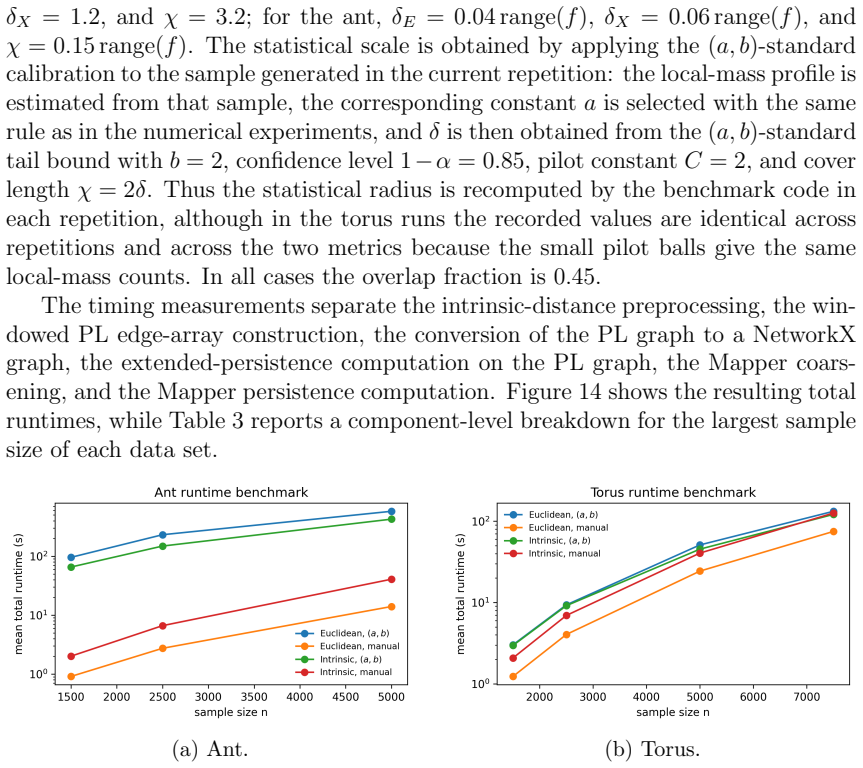
- pilot constant C for (a,b) local-mass radius r_n =
2
- confidence level 1-α =
0.85
- subsample size rule b_n = floor(n / (log n)^{1.001}) =
power 1.001
- Mapper cover length χ and overlap =
χ=2δ; overlap 0.45
- Isomap nearest-neighbor count for intrinsic metric =
10
- rate-correction intrinsic dimension d =
2 (displayed experiments)
axioms (6)
- standard math Constructible R-spaces and Reeb–cosheaf equivalence (de Silva–Munch–Patel) so d_I is a metric up to isomorphism on Reeb graphs.
- domain assumption Positive reach of the support X implies Euclidean–intrinsic distortion d_X(x,y) ≤ 2τ arcsin(‖x−y‖/(2τ)) for ‖x−y‖<2τ (Boissonnat–Lieutier–Wintraecken).
- domain assumption (a,b)-standard lower mass bounds on metric balls yield exponential Hausdorff covering tails (Chazal et al.).
- domain assumption Fasy et al. subsampling quantile for Euclidean Hausdorff distance on compact manifolds without boundary, positive reach, noiseless sampling on M.
- domain assumption Filter f continuous with modulus of continuity ω_f w.r.t. intrinsic distance; (X,f) constructible.
- ad hoc to paper Rate-corrected radii δ_log, δ_pow are valid finite-sample calibrations of the raw Fasy radius.
invented entities (2)
-
PL-Reeb estimator R^{S_n,ρ}_δ (Reeb cosheaf of proximity graph with PL filter extension)
independent evidence
-
Mapper coarsening M_U of the PL-Reeb cosheaf with multivalued pushforward Ξ_I
independent evidence
read the original abstract
We develop confidence regions for Reeb graphs from finite samples using the interleaving distance. Given a point cloud equipped with a filter function, we construct a finite proximity graph, extend the filter linearly, and use the Reeb cosheaf of the resulting filtered graph as the primary estimator. Mapper graphs are then treated as controlled cover-based coarsenings of this estimator, separating the statistical approximation problem from the visualization problem. We prove stability bounds for the Reeb estimators obtained both using intrinsic and extrinsic metrics, the latter under positive-reach assumptions, and derive interleaving-distance confidence regions from either \((a,b)\)-standard sampling assumptions or subsampling-based Hausdorff scale estimates. We also compare this object-level metric viewpoint with persistence-based guarantees by showing that the extended-persistence pseudometric is bounded by twice the interleaving distance, with sharp constant \(1\) for the \(H_0\)-related components. Numerical experiments illustrate how statistically significant features can be identified and then projected to Mapper graphs for interpretation.
Figures



Reference graph
Works this paper leans on
-
[1]
arXiv preprint arXiv:2512.08159 , year=
Reeb Graph of Sample Thickenings , author=. arXiv preprint arXiv:2512.08159 , year=
- [2]
- [3]
-
[4]
Probability Theory and Related Fields , volume=
Random Euclidean coverage from within , author=. Probability Theory and Related Fields , volume=. 2023 , publisher=
work page 2023
-
[5]
Diestel, Reinhard , title =
-
[6]
Journal of Computational Geometry , volume =
Bauer, Ulrich and Lesnick, Michael , title =. Journal of Computational Geometry , volume =. 2015 , doi =
work page 2015
-
[7]
On the Stability of Interval Decomposable Persistence Modules , journal =
Bakke Bjerkevik, H. On the Stability of Interval Decomposable Persistence Modules , journal =. 2021 , doi =
work page 2021
-
[8]
Computing in Geometry and Topology , volume =
Alharbi, Rehab and Chambers, Erin Wolf and Munch, Elizabeth , title =. Computing in Geometry and Topology , volume =. 2024 , url =
work page 2024
-
[9]
Computing in Geometry and Topology , volume =
Realizable Piecewise Linear Paths of Persistence Diagrams with Reeb Graphs , author =. Computing in Geometry and Topology , volume =. 2024 , doi =
work page 2024
-
[10]
Proceedings of the 30th Annual Symposium on Computational Geometry , series =
Ulrich Bauer and Xiaoyin Ge and Yusu Wang , title =. Proceedings of the 30th Annual Symposium on Computational Geometry , series =. 2014 , doi =
work page 2014
-
[11]
31st International Symposium on Computational Geometry (SoCG 2015) , series =
Ulrich Bauer and Elizabeth Munch and Yusu Wang , title =. 31st International Symposium on Computational Geometry (SoCG 2015) , series =. 2015 , doi =
work page 2015
-
[12]
36th International Symposium on Computational Geometry (SoCG 2020) , pages =
Kim, Jisu and Shin, Jaehyeok and Chazal, Fr. 36th International Symposium on Computational Geometry (SoCG 2020) , pages =. 2020 , doi =
work page 2020
- [13]
-
[14]
Transactions of the American Mathematical Society , volume =
Herbert Federer , title =. Transactions of the American Mathematical Society , volume =
-
[15]
Kandror, Elena K. and Carrière, Mathieu and Peterson, Alexis and Liao, Will and Tjärnberg, Andreas and Fung, Jun Hou and Mahbubani, Krishnaa T. and Loper, Jackson and Pangburn, William and Xu, Yuchen and Saeb-Parsy, Kourosh and Maniatis, Tom and Rizvi, Abbas H. , urldate =. Enhancer Dynamics and Cellular Architecture in the Human Spinal Cord , issn =. doi...
-
[16]
Boissonnat, Jean-Daniel and Lieutier, André and Wintraecken, Mathijs , date =. The
-
[17]
Nicolau, Monica and Levine, Arnold J. and Carlsson, Gunnar , date =. Topology Based Data Analysis Identifies a Subgroup of Breast Cancers with a Unique Mutational Profile and Excellent Survival , volume =. doi:10.1073/pnas.1102826108 , pages =
-
[18]
Rizvi, Abbas H. and Cámara, Pablo G. and Kandror, Elena K. and Roberts, Thomas J. and Schieren, Ira and Maniatis, Tom and Rabadán, Raúl , urldate =. Single-Cell Topological. doi:10.1038/nbt.3854 , pages =
-
[19]
Convergence between Categorical Representations of Reeb Space and Mapper , volume =
Munch, Elizabeth and Wang, Bei , date =. Convergence between Categorical Representations of Reeb Space and Mapper , volume =. 32nd International Symposium on Computational Geometry (. doi:10.4230/LIPIcs.SoCG.2016.53 , series =
-
[20]
Topological Data Analysis of Single-Cell Hi-C Contact Maps , booktitle =
Carri. Topological Data Analysis of Single-Cell Hi-C Contact Maps , booktitle =. 2020 , publisher =
work page 2020
-
[21]
Jeitziner, Rachel and Carri. Two-Tier Mapper, an unbiased topology-based clustering method for enhanced global gene expression analysis , journal =. 2019 , doi =
work page 2019
-
[22]
Differentiable Mapper for Topological Optimization of Data Representation , booktitle =
Oulhaj, Ziyad and Carri. Differentiable Mapper for Topological Optimization of Data Representation , booktitle =. 2024 , editor =
work page 2024
- [23]
-
[24]
Journal of Computational Geometry , year =
Farahbakhsh Touli, Elena and Wang, Yusu , title =. Journal of Computational Geometry , year =
-
[25]
and Fox, Kyle and Nath, Abhinandan and Sidiropoulos, Anastasios and Wang, Yusu , title =
Agarwal, Pankaj K. and Fox, Kyle and Nath, Abhinandan and Sidiropoulos, Anastasios and Wang, Yusu , title =. ACM Transactions on Algorithms , year =
-
[26]
Gasparovic, Ellen and Munch, Elizabeth and Oudot, Steve and Turner, Katharine and Wang, Bei , title =. La Matematica , year =
-
[27]
Journal of Applied and Computational Topology , year =
Curry, Justin and Gasparovic, Ellen and Munch, Elizabeth and Oudot, Steve and Wang, Bei , title =. Journal of Applied and Computational Topology , year =
-
[28]
Reeb graphs for shape analysis and applications , journal =. 2008 , note =. doi:https://doi.org/10.1016/j.tcs.2007.10.018 , author =
-
[29]
Saunders Mac Lane , title =
-
[30]
Categorified Reeb Graphs , volume=
de Silva, Vin and Munch, Elizabeth and Patel, Amit , year=. Categorified Reeb Graphs , volume=. Discrete & Computational Geometry , publisher=. doi:10.1007/s00454-016-9763-9 , number=
-
[31]
Journal of Applied and Computational Topology , volume =
Adam Brown and Omer Bobrowski and Elizabeth Munch and Bei Wang , title =. Journal of Applied and Computational Topology , volume =. 2021 , doi =
work page 2021
- [32]
-
[33]
Proceedings of the Twenty-Fifth Annual Symposium on Computational Geometry , pages =
Chazal, Fr\'. Proximity of persistence modules and their diagrams , year =. Proceedings of the Twenty-Fifth Annual Symposium on Computational Geometry , pages =. doi:10.1145/1542362.1542407 , abstract =
-
[34]
Bubenik, Peter and Scott, Jonathan A. , journal =. Categorification of Persistent Homology , volume =
-
[35]
32nd International Symposium on Computational Geometry (SoCG 2016) , pages =
Carri\`. 32nd International Symposium on Computational Geometry (SoCG 2016) , pages =. 2016 , volume =. doi:10.4230/LIPIcs.SoCG.2016.25 , annote =
-
[36]
Structure and Stability of the 1-Dimensional Mapper , journal =
Carri. Structure and Stability of the 1-Dimensional Mapper , journal =
- [37]
-
[38]
Extending Persistence Using Poincar
Cohen-Steiner, David and Edelsbrunner, Herbert and Harer, John , doi =. Extending Persistence Using Poincar. Foundations of Computational Mathematics , number =. 2009 , bdsk-url-1 =
work page 2009
-
[39]
Proceedings of the Thirtieth Annual Symposium on Computational Geometry , pages =
Bauer, Ulrich and Ge, Xiaoyin and Wang, Yusu , title =. Proceedings of the Thirtieth Annual Symposium on Computational Geometry , pages =. 2014 , isbn =. doi:10.1145/2582112.2582169 , abstract =
-
[40]
Carlsson, Gunnar and de Silva, Vin , date-added =. Zigzag Persistence , url =. Foundations of Computational Mathematics , number =. 2010 , bdsk-url-1 =. doi:10.1007/s10208-010-9066-0 , id =
-
[41]
Proceedings of the Twenty-Fifth Annual Symposium on Computational Geometry , pages =
Carlsson, Gunnar and de Silva, Vin and Morozov, Dmitriy , title =. Proceedings of the Twenty-Fifth Annual Symposium on Computational Geometry , pages =. 2009 , isbn =. doi:10.1145/1542362.1542408 , abstract =
-
[42]
33rd International Symposium on Computational Geometry (SoCG 2017) , pages =
Carri\`. 33rd International Symposium on Computational Geometry (SoCG 2017) , pages =. 2017 , volume =. doi:10.4230/LIPIcs.SoCG.2017.25 , annote =
-
[43]
Singh, Gurjeet and Mémoli, Facundo and Carlsson, Gunnar , year =. Topological Methods for the Analysis of High Dimensional Data Sets and 3D Object Recognition , journal =
-
[44]
Topological Methods for Exploring Low-density States in Biomolecular Folding Pathways , volume =
Yao, Yuan and Sun, Jian and Huang, Xuhui and Bowman, Gregory and Singh, Gurjeet and Lesnick, Michael and Guibas, Leonidas and Pande, Vijay and Carlsson, Gunnar , year =. Topological Methods for Exploring Low-density States in Biomolecular Folding Pathways , volume =. The Journal of chemical physics , doi =
-
[45]
Journal of allergy and clinical immunology , volume=
Innate and adaptive T cells in asthmatic patients: relationship to severity and disease mechanisms , author=. Journal of allergy and clinical immunology , volume=. 2015 , publisher=
work page 2015
-
[46]
Extracting insights from the shape of complex data using topology , volume =
Lum, Pek and Singh, G and Lehman, A and Ishkanov, T and Vejdemo-Johansson, Mikael and Alagappan, Meenatchi and Carlsson, J and Carlsson, Gunnar , year =. Extracting insights from the shape of complex data using topology , volume =. Scientific reports , doi =
-
[47]
Statistical Analysis and Parameter Selection for Mapper , journal =
Mathieu Carri. Statistical Analysis and Parameter Selection for Mapper , journal =. 2018 , volume =
work page 2018
-
[48]
Convergence Rates for Persistence Diagram Estimation in Topological Data Analysis , journal =
Fr. Convergence Rates for Persistence Diagram Estimation in Topological Data Analysis , journal =. 2015 , volume =
work page 2015
-
[49]
Confidence Sets for Persistence Diagrams , volume =
Fasy, Brittany and Lecci, Fabrizio and Rinaldo, Alessandro and Wasserman, Larry and Balakrishnan, Sivaraman and Singh, Aarti , year =. Confidence Sets for Persistence Diagrams , volume =
-
[50]
Geometric Inference for Probability Measures , volume =
Chazal, Frédéric and Cohen-Steiner, David and Mérigot, Quentin , year =. Geometric Inference for Probability Measures , volume =. Foundations of Computational Mathematics , doi =
-
[51]
Chen, Xiaobai and Golovinskiy, Aleksey and Funkhouser, Thomas , title =. ACM Trans. Graph. , month = jul, articleno =. 2009 , issue_date =. doi:10.1145/1531326.1531379 , abstract =
-
[52]
Sam T. Roweis and Lawrence K. Saul , title =. Science , volume =. 2000 , doi =. https://www.science.org/doi/pdf/10.1126/science.290.5500.2323 , abstract =
-
[53]
34th International Symposium on Computational Geometry (SoCG 2018) , pages =
Boissonnat, Jean-Daniel and Lieutier, Andr\'. 34th International Symposium on Computational Geometry (SoCG 2018) , pages =. 2018 , volume =. doi:10.4230/LIPIcs.SoCG.2018.10 , annote =
-
[54]
Discrete & Computational Geometry , volume=
Stability and minimax optimality of tangential Delaunay complexes for manifold reconstruction , author=. Discrete & Computational Geometry , volume=. 2018 , publisher=
work page 2018
-
[55]
and Hamann, Bernd , booktitle =
Beketayev, Kenes and Yeliussizov, Damir and Morozov, Dmitriy and Weber, Gunther H. and Hamann, Bernd , booktitle =. Measuring the Distance Between Merge Trees , year =
-
[56]
Finding the Homology of Submanifolds with High Confidence from Random Samples , volume =
Niyogi, Partha and Smale, Stephen and Weinberger, Shmuel , year =. Finding the Homology of Submanifolds with High Confidence from Random Samples , volume =. Discrete & Computational Geometry , doi =
-
[57]
Computational Topology: An Introduction , isbn =
Edelsbrunner, Herbert and Harer, John , year =. Computational Topology: An Introduction , isbn =
-
[58]
A graph-matching formulation of the interleaving distance between merge trees , journal =
Matteo Pegoraro , keywords =. A graph-matching formulation of the interleaving distance between merge trees , journal =. 2025 , issn =. doi:10.3934/math.2025586 , url =
-
[59]
Bounding the interleaving distance for mapper graphs with a loss function , url =
Chambers, Erin Wolf and Munch, Elizabeth and Percival, Sarah and Wang, Bei , date =. Bounding the interleaving distance for mapper graphs with a loss function , url =. Journal of Applied and Computational Topology , number =. 2025 , bdsk-url-1 =. doi:10.1007/s41468-025-00215-x , id =
-
[60]
Categories for the Working Mathematician , author=. 1998 , publisher=
work page 1998
-
[61]
On standardness: estimation of the standardness constant and decidability aspects , url =
Alejandro Cholaquidis and Leonardo Moreno and Beatriz Pateiro-L. On standardness: estimation of the standardness constant and decidability aspects , url =. Journal of Nonparametric Statistics , number =. 2026 , bdsk-url-1 =. doi:10.1080/10485252.2025.2591341 , eprint =
-
[62]
Intrinsic dimension estimation of data by principal component analysis , author=. 2010 , eprint=
work page 2010
-
[63]
Tenenbaum and Vin de Silva and John C
Joshua B. Tenenbaum and Vin de Silva and John C. Langford , journal =. A Global Geometric Framework for Nonlinear Dimensionality Reduction , volume =
-
[64]
Mathieu Carri. Cover complex , publisher =. GUDHI User and Reference Manual , url =
-
[65]
Pedregosa, F. and Varoquaux, G. and Gramfort, A. and Michel, V. and Thirion, B. and Grisel, O. and Blondel, M. and Prettenhofer, P. and Weiss, R. and Dubourg, V. and Vanderplas, J. and Passos, A. and Cournapeau, D. and Brucher, M. and Perrot, M. and Duchesnay, E. , journal=. Scikit-learn: Machine Learning in
-
[66]
Aric A. Hagberg and Daniel A. Schult and Pieter J. Swart , title =. Proceedings of the 7th Python in Science Conference , pages =
discussion (0)
Sign in with ORCID, Apple, or X to comment. Anyone can read and Pith papers without signing in.