REVIEW 3 major objections 5 minor 112 references
Text-to-image models reduce disability to wheelchairs and other narrow markers, generating less diverse images that match real-world high-warmth, low-competence stereotypes.
Reviewed by Pith at T0; open to challenge. T0 means a machine referee read the full paper against a public rubric. the ladder, T0–T4 →
T0 review · grok-4.5
2026-07-10 06:07 UTC pith:WTLS2N3A
load-bearing objection First real large-scale T2I disability benchmark; wheelchair default and diversity collapse are solid, SCM claim is more circular than presented. the 3 major comments →
Beyond wheelchairs and blindfolds: Investigating disability stereotypes in T2I models with INCLUDE-BENCH
The pith
A machine-rendered reading of the paper's core claim, the machinery that carries it, and where it could break.
Core claim
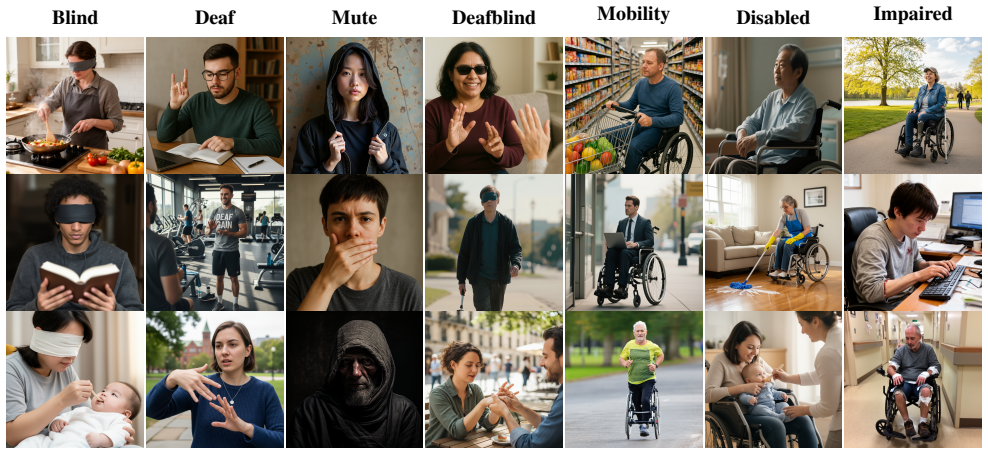
Across 17 text-to-image models and 119,680 images, mobility-impaired and default disability prompts predominantly yield wheelchair depictions; disability-conditioned generations exhibit reduced visual diversity; stereotypical portrayals show stronger disability-text alignment; and the introduced SCM Score demonstrates that the models systematically reproduce real-world high-warmth/low-competence associations for people with disabilities.
What carries the argument
INCLUDE-BENCH (352 prompts in four subsets varying impairment specificity, intersectional identity, and context) plus the SCM Score, which projects CLIP image embeddings onto normalized warmth and competence directions derived from positive/negative attribute texts, quantifying how closely generations match sociological stereotype content.
Load-bearing premise
The automated pipeline of person crops, vision-language captions and demographics, CLIP embeddings, and diversity scores is a valid enough stand-in for real representational harm and stereotype content even without large-scale validation by people with disabilities.
What would settle it
A large, diverse panel of people with disabilities rates the same generated images and finds high intra-group variety, low stereotyping, and competence/warmth judgments that reverse the SCM pattern while the automated metrics continue to report the opposite.
If this is right
- Disability must become a core, not optional, axis in any serious T2I bias benchmark.
- Models that overweight diagnostic visual markers will keep sacrificing diversity for label alignment.
- Adding context or intersectional cues alone does not break the alignment-diversity trade-off for physical disabilities.
- Creative tools built on current models will continue defaulting to demographically narrow, low-agency portrayals of disability unless the training and evaluation regimes change.
Where Pith is reading between the lines
- The same diagnostic-feature over-weighting likely explains why other underrepresented groups collapse to single visual tropes in generative models.
- Community-validated SCM ratings could turn the metric into a practical fairness audit for future model releases.
- Targeted diversification or filtering of wheelchair-dominant training images may be sufficient to raise diversity without collapsing prompt alignment.
Editorial analysis
A structured set of objections, weighed in public.
Referee Report
Summary. The paper introduces INCLUDE-BENCH, a large-scale benchmark for disability-related bias in text-to-image models. It constructs 352 prompts spanning generic and specific impairments (mobility, sensory), intersectional attributes (age, race, gender), and static/dynamic contexts grounded in WHO ICF domains, then generates 20 images per prompt from 17 T2I models (15 open, 2 closed) for a total of ~119K images. Evaluation uses person-centric crops (SAM3), clustering + captioning (Qwen3-VL), CLIPScore for disability-text alignment, Vendi Score for spectral diversity, intersectional frequency ratios, and a new multimodal SCM Score that projects image CLIP embeddings onto warmth/competence directions derived from fixed adjective sets. Main empirical claims are that mobility/default disability prompts overwhelmingly produce wheelchair imagery, disability-conditioned outputs show reduced diversity and higher alignment for stereotypical depictions, and SCM scores track real-world high-warmth/low-competence patterns for PWD.
Significance. Disability is a clear gap in T2I bias evaluation relative to gender, race, and occupation. The scale (17 models, 119K images, four controlled prompt subsets) and the multi-metric toolbox (clustering, alignment-diversity trade-off, intersectional ratios, SCM) constitute a useful community resource. Explicit credit is due for releasing a structured prompt design that isolates impairment, identity, and context, for evaluating both open and closed models under identical conditions, and for attempting to ground evaluation in the sociological Stereotype Content Model rather than ad-hoc visual checklists. If the descriptive findings hold under external validation, the benchmark can become a standard diagnostic for representational harm toward PWD.
major comments (3)
- §3.2.4 and finding (4): The SCM Score is defined as the projection of image CLIP embeddings onto normalized warmth/competence directions obtained from the same CLIP text encoder (adjectives adapted from Fraser et al.). CLIPScore (§3.2.2) and Vendi (§3.2.3) also live in CLIP space, and demographic labels for Table 2 come from Qwen3-VL. Because these evaluators themselves encode the social stereotypes under study, elevated SCM scores for wheelchair-heavy clusters (C1–C2) and older-white over-representation may re-project evaluator priors rather than independently confirm that T2I outputs match real-world SCM patterns. The Limitations section (§6) acknowledges the absence of PWD human annotation, yet the abstract and conclusion still treat the automated SCM numbers as evidence that “T2I models reflect real-world stereotypical associations.” An external anchor (human SCM ratings on a stratif
- §3.1 and axiom of visual observability: The benchmark deliberately excludes cognitive and intellectual disabilities because they are “less visually apparent.” While this is a practical design choice, it is not neutral: the paper’s own sociological framing (representativeness, diagnostic features) predicts that models will over-weight the most visible markers. Restricting the functional groups therefore risks confirming the very visual-shorthand bias the authors criticize, and weakens the claim that INCLUDE-BENCH comprehensively evaluates “disability-related bias.” At minimum the paper should quantify how much of the observed wheelchair/blindfold dominance is an artifact of this exclusion, or provide a parallel analysis for prompts that name non-visible disabilities.
- §4.0.1 / Table 3 and §3.2.1: Clustering (MiniBatchKMeans, k=10) and subsequent token-frequency / VQA analyses are performed on the pooled set of all models and prompts. Without model-stratified or prompt-subset-stratified cluster statistics, it is impossible to tell whether the wheelchair dominance and age/gender compression are uniform or driven by a subset of architectures (e.g., older SD variants vs. FLUX/Janus). The central claim that the patterns hold “across all models” therefore rests on an untested aggregation. Reporting per-model cluster membership or silhouette diagnostics would make the claim falsifiable.
minor comments (5)
- Abstract and §1: “15 open-source and 2 closed-source models” vs. later “17 state-of-the-art”; keep the count consistent and list the closed models (NanoBanana, GPT-Image-1-mini) in the abstract or early introduction.
- Table 2 caption and body: intersection codes (o f w, y m af, etc.) are dense; a short legend or expanded first column would improve readability.
- Figure 3 / 4 / 5 / 6: axis labels and Δ definitions are only partially explained in the main text; move the precise baseline subtraction formula into the caption or §4.0.2.
- §3.2.3: Vendi is reported primarily with CLIP embeddings; the DINO results are deferred to the supplement without a one-sentence summary of whether the diversity ranking is stable.
- References: several arXiv preprints and model cards lack stable version identifiers or access dates; standardize for archival purposes.
Circularity Check
Empirical benchmark measurements with external metrics; no derivation reduces to inputs by construction.
full rationale
INCLUDE-BENCH is an observational evaluation paper: prompts are constructed along impairment/context/identity axes, 119K images are generated from 17 T2I models, and properties are measured with off-the-shelf tools (SAM3 crops, Qwen3-VL captions/VQA, CLIP embeddings for CLIPScore and Vendi, MiniBatchKMeans clusters). The SCM Score (§3.2.4) is a fixed projection of image CLIP embeddings onto normalized directions δ_W and δ_C obtained from external positive/negative warmth and competence adjective lists (adapted from Fraser et al. 2021, itself grounded in the classic Fiske/Cuddy SCM literature). No parameters are fitted to the generated images and then re-used as “predictions”; no equation equates a claimed result to its own definition; no uniqueness theorem or ansatz is imported via self-citation. The authors’ own prior work is not load-bearing. Mild evaluator-bias concerns (CLIP/Qwen may themselves encode stereotypes) are validity/limitations issues (§6), not circularity of the derivation chain. Findings remain self-contained empirical measurements against the constructed prompt set.
Axiom & Free-Parameter Ledger
free parameters (3)
- n_clusters (MiniBatchKMeans)
- images_per_prompt
- SCM attribute prompt set size R
axioms (6)
- domain assumption CLIP image–text cosine similarity is a valid measure of disability-label semantic alignment and of warmth/competence stereotype directions.
- domain assumption Vendi Score on CLIP (and DINO) embeddings quantifies representational diversity of disability depictions.
- domain assumption SAM3 person detections and largest-box crops yield person-centric images free enough of background confounds for stereotype analysis.
- domain assumption Qwen3-VL captions and VQA demographic labels are accurate enough for cluster characterization and intersectional ratios R_i,g.
- domain assumption Stereotype Content Model warmth and competence dimensions transfer from social psychology / NLP to T2I image embeddings.
- ad hoc to paper Focusing on visually observable impairments (excluding cognitive/intellectual disabilities) is sufficient for a disability bias benchmark.
invented entities (2)
-
INCLUDE-BENCH
no independent evidence
-
Multimodal SCM Score
no independent evidence
read the original abstract
Text-to-image (T2I) models have been shown to exhibit social biases. Prior work has mainly focused on gender, skin tone, and cultural representation within restricted occupational associations, and emerging benchmarks increasingly incorporate these dimensions. However, disability remains systematically underexplored. Current evaluation practices often fail to align with sociologically grounded definitions of stereotyping, limiting principled assessment of representational harms toward people with disabilities (PWD). To address this, we introduce INCLUDE-BENCH, the first large-scale benchmark for evaluating disability-related bias in T2I models. INCLUDE-BENCH comprises 119K generated images based on prompt design across multiple bias dimensions and both static and dynamic contexts. We evaluate 15 open-source and 2 closed-source models. Our key findings reveal that: (1) mobility-impaired and default disability prompts predominantly yield wheelchair depictions across all models; (2) disability-conditioned generations consistently exhibit less diversity; (3) stereotypical portrayals demonstrate stronger disability-text alignment; and (4) we introduce the Stereotype Content Model (SCM) Score, demonstrating that T2I models reflect real-world stereotypical associations.
Figures


Reference graph
Works this paper leans on
-
[1]
Qwen3-vl technical report, 2025
Shuai Bai, Yuxuan Cai, Ruizhe Chen, Keqin Chen, Xionghui Chen, Zesen Cheng, Lianghao Deng, Wei Ding, Chang Gao, Chunjiang Ge, Wenbin Ge, Zhifang Guo, Qi- dong Huang, Jie Huang, Fei Huang, Binyuan Hui, Shu- tong Jiang, Zhaohai Li, Mingsheng Li, Mei Li, Kaixin Li, Zicheng Lin, Junyang Lin, Xuejing Liu, Jiawei Liu, Chenglong Liu, Yang Liu, Dayiheng Liu, Shix...
work page 2025
-
[2]
Hrs-bench: Holistic, reliable and scalable benchmark for text-to-image models, 2023
Eslam Mohamed Bakr, Pengzhan Sun, Xiaoqian Shen, Faizan Farooq Khan, Li Erran Li, and Mohamed Elhoseiny. Hrs-bench: Holistic, reliable and scalable benchmark for text-to-image models, 2023. 3
work page 2023
-
[3]
Hritik Bansal, Da Yin, Masoud Monajatipoor, and Kai-Wei Chang. How well can text-to-image generative models un- derstand ethical natural language interventions?, 2022. 3
work page 2022
-
[4]
Trupti Bavalatti, Osama Ahmed, Dhaval Potdar, Rakeen Rouf, Faraz Jawed, Manish Kumar Govind, and Siddharth Krishnan. A systematic review of open datasets used in text-to-image (t2i) gen ai model safety.IEEE Access, 13:32661–32680, 2025. 1
work page 2025
-
[5]
Cynthia L Bennett, Cole Gleason, Morgan Klaus Scheuer- man, Jeffrey P Bigham, Anhong Guo, and Alexandra To. “it’s complicated”: Negotiating accessibility and (mis) rep- resentation in image descriptions of race, gender, and dis- ability. InProceedings of the 2021 chi conference on human factors in computing systems, pages 1–19, 2021. 2
work page 2021
-
[6]
Cynthia L Bennett, Shaun K Kane, and Christina N Har- rington. Toward community-led evaluations of text-to- image ai representations of disability, health, and accessi- bility. InProceedings of the 5th ACM Conference on Equity and Access in Algorithms, Mechanisms, and Optimization, pages 256–270, 2025. 1, 2, 3
work page 2025
-
[7]
Easily accessible text-to-image generation amplifies demographic stereotypes at large scale
Federico Bianchi, Pratyusha Kalluri, Esin Durmus, Faisal Ladhak, Myra Cheng, Debora Nozza, Tatsunori Hashimoto, Dan Jurafsky, James Zou, and Aylin Caliskan. Easily accessible text-to-image generation amplifies demographic stereotypes at large scale. InProceedings of the 2023 ACM conference on fairness, accountability, and transparency, pages 1493–1504, 2023. 2
work page 2023
-
[8]
Flux dev.https:// huggingface.co/black-forest-labs/FLUX
Black-Forest-Labs. Flux dev.https:// huggingface.co/black-forest-labs/FLUX. 1-dev, 2024. AI text-to-image generation model. 5
work page 2024
-
[9]
Flux schnell.https: //huggingface.co/black-forest-labs/ FLUX.1-schnell, 2024
Black-Forest-Labs. Flux schnell.https: //huggingface.co/black-forest-labs/ FLUX.1-schnell, 2024. AI text-to-image generation model. 5
work page 2024
-
[10]
Flux2 dev.https: //huggingface.co/black-forest-labs/ FLUX.2-dev, 2026
Black-Forest-Labs. Flux2 dev.https: //huggingface.co/black-forest-labs/ FLUX.2-dev, 2026. AI text-to-image generation model. 5
work page 2026
-
[11]
Language (technology) is power: A critical survey of “bias” in nlp
Su Lin Blodgett, Solon Barocas, Hal Daum ´e Iii, and Hanna Wallach. Language (technology) is power: A critical survey of “bias” in nlp. InProceedings of the 58th annual meet- ing of the association for computational linguistics, pages 5454–5476, 2020. 1
work page 2020
-
[12]
Stereotyping norwegian salmon: An inventory of pitfalls in fairness benchmark datasets
Su Lin Blodgett, Gilsinia Lopez, Alexandra Olteanu, Robert Sim, and Hanna Wallach. Stereotyping norwegian salmon: An inventory of pitfalls in fairness benchmark datasets. InProceedings of the 59th Annual Meeting of the Association for Computational Linguistics and the 11th International Joint Conference on Natural Language Pro- cessing (Volume 1: Long Pap...
work page 2021
-
[13]
On the Opportunities and Risks of Foundation Models
Rishi Bommasani, Drew A Hudson, Ehsan Adeli, Russ Alt- man, Simran Arora, Sydney von Arx, Michael S Bernstein, Jeannette Bohg, Antoine Bosselut, Emma Brunskill, et al. On the opportunities and risks of foundation models.arXiv preprint arXiv:2108.07258, 2021. 2 9
work page internal anchor Pith review Pith/arXiv arXiv 2021
-
[14]
Stereotypes.The Quarterly journal of eco- nomics, 131(4):1753–1794, 2016
Pedro Bordalo, Katherine Coffman, Nicola Gennaioli, and Andrei Shleifer. Stereotypes.The Quarterly journal of eco- nomics, 131(4):1753–1794, 2016. 1
work page 2016
-
[15]
Envisioning equitable speech technologies for black older adults
Robin N Brewer, Christina Harrington, and Courtney Hel- dreth. Envisioning equitable speech technologies for black older adults. InProceedings of the 2023 ACM Conference on Fairness, Accountability, and Transparency, pages 379– 388, 2023. 2
work page 2023
-
[16]
Qi Cai, Jingwen Chen, Yang Chen, Yehao Li, Fuchen Long, Yingwei Pan, Zhaofan Qiu, Yiheng Zhang, Fengbin Gao, Peihan Xu, Yimeng Wang, Kai Yu, Wenxuan Chen, Zi- wei Feng, Zijian Gong, Jianzhuang Pan, Yi Peng, Rui Tian, Siyu Wang, Bo Zhao, Ting Yao, and Tao Mei. Hidream-i1: A high-efficient image generative foundation model with sparse diffusion transformer, 2025. 5
work page 2025
-
[17]
The stereotype content model and disabilities.The Journal of Social Psychology, 163(4):480–500, 2023
Emily Canton, Darren Hedley, and Jennifer R Spoor. The stereotype content model and disabilities.The Journal of Social Psychology, 163(4):480–500, 2023. 8
work page 2023
-
[18]
Sam 3: Segment anything with concepts, 2025
Nicolas Carion, Laura Gustafson, Yuan-Ting Hu, Shoub- hik Debnath, Ronghang Hu, Didac Suris, Chaitanya Ryali, Kalyan Vasudev Alwala, Haitham Khedr, Andrew Huang, Jie Lei, Tengyu Ma, Baishan Guo, Arpit Kalla, Markus Marks, Joseph Greer, Meng Wang, Peize Sun, Roman R¨adle, Triantafyllos Afouras, Effrosyni Mavroudi, Kather- ine Xu, Tsung-Han Wu, Yu Zhou, Lil...
work page 2025
-
[19]
Disability im- pacts all of us infographic, 2025
Centers for Disease Control and Prevention. Disability im- pacts all of us infographic, 2025. Accessed: 2025-09-12. 1
work page 2025
-
[20]
Pixart-α: Fast train- ing of diffusion transformer for photorealistic text-to-image synthesis, 2023
Junsong Chen, Jincheng Yu, Chongjian Ge, Lewei Yao, Enze Xie, Yue Wu, Zhongdao Wang, James Kwok, Ping Luo, Huchuan Lu, and Zhenguo Li. Pixart-α: Fast train- ing of diffusion transformer for photorealistic text-to-image synthesis, 2023. 5
work page 2023
-
[21]
Janus- pro: Unified multimodal understanding and generation with data and model scaling, 2025
Xiaokang Chen, Zhiyu Wu, Xingchao Liu, Zizheng Pan, Wen Liu, Zhenda Xie, Xingkai Yu, and Chong Ruan. Janus- pro: Unified multimodal understanding and generation with data and model scaling, 2025. 5
work page 2025
-
[22]
Tibet: Identifying and evaluating biases in text-to-image generative models, 2024
Aditya Chinchure, Pushkar Shukla, Gaurav Bhatt, Kiri Salij, Kartik Hosanagar, Leonid Sigal, and Matthew Turk. Tibet: Identifying and evaluating biases in text-to-image generative models, 2024. 3
work page 2024
-
[23]
Dall-eval: Probing the reasoning skills and social biases of text-to- image generation models
Jaemin Cho, Abhay Zala, and Mohit Bansal. Dall-eval: Probing the reasoning skills and social biases of text-to- image generation models. InProceedings of the IEEE/CVF international conference on computer vision, pages 3043– 3054, 2023. 2
work page 2023
-
[24]
Dall-eval: Probing the reasoning skills and social biases of text-to- image generation models, 2023
Jaemin Cho, Abhay Zala, and Mohit Bansal. Dall-eval: Probing the reasoning skills and social biases of text-to- image generation models, 2023. 3
work page 2023
-
[25]
Mapping the margins: Inter- sectionality, identity politics, and violence against women of color
Kimberl ´e Williams Crenshaw. Mapping the margins: Inter- sectionality, identity politics, and violence against women of color. InThe public nature of private violence, pages 93–118. Routledge, 2013. 2
work page 2013
-
[26]
The bias map: behaviors from intergroup affect and stereotypes
Amy JC Cuddy, Susan T Fiske, and Peter Glick. The bias map: behaviors from intergroup affect and stereotypes. Journal of personality and social psychology, 92(4):631,
-
[27]
Adriana Fern ´andez de Caleya V ´azquez and Eduardo C. Garrido-Merch´an. A taxonomy of the biases of the images created by generative artificial intelligence, 2024. 1
work page 2024
-
[28]
OASIS Uncovers: High-Quality T2I Models, Same Old Stereotypes
Sepehr Dehdashtian, Gautam Sreekumar, and Vishnu Naresh Boddeti. Oasis uncovers: High- quality t2i models, same old stereotypes.arXiv preprint arXiv:2501.00962, 2025. 3
work page internal anchor Pith review Pith/arXiv arXiv 2025
-
[29]
Harms of gender exclusivity and challenges in non-binary repre- sentation in language technologies
Sunipa Dev, Masoud Monajatipoor, Anaelia Ovalle, Arjun Subramonian, Jeff Phillips, and Kai-Wei Chang. Harms of gender exclusivity and challenges in non-binary repre- sentation in language technologies. InProceedings of the 2021 Conference on Empirical Methods in Natural Lan- guage Processing, pages 1968–1994, 2021. 2
work page 2021
-
[30]
Addressing age-related bias in sentiment analysis
Mark D ´ıaz, Isaac Johnson, Amanda Lazar, Anne Marie Piper, and Darren Gergle. Addressing age-related bias in sentiment analysis. InProceedings of the 2018 chi confer- ence on human factors in computing systems, pages 1–14,
work page 2018
-
[31]
Openbias: Open-set bias detection in text-to-image generative models, 2024
Moreno D’Inc `a, Elia Peruzzo, Massimiliano Mancini, Dejia Xu, Vidit Goel, Xingqian Xu, Zhangyang Wang, Humphrey Shi, and Nicu Sebe. Openbias: Open-set bias detection in text-to-image generative models, 2024. 3
work page 2024
-
[32]
Elizabeth Ellcessor and Bill Kirkpatrick.Disability media studies. NYU Press, 2017. 2
work page 2017
-
[33]
Susan T Fiske, Amy JC Cuddy, Peter Glick, and Jun Xu. A model of (often mixed) stereotype content: Competence and warmth respectively follow from perceived status and competition. InSocial cognition, pages 162–214. Rout- ledge, 2018. 5
work page 2018
-
[34]
Fraser, Isar Nejadgholi, and Svetlana Kir- itchenko
Kathleen C. Fraser, Isar Nejadgholi, and Svetlana Kir- itchenko. Understanding and countering stereotypes: A computational approach to the stereotype content model. In Chengqing Zong, Fei Xia, Wenjie Li, and Roberto Navigli, editors,Proceedings of the 59th Annual Meeting of the As- sociation for Computational Linguistics and the 11th Inter- national Joint...
-
[35]
Association for Computational Linguistics. 5
-
[36]
The Vendi Score: A Diversity Evaluation Metric for Machine Learning
Dan Friedman and Adji Bousso Dieng. The vendi score: A diversity evaluation metric for machine learning.arXiv preprint arXiv:2210.02410, 2022. 4
work page internal anchor Pith review Pith/arXiv arXiv 2022
-
[37]
” i wouldn’t say offensive but...”: Disability-centered perspectives on large language models
Vinitha Gadiraju, Shaun Kane, Sunipa Dev, Alex Taylor, Ding Wang, Remi Denton, and Robin Brewer. ” i wouldn’t say offensive but...”: Disability-centered perspectives on large language models. InProceedings of the 2023 ACM conference on fairness, accountability, and transparency, pages 205–216, 2023. 2
work page 2023
-
[38]
Nikhil Garg, Londa Schiebinger, Dan Jurafsky, and James Zou. Word embeddings quantify 100 years of gender and ethnic stereotypes.Proceedings of the National Academy of Sciences, 115(16):E3635–E3644, 2018. 2
work page 2018
-
[39]
Disability and representa- tion.Pmla, 120(2):522–527, 2005
Rosemarie Garland-Thomson. Disability and representa- tion.Pmla, 120(2):522–527, 2005. 2 10
work page 2005
-
[40]
Feminist disability stud- ies.Signs: Journal of women in Culture and Society, 30(2):1557–1587, 2005
Rosemarie Garland-Thomson. Feminist disability stud- ies.Signs: Journal of women in Culture and Society, 30(2):1557–1587, 2005. 2
work page 2005
-
[41]
Misfits: A feminist materi- alist disability concept.Hypatia, 26(3):591–609, 2011
Rosemarie Garland-Thomson. Misfits: A feminist materi- alist disability concept.Hypatia, 26(3):591–609, 2011. 2, 3
work page 2011
-
[42]
Integrating disability, trans- forming feminist theory
Rosemarie Garland-Thomson. Integrating disability, trans- forming feminist theory. InFeminist theory reader, pages 181–191. Routledge, 2020. 2
work page 2020
-
[43]
Rosemarie Garland-Thomson et al. The politics of staring: Visual rhetorics of disability in popular photography.Dis- ability studies: Enabling the humanities, 1, 2002. 2
work page 2002
-
[44]
Leander Girrbach, Stephan Alaniz, Genevieve Smith, and Zeynep Akata. A large scale analysis of gender bi- ases in text-to-image generative models.arXiv preprint arXiv:2503.23398, 2025. 3, 4
-
[45]
Luda Gogolushko. Ai, the storyteller: Content analy- sis of disability representation in stories created for chil- dren.Interactions: Studies in Communication & Culture, 13(3):289–306, 2022. 2
work page 2022
-
[46]
Nanobanana: Gemini-2.5-flash- image.https://deepmind.google/models/ gemini-image/flash/, 2025
Google/DeepMind. Nanobanana: Gemini-2.5-flash- image.https://deepmind.google/models/ gemini-image/flash/, 2025. 5
work page 2025
-
[47]
Marine Granjon, Odile Rohmer, Maria Popa-Roch, Benoite Aub´e, and Camille Sanrey. Disability stereotyping is shaped by stigma characteristics.Group Processes & In- tergroup Relations, 27(6):1403–1422, 2024. 2, 5, 8
work page 2024
-
[48]
Saad Hassan, Matt Huenerfauth, and Cecilia Ovesdotter Alm. Unpacking the interdependent systems of discrimina- tion: Ableist bias in nlp systems through an intersectional lens. InFindings of the Association for Computational Lin- guistics: EMNLP 2021, pages 3116–3123, 2021. 2
work page 2021
-
[49]
Brienna Herold, James Waller, and Raja Kushalnagar. Ap- plying the stereotype content model to assess disability bias in popular pre-trained nlp models underlying ai-based as- sistive technologies. InNinth workshop on speech and lan- guage processing for assistive technologies (SLPAT-2022), pages 58–65, 2022. 2, 8
work page 2022
-
[50]
Clipscore: A reference-free evalu- ation metric for image captioning, 2022
Jack Hessel, Ari Holtzman, Maxwell Forbes, Ronan Le Bras, and Yejin Choi. Clipscore: A reference-free evalu- ation metric for image captioning, 2022. 4
work page 2022
-
[51]
vulnerable, victimized, and objectified
Sharon Heung, Lucy Jiang, Shiri Azenkot, and Aditya Vashistha. “vulnerable, victimized, and objectified”: Un- derstanding ableist hate and harassment experienced by dis- abled content creators on social media. InProceedings of the 2024 CHI Conference on Human Factors in Computing Systems, pages 1–19, 2024. 2
work page 2024
-
[52]
Stereotypes.An- nual review of psychology, 47(1):237–271, 1996
James L Hilton and William V on Hippel. Stereotypes.An- nual review of psychology, 47(1):237–271, 1996. 1
work page 1996
-
[53]
Hsin-Ping Huang, Xinyi Wang, Yonatan Bitton, Hagai Taitelbaum, Gaurav Singh Tomar, Ming-Wei Chang, Xuhui Jia, Kelvin C. K. Chan, Hexiang Hu, Yu-Chuan Su, and Ming-Hsuan Yang. Kitten: A knowledge-intensive evalua- tion of image generation on visual entities, 2024. 3
work page 2024
-
[54]
Ben Hutchinson, Vinodkumar Prabhakaran, Remi Denton, Kellie Webster, Yu Zhong, and Stephen Denuyl. Unin- tended machine learning biases as social barriers for per- sons with disabilitiess.ACM SIGACCESS Accessibility and Computing, (125):1–1, 2020. 2
work page 2020
-
[55]
Akshita Jha, Vinodkumar Prabhakaran, Remi Denton, Sarah Laszlo, Shachi Dave, Rida Qadri, Chandan K. Reddy, and Sunipa Dev. Visage: A global-scale analysis of visual stereotypes in text-to-image generation, 2024. 3
work page 2024
-
[56]
Beyond aesthetics: Cultural competence in text-to-image models, 2025
Nithish Kannen, Arif Ahmad, Marco Andreetto, Vinodku- mar Prabhakaran, Utsav Prabhu, Adji Bousso Dieng, Push- pak Bhattacharyya, and Shachi Dave. Beyond aesthetics: Cultural competence in text-to-image models, 2025. 3
work page 2025
-
[57]
Rhea Kapur and Elisa Kreiss. Reference-based metrics are biased against blind and low-vision users’ image de- scription preferences. In Daryna Dementieva, Oana Ignat, Zhijing Jin, Rada Mihalcea, Giorgio Piatti, Joel Tetreault, Steven Wilson, and Jieyu Zhao, editors,Proceedings of the Third Workshop on NLP for Positive Impact, pages 308– 314, Miami, Florid...
work page 2024
-
[58]
Taxonomizing and measuring representational harms: A look at image tagging
Jared Katzman, Angelina Wang, Morgan Scheuerman, Su Lin Blodgett, Kristen Laird, Hanna Wallach, and Solon Barocas. Taxonomizing and measuring representational harms: A look at image tagging. InProceedings of the AAAI Conference on artificial intelligence, volume 37, pages 14277–14285, 2023. 1
work page 2023
-
[59]
Examining gender and race bias in two hundred sentiment analysis sys- tems
Svetlana Kiritchenko and Saif Mohammad. Examining gender and race bias in two hundred sentiment analysis sys- tems. InProceedings of the seventh joint conference on lex- ical and computational semantics, pages 43–53, 2018. 2
work page 2018
-
[60]
Fairface: Face at- tribute dataset for balanced race, gender, and age, 2019
Kimmo K ¨arkk¨ainen and Jungseock Joo. Fairface: Face at- tribute dataset for balanced race, gender, and age, 2019. 3
work page 2019
-
[61]
Holis- tic evaluation of text-to-image models, 2023
Tony Lee, Michihiro Yasunaga, Chenlin Meng, Yifan Mai, Joon Sung Park, Agrim Gupta, Yunzhi Zhang, Deepak Narayanan, Hannah Benita Teufel, Marco Bellagente, Min- guk Kang, Taesung Park, Jure Leskovec, Jun-Yan Zhu, Li Fei-Fei, Jiajun Wu, Stefano Ermon, and Percy Liang. Holis- tic evaluation of text-to-image models, 2023. 3
work page 2023
-
[62]
Daiqing Li, Aleks Kamko, Ehsan Akhgari, Ali Sabet, Lin- miao Xu, and Suhail Doshi. Playground v2.5: Three in- sights towards enhancing aesthetic quality in text-to-image generation, 2024. 5
work page 2024
-
[63]
Zhixuan Liu, Youeun Shin, Beverley-Claire Okogwu, Youngsik Yun, Lia Coleman, Peter Schaldenbrand, Jihie Kim, and Jean Oh. Towards equitable representation in text-to-image synthesis models with the cross-cultural un- derstanding benchmark (ccub) dataset, 2023. 3
work page 2023
-
[64]
Stable bias: Analyzing so- cietal representations in diffusion models, 2023
Alexandra Sasha Luccioni, Christopher Akiki, Margaret Mitchell, and Yacine Jernite. Stable bias: Analyzing so- cietal representations in diffusion models, 2023. 3
work page 2023
-
[65]
Faintbench: A holistic and precise benchmark for bias eval- uation in text-to-image models, 2025
Hanjun Luo, Ziye Deng, Ruizhe Chen, and Zuozhu Liu. Faintbench: A holistic and precise benchmark for bias eval- uation in text-to-image models, 2025. 3
work page 2025
-
[66]
Hanjun Luo, Haoyu Huang, Ziye Deng, Xinfeng Li, Hewei Wang, Yingbin Jin, Yang Liu, Wenyuan Xu, and Zuozhu Liu. Bigbench: A unified benchmark for evaluating multi- dimensional social biases in text-to-image models, 2025. 3
work page 2025
-
[67]
they only care to show us 11 the wheelchair
Kelly Avery Mack, Rida Qadri, Remi Denton, Shaun K. Kane, and Cynthia L. Bennett. “they only care to show us 11 the wheelchair”: disability representation in text-to-image ai models. InProceedings of the CHI Conference on Hu- man Factors in Computing Systems, CHI ’24, page 1–23. ACM, May 2024. 1, 2
work page 2024
-
[68]
Katelyn Mei, Sonia Fereidooni, and Aylin Caliskan. Bias against 93 stigmatized groups in masked language models and downstream sentiment classification tasks. InProceed- ings of the 2023 ACM Conference on Fairness, Account- ability, and Transparency, pages 1699–1710, 2023. 2
work page 2023
-
[69]
Social biases through the text-to-image generation lens
Ranjita Naik and Besmira Nushi. Social biases through the text-to-image generation lens. InProceedings of the 2023 AAAI/ACM Conference on AI, Ethics, and Society, pages 786–808, 2023. 2
work page 2023
-
[70]
Gpt-image-1-mini.https:// developers.openai.com/api/docs/models/ gpt-image-1-mini, 2025
OpenAI. Gpt-image-1-mini.https:// developers.openai.com/api/docs/models/ gpt-image-1-mini, 2025. 5
work page 2025
-
[71]
Accesseval: Benchmarking disability bias in large lan- guage models, 2025
Srikant Panda, Amit Agarwal, and Hitesh Laxmichand Pa- tel. Accesseval: Benchmarking disability bias in large lan- guage models, 2025. 2
work page 2025
-
[72]
Ableist: Intersectional dis- ability bias in llm-generated hiring scenarios, 2025
Mahika Phutane, Hayoung Jung, Matthew Kim, Tanushree Mitra, and Aditya Vashistha. Ableist: Intersectional dis- ability bias in llm-generated hiring scenarios, 2025. 2
work page 2025
-
[73]
cold, calculated, and condescending
Mahika Phutane, Ananya Seelam, and Aditya Vashistha. “cold, calculated, and condescending”: How ai identifies and explains ableism compared to disabled people. InPro- ceedings of the 2025 ACM Conference on Fairness, Ac- countability, and Transparency, pages 1927–1941, 2025. 2
work page 2025
-
[74]
Disability across cultures: A human-centered audit of ableism in western and indic llms
Mahika Phutane and Aditya Vashistha. Disability across cultures: A human-centered audit of ableism in western and indic llms. InProceedings of the AAAI/ACM Conference on AI, Ethics, and Society, volume 8, pages 2000–2014, 2025. 2
work page 2000
-
[75]
Sdxl: Improving latent diffusion models for high-resolution image synthesis, 2023
Dustin Podell, Zion English, Kyle Lacey, Andreas Blattmann, Tim Dockhorn, Jonas M ¨uller, Joe Penna, and Robin Rombach. Sdxl: Improving latent diffusion models for high-resolution image synthesis, 2023. 5
work page 2023
-
[76]
Hidden bias in the machine: Stereotypes in text-to-image models, 2025
Sedat Porikli and Vedat Porikli. Hidden bias in the machine: Stereotypes in text-to-image models, 2025. 3
work page 2025
-
[77]
Vinodkumar Prabhakaran and Donald Martin Jr. Participa- tory machine learning using community-based system dy- namics.Health and Human Rights, 22(2):71, 2020. 2
work page 2020
-
[78]
Ai’s regimes of representation: A community- centered study of text-to-image models in south asia
Rida Qadri, Renee Shelby, Cynthia L Bennett, and Remi Denton. Ai’s regimes of representation: A community- centered study of text-to-image models in south asia. In Proceedings of the 2023 ACM Conference on Fairness, Ac- countability, and Transparency, pages 506–517, 2023. 2
work page 2023
-
[79]
Lumina-image 2.0: A unified and efficient image generative framework, 2025
Qi Qin, Le Zhuo, Yi Xin, Ruoyi Du, Zhen Li, Bin Fu, Yiting Lu, Jiakang Yuan, Xinyue Li, Dongyang Liu, Xiangyang Zhu, Manyuan Zhang, Will Beddow, Erwann Millon, Victor Perez, Wenhai Wang, Conghui He, Bo Zhang, Xiaohong Liu, Hongsheng Li, Yu Qiao, Chang Xu, and Peng Gao. Lumina-image 2.0: A unified and efficient image generative framework, 2025. 5
work page 2025
-
[80]
Columbia University Press, 2007
Ato Quayson.Aesthetic nervousness: Disability and the crisis of representation. Columbia University Press, 2007. 2
work page 2007
discussion (0)
Sign in with ORCID, Apple, or X to comment. Anyone can read and Pith papers without signing in.