REVIEW 2 major objections 4 minor 47 references
Cutting liquidity providers' share of Uniswap fees produced no large short-run drop in active liquidity or depth.
Reviewed by Pith at T0; open to challenge. T0 means a machine referee read the full paper against a public rubric. the ladder, T0–T4 →
T0 review · grok-4.5
2026-07-10 05:58 UTC pith:NTNNJJEN
load-bearing objection Careful non-detection of short-run LP supply response to a real Uniswap take-rate cut, with strong reconstruction discipline and an honest identification boundary. the 2 major comments →
Causal Effects of Protocol-Fee Changes on Liquidity Provision in Automated Market Makers
The pith
A machine-rendered reading of the paper's core claim, the machinery that carries it, and where it could break.
Core claim
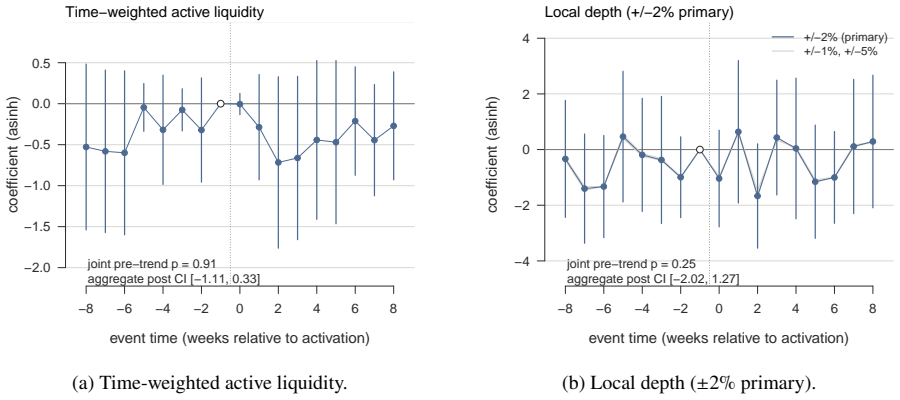
Under the frozen matched-overlap event-study design, the Uniswap protocol-fee switch that cut LP take-rates produces no large short-run average response in active liquidity or local depth among matched treated pools; LP participation and composition are more precisely estimated and also show no detectable response. The result is a non-detection at the design's resolution rather than a precise zero, and it survives the paper's pre-specified sensitivity checks. Token-1 volume and native fee income fail the parallel-trends gate and stay descriptive.
What carries the argument
The kernel K_L: the finite-horizon matched-overlap average treatment effect on the treated for LP-supply outcomes (active liquidity, depth, and related participation measures), recovered by a pre-specified event-study difference-in-differences design that moves only the LP take-rate while holding trader-facing fees fixed.
Load-bearing premise
After matching and baseline adjustment, treated and low-exposure control pools would have followed the same path in liquidity and depth if the fee switch had never happened.
What would settle it
Re-estimate the same event-study paths after regenerating the frozen panel with an independent reconstruction of active liquidity and depth; if post-period aggregate intervals for active liquidity and local depth then exclude zero and show a clear withdrawal, the non-detection claim fails.
Editorial analysis
A structured set of objections, weighed in public.
Referee Report
Summary. The paper estimates the short-run causal effect of the Uniswap protocol-fee switch (executed 2025-12-28) on LP liquidity supply. The switch cut LP take-rates with tier-differentiated intensity while leaving trader-facing fees fixed, identifying an LP-side response kernel K_L rather than trader-facing dynamic-fee effects. Using a pre-specified matched-overlap event-study DiD design on a frozen, hash-checked panel reconstructed from public logs, the authors find no large average short-run response in active liquidity or local depth among matched treated pools; more precisely estimated LP participation and composition outcomes likewise show none. Token-1 volume and native fee income fail the parallel-trends gate and are reported only descriptively. A channel-admissibility audit delimits the estimand: K_L is design-based, while trader-facing dynamic-fee protection remains outside the empirical claim.
Significance. If the non-detection holds under the stated assumptions, the paper supplies a rare design-based constraint on the LP-exit margin that fee-controller simulations routinely freeze. The contribution is methodological as much as substantive: pre-specification, deterministic reconstruction of treatment/event time/outcomes into a hash-checked panel before any estimate, explicit parallel-trends gating with descriptive fallback, and a channel map that separates what the shock identifies from what it cannot. These practices raise the bar for causal claims from on-chain DeFi data and give a concrete empirical input (short-run K_L near zero at the design's resolution) for subsequent welfare and controller work. The result is carefully scoped as a non-detection rather than a precise zero, which is appropriate given the precision of the primary liquidity intervals.
major comments (2)
- A3 / Eq. (6) and Appendix A Figure 5: residual post-match SMD on log pre-period fee revenue remains 0.84 (from 1.19). Identification therefore rests almost entirely on dynamic conditional parallel trends after baseline-time adjustment rather than on level balance. The paper already reports this honestly and supplies Honest-DiD, placebo-date, entropy-balancing, window, and caliper checks that leave the null intact. Still, for the primary liquidity/depth outcomes whose aggregate CIs are wide (e.g., active liquidity [−1.11, 0.33] asinh), the manuscript should more explicitly quantify how large a differential untreated trend would need to be to overturn the non-detection reading, beyond the zero-breakdown Honest-DiD statement that follows from intervals already containing zero.
- Section 4.2 precision discussion: the design rules out only very large average responses for active liquidity (MDE near 1.03 asinh) and is still less precise for depth (MDE near 2.35). The participation nulls are well-powered. The central claim is already framed as non-detection at design resolution, which is correct; the abstract and conclusion should keep that language and avoid any implication that moderate short-run liquidity responses are ruled out. A short power/MDE table in the main text (currently only in Appendix A) would make the resolution transparent to readers who stop at the figures.
minor comments (4)
- Figure 2 identification-gate map is useful but dense; a one-sentence caption note explaining the joint pre-trend p-value threshold used for the colour coding would help.
- Notation: K_L is introduced as shorthand for the reduced-form LP-supply ATT path on M_A; a single explicit sentence in §3.1 equating it to the vector of Δ^m_h for m in M_A would prevent readers from treating it as a structural elasticity.
- References include several 2026 package citations (fixest, HonestDiD, ebal, fect); ensure arXiv/CRAN versions are stable or pin DOIs where available.
- Appendix B reconstruction pipeline is a strength; a one-paragraph main-text pointer to the subset bit-parity and estimator-parity checks would make the reproducibility claim more visible without expanding the main body.
Circularity Check
No circularity: empirical DiD non-detection under pre-specified design; estimand is reduced-form ATT path, not a fitted or self-defined prediction.
full rationale
This is an observational matched-overlap event-study DiD of a real Uniswap protocol-fee switch (2025-12-28). The primary object K_L is defined as the finite-horizon reduced-form ATT path of reconstructed LP-supply outcomes (active liquidity, depth, participation) for matched treated pools relative to low-exposure controls (Eq. 2, Section 3.1); the event-study coefficients of Eq. 3 target that path under dynamic conditional parallel trends (A3, Eq. 6) and the other stated assumptions. Nothing is fitted to a subset and then re-labeled a prediction; no uniqueness theorem or ansatz is imported from the author's prior work; the channel-admissibility audit routes trader-facing dynamic-fee claims outside the estimand rather than redefining them into the result. Reconstruction is deterministic from public logs into a frozen hash-checked panel before estimation (A1). The headline non-detection (wide post CIs that include zero; tighter nulls on participation) is an empirical measurement under those assumptions, not a quantity forced by construction. Residual post-match imbalance on the selection variable is acknowledged and does not create circularity. Score 0 is the correct honest finding.
Axiom & Free-Parameter Ledger
free parameters (4)
- matched-overlap caliper on log pre-period fee revenue =
0.5 log-points (primary)
- event-study window =
±8 weeks (primary)
- nearest-neighbor match multiplicity k =
k≤3
- depth/liquidity band widths =
±1/2/5% (±2% primary)
axioms (6)
- domain assumption Dynamic conditional parallel trends in untreated increments for matched treated vs low-exposure controls after baseline-time adjustment (A3, Eq. 6).
- domain assumption Restricted interference: primary controls have near-zero exposure e_i≈0; exposed units are excluded from the primary counterfactual (A4).
- domain assumption No clean-pre anticipation: proposal-to-activation weeks are excluded from the clean pre-period (A5).
- domain assumption Replayability: D_i, κ_i, t0_i, unit roles, and Y_it^m are deterministic functions of raw logs and fixed reconstruction rules (A1).
- standard math Matched overlap: a treated unit enters M only if a low-exposure control exists within the pre-specified caliper on (S_i, X_i0) (A2).
- domain assumption Selection into the treatment list is on observables at the fee-revenue coverage margin, licensed by matching on pre-period realized fee revenue.
invented entities (1)
-
K_L (LP-side liquidity-supply response kernel)
independent evidence
read the original abstract
Automated market maker (AMM) fee rules are often evaluated by liquidity-provider (LP) welfare, but that objective mixes fee revenue, adverse-selection loss (loss-versus-rebalancing, LVR), routing response, and liquidity supply. Fixed-fee Uniswap v3 history cannot separate these channels or identify counterfactual trader-facing dynamic-fee rules. Real fee-related variation nonetheless exists: the Uniswap protocol-fee switch cut LP take-rates with tier-differentiated intensity while leaving trader-facing fees unchanged. Using a pre-specified matched-overlap event-study difference-in-differences design, we estimate the liquidity-supply response to take-rate cuts, the kernel K_L that simulator-based fee-controller evaluations routinely freeze, while reconstructing treatment, event time, unit roles, and outcomes from public logs into a frozen, hash-checked panel before any estimate. We detect no large short-run average response in active liquidity or local depth; LP participation and composition, more precisely estimated, likewise show none, so the result is a non-detection at the design's resolution rather than a precise zero. Token-1 volume and native fee income fail the parallel-trends gate and are reported descriptively. A channel-admissibility audit delimits the estimand: the LP-side response K_L is design-based, while trader-facing dynamic-fee protection is a model-conditioned boundary, not a second estimand.
Figures




Reference graph
Works this paper leans on
-
[1]
Review of Economic Studies , volume =
Rambachan, Ashesh and Roth, Jonathan , title =. Review of Economic Studies , volume =
-
[2]
Journal of the Royal Statistical Society: Series B , volume =
Cinelli, Carlos and Hazlett, Chad , title =. Journal of the Royal Statistical Society: Series B , volume =
-
[3]
Aronow, Peter M. and Samii, Cyrus , title =. Annals of Applied Statistics , volume =
-
[4]
Adams, Hayden and Zinsmeister, Noah and Salem, Moody and Keefer, River and Robinson, Dan , title =. 2021 , url =
work page 2021
- [5]
-
[6]
am-AMM: An Auction-Managed Automated Market Maker
Adams, Austin and Moallemi, Ciamac C. and Reynolds, Sara and Robinson, Dan , title =. arXiv preprint arXiv:2403.03367 , year =
work page internal anchor Pith review Pith/arXiv arXiv
-
[7]
Fees in AMMs: A quantitative study
Alexander, Abe and Fritz, Lars , title =. arXiv preprint arXiv:2406.12417 , year =
work page internal anchor Pith review Pith/arXiv arXiv
-
[8]
Cryptoeconomic Systems , year =
Angeris, Guillermo and Kao, Hsien-Tang and Chiang, Rei and Noyes, Charlie and Chitra, Tarun , title =. Cryptoeconomic Systems , year =
-
[9]
Optimal Dynamic Fees in Automated Market Makers , journal =
Baggiani, Leonardo and Herdegen, Martin and S. Optimal Dynamic Fees in Automated Market Makers , journal =
-
[10]
Competition between DEXs through Dynamic Fees , journal =
Baggiani, Leonardo and Herdegen, Martin and S. Competition between DEXs through Dynamic Fees , journal =
-
[11]
Optimal Fees for Liquidity Provision in Automated Market Makers
Campbell, Steven and Bergault, Philippe and Milionis, Jason and Nutz, Marcel , title =. arXiv preprint arXiv:2508.08152 , year =
work page internal anchor Pith review Pith/arXiv arXiv
-
[12]
Review of Financial Studies , year =
Capponi, Agostino and Jia, Ruizhe , title =. Review of Financial Studies , year =
-
[13]
Capponi, Agostino and Jia, Ruizhe and Zhu, Brian Z. , title =. arXiv preprint arXiv:2311.18164 , year =
work page internal anchor Pith review Pith/arXiv arXiv
-
[14]
Reinforcement Learning Approaches to Optimal Market Making , journal =
Ga. Reinforcement Learning Approaches to Optimal Market Making , journal =
-
[15]
Ghasemlu, Farbod , title =. arXiv preprint arXiv:2606.21769 , year =
work page internal anchor Pith review Pith/arXiv arXiv
-
[16]
Automated Market Making and Loss-Versus-Rebalancing
Milionis, Jason and Moallemi, Ciamac C. and Roughgarden, Tim and Zhang, Anthony Lee , title =. arXiv preprint arXiv:2208.06046 , year =
work page internal anchor Pith review Pith/arXiv arXiv
-
[17]
Pearl, Judea , title =
- [18]
-
[19]
von Stackelberg, Heinrich , title =
-
[20]
What Drives Liquidity on Decentralized Exchanges? Evidence from the Uniswap Protocol
Zhu, Brian Z. and Liu, Dingyue and Wan, Xin and Liao, Gordon and Moallemi, Ciamac C. and Bachu, Brad , title =. arXiv preprint arXiv:2410.19107 , year =
work page internal anchor Pith review Pith/arXiv arXiv
-
[21]
Encyclopedia of Epidemiology , editor =
Greenland, Sander and Pearl, Judea , title =. Encyclopedia of Epidemiology , editor =
-
[22]
Proceedings of the Second Conference on Causal Learning and Reasoning (CLeaR) , publisher =
Zhang, Chi and Mohan, Karthika and Pearl, Judea , title =. Proceedings of the Second Conference on Causal Learning and Reasoning (CLeaR) , publisher =
-
[23]
DEX Specs: A Mean Field Approach to DeFi Currency Exchanges
Bayraktar, Erhan and Cohen, Asaf and Nellis, April , title =. arXiv preprint arXiv:2404.09090 , year =
work page internal anchor Pith review Pith/arXiv arXiv
-
[24]
Angrist, Joshua D. and Pischke, J. Mostly Harmless Econometrics: An Empiricist's Companion , publisher =
-
[25]
Estimation and Inference of Impulse Responses by Local Projections , journal =
Jord. Estimation and Inference of Impulse Responses by Local Projections , journal =
-
[26]
Journal of the American Statistical Association , volume =
Bojinov, Iavor and Shephard, Neil , title =. Journal of the American Statistical Association , volume =
-
[27]
Rosenbaum, Paul R. and Rubin, Donald B. , title =. Biometrika , volume =
- [28]
-
[29]
Roth, Jonathan and Sant'Anna, Pedro H. C. and Bilinski, Alyssa and Poe, John , title =. Journal of Econometrics , volume =
-
[30]
Journal of Econometrics , volume =
Sun, Liyang and Abraham, Sarah , title =. Journal of Econometrics , volume =
-
[31]
American Economic Review: Insights , volume =
Roth, Jonathan , title =. American Economic Review: Insights , volume =
- [32]
-
[33]
Cameron, A. Colin and Miller, Douglas L. , title =. Journal of Human Resources , volume =
-
[34]
Cameron, A. Colin and Gelbach, Jonah B. and Miller, Douglas L. , title =. Review of Economics and Statistics , volume =
-
[35]
Fast and Wild: Bootstrap Inference in Stata Using boottest , journal =
Roodman, David and Nielsen, Morten. Fast and Wild: Bootstrap Inference in Stata Using boottest , journal =
- [36]
-
[37]
Bellemare, Marc F. and Wichman, Casey J. , title =. Oxford Bulletin of Economics and Statistics , volume =
-
[38]
Burbidge, John B. and Magee, Lonnie and Robb, A. Leslie , title =. Journal of the American Statistical Association , volume =
-
[39]
American Journal of Political Science , volume =
Liu, Licheng and Wang, Ye and Xu, Yiqing , title =. American Journal of Political Science , volume =
-
[40]
R: A Language and Environment for Statistical Computing , author =. 2025 , url =
work page 2025
-
[41]
Fast and User-Friendly Econometrics Estimations: The R Package fixest , journal =
Berg. Fast and User-Friendly Econometrics Estimations: The R Package fixest , journal =. 2026 , doi =
work page 2026
- [42]
- [43]
-
[44]
Cinelli, Carlos and Ferwerda, Jeremy and Hazlett, Chad , title =. 2024 , note =
work page 2024
- [45]
- [46]
-
[47]
fdapace: Functional Data Analysis and Empirical Dynamics , year =
discussion (0)
Sign in with ORCID, Apple, or X to comment. Anyone can read and Pith papers without signing in.