REVIEW 2 major objections 6 minor 47 references
A dependency-free native runtime runs the full Stable Audio 3 pipeline on ordinary GPUs, CPUs, and a Raspberry Pi 5, with eight-bit precision showing no measurable quality loss against seed variation.
Reviewed by Pith at T0; open to challenge. T0 means a machine referee read the full paper against a public rubric. the ladder, T0–T4 →
T0 review · grok-4.5
2026-07-10 05:57 UTC pith:GRZ4MY3K
load-bearing objection Solid systems paper: first full-pipeline native SA3 runtime with careful in-place quantization and honest multi-oracle steering; main gap is automatic oracles only, which the authors already flag. the 2 major comments →
A Quantized Native Runtime for On-Device Semantic Audio Generation
The pith
A machine-rendered reading of the paper's core claim, the machinery that carries it, and where it could break.
Core claim
A compact quantized native runtime can deploy a full state-of-the-art latent-diffusion music model on commodity and embedded hardware so that eight-bit precision is indistinguishable from half precision under three independent automatic quality checks, matches or exceeds the official stack on warm generation, cold-starts roughly seven times faster, and exposes activation steering as a free in-graph primitive.
What carries the argument
The aria runtime: a ~7.7k-line dependency-free C/CUDA engine that owns the full SA3 pipeline, packs weights from half precision down to 4-bit while releasing the original so lower precision reduces resident memory in place, optionally runs 8-bit arithmetic on GPU integer tensor cores and ARM, and injects steering directions into residual stream, latent, or text conditioning inside a captured graph at zero measurable overhead.
Load-bearing premise
That staying inside the ordinary seed-to-seed variation on three automatic metrics is enough to call eight-bit “no measurable quality loss” for music audio without human listening confirmation.
What would settle it
A pairwise listening study in which listeners systematically prefer the half-precision clips over matched eight-bit clips for the same prompts and seeds, or rate eight-bit outputs as lower quality or less prompt-faithful beyond chance.
If this is right
- Eight-bit weight and activation quantization can be treated as effectively free for SA3-class music diffusion transformers under the three automatic checks used here.
- The 1.2-billion-parameter medium model becomes runnable on an 8 GB Raspberry Pi 5 at four-bit precision.
- Interactive and edge services gain most from a warm-resident native binary because cold start, GPU-context setup, and per-length recompilation dominate short generations.
- Activation steering can ship as a built-in runtime feature rather than a trained adapter or external Python patch.
- Genuine semantic control of hard-to-lexicalize attributes such as taste exists but is confined to a narrow strength window and only a subset of axes when independent oracles are required.
Where Pith is reading between the lines
- The same in-place quantization plus dependency-free runtime pattern is likely to unlock other DiT-based audio and image generators currently locked behind heavy Python stacks.
- Any evaluation that optimizes a learned regressor for activation steering should adopt multi-oracle gating (target plus independent semantic check plus degradation metric) as standard practice.
- If listening studies later confirm the automatic floors, on-device sonic seasoning becomes feasible for real-time gastronomy or assistive audio products without cloud round-trips.
- Releasing the full-precision weights after packing is a simple systems habit other edge quantizers can copy to avoid the usual dual-copy memory tax.
Editorial analysis
A structured set of objections, weighed in public.
Referee Report
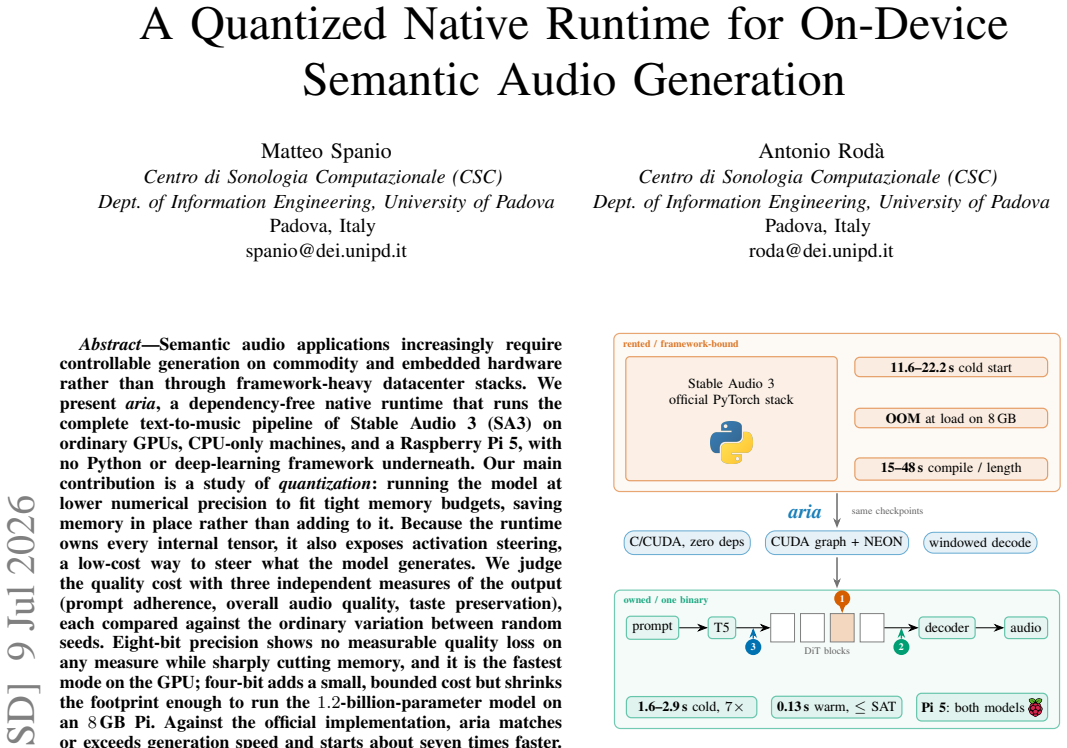
Summary. The paper presents aria, a dependency-free C/CUDA runtime that executes the full Stable Audio 3 text-to-music pipeline (tokenizer, T5Gemma encoder, DiT denoiser, SAME autoencoder) on commodity GPUs, CPU-only hosts, and a Raspberry Pi 5. Its central systems claim is a deployment-oriented quantization study: weights stored from fp16 down to 8- and 4-bit, with an optional W8A8 arithmetic path, releasing the full-precision copy so lower precision reduces rather than adds memory. Quality is gated against fp16 by three automatic metrics (CLAP prompt adherence, CLAP-embedding FAD, wav2taste L2) scaled to re-seed noise floors; 8-bit stays inside every floor and is the fastest GPU mode, while 4-bit enables the 1.2B medium model on an 8 GB Pi at a bounded cost. Against the official PyTorch stack (commit cited), aria matches or slightly exceeds warm generation and cold-starts ~7× faster (Table I). Because the runtime owns every tensor it also exposes in-graph activation steering; a sonic-seasoning case study shows genuine but narrow multi-oracle control for a subset of taste axes.
Significance. If the measurements hold, the work supplies a practical, open, single-binary path for on-device latent-diffusion music generation—an under-served niche relative to LLM and image runtimes. Strengths that should be credited explicitly include: (i) a clean warm/invocation/cold protocol with direct comparison to a pinned official commit, (ii) memory-replacement quantization rather than additive compression, (iii) three independent automatic fidelity checks scaled by re-seed floors (Table II, Fig. 4), (iv) a multi-oracle steering protocol that actively surfaces metric-gaming rather than hiding it, and (v) a released dependency-free codebase. These make the systems contribution reproducible and the control interface immediately usable for Internet-of-Sounds prototypes.
major comments (2)
- Section IV-A0e / Table II / Fig. 4: the strongest claim—“8-bit shows no measurable quality loss on any measure”—rests entirely on three automatic metrics staying inside fp16 re-seed floors. The paper itself flags perceptual confirmation as future work (V-C) and reports wav2taste’s imperfect held-out correlations (r≈0.59–0.82). Without at least a small listening study (or an explicit, narrower re-statement of the claim as “within automatic re-seed noise”), the certification of “no measurable quality loss” remains under-supported for a systems paper whose headline result is quality-preserving quantization.
- Section IV-B / Table I: the efficiency comparison cites a tuned official baseline (faster of default vs. options-enabled+compiled), yet the official path still uses the repository’s fallback attention and incurs per-length recompilation (14.5–48 s). A short sensitivity paragraph quantifying how much of the 7× cold-start and warm-parity advantage survives against a fully optimized reference (FlashAttention-class kernels, persistent server) would strengthen the systems claim; the current numbers are already useful but risk overstating the gap relative to a production-tuned stack.
minor comments (6)
- Figure 1 caption and abstract: “7× faster cold start” is clear; ensure the same factor is consistently reported for both model sizes in the body (I gives 7.2–7.7×).
- Table II: the re-seed floors (ΔCLAP ±0.004, FAD 44.0, Δtaste 0.153) are crucial; state the exact seed sets and sample size used to compute them in the caption or IV-A0e.
- Section III-B / Eq. (2): α is defined in units of mean residual norm; a one-sentence reminder that this makes α comparable across blocks and model sizes would help readers of the dense-window tables.
- Table V and IV-C0g: LoRA is a fair training-based comparator, but the trigger-token objective and 800-step budget could be briefly justified against a longer or caption-matched alternative so the negative result is not read as under-training.
- Typographical: “Rod `a” and “Fr ´echet” appear with stray spaces/accents in several places; normalize author names and FAD spelling throughout.
- Outlook (VI-A): the planned Bradley–Terry listening study is the right next step; stating the planned sample size or attribute set would make the limitation more concrete.
Circularity Check
No derivation-by-construction circularity; systems claims are direct measurements. Only minor residual self-citation risk in the scoped taste case study, already gated by independent oracles.
specific steps
-
self citation load bearing
[Section III-B / IV-C (taste case study); refs [40], [41]]
"Directions are grounded in norm-sonic-seasoning [40] (377 human-rated clips). ... Our target is wav2taste [41], a learned audio-to-taste regressor. The effect on axis i is ∆i(α)=τ̂i(xα)−τ̂i(x0) against the matched α=0 baseline."
The case-study attribute (basic tastes) and the optimized target oracle both come from prior work by the same authors. This is a mild self-citation dependency for the steering narrative only. It is not load-bearing for the paper's central systems/quantization claims, and the paper gates 'genuine' control on independent CLAP/FAD/drift rather than on wav2taste alone, so the reduction is partial and non-central rather than definitional.
full rationale
This is an engineering/systems paper whose load-bearing claims are empirical measurements, not first-principles derivations that could collapse into their inputs. Runtime efficiency (warm/invocation/cold latency, VRAM, Pi RSS, W8A8 speed) is measured against the official SA3 PyTorch stack under an explicit multi-regime protocol (Table I); nothing is fitted then re-reported as a prediction. Quantization fidelity is gated against fp16 re-seed noise floors on three metrics, deliberately leading with CLAP prompt adherence and CLAP-embedding FAD that share no training path with the taste oracle, with wav2taste L2 only as a narrow corroborator (Section IV-A0e, Table II, Fig. 4). The steering case study optimizes wav2taste but treats success as genuine only when independent CLAP rises with it at bounded FAD/drift, and the paper surfaces the failure mode where the target keeps climbing while checks collapse (Fig. 2, Table III). Self-citations to the authors' sonic-seasoning dataset [40] and wav2taste [41] supply the case-study attribute and one oracle, but they are not uniqueness theorems, do not force the systems results, and are not the sole evidence for the claimed genuine window. The paper itself scopes steering as a bounded case study and flags perceptual listening as future work. Under the circularity criteria, this is at most a minor non-load-bearing self-citation (score 1), not a reduction of prediction to input.
Axiom & Free-Parameter Ledger
free parameters (6)
- steering strength α (per axis / site)
- injection layer ℓ per taste axis
- quantization bit-width and W8A8 mode
- denoising step count (default 8; fast preset 6)
- LoRA rank and training steps (r=8, 800 steps; larger r=32 ablations)
- top/bottom-k contrast set size for audio-side directions
axioms (6)
- domain assumption Linear representation hypothesis: taste and related attributes are approximately linear directions in DiT residual (or latent) space, so additive injection shifts the attribute.
- domain assumption CLAP prompt similarity, CLAP-embedding FAD, and wav2taste vector distance are adequate proxies for prompt adherence, distributional quality, and taste preservation when compared to re-seed floors.
- domain assumption Difference-in-means over contrastive sets yields transferable steering directions (audio-side preferred).
- domain assumption Official SA3 PyTorch path (cited commit, half precision, 8-step sampler, faster of default vs tuned config) is a fair efficiency baseline.
- standard math Standard floating-point / integer matmul and graph-capture semantics preserve model behavior up to documented precision effects.
- domain assumption Crossmodal sonic-seasoning literature correctly maps acoustic structure to basic-taste associations used as external ground.
invented entities (2)
-
aria runtime (dependency-free SA3 C/CUDA engine)
independent evidence
-
multi-oracle “genuine window” operating regime for taste steering
no independent evidence
read the original abstract
Semantic audio applications increasingly require controllable generation on commodity and embedded hardware rather than through framework-heavy datacenter stacks. We present \textit{aria}, a dependency-free native runtime that runs the complete text-to-music pipeline of Stable Audio~3 (SA3) on ordinary GPUs, CPU-only machines, and a Raspberry~Pi~5, with no Python or deep-learning framework underneath. Our main contribution is a study of quantization: running the model at lower numerical precision to fit tight memory budgets, saving memory in place rather than adding to it. Because the runtime owns every internal tensor, it also exposes activation steering, a low-cost way to steer what the model generates. We judge the quality cost with three independent measures of the output (prompt adherence, overall audio quality, taste preservation), each compared against the ordinary variation between random seeds. Eight-bit precision shows no measurable quality loss on any measure while sharply cutting memory, and it is the fastest mode on the GPU; four-bit adds a small, bounded cost but shrinks the footprint enough to run the $1.2$-billion-parameter model on an $8$\,GB Pi. Against the official implementation, aria matches or exceeds generation speed and starts about seven times faster. A case study of the steering interface generates music carrying taste associations (\emph{sonic seasoning}), with genuine but bounded control for a subset of attributes. These results make a compact, quantized runtime with built-in control a practical basis for on-device semantic audio in Internet-of-Sounds settings. The \textit{aria} runtime is released at https://github.com/matteospanio/aria.
Figures


Reference graph
Works this paper leans on
-
[1]
Z. Evans, J. D. Parker, C. Carr, Z. Zukowski, J. Taylor, and J. Pons, “Stable audio open,” inICASSP 2025 - 2025 IEEE International Conference on Acoustics, Speech and Signal Processing (ICASSP), April 2025, pp. 1–5
work page 2025
-
[2]
Highly Optimized Kernels and Fine-Grained Codebooks for LLM Inference on Arm CPUs
D. Gope, D. Mansell, D. Loh, and I. Bratt, “Highly optimized kernels and fine-grained codebooks for llm inference on arm cpus,” 2024. [Online]. Available: https://arxiv.org/abs/2501.00032
work page internal anchor Pith review Pith/arXiv arXiv 2024
-
[3]
O. R. developers, “Onnx runtime,” https://onnxruntime.ai/, 2021, ver- sion: 1.27.0
work page 2021
-
[4]
S. Sanfilippo and contributors, “Dwarfstar,” https://github.com/antirez/ ds4, 2026, deepSeek 4 Flash and PRO local inference engine for Metal, CUDA and ROCm
work page 2026
-
[5]
Ace- step 1.5: Pushing the boundaries of open-source music generation,
J. Gong, Y . Song, W. Zhao, S. Wang, S. Xu, J. Guo, and X. Yang, “Ace- step 1.5: Pushing the boundaries of open-source music generation,”
-
[6]
Available: https://arxiv.org/abs/2602.00744
[Online]. Available: https://arxiv.org/abs/2602.00744
-
[7]
Z. Evans, J. D. Parker, M. Rice, C. Carr, Z. Zukowski, J. Taylor, and J. Pons, “Stable audio 3,” 2026. [Online]. Available: https: //arxiv.org/abs/2605.17991
work page internal anchor Pith review Pith/arXiv arXiv 2026
-
[8]
A multimodal symphony: integrating taste and sound through generative ai,
M. Spanio, M. Zampini, A. Rod `a, and F. Pierucci, “A multimodal symphony: integrating taste and sound through generative ai,”Frontiers in Computer Science, vol. V olume 7 - 2025, 2025
work page 2025
-
[9]
M. Spanio, “Towards emotionally aware ai: Challenges and opportunities in the evolution of multimodal generative models,” inProceedings of the AIxIA Doctoral Consortium 2024 co-located with the 23nd International Conference of the Italian Association for Artificial Intelligence (AIxIA 2024), ser. CEUR Workshop Proceedings. http://CEUR-WS.org, 2024. [Onlin...
work page 2024
-
[10]
SAME: A Semantically-Aligned Music Autoencoder
J. D. Parker, Z. Evans, C. Carr, Z. Zukowski, J. Taylor, M. Rice, and J. Pons, “Same: A semantically-aligned music autoencoder,” 2026. [Online]. Available: https://arxiv.org/abs/2605.18613
work page internal anchor Pith review Pith/arXiv arXiv 2026
-
[11]
Scalable diffusion models with transformers,
W. Peebles and S. Xie, “Scalable diffusion models with transformers,” in 2023 IEEE/CVF International Conference on Computer Vision (ICCV), Oct 2023, pp. 4172–4182
work page 2023
-
[12]
Gemma 2: Improving Open Language Models at a Practical Size
G. Team, M. Riviere, S. Pathak, P. G. Sessa, C. Hardin, S. Bhupatiraju, L. Hussenot, T. Mesnard, B. Shahriari, A. Ram ´eet al., “Gemma 2: Improving open language models at a practical size,” 2024. [Online]. Available: https://arxiv.org/abs/2408.00118
work page internal anchor Pith review Pith/arXiv arXiv 2024
-
[13]
Flow Matching for Generative Modeling,
Y . Lipman, R. T. Q. Chen, H. Ben-Hamu, M. Nickel, and M. Le, “Flow Matching for Generative Modeling,” inInternational Conference on Learning Representations, 2023. [Online]. Available: https://mlanthology.org/iclr/2023/lipman2023iclr-flow/
work page 2023
-
[14]
A. Caillon, B. McWilliams, C. Tarakajian, I. Simon, I. Manco, J. Engel, N. Constant, Y . Li, T. I. Denk, A. Lalama, A. Agostinelli, C.-Z. A. Huang, E. Manilow, G. Brower, H. Erdogan, H. Lei, I. Rolnick, I. Grishchenko, M. Orsini, M. Kastelic, M. Zuluaga, M. Verzetti, M. Dooley, O. Skopek, R. Ferrer, Z. Borsos, A. van den Oord, D. Eck, E. Collins, J. M. Ba...
work page 2025
-
[15]
Obsidian-neural: Stable audio 3 medium running locally on cpu,
innermost47, “Obsidian-neural: Stable audio 3 medium running locally on cpu,” https://github.com/innermost47/ai-dj, 2026, local edition; re- ports≈11s/generation on a laptop CPU (Apple Silicon). Verify before camera-ready
work page 2026
-
[16]
whisper.cpp: Port of openai’s whisper model in c/c++,
G. Gerganov and contributors, “whisper.cpp: Port of openai’s whisper model in c/c++,” https://github.com/ggml-org/whisper.cpp, 2022, ggml- based, dependency-free speech recognition on CPU and GPU
work page 2022
-
[17]
Open-Source Acceleration of Stable-Diffusion.cpp Deployable on All Devices
J. Ng, C. Lv, P. Zhao, W. Niu, J. Lin, M. Pan, Y . Liang, and Y . Wang, “Open-source acceleration of stable-diffusion.cpp deployable on all devices,” 2025. [Online]. Available: https://arxiv.org/abs/2412.05781
work page internal anchor Pith review Pith/arXiv arXiv 2025
-
[18]
ExecuTorch -- A Unified PyTorch Solution to Run AI Models On-Device
M. Nachin, D. Desai, S. S. Jia, C. Lai, M. Liu, J. Szwejbka, R. Alvarez, R. Ascani, D. Bort, M. Candaleset al., “ExecuTorch - a unified PyTorch solution to run AI models on-device,”arXiv preprint arXiv:2605.08195,
work page internal anchor Pith review Pith/arXiv arXiv
-
[19]
Available: https://github.com/pytorch/executorch
[Online]. Available: https://github.com/pytorch/executorch
-
[20]
MLX: Efficient and flexible machine learning on apple silicon,
A. Hannun, J. Digani, A. Katharopoulos, and R. Collobert, “MLX: Efficient and flexible machine learning on apple silicon,” 2023. [Online]. Available: https://github.com/ml-explore
work page 2023
-
[21]
NVIDIA Corporation. (2018) Tensorrt. https://developer.nvidia.com/ tensorrt. Per-model engine compilation for datacenter GPU inference. [Online]. Available: https://github.com/NVIDIA/TensorRT
work page 2018
-
[22]
SmoothQuant: Accurate and efficient post-training quantization for large language models,
G. Xiao, J. Lin, M. Seznec, H. Wu, J. Demouth, and S. Han, “SmoothQuant: Accurate and efficient post-training quantization for large language models,” inInternational Conference on Machine Learn- ing (ICML), 2023
work page 2023
-
[23]
Q-Diffusion: Quantizing diffusion models,
X. Li, Y . Liu, L. Lian, H. Yang, Z. Dong, D. Kang, S. Zhang, and K. Keutzer, “Q-Diffusion: Quantizing diffusion models,” inIEEE/CVF International Conference on Computer Vision (ICCV), 2023
work page 2023
-
[24]
Post-training quantization for audio diffusion transformers,
T. Khandelwal and M. Fuentes, “Post-training quantization for audio diffusion transformers,” 2025
work page 2025
-
[25]
Steering Language Models With Activation Engineering
A. M. Turner, L. Thiergart, D. Udell, G. Leech, U. Mini, and M. MacDiarmid, “Activation addition: Steering language models without optimization,”CoRR, vol. abs/2308.10248, 2023. [Online]. Available: https://doi.org/10.48550/arXiv.2308.10248
work page internal anchor Pith review Pith/arXiv arXiv doi:10.48550/arxiv.2308.10248 2023
-
[26]
Representation Engineering: A Top-Down Approach to AI Transparency
A. Zou, L. Phan, S. Chen, J. Campbell, P. Guo, R. Ren, A. Pan, X. Yin, M. Mazeika, A.-K. Dombrowski, S. Goel, N. Li, M. J. Byun, Z. Wang, A. Mallen, S. Basart, S. Koyejo, D. Song, M. Fredrikson, J. Z. Kolter, and D. Hendrycks, “Representation engineering: A top-down approach to ai transparency,” 2025. [Online]. Available: https://arxiv.org/abs/2310.01405
work page internal anchor Pith review Pith/arXiv arXiv 2025
-
[27]
Analysing the generalisation and reliability of steering vectors,
D. Tan, D. Chanin, A. Lynch, B. Paige, D. Kanoulas, A. Garriga-Alonso, and R. Kirk, “Analysing the generalisation and reliability of steering vectors,” inProceedings of the 38th International Conference on Neural Information Processing Systems, ser. NIPS ’24. Red Hook, NY , USA: Curran Associates Inc., 2024
work page 2024
-
[28]
Mood vectors in audio diffusion: Steering stable audio 3,
G. Camporese, “Mood vectors in audio diffusion: Steering stable audio 3,” May 2026. [Online]. Available: https://guglielmocamporese.github. io/blog/audio-mood-steering.html
work page 2026
-
[29]
Activation Patching for Interpretable Steering in Music Generation
S. Facchiano, G. Strano, D. Crisostomi, I. Tallini, T. Mencattini, F. Galasso, and E. Rodol `a, “Activation patching for interpretable steering in music generation,” 2025. [Online]. Available: https: //arxiv.org/abs/2504.04479
work page internal anchor Pith review Pith/arXiv arXiv 2025
-
[30]
TADA! tuning audio diffusion models through activation steering,
Ł. Staniszewski, K. Zaleska, M. Modrzejewski, and K. Deja, “TADA! tuning audio diffusion models through activation steering,” inICLR 2026 Workshop on Representational Alignment (Reˆ4-Align), 2026. [Online]. Available: https://openreview.net/forum?id=OUux4upENk
work page 2026
-
[31]
Steering autoregressive music generation with recursive feature machines,
D. Zhao, D. Beaglehole, J. McAuley, T. Berg-Kirkpatrick, and Z. Novack, “Steering autoregressive music generation with recursive feature machines,” inThe Fourteenth International Conference on Learning Representations, 2026. [Online]. Available: https: //openreview.net/forum?id=NaHzPMaCY9
work page 2026
-
[32]
Discovering and steering interpretable concepts in large generative music models,
N. Singh, M. Cherep, and P. Maes, “Discovering and steering interpretable concepts in large generative music models,” inAI for Music Workshop, 2025. [Online]. Available: https://openreview.net/ forum?id=jVSlJk5qNA
work page 2025
-
[33]
Learning interpretable features in audio latent spaces via sparse autoencoders,
N. Paek, Y . Zang, Q. Yang, and R. Leistikow, “Learning interpretable features in audio latent spaces via sparse autoencoders,” inMechanistic Interpretability Workshop at NeurIPS 2025, 2025. [Online]. Available: https://openreview.net/forum?id=5fsYFQzzMX
work page 2025
-
[34]
LoRA: Low-rank adaptation of large language models,
E. J. Hu, yelong shen, P. Wallis, Z. Allen-Zhu, Y . Li, S. Wang, L. Wang, and W. Chen, “LoRA: Low-rank adaptation of large language models,” inInternational Conference on Learning Representations, 2022. [Online]. Available: https://openreview.net/forum?id=nZeVKeeFYf9
work page 2022
-
[35]
Adding conditional control to text-to-image diffusion models,
L. Zhang, A. Rao, and M. Agrawala, “Adding conditional control to text-to-image diffusion models,” inProceedings of the IEEE/CVF International Conference on Computer Vision (ICCV), October 2023, pp. 3836–3847
work page 2023
-
[36]
Concept sliders: Lora adaptors for precise control in diffusion models,
R. Gandikota, J. Materzy ´nska, T. Zhou, A. Torralba, and D. Bau, “Concept sliders: Lora adaptors for precise control in diffusion models,” inComputer Vision – ECCV 2024, A. Leonardis, E. Ricci, S. Roth, O. Russakovsky, T. Sattler, and G. Varol, Eds. Cham: Springer Nature Switzerland, 2025, pp. 172–188
work page 2024
-
[37]
A.-S. Crisinel and C. Spence, “As bitter as a trombone: Synesthetic correspondences in nonsynesthetes between tastes/flavors and musical notes,”Attention, Perception, & Psychophysics, vol. 72, no. 7, pp. 1994– 2002, 2010. [Online]. Available: https://doi.org/10.3758/APP.72.7.1994
-
[38]
B. Mesz, M. A. Trevisan, and M. Sigman, “The taste of music,” Perception, vol. 40, no. 2, pp. 209–219, 2011
work page 2011
-
[39]
Crossmodal correspondences between sounds and tastes,
K. Kn ¨oferle and C. Spence, “Crossmodal correspondences between sounds and tastes,”Psychonomic Bulletin & Review, vol. 19, pp. 992– 1006, 2012
work page 2012
-
[40]
Q. J. Wang, A. T. Woods, and C. Spence, ““what’s your taste in music?” a comparison of the effectiveness of various soundscapes in evoking specific tastes,”i-Perception, vol. 6, no. 6, 2015
work page 2015
-
[41]
Spence,Gastrophysics: The New Science of Eating
C. Spence,Gastrophysics: The New Science of Eating. Viking, 2017
work page 2017
-
[42]
Multimodal Dataset Normalization and Perceptual Validation for Music-Taste Correspondences
M. Spanio, V . Frezzato, and A. Rod`a, “Multimodal dataset normalization and perceptual validation for music-taste correspondences,” 2026. [Online]. Available: https://arxiv.org/abs/2604.10632
work page internal anchor Pith review Pith/arXiv arXiv 2026
-
[43]
Taste-aware music retrieval from audio embeddings,
M. Spanio and A. Rod `a, “Taste-aware music retrieval from audio embeddings,” inProceedings of the 23rd IEEE International Conference on Content-Based Multimedia Indexing (CBMI). Toulouse, France: IEEE, Oct. 2026, accepted for publication
work page 2026
-
[44]
Clap learning audio concepts from natural language supervision,
B. Elizalde, S. Deshmukh, M. A. Ismail, and H. Wang, “Clap learning audio concepts from natural language supervision,” inICASSP 2023 - 2023 IEEE International Conference on Acoustics, Speech and Signal Processing (ICASSP), June 2023, pp. 1–5
work page 2023
-
[45]
Natural language supervision for general-purpose audio representations,
B. Elizalde, S. Deshmukh, and H. Wang, “Natural language supervision for general-purpose audio representations,” inICASSP 2024 - 2024 IEEE International Conference on Acoustics, Speech and Signal Processing (ICASSP), April 2024, pp. 336–340
work page 2024
-
[46]
Fr ´echet Audio Distance: A Reference-Free Metric for Evaluating Music Enhancement Algorithms,
K. Kilgour, M. Zuluaga, D. Roblek, and M. Sharifi, “Fr ´echet Audio Distance: A Reference-Free Metric for Evaluating Music Enhancement Algorithms,” inInterspeech 2019, 2019, pp. 2350–2354
work page 2019
-
[47]
Rank analysis of incomplete block designs: I. the method of paired comparisons,
R. A. Bradley and M. E. Terry, “Rank analysis of incomplete block designs: I. the method of paired comparisons,”Biometrika, vol. 39, no. 3/4, pp. 324–345, 1952
work page 1952
discussion (0)
Sign in with ORCID, Apple, or X to comment. Anyone can read and Pith papers without signing in.