REVIEW 1 major objections 7 minor 43 references
Stochastic dynamics of particles in correlated fields
T0 review · 1 major / 7 minor · reviewed 2026-07-10 · glm-5.2
Pith's one-line read Coupling a particle to a correlated field makes its dynamics nonlinear
desk verdict Solid review of the author's own program on particle-field dynamics; the Gaussian field limitation is the real constraint on how far the predictions travel. read the letter →
The pith
A machine-rendered reading of the paper's core claim, the machinery that carries it, and where it could break.
The reading
What carries the argument
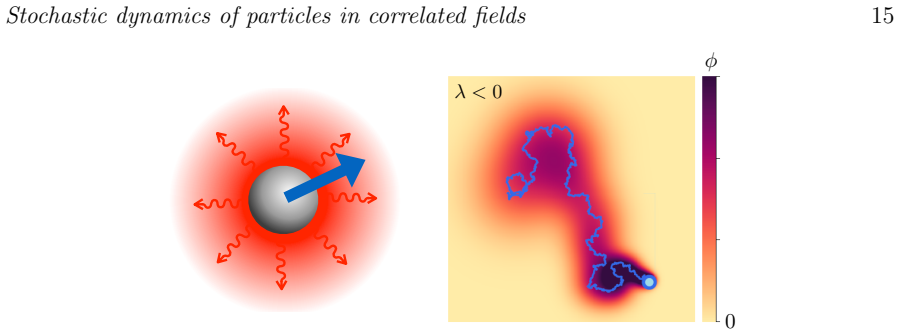
The model couples an overdamped particle (coordinate X, in a harmonic trap κX²/2) to a Gaussian field ϕ with correlation length ξ = r^{−1/2} via a linear interaction −λ∫ϕ(x)U(X−x). Solving the field dynamics exactly and substituting back yields the effective force in Eq. (10): a nonlinear memory kernel F_l(t, x) = λ²D∫dq/(2π)^d · (i q_l |U_q|² / q²) e^{iq·x − Dq²(q²+r)t} integrated over the particle's past trajectory, plus a colored noise Ξ with correlations G_{lm}(x, t) satisfying the generalized FDT ∂F_m/∂x_l = −∂_t G_{lm}. Perturbative expansion in λ² (justified by the {ϕ,λ}↔{−ϕ,−λ} symmetry) yields all analytical predictions. The self-chemotactic limit sets field fluctuations to zero and
What would settle it
Measure the power spectrum of a trapped colloid in a near-critical binary mixture and check whether the low-frequency singularity follows S(ω)∝ω^{−1+d/4}; if the exponent differs from this prediction (e.g., due to non-Gaussian field fluctuations or higher-order coupling terms), the perturbative derivation is incomplete.
Extended reading notes
Core claim
The central result is that tracing out a correlated Gaussian field linearly coupled to a particle yields an effective equation of motion that is both nonlinear and non-Markovian, with the force given by a memory kernel F(t, x) depending on the full history of position differences and a colored noise Ξ satisfying a generalized fluctuation-dissipation relation ∂F_m/∂x_l = −∂_t G_{lm}. This single structure produces, as consequences, critical spectral singularities S(ω)∝ω^{−1+d/4}, a threshold Weissenberg number for oscillatory relaxation, dipolar heat-exchange patterns in the driven medium, and dimension-dependent anomalous diffusion for self-chemotactic particles.
Load-bearing premise
The analytical predictions rest on a perturbative expansion in the particle-field coupling λ, carried out to leading nontrivial order λ². The agreement with simulations is shown for specific parameter choices, but the range of validity of this expansion—and whether it holds at experimentally relevant coupling strengths—is not systematically bounded. If higher-order terms qualitatively alter the behavior, the predicted exponents and thresholds would change.
Editorial extensions
If this is right
- The spectral singularity S(ω)∝ω^{−1+d/4} near criticality provides a frequency-domain fingerprint that could be measured in microrheology experiments on near-critical binary mixtures, distinguishing field-induced memory from hydrodynamic memory.
- The threshold Weissenberg number for oscillatory relaxation offers a tunable, experimentally testable prediction: increasing the driving velocity of an optical trap through a correlated medium should trigger a transition from monotonic to oscillatory relaxation.
- The dipolar heat-exchange pattern in the driven medium implies that stochastic thermodynamics in correlated media requires spatially resolved heat and work fields, not scalar quantities, which constrains how entropy production should be measured in such systems.
- The t^{4/3} superdiffusion for repulsive self-chemotaxis in d=1 connects self-chemotactic active particles to the true self-avoiding random walk, suggesting a universality class that could be tested in quasi-one-dimensional channels.
- The existence of an upper critical dimension d_c = 2 for self-chemotactic anomalous diffusion means that three-dimensional experiments should recover normal diffusion, providing a dimensional crossover to search for experimentally.
Reading between the lines
- The perturbative λ² expansion is validated against simulations only for specific parameter choices; if the coupling to a real near-critical medium is strong enough that higher-order terms matter, the predicted spectral singularity exponent and oscillation threshold could shift. A systematic study of the convergence radius would determine whether the analytical predictions are quantitatively reliab
- The model treats the field as Gaussian, but real critical media have non-Gaussian order-parameter fluctuations (the ϕ⁴ interaction). Including this self-interaction could modify the spectral singularity exponent away from the Gaussian-field prediction, potentially bringing it closer to or further from experimental observations.
- The dipolar heat-exchange pattern emerges when ξ exceeds the particle size R; this suggests a natural experimental protocol using binary liquid mixtures near criticality, where ξ is tunable by temperature, to observe the onset of spatial heat-exchange structure as the correlation length grows.
- The connection between repulsive self-chemotaxis and the true self-avoiding random walk in d=1 raises the question of whether the run-and-tumble-like dynamics in higher dimensions (but still below d_c = 2) belong to a known universality class or define a new one.
Signed reviews
Editorial analysis
A structured set of objections, weighed in public.
Referee Report
Summary. This manuscript reviews recent work by the author and collaborators on the effective dynamics of a colloidal particle linearly coupled to a fluctuating Gaussian field with spatial and temporal correlations. The core result is that tracing out the field yields a nonlinear, non-Markovian Langevin equation for the particle (Eq. 10), with a generalized fluctuation-dissipation theorem (Eq. 13) linking the memory kernel and colored noise. The paper discusses equilibrium consequences (critical spectral singularity S(ω)∝ω^{−1+d/4}, non-Gaussian displacement statistics), driven dynamics (damped oscillations above a threshold Weissenberg number, spatially structured heat flow), and a non-reciprocal extension describing self-chemotaxis (anomalous diffusion MSD∝t^{4/3} in d=1 for repulsive coupling). The presentation is clear and the results are supported by perturbative calculations and numerical simulations.
Significance. The paper provides a unifying framework for understanding how correlated media induce nonlinear and non-Markovian effective dynamics on probe particles. The generalized FDT (Eq. 13) is a clean structural result. The perturbative predictions are parameter-free in the sense that scaling exponents (e.g., ω^{−1+d/4}, t^{4/3}) follow from the field propagator without fitting. The oscillation threshold Wi is derived from the zeros of a denominator rather than introduced phenomenologically. The stochastic thermodynamics extension with spatially resolved heat fields is a natural and interesting generalization. The self-chemotaxis results, including the identification of an upper critical dimension d_c=2 and the connection to run-and-tumble motion, are analytically tractable and falsifiable.
major comments (1)
- Sec. 3 and the spectral singularity S(ω)∝ω^{−1+d/4}: This exponent is derived for a Gaussian field with model B dynamics, where the dynamic exponent is z=4 (mean-field). For a real critical medium in d=3 with model B dynamics, the true dynamic exponent is z≈3 (Wilson-Fisher fixed point), which would change the singularity to S(ω)∝ω^{−1+d/z}. The paper acknowledges in Sec. 6, point (2) that the self-interaction ∝ϕ^4 is necessary for actual critical systems, but the spectral predictions in Sec. 3 are presented as characterizing critical media without clearly flagging that the exponent is specific to the Gaussian approximation. The authors should state explicitly, at the point where the singularity is discussed, that the exponent z=4 is the Gaussian (mean-field) value and that it would be renormalized for a true Ising-type critical point. This is important because the spectral singularity,,
minor comments (7)
- Sec. 2, Eq. (8): The notation γ_∞ is introduced as the friction coefficient for U=0, but the subscript '∞' is not explained. A brief clarifying sentence would help.
- Sec. 3, Fig. 2 (left): The caption states parameters are 'set to 1' except κ=2 and R=2. It would help to specify which dimensionless combination of λ, D, T, and γ_∞ is being held fixed, so the reader can assess whether the perturbative regime λ^2/(κ R^d) ≪ 1 is actually satisfied.
- Sec. 4.1, Eq. (16)–(17): The memory kernel Γ(t) is stated to emerge 'after the change of reference system and linearisation of the non-linear and non-Markovian force in Eq. (10) (see Ref. [22] for details).' Since the oscillation threshold is a central result, a brief statement of how Γ(t) relates to F(t,x) in Eq. (11) would improve self-containedness.
- Sec. 5, Eq. (18): The assumption of negligible field fluctuations (η=0) is central to the self-chemotaxis model. The physical conditions under which this is justified (e.g., large number of chemical molecules, fast diffusion) should be briefly stated, as it determines the range of applicability of the MSD predictions.
- Sec. 5: The upper critical dimension d_c=2 for self-chemotaxis is stated without derivation or reference to a scaling argument. A one-sentence indication of the scaling argument or a forward reference to where it is derived would help the reader.
- The paper uses both model A and model B dynamics in different sections (model B in Sec. 2–3, model A in Sec. 3 right panel, Sec. 4, and Sec. 5). A brief remark on why model A is used in certain cases (e.g., simpler analytical tractability in d=1) would improve clarity.
- Sec. 1: The reference to the 2025 Boltzmann Medal awarded to Mehran Kardar is a nice contextual note, but the phrasing 'which were also mentioned in the motivation for the award' is slightly informal for a journal article; a minor rephrasing would be appropriate.
Circularity Check
No significant circularity: derivations are parameter-free and falsifiable, with self-citations providing independent prior results rather than circular definitions.
full rationale
The paper's main derivation chain proceeds from the Hamiltonian (Eq. 7) and coupled Langevin equations (Eq. 8) to an effective non-linear, non-Markovian equation of motion (Eq. 10-11) with a generalized FDT (Eq. 13). Each step involves genuine calculation: solving the linear field equation, substituting into the particle equation, and identifying the memory kernel and colored noise. The key predictions—spectral singularity S(ω)∝ω^{−1+d/4}, oscillation threshold Wi, MSD∝t^{4/3}—are derived from the structure of the field propagator and scaling arguments, not fitted to data and re-presented as predictions. Self-citations (Refs. [18, 20-23, 26]) refer to prior works by the author and collaborators, but these contain independent derivations with stated assumptions (Gaussian field, linear coupling, perturbative expansion in λ²) that do not include the target results as inputs. The perturbative expansion at O(λ²) is a legitimate approximation, not a circular definition: the expansion parameter λ is the physical coupling constant in the Hamiltonian, not a fitted quantity. The generalized FDT (Eq. 13) is derived from the equilibrium structure of the model, not assumed. The self-chemotaxis results (Sec. 5) follow from setting field fluctuations to zero and breaking reciprocity in Eq. 18, which is a model specification, not a circular input-output relationship. The only mild concern is that several load-bearing results come from the author's own prior works without full re-derivation here, but this is a review-style presentation, not circularity: the cited works contain self-contained derivations. No step reduces to its inputs by construction, no fitted parameter is renamed as a prediction, and no uniqueness theorem is invoked to forbid alternatives. The Gaussian field limitation (acknowledged in Sec. 6, point 2) is a correctness/applicability concern, not a circularity issue. Score 1 reflects the presence of self-citations that are not load-bearing in a circular sense but could invite closer scrutiny of whether the cited derivations are fully independent of the present paper's framing.
Assumptions & free parameters
free parameters (4)
- λ (particle-field coupling) =
varies by figure: 0.05, 0.5, 5
- r (distance from criticality) =
0, 0.05
- R (particle radius / interaction range) =
2, 4, 5
- κ (trap stiffness) =
0.2, 2
assumptions (5)
- domain assumption The medium is described by a Gaussian field ϕ with Hamiltonian H = ∫ [½(∇ϕ)² + (r/2)ϕ²] (Eq. 7)
- domain assumption The particle-field coupling is linear in ϕ (Eq. 7, last term)
- ad hoc to paper Perturbation theory in λ² captures the relevant physics
- domain assumption The field dynamics follows Model A or Model B (conserved vs. non-conserved)
- ad hoc to paper For self-chemotaxis, field fluctuations are negligible (η=0 in Eq. 18)
invented entities (3)
-
Generalized nonlinear memory kernel F(t,x) (Eq. 11)
independent evidence
-
Colored noise Ξ(x,t) with spatial correlations (Eq. 12)
independent evidence
-
Effective run-and-tumble process for d=1 repulsive chemotaxis
independent evidence
Cite this review
Pith. "Pith review of Stochastic dynamics of particles in correlated fields." pith.science (2026). https://pith.science/paper/62XEENWN
@misc{pith2026260708627,
  author       = {Pith},
  title        = {Pith review of: Stochastic dynamics of particles in correlated fields},
  year         = {2026},
  howpublished = {\url{https://pith.science/paper/62XEENWN}},
  note         = {Machine review of arXiv:2607.08627}
}
read the original abstract
The effective dynamics of a colloidal particle immersed in a complex medium at equilibrium is usually described in terms of a linear overdamped Langevin equation, possibly with memory. However, numerical simulations and experiments have shown that this linear model fails, suggesting that the effective dynamics of the probe is actually nonlinear. Focusing on the case in which the medium is described by a fluctuating and correlated Gaussian field, linearly coupled to the colloid, we derive this effective dynamics and discuss its various consequences, including those on the stochastic thermodynamics of a driven particle. When the field is generated by the particle itself, with negligible fluctuations, the resulting self-chemotactic dynamics turns out to display anomalous diffusion and run-and-tumble motion in low spatial dimension, which we characterise analytically.
Figures


Figures from the paper (3 more)


Reference graph
Works this paper leans on
-
[1]
Phys.324371 URLhttps://doi.org/10.1002/andp.19063240208
Einstein A 1906Ann. Phys.324371 URLhttps://doi.org/10.1002/andp.19063240208
- [2]
-
[3]
Perrin J 1916Atoms(Constable & Company LTD)
-
[4]
Kubo R 1966Rep. Prog. Phys.29255
-
[5]
Franosch T, Grimm M, Belushkin M, Mor F M, Foffi G, Forr´ o L and Jeney S 2011Nature47885 URLhttps://doi.org/10.1038/nature10498 Stochastic dynamics of particles in correlated fields18
-
[6]
Daldrop J O, Kowalik B G and Netz R R 2017Phys. Rev. X7041065 URLhttps://link.aps. org/doi/10.1103/PhysRevX.7.041065
-
[7]
Commun.9999 URLhttps://doi.org/10.1038/s41467-018-03345-2
Berner J, M¨ uller B, Gomez-Solano J R, Kr¨ uger M and Bechinger C 2018Nat. Commun.9999 URLhttps://doi.org/10.1038/s41467-018-03345-2
-
[8]
Mori H 1965Progr. Theor. Phys.33423 URLhttps://doi.org/10.1143/PTP.33.423
Show all 43 references
-
[9]
Zwanzig R 2001Nonequilibrium statistical mechanics(Oxford University Press)
-
[10]
Phys.22023014 URLhttps: //dx.doi.org/10.1088/1367-2630/ab6a39
M¨ uller B, Berner J, Bechinger C and Kr¨ uger M 2020New J. Phys.22023014 URLhttps: //dx.doi.org/10.1088/1367-2630/ab6a39
-
[11]
Gambassi A 2009J. Phys. Conf. Ser.161012037 URLhttps://dx.doi.org/10.1088/ 1742-6596/161/1/012037
-
[12]
Gambassi A and Dietrich S 2024Soft Matter203212 URLhttp://dx.doi.org/10.1039/ D3SM01408H
-
[13]
D´ emery V and Dean D S 2010Phys. Rev. Lett.104080601 URLhttps://link.aps.org/doi/ 10.1103/PhysRevLett.104.080601
-
[15]
Dean D S and D´ emery V 2011J. Phys. Condens. Mat.23234114 URLhttps://dx.doi.org/10. 1088/0953-8984/23/23/234114
-
[16]
D´ emery V and Dean D S 2011Phys. Rev. E84011148 URLhttps://link.aps.org/doi/10. 1103/PhysRevE.84.011148
-
[18]
21468/SciPostPhys.13.4.078
Basu U, D´ emery V and Gambassi A 2022SciPost Phys.13078 URLhttps://scipost.org/10. 21468/SciPostPhys.13.4.078
-
[19]
Hohenberg P C and Halperin B I 1977Rev. Mod. Phys.49435 URLhttps://link.aps.org/ doi/10.1103/RevModPhys.49.435
-
[20]
Venturelli D, Ferraro F and Gambassi A 2022Phys. Rev. E105054125 URLhttps://link.aps. org/doi/10.1103/PhysRevE.105.054125
-
[21]
D´ emery V and Gambassi A 2023Phys. Rev. E108044604 URLhttps://link.aps.org/doi/ 10.1103/PhysRevE.108.044604
-
[22]
Phys.25093025 URLhttps://dx.doi.org/10.1088/ 1367-2630/acf240
Venturelli D and Gambassi A 2023New J. Phys.25093025 URLhttps://dx.doi.org/10.1088/ 1367-2630/acf240
-
[23]
Venturelli D, Loos S A M, Walter B, Rold´ an ´E and Gambassi A 2024EPL14627001 URL http://dx.doi.org/10.1209/0295-5075/ad3469
-
[24]
Peliti L and Pigolotti S 2021Stochastic Thermodynamics: An Introduction(Princeton University Press)
-
[25]
Seifert U 2025Stochastic Thermodynamics(Cambridge University Press)
-
[26]
Romano J and Gambassi A 2026Phys. Rev. Lett.136107102 URLhttps://link.aps.org/doi/ 10.1103/zn4t-gv6y
-
[27]
Fluids25061701 URLhttps://doi.org/10
Michelin S, Lauga E and Bartolo D 2013Phys. Fluids25061701 URLhttps://doi.org/10. 1063/1.4810749
-
[29]
Chamolly A and Lauga E 2019Eur. Phys. J. E4288 URLhttps://doi.org/10.1140/epje/ i2019-11854-3
-
[30]
Fluid Mech.860711 URLhttps://doi.org/10.1017/jfm
Morozov M and Michelin S 2019J. Fluid Mech.860711 URLhttps://doi.org/10.1017/jfm. 2018.853
2018 doi
-
[31]
Grima R 2006Phys. Rev. E74011125 URLhttps://link.aps.org/doi/10.1103/PhysRevE. 74.011125
-
[32]
Grima R 2006Phys. Rev. Lett.95128103 URLhttps://link.aps.org/doi/10.1103/ PhysRevLett.95.128103 Stochastic dynamics of particles in correlated fields19
-
[33]
Sengupta A, van Teeffelen S and L¨ owen H 2009Phys. Rev. E80031122 URLhttps://link. aps.org/doi/10.1103/PhysRevE.80.031122
-
[34]
Daftari K and Newhall K A 2022Phys. Rev. E105024609 URLhttps://link.aps.org/doi/ 10.1103/PhysRevE.105.024609
-
[35]
Amit D J, Parisi G and Peliti L 1983Phys. Rev. B271635 URLhttps://link.aps.org/doi/ 10.1103/PhysRevB.27.1635
-
[36]
Pietronero L 1983Phys. Rev. B275887 URLhttps://link.aps.org/doi/10.1103/PhysRevB. 27.5887
-
[37]
Obukhov S P and Peliti L 1983J. Phys. A: Math. Gen.16L147 URLhttps://dx.doi.org/10. 1088/0305-4470/16/5/004
-
[38]
Pruszczyk M P, Venturelli D and Gambassi A 2025J. Stat. Mech.: Theor. Exp.2025113202 URL https://doi.org/10.1088/1742-5468/ae0d7b
-
[39]
Phys.24123013 URLhttps://dx.doi.org/10.1088/1367-2630/aca8c7
Ginot F, Caspers J, Reinalter L F, Krishna Kumar K, Kr¨ uger M and Bechinger C 2022New J. Phys.24123013 URLhttps://dx.doi.org/10.1088/1367-2630/aca8c7
-
[40]
Ginot F, Caspers J, Kr¨ uger M and Bechinger C 2022Phys. Rev. Lett.128028001 URL https://link.aps.org/doi/10.1103/PhysRevLett.128.028001
-
[41]
Phys.191904 URL https://doi.org/10.1038/s41567-023-02213-1
Cao X, Das D, Windbacher N, Ginot F, Kr¨ uger M and Bechinger C 2023Nat. Phys.191904 URL https://doi.org/10.1038/s41567-023-02213-1
-
[42]
Gomez-Solano J R and Bechinger C 2014EPL10854008 URLhttps://dx.doi.org/10.1209/ 0295-5075/108/54008
-
[43]
Jain R, Ginot F, Berner J, Bechinger C and Kr¨ uger M 2021J. Chem. Phys.154184904 URL https://doi.org/10.1063/5.0048320
-
[44]
Furukawa A, Gambassi A, Dietrich S and Tanaka H 2013Phys. Rev. Lett.111055701 URL https://link.aps.org/doi/10.1103/PhysRevLett.111.055701
-
[45]
Phys.27105003 URLhttps: //doi.org/10.1088/1367-2630/ae09d3
Muzzeddu P L, Venturelli D and Gambassi A 2025New J. Phys.27105003 URLhttps: //doi.org/10.1088/1367-2630/ae09d3
-
[46]
Phys.28064603 URLhttps://doi.org/10.1088/ 1367-2630/ae759b
Pruszczyk M P and Gambassi A 2026New J. Phys.28064603 URLhttps://doi.org/10.1088/ 1367-2630/ae759b
Reviewed July 10, 2026 · model on record in the stance chip above.
Discussion (0). Continue with ORCID to comment.