REVIEW 1 major objections 8 minor 53 references
Debris Disc Substructures Induced by Secular Planetary Perturbations
T0 review · 1 major / 8 minor · reviewed 2026-07-10 · glm-5.2
Pith's one-line read Planet-induced density waves in debris discs trace unseen planets
desk verdict Solid analytical work on debris disc substructure with one testable gap in the observational claims read the letter →
The pith
A machine-rendered reading of the paper's core claim, the machinery that carries it, and where it could break.
The reading
What carries the argument
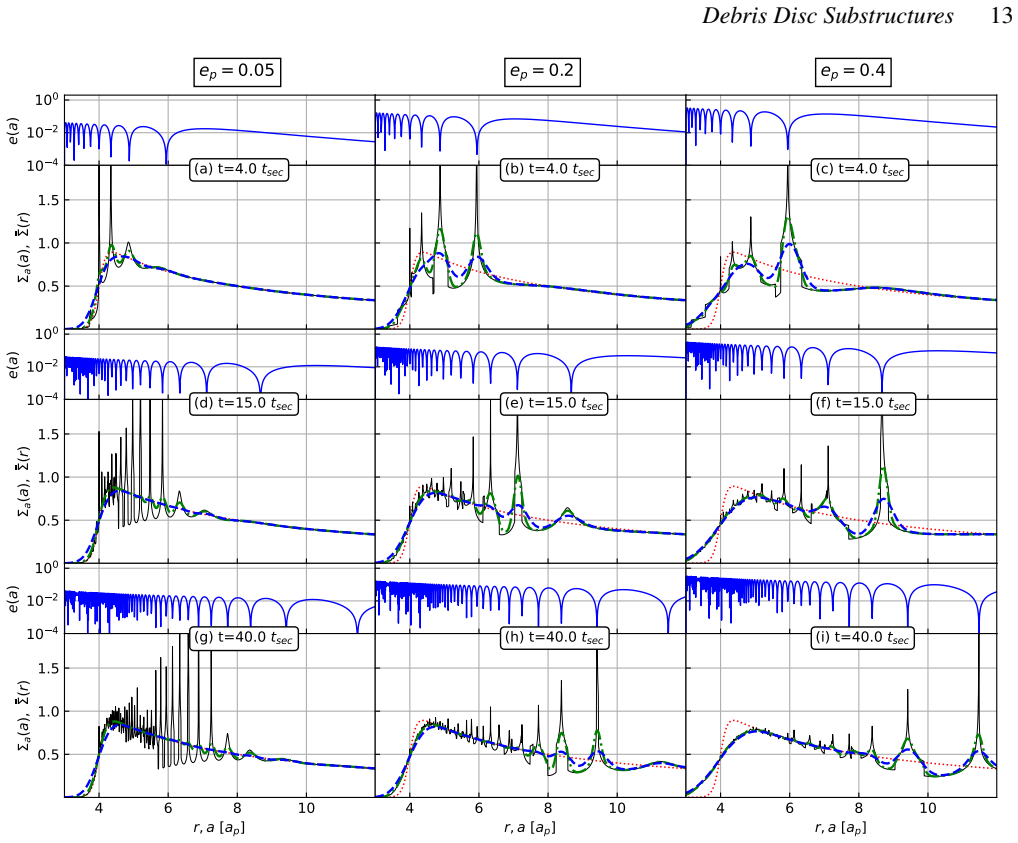
The central mechanism is the secular precession of debris particle eccentricities driven by an interior planet. Each particle's eccentricity oscillates in time at a rate proportional to a^(-7/2), passing through zero at semi-major axes a_k that march outward as the system ages. The ASD is computed via an exact integral (Equation 14) that sums contributions from all particle orbits crossing a given radius, with the integrand controlled by the interplay between the eccentricity profile e(a) and a geometric function κ(r,a) = |1 − r/a|. Peaks arise where e(a) vanishes (eccentricity nulls) and the parameter ζ_k — the ratio of eccentricity gradient to κ-gradient at the null — exceeds unity. Jumps,
What would settle it
If the random eccentricity dispersion of debris particles is comparable to or larger than the forced eccentricity from the planet, the sharp ASD peaks and jumps predicted by the theory would be washed out below the detection threshold, making the predicted (t/k)^(2/7) spacing pattern unobservable and undermining the planet-constraining claims.
Extended reading notes
Core claim
Secular perturbation by an inner planet on an eccentric orbit produces a train of density peaks in a debris disc's azimuthally-averaged surface density at radii a_k = a_in × (t / t_sec × k)^(2/7), and the detection or non-detection of this pattern constrains the perturbing planet's mass, semi-major axis, and eccentricity.
Load-bearing premise
The analytical theory assumes that every debris particle at a given orbital distance has a single, deterministic eccentricity value set by secular evolution alone, with no random scatter. Real debris discs have eccentricity dispersions from self-stirring, collisions, and gravitational stirring by embedded bodies, which the paper handles only by post-hoc smoothing of the idealized result rather than by incorporating the dispersion into the core calculation.
Editorial extensions
If this is right
- Observing a sequence of density peaks in a debris disc following the (t/k)^(2/7) spacing rule would provide a mass-times-semi-major-axis-squared measurement of an unseen planet, independent of direct imaging.
- Combining the secular ASD constraint on M_p × a_p^2 with a stellar radial-velocity or astrometric acceleration measurement (which constrains M_p / a_p^2) would uniquely determine the planet's mass and orbital distance.
- A non-detection of secular ASD features in a well-resolved disc excludes planets in a calculable region of the (M_p × a_p^2, e_p × a_p) parameter space, guiding target selection for direct imaging campaigns.
- Narrow debris rings observed with ALMA or JWST that show skewed or multi-peaked radial profiles may be explained by a single interior planet rather than requiring multiple distinct planetesimal belts.
- The publicly released DebrisPy tool enables forward-modeling of ASD profiles for any assumed eccentricity distribution, allowing observers to test planetary hypotheses against measured radial density profiles.
Reading between the lines
- If multiple planets orbit interior to a debris disc, their combined secular perturbations could produce eccentricity profiles with more complex null patterns, potentially breaking the clean (t/k)^(2/7) spacing rule — the absence of this rule in observed discs might itself signal multi-planet architecture.
- The pedestal overlap phenomenon at high null order suggests that very old or very massive planets could produce discs with featureless inner regions but structured outer regions, creating a radial gradient of secular signature visibility that evolves with system age.
- If future high-resolution surveys of debris discs systematically fail to find the predicted peak spacing pattern, this would either imply that most debris discs are not secularly perturbed by interior planets on eccentric orbits, or that collisional and stirring processes randomize eccentricities faster than secular oscillations can organize them.
Editorial analysis
A structured set of objections, weighed in public.
Referee Report
Summary. This manuscript studies the azimuthally-averaged surface density (ASD) of a debris disc secularly perturbed by an inner planet. Building on the exact analytical framework of Rafikov (2023), the authors show that secular evolution of the particle eccentricity profile e(a) produces sharp ASD features: weakly singular (logarithmically divergent) peaks at eccentricity nulls and finite discontinuous jumps at caustic (tangent) points. These features march outward through the disc as it ages, with their radial locations following the well-defined pattern a_k proportional to (t/k)^{2/7}. The authors develop detailed asymptotic analysis (Appendix C) for the conditions under which peaks form (parameter zeta_k > 1) versus mere bumps, and for the amplitudes and widths of the caustic jumps. They verify all analytical predictions against a new numerical tool, DebrisPy, which is made publicly available. The paper explores parameter dependence (planetary eccentricity, free eccentricity fraction, disc mass profile), discusses observational detectability under PSF convolution and random eccentricity, and illustrates how detection or non-detection of secular ASD features can constrain planetary mass, semi-major axis, and eccentricity.
Significance. The paper makes a solid contribution to the debris-disc dynamics literature. The analytical results are derived from first principles: the peak-location pattern (Eq. 19), the peak-to-bump transition criterion (Eq. 22), the jump amplitudes (Eq. C21), and the pedestal overlap threshold (Eq. C33) are all falsifiable predictions verified against DebrisPy calculations. The public release of DebrisPy as a reproducible computational tool is a genuine strength. The proposed observational test (Eq. 29) for identifying secular features via their radial spacing pattern is concrete and immediately applicable to ALMA/JWST data. The framework for constraining planetary parameters from both detection and non-detection (Section 9.1-9.2, Figure 9-10) is well-constructed and practical.
major comments (1)
- Section 8: The effect of random free eccentricity on ASD is modeled by convolving the exact ASD (computed with deterministic e(a)) with a 1D Gaussian of width sigma_e,0 * r. This is not equivalent to computing ASD from first principles using an eccentricity distribution psi_e(e,a), which equation (A1) and DebrisPy can in principle handle. The mapping from e(a) to Sigma_bar(r) in equation (14) is nonlinear (it involves a Heaviside constraint and a square root), so convolving the output ASD is not generally equivalent to integrating over a distribution of inputs. The discrepancy matters most when sigma_e is comparable to e_f, which is precisely the regime where features are most threatened. The paper itself notes (Section 9.3) that DebrisPy can handle eccentricity distributions, so the tool to test this exists but is not exercised. This does not undermine the core analytical results (the e
minor comments (8)
- Section 2.2, equation (9): The general eccentricity solution is presented here with f_free defined as e_free/e_f, but the specific case f_free = 1 is not adopted until Section 4. It would help the reader to state upfront in Section 2.2 that f_free = 1 will be the default for most of the paper.
- Section 4.1, Figure 1: The Monte Carlo comparison uses N_p = 10^8 particles and reports 2.88% RMS fractional deviation. It would be useful to state the computational time for this comparison to give readers a sense of DebrisPy's efficiency advantage.
- Section 7: The 1D Gaussian convolution used to model PSF effects is an approximation, since the actual observational procedure involves 2D convolution of the sky image followed by azimuthal averaging. The authors should briefly note this approximation and its expected validity for moderately inclined discs.
- Section 9.2, Figure 10: The threshold psi_e = 2 AU is described as 'chosen rather arbitrarily and only for illustration.' Given that this parameter determines the boundary of the excluded grey region, a brief justification of why 2 AU is a reasonable order-of-magnitude choice (or a note that it should be calibrated per system) would help readers gauge sensitivity.
- Equation (32): The notation [(i+k_0)^2 r_i^{7/2}]^{1/2} is slightly ambiguous. It should be clarified whether the exponent 1/2 applies to the product (i+k_0)^2 * r_i^{7/2} or just to r_i^{7/2}. Based on the derivation, it appears to be (i+k_0) * r_i^{7/2}.
- Appendix C1.1, equation (C11): The constant C(a_1, a_2, zeta_k) depends on integration endpoints a_1, a_2 that are defined only implicitly. A brief note on how these are determined (or a reference to where this is specified) would be helpful.
- Section 6.3, Figure 7: For the narrow Gaussian ring models (center and right columns), the radial range is different from the left column, which can cause confusion. Adding a panel showing the underlying e(a) profile for the narrow ring case, or at least noting the different radial scale, would improve clarity.
- The paper uses both 'ASD' and 'Sigma_bar(r)' interchangeably. While defined in Section 3, a brief reminder at first use in later sections would aid readability.
Circularity Check
No circularity found; derivation chain is self-contained and independently verified
full rationale
The paper's derivation chain proceeds from standard secular perturbation theory (Murray & Dermott 1999, equations 1-5) to the eccentricity profile e(a,t) (equation 10, derived from initial condition e=0), then uses the ASD integral framework of Rafikov (2023) — equation 14 — to compute axisymmetric surface density. The key prediction, the radial spacing of ASD peaks a_k ∝ (t/k)^{2/7} (equation 19), follows directly from the null condition A_p(a_k)t/2 = kπ (equation 18) combined with the secular precession rate A_p(a) ∝ a^{-7/2} (equation 4). This is a genuine first-principles derivation with no fitting to observational data. The self-citation to Rafikov (2023) for equation 14 is load-bearing for the analytical framework, but it is independently verified: Figure 1c and Figure 3 show exact agreement between the analytical ASD and Monte Carlo sampling (2.88% RMS deviation attributable to Poisson noise). The feature analysis in Appendix C (peaks at nulls, caustic jumps) is mathematical derivation from equation 14, not assumption. The observational detectability claims in Sections 7-8 use post-hoc Gaussian convolution as an approximation rather than the exact eccentricity-distribution capability of DebrisPy (equation A1), which is a correctness/approximation concern (the skeptic's valid point) but not circularity — no prediction is forced by construction to equal a fitted input. No step in the chain reduces to its own inputs by definition, fit, or self-citation chain.
Assumptions & free parameters
free parameters (4)
- e_p (planetary eccentricity)
- f_free (free eccentricity fraction)
- Sigma_a(a) profile parameters (a_in, a_out, gamma, w_in, w_out) =
a_in=4ap, a_out=15ap, gamma=1, w_in=w_out=0.2ap
- sigma (PSF width for convolution) =
0.1ap and 0.25ap
assumptions (5)
- standard math Secular perturbation theory: particle semi-major axes are conserved under secular gravitational perturbations (Section 2.1, equation 1).
- domain assumption Debris particles are collisionless on secular timescales (Section 3, paragraph 2).
- domain assumption Eccentricity e is a unique function of semi-major axis a (Section 2.2).
- domain assumption The disc is coplanar with the planet (Section 2, paragraph 4).
- domain assumption The planet orbits interior to the disc (alpha = ap/a << 1, Section 2.1).
Cite this review
Pith. "Pith review of Debris Disc Substructures Induced by Secular Planetary Perturbations." pith.science (2026). https://pith.science/paper/ILAKSHXF
@misc{pith2026260708750,
  author       = {Pith},
  title        = {Pith review of: Debris Disc Substructures Induced by Secular Planetary Perturbations},
  year         = {2026},
  howpublished = {\url{https://pith.science/paper/ILAKSHXF}},
  note         = {Machine review of arXiv:2607.08750}
}
read the original abstract
Observations of debris discs have the potential to provide us with valuable information about massive planets perturbing them gravitationally. In this work, we explore the evolution of the azimuthally-averaged (or axisymmetric) surface density (ASD) -- a characteristic routinely derived from observations -- in a disc secularly perturbed by an inner planet. We develop detailed analytical understanding of ASD evolution and verify it using a novel numerical framework DebrisPy, which we make publicly available. With these tools we show that in a secularly evolving disc ASD develops a set of sharp features -- weakly discontinuous peaks at eccentricity nulls and sharp discontinuities at caustic points where particle periastra or apoastra pile up -- marching out through the disc as it ages. We probe the dependence of these features on planetary eccentricity, ratio of the free to forced particle eccentricity, and underlying radial mass distribution, showing in particular that more eccentric planets produce more prominent ASD features. Convolution with the PSF of realistic observations (as well as the non-zero random free eccentricity of debris) smooths out these features, but they can still be detectable in high-resolution observations. Radial locations of secular ASD peaks follow a particular, well-defined pattern, which should unambiguously point to their secular nature in observations. We illustrate how both detection and non-detection of such secular features in observed discs can be used (in combination with other constraints) to measure or constrain key parameters of perturbing planets (even those not yet detected) -- mass, semi-major axis and eccentricity.
Figures


Figures from the paper (7 more)




Reference graph
Works this paper leans on
-
[1]
Apai D., et al., 2008, @doi [ ] 10.1086/524191 , https://ui.adsabs.harvard.edu/abs/2008ApJ...672.1196A 672, 1196
-
[2]
Augereau J. C., Nelson R. P., Lagrange A. M., Papaloizou J. C. B., Mouillet D., 2001, @doi [ ] 10.1051/0004-6361:20010199 , https://ui.adsabs.harvard.edu/abs/2001A&A...370..447A 370, 447
-
[3]
Caswell T. A., et al., 2023, matplotlib/matplotlib: REL : v3.7.4, @doi 10.5281/ZENODO.592536 , https://zenodo.org/doi/10.5281/zenodo.592536
-
[4]
Chittidi J. S., et al., 2025, @doi [ ] 10.3847/2041-8213/adfadb , https://ui.adsabs.harvard.edu/abs/2025ApJ...990L..40C 990, L40
-
[5]
Dawson R. I., Murray-Clay R. A., Fabrycky D. C., 2011, @doi [ ] 10.1088/2041-8205/743/1/L17 , https://ui.adsabs.harvard.edu/abs/2011ApJ...743L..17D 743, L17
-
[6]
Farhat M. A., Sefilian A. A., Touma J. R., 2023, @doi [ ] 10.1093/mnras/stad316 , https://ui.adsabs.harvard.edu/abs/2023MNRAS.521.2067F 521, 2067
-
[7]
Han Y., et al., 2026, @doi [ ] 10.1051/0004-6361/202556450 , https://ui.adsabs.harvard.edu/abs/2026A&A...705A.196H 705, A196
-
[8]
Harris C. R., et al., 2020, @doi [Nature] 10.1038/s41586-020-2649-2 , 585, 357
Show all 53 references
-
[9]
M., Duch \^e ne G., Matthews B
Hughes A. M., Duch \^e ne G., Matthews B. C., 2018, @doi [ ] 10.1146/annurev-astro-081817-052035 , https://ui.adsabs.harvard.edu/abs/2018ARA&A..56..541H 56, 541
2018 doi
-
[10]
Ida S., 1990, @doi [ ] 10.1016/0019-1035(90)90182-9 , https://ui.adsabs.harvard.edu/abs/1990Icar...88..129I 88, 129
1990 doi
-
[11]
Ida S., Makino J., 1992, @doi [ ] 10.1016/0019-1035(92)90008-U , https://ui.adsabs.harvard.edu/abs/1992Icar...96..107I 96, 107
1992 doi
-
[12]
Ida S., Makino J., 1993, @doi [ ] 10.1006/icar.1993.1167 , https://ui.adsabs.harvard.edu/abs/1993Icar..106..210I 106, 210
1993 doi
-
[13]
Imaz Blanco A., et al., 2023, @doi [ ] 10.1093/mnras/stad1221 , https://ui.adsabs.harvard.edu/abs/2023MNRAS.522.6150I 522, 6150
2023 doi
-
[14]
J., 1973, @doi [ ] 10.1017/S1323358000013461 , https://ui.adsabs.harvard.edu/abs/1973PASA....2..174K 2, 174
Kalnajs A. J., 1973, @doi [ ] 10.1017/S1323358000013461 , https://ui.adsabs.harvard.edu/abs/1973PASA....2..174K 2, 174
1973 doi
-
[15]
M., 2020, @doi [Royal Society Open Science] 10.1098/rsos.200063 , https://ui.adsabs.harvard.edu/abs/2020RSOS....700063K 7, 200063
Kennedy G. M., 2020, @doi [Royal Society Open Science] 10.1098/rsos.200063 , https://ui.adsabs.harvard.edu/abs/2020RSOS....700063K 7, 200063
2020 doi
-
[16]
J., Bromley B
Kenyon S. J., Bromley B. C., 2001, @doi [ ] 10.1086/318019 , https://ui.adsabs.harvard.edu/abs/2001AJ....121..538K 121, 538
2001 doi
-
[17]
V., Rodmann J., 2008, @doi [ ] 10.1086/524840 , https://ui.adsabs.harvard.edu/abs/2008ApJ...673.1123L 673, 1123
L \"o hne T., Krivov A. V., Rodmann J., 2008, @doi [ ] 10.1086/524840 , https://ui.adsabs.harvard.edu/abs/2008ApJ...673.1123L 673, 1123
2008 doi
-
[18]
B., Lynch E
Lovell J. B., Lynch E. M., 2023, @doi [ ] 10.1093/mnrasl/slad083 , https://ui.adsabs.harvard.edu/abs/2023MNRAS.525L..36L 525, L36
2023 doi
-
[19]
B., et al., 2025, @doi [ ] 10.3847/1538-4357/adfadc , https://ui.adsabs.harvard.edu/abs/2025ApJ...990..145L 990, 145
Lovell J. B., et al., 2025, @doi [ ] 10.3847/1538-4357/adfadc , https://ui.adsabs.harvard.edu/abs/2025ApJ...990..145L 990, 145
2025 doi
-
[20]
Malhotra R., 1993, @doi [ ] 10.1038/365819a0 , https://ui.adsabs.harvard.edu/abs/1993Natur.365..819M 365, 819
1993 doi
-
[21]
Marino S., 2021, @doi [ ] 10.1093/mnras/stab771 , https://ui.adsabs.harvard.edu/abs/2021MNRAS.503.5100M 503, 5100
2021 doi
-
[22]
Marino S., et al., 2018, @doi [ ] 10.1093/mnras/sty1790 , https://ui.adsabs.harvard.edu/abs/2018MNRAS.479.5423M 479, 5423
2018 doi
-
[23]
Marino S., et al., 2026, @doi [ ] 10.1051/0004-6361/202556489 , https://ui.adsabs.harvard.edu/abs/2026A&A...705A.195M 705, A195
2026 doi
-
[24]
Matr \`a L., et al., 2025, @doi [ ] 10.1051/0004-6361/202451397 , https://ui.adsabs.harvard.edu/abs/2025A&A...693A.151M 693, A151
2025 doi
-
[25]
Morrison S., Malhotra R., 2015, @doi [ ] 10.1088/0004-637X/799/1/41 , https://ui.adsabs.harvard.edu/abs/2015ApJ...799...41M 799, 41
2015 doi
-
[26]
D., Papaloizou J
Mouillet D., Larwood J. D., Papaloizou J. C. B., Lagrange A. M., 1997, @doi [ ] 10.1093/mnras/292.4.896 , https://ui.adsabs.harvard.edu/abs/1997MNRAS.292..896M 292, 896
1997 doi
-
[27]
D., Dermott S
Murray C. D., Dermott S. F., 1999, Solar system dynamics
1999
-
[28]
E., 2012, @doi [ ] 10.1088/0004-637X/747/2/113 , https://ui.adsabs.harvard.edu/abs/2012ApJ...747..113P 747, 113
Pan M., Schlichting H. E., 2012, @doi [ ] 10.1088/0004-637X/747/2/113 , https://ui.adsabs.harvard.edu/abs/2012ApJ...747..113P 747, 113
2012 doi
-
[29]
D., Wyatt M
Pearce T. D., Wyatt M. C., 2015, @doi [ ] 10.1093/mnras/stv1847 , https://ui.adsabs.harvard.edu/abs/2015MNRAS.453.3329P 453, 3329
2015 doi
-
[30]
D., et al., 2024, @doi [ ] 10.1093/mnras/stad3462 , https://ui.adsabs.harvard.edu/abs/2024MNRAS.527.3876P 527, 3876
Pearce T. D., et al., 2024, @doi [ ] 10.1093/mnras/stad3462 , https://ui.adsabs.harvard.edu/abs/2024MNRAS.527.3876P 527, 3876
2024 doi
-
[31]
R., 2003a, @doi [ ] 10.1086/345969 , https://ui.adsabs.harvard.edu/abs/2003AJ....125..906R 125, 906
Rafikov R. R., 2003a, @doi [ ] 10.1086/345969 , https://ui.adsabs.harvard.edu/abs/2003AJ....125..906R 125, 906
-
[32]
R., 2003b, @doi [ ] 10.1086/345970 , https://ui.adsabs.harvard.edu/abs/2003AJ....125..922R 125, 922
Rafikov R. R., 2003b, @doi [ ] 10.1086/345970 , https://ui.adsabs.harvard.edu/abs/2003AJ....125..922R 125, 922
-
[33]
R., 2003c, @doi [ ] 10.1086/378609 , https://ui.adsabs.harvard.edu/abs/2003AJ....126.2529R 126, 2529
Rafikov R. R., 2003c, @doi [ ] 10.1086/378609 , https://ui.adsabs.harvard.edu/abs/2003AJ....126.2529R 126, 2529
-
[34]
R., 2013a, @doi [ ] 10.1088/2041-8205/764/1/L16 , https://ui.adsabs.harvard.edu/abs/2013ApJ...764L..16R 764, L16
Rafikov R. R., 2013a, @doi [ ] 10.1088/2041-8205/764/1/L16 , https://ui.adsabs.harvard.edu/abs/2013ApJ...764L..16R 764, L16
-
[35]
R., 2013b, @doi [ ] 10.1088/2041-8205/765/1/L8 , http://adsabs.harvard.edu/abs/2013ApJ...765L...8R 765, L8
Rafikov R. R., 2013b, @doi [ ] 10.1088/2041-8205/765/1/L8 , http://adsabs.harvard.edu/abs/2013ApJ...765L...8R 765, L8
-
[36]
R., 2023, @doi [ ] 10.1093/mnras/stac3411 , https://ui.adsabs.harvard.edu/abs/2023MNRAS.519.5607R 519, 5607
Rafikov R. R., 2023, @doi [ ] 10.1093/mnras/stac3411 , https://ui.adsabs.harvard.edu/abs/2023MNRAS.519.5607R 519, 5607
2023 doi
-
[37]
R., Silsbee K., 2015, @doi [ ] 10.1088/0004-637X/798/2/69 , http://adsabs.harvard.edu/abs/2015ApJ...798...69R 798, 69
Rafikov R. R., Silsbee K., 2015, @doi [ ] 10.1088/0004-637X/798/2/69 , http://adsabs.harvard.edu/abs/2015ApJ...798...69R 798, 69
2015 doi
-
[38]
A., Rafikov R
Sefilian A. A., Rafikov R. R., Wyatt M. C., 2021, @doi [ ] 10.3847/1538-4357/abda46 , https://ui.adsabs.harvard.edu/abs/2021ApJ...910...13S 910, 13
2021 doi
-
[39]
A., Rafikov R
Sefilian A. A., Rafikov R. R., Wyatt M. C., 2023, @doi [ ] 10.3847/1538-4357/ace68e , https://ui.adsabs.harvard.edu/abs/2023ApJ...954..100S 954, 100
2023 doi
-
[40]
A., Kratter K
Sefilian A. A., Kratter K. M., Wyatt M. C., Petrovich C., Th \'e bault P., Malhotra R., Faramaz-Gorka V., 2025, @doi [ ] 10.1093/mnras/staf1555 , https://ui.adsabs.harvard.edu/abs/2025MNRAS.543.3123S 543, 3123
2025 doi
-
[41]
R., 2015a, @doi [ ] 10.1088/0004-637X/798/2/71 , http://adsabs.harvard.edu/abs/2015ApJ...798...71S 798, 71
Silsbee K., Rafikov R. R., 2015a, @doi [ ] 10.1088/0004-637X/798/2/71 , http://adsabs.harvard.edu/abs/2015ApJ...798...71S 798, 71
-
[42]
R., 2015b, @doi [ ] 10.1088/0004-637X/808/1/58 , http://adsabs.harvard.edu/abs/2015ApJ...808...58S 808, 58
Silsbee K., Rafikov R. R., 2015b, @doi [ ] 10.1088/0004-637X/808/1/58 , http://adsabs.harvard.edu/abs/2015ApJ...808...58S 808, 58
-
[43]
S., Burrows A., 2012, @doi [ ] 10.1088/0004-637X/745/2/174 , https://ui.adsabs.harvard.edu/abs/2012ApJ...745..174S 745, 174
Spiegel D. S., Burrows A., 2012, @doi [ ] 10.1088/0004-637X/745/2/174 , https://ui.adsabs.harvard.edu/abs/2012ApJ...745..174S 745, 174
2012 doi
-
[44]
R., Ida S., 2000, @doi [ ] 10.1006/icar.1999.6242 , https://ui.adsabs.harvard.edu/abs/2000Icar..143...28S 143, 28
Stewart G. R., Ida S., 2000, @doi [ ] 10.1006/icar.1999.6242 , https://ui.adsabs.harvard.edu/abs/2000Icar..143...28S 143, 28
2000 doi
-
[45]
Tremaine S., 1998, @doi [ ] 10.1086/300567 , https://ui.adsabs.harvard.edu/abs/1998AJ....116.2015T 116, 2015
1998 doi
-
[46]
Virtanen P., et al., 2020, @doi [Nature Methods] 10.1038/s41592-019-0686-2 , 17, 261
2020 doi
-
[47]
C., 2005, @doi [ ] 10.1051/0004-6361:20053391 , https://ui.adsabs.harvard.edu/abs/2005A&A...440..937W 440, 937
Wyatt M. C., 2005, @doi [ ] 10.1051/0004-6361:20053391 , https://ui.adsabs.harvard.edu/abs/2005A&A...440..937W 440, 937
2005 doi
- [48]
-
[49]
C., 2018, in Deeg H
Wyatt M. C., 2018, in Deeg H. J., Belmonte J. A., eds, , Handbook of Exoplanets. p. 146, @doi 10.1007/978-3-319-55333-7_146
2018 doi
-
[50]
C., Dent W
Wyatt M. C., Dent W. R. F., 2002, @doi [ ] 10.1046/j.1365-8711.2002.05533.x , https://ui.adsabs.harvard.edu/abs/2002MNRAS.334..589W 334, 589
2002 doi
-
[51]
C., Dermott S
Wyatt M. C., Dermott S. F., Telesco C. M., Fisher R. S., Grogan K., Holmes E. K., Pi \ n a R. K., 1999, @doi [ ] 10.1086/308093 , https://ui.adsabs.harvard.edu/abs/1999ApJ...527..918W 527, 918
1999 doi
-
[52]
M., 2018, @doi [ ] 10.1093/mnras/sty1678 , https://ui.adsabs.harvard.edu/abs/2018MNRAS.479.2673Y 479, 2673
Yelverton B., Kennedy G. M., 2018, @doi [ ] 10.1093/mnras/sty1678 , https://ui.adsabs.harvard.edu/abs/2018MNRAS.479.2673Y 479, 2673
2018 doi
-
[53]
Zawadzki B., et al., 2026, @doi [ ] 10.1051/0004-6361/202556505 , https://ui.adsabs.harvard.edu/abs/2026A&A...705A.197Z 705, A197
2026 doi
Reviewed July 10, 2026 · model on record in the stance chip above.
Discussion (0). Continue with ORCID to comment.