REVIEW 3 major objections 58 references
DaDaDa: A Dataset for Data Pricing in Data Marketplaces
T0 review · 3 major / 0 minor · reviewed 2026-07-13 · grok-4.5
Pith's one-line read DaDaDa supplies the first cross-marketplace catalog of 16,147 data products so listed prices can be predicted from standardized metadata.
desk verdict Solid released multi-marketplace dataset with honest baselines; useful infrastructure, but the sales-comparison framing overreaches listed-price prediction. read the letter →
The pith
A machine-rendered reading of the paper's core claim, the machinery that carries it, and where it could break.
The reading
What carries the argument
DaDaDa: a unified 14-field metadata schema for 16,147 products, built by marketplace selection, web scraping, cleaning, currency and mode normalization, and manual mapping of heterogeneous categories onto an AWS-style taxonomy.
What would settle it
Train the same pricing protocol on the released explicit-price subset, then check whether predicted log-prices systematically fail on a held-out marketplace or against any newly disclosed actual transaction prices, private discounts, or renegotiated contracts that diverge from catalog listings.
Extended reading notes
Core claim
The paper establishes that a single standardized metadata schema spanning nine real marketplaces is enough to train supervised models that estimate public listed prices for data products and to support classification and cross-marketplace retrieval. Free and negotiation listings stay in the release for marketplace analysis, while explicit nonzero subscription, one-off, and usage-based prices form the supervised pricing target after mode-specific normalization.
Load-bearing premise
The central claim rests on treating seller-written public catalog prices and metadata, after manual alignment and mode-specific normalization, as a usable sales-comparison signal for pricing new data products rather than private transaction prices or buyer value.
Editorial extensions
If this is right
- New data products can receive automated listed-price benchmarks by matching their metadata against DaDaDa instead of relying only on seller guesswork.
- Heterogeneous marketplace taxonomies can be reduced to a shared category layer for comparable classification and search.
- A vertical retrieval layer can surface cross-platform alternatives with price, coverage, and update constraints in one interface.
- Future marketplace studies can retrain pricing, classification, and retrieval methods under one public schema and refresh protocol.
Reading between the lines
- If catalog prices remain the main observable signal, pricing research will likely stay text-heavy, because descriptions dominate feature importance when structured fields are sparse.
- Separating pricing-mode prediction from continuous price regression would better match real marketplaces where negotiation and free listings dominate many catalogs.
- Periodic public snapshots of the same schema would turn one-shot benchmarks into a way to track how listed prices and disclosure practices drift over time.
Editorial analysis
A structured set of objections, weighed in public.
Referee Report
Summary. The paper introduces DaDaDa, a standardized metadata corpus of 16,147 data products from nine public marketplaces (Datarade, AWS Data Exchange, Snowflake, Databricks, and five Chinese exchanges). After marketplace selection, scraping, cleaning, currency normalization, and manual alignment of categories to the AWS taxonomy, the authors release a unified schema (title, description, volume, size, dimension, coverage, update frequency, price mode, price, etc.) together with crawlers, preprocessing scripts, and samples. They treat data pricing as supervised listed-price regression on the ~4,929 products with explicit nonzero prices (log(price+1) target), report XGBoost R² ≈ 0.833 under 5-fold CV, ablations of text vs. structured features, SHAP feature groups by pricing mode, and leave-one-marketplace generalization to Snowflake (R² ≈ 0.744). Complementary experiments fine-tune multilingual transformers for category classification (weighted F1 ≈ 0.82) and demonstrate an Elasticsearch retrieval prototype with structured filters.
Significance. If the resource is maintained and used as intended, it fills a genuine empirical gap: theoretical data-pricing mechanisms have lacked real marketplace benchmarks, while prior commercial studies have been largely descriptive. The public release of raw crawls, intermediate files, scripts, and a working retrieval layer is a concrete contribution that enables reproducible pricing, classification, and discovery research. The paper is appropriately scoped as a dataset-plus-baseline resource rather than a new pricing theory; its value lies in making sales-comparison-style experiments feasible across heterogeneous platforms.
major comments (3)
- §I and §V-A frame DaDaDa as enabling the sales-comparison approach, yet the supervised task (Table IV) is listed-price regression on the explicit nonzero subset after free/negotiation products are excluded (Table I: only 30.5% of products). Catalog offers are not observed transactions, private discounts, or buyer valuations. The manuscript should either (a) restate the claim as “listed-price estimation under public metadata” and discuss the gap to realized sales comparison, or (b) provide additional evidence (e.g., sensitivity to negotiation-mode products, platform-level price-disclosure bias) that the retained prices are valid comparables.
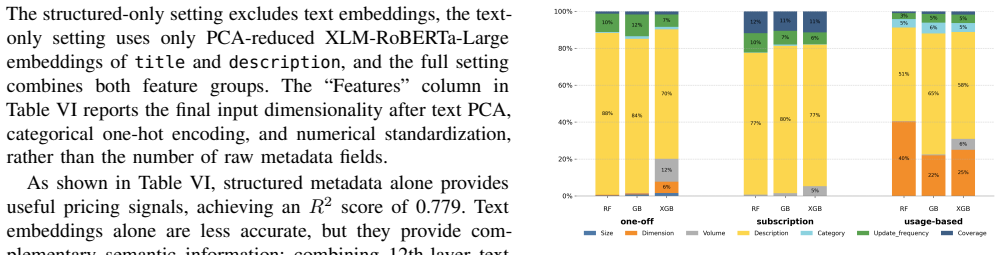
- Table IX leave-one-marketplace transfer to Snowflake drops to R² 0.744 with substantially higher MAE/MSE than the pooled 5-fold results in Table IV. Combined with SHAP results (Fig. 6, Table VIII) showing description as the dominant feature group across modes, this suggests models largely recover catalog-price and marketing-language patterns rather than transferable structural value. A stronger generalization protocol (multiple held-out platforms, or explicit platform-invariant features) is needed before claiming cross-marketplace price benchmarks.
- §IV-C and §III: category labels are manually mapped onto the AWS Marketplace taxonomy, and missing coverage/size fields are filled by reading descriptions or defaults. These curation steps are load-bearing for both pricing and classification, yet inter-annotator agreement, mapping rules, and the fraction of imputed fields are not reported. Without that documentation, reproducibility of the “standardized” labels is incomplete.
Circularity Check
No circularity: empirical dataset release plus standard supervised regression/classification on held-out listed prices, not a self-defining derivation.
full rationale
DaDaDa is a resource paper that scrapes, standardizes, and releases marketplace metadata, then trains ordinary ML models (XGBoost, Gradient Boosting, etc.) to regress log(price+1) or classify categories. Performance is measured by 5-fold CV and held-out marketplace transfer against the same observed listed prices that constitute the labels; free/negotiation items are explicitly excluded from the regression task rather than being redefined into the target. There are no equations that define a quantity in terms of itself, no fitted constant re-labeled as a first-principles prediction, no load-bearing uniqueness theorem imported from the authors’ prior work, and no ansatz smuggled via self-citation. Ordinary dependence of a supervised model on its training distribution is not circularity under the stated criteria. The derivation chain is therefore self-contained and non-circular.
Assumptions & free parameters
free parameters (4)
- PCA retained dimensions for text embeddings =
223 dims at 95% variance (12th layer)
- log(price + 1) target transform =
log1p(price)
- Model hyperparameters via grid search
- Marketplace selection thresholds =
≥8 categories; ≥70% metadata coverage
assumptions (5)
- domain assumption Cost and income pricing approaches fail for data products, so sales comparison is the viable practical approach.
- domain assumption Public listed prices, after mode-specific normalization to USD, are a useful supervised target for data-product pricing models.
- ad hoc to paper AWS Marketplace category taxonomy is an adequate common label space for products from all included marketplaces.
- domain assumption Title and description text plus partial structured metadata are sufficient features for pricing, classification, and retrieval benchmarks.
- standard math Standard supervised learning evaluation (shuffled 5-fold CV, held-out marketplace test) measures pricing-model effectiveness.
invented entities (1)
-
DaDaDa unified data-product schema and dataset
independent evidence
Cite this review
Pith. "Pith review of DaDaDa: A Dataset for Data Pricing in Data Marketplaces." pith.science (2026). https://pith.science/paper/KRKDJNLG
@misc{pith2026260708785,
  author       = {Pith},
  title        = {Pith review of: DaDaDa: A Dataset for Data Pricing in Data Marketplaces},
  year         = {2026},
  howpublished = {\url{https://pith.science/paper/KRKDJNLG}},
  note         = {Machine review of arXiv:2607.08785}
}
read the original abstract
High-quality data drives machine learning advances across industries. Recognizing the value of data, data transactions are increasingly common, giving rise to many data marketplaces, e.g., AWS Marketplace, Databricks, and Datarade. However, determining the appropriate prices for data products remains a significant challenge due to the unique properties of data products. Traditional pricing methods in economics can be categorized into the cost approach, the income approach, and the sales comparison approach. The cost approach fails in data pricing due to near-zero marginal cost from data replication, and the income approach fails due to inherently unpredictable data revenue. The sales comparison approach remains viable, yet its application is hindered by the absence of standardized pricing benchmarks for data products across marketplaces. To address this challenge, we introduce \texttt{DaDaDa}, the first dataset for data product pricing, containing metadata for 16,147 data products from 9 major data marketplaces worldwide. \texttt{DaDaDa} enables the training of pricing models, thereby establishing price benchmarks for new data products. In addition, \texttt{DaDaDa} can be utilized for other important tasks in data markets, such as data product classification and retrieval. Experiments and a retrieval prototype demonstrate the effectiveness of \texttt{DaDaDa} for pricing, classification, and retrieval of data products. The dataset and code are available at https://github.com/ZJU-DIVER/DaDaDa.
Figures


Figures from the paper (4 more)



Reference graph
Works this paper leans on
-
[1]
https://www.advaneo-datamarketplace.de/database/en, 2026
Advaneo. https://www.advaneo-datamarketplace.de/database/en, 2026
2026
-
[2]
https://aws.amazon.com/marketplace, 2026
AWS Marketplace. https://aws.amazon.com/marketplace, 2026
2026
-
[3]
https://azure.microsoft.com/en-us/products/open-datasets/ , 2026
Azure. https://azure.microsoft.com/en-us/products/open-datasets/ , 2026
2026
-
[4]
https://www.bbgdex.com/, 2026
Beibu Gulf Data Exchange. https://www.bbgdex.com/, 2026
2026
-
[5]
https://www.bjidex.com, 2026
Beijing International Data Exchange. https://www.bjidex.com, 2026
2026
-
[6]
https://www.cantonde.com, 2026
Canton Data Exchange. https://www.cantonde.com, 2026
2026
-
[7]
https://carto.com, 2026
Carto. https://carto.com, 2026
2026
-
[8]
https://www.databricks.com/product/marketplace, 2026
Databricks. https://www.databricks.com/product/marketplace, 2026
2026
Show all 58 references
-
[9]
https://www.databroker.global/data-marketplace, 2026
DataBroker. https://www.databroker.global/data-marketplace, 2026
2026
-
[10]
https://datarade.ai/, 2026
Datarade. https://datarade.ai/, 2026
2026
-
[11]
https://www.datatang.com/, 2026
Datatang. https://www.datatang.com/, 2026
2026
-
[12]
https://www.elastic.co/, 2026
Elasticsearch. https://www.elastic.co/, 2026
2026
-
[13]
https://console.cloud.google.com/marketplace, 2026
Google Cloud. https://console.cloud.google.com/marketplace, 2026
2026
-
[14]
https://www.gzdex.com.cn, 2026
Guiyang Global Big Data Exchange. https://www.gzdex.com.cn, 2026
2026
-
[15]
https://mobilithek.info, 2026
Mobilithek. https://mobilithek.info, 2026
2026
-
[16]
https://data.nasdaq.com, 2026
Nasdaq data link. https://data.nasdaq.com, 2026
2026
-
[17]
https://www.selenium.dev/, 2026
Selenium. https://www.selenium.dev/, 2026
2026
-
[18]
https://dtxp.chinadep.com, 2026
Shanghai Data Exchange. https://dtxp.chinadep.com, 2026
2026
-
[19]
https://www.szdex.com, 2026
Shenzhen Data Exchange. https://www.szdex.com, 2026
2026
-
[20]
https://www.snowflake.com/en/data-cloud/marketplace/, 2026
Snowflake . https://www.snowflake.com/en/data-cloud/marketplace/, 2026
2026
-
[21]
https://www.veracity.com, 2026
V eracity. https://www.veracity.com, 2026
2026
-
[22]
https://www.westdex.com.cn, 2026
Western China Data Exchange. https://www.westdex.com.cn, 2026
2026
-
[23]
https: //www.irs.gov/individuals/international-taxpayers/ yearly-average-currency-exchange-rates , 2026
Y early Average Currency Exchange Rates. https: //www.irs.gov/individuals/international-taxpayers/ yearly-average-currency-exchange-rates , 2026
2026
-
[24]
https://ditm.zjdex.com, 2026
Zhejiang Big Data Exchange. https://ditm.zjdex.com, 2026
2026
-
[25]
A. F. Agarap. Deep learning using rectified linear units (relu). arXiv preprint arXiv:1803.08375 , 2018
2018 arXiv
-
[26]
Agarwal, M
A. Agarwal, M. Dahleh, and T. Sarkar. A marketplace for data: An algorithmic solution. In Proceedings of the 2019 ACM Conference on Economics and Computation , pages 701–726, 2019
2019
-
[27]
S. A. Azcoitia, C. Iordanou, and N. Laoutaris. What is the price of data? a measurement study of commercial data marketplaces. arXiv preprint arXiv:2111.04427, 2021
2021 arXiv
-
[28]
S. A. Azcoitia, C. Iordanou, and N. Laoutaris. Understanding the price of data in commercial data marketplaces. In Proceedings-International Conference on Data Engineering , 2023
2023
-
[29]
S. A. Azcoitia and N. Laoutaris. A survey of data marketplaces and their business models. ACM SIGMOD Record , 51(3):18–29, 2022
2022
-
[30]
A. E. Baum, N. Crosby, and S. Devaney. Property investment appraisal . John Wiley & Sons, 2021
2021
-
[31]
L. Breiman. Random forests. Machine learning , 45:5–32, 2001
2001
-
[32]
C. Chai, J. Wang, Y . Luo, Z. Niu, and G. Li. Data management for machine learning: A survey. IEEE Transactions on Knowledge and Data Engineering , 35(5):4646–4667, 2022
2022
-
[33]
Chawla, S
S. Chawla, S. Deep, P . Koutris, and Y . Teng. Revenue maximization for query pricing. Proc. VLDB Endow. , 13(1):1–14, 2019
2019
-
[34]
L. Chen, P . Koutris, and A. Kumar. Towards model-based pricing for machine learning in a data marketplace. In P . A. Boncz, S. Manegold, A. Ailamaki, A. Deshpande, and T. Kraska, editors, Proceedings of the 2019 International Conference on Management of Data, SIGMOD Conferenc...
2019
-
[35]
Chen and C
T. Chen and C. Guestrin. Xgboost: A scalable tree boosting system. In Proceedings of the 22nd acm sigkdd international conference on knowledge discovery and data mining , pages 785–794, 2016
2016
-
[36]
Y . Chen, Y . Shen, and S. Zheng. Truthful data acquisition via peer prediction. In H. Larochelle, M. Ranzato, R. Hadsell, M. Balcan, and H. Lin, editors, Advances in Neural Information Processing Systems 33: Annual Conference on Neural Information Processing Systems 2020, Neu...
2020
-
[37]
Conneau, K
A. Conneau, K. Khandelwal, N. Goyal, V . Chaudhary, G. Wenzek, F. Guzmán, E. Grave, M. Ott, L. Zettlemoyer, and V . Stoyanov. Unsupervised cross-lingual representation learning at scale. CoRR, abs/1911.02116, 2019
1911 arXiv
-
[38]
Damodaran
A. Damodaran. Investment valuation: Tools and techniques for deter- mining the value of any asset . John Wiley & Sons, 2012
2012
-
[39]
Deep and P
S. Deep and P . Koutris. QIRANA: A framework for scalable query pricing. In S. Salihoglu, W. Zhou, R. Chirkova, J. Y ang, and D. Suciu, editors, Proceedings of the 2017 ACM International Conference on Management of Data, SIGMOD Conference 2017, Chicago, IL, USA, May 14-19, 201...
2017
-
[40]
Devlin, M
J. Devlin, M. Chang, K. Lee, and K. Toutanova. BERT: pre-training of deep bidirectional transformers for language understanding. CoRR, abs/1810.04805, 2018
2018 arXiv
-
[41]
R. Dolan. How do you know when the price is right? Harvard Business Review, 73(5):174–180, 1995
1995
-
[42]
R. C. Fernandez, Z. Abedjan, F. Koko, G. Y uan, S. Madden, and M. Stonebraker. Aurum: A data discovery system. In 34th IEEE International Conference on Data Engineering, ICDE 2018, Paris, France, April 16-19, 2018 , pages 1001–1012. IEEE Computer Society, 2018
2018
-
[43]
R. C. Fernandez, P . Subramaniam, and M. J. Franklin. Data market platforms: Trading data assets to solve data problems. Proceedings of the VLDB Endowment , 13(11):1933–1947, 2020
1933
-
[44]
J. H. Friedman. Greedy function approximation: a gradient boosting machine. Annals of statistics , pages 1189–1232, 2001
2001
-
[45]
Ghosh and A
A. Ghosh and A. Roth. Selling privacy at auction. In Proceedings of the 12th ACM conference on Electronic commerce , pages 199–208, 2011
2011
-
[46]
Hanspach, G
P . Hanspach, G. Sapi, and M. Wieting. Algorithms in the marketplace: An empirical analysis of automated pricing in e-commerce. Information Economics and Policy , 69:101111, 2024
2024
-
[47]
N. Jones. The AI revolution is running out of data. what can researchers do? Nature, 636(8042):290–292, 2024
2024
-
[48]
D. P . Kingma and J. Ba. Adam: A method for stochastic optimization. arXiv preprint arXiv:1412.6980 , 2014
2014 arXiv
-
[49]
Koutris, P
P . Koutris, P . Upadhyaya, M. Balazinska, B. Howe, and D. Suciu. Query- based data pricing. Journal of the ACM (JACM) , 62(5):1–44, 2015
2015
-
[50]
O. Kramer. Unsupervised k-nearest neighbor regression. arXiv preprint arXiv:1107.3600, 2011
2011 arXiv
-
[51]
C. Li, D. Y . Li, G. Miklau, and D. Suciu. A theory of pricing private data. ACM Transactions on Database Systems (TODS) , 39(4):1–28, 2014
2014
-
[52]
J. Liu, J. Lou, J. Liu, L. Xiong, J. Pei, and J. Sun. Dealer: an end-to-end model marketplace with differential privacy. Proceedings of the VLDB Endowment, 14(6), 2021
2021
-
[53]
S. M. Lundberg and S.-I. Lee. A unified approach to interpreting model predictions. Advances in neural information processing systems , 30, 2017
2017
-
[54]
Ma ´ckiewicz and W
A. Ma ´ckiewicz and W. Ratajczak. Principal components analysis (pca). Computers & Geosciences , 19(3):303–342, 1993
1993
-
[55]
Mehta, M
S. Mehta, M. Dawande, G. Janakiraman, and V . S. Mookerjee. How to sell a data set? pricing policies for data monetization. Inf. Syst. Res. , 32(4):1281–1297, 2021
2021
-
[56]
J. Pei, R. C. Fernandez, and X. Y u. Data and ai model markets: Opportunities for data and model sharing, discovery, and integration. Proceedings of the VLDB Endowment , 16(12):3872–3873, 2023
2023
-
[57]
Srivastava, G
N. Srivastava, G. Hinton, A. Krizhevsky, I. Sutskever, and R. Salakhutdi- nov. Dropout: a simple way to prevent neural networks from overfitting. The journal of machine learning research , 15(1):1929–1958, 2014
1929
-
[58]
Wieting and G
M. Wieting and G. Sapi. Algorithms in the marketplace: An empirical analysis of automated pricing in e-commerce. Available at SSRN , 3945137, 2021
2021
Reviewed July 13, 2026 · model on record in the stance chip above.
Discussion (0). Sign in to comment.