REVIEW 2 major objections 5 minor 49 references
An explicit high-order dual basis generalizes Buffa-Christiansen functions and keeps Calderón-preconditioned EFIE iterations low and constant in mesh size and polynomial degree.
Reviewed by Pith at T0; open to challenge. T0 means a machine referee read the full paper against a public rubric. the ladder, T0–T4 →
T0 review · grok-4.5
2026-07-13 06:16 UTC pith:E5VYK6PF
load-bearing objection Explicit arbitrary-order dual B-spline basis that finally makes multiplicative Calderón preconditioning practical for higher-order isogeometric EFIE, with iteration counts that stay flat in both N and p. the 2 major comments →
An Explicit Higher-Order Dual Basis for a Multiplicatively Calder\'on Preconditioned Electric Field Integral Equation
The pith
A machine-rendered reading of the paper's core claim, the machinery that carries it, and where it could break.
Core claim
The authors construct an explicit dual basis for any polynomial degree that is dual (in the Buffa-Christiansen sense) to a divergence-conforming B-spline primal basis on curvilinear quadrilateral patches; when this dual is used inside a multiplicative Calderón preconditioner the discrete operator remains spectrally well-behaved and the GMRES iteration count stays low and essentially independent of both the number of unknowns and the polynomial degree.
What carries the argument
The dual basis is formed by taking linear combinations, with coefficients in {1, 1/2}, of a refined B-spline space whose knot vectors are non-uniformly shifted so that Greville sites of the dual align with those of the primal; the refinement doubles the number of functions per parametric direction and exchanges the roles of loops and stars on the Greville mesh.
Load-bearing premise
The particular non-uniform knot shift that aligns Greville sites is assumed to keep the Gram-matrix condition number bounded for all practical mesh sizes and polynomial degrees; the paper only shows this numerically up to a few hundred unknowns per patch and degree four.
What would settle it
Compute the condition number of the mixed Gram matrix (or the GMRES iteration count of the preconditioned EFIE) for the same family of dual bases on a sequence of meshes with N_uv well beyond 100 and polynomial degrees p_uv greater than 4; unbounded growth would falsify the claim that the refinement rule is sufficient.
Editorial analysis
A structured set of objections, weighed in public.
Referee Report
Summary. The paper constructs an explicit higher-order dual basis for divergence-conforming B-spline (isogeometric) discretizations of the EFIE and uses it to form a multiplicative Calderón preconditioner. The dual functions are local linear combinations of refined Curry–Schoenberg B-splines on a Greville mesh that generalizes the barycentric refinement of Buffa–Christiansen functions; a non-uniform knot shift is introduced so that the mixed Gram matrix remains well-conditioned. The three classical dual-basis properties (divergence conformity, bounded Gram condition number, and vanishing of the dual-primal scalar-potential product via swapped loop-star association) are verified analytically. Numerical experiments on spheres, cubes, plates, a spaceplane and a car show that GMRES iteration counts stay low and essentially independent of both the number of unknowns and the polynomial degree.
Significance. An explicit dual basis of arbitrary polynomial degree removes a long-standing obstacle to higher-order multiplicative Calderón preconditioning of the EFIE. Because the construction recovers the classical BC functions at lowest order and inherits the loop-star structure already available for B-splines, it supplies a reusable building block for other dual-basis techniques (quasi-Helmholtz projectors, combined-field formulations, etc.). The numerical evidence that iteration counts remain constant with both h- and p-refinement is practically important: it finally lets higher-order bases deliver their theoretical accuracy advantage without a prohibitive growth in solver cost. The work is therefore a solid and timely contribution to computational electromagnetics and isogeometric boundary-element methods.
major comments (2)
- §III-C, Eqs. (26)–(33) and Figs. 7–8: the claim that the mixed Gram matrix remains well-conditioned for arbitrary N_uv and p_uv rests entirely on a numerically tuned non-uniform knot shift whose clipping parameter a is chosen ad hoc. While the reported range (N_uv up to ~100, p up to 4) is already useful, a short analytic argument or a sharper asymptotic bound would strengthen the central claim that the preconditioner is robust for all practical refinements.
- §IV-D and Fig. 18: the high-frequency complexification of the dual wavenumber employs a free parameter H that is selected by inspecting a histogram of mean curvature. The paper should either provide a reproducible, geometry-independent rule for choosing H or demonstrate that a simple default (e.g., the median or a fixed fraction of the maximum) already yields iteration counts comparable to the hand-tuned value.
minor comments (5)
- Abstract and throughout: “unknonws” is a recurring typographical error for “unknowns”.
- §III-B, Fig. 3 and surrounding text: the precise assignment of the six refined functions and the weights {1,1/2} for a general dual edge would be clearer if a short algorithmic description or a small table of local indices were added.
- §III-E: the remark that the primal and refined Bézier meshes are in general non-aligned is important for implementers; a brief note on how the sparse Gram matrix is still assembled efficiently (intersection mesh) would help reproducibility.
- References [26],[27] are conference abstracts of the same work; they could be moved to a “preliminary results” footnote to avoid self-citation inflation.
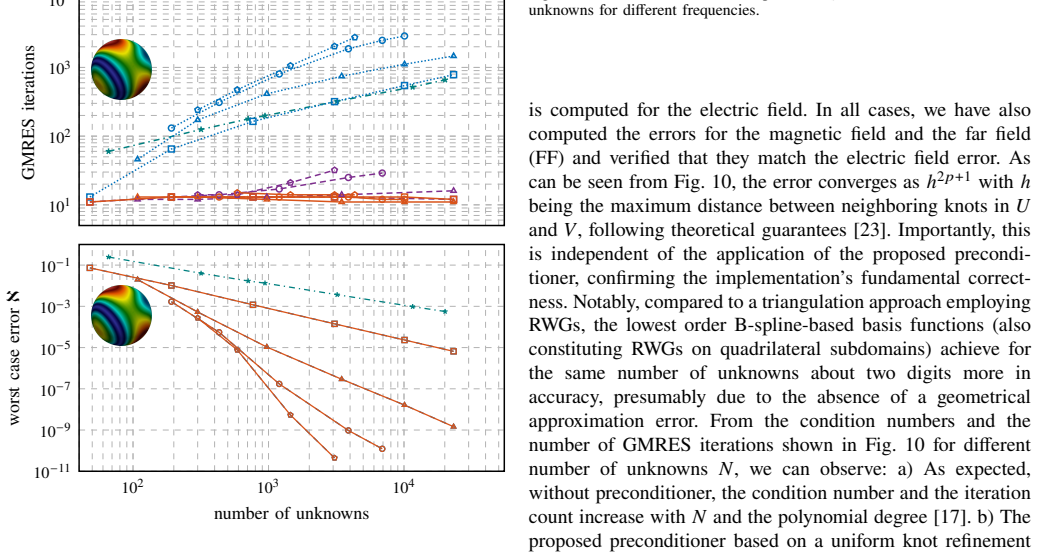
- Fig. 9 caption: the RWG triangulation is said to use 8100 functions; confirming that the same number is used for every p_uv would make the accuracy comparison more transparent.
Circularity Check
No significant circularity: dual-basis construction is explicit and independent of the numerical confirmation of constant GMRES iterations.
specific steps
-
self citation load bearing
[§III-A (primal basis) and §III-D (properties iii)]
"we choose the same divergence conforming basis functions as introduced in [4], since we can leverage the loop-star decomposition of [4] and its specific graph properties. ... the relations TΦ,k Λ=0, ΛT TΦ,k=0, ... holding for the primal basis carry over to eTΦ,˜k Σ=0, ΣT eTΦ,˜k=0 ... for the dual basis"
The dual-basis construction and the proof that property (iii) holds rely on the loop-star matrices and graph properties previously defined by the same authors. Those prior results are used as established tools rather than as circular definitions of the dual basis itself, so the circularity is minor and not load-bearing for the central claim of constant GMRES iterations.
full rationale
The paper constructs an explicit higher-order dual basis by linear combination of refined B-spline functions on a non-uniformly refined Greville mesh (Eqs. 18–33, Figs. 2–5), then verifies the three required properties (divergence conformity, well-conditioned Gram matrix, vanishing dual-primal scalar-potential product) from that construction and the interchange of loop/star roles (§III-B,D). The subsequent numerical results (§IV) are independent confirmation that the resulting Calderón-preconditioned system yields low, essentially constant GMRES iteration counts. Self-citations to the authors’ prior B-spline EFIE and loop-star work ([4] and related) supply the primal space and mapping matrices as established tools; they do not define the dual basis or force the iteration-count claim by construction. The only mild self-referential element is the non-uniform knot-shift rule (Eqs. 26–33), whose sufficiency for bounded Gram conditioning is shown only numerically (Figs. 7–8); that is a weakest-assumption issue, not a circular reduction of a claimed prediction to its inputs. Score 1 reflects ordinary, non-load-bearing self-citation of prior tools.
Axiom & Free-Parameter Ledger
free parameters (2)
- clipping parameter a in μ_a =
a = p_u/(2N_u-1-p_u)
- mean-curvature value H used in complexified dual wavenumber =
0.5 m^{-1}
axioms (3)
- domain assumption Calderón identity T_k^{2} = -I/4 + K^{2} holds for the continuous EFIE operator on Lipschitz surfaces.
- domain assumption The B-spline primal basis of Hofmann et al. (2024) admits a discrete loop-star decomposition associated with the Greville mesh.
- ad hoc to paper Linear combinations of refined Curry-Schoenberg B-splines with coefficients in {1,1/2} (plus corner weights) remain divergence-conforming and produce a well-conditioned mixed Gram matrix under the proposed non-uniform refinement.
invented entities (1)
-
explicit higher-order dual B-spline basis (generalized Buffa-Christiansen functions)
no independent evidence
read the original abstract
One of the most effective means to precondition the electric field integral equation (EFIE) discretized with Rao-Wilton-Glisson (RWG) functions is the multiplicative Calder\'on preconditioner employing Buffa-Christiansen (BC) functions as a basis dual to the RWG basis. It results in a formulation that is free from the dense-discretization and the low-frequency breakdown. To generalize the multiplicative Calder\'on preconditioner from the low-order BC and RWG basis to higher orders, we utilize B-spline-based basis functions and establish the first explicit high-order dual basis. It can be regarded as a generalization of the BC functions to arbitrary polynomial degrees and constitutes a fundamental building block for other approaches that rely on a dual basis. Numerical results for the obtained preconditioner demonstrate a low and constant number of generalized minimum residual (GMRES) iterations independent of the number of unknonws and the polynomial degree for canonical and realistic perfectly electrically conducting (PEC) scatterers; a key to enable the full potential of higher-order bases.
Figures




Reference graph
Works this paper leans on
-
[1]
Zur Formulierung eines allgemeinen Beugungsproblems durch eine Integralgleichung,
A.-W. Maue, “Zur Formulierung eines allgemeinen Beugungsproblems durch eine Integralgleichung,”Zeitschrift Phys., vol. 126, pp. 601–618, Jul. 1949
1949
-
[2]
Galerkin boundary element methods for electromagnetic scattering,
A. Buffa and R. Hiptmair, “Galerkin boundary element methods for electromagnetic scattering,” inTopics in Computational Wave Propa- gation, M. Ainsworth, P. Davies, D. Duncan, B. Rynne, and P. Martin, Eds., ed. by T. J. Barth, M. Griebel, D. E. Keyes, R. M. Nieminen, D. Roose, and T. Schlick, vol. 31, Berlin, Heidelberg: Springer Berlin Heidelberg, 2003, ...
2003
-
[3]
On a well-conditioned electric field integral operator for multiply connected geometries,
F. P. Andriulli, K. Cools, I. Bogaert, and E. Michielssen, “On a well-conditioned electric field integral operator for multiply connected geometries,”IEEE Trans. Antennas Propag., vol. 61, no. 4, pp. 2077– 2087, Apr. 2013
2077
-
[4]
Low-frequency stabilization for the B-spline-based isogeometric discretization of the electric field integral equation,
B. Hofmann, M. Mirmohammadsadeghi, T. F. Eibert, F. P. Andriulli, and S. B. Adrian, “Low-frequency stabilization for the B-spline-based isogeometric discretization of the electric field integral equation,”IEEE Trans. Antennas Propag., vol. 72, no. 4, pp. 3558–3571, Apr. 2024
2024
-
[5]
An excitation-aware and self-adaptive frequency normalization for low- frequencystabilizedelectricfieldintegralequationformulations,
B. Hofmann, T. F. Eibert, F. P. Andriulli, and S. B. Adrian, “An excitation-aware and self-adaptive frequency normalization for low- frequencystabilizedelectricfieldintegralequationformulations,”IEEE Trans. Antennas Propag., vol. 71, no. 5, pp. 4301–4314, May 2023
2023
-
[6]
A low-frequency stable, excitation agnostic discretization of the right- hand side for the electric field integral equation on multiply-connected geometries,
B. Hofmann, T. F. Eibert, F. P. Andriulli, and S. B. Adrian, “A low-frequency stable, excitation agnostic discretization of the right- hand side for the electric field integral equation on multiply-connected geometries,”IEEE Trans. Antennas Propag., vol. 71, no. 12, pp. 9277– 9288, Dec. 2023
2023
-
[7]
The construction of some efficient preconditioners in the boundary element method,
O. Steinbach and W. Wendland, “The construction of some efficient preconditioners in the boundary element method,”Advances in Com- putational Mathematics, vol. 9, no. 1, pp. 191–216, Sep. 1, 1998
1998
-
[8]
Operator preconditioning,
R. Hiptmair, “Operator preconditioning,”Comp. Math. Appl., vol. 52, no. 5, pp. 699–706, Sep. 1, 2006
2006
-
[9]
A dual finite element complex on the barycentric refinement,
A. Buffa and S. Christiansen, “A dual finite element complex on the barycentric refinement,”Math. Comp., vol. 76, no. 260, pp. 1743–1769, Oct. 2007
2007
-
[10]
A multiplicative Calderon preconditioner for the electric field integral equation,
F. P. Andriulli, K. Cools, H. Bagci, F. Olyslager, A. Buffa, S. Chris- tiansen, and E. Michielssen, “A multiplicative Calderon preconditioner for the electric field integral equation,”IEEE Trans. Antennas Propag., vol. 56, no. 8, pp. 2398–2412, Aug. 2008
2008
-
[11]
An introduction to operator precondition- ing for the fast iterative integral equation solution of time-harmonic scattering problems,
X. Antoine and M. Darbas, “An introduction to operator precondition- ing for the fast iterative integral equation solution of time-harmonic scattering problems,”Multiscale Sci. Eng., vol. 3, no. 1, pp. 1–35, Mar. 1, 2021
2021
-
[12]
Quadrilateral barycentric basis functions for surface integral equations,
R. Chang and V. Lomakin, “Quadrilateral barycentric basis functions for surface integral equations,”IEEE Trans. Antennas Propag., vol. 61, no. 12, pp. 6039–6050, Dec. 2013
2013
-
[13]
Electromagnetic scattering by surfaces of arbitrary shape,
S. Rao, D. Wilton, and A. Glisson, “Electromagnetic scattering by surfaces of arbitrary shape,”IEEE Trans. Antennas Propag., vol. 30, no. 3, pp. 409–418, May 1982
1982
-
[14]
Parametric mapping of vector basis functions for surface integral equation formulations,
A. F. Peterson and K. R. Aberegg, “Parametric mapping of vector basis functions for surface integral equation formulations,”Appl. Comput. Electromagn. Soc. J. ACES, pp. 107–115, 1995
1995
-
[15]
Higher order interpolatory vector bases for computational electromagnetics,
R. Graglia, D. Wilton, and A. Peterson, “Higher order interpolatory vector bases for computational electromagnetics,”IEEE Trans. Anten- nas Propag., vol. 45, no. 3, pp. 329–342, Mar. 1997
1997
-
[16]
A. F. Peterson,Mapped Vector Basis Functions for Electromagnetic Integral Equations. Morgan & Claypool Publishers, Dec. 2006
2006
-
[17]
High- order div- and quasi curl-conforming basis functions for Calderón multiplicative preconditioning of the EFIE,
F. Valdés, F. P. Andriulli, K. Cools, and E. Michielssen, “High- order div- and quasi curl-conforming basis functions for Calderón multiplicative preconditioning of the EFIE,”IEEE Trans. Antennas Propag., vol. 59, no. 4, pp. 1321–1337, Apr. 2011
2011
-
[18]
On a novel Calderón preconditioning strategy based on high-order quasi- Helmholtz projectors,
J. Bourhis, D. Franzo, A. Merlini, and F. P. Andriulli, “On a novel Calderón preconditioning strategy based on high-order quasi- Helmholtz projectors,” inProc. Int. Conf. Electromagn. Adv. Appl. (ICEAA), Sep. 2024, pp. 700–703
2024
-
[19]
Preconditioning strategies and conformal discretizations empowered by high-order projectors,
J. Bourhis, A. Merlini, and F. P. Andriulli, “Preconditioning strategies and conformal discretizations empowered by high-order projectors,” in URSI Int. Symp. Electrom. Theory (EMTS), Jun. 2025, pp. 1–4
2025
-
[20]
Subdivision based isogeometric analysis technique for electric field integral equations for simply connected structures,
J. Li, D. Dault, B. Liu, Y. Tong, and B. Shanker, “Subdivision based isogeometric analysis technique for electric field integral equations for simply connected structures,”J. Comput. Phys., vol. 319, pp. 145–162, Aug. 15, 2016
2016
-
[21]
Mathematical analysis of variational isogeometric methods,
L. B. Veiga, A. Buffa, G. Sangalli, and R. Vázquez, “Mathematical analysis of variational isogeometric methods,”Acta Numer., vol. 23, pp. 157–287, May 2014
2014
-
[22]
An isogeometric boundary element method for electromagnetic scattering with compat- ible B-spline discretizations,
R. N. Simpson, Z. Liu, R. Vázquez, and J. A. Evans, “An isogeometric boundary element method for electromagnetic scattering with compat- ible B-spline discretizations,”J. Comp. Physics, vol. 362, pp. 264–289, Jun. 1, 2018
2018
-
[23]
J. Dölz, S. Kurz, S. Schöps, and F. Wolf, “Isogeometric boundary elements in electromagnetism: Rigorous analysis, fast methods, and HOFMANNet al.: AN EXPLICIT HIGHER-ORDER DUAL BASIS FOR A MULTIPLICATIVELY CALDERÓN PRECONDITIONED EFIE 13 examples,”SIAM J. Sci. Comput., vol. 41, no. 5, B983–B1010, Jan. 2019
2019
-
[24]
A mixed finite element method for 2-nd order elliptic problems,
P. A. Raviart and J. M. Thomas, “A mixed finite element method for 2-nd order elliptic problems,” inMathematical Aspects of Finite Element Methods, I. Galligani and E. Magenes, Eds., ser. Lecture Notes in Mathematics, Berlin, Heidelberg: Springer, 1977, pp. 292–315
1977
-
[25]
Isogeometric analysis: CAD, finite elements, NURBS, exact geometry and mesh refinement,
T. J. R. Hughes, J. A. Cottrell, and Y. Bazilevs, “Isogeometric analysis: CAD, finite elements, NURBS, exact geometry and mesh refinement,” Comput. Methods Appl. Mech. Eng., vol. 194, no. 39, pp. 4135–4195, Oct. 1, 2005
2005
-
[26]
A multiplicative Calderón preconditioner for the B-spline-based electric field integral equation,
B. Hofmann, T. F. Eibert, F. P. Andriulli, and S. B. Adrian, “A multiplicative Calderón preconditioner for the B-spline-based electric field integral equation,” inProc. Int. Conf. Electromagn. Adv. Appl. (ICEAA), Lisbon, Portugal, Sep. 2024
2024
-
[27]
B- spline-based higher-order discretization of the magnetic field integral equation,
B. Hofmann, T. F. Eibert, F. P. Andriulli, and S. B. Adrian, “B- spline-based higher-order discretization of the magnetic field integral equation,”inProc.KleinheubacherTagung,Miltenberg,Germany,Sep. 2024
2024
-
[28]
H-field, E-field, and combined- field solutions for conducting bodies of revolution,
J. R. Mautz and R. F. Harrington, “H-field, E-field, and combined- field solutions for conducting bodies of revolution,”Int. J. Electron. Commun., vol. 32, pp. 157–164, Apr. 1978
1978
-
[29]
Electromagnetic integral equations: Insights in conditioning and pre- conditioning,
S. B. Adrian, A. Dély, D. Consoli, A. Merlini, and F. P. Andriulli, “Electromagnetic integral equations: Insights in conditioning and pre- conditioning,”IEEE Open J. Antennas Propag., pp. 1143–1174, Oct. 2021
2021
-
[30]
Magnetic and combined field integral equations based on the quasi- Helmholtz projectors,
A. Merlini, Y. Beghein, K. Cools, E. Michielssen, and F. P. Andriulli, “Magnetic and combined field integral equations based on the quasi- Helmholtz projectors,”IEEE Trans. Antennas Propag., vol. 68, no. 5, pp. 3834–3846, May 2020
2020
-
[31]
Préconditionneurs analytiques de type Calderón pour les formulations intégrales des problèmes de diffraction d’ondes,
M. Darbas, “Préconditionneurs analytiques de type Calderón pour les formulations intégrales des problèmes de diffraction d’ondes,” Département de Génie Mathématique, Nat. Inst. Appl. Sci. Toulouse, Toulouse, France, 2004
2004
-
[32]
Well-conditioned boundary integral equa- tion formulations for the solution of high-frequency electromagnetic scattering problems,
Y. Boubendir and C. Turc, “Well-conditioned boundary integral equa- tion formulations for the solution of high-frequency electromagnetic scattering problems,”Computers & Mathematics with Applications, vol. 67, no. 10, pp. 1772–1805, Jun. 1, 2014
2014
-
[33]
Time do- main Calderón identities and their application to the integral equation analysis of scattering by PEC objects Part I: Preconditioning,
K. Cools, F. P. Andriulli, F. Olyslager, and E. Michielssen, “Time do- main Calderón identities and their application to the integral equation analysis of scattering by PEC objects Part I: Preconditioning,”IEEE Trans. Antennas Propag., vol. 57, no. 8, pp. 2352–2364, Aug. 2009
2009
-
[34]
de Boor,A Practical Guide to Splines(Applied Mathematical Sciences 27), 1st ed
C. de Boor,A Practical Guide to Splines(Applied Mathematical Sciences 27), 1st ed. New York, NY: Springer, Nov. 2001
2001
-
[35]
Isogeometric methods for computational electromagnetics: B-spline and T-spline discretizations,
A. Buffa, G. Sangalli, and R. Vázquez, “Isogeometric methods for computational electromagnetics: B-spline and T-spline discretizations,” J. Comput. Phys., Physics-compatible numerical methods, vol. 257, pp. 1291–1320, Jan. 15, 2014
2014
-
[36]
Piegl,The NURBS Book
L. Piegl,The NURBS Book. Berlin, Heidelberg: Springer Berlin Hei- delberg, 1995
1995
-
[37]
The adaptive cross approxi- mation algorithm for accelerated method of moments computations of EMC problems,
K. Zhao, M. Vouvakis, and J.-F. Lee, “The adaptive cross approxi- mation algorithm for accelerated method of moments computations of EMC problems,”IEEE Trans. Electromagn. Compat., vol. 47, no. 4, pp. 763–773, Nov. 2005
2005
-
[38]
W. C. Chew, J.-M. Jin, E. Michielssen, and J. Song,Fast and efficient algorithms in computational electromagnetics(Artech House antennas and propagation library). Boston: Artech House, 2001, 931 pp
2001
-
[39]
D. Jukić, B. Hofmann, T. F. Eibert, and S. B. Adrian, “A stabilized multilevel B-spline-based fast integral method for the solution of the electric field integral equation,” Jun. 11, 2026. arXiv: 2606.13482, pre-published
Pith/arXiv arXiv 2026
-
[40]
K. Cools, S. Adrian, and collaborators,BEAST.jl, version v2.9.0, Genève, Switzerland, Feb. 13, 2026. [Online]. Available: https://doi. org/10.5281/zenodo.3865279
-
[41]
Hofmann,NURBS.jl, version v0.8.0, Genève, Switzerland, Nov
B. Hofmann,NURBS.jl, version v0.8.0, Genève, Switzerland, Nov. 4,
-
[42]
Available: https://doi.org/10.5281/zenodo.14031791
[Online]. Available: https://doi.org/10.5281/zenodo.14031791
-
[43]
Quadrature forℎ 𝑝-Galerkin BEM in R3,
S. A. Sauter and C. Schwab, “Quadrature forℎ 𝑝-Galerkin BEM in R3,”Numer. Math., vol. 78, no. 2, pp. 211–258, Dec. 1997
1997
-
[44]
S. A. Sauter and C. Schwab,Boundary Element Methods. Berlin, Heidelberg: Springer Berlin Heidelberg, 2011
2011
-
[45]
Jin,Theory and Computation of Electromagnetic Fields, Second edition
J.-M. Jin,Theory and Computation of Electromagnetic Fields, Second edition. Hoboken, New Jersey: John Wiley & Sons, Inc, 2015
2015
-
[46]
SphericalScattering: A Julia package for electromagnetic scattering from spherical objects,
B. Hofmann, P. Respondek, and S. B. Adrian, “SphericalScattering: A Julia package for electromagnetic scattering from spherical objects,” J. Open Source Softw., vol. 8, no. 91, pp. 1–4, Nov. 2023
2023
-
[47]
Low- frequency-stabilized electric field integral equation on topologically non-trivial geometries for arbitrary excitations,
B. Hofmann, T. F. Eibert, F. P. Andriulli, and S. B. Adrian, “Low- frequency-stabilized electric field integral equation on topologically non-trivial geometries for arbitrary excitations,” inProc. IEEE Anten- nas Propag. Soc. Int. Symp. URSI Nat. Radio Sci. Meeting, Denver, CO, Jul. 2022
2022
-
[48]
A numerical comparison of an isogeometric and a parametric higher order Raviart–Thomas approach to the electric field integral equation,
J. Dölz, S. Kurz, S. Schöps, and F. Wolf, “A numerical comparison of an isogeometric and a parametric higher order Raviart–Thomas approach to the electric field integral equation,”IEEE Trans. Antennas Propag., vol. 68, no. 1, pp. 593–597, Jan. 2020
2020
-
[49]
Preconditioning the EFIE on screens,
R. Hiptmair and C. Urzúa-Torres, “Preconditioning the EFIE on screens,”Math. Models Methods Appl. Sci., vol. 30, no. 9, Sep. 2020
2020
discussion (0)
Sign in with ORCID, Apple, or X to comment. Anyone can read and Pith papers without signing in.