REVIEW 2 major objections 6 minor 35 references
A hierarchical hyperbolic embedding keeps both cross-view identity consistency and view-specific cues for aerial-ground person re-identification.
Reviewed by Pith at T0; open to challenge. T0 means a machine referee read the full paper against a public rubric. the ladder, T0–T4 →
T0 review · grok-4.5
2026-07-13 04:49 UTC pith:CNM5OB4J
load-bearing objection Solid AG-ReID methods paper: hierarchical Lorentz parent/child embeddings plus text-guided multi-layer fusion give consistent mAP gains; geometry is a design choice, not a proof. the 2 major comments →
HiHR: Hierarchical Hyperbolic Representation for Aerial-Ground Person Re-Identification
The pith
A machine-rendered reading of the paper's core claim, the machinery that carries it, and where it could break.
Core claim
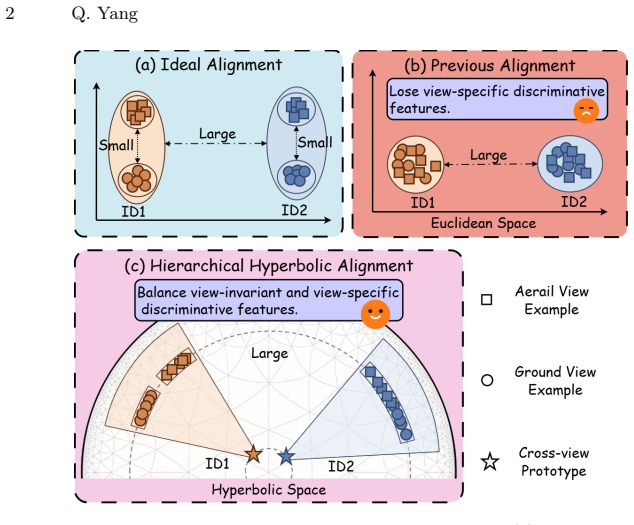
Direct cross-view alignment for aerial-ground person re-identification is suboptimal because it suppresses view-specific discriminative cues. By building hierarchical hyperbolic representations—coarse parent embeddings for identity separability and cross-view consistency, fine child embeddings for view-specific cues—regularized by Lorentz entailment constraints and supervised with mixed cross-view plus intra-view losses, the framework aggregates both kinds of features and improves retrieval.
What carries the argument
Hierarchical Hyperbolic Learning (HHL): view-agnostic fused features become scaled parent embeddings and view-aware fused features become farther child embeddings on a Lorentz manifold; four entailment-cone losses keep children inside parent cones and keep prompts and visuals consistent at each level.
Load-bearing premise
That casting view-agnostic features as hyperbolic parents and view-aware features as scaled children, then forcing children inside parent cones, is a faithful model of aerial-ground variation rather than an arbitrary regularizer.
What would settle it
On CARGO under the A→G protocol, train the identical multi-granularity backbone with and without the four entailment losses (or with parent and child roles swapped); if mAP does not fall when the cones are removed or inverted, the hierarchical geometry claim fails.
If this is right
- Preserving view-specific cues instead of erasing them can raise mean average precision on aerial-to-ground and ground-to-aerial protocols.
- Hyperbolic space can host multi-granularity person features as a true hierarchy rather than a single flat embedding.
- Text-guided fusion of intermediate Transformer layers supplies mid-level structure that global-only features miss.
- Full-list ranking quality (mAP) improves when hierarchy prevents cross-view feature collapse.
- The same coarse-to-fine hyperbolic pattern is offered as a template for other heterogeneous camera networks.
Where Pith is reading between the lines
- Entailment cones may also suit other ReID settings where attributes form natural hierarchies such as clothing, pose, or time of day.
- Because curvature and scale factors are learned end-to-end, similar hierarchies could be discovered for multi-modal retrieval without hand-assigned parent and child roles.
- Aerial-ground gaps resemble other domain gaps (day-night, RGB-infrared); hierarchical hyperbolic alignment might reduce the need for synthetic view translation.
- Practitioners could replace pure contrastive alignment losses with parent-child cone constraints whenever two views are systematically asymmetric.
Editorial analysis
A structured set of objections, weighed in public.
Referee Report
Summary. The paper proposes HiHR for Aerial-Ground Person Re-Identification. It extracts multi-granularity visual features from CLIP Transformer layers together with dual-level view-agnostic and view-aware text prompts, fuses them via Text-guided Multi-granularity Fusion (TMF), and embeds the fused features into a Lorentz hyperbolic hierarchy via Hierarchical Hyperbolic Learning (HHL). Parent (view-agnostic) embeddings are supervised for cross-view identity consistency; child (view-aware) embeddings are supervised within-view and constrained inside parent entailment cones (Eqs. 7–13, §3.3). Inference concatenates the log-mapped parent and child features. Experiments on AG-ReID v1/v2, LAGPeR, and CARGO report competitive or best mAP under most protocols, with ablations of TMF, HHL, losses, prompts, fusion, layers, and hyperparameters.
Significance. AG-ReID is practically relevant because real surveillance mixes aerial and ground platforms with large viewpoint gaps. The paper’s main contribution is architectural: it is, to the authors’ knowledge, the first use of hierarchical hyperbolic embeddings for cross-view person retrieval, and it explicitly tries to keep view-specific cues rather than only aligning view-invariant features. Strengths include a clear modular design (MFE/TMF/HHL), consistent mAP gains across four public benchmarks, component and hyperparameter ablations (Tables 4–7, Fig. 4), and a public code link. If the parent–child entailment construction is a useful inductive bias, the work offers a reusable template for heterogeneous-view ReID beyond pure Euclidean alignment.
major comments (2)
- §3.3, Eqs. (7)–(13) and the four entailment terms in Eq. (16): the central claim that HHL “preserves view-specific discriminative cues” while enforcing identity hierarchy rests on treating view-agnostic features as parents and view-aware features as scaled children inside Lorentz cones. Ablations (Tables 4–5) show the losses help, but there is no direct diagnostic that the geometry retains view-specific information rather than acting as a generic regularizer (e.g., no cone-membership / aperture statistics, no parent–child distance analysis, no controlled comparison that freezes hierarchy while removing hyperbolic geometry or vice versa). A short analysis or alternative Euclidean hierarchical baseline would make the inductive-bias claim load-bearing rather than inferred from end metrics.
- Tables 1–3: the paper claims “competitive or state-of-the-art” performance, yet Rank-1 is not uniformly best (e.g., CARGO ALL Rank-1 74.36 vs LATex 76.96; several AG-ReID v1/v2 Rank-1 entries trail LATex/ViSA). Results are single-run with no multi-seed means or error bars, so the mAP leadership—especially the smaller margins—cannot be assessed for significance. Reporting mean±std over seeds (or at least confirming single-run protocol) is needed for the SOTA claim to be fully supported.
minor comments (6)
- Fig. 4 caption/labeling is duplicated in the manuscript text (“Fig. 4: Ablation study…” then again “Fig. 4: Hyperparameter and layer-selection…”); clean the figure numbering and captions.
- §3.1–3.2: notation for selected layers {l1…lM}, class tokens C, and fused tokens sk is dense; a short symbol table or expanded description of how αk is reused for patch aggregation would help reproducibility.
- §4.2: free parameters (λe, λg / λg,intra, s1, s2, τ, k, layer set) are listed with defaults; briefly state whether curvature and scales are optimized jointly with the backbone or with a different learning rate.
- Related work §2.2 correctly notes limited prior hyperbolic ReID; a one-sentence contrast with non-hierarchical Poincaré/kernel baselines (Khrulkov et al., Fang et al.) on AG-ReID would sharpen novelty.
- Minor prose issues: “manyAG-ReIDmethods”, “theidealalignment”, and similar spacing typos in early pages; also fix “https: //github.com” spacing in the abstract.
- Inference (§3.4) concatenates log-mapped parent and child features after undoing scales; state the final feature dimension and whether any re-normalization is applied before cosine/Euclidean matching.
Circularity Check
No significant circularity: HiHR is an empirical method paper whose hierarchy, losses, and reported mAP/Rank-1 gains are design choices evaluated on external public AG-ReID splits, not algebraic restatements of the metrics.
full rationale
The paper proposes Multi-granularity Feature Extraction, Text-guided Multi-granularity Fusion, and Hierarchical Hyperbolic Learning (parent/child scale separation, Lorentz exp/log maps, four entailment regularizers, and level-specific CE+triplet objectives). These are inductive design choices, not definitions of the evaluation metrics. Training objective L (Eq. 16) combines Lg(gp), Lg,intra(gc), and weighted entailment terms; inference concatenates log-mapped parent and child features. Reported Rank-1 and mAP are computed on held-out official splits of AG-ReID v1/v2, LAGPeR, and CARGO against external baselines. Ablations (Tables 4–7, Fig. 4) vary modules, losses, prompts, fusion, layers, and hyperparameters and show empirical gains; none of those quantities is forced by construction from the inputs. Self-citations (e.g., SAS-VPReID, LATex, SD-ReID) appear as related AG-ReID baselines or prior work, not as uniqueness theorems that forbid alternatives or as load-bearing premises that define the present results. Hyperbolic geometry and entailment cones are imported from the broader literature and used as a regularizer; they do not tautologically produce the claimed retrieval numbers. Therefore the derivation chain is self-contained against external benchmarks and exhibits no self-definitional, fitted-as-prediction, or self-citation-forced circularity.
Axiom & Free-Parameter Ledger
free parameters (6)
- entailment weight λ_e =
5
- classification weights λ_g / λ_g,intra =
1.0 / 0.25
- parent/child scale factors (s1, s2) =
init (0.5, 2.0)
- curvature τ =
init 1.0
- cone aperture constant k =
0.1
- selected Transformer layers =
{5,8,12}
axioms (4)
- standard math Lorentz hyperbolic geometry with exponential/logarithmic maps and entailment cones is a valid embedding geometry for hierarchical visual features.
- domain assumption CLIP multi-layer visual tokens plus dual text prompts provide complementary multi-granularity identity cues for AG-ReID.
- ad hoc to paper View-agnostic features should be parents and view-aware features children in a coarse-to-fine hierarchy, with child embeddings constrained inside parent identity cones.
- ad hoc to paper Cross-view mixed sampling at the parent level and same-view sampling at the child level correctly separate view-invariant vs view-specific supervision.
invented entities (3)
-
Text-guided Multi-granularity Fusion (TMF)
no independent evidence
-
Hierarchical Hyperbolic Learning (HHL) parent-child structure
no independent evidence
-
Dual-level view-agnostic / view-aware prompts with [shared] and [view-private] tokens
no independent evidence
read the original abstract
Aerial-Ground Person Re-IDentification (AG-ReID) aims to retrieve the same person across heterogeneous aerial and ground camera platforms. Although great progress has been made, existing methods remain suboptimal due to the direct feature alignment across views, overlooking view-specific cues. To address this issue, we propose a novel Hierarchical Hyperbolic Representation (HiHR) framework for AG-ReID. More specifically, we first extract multi-granularity features based on pre-trained visual-text encoders. Then, we propose a Text-guided Multi-granularity Fusion (TMF) to fuse multi-granularity features and enhance the representation ability of identity features. Furthermore, we introduce the Hierarchical Hyperbolic Learning (HHL) to construct a hierarchical feature structure in a hyperbolic space. This hierarchy includes a coarse level that ensures identity separability and cross-view consistency, and a fine level that preserves view-specific discriminative cues. As a result, our proposed framework can effectively aggregate view-invariant and view-specific discriminative features for AG-ReID. Extensive experiments on four AG-ReID benchmarks demonstrate the effectiveness of our framework. The source code is available at https://github.com/YangQiWei3/HiHR.
Figures


Reference graph
Works this paper leans on
-
[1]
Flavors of geometry31(59-115), 2 (1997)
Cannon, J.W., Floyd, W.J., Kenyon, R., Parry, W.R., et al.: Hyperbolic geometry. Flavors of geometry31(59-115), 2 (1997)
1997
-
[2]
In: Proceedings of the IEEE/CVF International Conference on Computer Vision
Fang, P., Harandi, M., Petersson, L.: Kernel methods in hyperbolic spaces. In: Proceedings of the IEEE/CVF International Conference on Computer Vision. pp. 10665–10674 (2021)
2021
-
[3]
In: Proceedings of the IEEE/CVF International Conference on Computer Vision
Ha, R., Jiang, S., Li, B., Pan, B., Zhu, Y., Zhang, J., Zhu, X., Gong, S., Wang, J.: Multi-modal multi-platform person re-identification: Benchmark and method. In: Proceedings of the IEEE/CVF International Conference on Computer Vision. pp. 10251–10261 (2025)
2025
-
[4]
arXiv preprint arXiv:1703.07737 (2017)
Hermans, A., Beyer, L., Leibe, B.: In defense of the triplet loss for person re- identification. arXiv preprint arXiv:1703.07737 (2017)
Pith/arXiv arXiv 2017
-
[5]
In: International Conference on Image and Graphics
Huang, Y., Chen, H., Feng, Z., Lai, J.: Perspective driven prototype alignment for aerial-ground person re-identification. In: International Conference on Image and Graphics. pp. 517–528. Springer (2025)
2025
-
[6]
In: Proceedings of the IEEE/CVF International Conference on Com- puter Vision
Huang, Z., Liu, X.: Generalizable object re-identification via visual in-context prompting. In: Proceedings of the IEEE/CVF International Conference on Com- puter Vision. pp. 22539–22550 (2025)
2025
-
[7]
In: Proceedings of the IEEE/CVF International Conference on Computer Vision
Khalid, W., Liu, B., Li, X., Waqas, M., Afgan, M.S.: Bridging the sky and ground: Towards view-invariant feature learning for aerial-ground person re-identification. In: Proceedings of the IEEE/CVF International Conference on Computer Vision. pp. 9749–9758 (2025)
2025
-
[8]
In: Proceedings of the IEEE/CVF Conference on Com- puter Vision and Pattern Recognition
Khrulkov, V., Mirvakhabova, L., Ustinova, E., Oseledets, I., Lempitsky, V.: Hyper- bolic image embeddings. In: Proceedings of the IEEE/CVF Conference on Com- puter Vision and Pattern Recognition. pp. 6418–6428 (2020)
2020
-
[9]
arXiv preprint arXiv:1412.6980 (2014)
Kingma, D.P., Ba, J.: Adam: A method for stochastic optimization. arXiv preprint arXiv:1412.6980 (2014)
Pith/arXiv arXiv 2014
-
[10]
Springer Science & Business Media (2006)
Lee, J.M.: Riemannian manifolds: an introduction to curvature. Springer Science & Business Media (2006)
2006
-
[11]
Advances in Neural Information Processing Systems38, 93785–93805 (2026)
Li, Q., Li, J., Zhang, Y., Tan, L., Chen, J., Ji, J.: Gsalign: Geometric and semantic alignment network for aerial-ground person re-identification. Advances in Neural Information Processing Systems38, 93785–93805 (2026)
2026
-
[12]
In: Proceedings of the AAAI Conference on Artificial Intelligence
Li, S., Sun, L., Li, Q.: Clip-reid: exploiting vision-language model for image re- identification without concrete text labels. In: Proceedings of the AAAI Conference on Artificial Intelligence. vol. 37, pp. 1405–1413 (2023)
2023
-
[13]
ACM Transactions on Multimedia Computing, Communications and Applications22(3), 1–19 (2026)
Mao, D., Teng, S., Lyu, X.: Cvaf: A clip-based view-consistent alignment frame- work for aerial-ground person re-identification. ACM Transactions on Multimedia Computing, Communications and Applications22(3), 1–19 (2026)
2026
-
[14]
In: IEEE International Conference on Multimedia and Expo
Nguyen, H., Nguyen, K., Sridharan, S., Fookes, C.: Aerial-ground person re-id. In: IEEE International Conference on Multimedia and Expo. pp. 2585–2590 (2023)
2023
-
[15]
v2: Bridging aerial and ground views for person re-identification
Nguyen, H., Nguyen, K., Sridharan, S., Fookes, C.: Ag-reid. v2: Bridging aerial and ground views for person re-identification. IEEE Transactions on Information Forensics and Security19, 2896–2908 (2024)
2024
-
[16]
In: IEEE International Joint Conference on Bio- metrics
Nguyen, K., Fookes, C., Sridharan, S., Liu, F., Liu, X., Ross, A., Michalski, D., Nguyen, H., Deb, D., Kothari, M., et al.: Ag-reid 2023: Aerial-ground person re- identification challenge results. In: IEEE International Joint Conference on Bio- metrics. pp. 1–10 (2023)
2023
-
[17]
Yang models
Pal, A., Van Spengler, M., D’Amely di Melendugno, G., Flaborea, A., Galasso, F., Mettes, P.: Compositional entailment learning for hyperbolic vision-language 16 Q. Yang models. In: International Conference on Learning Representations. vol. 2025, pp. 87371–87399 (2025)
2025
-
[18]
In: International Conference on Machine Learning
Radford, A., Kim, J.W., Hallacy, C., Ramesh, A., Goh, G., Agarwal, S., Sastry, G., Askell, A., Mishkin, P., Clark, J., et al.: Learning transferable visual models from natural language supervision. In: International Conference on Machine Learning. pp. 8748–8763 (2021)
2021
-
[19]
In: Proceedings of the IEEE Conference on Computer Vision and Pattern Recognition
Szegedy, C., Vanhoucke, V., Ioffe, S., Shlens, J., Wojna, Z.: Rethinking the incep- tion architecture for computer vision. In: Proceedings of the IEEE Conference on Computer Vision and Pattern Recognition. pp. 2818–2826 (2016)
2016
-
[20]
In: Proceedings of the IEEE/CVF Conference on Computer Vision and Pattern Recognition
Wang, S., Wang, Y., Wu, R., Jiao, B., Wang, W., Wang, P.: Secap: self-calibrating and adaptive prompts for cross-view person re-identification in aerial-ground net- works. In: Proceedings of the IEEE/CVF Conference on Computer Vision and Pattern Recognition. pp. 22119–22128 (2025)
2025
-
[21]
IEEETransactions on Circuitsand Systems for Video Technology pp
Wang, Y., Zhang, P., Sun, C., Wang, D., Lu, H.: What makes you unique? attribute prompt composition forobject re-identification. IEEETransactions on Circuitsand Systems for Video Technology pp. 3173–3184 (2025)
2025
-
[22]
Computer Vision and Image Understanding244, 104030 (2024)
Wang, Y., Zhang, P., Wang, D., Lu, H.: Other tokens matter: Exploring global and local features of vision transformers for object re-identification. Computer Vision and Image Understanding244, 104030 (2024)
2024
-
[23]
arXiv preprint arXiv:2412.00433 (2024)
Wang, Y., Pishgar, M.: Dynamic token selection for aerial-ground person re- identification. arXiv preprint arXiv:2412.00433 (2024)
Pith/arXiv arXiv 2024
-
[24]
IEEE Transactions on Image Processing 35, 5686–5697 (2026)
Wang, Y., Hu, X., Wang, L., Zhang, P., Lu, H.: Sd-reid: View-aware stable diffusion for aerial-ground person re-identification. IEEE Transactions on Image Processing 35, 5686–5697 (2026)
2026
-
[25]
In: Proceedings of the AAAI Con- ference on Artificial Intelligence
Wang, Y., Liu, Y., Zheng, A., Zhang, P.: Decoupled feature-based mixture of ex- perts for multi-modal object re-identification. In: Proceedings of the AAAI Con- ference on Artificial Intelligence. vol. 39, pp. 8141–8149 (2025)
2025
-
[26]
In: Proceedings of the IEEE/CVF Conference on Computer Vision and Pattern Recognition
Wang, Y., Lv, Y., Zhang, P., Lu, H.: Idea: Inverted text with cooperative de- formable aggregation for multi-modal object re-identification. In: Proceedings of the IEEE/CVF Conference on Computer Vision and Pattern Recognition. pp. 29701–29710 (2025)
2025
-
[27]
IEEE Trans- actions on Intelligent Transportation Systems pp
Wang, Y., Zhang, P., Liu, X., Tu, Z., Lu, H.: Unity is strength: Unifying convolu- tional and transformeral features for better person re-identification. IEEE Trans- actions on Intelligent Transportation Systems pp. 3713–3723 (2025)
2025
-
[28]
Visual Intelligence1(1), 24 (2023)
Yan, P., Liu, X., Zhang, P., Lu, H.: Learning convolutional multi-level transformers for image-based person re-identification. Visual Intelligence1(1), 24 (2023)
2023
-
[29]
In: Proceedings of the IEEE/CVF Winter Conference on Applications of Computer Vision Workshops
Yang, Q., Zhang, P., Wang, Y., Gong, Z.: Sas-vpreid: A scale-adaptive framework with shape priors for video-based person re-identification at extreme far distances. In: Proceedings of the IEEE/CVF Winter Conference on Applications of Computer Vision Workshops. pp. 1599–1608 (March 2026)
2026
-
[30]
arXiv preprint arXiv:2503.23722 (2025)
Zhang, P., Hu, X., Wang, Y., Lu, H.: Latex: Leveraging attribute-based text knowl- edge for aerial-ground person re-identification. arXiv preprint arXiv:2503.23722 (2025)
arXiv 2025
-
[31]
In: Proceedings of the IEEE/CVF Conference on Computer Vision and Pattern Recognition
Zhang, P., Wang, Y., Liu, Y., Tu, Z., Lu, H.: Magic tokens: Select diverse tokens for multi-modal object re-identification. In: Proceedings of the IEEE/CVF Conference on Computer Vision and Pattern Recognition. pp. 17117–17126 (2024)
2024
-
[32]
In: Proceedings of the IEEE/CVF Conference on Computer Vision and Pattern Recognition
Zhang, Q., Cai, Z., Zhao, P., Wu, J., Wu, C., Chen, H., Lai, J.: View-aware se- mantic alignment for aerial-ground person re-identification. In: Proceedings of the IEEE/CVF Conference on Computer Vision and Pattern Recognition. pp. 4383– 4392 (2026) HiHR: Hierarchical Hyperbolic Representation for AG-ReID 17
2026
-
[33]
In: Proceedings of the IEEE/CVF Conference on Computer Vision and Pattern Recognition
Zhang, Q., Wang, L., Patel, V.M., Xie, X., Lai, J.: View-decoupled transformer for person re-identification under aerial-ground camera network. In: Proceedings of the IEEE/CVF Conference on Computer Vision and Pattern Recognition. pp. 22000–22009 (2024)
2024
-
[34]
In: Proceedings of the IEEE/CVF Conference on Computer Vi- sion and Pattern Recognition
Zhou, K., Yang, J., Loy, C.C., Liu, Z.: Conditional prompt learning for vision- language models. In: Proceedings of the IEEE/CVF Conference on Computer Vi- sion and Pattern Recognition. pp. 16816–16825 (2022)
2022
-
[35]
In: Chinese Conference on Pattern Recognition and Computer Vision
Zhu, R., Chen, H., Xie, X., Lai, J.: Global-local prompts-driven semantic guid- ance for aerial-ground person re-identification. In: Chinese Conference on Pattern Recognition and Computer Vision. pp. 99–112. Springer (2025)
2025
discussion (0)
Sign in with ORCID, Apple, or X to comment. Anyone can read and Pith papers without signing in.