REVIEW 2 major objections 5 minor 65 references
Rigid object motion supplies enough lighting diversity to disentangle surface material from illumination better than a static multiview capture.
Reviewed by Pith at T0; open to challenge. T0 means a machine referee read the full paper against a public rubric. the ladder, T0–T4 →
T0 review · grok-4.5
2026-07-13 03:49 UTC pith:WSXDEPEY
load-bearing objection Clean empirical result: free rigid motion under one far-field light measurably beats static multiview for material-lighting decomposition, even with estimated poses. the 2 major comments →
Dynamic Inverse Rendering for Enhanced Material-Lighting Decomposition
The pith
A machine-rendered reading of the paper's core claim, the machinery that carries it, and where it could break.
Core claim
Observing a rigidly moving object from a stationary camera produces a richer set of surface-light interactions than a moving camera around a static object; those interactions are sufficient to drive materially more accurate albedo and lighting decomposition under a single far-field illumination model.
What carries the argument
A three-stage 4D inverse-rendering pipeline: progressive NeuS pose-and-geometry estimation, SDF-regularized 3D-Gaussian refinement of geometry and poses, then deferred physically based rendering of albedo and roughness under Gaussian ray-traced visibility, all optimized against the monocular video.
Load-bearing premise
The entire lighting field can be represented by one distant environment map plus simple one-bounce occlusion; near-field lights, hand shadows, or time-varying illumination would remove the claimed advantage of motion.
What would settle it
Capture the same physical object under identical real lighting once static (many viewpoints) and once under free hand-held rotation, then measure whether the hand-held albedo still scores higher on PSNR/SSIM/LPIPS against ground-truth material maps and produces more accurate novel-light renderings.
If this is right
- Casual hand-held smartphone videos become a practical capture protocol for relightable assets without multi-light rigs or large training priors.
- Inverse-rendering pipelines can trade expensive multi-environment hardware for accurate rigid pose tracking.
- The same motion-induced constraint should improve material recovery for any object that can be rotated in place under fixed far-field lighting.
- Turntable capture is shown to be an intermediate case: limited axial motion already helps, but full 6-DoF hand-held motion helps more.
Where Pith is reading between the lines
- If non-rigid deformation can be tracked as accurately as rigid motion, the same lighting-diversity argument should extend to cloth, faces, or soft objects.
- Explicit modelling of the holding hand as a dynamic occluder would likely enlarge the real-world gap between hand-held and static capture.
- The result suggests that view-count alone is a poor proxy for inverse-rendering quality; the diversity of incident lighting directions matters more.
Editorial analysis
A structured set of objections, weighed in public.
Referee Report
Summary. The paper claims that rigid object motion under a fixed far-field environment provides stronger surface-light interaction constraints than static multiview capture, yielding more accurate material-lighting decomposition for inverse rendering. It introduces a three-stage pipeline (progressive NeuS pose/geometry estimation, global SDF-augmented 3D-GS refinement, then PBR material + envmap optimization with Gaussian ray tracing) for monocular hand-held RGB sequences of general rigid objects. Controlled synthetic experiments on HOT3D-derived assets compare static-dome, turntable, and hand-held trajectories that share evaluation views; hand-held (even with estimated poses) outperforms static (with GT poses) on albedo and novel-light relighting for both original and diffuse material variants (Table 1). Real hand-held captures and ablations on roughness, illumination complexity, and view count support the claim under the stated far-field model.
Significance. If the result holds, the work supplies a practical, prior-light alternative to multi-illumination capture or heavy learned priors for material-lighting disentanglement, and it is immediately relevant to casual AR/relighting pipelines that already use hand-held video. Strengths include a clean experimental isolation of the motion effect (shared evaluation views, original vs. diffuse variants, GT vs. estimated poses), a new synthetic benchmark with ground-truth materials and relit views, and competitive static-setting numbers on TensoIR (Table 2). The pipeline also improves pose accuracy over FMOV on HO3D (Table 4). The contribution is empirical and systems-oriented rather than a new theoretical bound, but the controlled evidence is stronger than typical inverse-rendering papers that only show qualitative relights.
major comments (2)
- The central claim rests on a single far-field envmap + one-bounce 3DGRT visibility model (Eq. 2, Sec. 4.3). Real hand-held sequences necessarily include near-field hand occlusion and possible inter-reflections; the paper only qualitatively shows cleaner albedo (Fig. 4) and lists hand occlusion as future work. A quantitative stress test (e.g., synthetic hands or measured near-field lighting) is needed before the real-data claim can be considered fully supported.
- Table 1 reports that hand-held with estimated poses beats static with GT poses on albedo/relighting despite worse normals. The paper does not quantify residual pose error on the synthetic sequences themselves (only HO3D ATE/RPE in Table 4). Without that error distribution, it is hard to rule out that residual pose noise is partially absorbed into the material maps, inflating the apparent disentanglement gain.
minor comments (5)
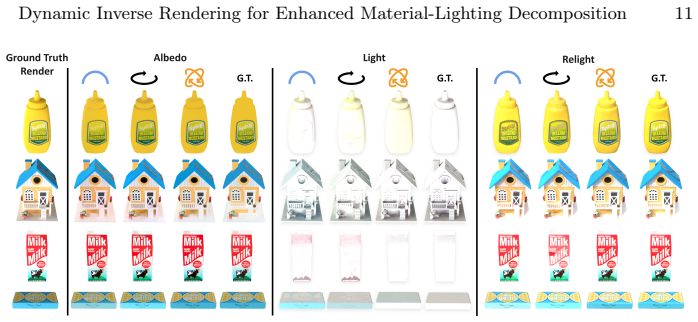
- Fig. 3 caption and surrounding text claim progressive disentanglement from left to right; the figure itself would benefit from an explicit column legend (static / turntable / hand-held) rather than relying solely on the progression narrative.
- Sec. 4.1 virtual-camera centering removes two translational DoFs; the text should state more clearly how the subsequent RANSAC-EPnP initialization recovers full 6-DoF poses and whether any residual bias remains.
- Loss weights and learning rates are listed only in the appendix; a short sensitivity statement (or fixed-seed reproducibility note) would strengthen confidence that the Table 1 ranking is not brittle to these free parameters.
- Notation for the positive clamping function in Eq. 3 is written as ()+; a standard max(0,·) or [·]+ would improve readability.
- The per-object tables (Tables 5–6) are useful but lengthy; a short summary of variance across objects in the main text would help readers assess robustness without flipping to the appendix.
Circularity Check
No significant circularity; the central claim is an empirical comparison of material accuracy under motion vs. static capture, evaluated against external ground-truth materials and novel lighting on a controlled synthetic dataset.
full rationale
The paper's load-bearing claim (motion yields significantly more accurate materials than static multiview) is not derived by construction from any fitted quantity or self-referential definition. It is tested by rendering HOT3D assets under three trajectories that share evaluation views (static dome / turntable / hand-held), with known GT albedo/roughness and novel-light images, then measuring PSNR/SSIM/LPIPS on recovered albedo and relights (Table 1, original and diffuse variants). Hand-held with estimated poses already beats static with GT poses; this is an external comparison, not a tautology. The rendering equation (Eq. 3) and far-field model (Eq. 2) motivate why pose diversity should add constraints, but the claim is not proved from them—it is measured. Pipeline stages (NeuS progressive tracking, SDF-Gaussians, PBR with 3DGRT) use standard losses and free hyperparameters that do not enter the reported metrics by definition. Citations (FMOV, NeuS, 3DGS, SVG-IR, etc.) supply components; none is a uniqueness theorem or ansatz from overlapping authors that forces the result. No self-definitional loop, fitted-input-as-prediction, or renaming of a known pattern appears. Score 0 is therefore the correct, non-manufactured outcome.
Axiom & Free-Parameter Ledger
free parameters (5)
- loss weights (eikonal, mask, match, normal, variance, rank, gamma, proj, light, material)
- learning rates for pose MLPs, materials, environment map
- environment-map progressive resolution schedule (16x32 to 1024x2048)
- number of Fibonacci samples (512) and BRDF/light importance samples
- SDF opacity temperature gamma and material sigmoid temperature
axioms (4)
- domain assumption Environment illumination is distant (far-field) and constant over time, representable by a single environment map.
- domain assumption Objects are rigid (SE(3) motion only) and dielectric with fixed F0=0.04.
- domain assumption One-bounce Gaussian ray-tracing plus split-sum approximation is sufficient for visibility and indirect illumination.
- ad hoc to paper Progressive sequential NeuS optimization followed by global 3D-GS refinement yields poses accurate enough for inverse rendering.
read the original abstract
Decomposing outgoing surface radiance into material and illumination during inverse rendering is essential for applications such as relighting and augmented reality, yet it is severely ill-posed since multiple combinations can result in the same observed colour. Capturing an object under multiple lighting conditions usually helps resolve this ambiguity as it constrains the optimization towards correct solutions. In this work, we explore the potential of reconstructing rigidly moving objects -- which provides observations of diverse light-surface interactions -- to resolve the material-lighting ambiguity in inverse rendering. For this purpose, we introduce a relightable approach that marries object tracking and reconstruction with inverse rendering for general rigidly moving objects. Our experimental analysis on synthetic data demonstrates that motion can be an advantage for disentangling material and lighting: the reconstructed material is significantly more accurate when the object is observed under rigid motion than when it is static. Moreover, results on RGB videos of real hand-held objects show that our pipeline preserves this advantage even under noisy real-world conditions.
Figures




Reference graph
Works this paper leans on
-
[1]
In: IEEE/CVF Conference on Computer Vision and Pattern Recognition (CVPR)
Alzayer, H., Henzler, P., Barron, J.T., Huang, J.B., Srinivasan, P.P., Verbin, D.: Generative multiview relighting for 3d reconstruction under extreme illumination variation. In: IEEE/CVF Conference on Computer Vision and Pattern Recognition (CVPR). pp. 10933–10942 (June 2025)
2025
-
[2]
In: IEEE/CVF Conference on Computer Vision and Pattern Recognition (CVPR)
Banerjee, P., Shkodrani, S., Moulon, P., Hampali, S., Han, S., Zhang, F., Zhang, L., Fountain, J., Miller, E., Basol, S., Newcombe, R., Wang, R., Engel, J.J., Hodan, T.: Hot3d: Hand and object tracking in 3d from egocentric multi-view videos. In: IEEE/CVF Conference on Computer Vision and Pattern Recognition (CVPR). pp. 7061–7071 (June 2025)
2025
-
[3]
In: IEEE/CVF International Conference on Computer Vision (ICCV)
Boss, M., Braun, R., Jampani, V., Barron, J.T., Liu, C., Lensch, H.: Nerd: Neu- ral reflectance decomposition from image collections. In: IEEE/CVF International Conference on Computer Vision (ICCV). pp. 12684–12694 (2021)
2021
-
[4]
Advances in Neural Information Processing Systems (NeurIPS)35, 26389–26403 (2022)
Boss, M., Engelhardt, A., Kar, A., Li, Y., Sun, D., Barron, J., Lensch, H., Jampani, V.: Samurai: Shape and material from unconstrained real-world arbitrary image collections. Advances in Neural Information Processing Systems (NeurIPS)35, 26389–26403 (2022)
2022
-
[5]
In: International Conference on Learning Representations (ICLR) (2026),https://openreview
Carion, N., Gustafson, L., Hu, Y.T., Debnath, S., Hu, R., Coll-Vinent, D.S., Ryali, C., Alwala, K.V., Khedr, H., Huang, A., Lei, J., Ma, T., Guo, B., Kalla, A., Marks, M., Greer, J., Wang, M., Sun, P., Rädle, R., Afouras, T., Mavroudi, E., Xu, K., Wu, T.H., Zhou, Y., Momeni, L., HAZRA, R., Ding, S., Vaze, S., Porcher, F., Li, F., Li, S., Kamath, A., Cheng...
2026
-
[6]
In: European Conference on Computer Vision (ECCV) (2022)
Chen, A., Xu, Z., Geiger, A., Yu, J., Su, H.: Tensorf: Tensorial radiance fields. In: European Conference on Computer Vision (ECCV) (2022)
2022
-
[7]
In: European Conference on Computer Vision (ECCV)
Chen, X., Peng, S., Yang, D., Liu, Y., Pan, B., Lv, C., Zhou, X.: Intrinsicanything: Learning diffusion priors for inverse rendering under unknown illumination. In: European Conference on Computer Vision (ECCV). p. 450–467. Springer-Verlag, Berlin, Heidelberg (2024).https://doi.org/10.1007/978-3-031-73027-6_26, https://doi.org/10.1007/978-3-031-73027-6_26
-
[8]
In: IEEE/CVF International Conference on Computer Vision (ICCV) (2025)
Chen, Z., Potamias, R.A., Chen, S., Schmid, C.: HORT: Monocular hand-held objects reconstruction with transformers. In: IEEE/CVF International Conference on Computer Vision (ICCV) (2025)
2025
-
[9]
Advances in Neural Information Processing Systems (NeurIPS)37, 121765–121789 (2024)
Dihlmann, J.N., Majumdar, A., Engelhardt, A., Braun, R., Lensch, H.: Subsur- face scattering for gaussian splatting. Advances in Neural Information Processing Systems (NeurIPS)37, 121765–121789 (2024)
2024
-
[10]
Edstedt, J., Nordström, D., Zhang, Y., Bökman, G., Astermark, J., Larsson, V., Heyden, A., Kahl, F., Wadenbäck, M., Felsberg, M.: Roma v2: Harder better faster denser feature matching (2025),https://arxiv.org/abs/2511.15706
Pith/arXiv arXiv 2025
-
[11]
In: IEEE/CVF Conference on Computer Vision and Pattern Recognition (CVPR)
Engelhardt, A., Raj, A., Boss, M., Zhang, Y., Kar, A., Li, Y., Sun, D., Brualla, R.M., Barron, J.T., Lensch, H., et al.: Shinobi: Shape and illumination using neural object decomposition via brdf optimization in-the-wild. In: IEEE/CVF Conference on Computer Vision and Pattern Recognition (CVPR). pp. 19636–19646 (2024)
2024
-
[12]
In: IEEE/CVF Conference on Computer Vision and Pattern Recogni- tion (CVPR)
Fan, Z., Parelli, M., Kadoglou, M.E., Chen, X., Kocabas, M., Black, M.J., Hilliges, O.: Hold: Category-agnostic 3d reconstruction of interacting hands and objects from video. In: IEEE/CVF Conference on Computer Vision and Pattern Recogni- tion (CVPR). pp. 494–504 (2024) Dynamic Inverse Rendering for Enhanced Material-Lighting Decomposition 17
2024
-
[13]
In: IEEE/CVF Conference on Computer Vision and Pattern Recognition (CVPR)
Fei, F., Tang, J., Tan, P., Shi, B.: Vminer: Versatile multi-view inverse rendering with near- and far-field light sources. In: IEEE/CVF Conference on Computer Vision and Pattern Recognition (CVPR). pp. 11800–11809 (June 2024)
2024
-
[14]
In: IEEE/CVF International Con- ference on Computer Vision (ICCV)
Fischer, T., Zhang, X., Ilg, E.: Unified category-level object detection and pose es- timation from rgb images using 3d prototypes. In: IEEE/CVF International Con- ference on Computer Vision (ICCV). pp. 9790–9800 (2025)
2025
-
[15]
In: CVPR
Fu, Y., Wang, X., Liu, S., Kulkarni, A., Kautz, J., Efros, A.A.: Colmap-free 3d gaussian splatting. In: CVPR. pp. 20796–20805. IEEE (2024)
2024
-
[16]
In: Leonardis, A., Ricci, E., Roth, S., Russakovsky, O., Sattler, T., Varol, G
Gao, J., Gu, C., Lin, Y., Li, Z., Zhu, H., Cao, X., Zhang, L., Yao, Y.: Relightable 3d gaussians: Realistic point cloud relighting with brdf decomposition and ray tracing. In: Leonardis, A., Ricci, E., Roth, S., Russakovsky, O., Sattler, T., Varol, G. (eds.) European Conference on Computer Vision (ECCV). pp. 73–89. Springer Nature Switzerland, Cham (2025)
2025
-
[17]
In: IEEE/CVF Conference on Computer Vision and Pattern Recognition (CVPR)
Gu, C., Wei, X., Zeng, Z., Yao, Y., Zhang, L.: Irgs: Inter-reflective gaussian splat- ting with 2d gaussian ray tracing. In: IEEE/CVF Conference on Computer Vision and Pattern Recognition (CVPR). pp. 10943–10952 (2025)
2025
-
[18]
In: IEEE/CVF Conference on Computer Vision and Pattern Recognition (CVPR)
Gu, C., Wei, X., Zhang, L., Zhu, X.: Tensoflow: Tensorial flow-based sampler for inverse rendering. In: IEEE/CVF Conference on Computer Vision and Pattern Recognition (CVPR). pp. 495–504 (2025)
2025
-
[19]
In: IEEE/CVF Conference on Computer Vision and Pattern Recognition (CVPR) (2020)
Hampali, S., Rad, M., Oberweger, M., Lepetit, V.: Honnotate: A method for 3d annotation of hand and object poses. In: IEEE/CVF Conference on Computer Vision and Pattern Recognition (CVPR) (2020)
2020
-
[20]
In: Koyejo, S., Mohamed, S., Agarwal, A., Belgrave, D., Cho, K., Oh, A
Hasselgren, J., Hofmann, N., Munkberg, J.: Shape, light, and material decom- position from images using monte carlo rendering and denoising. In: Koyejo, S., Mohamed, S., Agarwal, A., Belgrave, D., Cho, K., Oh, A. (eds.) Advances in Neu- ral Information Processing Systems (NeurIPS). vol. 35, pp. 22856–22869. Curran Associates, Inc. (2022),https://proceedin...
2022
-
[21]
Huang,B.,Yu,Z.,Chen,A.,Geiger,A.,Gao,S.:2dgaussiansplattingforgeometri- cally accurate radiance fields. In: ACM SIGGRAPH. SIGGRAPH ’24, Association for Computing Machinery, New York, NY, USA (2024).https://doi.org/10. 1145/3641519.3657428,https://doi.org/10.1145/3641519.3657428
-
[22]
In: Advances in Neural In- formation Processing Systems (NeurIPS) (2025)
Huang, M.H., Foo, L.G., Theobalt, C., Sun, Y., Soh, D.W.: Onlinesplatter: Pose- free online 3d reconstruction for free-moving objects. In: Advances in Neural In- formation Processing Systems (NeurIPS) (2025)
2025
-
[23]
In: NeurIPS (2024)
Hyung, J., Hong, S., Hwang, S., Lee, J., Choo, J., Kim, J.: Effective rank analysis and regularization for enhanced 3d gaussian splatting. In: NeurIPS (2024)
2024
-
[24]
In: IEEE/CVF Conference on Computer Vision and Pattern Recognition (CVPR)
Jiang, Y., Tu, J., Liu, Y., Gao, X., Long, X., Wang, W., Ma, Y.: Gaussianshader: 3d gaussian splatting with shading functions for reflective surfaces. In: IEEE/CVF Conference on Computer Vision and Pattern Recognition (CVPR). pp. 5322–5332 (2024)
2024
-
[25]
In: Proceedings of the IEEE/CVF Conference on Computer Vision and Pattern Recognition (CVPR)
Jin, H., Liu, I., Xu, P., Zhang, X., Han, S., Bi, S., Zhou, X., Xu, Z., Su, H.: Tensoir: Tensorial inverse rendering. In: Proceedings of the IEEE/CVF Conference on Computer Vision and Pattern Recognition (CVPR). pp. 165–174 (June 2023)
2023
-
[26]
In: IEEE/CVF International Conference on Computer Vision (ICCV)
Jin, Y., Prasad, V., Jauhri, S., Franzius, M., Chalvatzaki, G.: 6dope-gs: Online 6d object pose estimation using gaussian splatting. In: IEEE/CVF International Conference on Computer Vision (ICCV). pp. 8032–8043 (2025)
2025
-
[27]
ACM SIGGRAPH Computer Graphics 20(4), 143–150 (1986).https://doi.org/10.1145/15886.15902
Kajiya, J.T.: The rendering equation. ACM SIGGRAPH Computer Graphics 20(4), 143–150 (1986).https://doi.org/10.1145/15886.15902
-
[28]
Karis, B., Games, E.: Real shading in unreal engine 4. Proc. Physically Based Shading Theory Practice4(3), 1 (2013) 18 R. Yunus et al
2013
-
[29]
ACM Transactions on Graphics (ToG)42(4), 1–14 (2023)
Kerbl, B., Kopanas, G., Leimkühler, T., Drettakis, G.: 3d gaussian splatting for real-time radiance field rendering. ACM Transactions on Graphics (ToG)42(4), 1–14 (2023)
2023
-
[30]
ACM Transactions on Graphics (ToG)41(4), 1–12 (2022)
Kuang, Z., Olszewski, K., Chai, M., Huang, Z., Achlioptas, P., Tulyakov, S.: Neroic: Neural rendering of objects from online image collections. ACM Transactions on Graphics (ToG)41(4), 1–12 (2022)
2022
-
[31]
In: European Conference on Computer Vision (ECCV)
Leroy, V., Cabon, Y., Revaud, J.: Grounding image matching in 3d with mast3r. In: European Conference on Computer Vision (ECCV). p. 71–91. Springer-Verlag, Berlin, Heidelberg (2024).https://doi.org/10.1007/978- 3- 031- 73220- 1_5, https://doi.org/10.1007/978-3-031-73220-1_5
doi:10.1007/978- 2024
-
[32]
Li, J., Wang, L., Zhang, L., Wang, B.: Tensosdf: Roughness-aware tensorial representation for robust geometry and material reconstruction. ACM Transac- tions on Graphics (ToG)43(4) (Jul 2024).https://doi.org/10.1145/3658211, https://doi.org/10.1145/3658211
-
[33]
In: IEEE/CVF Conference on Computer Vision and Pattern Recognition (CVPR)
Li, J., Wu, Z., Zamfir, E., Timofte, R.: Recap: Better gaussian relighting with cross-environment captures. In: IEEE/CVF Conference on Computer Vision and Pattern Recognition (CVPR). pp. 21307–21316 (June 2025)
2025
-
[34]
In: IEEE/CVF Conference on Computer Vision and Pattern Recognition (CVPR)
Liang, Z., Zhang, Q., Feng, Y., Shan, Y., Jia, K.: Gs-ir: 3d gaussian splatting for inverse rendering. In: IEEE/CVF Conference on Computer Vision and Pattern Recognition (CVPR). pp. 21644–21653 (2024)
2024
-
[35]
ACM Transactions on Graphics (ToG)42(4), 1–22 (2023)
Liu, Y., Wang, P., Lin, C., Long, X., Wang, J., Liu, L., Komura, T., Wang, W.: Nero: Neural geometry and brdf reconstruction of reflective objects from multiview images. ACM Transactions on Graphics (ToG)42(4), 1–22 (2023)
2023
-
[36]
Lyu, L., Tewari, A., Habermann, M., Saito, S., Zollhöfer, M., Leimkühler, T., Theobalt, C.: Diffusion posterior illumination for ambiguity-aware inverse render- ing. ACM Transactions on Graphics (ToG)42(6) (Dec 2023).https://doi.org/ 10.1145/3618357,https://doi.org/10.1145/3618357
-
[37]
In: Eu- ropean Conference on Computer Vision (ECCV) (2020)
Mildenhall, B., Srinivasan, P.P., Tancik, M., Barron, J.T., Ramamoorthi, R., Ng, R.: Nerf: Representing scenes as neural radiance fields for view synthesis. In: Eu- ropean Conference on Computer Vision (ECCV) (2020)
2020
-
[38]
ACM Transactions on Graphics (ToG)43(6) (Nov 2024).https://doi
Moenne-Loccoz, N., Mirzaei, A., Perel, O., de Lutio, R., Martinez Esturo, J., State, G., Fidler, S., Sharp, N., Gojcic, Z.: 3d gaussian ray tracing: Fast tracing of particle scenes. ACM Transactions on Graphics (ToG)43(6) (Nov 2024).https://doi. org/10.1145/3687934,https://doi.org/10.1145/3687934
doi:10.1145/3687934 2024
-
[39]
Müller,T.,Evans,A.,Schied,C.,Keller,A.:Instantneuralgraphicsprimitiveswith a multiresolution hash encoding. ACM Transactions on Graphics (ToG)41(4) (Jul 2022).https://doi.org/10.1145/3528223.3530127,https://doi.org/10.1145/ 3528223.3530127
-
[40]
MIT Press (2023)
Pharr, M., Jakob, W., Humphreys, G.: Physically based rendering: From theory to implementation. MIT Press (2023)
2023
-
[41]
Poirier-Ginter, Y., Gauthier, A., Phillip, J., Lalonde, J.F., Drettakis, G.: A diffusion approach to radiance field relighting using multi-illumination synthe- sis. Computer Graphics Forum43(4), e15147 (2024).https://doi.org/https: //doi.org/10.1111/cgf.15147,https://onlinelibrary.wiley.com/doi/abs/ 10.1111/cgf.15147
-
[42]
Pont, S.C., te Pas, S.F.: Material — illumination ambiguities and the perception of solid objects. Perception35(10), 1331–1350 (2006).https://doi.org/10.1068/ p5440,https://doi.org/10.1068/p5440, pMID: 17214380
-
[43]
In: Proceedings of the IEEE/CVF Conference on Computer Vision and Pattern Recognition
Ren, S., Wen, T., Fang, Y., Lu, B.: Fastgs: Training 3d gaussian splatting in 100 seconds. In: Proceedings of the IEEE/CVF Conference on Computer Vision and Pattern Recognition. pp. 26094–26103 (2026) Dynamic Inverse Rendering for Enhanced Material-Lighting Decomposition 19
2026
-
[44]
Shi, H., Hu, Y., Koguciuk, D., Lin, J.T., Salzmann, M., Ferstl, D.: Free-moving object reconstruction and pose estimation with virtual camera. AAAI Confer- ence on Artificial Intelligence39(7), 6860–6868 (Apr 2025).https://doi.org/ 10.1609/aaai.v39i7.32736,https://ojs.aaai.org/index.php/AAAI/article/ view/32736
-
[45]
In: IEEE/CVF Conference on Computer Vision and Pattern Recognition (CVPR)
Sun, H., Gao, Y., Xie, J., Yang, J., Wang, B.: Svg-ir: Spatially-varying gaussian splatting for inverse rendering. In: IEEE/CVF Conference on Computer Vision and Pattern Recognition (CVPR). pp. 16143–16152 (2025)
2025
-
[46]
In: IEEE/CVF Conference on Computer Vision and Pattern Recognition (CVPR)
Sun, J., Shen, Z., Wang, Y., Bao, H., Zhou, X.: Loftr: Detector-free local feature matching with transformers. In: IEEE/CVF Conference on Computer Vision and Pattern Recognition (CVPR). pp. 8922–8931 (2021)
2021
-
[47]
In: Advances in Neural Information Processing Systems (NeurIPS) (2025)
Tang, J., Levine, M., Verbin, D., Garbin, S.J., Niessner, M., Martin-Brualla, R., Srinivasan, P.P., Henzler, P.: ROGR: Relightable 3D Objects using Generative Re- lighting. In: Advances in Neural Information Processing Systems (NeurIPS) (2025)
2025
-
[48]
In: European Conference on Computer Vision (ECCV)
Tian, X., Lin, X., Zhong, F., Qin, X.: Large-displacement 3d object tracking with hybrid non-local optimization. In: European Conference on Computer Vision (ECCV). pp. 627–643. Springer (2022)
2022
-
[49]
In: IEEE/CVF Conference on Computer Vision and Pattern Recognition (CVPR)
Verbin, D., Mildenhall, B., Hedman, P., Barron, J.T., Zickler, T., Srinivasan, P.P.: Eclipse: Disambiguating illumination and materials using unintended shadows. In: IEEE/CVF Conference on Computer Vision and Pattern Recognition (CVPR). pp. 77–86 (June 2024)
2024
-
[50]
Rendering techniques2007, 18th (2007)
Walter, B., Marschner, S.R., Li, H., Torrance, K.E.: Microfacet models for refrac- tion through rough surfaces. Rendering techniques2007, 18th (2007)
2007
-
[51]
In: IEEE International Conference on Robotics and Automation (ICRA)
Wang, C., Martín-Martín, R., Xu, D., Lv, J., Lu, C., Fei-Fei, L., Savarese, S., Zhu, Y.: 6-pack: Category-level 6d pose tracker with anchor-based keypoints. In: IEEE International Conference on Robotics and Automation (ICRA). pp. 10059–10066. IEEE (2020)
2020
-
[52]
In: IEEE/CVF International Confer- ence on Computer Vision (ICCV)
Wang, L., Yan, S., Zhen, J., Liu, Y., Zhang, M., Zhang, G., Zhou, X.: Deep active contours for real-time 6-dof object tracking. In: IEEE/CVF International Confer- ence on Computer Vision (ICCV). pp. 14034–14044 (2023)
2023
-
[53]
In: Ranzato, M., Beygelzimer, A., Dauphin, Y.N., Liang, P., Vaughan, J.W
Wang, P., Liu, L., Liu, Y., Theobalt, C., Komura, T., Wang, W.: Neus: Learning neural implicit surfaces by volume rendering for multi-view reconstruction. In: Ranzato, M., Beygelzimer, A., Dauphin, Y.N., Liang, P., Vaughan, J.W. (eds.) Advances in Neural Information Processing Systems (NeurIPS). pp. 27171–27183 (2021)
2021
-
[54]
In: IEEE/RSJ Inter- national Conference on Intelligent Robots and Systems (IROS)
Wen, B., Mitash, C., Ren, B., Bekris, K.E.: se (3)-tracknet: Data-driven 6d pose tracking by calibrating image residuals in synthetic domains. In: IEEE/RSJ Inter- national Conference on Intelligent Robots and Systems (IROS). pp. 10367–10373. IEEE (2020)
2020
-
[55]
In: IEEE/CVF Conference on Computer Vision and Pattern Recog- nition (CVPR)
Wen, B., Tremblay, J., Blukis, V., Tyree, S., Müller, T., Evans, A., Fox, D., Kautz, J., Birchfield, S.: Bundlesdf: Neural 6-dof tracking and 3d reconstruction of un- known objects. In: IEEE/CVF Conference on Computer Vision and Pattern Recog- nition (CVPR). pp. 606–617 (2023)
2023
-
[56]
In: IEEE/CVF Conference on Computer Vision and Pattern Recognition (CVPR)
Wen, B., Yang, W., Kautz, J., Birchfield, S.: Foundationpose: Unified 6d pose estimation and tracking of novel objects. In: IEEE/CVF Conference on Computer Vision and Pattern Recognition (CVPR). pp. 17868–17879 (2024)
2024
-
[57]
In: IEEE/CVF Conference on Computer Vision and Pattern Recognition (CVPR)
Wu, H., Hu, Z., Li, L., Zhang, Y., Fan, C., Yu, X.: Nefii: Inverse rendering for reflectance decomposition with near-field indirect illumination. In: IEEE/CVF Conference on Computer Vision and Pattern Recognition (CVPR). pp. 4295–4304 (2023) 20 R. Yunus et al
2023
-
[58]
In: European Conference on Computer Vision (ECCV)
Yao, Y., Zhang, J., Liu, J., Qu, Y., Fang, T., McKinnon, D., Tsin, Y., Quan, L.: Neilf: Neural incident light field for physically-based material estimation. In: European Conference on Computer Vision (ECCV). pp. 700–716. Springer (2022)
2022
-
[59]
In: Ranzato, M., Beygelzimer, A., Dauphin, Y., Liang, P., Vaughan, J.W
Yariv, L., Gu, J., Kasten, Y., Lipman, Y.: Volume rendering of neural implicit surfaces. In: Ranzato, M., Beygelzimer, A., Dauphin, Y., Liang, P., Vaughan, J.W. (eds.) Advances in Neural Information Processing Systems (NeurIPS). vol. 34, pp. 4805–4815. Curran Associates, Inc. (2021),https://proceedings.neurips.cc/ paper _ files / paper / 2021 / file / 25e...
2021
-
[60]
Advances in Neural Information Processing Systems (NeurIPS)37, 129507–129530 (2024)
Yu, M., Lu, T., Xu, L., Jiang, L., Xiangli, Y., Dai, B.: Gsdf: 3dgs meets sdf for improved neural rendering and reconstruction. Advances in Neural Information Processing Systems (NeurIPS)37, 129507–129530 (2024)
2024
-
[61]
Zhang, B., Fang, C., Shrestha, R., Liang, Y., Long, X., Tan, P.: Rade-gs: Raster- izing depth in gaussian splatting. CoRRabs/2406.01467(2024)
Pith/arXiv arXiv 2024
-
[62]
In: IEEE/CVF International Conference on Computer Vision (ICCV)
Zhang, J., Yao, Y., Li, S., Liu, J., Fang, T., McKinnon, D., Tsin, Y., Quan, L.: Neilf++: Inter-reflectable light fields for geometry and material estimation. In: IEEE/CVF International Conference on Computer Vision (ICCV). pp. 3601–3610 (2023)
2023
-
[63]
ACM Transactions on Graphics (ToG)40(6), 1–18 (2021)
Zhang, X., Srinivasan, P.P., Deng, B., Debevec, P., Freeman, W.T., Barron, J.T.: Nerfactor: Neural factorization of shape and reflectance under an unknown illumi- nation. ACM Transactions on Graphics (ToG)40(6), 1–18 (2021)
2021
-
[64]
In: Globerson, A., Mackey, L., Belgrave, D., Fan, A., Paquet, U., Tomczak, J., Zhang, C
Zhao, X., Srinivasan, P.P., Verbin, D., Park, K., Martin-Brualla, R., Henzler, P.: Illuminerf: 3d relighting without inverse rendering. In: Globerson, A., Mackey, L., Belgrave, D., Fan, A., Paquet, U., Tomczak, J., Zhang, C. (eds.) Advances in Neural Information Processing Systems (NeurIPS). vol. 37, pp. 42593–42617. Curran Associates, Inc. (2024).https:/...
-
[65]
In: IEEE/CVF International Conference on Computer Vision (ICCV)
Zhu, Z.L., Yang, J., Wang, B.: Gaussian splatting with discretized sdf for re- lightable assets. In: IEEE/CVF International Conference on Computer Vision (ICCV). pp. 25155–25164 (2025) A Implementation Details Stage 1.We mostly follow the settings from FMOV [44] for this stage. The geometry is initially warmed up for 100 iterations from the first frame an...
2025
discussion (0)
Sign in with ORCID, Apple, or X to comment. Anyone can read and Pith papers without signing in.