REVIEW 2 major objections 5 minor 160 references
When functional predictors are seen only through noisy points, minimax prediction risk splits into a dense-FLR term plus design-specific discretization costs.
Reviewed by Pith at T0; open to challenge. T0 means a machine referee read the full paper against a public rubric. the ladder, T0–T4 →
T0 review · grok-4.5
2026-07-13 03:40 UTC pith:44HC6J6H
load-bearing objection Sharp joint (n,m) minimax rates for discretely observed FLR, with a genuine four-term common-design rate and matching adaptive estimators. the 2 major comments →
The Cost of Discretization in Functional Linear Regression: Minimax Rates and Adaptation
The pith
A machine-rendered reading of the paper's core claim, the machinery that carries it, and where it could break.
Core claim
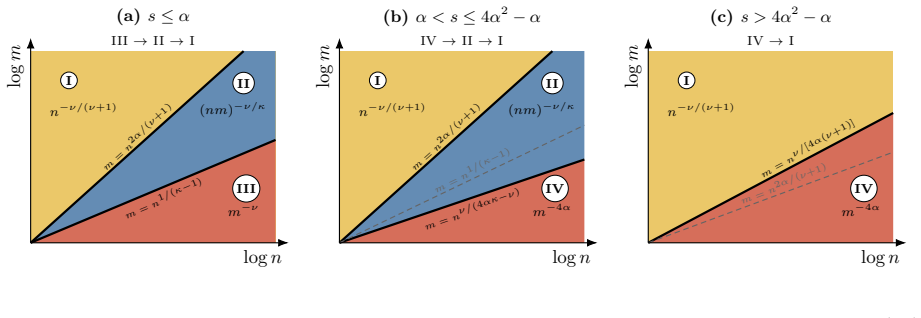
Under independent design the minimax prediction risk is of exact order n to the power -(2α+2s)/(2α+2s+1) plus (nm) to the power -(2α+2s)/(4α+2s+1). Under common design with unknown eigenvalues the same two terms remain and are joined by m to the power -(2α+2s) and m to the power -4α, with matching adaptive upper bounds. The first term recovers the fully observed functional-linear-regression benchmark; the second is the statistical price of noisy point evaluations after inverse-covariance amplification; the last two are geometric obstructions created by a shared grid.
What carries the argument
Matching upper and lower bounds obtained by combining a plug-in Fourier estimator (with eigenvalue screening and blockwise prediction-energy thresholding) against van Trees lower bounds that control Fisher information for noisy point evaluations, plus two indistinguishability constructions that isolate fixed-grid aliasing and unknown-eigenvalue identification on a common lattice.
Load-bearing premise
The covariance operator is assumed to be diagonalized by a fixed, known trigonometric basis, so the theory does not yet pay for estimating an unknown eigenbasis or for misalignment between covariance geometry and slope smoothness.
What would settle it
If, for independent design, the excess prediction risk fails to obey the two-term rate (or the stated phase transition at m ~ n^{2α/(2α+2s+1)}) under the paper's Gaussian trigonometric model, or if common-design risk remains free of the m^{-4α} term when eigenvalues are unknown, the claimed minimax characterization is false.
Editorial analysis
A structured set of objections, weighed in public.
Referee Report
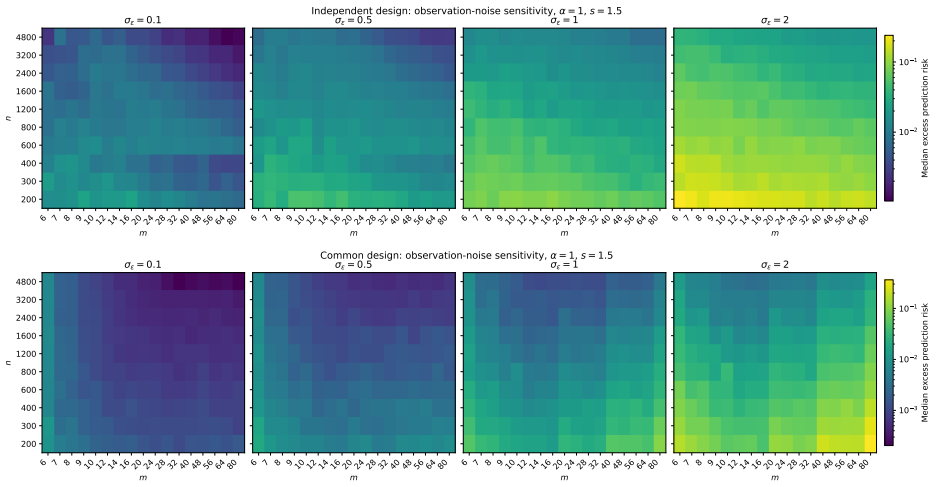
Summary. The paper derives matching minimax rates for prediction (and sketches estimation) in scalar-on-function linear regression when each trajectory is observed only at m noisy points. Working in a fixed trigonometric eigenbasis with eigenvalue decay α and slope Sobolev smoothness s, it treats independent random design and common equispaced design separately. Under independent design the minimax prediction risk is of order n^{-(2α+2s)/(2α+2s+1)}+(nm)^{-(2α+2s)/(4α+2s+1)}; under common design with unknown eigenvalues the rate adds the grid terms m^{-(2α+2s)}+m^{-4α}. Adaptive estimators that screen covariance scale and threshold blockwise prediction energy attain these rates without knowledge of (λ_r), α, or s. Phase diagrams, simulations, and a wheat-spectra example illustrate the theory.
Significance. The contribution is substantial for functional data analysis and nonparametric inverse problems. Fully observed FLR rates and sparse-to-dense transitions for mean/covariance estimation were known; a complete (n,m)-minimax theory for FLR that separates noisy-point cost from fixed-grid aliasing and eigenvalue identification was not. Matching lower bounds (van Trees with refined Fisher control; two distinct common-grid indistinguishability constructions) and adaptive upper bounds make the phase transitions sharp rather than merely sufficient. The fixed trigonometric eigenbasis is an explicit modeling choice that isolates discretization cost; within that model the results are definitive and will serve as a benchmark for subsequent work on unknown eigenbases and alignment.
major comments (2)
- Section 6 states L2 estimation rates (independent: n^{-2s/(2α+2s+1)}+(nm)^{-2s/(4α+2s+1)}; common: plus m^{-2s}+m^{-4α}) as following by the same arguments after reweighting by λ_r^2 and adjusting the energy threshold. The sketch is plausible but incomplete: the van Trees block priors, Fisher bounds, and eligible-block risk decompositions all change with the unweighted loss, and the plug-in remainder B^λ_ℓ must be re-controlled. Either supply the full parallel proofs (or a self-contained appendix lemma) or present the L2 rates as conjectured extensions rather than established corollaries.
- The fixed trigonometric eigenbasis (Section 2 after (4)–(5)) is load-bearing for every rate. Section 6 correctly flags eigenbasis estimation and alignment as open, but the abstract and introduction still present the rates as the cost of discretization for FLR without always restating the basis restriction. A short, prominent caveat in the abstract and at the start of Corollaries 3.4 and 4.4 would prevent misapplication when the covariance eigenbasis is unknown or misaligned with the Sobolev scale of β.
minor comments (5)
- Table 2 (wheat data): CD beats IND and the published benchmarks, contrary to the asymptotic ranking. The finite-sample explanation is reasonable; a one-sentence note that the common subgrid is deterministic while IND and the Zhou et al. numbers use random subsampling would make the comparison protocol fully transparent.
- Figure 1 phase diagrams are clear; adding the critical exponents (e.g. ζ_ind = 2α/(ν+1)) as axis annotations would help readers match the figure to Subsection 4.4.1 without flipping back to the text.
- Notation: ν := 2α+2s and κ := 4α+2s+1 are introduced late (Table 1 / §4.4). Defining them once in Section 2 or at the first rate display would reduce repetition.
- Adaptive constants (M0, CV, CL, cL) are fixed but their practical choice is not discussed. A brief remark in Section 5 on the values used in the simulations would aid reproducibility.
- Typos/style: “What left open” (p. 3) → “What is left open”; occasional double spaces and “them −4α” line-break artifacts in the PDF.
Circularity Check
No significant circularity: minimax rates are derived from stated model assumptions via Fisher/van Trees lower bounds and constructive oracle/adaptive upper bounds, not by fitting or redefining the target.
full rationale
The paper is a standard minimax theory contribution. Under a fixed trigonometric eigenbasis that diagonalizes the covariance (Section 2), prediction risk is the weighted ℓ2 error ∑ λ_r |θ̂_r − θ_r|². Oracle upper bounds (Theorems 3.1, 4.1) balance truncation bias against variance of cross-covariance estimators; matching lower bounds use van Trees on Gaussian block submodels with Fisher information controlled for noisy point evaluations (Appendix D) and, under common design, two distinct indistinguishability constructions for fixed-grid aliasing and unknown-eigenvalue identification (Appendix G). Adaptive procedures screen eigenvalues and threshold blockwise prediction energy with fixed universal constants (M0, CV, CL), attaining the same rates without knowledge of (λ_r), α, or s (Theorems 3.3, 4.3). Self-citations to Cai–Yuan supply the fully-observed FLR benchmark term and mean/covariance phase-transition context; they do not redefine or force the new (nm) and m-only discretization terms. Simulations and the wheat example illustrate the theory rather than fit the rates. No step reduces the claimed rates to their inputs by construction.
Axiom & Free-Parameter Ledger
free parameters (2)
- Adaptive pilot/threshold constants (M0, CV, CL, cL, R)
- Noise levels σε, σδ and eigenvalue envelope constants cλ, Cλ, R0
axioms (5)
- domain assumption Predictor trajectories are centered Gaussian processes with continuous paths; response and measurement errors are independent Gaussian.
- domain assumption Covariance operator is diagonalized by the fixed trigonometric basis with eigenvalues in Lα(cλ,Cλ), α>1/2.
- domain assumption Slope Fourier coefficients lie in Sobolev ball Θs(R0), s≥0.
- domain assumption Independent design: tij iid Unif[0,1]; common design: equal grid tj=(j-1)/m.
- standard math Van Trees inequality and standard sub-Weibull/Bernstein concentration tools.
read the original abstract
We study scalar-on-function linear regression when each covariate curve is observed only through finitely many noisy point evaluations. Our goal is to characterize the minimax estimation and prediction risks as joint functions of the number of trajectories $n$ and the within-trajectory resolution $m$. Working in a fixed trigonometric eigenbasis, with covariance eigenvalues decaying at rate $\alpha$ and slope function of Sobolev smoothness $s$, we derive matching minimax upper and lower bounds under two canonical sampling schemes. Under an independent random design, the minimax prediction rate is $n^{-\frac{2\alpha+2s}{2\alpha+2s+1}} + (nm)^{-\frac{2\alpha+2s}{4\alpha+2s+1}}$. The first term is the fully observed functional linear regression benchmark, while the second term captures the cost of noisy point evaluations after amplification by the inverse covariance operator. Under a common design on an equally spaced grid, the shared sampling geometry introduces additional obstructions, and the minimax prediction rate becomes $n^{-\frac{2\alpha+2s}{2\alpha+2s+1}} + (nm)^{-\frac{2\alpha+2s}{4\alpha+2s+1}} + m^{-(2\alpha+2s)} + m^{-4\alpha}$. Here the third term represents discretization error induced by the fixed grid, whereas the fourth reflects the cost of identifying unknown eigenvalues from observations on a common grid. We further construct data-driven adaptive estimators that screen the covariance scale and threshold blockwise prediction energy, attaining these rates without prior knowledge of the eigenvalue sequence or the smoothness indices. The results reveal a sharp phase transition that depends on the sampling resolution under independent design and a richer phase diagram under common design. Numerical simulations and a real data example illustrate the theoretical findings.
Figures


Reference graph
Works this paper leans on
-
[1]
2003 , publisher =
Sobolev Spaces , author =. 2003 , publisher =
2003
-
[2]
2008 , journal =
A Tail Inequality for Suprema of Unbounded Empirical Processes with Applications to Markov Chains , author =. 2008 , journal =
2008
-
[3]
Bousquet, Olivier , year =. A. Comptes Rendus. Math. doi:10.1016/S1631-073X(02)02292-6 , url =
-
[4]
Concentration Inequalities: A Nonasymptotic Theory of Independence , author =. 2013 , publisher =. doi:10.1093/acprof:oso/9780199535255.001.0001 , isbn =
-
[5]
2019 , journal =
On the Convergence Rate of Training Recurrent Neural Networks , author =. 2019 , journal =
2019
-
[6]
2019 , month = jun, eprint =
A Convergence Theory for Deep Learning via Over-Parameterization , author =. 2019 , month = jun, eprint =
2019
-
[7]
2021 , journal =
Concentration of Kernel Matrices with Application to Kernel Spectral Clustering , author =. 2021 , journal =
2021
-
[8]
Support Vector Machines , author =. 2008 , series =. doi:10.1007/978-0-387-77242-4 , isbn =
-
[9]
and Hu, Wei and Li, Zhiyuan and Salakhutdinov, Russ R and Wang, Ruosong , year =
Arora, Sanjeev and Du, Simon S. and Hu, Wei and Li, Zhiyuan and Salakhutdinov, Russ R and Wang, Ruosong , year =. On Exact Computation with an Infinitely Wide Neural Net , booktitle =
-
[10]
Fine-Grained Analysis of Optimization and Generalization for Overparameterized Two-Layer Neural Networks , booktitle =
Arora, Sanjeev and Du, Simon and Hu, Wei and Li, Zhiyuan and Wang, Ruosong , year =. Fine-Grained Analysis of Optimization and Generalization for Overparameterized Two-Layer Neural Networks , booktitle =
-
[11]
Sharp Estimates for Eigenvalues of Integral Operators Generated by Dot Product Kernels on the Sphere , author =. 2014 , month = jan, journal =. doi:10.1016/j.jat.2013.10.002 , abstract =
-
[12]
2017 , journal =
Breaking the Curse of Dimensionality with Convex Neural Networks , author =. 2017 , journal =
2017
-
[13]
Characterization of Sobolev spaces on the sphere
Barcel. Characterization of. 2019 , month =. doi:10.48550/arXiv.1907.01571 , abstract =. arxiv , keywords =:arXiv:1907.01571 , publisher =
work page internal anchor Pith review Pith/arXiv arXiv doi:10.48550/arxiv.1907.01571 2019
-
[14]
A Kernel Perspective of Skip Connections in Convolutional Networks
A Kernel Perspective of Skip Connections in Convolutional Networks , author =. 2022 , month = nov, number =. doi:10.48550/arXiv.2211.14810 , abstract =. arxiv , keywords =:arXiv:2211.14810 , publisher =
work page internal anchor Pith review Pith/arXiv arXiv doi:10.48550/arxiv.2211.14810 2022
-
[15]
On Regularization Algorithms in Learning Theory , author =. 2007 , journal =. doi:10.1016/j.jco.2006.07.001 , abstract =
-
[16]
On Deep Learning as a Remedy for the Curse of Dimensionality in Nonparametric Regression , author =
-
[17]
Kernel Ridgeless Regression Is Inconsistent in Low Dimensions , author =. 2022 , month = jun, number =. doi:10.48550/arXiv.2205.13525 , abstract =. arXiv:2205.13525 , publisher =
-
[18]
Beatson, R. K. and zu Castell, W. and Xu, Y. , year =. A. doi:10.48550/arXiv.1110.2437 , abstract =. arxiv , keywords =:arXiv:1110.2437 , publisher =
work page internal anchor Pith review Pith/arXiv arXiv doi:10.48550/arxiv.1110.2437
-
[19]
To Understand Deep Learning We Need to Understand Kernel Learning , booktitle =
Belkin, Mikhail and Ma, Siyuan and Mandal, Soumik , year =. To Understand Deep Learning We Need to Understand Kernel Learning , booktitle =
-
[20]
On the Inductive Bias of Neural Tangent Kernels , booktitle =
Bietti, Alberto and Mairal, Julien , year =. On the Inductive Bias of Neural Tangent Kernels , booktitle =
-
[21]
Deep Equals Shallow for Relu Networks in Kernel Regimes , author =. 2020 , journal =. 2009.14397 , archiveprefix =
Pith/arXiv arXiv 2020
-
[22]
, year =
Bingham, Nicholas H. , year =. Positive Definite Functions on Spheres , booktitle =
-
[23]
Optimal Rates for Regularization of Statistical Inverse Learning Problems , author =. 2018 , journal =. doi:10.1007/s10208-017-9359-7 , abstract =
-
[24]
2003 , journal =
Spectral Properties of Distance Matrices , author =. 2003 , journal =
2003
-
[25]
Spectrum Dependent Learning Curves in Kernel Regression and Wide Neural Networks , booktitle =
Bordelon, Blake and Canatar, Abdulkadir and Pehlevan, Cengiz , year =. Spectrum Dependent Learning Curves in Kernel Regression and Wide Neural Networks , booktitle =
-
[26]
Brauchart, Johann S. and Dick, Josef , year =. A Characterization of. Constructive Approximation , volume =. doi:10.1007/s00365-013-9217-z , abstract =
-
[27]
2005 , abstract =
Spectral Properties of the Kernel Matrix and Their Relation to Kernel Methods in Machine Learning , author =. 2005 , abstract =
2005
-
[28]
What Can Be Learnt With Wide Convolutional Neural Networks?
What Can Be Learnt with Wide Convolutional Neural Networks? , author =. 2022 , month =. doi:10.48550/arXiv.2208.01003 , abstract =. arxiv , keywords =:arXiv:2208.01003 , publisher =
work page internal anchor Pith review Pith/arXiv arXiv doi:10.48550/arxiv.2208.01003 2022
-
[29]
Spectral Bias and Task-Model Alignment Explain Generalization in Kernel Regression and Infinitely Wide Neural Networks , author =. 2021 , month = may, journal =. doi:10.1038/s41467-021-23103-1 , abstract =
-
[30]
Generalization Error Bounds of Gradient Descent for Learning Over-Parameterized Deep
Cao, Yuan and Gu, Quanquan , year =. Generalization Error Bounds of Gradient Descent for Learning Over-Parameterized Deep. Proceedings of the
-
[31]
Optimal Rates for the Regularized Least-Squares Algorithm , author =. 2007 , journal =. doi:10.1007/s10208-006-0196-8 , abstract =
-
[32]
Cross-Validation Based Adaptation for Regularization Operators in Learning Theory , author =. 2010 , journal =. doi:10.1142/S0219530510001564 , abstract =
-
[33]
2012 , journal =
Eigenvalue Decay of Positive Integral Operators on the Sphere , author =. 2012 , journal =
2012
-
[34]
Deep Neural Tangent Kernel and Laplace Kernel Have the Same
Chen, Lin and Xu, Sheng , year =. Deep Neural Tangent Kernel and Laplace Kernel Have the Same. arXiv preprint arXiv:2009.10683 , eprint =
Pith/arXiv arXiv 2009
-
[35]
Kernel Methods for Deep Learning , booktitle =
Cho, Youngmin and Saul, Lawrence , editor =. Kernel Methods for Deep Learning , booktitle =. 2009 , volume =
2009
-
[36]
The Loss Surfaces of Multilayer Networks , booktitle =
Choromanska, Anna and Henaff, Mikael and Mathieu, Michael and Arous, G. The Loss Surfaces of Multilayer Networks , booktitle =. 2015 , pages =
2015
-
[37]
Conference on Learning Theory , author =
On the Expressive Power of Deep Learning:. Conference on Learning Theory , author =. 2016 , pages =
2016
-
[38]
Approximation Theory and Harmonic Analysis on Spheres and Balls , author =. 2013 , series =. doi:10.1007/978-1-4614-6660-4 , isbn =
-
[39]
doi:10.48550/arXiv.1810.04805 , abstract =
Devlin, Jacob and Chang, Ming-Wei and Lee, Kenton and Toutanova, Kristina , year =. doi:10.48550/arXiv.1810.04805 , abstract =. arxiv , keywords =:arXiv:1810.04805 , publisher =
-
[40]
and Zhai, Xiyu and Poczos, Barnabas and Singh, Aarti , year =
Du, Simon S. and Zhai, Xiyu and Poczos, Barnabas and Singh, Aarti , year =. Gradient Descent Provably Optimizes Over-Parameterized Neural Networks , booktitle =
-
[41]
and Lee, Jason and Li, Haochuan and Wang, Liwei and Zhai, Xiyu , year =
Du, Simon S. and Lee, Jason and Li, Haochuan and Wang, Liwei and Zhai, Xiyu , year =. Gradient Descent Finds Global Minima of Deep Neural Networks , booktitle =
-
[42]
Deep Neural Networks as Point Estimates for Deep
Dutordoir, Vincent and Hensman, James and. Deep Neural Networks as Point Estimates for Deep. Advances in. 2021 , volume =
2021
-
[43]
2020 , journal =
Spectra of the Conjugate Kernel and Neural Tangent Kernel for Linear-Width Neural Networks , author =. 2020 , journal =
2020
-
[44]
Integral Operators on the Sphere Generated by Positive Definite Smooth Kernels , author =. 2008 , month = oct, journal =. doi:10.1016/j.jco.2008.04.001 , abstract =
-
[45]
Eigenvalues of Integral Operators Defined by Smooth Positive Definite Kernels , author =. 2009 , month = may, journal =. doi:10.1007/s00020-009-1680-3 , abstract =
-
[46]
Eigenvalue Decay Rates for Positive Integral Operators , author =. 2013 , month = dec, journal =. doi:10.1007/s10231-012-0256-z , abstract =
-
[47]
2020 , journal =
Sobolev Norm Learning Rates for Regularized Least-Squares Algorithms , author =. 2020 , journal =
2020
-
[48]
and Bartlett, Peter , year =
Frei, Spencer and Chatterji, Niladri S. and Bartlett, Peter , year =. Benign Overfitting without Linearity:. Proceedings of
-
[49]
Notes on Spherical Harmonics and Linear Representations of Lie Groups , author =
-
[50]
Deep Convolutional Networks as Shallow Gaussian Processes , author =. 2018 , journal =. 1808.05587 , archiveprefix =
Pith/arXiv arXiv 2018
-
[51]
On the Similarity between the
Geifman, Amnon and Yadav, Abhay and Kasten, Yoni and Galun, Meirav and Jacobs, David and Ronen, Basri , year =. On the Similarity between the. Advances in
-
[52]
Spectral Algorithms for Supervised Learning , author =. 2008 , journal =. doi:10.1162/neco.2008.05-07-517 , abstract =
-
[53]
2020 , journal =
When Do Neural Networks Outperform Kernel Methods? , author =. 2020 , journal =
2020
-
[54]
Linearized Two-Layers Neural Networks in High Dimension , author =
-
[55]
2013 , journal =
Strictly and Non-Strictly Positive Definite Functions on Spheres , author =. 2013 , journal =
2013
-
[56]
2002 , series =
A Distribution-Free Theory of Nonparametric Regression , editor =. 2002 , series =
2002
-
[57]
Approximating Continuous Functions by
Hanin, Boris and Sellke, Mark , year =. Approximating Continuous Functions by. arXiv preprint arXiv:1710.11278 , eprint =
-
[58]
Random Neural Networks in the Infinite Width Limit as
Hanin, Boris , year =. Random Neural Networks in the Infinite Width Limit as. arXiv preprint arXiv:2107.01562 , eprint =
-
[59]
2020 , journal =
On the Minimax Optimality and Superiority of Deep Neural Network Learning over Sparse Parameter Spaces , author =. 2020 , journal =
2020
-
[60]
The Curse of Depth in Kernel Regime , booktitle =
Hayou, Soufiane and Doucet, Arnaud and Rousseau, Judith , year =. The Curse of Depth in Kernel Regime , booktitle =
-
[61]
Deep Residual Learning for Image Recognition , booktitle =
He, Kaiming and Zhang, Xiangyu and Ren, Shaoqing and Sun, Jian , year =. Deep Residual Learning for Image Recognition , booktitle =
-
[62]
2017 , edition =
Matrix Analysis , author =. 2017 , edition =
2017
-
[63]
1989 , journal =
Multilayer Feedforward Networks Are Universal Approximators , author =. 1989 , journal =
1989
-
[64]
1939 , journal =
Tubes and Spheres in N-Spaces, and a Class of Statistical Problems , author =. 1939 , journal =
1939
-
[65]
Regularization Matters:
Hu, Tianyang and Wang, Wenjia and Lin, Cong and Cheng, Guang , year =. Regularization Matters:. International
-
[66]
Sharp Asymptotics of Kernel Ridge Regression beyond the Linear Regime , author =. 2022 , month = may, number =. arxiv , langid =:arXiv:2205.06798 , publisher =
Pith/arXiv arXiv 2022
-
[67]
Dynamics of Deep Neural Networks and Neural Tangent Hierarchy , booktitle =
Huang, Jiaoyang and Yau, Horng-Tzer , year =. Dynamics of Deep Neural Networks and Neural Tangent Hierarchy , booktitle =
-
[68]
Advances in Neural Information Processing Systems , author =
Neural Tangent Kernel:. Advances in Neural Information Processing Systems , author =. 2018 , volume =
2018
-
[69]
2022 , abstract =
Generalization of Wide Neural Networks from the Perspective of Linearization and Kernel Learning , author =. 2022 , abstract =
2022
-
[70]
, author =
Distribution of Eigenvalues of Certain Integral Operators. , author =. 1955 , journal =
1955
-
[71]
Kanagawa, Motonobu and Hennig, Philipp and Sejdinovic, Dino and Sriperumbudur, Bharath K. , year =. Gaussian Processes and Kernel Methods:. arXiv preprint arXiv:1807.02582 , eprint =
-
[72]
A Style-Based Generator Architecture for Generative Adversarial Networks , booktitle =
Karras, Tero and Laine, Samuli and Aila, Timo , year =. A Style-Based Generator Architecture for Generative Adversarial Networks , booktitle =
-
[73]
Asymptotic Properties of Eigenvalues of Integral Equations , author =. 1991 , month = feb, journal =. doi:10.1137/0151013 , abstract =
-
[74]
Random Matrix Approximation of Spectra of Integral Operators , author =. 2000 , journal =. doi:10.2307/3318636 , abstract =
doi:10.2307/3318636 2000
-
[75]
2017 , journal =
Imagenet Classification with Deep Convolutional Neural Networks , author =. 2017 , journal =
2017
-
[76]
2022 , journal =
Moving Beyond Sub-Gaussianity in High-Dimensional Statistics: Applications in Covariance Estimation and Linear Regression , author =. 2022 , journal =
2022
-
[77]
Nonparametric Regression with Shallow Overparameterized Neural Networks Trained by
Kuzborskij, Ilja and Szepesv. Nonparametric Regression with Shallow Overparameterized Neural Networks Trained by. Conference on. 2021 , pages =
2021
-
[78]
Generalization Ability of Wide Neural Networks on
Lai, Jianfa and Xu, Manyun and Chen, Rui and Lin, Qian , year =. Generalization Ability of Wide Neural Networks on. doi:10.48550/arXiv.2302.05933 , abstract =. arxiv , keywords =:arXiv:2302.05933 , publisher =
-
[79]
Deep Neural Networks as Gaussian Processes , author =. 2017 , journal =. 1711.00165 , archiveprefix =
Pith/arXiv arXiv 2017
-
[80]
Wide Neural Networks of Any Depth Evolve as Linear Models under Gradient Descent , booktitle =
Lee, Jaehoon and Xiao, Lechao and Schoenholz, Samuel and Bahri, Yasaman and Novak, Roman and. Wide Neural Networks of Any Depth Evolve as Linear Models under Gradient Descent , booktitle =. 2019 , volume =
2019
discussion (0)
Sign in with ORCID, Apple, or X to comment. Anyone can read and Pith papers without signing in.