REVIEW 4 major objections 6 minor 32 references
A bilevel reweighting scheme can recover the clean-preference optimum of Direct Preference Optimization from noisy preference labels, and a metadata-free implementation outperforms robust DPO baselines under 20–40% random label flips.
Reviewed by Pith at T0; open to challenge. T0 means a machine referee read the full paper against a public rubric. the ladder, T0–T4 →
T0 review · deepseek-v4-flash
2026-08-02 07:54 UTC pith:BBUWX23D
load-bearing objection Useful method paper with a correct but partly tautological theory; the empirical claims need multi-seed support and the pseudo-label signal is validated only on a clean probe. the 4 major comments →
Metadata-Free Meta-Reweighted Direct Preference Optimization under Noisy Preference Labels
The pith
A machine-rendered reading of the paper's core claim, the machinery that carries it, and where it could break.
Core claim
The central claim is that weighted DPO under noisy preferences has a pointwise optimum u*(g+,g−,z) = log(q/(1−q)) + log(g+(z)/g−(z)), so choosing the weight ratio equal to log(η/(1−η)) − log(q/(1−q)) cancels the noise-induced shift and recovers the clean DPO optimum u*_DPO-clean(z) = logit(η). Under idealized conditions this ratio is the optimum of a bilevel problem whose outer objective is the clean-preference risk. The paper then uses the noisy-trained model's implicit reward difference u(z) as a practical stand-in for the clean preference strength and trains a small network, VNet, to map [Δ(z), u(z)] to a weight g(z) = σ(a(z)u(z) + b(z)), with the outer signal supplied by prompt-augmentat
What carries the argument
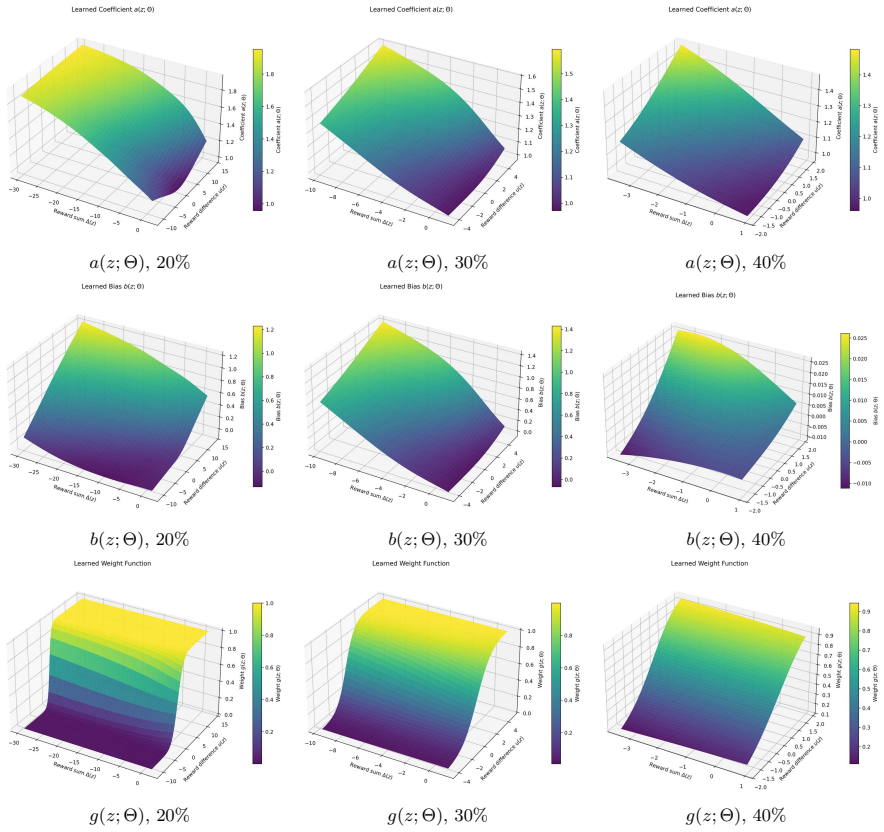
The load-bearing identity is the weight-ratio correction: u*_W-DPO-noisy(z) = log(q/(1−q)) + log(g+(z)/g−(z)), so setting log(g+/g−) to logit(η) − logit(q) makes weighted noisy DPO match clean DPO. The implemented version replaces the two-sided weights with a single sigmoid gate VNet, g(z;Θ) = σ(a(z;Θ)u(z) + b(z;Θ)), where u(z) is the policy's implicit reward difference and Δ(z) is the implicit reward sum; the outer meta-objective is a pseudo-labelled consistency loss between the original prompt and its back-translation, with confidence threshold τ and a central-difference/LoRA approximation of the higher-order meta-gradient.
Load-bearing premise
The load-bearing premise is that the current policy's confident preference predictions are reliable enough to serve as pseudo-labels; the paper validates this with a fixed clean-trained probe, not with the noisy-trained policy whose errors the outer loop is supposed to correct.
What would settle it
Measure the clean-label accuracy of the pseudo-labels produced by the actual noisy-trained policy at τ=0.60 and 40% flips during PACMR-DPO training. If that accuracy is close to the flip rate (i.e., pseudo-labels are no better than random preference guesses), or if VNet assigns similar average weights to flipped and unflipped pairs, the reported win-rate gains would not be attributable to the augmentation-consistency reweighting.
If this is right
- Robust alignment no longer requires a clean validation preference set; consistency under prompt transformation can stand in as the outer meta-signal.
- The learned weight function is interpretable: unflipped pairs receive higher mean weights than flipped pairs, and the gap shrinks as noise increases.
- The theoretical recovery result implies that any noise model with label-independent sampling can in principle be corrected by the right weight ratio, not only symmetric random flips.
- The central-difference treatment makes bilevel reweighting memory-feasible for LLM LoRA training, removing the need to retain the higher-order inner-update graph.
- At 40% flips on HH, the win-rate advantage narrows while the win-score remains best, suggesting the method preserves overall comparison quality even when per-pair discrimination weakens.
Where Pith is reading between the lines
- If the learned weight shapes generalize across tasks at matched flip rates—as the figures suggest—VNet may be capturing a task-agnostic reliability signal; a direct test would be to pretrain VNet on one task and apply it to another without retraining.
- The augmentation-consistency outer objective could be ported to other preference objectives (e.g., IPO or KTO) or other semantics-preserving transforms beyond English–Chinese back-translation, though the paper only tests the DPO-style loss and this one augmenter.
- A testable extension is an annealed confidence threshold τ(t) that rises as the policy aligns; the paper uses a fixed τ=0.60, but pseudo-label accuracy should improve during training, so a schedule could help most at 40% noise.
- The method's safety margin depends on the initial reference policy: if the reference is already biased toward flipped labels, the consistency objective could reinforce those biases rather than correct them, so the method's benefit may shrink when starting from a heavily misaligned policy.
Editorial analysis
A structured set of objections, weighed in public.
Referee Report
Summary. The paper proposes PACMR-DPO, a bilevel meta-reweighting method for DPO under randomly flipped preference labels. The inner level trains a weighted DPO objective, with per-sample weights produced by a small MLP (VNet) taking the implicit reward difference and sum as inputs. The outer level uses a prompt-augmentation consistency objective instead of clean metadata: pseudo-labels are derived from the current policy's own sigmoid implicit-reward score, confidence-filtered, and then used to enforce consistency between the original and back-translated prompt. The paper proves an idealized clean-optimum recovery theorem, derives a weight-prior construction under a general label-flipping model, and introduces a central-difference approximation of the meta-gradient in LoRA space. Experiments on TL;DR and Anthropic HH report improvements over cDPO, IPO, rDPO, and Dr.DPO at 20–40% label-flip noise.
Significance. If the empirical claims hold, the paper makes a useful practical contribution by showing that a meta-learned reweighting can be driven by prompt-augmentation consistency rather than clean metadata, with a scalable LoRA-based bilevel update. The algebraic derivations in §4 and Appendices C–D are coherent and appear correct, and the central-difference complexity analysis is a useful practical addition. The paper is also honest about the idealized nature of Theorem 1. However, the central methodological bridge — that the policy's own pseudo-labels track the clean preference direction while training on noisy data — is not validated for the actual in-loop policy, and the experimental evaluation is single-seed with no variance estimates. The significance therefore depends on closing that validation gap.
major comments (4)
- [§5.3 and Appendix E] The load-bearing assumption of the method is that the pseudo-labels ŷ_i(ω) in Eq. (35) track the clean preference direction for the policy actually being trained on noisy data. This is not established. Appendix E validates the prompt-augmentation-consistency signal only with a fixed clean-DPO probe on uncorrupted data (Table 7). The reported clean accuracies of 82.74% (TL;DR) and 75.58% (HH) at τ=0.60 therefore say nothing about a policy that may have confidently adopted flipped labels during noisy training. The E.3 relabeling-invariance statement further confirms that these metrics are convention-dependent and do not measure in-loop pseudo-label quality. I would like to see, during PACMR-DPO training, pseudo-label accuracy and weight statistics on known flipped vs. unflipped samples (the noise mask is available in the synthetic setup), or an equivalent analysis; without this, the outer
- [§6.1–6.3, Tables 1–2] All main results are single-seed point estimates (seed 42) with no confidence intervals, standard errors, or significance tests. Several reported differences are small, e.g., TL;DR 30% win-score 1.5263 vs. 1.5300 for fixed σ(u) in Table 4, and HH 40% win rate 40.63% vs. rDPO's 41.38% in Table 2. Pairwise evaluation is by GPT-5.1 with a single deterministic call per order and ties counted, which does not provide reliable error bars. I recommend multi-seed runs and/or bootstrap intervals, and ideally human or judge-agreement validation, before the claimed superiority over rDPO/Dr.DPO at high noise rates is established.
- [§6.5, Table 5] The main experiments use τ=0.60, which is selected after inspecting the sensitivity results in Table 5 and described as a compromise. Since τ is a free hyperparameter tuned on the same evaluation setup, the reported main-table numbers are selected rather than predictive. Please prespecify τ, or perform a validation-based selection and report the corresponding test performance, to avoid the appearance of post-hoc selection.
- [§4, Eq. (19) vs. §5.2, Eq. (36)] Theorem 1 is an idealized recoverability statement for a bilevel problem whose outer objective uses the clean preference posterior η_meta. The actual method replaces that outer objective with a consistency loss based on the policy's own pseudo-labels, restricts weights to an MLP on [Δ,u], and uses a one-step virtual update. The theorem therefore does not imply that PACMR-DPO has a fixed point at the clean DPO optimum. The paper should state this limitation explicitly and either prove a surrogate result under a model of consistent pseudo-labels or reframe Theorem 1 as motivation only. Currently §5.1 relies on Eq. (25) as if the in-training u(z) already approximates logit η(z), which is precisely the unvalidated step.
minor comments (6)
- [Abstract / Introduction] Missing space in 'KeywordsDirect Preference Optimization' and similar spacing issues in the title/header. Minor copyediting.
- [§3.2] The phrase 'becauseη train(z) =η(z)' lacks spaces around 'because'. Also, the notation Δ(z) for implicit reward sum is introduced in §5.1 without a formal definition; please define it explicitly.
- [Table 12] The cDPO row states 'ϵ=0.1 under 10% random flipping', but the experiments use 20%, 30%, and 40%. Clarify how the noise parameter is set for the reported rates.
- [Appendix E] In the first paragraph of E, 'we conduct a analysis' is a typo. Also, Eq. (118) defines exact clean accuracy but the connection to the relabeling invariance in E.3 would be clearer if the formula were written in terms of the latent clean label.
- [References] The win-score definition is cited to [11], but the reference list and the text in §6.2 would benefit from checking the source; if it is a standard definition, cite the original method that introduced it.
- [Appendix A] The complexity analysis is sound, but the notation 'P L' is used ambiguously: it should be written as P_L or 'P·L' to avoid confusion with the product of P and L.
Circularity Check
Theorem 1 is a self-definitional restatement of the clean-risk outer objective; the practical PAC signal is self-referential, but the win-rate claims rest on external baselines, so no deep circularity.
specific steps
-
self definitional
[Theorem 1, Eqs. (19)-(21); Appendix C]
"min_{g+>0,g−>0} E_{z′∼Pmeta} [−η_meta(z′) log σ(u*(g+,g−,z′)) − (1−η_meta(z′)) log σ(−u*(g+,g−,z′))] ... Theorem 1 (Clean-optimum recovery by ideal bilevel reweighting). ... Then u*(g*+,g*−,z)=u*_DPO-clean(z)=log η(z)/(1−η(z))."
The outer objective in (19) is by definition the clean DPO conditional risk (eq. 14) evaluated at the inner solution, with η_meta=η by Prop. 1. Appendix B proves this risk is uniquely minimized at u=logit η. Because g+ and g− are unconstrained pointwise, the inner formula (18) can realize any u by choosing log(g+/g−), so Theorem 1's conclusion (20) is simply the minimizer of the objective just written, not a prediction derived from noisy data. Appendix C confirms: 'this outer conditional objective reaches its unique minimum at u=log η/(1−η)' and then chooses weights to attain it. The clean-optimum recovery is thus built into the problem definition.
full rationale
The only formal reduction I can exhibit is Theorem 1. In eq. (19), the outer objective is the clean DPO conditional risk (eq. 14) under η_meta=η, and Appendix B shows its pointwise minimizer is logit(η). Since the inner weighted-DPO optimum (18) spans all real values as g+/g− varies, eq. (20) states little more than 'the minimizer of the clean risk is the clean optimum.' The proof in Appendix C says exactly that: the outer conditional objective reaches its unique minimum at u=log η/(1−η), then chooses weights to hit it. This is not an independent prediction from noisy-data mechanics; it is definitional. I therefore count it as one self-definitional step. That said, the paper's empirical claim is not circular: Tables 1-2 compare model outputs against external DPO baseline outputs using GPT-5.1, and the noise mask is fixed across methods. The PAC outer objective (28)-(36) is a self-training/consistency signal built from the model's own u; this is self-referential and Appendix E's validation uses a fixed clean DPO probe rather than the noisy-trained policy (E.3 explicitly limits it to 'the augmentation transformation rather than the degradation of a policy trained at a particular noise rate'). This is a support gap for the method's inner-loop reliability, but it is not a circular derivation of the win-rate results. No load-bearing self-citation or imported uniqueness theorem is present; [19] is cited as inspiration only. Score 3 rather than 6 because the central empirical contribution has independent external content and the tautological theorem is acknowledged as an idealized capacity statement.
Axiom & Free-Parameter Ledger
free parameters (4)
- Confidence threshold τ =
0.6
- Central-difference scale ε =
3e-3
- Central-difference coefficient clipping constant =
10.0
- VNet architecture and training hyperparameters =
MLP 64-16; lr 1e-3 (TL;DR), 5e-4 (HH); init a=1, b=0; update every 10 steps
axioms (6)
- domain assumption Assumption 1: label-independent sampling into train and meta sets
- ad hoc to paper Ideal pointwise separability and unrestricted weight function space for g+, g-
- domain assumption Label noise follows a two-rate random-swap model
- domain assumption Confident policy predictions approximate the clean preference posterior
- standard math Losses are differentiable in LoRA parameters and central differences are accurate at ε=3e-3
- domain assumption Back-translation is semantics-preserving for preference direction
read the original abstract
Direct Preference Optimization (DPO) has become an important method for aligning large language models (LLMs) with human preferences because it removes the need for explicit reward modeling and reinforcement learning. However, its performance depends heavily on the quality of preference data, and noisy preference data in real-world settings can weaken alignment performance. To address this issue, we propose a bilevel optimization framework and prove, under some idealized conditions, that this framework can recover the DPO optimum under clean data. We further derive a prior form for the learnable weighting function under label-flipping noise. Considering that high-quality metadata may be difficult to obtain, we propose a prompt augmentation consistency method that enables meta-learning even when metadata is completely unavailable. To reduce the high cost of higher-order gradients in LLM meta-learning, we combine central-difference approximation with LoRA fine-tuning and develop a scalable training scheme. Experiments on TL;DR summarization and Anthropic Helpful and Harmless dialogue show that the proposed method improves alignment performance over multiple DPO baselines under different noise rates.
Figures




Reference graph
Works this paper leans on
-
[1]
Llama 2: Open foundation and fine-tuned chat models,
H. Touvron, L. Martin, K. Stone, P. Albert, A. Almahairi, Y . Babaei, N. Bashlykov, S. Batra, P. Bhargava, S. Bhosaleet al., “Llama 2: Open foundation and fine-tuned chat models,”arXiv preprint arXiv:2307.09288, 2023
Pith/arXiv arXiv 2023
-
[2]
Gemini: a family of highly capable multimodal models,
G. Team, R. Anil, S. Borgeaud, J.-B. Alayrac, J. Yu, R. Soricut, J. Schalkwyk, A. M. Dai, A. Hauth, K. Millican et al., “Gemini: a family of highly capable multimodal models,”arXiv preprint arXiv:2312.11805, 2023
Pith/arXiv arXiv 2023
-
[3]
Training language models to follow instructions with human feedback,
L. Ouyang, J. Wu, X. Jiang, D. Almeida, C. Wainwright, P. Mishkin, C. Zhang, S. Agarwal, K. Slama, A. Ray et al., “Training language models to follow instructions with human feedback,”Advances in neural information processing systems, vol. 35, pp. 27 730–27 744, 2022
2022
-
[4]
A survey of reinforcement learning from human feedback,
T. Kaufmann, P. Weng, V . Bengs, and E. Hüllermeier, “A survey of reinforcement learning from human feedback,” arXiv preprint arXiv:2312.14925, 2023
arXiv 2023
-
[5]
Secrets of rlhf in large language models part i: Ppo,
R. Zheng, S. Dou, S. Gao, Y . Hua, W. Shen, B. Wang, Y . Liu, S. Jin, Q. Liu, Y . Zhouet al., “Secrets of rlhf in large language models part i: Ppo,”arXiv preprint arXiv:2307.04964, 2023
Pith/arXiv arXiv 2023
-
[6]
Direct preference optimization: Your language model is secretly a reward model,
R. Rafailov, A. Sharma, E. Mitchell, C. D. Manning, S. Ermon, and C. Finn, “Direct preference optimization: Your language model is secretly a reward model,”Advances in neural information processing systems, vol. 36, pp. 53 728–53 741, 2023
2023
-
[7]
Impact of preference noise on the alignment performance of generative language models,
Y . Gao, D. Alon, and D. Metzler, “Impact of preference noise on the alignment performance of generative language models,”arXiv preprint arXiv:2404.09824, 2024
Pith/arXiv arXiv 2024
-
[8]
Secrets of rlhf in large language models part ii: Reward modeling,
B. Wang, R. Zheng, L. Chen, Y . Liu, S. Dou, C. Huang, W. Shen, S. Jin, E. Zhou, C. Shiet al., “Secrets of rlhf in large language models part ii: Reward modeling,”arXiv preprint arXiv:2401.06080, 2024
Pith/arXiv arXiv 2024
-
[9]
Provably robust dpo: Aligning language models with noisy feedback,
S. R. Chowdhury, A. Kini, and N. Natarajan, “Provably robust dpo: Aligning language models with noisy feedback,”arXiv preprint arXiv:2403.00409, 2024
Pith/arXiv arXiv 2024
-
[10]
Towards robust alignment of language models: Distributionally robustifying direct preference optimization,
J. Wu, Y . Xie, Z. Yang, J. Wu, J. Chen, J. Gao, B. Ding, X. Wang, and X. He, “Towards robust alignment of language models: Distributionally robustifying direct preference optimization,” inInternational Conference on Learning Representations, vol. 2025, 2025, pp. 16 123–16 150
2025
-
[11]
Robust reinforcement learning from corrupted human feedback,
A. Bukharin, I. Hong, H. Jiang, Z. Li, Q. Zhang, Z. Zhang, and T. Zhao, “Robust reinforcement learning from corrupted human feedback,”Advances in Neural Information Processing Systems, vol. 37, pp. 124 093–124 113, 2024
2024
-
[12]
A note on dpo with noisy preferences & relationship to ipo,
E. Mitchell, “A note on dpo with noisy preferences & relationship to ipo,” 2023
2023
-
[13]
ROPO: Robust preference optimization for large language models,
X. Liang, C. Chen, S. Qiu, J. Wang, Y . Wu, Z. Fu, Z. Shi, F. Wu, and J. Ye, “ROPO: Robust preference optimization for large language models,”arXiv preprint arXiv:2404.04102, 2024
Pith/arXiv arXiv 2024
-
[14]
Perplexity-aware correction for robust alignment with noisy preferences,
K. Kong, X. Xu, D. Wang, J. Zhang, and M. Kankanhalli, “Perplexity-aware correction for robust alignment with noisy preferences,”Advances in Neural Information Processing Systems, vol. 37, pp. 28 296–28 321, 2024
2024
-
[15]
Aligner, diagnose thyself: A meta-learning paradigm for fusing intrinsic feedback in preference alignment,
M. Li, P. Zhao, and Z. Zhang, “Aligner, diagnose thyself: A meta-learning paradigm for fusing intrinsic feedback in preference alignment,” inThe Fourteenth International Conference on Learning Representations, 2026
2026
-
[16]
Learning temporally-aware sample weights for preference optimization,
M. Li, X. Zhou, and P. Zhao, “Learning temporally-aware sample weights for preference optimization,” inFindings of the Association for Computational Linguistics: ACL 2026, 2026, pp. 12 361–12 377
2026
-
[17]
Meta-weight-net: Learning an explicit mapping for sample weighting,
J. Shu, Q. Xie, L. Yi, Q. Zhao, S. Zhou, Z. Xu, and D. Meng, “Meta-weight-net: Learning an explicit mapping for sample weighting,”Advances in neural information processing systems, vol. 32, 2019
2019
-
[18]
Cmw-net: Learning a class-aware sample weighting mapping for robust deep learning,
J. Shu, X. Yuan, D. Meng, and Z. Xu, “Cmw-net: Learning a class-aware sample weighting mapping for robust deep learning,”IEEE Transactions on Pattern Analysis and Machine Intelligence, vol. 45, no. 10, pp. 11 521–11 539, 2023
2023
-
[19]
Dac-mr: Data augmentation consistency based meta-regularization for meta-learning,
——, “Dac-mr: Data augmentation consistency based meta-regularization for meta-learning,”IEEE Transactions on Pattern Analysis and Machine Intelligence, 2026
2026
-
[20]
Bilevel programming for hyperparameter optimization and meta-learning,
L. Franceschi, P. Frasconi, S. Salzo, R. Grazzi, and M. Pontil, “Bilevel programming for hyperparameter optimization and meta-learning,” inInternational conference on machine learning. PMLR, 2018, pp. 1568–1577
2018
-
[21]
Meta-learning in neural networks: A survey,
T. Hospedales, A. Antoniou, P. Micaelli, and A. Storkey, “Meta-learning in neural networks: A survey,”IEEE transactions on pattern analysis and machine intelligence, vol. 44, no. 9, pp. 5149–5169, 2021
2021
-
[22]
Improving neural machine translation models with monolingual data,
R. Sennrich, B. Haddow, and A. Birch, “Improving neural machine translation models with monolingual data,” in Proceedings of the 54th annual meeting of the association for computational linguistics (volume 1: long papers), 2016, pp. 86–96. 14
2016
-
[23]
Understanding back-translation at scale,
S. Edunov, M. Ott, M. Auli, and D. Grangier, “Understanding back-translation at scale,” inProceedings of the 2018 conference on empirical methods in natural language processing, 2018, pp. 489–500
2018
-
[24]
Unsupervised data augmentation for consistency training,
Q. Xie, Z. Dai, E. Hovy, T. Luong, and Q. Le, “Unsupervised data augmentation for consistency training,” Advances in neural information processing systems, vol. 33, pp. 6256–6268, 2020
2020
-
[25]
Rank analysis of incomplete block designs: I. the method of paired comparisons,
R. A. Bradley and M. E. Terry, “Rank analysis of incomplete block designs: I. the method of paired comparisons,” Biometrika, vol. 39, no. 3/4, pp. 324–345, 1952
1952
-
[26]
Lora: Low-rank adaptation of large language models,
E. J. Hu, Y . Shen, P. Wallis, Z. Allen-Zhu, Y . Li, S. Wang, L. Wang, W. Chenet al., “Lora: Low-rank adaptation of large language models,”Iclr, vol. 1, no. 2, p. 3, 2022
2022
-
[27]
Tl; dr: Mining reddit to learn automatic summarization,
M. Völske, M. Potthast, S. Syed, and B. Stein, “Tl; dr: Mining reddit to learn automatic summarization,” in Proceedings of the workshop on new frontiers in summarization, 2017, pp. 59–63
2017
-
[28]
Training a helpful and harmless assistant with reinforcement learning from human feedback,
Y . Bai, A. Jones, K. Ndousse, A. Askell, A. Chen, N. DasSarma, D. Drain, S. Fort, D. Ganguli, T. Henighanet al., “Training a helpful and harmless assistant with reinforcement learning from human feedback,”arXiv preprint arXiv:2204.05862, 2022
Pith/arXiv arXiv 2022
-
[29]
Learning to summarize with human feedback,
N. Stiennon, L. Ouyang, J. Wu, D. Ziegler, R. Lowe, C. V oss, A. Radford, D. Amodei, and P. F. Christiano, “Learning to summarize with human feedback,”Advances in neural information processing systems, vol. 33, pp. 3008–3021, 2020
2020
-
[30]
Openrlhf: An easy-to-use, scalable and high-performance rlhf framework,
J. Hu, X. Wu, Z. Zhu, W. Wang, D. Zhang, Y . Caoet al., “Openrlhf: An easy-to-use, scalable and high-performance rlhf framework,”arXiv preprint arXiv:2405.11143, vol. 6, 2024
Pith/arXiv arXiv 2024
-
[31]
A general theoretical paradigm to understand learning from human preferences,
M. G. Azar, Z. D. Guo, B. Piot, R. Munos, M. Rowland, M. Valko, and D. Calandriello, “A general theoretical paradigm to understand learning from human preferences,” inInternational Conference on Artificial Intelligence and Statistics. PMLR, 2024, pp. 4447–4455
2024
-
[32]
Judging llm-as-a-judge with mt-bench and chatbot arena,
L. Zheng, W.-L. Chiang, Y . Sheng, S. Zhuang, Z. Wu, Y . Zhuang, Z. Lin, Z. Li, D. Li, E. Xinget al., “Judging llm-as-a-judge with mt-bench and chatbot arena,”Advances in neural information processing systems, vol. 36, pp. 46 595–46 623, 2023. 15 Appendix A Exact Meta-Gradient and Complexity Analysis of the Central-Difference Approximation A.1 Notation an...
2023
discussion (0)
Sign in with ORCID, Apple, or X to comment. Anyone can read and Pith papers without signing in.