REVIEW 4 major objections 6 minor
Filtering synthetic minority samples by realism and boundary utility tightens generalization and raises recall under class imbalance.
Reviewed by Pith at T0; open to challenge. T0 means a machine referee read the full paper against a public rubric. the ladder, T0–T4 →
T0 review · grok-4.5
2026-07-14 15:20 UTC pith:KAIYYOY2
load-bearing objection Useful stackable post-filter with an explicit λ knob, but identical multi-generator RUBRIC rows undercut the generator-dependent realism story the theory needs. the 4 major comments →
RUBRIC: Realism--Utility Balanced Ranking for Imbalanced Classification
The pith
A machine-rendered reading of the paper's core claim, the machinery that carries it, and where it could break.
Core claim
Selective, budgeted filtering of already-generated synthetic minority samples by a realism–utility score (discriminator log-odds plus a concave margin shaper) monotonically tightens the generalization bound of margin-based classifiers by jointly reducing distribution shift and suppressing near-negative margin contributions, and in practice improves recall and F1 under a fixed synthetic budget.
What carries the argument
The realism–utility ranking score s(x̃)=λu(x̃)+(1−λ)r(x̃), where r is the discriminator log-odds and u is a concave margin shaper, maximized under a fixed budget K (optionally plus a monotone submodular diversity term) and then used to train the final classifier only on the selected subset.
Load-bearing premise
The discriminator’s score must stay close enough to the true density ratio between real minority points and the candidate pool; if that calibration fails, the realism term no longer reliably controls distribution shift and the bound-tightening claim collapses.
What would settle it
Train the same generator with and without RUBRIC on a held-out extreme-imbalance set; if the selected subset does not reduce estimated total-variation distance to the real minority, or if excess risk and recall do not improve under the paper’s default λ and K while the discriminator is well-calibrated, the central claim is false.
Editorial analysis
A structured set of objections, weighed in public.
Referee Report
Summary. RUBRIC is a generator-agnostic post-filter for synthetic minority samples in imbalanced classification. Candidates are scored by a realism–utility trade-off: realism via a discriminator logit trained to separate real minority points from the generator’s candidate pool, and utility via a concave margin shaper applied to a boundary model trained only on real data. Selection under a fixed budget is cast as monotone submodular maximization (facility-location diversity) with a (1−1/e) greedy guarantee. Under Assumptions 4.1–4.3 the authors claim that filtering tightens a margin-based excess-risk bound by reducing total-variation shift (Pinsker + discriminator calibration) and exponentially suppressing near-negative margin tails (Theorem 4.7 / Eq. 9). Experiments on Credit Card Fraud, IEEE-CIS, and Santander report mixed but often positive paired Δ in Recall/F1 for several generators, with an explicit λ-sensitivity analysis of the AUPRC–Recall frontier.
Significance. If the method and theory hold, the contribution is practically useful: a plug-in filter that can be stacked on any oversampler without redesigning generators, with an explicit user knob (λ) for ranking vs detection metrics and a submodular selection guarantee. The framing of synthetic selection as budgeted realism–utility optimization is cleaner than generator-specific heuristics, and the paper ships public code plus λ-sweeps and paired bootstrap Δ tables. The theoretical claim is modest (standard excess-risk terms plus TV and a margin floor) rather than a new learning principle, so significance rests mainly on whether the filter reliably improves risk-sensitive metrics without harming ranking quality—and whether the reported experiments actually implement the generator-dependent pipeline the theory requires.
major comments (4)
- Tables 4–5 and the long Appendix A–C tables show many distinct generators collapsing to numerically identical RUBRIC rows (same AUROC/AUPRC/F1/Recall to three decimals, often identical std). On Credit Card, NONE/SMOTE/SMOTE-Tomek/SMOTE-ENN/SVM-SMOTE/Borderline/ADASYN + RUBRIC share 0.959±0.021 / 0.632±0.223 / 0.413±0.336 / 0.828±0.160; only KMeans-SMOTE differs. Theorem 4.7 and Lemma 4.2 make the TV term data-dependent on the candidate density q induced by Gen: different S ⇒ different D ⇒ different score orderings ⇒ different U. Identical multi-generator RUBRIC metrics are incompatible with that pipeline unless selection ignores r or a single frozen U is reused. This is load-bearing for the claim that realism filtering reduces shift per generator; the main empirical support for bound tightening is not currently credible until the pipeline is audited and tables are regenerated with genera
- §4 / Theorem 4.7 (Eq. 9) is stated for linear predictors in an RKHS with convex L-Lipschitz surrogate loss and a margin floor induced by score thresholding (Assumptions 4.1–4.3). The main experimental suite (Tables 3–6, Appendix A–C) is dominated by tree ensembles (LightGBM, XGBoost, RandomForest, HistGradientBoosting, etc.) for which the margin-floor and near-negative-tail analysis does not apply in the form proved. The paper should either (i) restrict primary claims and tables to margin-based models that match the theory, or (ii) clearly demote Theorem 4.7 to a special case and provide a separate justification (or empirical diagnostic) for why the same filter improves non-margin models. As written, the strongest theoretical claim is only loosely connected to the bulk of the reported results.
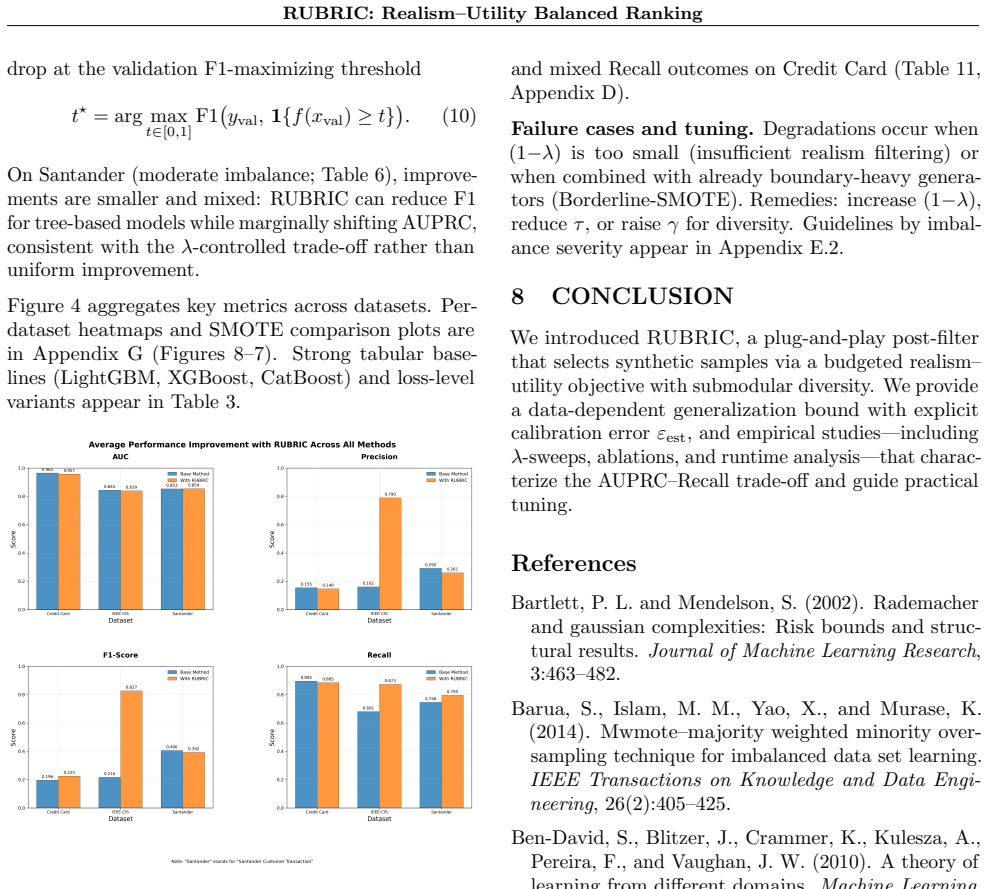
- Main results are statistically mixed in a way that undercuts the abstract’s unqualified claim that RUBRIC “improves F1-macro and recall while maintaining comparable ROC-AUC across several generators.” Paired Δ tables (Tables 11–13) show significant F1 or Recall degradations for NONE, SVM-SMOTE, and KMeans-SMOTE on Credit Card, and F1 drops for tree models on Santander; AUPRC often falls when λ prioritizes utility. The abstract and introduction should state the precision–recall / AUPRC–Recall trade-off as the primary empirical finding (as §7 does), not net uniform improvement. Without that framing, the central empirical claim overstates what Tables 4–6 and 11–13 show.
- Assumption 4.1 (uniform discriminator calibration error ε_est) is the weakest link in the TV argument (Lemma 4.2). The paper never reports calibration diagnostics (e.g., estimated KL or TV between selected U and real minority, or ε_est proxies) per generator. Given that many generators already target boundary regions, D may be poorly calibrated or nearly constant on S, in which case r does not control shift and the joint reduction claimed in Theorem 4.7 need not hold. A short diagnostic table (δ̂ or density-ratio histograms for each Gen) would make the theory–experiment link falsifiable rather than assumed.
minor comments (6)
- Appendix F contains a large amount of loosely related material (multi-stage Q-learning-style recursions, “ultra-complex concentration,” combination-lock lower bounds) that is not used by Theorem 4.7. Trim to proofs of Lemmas 4.2–4.6 and Theorem 4.7; the rest reads as padding and weakens confidence in the theoretical appendix.
- Notation: abstract and §1 say “F1-macro” while tables report F1 (thresholded, validation F1-max). Align terminology and state whether F1 is binary or macro throughout.
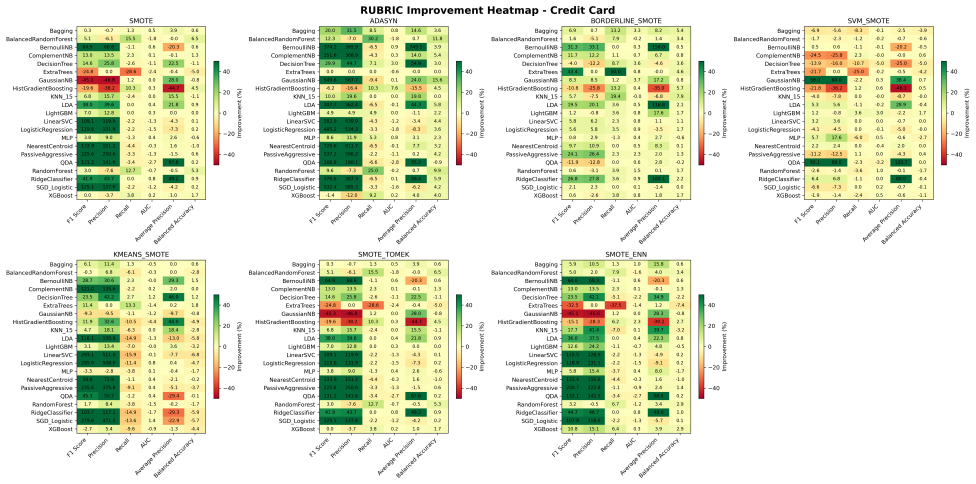
- Figure 1 / heatmaps: “percentage improvements” without stating the baseline metric formula and without pairing to the bootstrap Δ tables makes it hard to reconcile visual gains with significant negative Δs in Tables 11–13.
- Related work cites several contemporaneous Liu & Yu long-context / KV-cache papers that are orthogonal to tabular oversampling; if retained, one sentence should justify relevance, otherwise drop to reduce citation noise.
- Table 1 training order is clear; Algorithm 1 line numbers in the text (“lines 6–8”) do not match the printed algorithm’s line count—fix cross-references.
- Default λ=0.5 is used for main tables while §6 and Figure 3 show strong λ sensitivity; state the default λ explicitly in every main-table caption.
Circularity Check
No significant circularity: the excess-risk bound is a conditional consequence of independent selection scores, not a tautology of its inputs.
full rationale
RUBRIC defines candidate scores independently of the excess-risk claim: utility u = g(margin_f) from a boundary model trained only on real data, realism r as discriminator log-odds, and selection as budgeted maximization of λu+(1−λ)r plus a facility-location diversity term (Eqs. 1–3, Prop. 3.1). Theorem 4.7 then states that if Assumptions 4.1–4.3 hold—so that selection induces a usable TV plug-in bound δ̂ via Pinsker (Lemma 4.2) and a margin floor m0 (Assumption 4.3)—the standard margin/Rademacher excess-risk form tightens by the additive terms C1(δ̂+ε_est)+C2 e^{−m0/τ}. That is a conditional bound under stated regularity, not a definition of success as the score itself, and λ is an explicit user trade-off rather than a parameter fitted to force the theorem. Self-citations (Liu & Yu long-context / KV-cache / multi-task papers; Yu et al. 2025 boundary-aware filtering) are labeled orthogonal or as prior line-of-work and do not supply a uniqueness theorem or ansatz that closes the imbalanced-learning derivation. Experimental anomalies (near-identical multi-generator RUBRIC rows) raise correctness questions about whether the generator-dependent D/S pipeline was actually run as described, but they do not make Eq. 9 reduce by construction to its inputs. No self-definitional loop, fitted-as-prediction, load-bearing self-citation chain, or renamed known result was found in the load-bearing theory chain.
Axiom & Free-Parameter Ledger
free parameters (5)
- lambda (realism–utility trade-off)
- tau (utility temperature)
- gamma (diversity weight)
- K (selection budget)
- discriminator architecture / training hyperparameters
axioms (7)
- standard math Pinsker’s inequality relating TV distance to KL divergence.
- standard math Standard excess-risk / Rademacher bounds for L-Lipschitz bounded surrogate losses of linear predictors in an RKHS ball.
- standard math Monotone submodular maximization under cardinality admits a (1−1/e) greedy guarantee (Nemhauser et al.).
- domain assumption Assumption 4.1: discriminator logit approximates log(p/q) within uniform error ε_est.
- domain assumption Assumption 4.3: score-based selection induces a positive margin floor m0 for all retained synthetics.
- ad hoc to paper Utility shaper g is nondecreasing, concave, and 1/τ-Lipschitz (default softplus-like form).
- ad hoc to paper Boundary model f is trained only on real data and frozen before scoring; final classifier never trains on unfiltered candidates.
invented entities (2)
-
RUBRIC realism–utility score s(˜x)=λu(˜x)+(1−λ)r(˜x)
no independent evidence
-
Concave margin utility shaper g (default log(1+e^{t/τ}))
no independent evidence
read the original abstract
Class imbalance poses a fundamental challenge in risk-sensitive applications such as fraud detection and medical diagnosis, where minority-class samples are scarce yet critical for accurate classification. Existing oversampling methods generate synthetic samples to rebalance class distributions; however, they often produce large numbers of low-quality candidates that distort decision boundaries or introduce artifacts, leading to overfitting and degraded generalization. In this work, we introduce RUBRIC, a generator-agnostic filtering framework that formulates synthetic sample selection as a quality-over-quantity optimization problem. RUBRIC ranks candidates using a realism-utility trade-off: realism is quantified by a learned discriminator that distinguishes real samples from synthetic samples, while utility captures proximity to the decision boundary through a concave margin-based scoring function. We show that, under mild regularity conditions, the proposed filtering strategy monotonically tightens the generalization bound for margin-based classifiers by jointly reducing distribution shift and suppressing near-negative tail contributions. Through extensive experiments on credit-card fraud detection and other imbalanced benchmarks, we demonstrate that RUBRIC improves F1-macro and recall while maintaining comparable ROC-AUC across several generators. We also provide explicit lambda-sensitivity analysis to show how users can recover AUPRC when ranking quality is prioritized.
Figures






discussion (0)
Sign in with ORCID, Apple, or X to comment. Anyone can read and Pith papers without signing in.