REVIEW 4 minor 69 references
The extractable work stored in a Gaussian state splits the phase-space Fisher information into a passive piece fixed by entropy rate and an ergotropic piece fixed by displacement and squeezing.
Reviewed by Pith at T0; open to challenge. T0 means a machine referee read the full paper against a public rubric. the ladder, T0–T4 →
T0 review · grok-4.5
2026-07-14 15:00 UTC pith:JZGOJJSM
load-bearing objection Clean analytic split of Wigner-Fisher into passive and ergotropic pieces for Gaussians; solid subfield bridge, not a paradigm shift.
Ergotropic and passive contributions on the phase-space information geometry of Gaussian states
The pith
A machine-rendered reading of the paper's core claim, the machinery that carries it, and where it could break.
Core claim
For single-mode Gaussian states the Wigner-Fisher information admits the exact decomposition I_W(t)=I_π(t)+I_E(t), where the passive term I_π(t)=2Ṡ_W^{2}(t) is fixed solely by the Wigner-entropy rate of the associated passive state and the ergotropic remainder I_E=I_d+I_s+I_ds quantifies the geometric effect of displacement and squeezing resources.
What carries the argument
The ergotropic decomposition of the Wigner-Fisher information: I_W = I_π + I_d + I_s + I_ds, derived from the mean-vector and covariance-matrix formula for the Fisher information and the Lyapunov equation of the open-system dynamics.
Load-bearing premise
The whole analysis assumes that every state remains Gaussian and that the open dynamics preserves that Gaussianity, so that a positive Wigner function and a two-by-two covariance matrix completely determine both the Fisher information and the passive–ergotropic split.
What would settle it
Prepare a single-mode Gaussian state that is both displaced and squeezed, measure its Wigner function at successive times under weak thermal damping, reconstruct the empirical Fisher information from the trajectory, and check whether it equals the sum of the analytically predicted passive and ergotropic pieces; any statistically significant mismatch falsifies the decomposition.
Editorial analysis
A structured set of objections, weighed in public.
Referee Report
Summary. The manuscript derives a closed-form expression for the Wigner-Fisher information of single-mode Gaussian states (Eq. 2) and shows that it decomposes exactly as I_W(t)=I_π(t)+I_E(t). The passive piece I_π=2 Ṗ_W^{2} is fixed solely by the Wigner-entropy rate of the associated passive state (Eq. 9), while the ergotropic remainder I_E=I_d+I_s+I_ds quantifies the geometric contributions of displacement, squeezing and their cross term (Eqs. 10–12). The derivation rests on the positivity of the Wigner function, the 2 imes2 matrix identity Tr{A^{2}}=(Tr A)^{2}-2 det A, and the Lyapunov equation for the covariance under weak-coupling GKLS dynamics. The same framework is used to re-interpret the ergotropic Mpemba effect as an anomalous trajectory of the passive state on the thermal manifold, with supporting analytic expressions and numerical illustrations.
Significance. If correct, the work supplies a concrete, parameter-free bridge between ergotropy and information geometry for continuous-variable systems. The analytic split is fully elementary (Appendices A–C) and immediately yields geometric interpretations of statistical length and velocity in terms of extractable work and entropy production. The Mpemba application demonstrates that the decomposition is not merely formal: it isolates the non-monotonic passive-state dynamics that underlie the anomalous discharge. Within the Gaussian regime the results are therefore both theoretically clean and practically useful for quantum-battery and metrology analyses.
minor comments (4)
- In the abstract and introduction the phrase “Wigner entropy rate of the associated passive state” is used; a one-sentence reminder that S_W coincides with the Rényi-2 entropy for Gaussian states would help non-specialist readers.
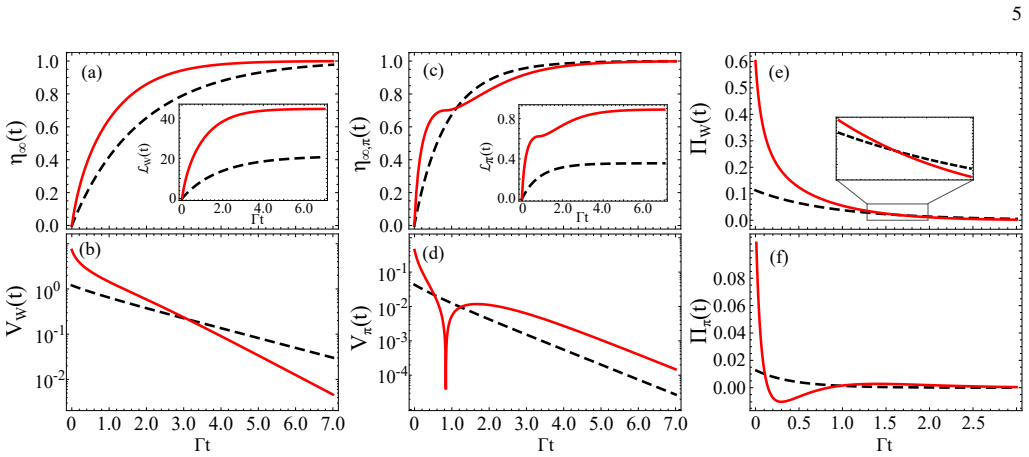
- Figure 3 panels (c,d) show non-monotonic η_∞,π and V_π for the squeezed passive state; adding a short remark that these quantities are computed from the instantaneous passive occupation (Eq. 18) rather than from a physical trajectory of the master equation would avoid possible misreading.
- Eq. (16) for the pure-displacement length L_d(t) is exact only when the passive state is the equilibrium state; a parenthetical note clarifying this restriction would improve readability.
- A few typographical inconsistencies appear (e.g., “ergotropic” vs. “ergotropy”, missing spaces around “×” in matrix dimensions); a light copy-edit pass would suffice.
Circularity Check
Algebraic decomposition of WFI is self-contained; only minor non-load-bearing self-citation for the Mpemba application.
specific steps
-
self citation load bearing
[Example: ergotropic Mpemba effect; also Eqs. (8),(17) and App. C]
"As an application, we analyze the recently proposed ergotropic Mpemba effect and demonstrate that it can be traced to the anomalous geometric evolution of the passive state associated with squeezed thermal states. ... In Ref. [44], it is shown that for Gaussian states ergotropy is given by E=ω(n̄_π+1/2)K[W||W_π] ..."
The Mpemba phenomenology and the closed-form Gaussian ergotropy are taken from the authors’ own prior paper [44]. The present work supplies an independent geometric reading via the new WFI split, so the self-citation is not load-bearing for the main claim; it is recorded only as a minor non-circular self-reference.
full rationale
The central result I_W(t)=I_π(t)+I_E(t) with I_π=2Ṡ_W^{2}(t) follows by direct Taylor expansion of the Wigner KL divergence (App. A, yielding Eq. 2) followed by the 2 imes2 matrix identity Tr{A^{2}}=(Tr A)^{2}-2 det A and the Gaussian identity det Θ=det Θ_π (App. B). All steps are algebraic rearrangements of the Lyapunov equation under the stated GKLS dynamics; no parameters are fitted, no uniqueness theorem is imported, and no quantity is redefined as its own prediction. The ergotropic Mpemba application re-uses the effect and ergotropy formulae of the authors’ prior work [44], but that citation is not load-bearing for the geometric decomposition itself, which stands independently. Hence only a minor self-citation score of 1.
Axiom & Free-Parameter Ledger
axioms (4)
- domain assumption Wigner function of any single-mode Gaussian state is positive and can be treated as a classical probability density on phase space.
- standard math Chentsov’s theorem: the Fisher information is the unique Riemannian metric contractive under stochastic maps.
- domain assumption System-bath interaction is weak and Markovian, generating the standard thermal GKLS master equation (6) whose covariance evolution is the Lyapunov equation.
- domain assumption Ergotropy of a Gaussian state equals ω(n_π+1/2) times the Wigner relative entropy to its passive state.
invented entities (1)
-
Ergotropic contribution I_E to the Wigner-Fisher information
no independent evidence
read the original abstract
We establish a direct connection between quantum thermodynamics and information geometry by introducing an ergotropic decomposition of the Wigner-Fisher information for Gaussian quantum states. We derive an analytical expression for the Wigner-Fisher information in terms of the phase-space covariance matrix and mean vector, and show that it naturally separates into passive and ergotropic contributions. The passive term is shown to be entirely determined by the Wigner entropy rate of the associated passive state. The ergotropic contribution, in turn, quantifies how displacement and squeezing resources modify the statistical velocity and length of the system trajectory in phase space. As an application, we analyze the recently proposed ergotropic Mpemba effect and demonstrate that it can be traced to the anomalous geometric evolution of the passive state associated with squeezed thermal states. Our results reveal how the extractable work stored in a quantum state constrains its information-geometric structure, establishing a framework that links ergotropy, entropy production rate, and statistical geometry in continuous-variable quantum systems.
Figures


Reference graph
Works this paper leans on
-
[1]
E. T. Jaynes, Information theory and statistical mechanics, Phys. Rev.106, 620 (1957)
1957
-
[2]
E. T. Jaynes, Information theory and statistical mechanics. ii, Phys. Rev.108, 171 (1957)
1957
-
[3]
H. S. Leff and A. F. Rex,Maxwell’s demon: entropy, informa- tion, computing(Princeton University Press, 1990)
1990
-
[4]
Maruyama, F
K. Maruyama, F. Nori, and V . Vedral, Colloquium: The physics of maxwell’s demon and information, Rev. Mod. Phys.81, 1 (2009)
2009
-
[5]
Amari and H
S.-i. Amari and H. Nagaoka,Methods of information geometry, V ol. 191 (American Mathematical Soc., 2000)
2000
-
[6]
G. E. Crooks, Measuring thermodynamic length, Phys. Rev. Lett.99, 100602 (2007)
2007
-
[7]
E. H. Feng and G. E. Crooks, Far-from-equilibrium measure- ments of thermodynamic length, Phys. Rev. E79, 012104 (2009)
2009
-
[8]
D. A. Sivak and G. E. Crooks, Thermodynamic metrics and op- timal paths, Phys. Rev. Lett.108, 190602 (2012)
2012
-
[9]
Ito, Stochastic thermodynamic interpretation of information geometry, Phys
S. Ito, Stochastic thermodynamic interpretation of information geometry, Phys. Rev. Lett.121, 030605 (2018)
2018
-
[10]
S. Ito, M. Oizumi, and S.-i. Amari, Unified framework for the entropy production and the stochastic interaction based on in- formation geometry, Phys. Rev. Res.2, 033048 (2020)
2020
-
[11]
Van Vu and Y
T. Van Vu and Y . Hasegawa, Geometrical bounds of the irre- versibility in markovian systems, Phys. Rev. Lett.126, 010601 (2021)
2021
-
[12]
Dechant, S.-i
A. Dechant, S.-i. Sasa, and S. Ito, Geometric decomposition of entropy production in out-of-equilibrium systems, Phys. Rev. Res.4, L012034 (2022)
2022
-
[13]
L. P. Bettmann and J. Goold, Information geometry approach to quantum stochastic thermodynamics, Phys. Rev. E111, 014133 (2025)
2025
-
[14]
S. L. Braunstein and C. M. Caves, Statistical distance and the geometry of quantum states, Phys. Rev. Lett.72, 3439 (1994)
1994
-
[15]
N. N. Cencov,Statistical decision rules and optimal inference, 53 (American Mathematical Soc., 2000)
2000
-
[16]
J. G. Dowty, Chentsov’s theorem for exponential families, In- formation Geometry1, 117 (2018)
2018
-
[17]
Bengtsson and K
I. Bengtsson and K. ˙Zyczkowski,Geometry of Quantum States: An Introduction to Quantum Entanglement, 2nd ed. (Cambridge University Press, 2017)
2017
-
[18]
E. A. Morozova and N. N. Chentsov, Markov invariant geom- etry on manifolds of states, Journal of Soviet Mathematics56, 2648 (1991)
1991
-
[19]
Petz, Monotone metrics on matrix spaces, Linear algebra and its applications244, 81 (1996)
D. Petz, Monotone metrics on matrix spaces, Linear algebra and its applications244, 81 (1996)
1996
-
[20]
Petz and H
D. Petz and H. Hasegawa, On the riemannian metric ofα- entropies of density matrices, Letters in Mathematical Physics 38, 221 (1996)
1996
-
[21]
S. B. Nicholson, A. del Campo, and J. R. Green, Nonequilib- rium uncertainty principle from information geometry, Phys. Rev. E98, 032106 (2018)
2018
-
[22]
Hasegawa and T
Y . Hasegawa and T. Van Vu, Uncertainty relations in stochastic processes: An information inequality approach, Phys. Rev. E 99, 062126 (2019)
2019
-
[23]
Hasegawa and T
Y . Hasegawa and T. Van Vu, Fluctuation theorem uncertainty relation, Phys. Rev. Lett.123, 110602 (2019)
2019
-
[24]
S. B. Nicholson, L. P. Garc ´ıa-Pintos, A. del Campo, and J. R. Green, Time–information uncertainty relations in thermody- namics, Nature Physics16, 1211 (2020)
2020
-
[25]
Van Vu and K
T. Van Vu and K. Saito, Thermodynamic unification of opti- mal transport: Thermodynamic uncertainty relation, minimum dissipation, and thermodynamic speed limits, Phys. Rev. X13, 011013 (2023)
2023
-
[26]
del Campo, I
A. del Campo, I. L. Egusquiza, M. B. Plenio, and S. F. Huelga, Quantum speed limits in open system dynamics, Phys. Rev. Lett.110, 050403 (2013)
2013
-
[27]
M. M. Taddei, B. M. Escher, L. Davidovich, and R. L. de Matos Filho, Quantum speed limit for physical processes, Phys. Rev. Lett.110, 050402 (2013)
2013
-
[28]
D. P. Pires, M. Cianciaruso, L. C. C ´eleri, G. Adesso, and D. O. Soares-Pinto, Generalized geometric quantum speed lim- its, Phys. Rev. X6, 021031 (2016)
2016
-
[29]
Shiraishi, K
N. Shiraishi, K. Funo, and K. Saito, Speed limit for classical stochastic processes, Phys. Rev. Lett.121, 070601 (2018)
2018
-
[30]
Okuyama and M
M. Okuyama and M. Ohzeki, Quantum speed limit is not quan- tum, Phys. Rev. Lett.120, 070402 (2018)
2018
-
[31]
Ito and A
S. Ito and A. Dechant, Stochastic time evolution, information geometry, and the cram´er-rao bound, Phys. Rev. X10, 021056 (2020)
2020
-
[32]
V . T. V o, T. Van Vu, and Y . Hasegawa, Unified approach to clas- sical speed limit and thermodynamic uncertainty relation, Phys. Rev. E102, 062132 (2020)
2020
-
[33]
L. P. Garc´ıa-Pintos, S. B. Nicholson, J. R. Green, A. del Campo, and A. V . Gorshkov, Unifying quantum and classical speed lim- its on observables, Phys. Rev. X12, 011038 (2022)
2022
-
[34]
Y . Dong, W. Jiang, Z.-W. Liu, Y . Liu, S.-C. Zhang, D. P. Pires, D. O. Soares-Pinto, X.-D. Chen, G.-C. Guo, and F.-W. Sun, Experimental investigation of the trade-off between quan- tum speed and energy cost, npj Quantum Information11, 199 (2025)
2025
-
[35]
P. B. Melo, F. Iemini, D. O. Soares-Pinto, S. M. D. Queir´os, and W. A. M. Morgado, Thermodynamic interpretation to stochastic fisher information and single-trajectory speed limits, Phys. Rev. E112, 014126 (2025)
2025
-
[36]
P. B. Melo, P. V . Paraguass´u, S. M. D. Queir´os, F. Iemini, M. Pa- ternostro, and W. A. M. Morgado, Stochastic quantum informa- tion geometry and speed limits at the trajectory level (2026), arXiv:2601.12475 [quant-ph]
Pith/arXiv arXiv 2026
-
[37]
L. P. Bettmann, A. M. Lacerda, M. T. Mitchison, and J. Goold, Thermodynamic universality across dissipative quantum phase transitions, (2025), arXiv:2512.05074 [quant-ph]
arXiv 2025
-
[38]
A. M. Lacerda, L. P. Bettmann, and J. Goold, Information ge- ometry of transitions between quantum nonequilibrium steady states, Physical Review E112, L022101 (2025)
2025
-
[39]
A. E. Allahverdyan, R. Balian, and T. M. Nieuwenhuizen, Max- imal work extraction from finite quantum systems, Europhysics Letters67, 565 (2004)
2004
-
[40]
Campaioli, S
F. Campaioli, S. Gherardini, J. Q. Quach, M. Polini, and G. M. Andolina, Colloquium: Quantum batteries, Rev. Mod. Phys.96, 031001 (2024)
2024
-
[41]
J. M. Z. Choquehuanca, P. A. C. Obando, M. S. Sarandy, and F. M. de Paula, Ergotropy-based quantum thermodynamics, Phys. Rev. A112, 052220 (2025). 7
2025
-
[42]
Francica, F
G. Francica, F. C. Binder, G. Guarnieri, M. T. Mitchison, J. Goold, and F. Plastina, Quantum coherence and ergotropy, Phys. Rev. Lett.125, 180603 (2020)
2020
-
[43]
Sone and S
A. Sone and S. Deffner, Quantum and classical ergotropy from relative entropies, Entropy23, 1107 (2021)
2021
-
[44]
Medina, O
I. Medina, O. Culhane, F. C. Binder, G. T. Landi, and J. Goold, Anomalous discharging of quantum batteries: The ergotropic mpemba effect, Phys. Rev. Lett.134, 220402 (2025)
2025
-
[45]
E. G. Brown, N. Friis, and M. Huber, Passivity and practi- cal work extraction using gaussian operations, New Journal of Physics18, 113028 (2016)
2016
-
[46]
Singh, M
U. Singh, M. G. Jabbour, Z. Van Herstraeten, and N. J. Cerf, Quantum thermodynamics in a multipartite setting: A resource theory of local gaussian work extraction for multimode bosonic systems, Phys. Rev. A100, 042104 (2019)
2019
-
[47]
F. E. Q. Rodriguez, F. A. Mele, S. F. E. Oliviero, V . Giovannetti, L. Lami, and V . Cavina, Extracting energy via bosonic gaussian operations, (2025), arXiv:2503.21748 [quant-ph]
Pith/arXiv arXiv 2025
-
[48]
P. B. Slater, Quantum and fisher information from the husimi and related distributions, Journal of Mathematical Physics47, 022104 (2006)
2006
-
[49]
Pinel, J
O. Pinel, J. Fade, D. Braun, P. Jian, N. Treps, and C. Fabre, Ul- timate sensitivity of precision measurements with intense gaus- sian quantum light: A multimodal approach, Phys. Rev. A85, 010101 (2012)
2012
-
[50]
Pinel, P
O. Pinel, P. Jian, N. Treps, C. Fabre, and D. Braun, Quantum pa- rameter estimation using general single-mode gaussian states, Phys. Rev. A88, 040102 (2013)
2013
-
[51]
Jiang, Quantum fisher information for states in exponential form, Phys
Z. Jiang, Quantum fisher information for states in exponential form, Phys. Rev. A89, 032128 (2014)
2014
-
[52]
Deffner, Geometric quantum speed limits: a case for wigner phase space, New Journal of Physics19, 103018 (2017)
S. Deffner, Geometric quantum speed limits: a case for wigner phase space, New Journal of Physics19, 103018 (2017)
2017
-
[53]
Huber, R
S. Huber, R. K ¨onig, and A. Vershynina, Geometric inequalities from phase space translations, Journal of Mathematical Physics 58, 012206 (2017)
2017
-
[54]
S. Tang, F. Albarelli, Y . Zhang, S. Luo, and M. G. A. Paris, Quantifying complexity of continuous-variable quantum states via wehrl entropy and fisher information, Quantum Science and Technology10, 045047 (2025)
2025
-
[55]
Fadel, N
M. Fadel, N. Roux, and M. Gessner, Quantum metrology with a continuous-variable system, Reports on Progress in Physics88, 106001 (2025)
2025
-
[56]
A. Monras, Phase space formalism for quantum estimation of gaussian states (2013), arXiv:1303.3682 [quant-ph]
Pith/arXiv arXiv 2013
-
[57]
Nielsen, A simple approximation method for the fisher–rao distance between multivariate normal distributions, Entropy25, 654 (2023)
F. Nielsen, A simple approximation method for the fisher–rao distance between multivariate normal distributions, Entropy25, 654 (2023)
2023
-
[58]
Sorelli, M
G. Sorelli, M. Gessner, N. Treps, and M. Walschaers, Gaussian quantum metrology for mode-encoded parameters, New Jour- nal of Physics26, 073022 (2024)
2024
-
[59]
J. P. Santos, G. T. Landi, and M. Paternostro, Wigner entropy production rate, Phys. Rev. Lett.118, 220601 (2017)
2017
-
[60]
E. B. Mpemba and D. G. Osborne, Cool?, Physics Education4, 172 (1969)
1969
-
[61]
G. S. Kell, The freezing of hot and cold water, American Jour- nal of Physics37, 564 (1969)
1969
-
[62]
Moroder, O
M. Moroder, O. Culhane, K. Zawadzki, and J. Goold, Thermo- dynamics of the quantum mpemba effect, Phys. Rev. Lett.133, 140404 (2024)
2024
-
[63]
F. Ares, P. Calabrese, and S. Murciano, The quantum mpemba effects, Nature Reviews Physics7, 451 (2025)
2025
-
[64]
Summer, M
A. Summer, M. Moroder, L. P. Bettmann, X. Turkeshi, I. Mar- vian, and J. Goold, Resource-theoretical unification of mpemba effects: Classical and quantum, Phys. Rev. X16, 011065 (2026)
2026
-
[65]
Westhoff, S
P. Westhoff, S. Paeckel, and M. Moroder, Fast and direct prepa- ration of a genuine lattice bose-einstein condensate via the quantum mpemba effect, Phys. Rev. A112, L061304 (2025)
2025
-
[66]
K. B. Petersen and M. S. Pedersen, The matrix cookbook (2012), version 20121115. 8 Appendix A: Wigner-Fisher information for Gaussian States In this appendix, we derive the Wigner-Fisher information expression for a single-bosonic mode described by a Gaussian state. Any single mode Gaussian state can be expressed in the phase space representation by a Wig...
2012
-
[67]
Mean vector term: (⃗ vθ+dθ −⃗ vθ)†Θ−1 θ (⃗ vθ+dθ −⃗ vθ)≈ d⃗ vθ dθ dθ+ 1 2 d2⃗ vθ dθ2 dθ2 † Θ−1 θ d⃗ vθ dθ dθ+ 1 2 d2⃗ vθ dθ2 dθ2 ≈ ˙⃗ v† θΘ−1 θ ˙⃗ vθdθ2.(A11) 9
-
[68]
The trace term: Tr{Θ−1 θ Θθ+dθ} ≈Tr Θ−1 θ Θθ + dΘθ dθ dθ+ 1 2 d2Θθ dθ2 dθ2 = 2 + Tr{Θ−1 θ ˙Θθ}dθ+ 1 2Tr{Θ−1 θ ¨Θθ}dθ2.(A12)
-
[69]
Γ 2 +iω 2 ei∆ # , where we defined the difference between the displacement and squeezing phases as∆ =ϕ d −ϕ s. Then ˙⃗ v† θΘ−1 θ ˙⃗ vθ = 4 2¯nπ(t) + 1
For the logarithm term, we use the following identities [66] d dθ (det Θθ) = det ΘθTr{Θ−1 θ ˙Θθ}(A13) d dθ Θ−1 θ =−Θ −1 θ ˙ΘθΘ−1 θ (A14) =⇒ d dθ ln[(det Θθ)] = Tr{Θ−1 θ ˙Θθ}(A15) =⇒ d2 dθ2 ln[(det Θθ)] = Tr{Θ−1 θ ¨Θθ −Θ −1 θ ˙ΘθΘ−1 θ ˙Θθ}.(A16) Then ln[det(Θθ+dθ)]≈det Θ θ + Tr{Θ−1 θ ˙Θθ}dθ+ 1 2Tr{Θ−1 θ ¨Θθ −Θ −1 θ ˙ΘθΘ−1 θ ˙Θθ}dθ2,(A17) and finally ln det...
discussion (0)
Sign in with ORCID, Apple, or X to comment. Anyone can read and Pith papers without signing in.