REVIEW 3 major objections 7 minor 12 references
A training-free LLM query channel, fused with behavioral neighbors via Union, serves vacation-rental long-tail and cold-start listings without cutting recall on popular properties.
Reviewed by Pith at T0; open to challenge. T0 means a machine referee read the full paper against a public rubric. the ladder, T0–T4 →
T0 review · grok-4.5
2026-07-14 14:52 UTC pith:PCURFUFZ
load-bearing objection Solid industrial CG paper: Union fusion is a clean, non-regressing way to bolt a metadata-only LLM query channel onto IBKNN, with real long-tail and cold-start coverage at 11.7M scale; offline co-view GT is the main soft spot, not a fatal one. the 3 major comments →
Serving the Long Tail: Training-Free LLM Candidate Generation for Vacation Rental Marketplaces
The pith
A machine-rendered reading of the paper's core claim, the machinery that carries it, and where it could break.
Core claim
Union fusion of a training-free LLM metadata-query channel with IBKNN guarantees Recall@K at least as high as IBKNN alone for every property and every K, while the LLM channel supplies the missing candidates that lift long-tail and cold-start coverage; under that fusion the choice of query-generator model becomes almost irrelevant.
What carries the argument
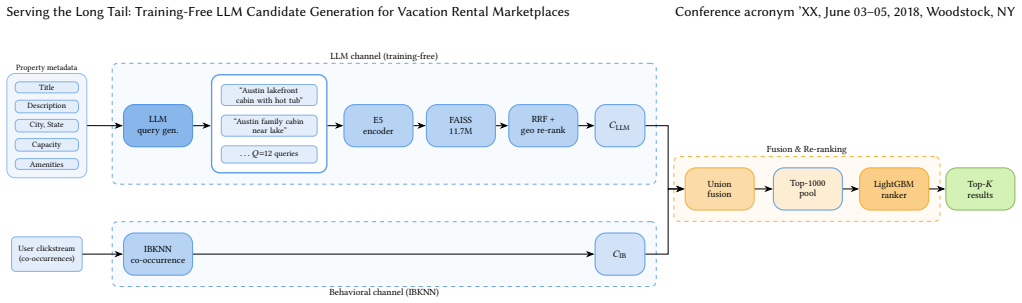
Union fusion: copy the ordered IBKNN list first, then append only novel LLM-retrieved candidates until the target length is reached, thereby preserving behavioral order and guaranteeing non-decreasing recall.
Load-bearing premise
Held-out session co-occurrence is treated as ground-truth relevance even for brand-new and barely-interacted listings, where that signal is sparse and may favor already-popular substitutes rather than true quality.
What would settle it
An online A/B test that measures click-through and booking conversion for long-tail and cold-start carousels under Union versus pure IBKNN would show whether the offline recall lifts translate into better traveler or host outcomes.
Editorial analysis
A structured set of objections, weighed in public.
Referee Report
Summary. The paper proposes a training-free candidate-generation channel for item-to-item vacation-rental recommendation that uses an off-the-shelf LLM to synthesize diverse natural-language queries from static property metadata, retrieves neighbors via a pre-trained dense encoder and FAISS over an 11.7M catalog, and merges the result with a mature IBKNN behavioral channel through an append-only Union fusion rule. A formal recall-preservation argument shows Union@K ≥ IBKNN@K for every focal property; a LightGBM LambdaRank stage then re-scores the fused top-1000 pool. On 1.6M focals the authors report: (i) Union matches or beats IBKNN at every K on shared properties, with lift concentrated on the 1–5 interaction segment (+4.34pp R@300, +6.25pp R@1000); (ii) coverage of ~51K properties IBKNN cannot serve; (iii) collapse of a 27–46% standalone recall gap between LLaMA-3.2-3B and frontier API models to under 1% under Union; and (iv) a modest further lift from the re-ranker.
Significance. If the empirical interpretation holds, this is a practically useful systems contribution for two-sided marketplace candidate generation: a deployable, training-free complement to collaborative filtering that is eligible for any listing with parseable metadata, comes with an explicit no-regression guarantee on well-served inventory, and makes self-hosted small LLMs operationally competitive with frontier APIs once fused. The formal Union construction and the LLM-choice robustness result under that construction are the clearest transferable findings. Scale (1.6M focals / 11.7M catalog) and the honest limitations discussion are strengths. The work is incremental relative to query-generation retrieval (e.g., QueRec) and content hybrids (e.g., Hotel2vec), but the marketplace-facing fusion design and the small-model deployment implication are concrete practitioner value.
major comments (3)
- [§4 Evaluation protocol; §5.2–5.3; §6] The headline long-tail and cold-start claims rest on held-out session co-occurrence (2025-09-09–2025-10-08) as ground-truth relevance for every focal (§4). For the very_low bucket and especially pure cold-start properties this proxy is sparse and biased toward already-popular substitutes; the paper acknowledges this in §6 but still presents offline Recall lifts and ~51K coverage as evidence that the stack “serves the long tail.” Coverage (§5.3, Table 3) only shows eligibility, not candidate quality. Please either (a) report LLM-channel Recall@K / precision-style diagnostics restricted to cold-start and very_low focals that do have test co-occurrences, with confidence intervals, or (b) substantially soften the marketplace-outcome language in abstract, §5.2–5.3, and conclusion so that offline co-view is not over-read as host/user value.
- [§3.2; §5.1; Related Work vs Hotel2vec] There is no non-LLM content baseline that embeds the same serialized metadata once and retrieves with the same E5+FAISS stack (or a simple BM25/geo hybrid). Without that ablation it is hard to isolate how much of the LLM channel’s complementary candidates come from multi-query facet expansion versus ordinary dense content retrieval. The design argument in §3.2 (“Why multiple queries…”) is plausible but untested. A single-embedding and/or bag-of-fields baseline on the same 1.6M (or the 10K ablation subset) is load-bearing for the claim that an LLM query generator is the right training-free mechanism.
- [§5.4; Table 4; §4 LLM-ablation subset] Table 4’s LLM-choice comparison (and the 27–46%→<1% collapse claim) is run only on a 10K subset forced by API rate limits. Representativeness is checked only by matching LLaMA aggregate recall within 1.7pp. Please report segment composition of the 10K draw (very_low/low/medium/high/cold-start shares) versus the full 1.6M, and ideally re-run at least the Union block stratified by interaction bucket so the robustness claim is not only an aggregate head-dominated effect of IBKNN position preservation.
minor comments (7)
- [Title page / ACM Reference Format] ACM front-matter is still placeholder (Conference acronym ’XX, Woodstock NY, 2018 copyright year, empty DOI). Clean before camera-ready.
- [Figure 1] Figure 1 is helpful but the “Q=12 queries” block is duplicated in the figure text; a single path would read more cleanly.
- [§3.3] Theorem in §3.3 is correct by construction; consider labeling it formally (Theorem 1) and stating the position-preservation corollary in the same box for citability.
- [Table 1] Table 1 footnote: LLM-only R@1000 = R@500 because of the ~500-candidate ceiling—state the mean unique-candidate count explicitly in the table caption.
- [§5.1; §5.5] Haversine rises under Union and further under LightGBM (§5.1, §5.5); a short note on whether production surfaces apply a hard geo radius after fusion would help practitioners.
- [§2] Related work cites QueRec and Hotel2vec appropriately; a one-sentence contrast table (training required? user history? item-to-item?) would sharpen positioning.
- [Abstract] Minor prose: “AUnion fusionstrategy” spacing in the abstract; consistent capitalization of Union vs union.
Circularity Check
No circularity: Union recall guarantee is an explicit algorithmic construction, evaluation is held-out, and no load-bearing self-citation or fitted-as-prediction chain exists.
full rationale
The paper’s central formal claim—the Union recall-preservation theorem (§3.3, Alg. 1)—is not a disguised prediction; it is proven directly from the append-only procedure (IBKNN prefix preserved, LLM only fills empty slots). The authors state this openly (“by construction,” “consistent with the recall-preservation guarantee”) rather than presenting the inequality as an independent empirical discovery. Empirical content that is not forced by that construction includes: (i) magnitude and long-tail concentration of the lift (Table 2: +4.34 pp R@300 / +6.25 pp R@1000 on the 1–5 bucket), (ii) ~51K cold-start coverage counts, (iii) 4% mean channel overlap, (iv) collapse of the 27–46% standalone LLM gap under Union (Table 4), and (v) LightGBM mid-K lift (Table 5). Ground-truth co-occurrence is taken from a held-out clickstream window (2025-09-09–2025-10-08) strictly disjoint from the IBKNN training window; the LLM channel uses no interaction labels at all. The LightGBM ranker is standard supervised LambdaRank on graded co-view/book labels with a disjoint training window—not a redefinition of the CG claim. References are external (Sarwar, Linden, Item2Vec, TALLRec, TIGER, QueRec, Hotel2vec, E5, Llama 3, RRF); there is no self-citation chain, uniqueness theorem imported from the authors, or ansatz smuggled via prior work. Weaknesses of the co-occurrence proxy are validity/limitation issues (§6), not circularity. Derivation chain is self-contained against external benchmarks.
Axiom & Free-Parameter Ledger
free parameters (6)
- Q (queries per focal)
- LLM sampling temperature T
- RRF constant k and per-query top-N
- geo re-rank weights 0.7 semantic : 0.3 haversine
- Union output size K / fused pool top-1000 for LTR
- LightGBM LambdaRank labels and negative sampling (4/1/0 grades, 5:1 negatives, 5M cap)
axioms (4)
- domain assumption Same-session co-occurrence in a held-out clickstream window defines relevance for Recall@K.
- domain assumption Parseable static metadata (location, type, amenities, text) is sufficient for an instruction-tuned LLM to generate useful substitute queries without interaction history.
- ad hoc to paper Preserving IBKNN order and only appending non-overlapping LLM candidates is the correct fusion objective for marketplace deployment (no host-side regression on well-served items).
- standard math Standard dense retrieval and RRF aggregation behave as established in prior IR literature (Cormack et al.; E5 encoder).
invented entities (1)
-
Union fusion (append-only IBKNN-then-LLM merge)
no independent evidence
read the original abstract
Vacation rental marketplaces face a structural imbalance on the supply side: a small fraction of properties receive most user interactions, while the long tail of new, niche, and seasonal listings generates too little behavioral signal for collaborative filtering to serve effectively. At Vrbo, item-based k-nearest neighbors (IBKNN) is a core candidate generation channel, but leaves tens of thousands of properties with no candidates and produces weak neighborhoods for sparsely interacted ones. We present a training-free, LLM-based candidate generation pipeline that complements IBKNN using static property metadata alone. An off-the-shelf LLM synthesizes diverse semantic queries per property, a pre-trained text encoder embeds them, and an approximate nearest-neighbor index retrieves candidates from an 11.7M-property catalog. A Union fusion strategy merges these with IBKNN while preserving the behavioral channel's ordering, guaranteeing no degradation on well-served properties, and a downstream learning-to-rank model re-scores the fused pool. Evaluated on 1.6M focal properties, the system extends candidate coverage to tens of thousands of properties IBKNN cannot reach, delivers its largest gains on the long-tail segment where behavioral methods are weakest, and matches or beats IBKNN at every K on shared properties. A downstream learning-to-rank stage further lifts the fused pool, yielding a complete candidate generation and re-ranking stack that serves the long tail without regressing well-served properties. We additionally show that Union fusion collapses the recall gap between a 3B open-weights LLM and frontier API-based models from 27-46% to under 1%, supporting self-hosted small-model deployment at marketplace catalog scale.
Figures

Reference graph
Works this paper leans on
-
[1]
Keqin Bao, Jizhi Zhang, Yang Zhang, Wenjie Wang, Fuli Feng, and Xiangnan He. 2023. TALLRec: An Effective and Efficient Tuning Framework to Align Large Language Model with Recommendation. InProceedings of the 17th ACM Conference on Recommender Systems (RecSys ’23). 1007–1014. doi:10.1145/3604915. 3608857
doi:10.1145/3604915 2023
-
[2]
Oren Barkan and Noam Koenigstein. 2016. Item2Vec: Neural Item Embedding for Collaborative Filtering. In2016 IEEE 26th International Workshop on Machine Learning for Signal Processing (MLSP). IEEE, 1–6. arXiv:1603.04259
Pith/arXiv arXiv 2016
-
[3]
Gordon V. Cormack, Charles L. A. Clarke, and Stefan Büttcher. 2009. Reciprocal Rank Fusion Outperforms Condorcet and Individual Rank Learning Methods. InProceedings of the 32nd International ACM SIGIR Conference on Research and Development in Information Retrieval (SIGIR ’09). ACM, 758–759. doi:10.1145/ 1571941.1572114
arXiv 2009
-
[4]
Abhimanyu Dubey, Abhinav Jauhri, Abhinav Pandey, et al. 2024. The Llama 3 Herd of Models.arXiv preprint arXiv:2407.21783(2024). arXiv:2407.21783
Pith/arXiv arXiv 2024
-
[5]
Sein Kim, HongSeok Kang, Kibum Kim, Jiwan Kim, et al. 2025. Rethinking LLM- Based Recommendations: A Query Generation-Based, Training-Free Approach. arXiv preprint arXiv:2504.11889(2025). arXiv:2504.11889
Pith/arXiv arXiv 2025
-
[6]
Greg Linden, Brent Smith, and Jeremy York. 2003. Amazon.com Recommenda- tions: Item-to-Item Collaborative Filtering.IEEE Internet Computing7, 1 (2003), 76–80. doi:10.1109/MIC.2003.1167344
-
[7]
Keshavan, Trung Vu, Lukasz Heldt, Lichan Hong, Yi Tay, Vinh Q
Shashank Rajput, Nikhil Mehta, Anima Singh, Raghunandan H. Keshavan, Trung Vu, Lukasz Heldt, Lichan Hong, Yi Tay, Vinh Q. Tran, Jonah Samost, Maciej Kula, Ed H. Chi, and Maheswaran Sathiamoorthy. 2023. Recommender Systems with Generative Retrieval. InAdvances in Neural Information Processing Systems (NeurIPS), Vol. 36. 10299–10315. arXiv:2305.05065
Pith/arXiv arXiv 2023
-
[8]
Ali Sadeghian, Shervin Minaee, Ioannis Partalas, Xinxin Li, Daisy Zhe Wang, and Brooke Cowan. 2019. Hotel2vec: Learning Attribute-Aware Hotel Embeddings with Self-Supervision. InarXiv preprint arXiv:1910.03943. arXiv:1910.03943
Pith/arXiv arXiv 2019
-
[9]
Badrul Sarwar, George Karypis, Joseph Konstan, and John Riedl. 2001. Item-Based Collaborative Filtering Recommendation Algorithms. InProceedings of the 10th International Conference on World Wide Web (WWW ’01). 285–295. doi:10.1145/ 371920.372071
arXiv 2001
-
[10]
Liang Wang, Nan Yang, Xiaolong Huang, Binxing Jiao, Linjun Yang, Daxin Jiang, Rangan Majumder, and Furu Wei. 2022. Text Embeddings by Weakly-Supervised Contrastive Pre-training.arXiv preprint arXiv:2212.03533(2022). arXiv:2212.03533
Pith/arXiv arXiv 2022
-
[11]
Xinyang Yi, Ji Yang, Lichan Hong, Derek Zhiyuan Cheng, Lukasz Heldt, Aditee Kumthekar, Zhe Zhao, Li Wei, and Ed Chi. 2019. Sampling-Bias-Corrected Neural Modeling for Large Corpus Item Recommendations. InProceedings of the 13th ACM Conference on Recommender Systems (RecSys ’19). 269–277. doi:10.1145/ 3298689.3346996
arXiv 2019
-
[12]
Rex Ying, Ruining He, Kaifeng Chen, Pong Eksombatchai, William L. Hamilton, and Jure Leskovec. 2018. Graph Convolutional Neural Networks for Web-Scale Recommender Systems. InProceedings of the 24th ACM SIGKDD International Conference on Knowledge Discovery & Data Mining (KDD ’18). 974–983. doi:10. 1145/3219819.3219890
arXiv 2018
discussion (0)
Sign in with ORCID, Apple, or X to comment. Anyone can read and Pith papers without signing in.