REVIEW 2 major objections 5 minor 16 references
A Dual-Stream Challenge-Response Protocol for Ocular Liveness Verification
T0 review · 2 major / 5 minor · reviewed 2026-07-14 · grok-4.5
Pith's one-line read A dual-stream visual challenge can separate live eyes from deepfakes and replays by locking gaze and pupil responses to randomized space and light.
desk verdict Clean simulation paper that jointly randomizes gaze trajectory and luminance for ocular PAD; results are theoretical separability under literature latencies, not a deployed detector. read the letter →
The pith
A machine-rendered reading of the paper's core claim, the machinery that carries it, and where it could break.
The reading
What carries the argument
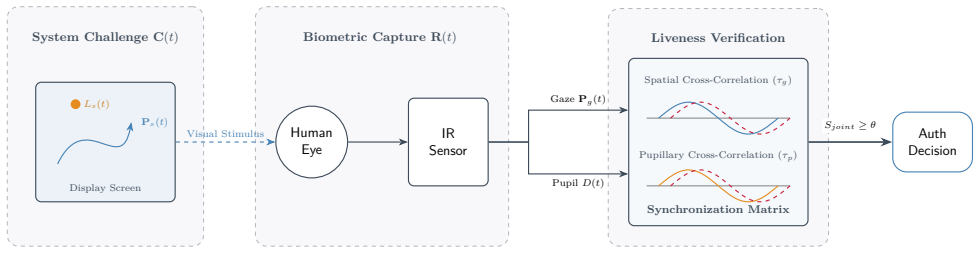
The Synchronization Matrix and its Joint Synchronization Metric S_joint: a weighted sum of sliding-window Pearson correlations for gaze and pupil streams, minus a quadratic biological-plausibility penalty Φ on the two estimated latencies (μ_g ≈ 150 ms, μ_p ≈ 290 ms).
What would settle it
Run the multi-round protocol against a real-time generative deepfake pipeline whose measured end-to-end rendering latency is driven below roughly 25 ms (or is strongly correlated across rounds) and check whether S_joint still separates from genuine human responses at AUC ≥ 0.90.
Extended reading notes
Core claim
A simultaneous dual-stream challenge that randomizes both spatial trajectory and luminance intensity, scored by a Joint Synchronization Metric S_joint that cross-correlates observed gaze and pupil responses against expected biological latencies, yields theoretical separability of live eyes from video-replay, generative-deepfake, and mechanical spoofs under literature-derived latency models, with multi-round averaging raising deepfake detection when a non-zero rendering lag exists.
Load-bearing premise
Deepfake detection works only if the attacker’s pipeline still incurs a non-zero rendering lag that shifts the observed latencies outside the normal biological window; near-zero or highly correlated lag across rounds collapses the score to chance.
Editorial extensions
If this is right
- Isolated PLR or gaze liveness checks can be replaced or augmented by a single coupled challenge that forces both streams to stay phase-locked to the live stimulus.
- Multi-round challenge designs can push the reliable-detection threshold for deepfakes down from ~50 ms to ~25 ms rendering lag, at the cost of longer sessions.
- Video-replay and rigid mechanical-aperture attacks become near-perfectly separable once the joint metric is used, because they either decorrelate completely or mismatch the biological pupil waveform.
- The framework is intended as an additional timing layer on top of existing iris or face pipelines rather than a standalone biometric.
Reading between the lines
- If generative rendering latency continues to fall, pure timing analysis will eventually fail and the protocol will need complementary texture or 3-D shape checks that the paper already flags as out of scope.
- The same dual-stream idea could be ported to other biometric channels that possess both a voluntary tracking response and an autonomic reflex (e.g., head pose plus heart-rate photoplethysmography).
- Hardware refresh-rate and IR-frame-rate requirements implied by the latency windows become a concrete engineering specification for next-generation iris sensors.
Signed reviews
Editorial analysis
A structured set of objections, weighed in public.
Referee Report
Summary. The paper proposes a Spatio-Luminance Sensor Fusion protocol for ocular presentation-attack detection: a dual-stream challenge that simultaneously randomizes a target’s spatial trajectory and luminance, then scores the joint temporal coupling of smooth-pursuit gaze and pupillary light reflex via a Joint Synchronization Metric S_joint (Eq. 5) that combines two max-correlation terms with a biological-latency penalty Φ (Eq. 6). Monte Carlo simulation (N = 10 000 trials per condition) grounded in literature means μ_g = 150 ms and μ_p = 290 ms shows strong separability for video-replay and mechanical/prosthetic attacks (AUC ≈ 0.996–1.0) and latency-dependent separability for generative deepfakes (AUC rising from chance at τ_render = 0 to ≥ 0.997 beyond 75 ms). A multi-round extension (Table 1) further improves deepfake detection when a non-zero, i.i.d. rendering lag is present. The authors explicitly frame the work as a simulation-supported theoretical framework and list human-subject calibration, hardware benchmarking, and adversarial red-teaming as required future work.
Significance. If the theoretical separability holds under real ocular dynamics, the dual-stream challenge supplies a concrete, latency-coupled alternative to single-cue PLR or gaze PAD and directly addresses the growing threat of real-time generative deepfakes. The explicit threat model (replay, deepfake, mechanical), the quantified multi-round trade-off (Table 1), and the transparent statement of the τ_render floor are useful contributions for the PAD community. Strengths include literature-grounded latency priors, an open acknowledgment that the framework collapses when rendering lag approaches zero, and a clear roadmap for empirical validation. The result remains provisional until human-subject and real-pipeline experiments are performed, but the in-silico analysis is a legitimate first step for a systems-security paper.
major comments (2)
- §5.1: Correlation terms inside S_joint are replaced by a Gaussian decay of latency deviation rather than being computed from simulated time series that integrate the PLR ODE (Eq. 4) and the pursuit model (Eq. 3). While the approximation is internally consistent and produces the claimed AUCs, it leaves open whether realistic hippus, pursuit noise, and first-order recovery dynamics would preserve the reported separability; a short ablation that scores full synthetic trajectories would strengthen the central claim.
- §4.3 and §5: Weights w1 = w2 = 1, w3 = 2 and the decision threshold θ are provisional and never calibrated to a target FAR. Because S_joint is the sole decision statistic, the absolute AUC numbers (and the multi-round gains in Table 1) remain sensitive to these free parameters; the manuscript should either fix them by a stated operating-point criterion or demonstrate that the ranking of genuine vs. attack scores is robust across a plausible weight range.
minor comments (5)
- Fig. 2 caption and §5.2: the phrase “reliable-detection threshold (AUC ≥ 0.90)” is used without defining the operating point; clarify whether it is the 95th-percentile genuine threshold mentioned earlier or a pure AUC cut-off.
- Eq. (5): the predicted pupil diameter ˆD(t|Ls) is obtained by “integrating the PLR equation,” yet the Monte Carlo never performs that integration; a one-sentence note reconciling the definition with the Gaussian-decay approximation would avoid reader confusion.
- §2: the claim that “no current methodology fuses continuous spatial tracking with simultaneous pupillary luminance response” is strong; a brief check against recent commercial or patent literature on joint pupil–corneal models would make the novelty statement more precise.
- Table 1: report standard errors or confidence intervals on the AUC estimates so that the improvement from M = 1 to M = 10 can be assessed statistically.
- Notation: Σ_g is introduced in Eq. (3) but later only σ_g appears; make the isotropic-variance assumption explicit.
Circularity Check
No load-bearing circular derivation; Monte Carlo separability is the expected numerical consequence of a latency-penalty metric evaluated on latency-offset attack models, with literature latencies and no self-citation chain.
-
other
[Section 5.1 (Simulation Methodology) and Eq. (5)–(6)]
"Correlation terms were approximated via a Gaussian decay function of latency deviation, and S_joint was computed per Section 4. ... generative deepfake, modeled as the genuine distribution offset by a swept rendering latency τ_render"
S_joint rewards small |τ−μ| via max ρ and the quadratic Φ penalty; deepfake/replay models are defined as latency offsets or decorrelation from those same μ. Reported AUCs therefore largely follow from evaluating a latency-deviation score on latency-deviation distributions rather than from independent empirical structure. This is mild and transparent (the paper claims only theoretical separability under these models), not a fitted-input-as-prediction or self-definitional claim about an external quantity.
full rationale
The paper’s central claim is theoretical separability of genuine vs. attack conditions under the defined Joint Synchronization Metric S_joint, evaluated by Monte Carlo with literature-derived means (μ_g = 150 ms, μ_p = 290 ms from Bergamin & Kardon, Carl & Gellman, Rashbass) and explicitly constructed attack models (replay: uniform decorrelated latencies; deepfake: genuine latencies plus τ_render; mechanical: near-zero latency with suppressed ρ_p). Weights are provisional, not fitted to produce the reported AUCs, and the authors scope the work as simulation-supported theory requiring future human-subject calibration. There is no self-citation load-bearing premise, no uniqueness theorem imported from the same author, and no fitted parameter renamed as an independent prediction. The only mild tautology is that S_joint is built to reward proximity to biological latencies (Pearson max-correlation plus quadratic Φ penalty, with correlation further approximated by Gaussian decay of latency deviation), so distributions that differ mainly by latency offset separate by design of the score-plus-attack definitions. That is ordinary detector design evaluated in silico, not a circular first-principles derivation. Score 1 reflects that minor by-construction character of the simulation results, not a hidden reduction of a claimed prediction to its inputs.
Assumptions & free parameters
free parameters (4)
- w1, w2, w3 =
1.0, 1.0, 2.0
- σ_g, σ_p =
swept; nominal 20/30 ms
- θ_threshold
- μ_g, μ_p =
150 ms, 290 ms
assumptions (5)
- domain assumption Smooth-pursuit latency is well-modeled as Pg(t)=Ps(t−τg)+ηg with τg∼N(150,σg²) ms under unpredictable trajectories.
- domain assumption Pupillary light reflex follows the first-order ODE (4) with constriction latency τp∼N(290,σp²) ms.
- ad hoc to paper Cross-correlation terms can be replaced by a Gaussian decay of latency deviation for Monte Carlo scoring.
- ad hoc to paper Deepfake rendering latency is additive and, across multi-round challenges, i.i.d.
- ad hoc to paper Mechanical/prosthetic pupils produce a 5× reduction in the pupillary correlation term.
invented entities (2)
-
Spatio-Luminance Sensor Fusion protocol / Synchronization Matrix
-
Joint Synchronization Metric S_joint
Cite this review
Pith. "Pith review of A Dual-Stream Challenge-Response Protocol for Ocular Liveness Verification." pith.science (2026). https://pith.science/paper/MM7VTL3V
@misc{pith2026260709883,
  author       = {Pith},
  title        = {Pith review of: A Dual-Stream Challenge-Response Protocol for Ocular Liveness Verification},
  year         = {2026},
  howpublished = {\url{https://pith.science/paper/MM7VTL3V}},
  note         = {Machine review of arXiv:2607.09883}
}
read the original abstract
Ocular biometric systems face sophisticated presentation attacks, including high-resolution video replays and real-time generative deepfakes, which easily bypass static liveness checks. Current Presentation Attack Detection (PAD) frameworks typically rely on isolated physiological metrics, such as gaze tracking or the Pupillary Light Reflex (PLR), which can be spoofed independently. This paper proposes a Spatio-Luminance Sensor Fusion protocol, which introduces a dual-stream challenge-response framework for ocular liveness verification by uniting these metrics into a simultaneous authentication challenge. By generating a randomized, time-varying visual stimulus that fluctuates in both spatial trajectory and luminance intensity, we construct a mathematically coupled state-space likelihood model, termed the Synchronization Matrix, to evaluate the continuous cross-correlation between the expected biological latencies of smooth pursuit tracking and pupillary constriction. Using Monte Carlo simulation grounded in literature-derived latency distributions, we demonstrate theoretical separability between genuine and simulated attack conditions, and show that a multi-round challenge design improves the detection of generative deepfakes when a non-zero rendering-latency gap exists. This work provides a simulation-supported theoretical framework for next-generation dynamic spoofing defense in ocular and iris biometrics; human-subject validation is identified as necessary future work before deployment claims can be made.
Figures

Reference graph
Works this paper leans on
-
[1]
How iris recognition works,
J. Daugman, “How iris recognition works,”IEEE Trans. Cir- cuits Syst. Video Technol., vol. 14, no. 1, pp. 21–30, 2004
2004
-
[2]
FaceForensics++: Learning to detect manipu- lated facial images,
A. R¨ ossler, D. Cozzolino, L. Verdoliva, C. Riess, J. Thies, and M. Nießner, “FaceForensics++: Learning to detect manipu- lated facial images,” inProc. IEEE/CVF Int. Conf. Com- puter Vision (ICCV), 2019, pp. 1–11
2019
-
[3]
C. Bhattacharyya, H. Wang, F. Zhang, S. Kim, and X. Zhu, “Diffusion deepfake,” arXiv preprint arXiv:2404.01579, 2024
arXiv 2024
-
[4]
Deepfake: Def- initions, performance metrics and standards, datasets, and a meta-review,
E. Altuncu, V. N. L. Franqueira, and S. Li, “Deepfake: Def- initions, performance metrics and standards, datasets, and a meta-review,”Front. Big Data, vol. 7, art. 1400024, 2024
2024
-
[5]
Presentation attack detection for iris recognition: An assessment of the state-of-the-art,
A. Czajka and K. W. Bowyer, “Presentation attack detection for iris recognition: An assessment of the state-of-the-art,” ACM Comput. Surv., vol. 51, no. 4, pp. 86:1–86:35, 2018
2018
-
[6]
Presentation attack detec- tion methods for face recognition systems: A comprehensive survey,
R. Ramachandra and C. Busch, “Presentation attack detec- tion methods for face recognition systems: A comprehensive survey,”ACM Comput. Surv., vol. 50, no. 1, pp. 8:1–8:37, 2017
2017
-
[7]
Multimodal biometrics: An overview,
A. Ross and A. K. Jain, “Multimodal biometrics: An overview,” inProc. 12th European Signal Processing Confer- ence (EUSIPCO), Vienna, Austria, 2004, pp. 1221–1224
2004
-
[8]
The pupillary light reflex in normal subjects,
C. J. Ellis, “The pupillary light reflex in normal subjects,” Br. J. Ophthalmol., vol. 65, no. 11, pp. 754–759, 1981
1981
Show all 16 references
-
[9]
Latency of the pupil light reflex: Sample rate, stimulus intensity, and variation in nor- mal subjects,
O. Bergamin and R. H. Kardon, “Latency of the pupil light reflex: Sample rate, stimulus intensity, and variation in nor- mal subjects,”Invest. Ophthalmol. Vis. Sci., vol. 44, no. 4, pp. 1546–1554, 2003
2003
-
[10]
DeepEyedentificationLive: Oculomo- toric biometric identification and presentation-attack detec- tion using deep neural networks,
S. Makowski, P. Prasse, D. R. Reich, D. Krakowczyk, L. A. J¨ ager, and T. Scheffer, “DeepEyedentificationLive: Oculomo- toric biometric identification and presentation-attack detec- tion using deep neural networks,”IEEE Trans. Biom. Behav. Identity Sci., vol. 3, no. 4, pp. 506...
2021
-
[11]
Human smooth pursuit: Stimulus-dependent responses,
J. R. Carl and R. S. Gellman, “Human smooth pursuit: Stimulus-dependent responses,”J. Neurophysiol., vol. 57, no. 5, pp. 1446–1463, 1987
1987
-
[12]
The relationship between saccadic and smooth tracking eye movements,
C. Rashbass, “The relationship between saccadic and smooth tracking eye movements,”J. Physiol., vol. 159, no. 2, pp. 326– 338, 1961
1961
-
[13]
Spatio-temporal deep learning for improved face presentation attack detection,
S. Khan, T. H. M. Siddique, M. S. Ibrahim, A. J. Siddiqui, and K. Huang, “Spatio-temporal deep learning for improved face presentation attack detection,”Knowl.-Based Syst., 2025, art. no. 113059
2025
-
[14]
GaitSpoofNet,
I. Mohamed, A. Salah, E. Debie, M. Abdellah, and A. Abdel- latif, “GaitSpoofNet,”Front. Artif. Intell., vol. 9, 2026, art. no. 1821341
2026
-
[15]
On the effectiveness of local binary patterns in face anti-spoofing,
I. Chingovska, A. Anjos, and S. Marcel, “On the effectiveness of local binary patterns in face anti-spoofing,” inProc. Int. Conf. Biometrics Special Interest Group (BIOSIG), 2012, pp. 1–7
2012
-
[16]
Attack of mechanical replicas: Liveness detection with eye movements,
O. V. Komogortsev, A. Karpov, and C. D. Holland, “Attack of mechanical replicas: Liveness detection with eye movements,” IEEE Trans. Inf. Forensics Security, vol. 10, no. 4, pp. 716– 725, 2015
2015
Reviewed July 14, 2026 · model on record in the stance chip above.
Discussion (0). Continue with ORCID to comment.