REVIEW 4 major objections 6 minor 20 references
Topology-aware archive selection speeds exploration by targeting only enterable voids and ignoring sealed ones.
Reviewed by Pith at T0; open to challenge. T0 means a machine referee read the full paper against a public rubric. the ladder, T0–T4 →
Topology-aware cell selection on the visited-set occupancy grid yields 1.52× median entry speedup over Go-Explore by bonus-ing only strict entrances of live voids and ignoring sealed regions.
T0 review reviewed 2026-07-14 challenge →
load-bearing objection Solid, carefully scoped selection rule for archive exploration under sealed structure; MiniGrid evidence is clean and the free-teleport caveat is real but already flagged by the author. the 4 major comments →
TopoExplore: Topological Discrimination for Archive-Based Exploration
The pith
A machine-rendered reading of the paper's core claim, the machinery that carries it, and where it could break.
The reading
Core claim
Topology-aware selection pays off where enclosed structure must be discriminated: on an 18-environment MiniGrid suite TopoExplore attains a 1.52× geometric-mean speedup in median steps-to-first-entry over its exact Go-Explore ablation (versus 1.37× for frontier); frontier degrades on sealed decoys (0.83–1.48×) while TopoExplore holds (1.65–2.11×) and records its largest win on hard multi-interaction doors (10.9×), remaining competitive at open coverage where frontier methods are strongest.
What carries the argument
The topological pass: voids (enclosed unexplored components of the visited-set occupancy grid, i.e. the H1 classes of its cubical complex) are detected by flood fill, and a decaying selection bonus is placed only on their strict entrances—cells adjacent to free interior or doors—so sealed regions are never targeted and entered regions retire.
Load-bearing premise
The method needs a reliable wall or navigability signal that distinguishes free gaps and doors from solid walls; without it, unreachable artifacts capture the bonus and the gains reverse.
What would settle it
On held-out environments that mix sealed decoys with one enterable chamber, if TopoExplore’s median steps-to-first-entry of the enterable chamber is no better than (or worse than) an identical-harness frontier baseline once the decoys are present, the discrimination claim fails.
If this is right
- Archive-based explorers can skip permanent sealed rims that trap pure frontier selection.
- Maps produced as a by-product already mark enterable rooms and their entrances for downstream planners.
- When wall or navigability knowledge is available, homology of the visited set becomes a usable selection signal.
- Discrimination under sealed structure is a distinct regime from blanket coverage, where frontier selection remains near-optimal.
- Without a traversability mask the bonus is captured by unreachable artifacts and performance degrades with its own weight.
Where Pith is reading between the lines
- Sensor-limited robots that must infer walls from partial observations would need an approximate entrance test before the same gains transfer.
- The same entrance-gating idea could prune waste in multi-agent coverage or search-and-rescue mapping of collapsed buildings with sealed cavities.
- Building the complex from Rips or Dowker constructions, as the paper sketches, would let non-grid agents discriminate enterable state-space cavities without an occupancy grid.
- Hard-door and nested-chamber results suggest topology bonuses may complement, rather than replace, policy persistence on sequential bottlenecks.
Editorial analysis
A structured set of objections, weighed in public.
Referee Report
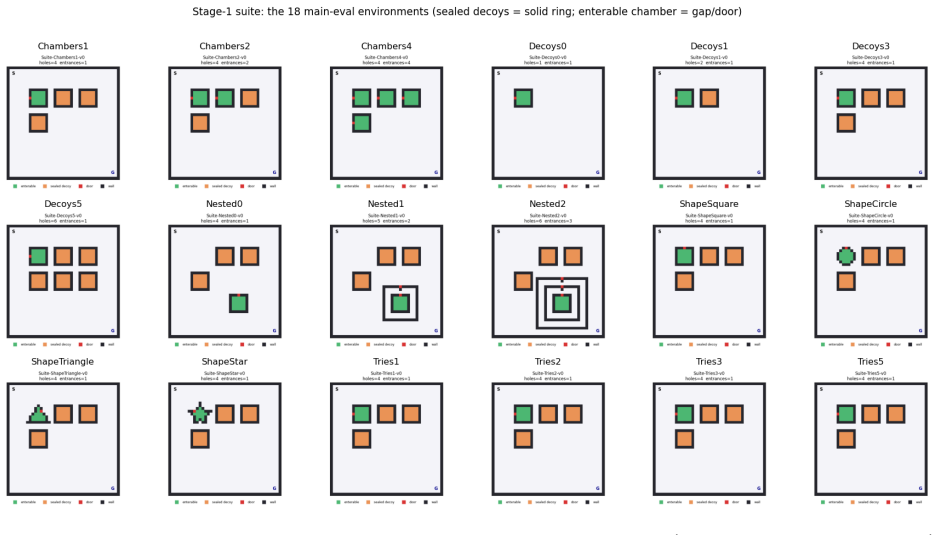
Summary. TopoExplore augments Go-Explore cell selection with a periodic topological pass over the visited-set occupancy grid: enclosed unexplored components (voids; H1 of the cubical complex) are found by flood fill, and a decaying selection bonus is applied only to their strict entrances (gap/door cells), so sealed regions receive no bonus and entered regions retire. On a controlled 18-environment MiniGrid suite (15 seeds, frozen hyperparameters, exact w_topo=0 ablation and a frontier baseline on the same archive/return harness), the method reports a 1.52× geometric-mean speedup in median steps-to-first-entry over Go-Explore (vs 1.37× for frontier), with frontier degrading on sealed decoys and TopoExplore’s largest win on hard multi-interaction doors (10.9×). An honest Montezuma’s Revenge negative isolates the wall-aware entrance test as load-bearing; a preliminary HM3D result shows modest speedup over Go-Explore that tracks scene difficulty while frontier dominates blanket coverage. The scoped claim is that topology-aware selection pays off for discrimination under sealed structure and remains competitive at open coverage.
Significance. If the discrimination result holds under realistic return costs and without privileged wall masks, this is a genuine contribution: it is, to my knowledge, the first use of the homology of the visited set as the exploration decision engine rather than as a post-hoc map or path-class tool, and the strict-entrance + retirement construction cleanly explains why sealed decoys should not attract budget. Strengths that should be credited include the exact one-term ablation (same code path), the controlled suite that varies decoys/geometry/nesting/doors independently, the bit-exact Montezuma autopsy that falsifies the method when the entrance test is unavailable, and the deliberate scoping that refuses to claim open-coverage superiority over frontier. Those practices raise the evidentiary bar for structured-exploration papers even if the quantitative MiniGrid headline is regime-dependent.
major comments (4)
- §3, Appendix A, and §7: the headline MiniGrid speedups (Table 1 geometric mean 1.52×; decoy rows 1.65–2.11×; Tries3 10.9×) are generated under free snapshot/teleport returns (“deepcopy snapshot restore”). With zero travel cost, concentrating score on sparse strict entrances is artificially cheap relative to spreading mass over a large frontier rim; the paper itself notes that free teleports “flatters all archive methods, frontier most” and defers travel-costed returns to v2. Because the central discrimination claim is evidenced by these magnitudes, either (i) report the same suite under path-costed or non-teleport returns, or (ii) restate the claim as holding under free archive returns and move the quantitative comparison out of the abstract until costed results exist. The qualitative sealed-vs-enterable mechanism (permanent frontier on sealed rims) can survive; the reported speedup fact
- §2.3 and §4: the strict-entrance test requires a wall/door or navigability mask (MiniGrid occupancy GT; Habitat navmesh). The Montezuma autopsy correctly shows that without it the whole rim is nominated, unresolvable artifacts capture 94% of selections at w=100, and performance degrades monotonically with weight. That isolation is excellent, but the abstract and contributions still present TopoExplore as a general archive-based method. The manuscript needs an explicit transferability bound: the discrimination claim is conditional on a reliable free/wall signal at the resolution of the archive cells; without that signal the method is not merely weaker but actively harmful as w_topo grows. Sensor-limited or noisy-mask ablations (promised for v2) should be treated as load-bearing, not optional polish.
- Table 1 and §3 protocol: results are reported as median steps-to-first-entry ratios and a geometric mean over 18 environments, with no confidence intervals, IQM, or seed-level dispersion, and with several rows where TopoExplore loses or never enters (ShapeCircle 0.55; Tries5 0.67; Chambers2/4 <1). The geometric mean therefore mixes large wins on hard doors with genuine losses on poor gap/rim geometry. For a claim that “topology-aware selection pays off where enclosed structure must be discriminated,” either stratify the summary by regime (decoy present / door difficulty / gap-rim ratio) with uncertainty, or justify why a single geometric mean is the right headline. The planned IQM/CI statistics for v2 should be required before treating 1.52× as stable.
- §5 HM3D: the abstract cites a preliminary positive (1.12× over Go-Explore, r=0.69 with difficulty) while simultaneously reporting that frontier is 2.58× over Go-Explore and beats TopoExplore on every scene. That scoping sentence is honest, but the current minival-only, 10-scene, free-teleport Habitat evidence is too thin to support even a “preliminary positive” in the abstract alongside the MiniGrid claim. Either demote HM3D to a pure feasibility note until the held-out 100-scene evaluation with region-entry/waste-on-sealed metrics is in, or add those metrics now so the discrimination (not coverage) claim can be tested where the paper says it matters.
minor comments (6)
- Eq. (1)–(2): Topo(c) is defined with mag(V_c) and nin(c), but the matching of voids across passes by interior IoU (§2.2) is only described in prose; a short formal statement of identity/retirement would make the score well-defined when voids split or merge.
- Figure 1 caption and Table 1 environment names (Chambers1–4, Decoys0–5, Nested0–2, Shape*, Tries1–5) are not fully aligned in the text; a one-line mapping of each row to the geometric factor it isolates would help readers.
- §4 Montezuma table: single seed (seed 0) at 30M frames; even with bit-exact reproducibility, note that variance across seeds is unreported so the weight-sweep trend, while directionally clear, is not multi-seed.
- Related work §6: TARE/GLEAM and topological memory are cited appropriately; a brief contrast with other archive selection heuristics (e.g., goal-conditioned or competence-based cell scoring) would situate the contribution more sharply among Go-Explore variants.
- Appendix A: ICM’s structural disadvantage in deterministic MiniGrid is well noted; still flag in the main Table 1 caption that PPO+ICM/RND are not on the archive/return harness so bold “best archive/return method” comparisons exclude them by design.
- Typo/consistency: abstract “1.52x” vs body “1.52 ×”; “enterable at all” spacing; arXiv date line “July 2026” is fine for a preprint but should be normalized in a journal submission.
Circularity Check
No circularity: explicit additive selection term evaluated empirically with frozen hyperparameters and independent ablations.
full rationale
TopoExplore defines an explicit additive Topo(c) term on the Go-Explore CellScore (Eqs. 1–2) that is nonzero only for strict entrances of live voids detected by flood fill; setting w_topo=0 recovers the exact Go-Explore ablation by construction of the shared code path. Hyperparameters (including w_topo=100) were selected on held-out sweeps and then frozen before the 18-environment MiniGrid table; the reported speedups are therefore ordinary empirical comparisons, not fitted quantities re-labeled as predictions. The Montezuma negative (performance degrades monotonically with weight when the wall mask is unavailable) and the Decoys0/HM3D frontier wins are independent of the discrimination claim and cut against self-serving selection of results. There are no self-citations of uniqueness theorems, no ansatz smuggled via prior author work, and no renaming of a known empirical pattern. The paper is self-contained against external benchmarks under a transparent free-return harness whose limitations it itself flags for v2.
Axiom & Free-Parameter Ledger
free parameters (4)
- w_topo =
100 (MiniGrid preset)
- p_topo / score functional form (sqrt inverse counts, epsilons) =
p_topo=0.5; eps1=1e-3; eps2=1e-5
- Go-Explore base weights (w_seen, w_horiz, w_vert) =
w_seen=0.3, w_horiz=0.3, w_vert=0.1
- topological pass frequency and explore horizon =
pass every 2000 steps; burst 30 (MiniGrid)
axioms (5)
- standard math For binary occupancy masks, connected components of unvisited cells not touching the border are exactly the H1 classes of the cubical complex of visited cells (flood fill is exact, not approximate).
- domain assumption A wall/door or navigability mask is available so that strict entrances can be defined as 4-adjacency to free unvisited interior or door cells.
- domain assumption Archive returns are free teleports (snapshot restore), so selection quality is measured without travel cost.
- domain assumption Cells are discrete positions (grid / RAM tiles / floor×0.5m bins); observations are not archive keys.
- ad hoc to paper Voids matched across passes by interior IoU keep stable identity and stay retired once retired.
invented entities (2)
-
strict entrance (gap/door cell of a live void)
no independent evidence
-
void retirement via nin decay and entry
no independent evidence
Cite this review
Pith. "Pith review of TopoExplore: Topological Discrimination for Archive-Based Exploration." pith.science (2026). https://pith.science/paper/GLVAOMH6
@misc{pith2026260709971,
  author       = {Pith},
  title        = {Pith review of: TopoExplore: Topological Discrimination for Archive-Based Exploration},
  year         = {2026},
  howpublished = {\url{https://pith.science/paper/GLVAOMH6}},
  note         = {Machine review of arXiv:2607.09971}
}
read the original abstract
Archive-based exploration methods such as Go-Explore select which visited state to return to using visitation rarity, and frontier methods return to the boundary of the unknown; neither asks whether the unexplored region behind a boundary is enterable at all. Exploration is not just about finding reward - it is about collecting a structurally complete experience for downstream learning and planning. We introduce TopoExplore, which augments Go-Explore cell selection with a periodic topological pass: enclosed unexplored regions (voids) of the visited-set occupancy grid are detected by flood fill (the H1 classes of its cubical complex), and a decaying selection bonus is placed only on their strict entrances (gap or door cells), so sealed regions are never targeted and entered regions retire. On a controlled 18-environment MiniGrid suite (15 seeds, frozen hyperparameters) TopoExplore attains a 1.52x geometric-mean speedup in median steps-to-first-entry over its exact Go-Explore ablation, versus 1.37x for a frontier baseline; frontier exploration degrades when sealed decoy structure appears (0.83-1.48x on decoy environments vs. 1.65-2.11x for TopoExplore), while TopoExplore holds its largest win on hard multi-interaction doors (10.9x). We report an honest negative on Montezuma's Revenge - without wall knowledge, unreachable occupancy artifacts capture the bonus and performance degrades as it grows, isolating the wall-aware entrance test as the load-bearing component - and a preliminary positive on HM3D scanned buildings, where the speedup over Go-Explore tracks scene difficulty (r=0.69) even as frontier selection dominates blanket coverage. The evidence supports a deliberately scoped claim: topology-aware selection pays off where enclosed structure must be discriminated, and remains competitive at open coverage, where frontier methods are strongest, despite not being tuned for that regime.
Figures


Reference graph
Works this paper leans on
-
[1]
Bellemare, Y
M. Bellemare, Y. Naddaf, J. Veness, and M. Bowling. The arcade learning environment: An evaluation platform for general agents.Journal of Artificial Intelligence Research, 47:253–279, 2013
2013
-
[2]
Bellemare, S
M. Bellemare, S. Srinivasan, G. Ostrovski, T. Schaul, D. Saxton, and R. Munos. Unifying count-based exploration and intrinsic motivation.NeurIPS, 2016
2016
-
[3]
Bhattacharya, R
S. Bhattacharya, R. Ghrist, and V. Kumar. Persistent homology for path planning in uncertain environments.IEEE Transactions on Robotics, 31(3):578–590, 2015
2015
-
[4]
Burda, H
Y. Burda, H. Edwards, A. Storkey, and O. Klimov. Exploration by random network distillation. ICLR, 2019
2019
-
[5]
Burda, H
Y. Burda, H. Edwards, D. Pathak, A. Storkey, T. Darrell, and A. Efros. Large-scale study of curiosity-driven learning.ICLR, 2019
2019
-
[6]
C. Cao, H. Zhu, H. Choset, and J. Zhang. TARE: A hierarchical framework for efficiently exploring complex 3D environments.RSS, 2021
2021
-
[7]
X. Chen et al. GLEAM: Learning generalizable exploration policy for active mapping in complex 3D indoor scenes.arXiv:2505.20294, 2025
arXiv 2025
-
[8]
Chevalier-Boisvert, B
M. Chevalier-Boisvert, B. Dai, M. Towers, R. de Lazcano, L. Willems, S. Lahlou, S. Pal, P. S. Castro, and J. Terry. Minigrid & miniworld: Modular & customizable reinforcement learning environments for goal-oriented tasks.NeurIPS Datasets and Benchmarks, 2023. 7
2023
-
[9]
Choset and J
H. Choset and J. Burdick. Sensor-based exploration: The hierarchical generalized Voronoi graph.The International Journal of Robotics Research, 19(2):96–125, 2000
2000
-
[10]
A. Ecoffet, J. Huizinga, J. Lehman, K. Stanley, and J. Clune. Go-explore: a new approach for hard-exploration problems.arXiv:1901.10995, 2019
Pith/arXiv arXiv 1901
-
[11]
Ecoffet, J
A. Ecoffet, J. Huizinga, J. Lehman, K. Stanley, and J. Clune. First return, then explore.Nature, 590:580–586, 2021
2021
-
[12]
Machado, M
M. Machado, M. Bellemare, E. Talvitie, J. Veness, M. Hausknecht, and M. Bowling. Revisiting the arcade learning environment: Evaluation protocols and open problems for general agents. Journal of Artificial Intelligence Research, 61:523–562, 2018
2018
-
[13]
Maria, J.-D
C. Maria, J.-D. Boissonnat, M. Glisse, and M. Yvinec. The GUDHI library: Simplicial complexes and persistent homology.International Congress on Mathematical Software, 2014
2014
-
[14]
Naitzat, A
G. Naitzat, A. Zhitnikov, and L.-H. Lim. Topology of deep neural networks.Journal of Machine Learning Research, 21(184):1–40, 2020
2020
-
[15]
Pathak, P
D. Pathak, P. Agrawal, A. Efros, and T. Darrell. Curiosity-driven exploration by self-supervised prediction.ICML, 2017
2017
-
[16]
Ramakrishnan et al
S. Ramakrishnan et al. Habitat-Matterport 3D dataset (HM3D): 1000 large-scale 3D environ- ments for embodied AI.NeurIPS Datasets and Benchmarks, 2021
2021
-
[17]
Savinov, A
N. Savinov, A. Dosovitskiy, and V. Koltun. Semi-parametric topological memory for navigation. ICLR, 2018
2018
-
[18]
Savva, A
M. Savva, A. Kadian, O. Maksymets, Y. Zhao, E. Wijmans, B. Jain, J. Straub, J. Liu, V. Koltun, J. Malik, D. Parikh, and D. Batra. Habitat: A platform for embodied AI research.ICCV, 2019
2019
-
[19]
Yamauchi
B. Yamauchi. A frontier-based approach for autonomous exploration.CIRA, 1997
1997
-
[20]
Zhang, H
T. Zhang, H. Xu, X. Wang, Y. Wu, K. Keutzer, J. Gonzalez, and Y. Tian. NovelD: A simple yet effective exploration criterion.NeurIPS, 2021. A Experimental details F rozen constants. wtopo=100, ptopo=0.5, area magnitude, strict entrances; Go-Explore weights wseen=0.3, whoriz=0.3, wvert=0.1, p=0.5, ε1=10−3, ε2=10−5 (grid-searched once on a held-out environme...
2021
This paper was first reviewed by grok-4.5 on July 14, 2026.
discussion (0)
Sign in with ORCID, Apple, or X to comment. Anyone can read and Pith papers without signing in.