REVIEW 2 major objections 6 minor 118 references
SALT-GNN: Handling Dense Neighborhoods in Anti-Money Laundering Graphs via Statistics-Aware Attention
T0 review · 2 major / 6 minor · reviewed 2026-07-14 · grok-4.5
Pith's one-line read Dense recipient accounts hide laundering signals from standard graph neural nets; fusing degree-aware statistics with attention at every layer recovers them with a compact model.
desk verdict Solid AML-GNN paper: recipient-degree diagnostics plus layer-wise stats–attention fusion that actually holds up on the evidence they have. read the letter →
The pith
A machine-rendered reading of the paper's core claim, the machinery that carries it, and where it could break.
The reading
What carries the argument
SALT-GNN layer-wise fusion: at each message-passing step a residual combination of the previous node state, a degree-scaled multi-statistic summary (mean, std, min, max), and a learned attention aggregation is formed so that subsequent attention scores operate on statistics-enriched representations.
What would settle it
On a proprietary multi-institution transaction graph with real labels, retrain the same SALT variants and the strongest baselines under identical protocols and check whether the dense recipient-degree bins still show the reported F1 lift of several points over late-fusion and attention-only baselines.
Extended reading notes
Core claim
Recipient-degree stratified evaluation reveals consistent degradation of standard AML GNNs in dense recipient contexts; SALT-GNN, which fuses degree-aware statistical aggregation with attention at every message-passing layer, improves dense-context F1 by 3–6 points on HI-Small and HI-Medium and by 16–20 points in the highest-degree bin of AMLSim-32k-5%, using up to 77% fewer parameters than the strongest task-specific graph-transformer baselines, with the benefit coming from where the two evidence streams interact rather than from a particular attention operator.
Load-bearing premise
The public synthetic AML graphs and their planted fraud patterns are representative enough of real multi-institution transaction data that both the dense-bin degradation and the layer-wise fusion benefit will transfer to production systems.
Editorial analysis
A structured set of objections, weighed in public.
Referee Report
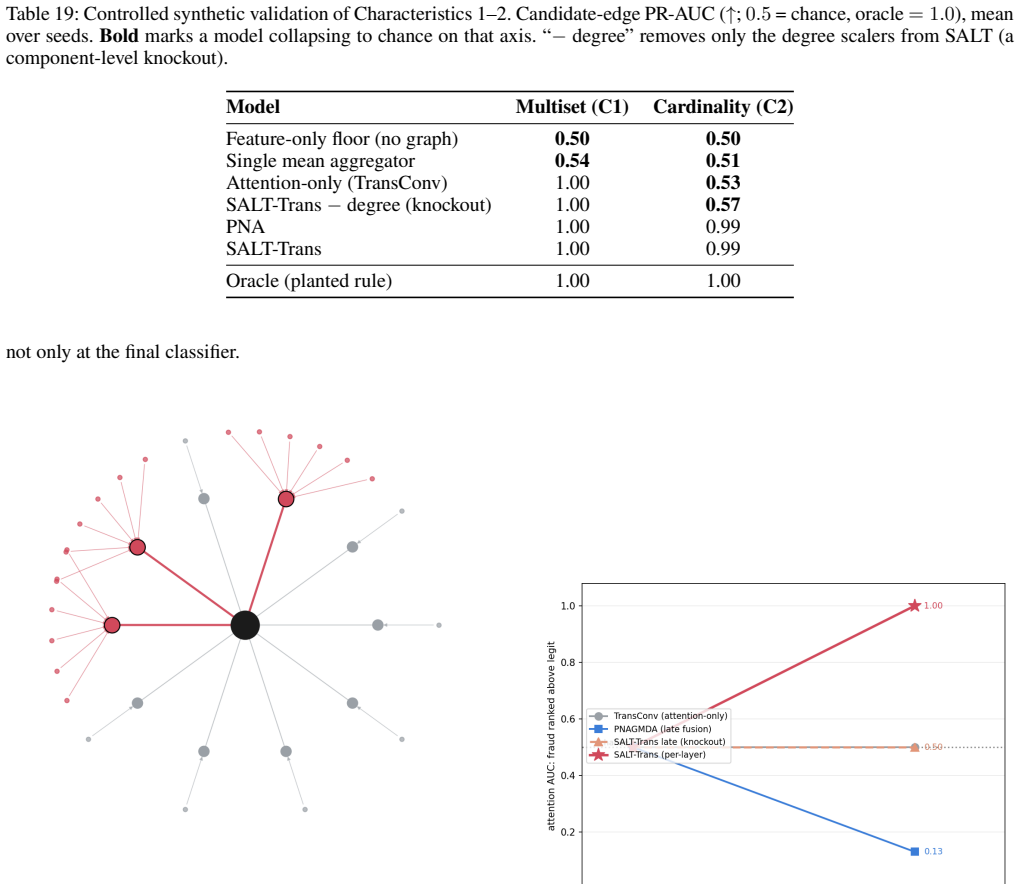
Summary. The paper argues that aggregate F1 hides systematic GNN degradation in dense recipient contexts on AML transaction graphs, and that this failure is driven by multiset non-discriminability, cardinality blindness, and attention-induced multi-hop attenuation. It introduces a post-hoc recipient-degree stratified evaluation protocol and SALT-GNN, which fuses degree-aware multi-statistic aggregation with attention at every message-passing layer so that distributional and cardinality cues shape subsequent attention states. Empirically, on HI-Small, HI-Medium, and AMLSim-32k-5%, SALT improves dense-bin F1 (about 3–6 points on IBM tasks; 16–20 in AMLSim’s extreme bin) with a compact parameter budget, for both Transformer- and GAT-style attention. Ablations, Hit@k diagnostics, a within-model fusion-placement knockout, and controlled synthetic C1–C3 tests are used to attribute gains to layer-wise fusion rather than branch presence or a particular attention operator.
Significance. If the results hold, the contribution is twofold and practically useful: (i) a simple, reusable evaluation unit—recipient in-degree—that makes dense-hub reliability a first-class AML-GNN reporting requirement, and (ii) a lightweight hybrid design principle (layer-wise statistics–attention fusion) that improves exactly those regimes without a heavy task-specific graph transformer. Strengths include multi-dataset coverage (edge and node tasks), degree-stratified F1 and PR-AUC, attention diagnostics (Hit@k, ENNs), characteristic-level ablations, a causal fusion-placement knockout (App. M), controlled synthetic isolation of C1–C3, Holm-corrected tests, and a promised code release for the stratified protocol and ablations. The main ceiling on impact is external validity: all evidence is on public synthetic AML graphs, which the authors acknowledge.
major comments (2)
- [§5, Tables 2–3; Appendix J] §5, Tables 2–3 and Appendix J: the headline dense-context gains on IBM (e.g., HI-Small deg[50–99], HI-Medium deg[100+]) rest on sparse positive support (on the order of ~124 / ~72 fraud cases in those test bins) together with n=3–5 seeds. After Holm correction several dense-bin contrasts are non-significant or only marginal, while effect sizes remain favorable. The central dense-bin claim is still directionally supported (especially by AMLSim’s paired tests and App. M), but the manuscript should surface per-bin positive counts next to the main stratified tables and state more carefully that the 3–6 point IBM dense gains are under-powered estimates rather than precisely established deltas.
- [§6; §4 Datasets] §6 and §4: external validity is correctly listed as a limitation, but it is load-bearing for the operational framing (investigation cost at high-activity recipients). The paper should expand, even briefly, which synthetic properties (agent-based/planted patterns, illicit-rate structure, single-generator topology, absence of multi-institution and product heterogeneity) could make either dense-bin degradation or the layer-wise fusion benefit fail to transfer, and what a minimal proprietary or multi-institution check would need to report under the same recipient-degree protocol. This does not require new private data in revision, but the transfer claim should be scoped more explicitly than the current short paragraph.
minor comments (6)
- [Abstract; §3] Abstract and §1: the three characteristics are clear, but Characteristic 3 is sometimes phrased as if SALT removes softmax attenuation; §3 correctly says it does not, and mitigates via a parallel statistical path. Align the abstract wording with that more precise claim.
- [Table 5; Appendix D] Table 5 / Appendix D: Hit@20 is well motivated by ENNs≈20 in deg[50–99], but the main text should state in one sentence why k is fixed rather than degree-adaptive, to avoid the impression that k was chosen post hoc for SALT.
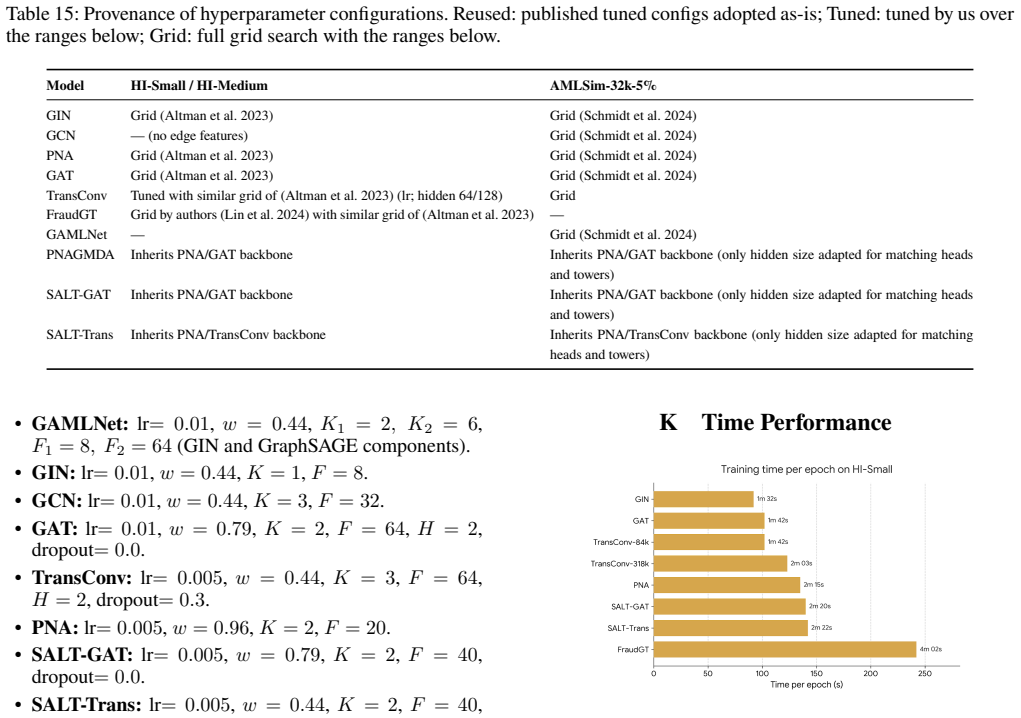
- [§4; Appendix G, I] §4 Baselines / Appendix I: the hyperparameter provenance table is helpful. In the main experimental setup, add one sentence that SALT and PNAGMDA inherit backbone hyperparameters and that App. G reports dense-bin retuning of TransConv/FraudGT, so readers do not assume an unfair tuning advantage without checking the appendix.
- [§3; Figure 2; Appendix H] Figure 2 and Eqs. (9)–(11): the residual averaging h=(h_prev + h_fusion)/2 is easy to miss relative to the concat–MLP fusion. Cross-reference Appendix H in the main architecture section so residual design is not confused with the fusion-placement claim.
- [Throughout] Presentation: several places in the compiled text show concatenated words (e.g., “graphneuralnetworks”, “denserecipientcontexts”). Clean spacing and line-break artifacts throughout before camera-ready.
- [§2; §7] Related Work §7: dense-subgraph fraud methods are correctly called complementary; a one-sentence contrast with cardinality-preserving attention work (already cited Zhang & Xie 2021) in the main diagnosis section would help readers place Characteristic 2.
Circularity Check
No significant circularity: empirical architecture paper whose dense-bin gains are measured on held-out splits, not derived by construction from fitted inputs or self-citation.
full rationale
SALT-GNN is an empirical GNN architecture paper. The load-bearing claims (recipient-degree degradation; layer-wise fusion of degree-aware multi-statistic aggregation with attention improving dense-context F1; fusion placement rather than attention operator as the driver) are established by post-hoc stratification of test predictions, external baselines (GIN, PNA, GAT, TransConv, FraudGT, PNAGMDA, GAMLNet), characteristic-level ablations, Hit@k diagnostics, and a within-model fusion-placement knockout on planted synthetic motifs (App. M). Degree scalers use the training-graph mean of log(d+1) exactly as in PNA (Corso et al. 2020)—a fixed normalization constant, not a parameter fitted to force dense-bin F1. Model selection is by overall validation F1; stratified metrics are reporting only. Citations for multiset non-discriminability, cardinality blindness, attention, and baselines are external (Corso, Zhang & Xie, Velickovic, Shi, Altman, Lin, Chen et al.); there is no self-citation uniqueness theorem or ansatz chain that forces the result. Performance numbers are not algebraically equivalent to any input definition. External-validity limits on synthetic AML graphs are stated as limitations, not circular reductions. Score 0 is therefore the correct finding.
Assumptions & free parameters
free parameters (4)
- PNA degree-scaler reference δ = mean log(d+1) on training graph
- Model hyperparameters (lr, hidden size, class weight, dropout, depth, heads)
- Recipient in-degree bin edges (log-spaced ranges)
- Hit@k threshold (k=20 on HI-Small deg[50–99])
assumptions (5)
- standard math Common single-statistic neighborhood aggregators cannot uniquely characterize multisets (multiset non-discriminability).
- standard math Normalized or order-statistic aggregators and softmax attention do not by themselves expose neighborhood cardinality (cardinality blindness).
- domain assumption Softmax attention influence compounds multiplicatively along multi-hop paths and can attenuate weak coordinated edges at dense hubs.
- domain assumption Synthetic IBM HI and AMLSim graphs with temporal/random splits are valid proxies for studying supervised AML GNN behavior under recipient density.
- ad hoc to paper Recipient in-degree is the right operational context unit for both edge (receiver) and node classification.
invented entities (2)
-
Recipient-degree stratified evaluation protocol
independent evidence
-
SALT-GNN (layer-wise statistics–attention fusion architecture)
Cite this review
Pith. "Pith review of SALT-GNN: Handling Dense Neighborhoods in Anti-Money Laundering Graphs via Statistics-Aware Attention." pith.science (2026). https://pith.science/paper/BS27O6HH
@misc{pith2026260710131,
  author       = {Pith},
  title        = {Pith review of: SALT-GNN: Handling Dense Neighborhoods in Anti-Money Laundering Graphs via Statistics-Aware Attention},
  year         = {2026},
  howpublished = {\url{https://pith.science/paper/BS27O6HH}},
  note         = {Machine review of arXiv:2607.10131}
}
read the original abstract
Money laundering threatens financial stability and exposes institutions to penalties, motivating automated detection. Because laundering schemes often emerge through relational patterns, graph neural networks (GNNs) are increasingly used for anti-money laundering (AML). Yet AML GNNs are typically evaluated with aggregate metrics such as overall F1 score, which hide an operational issue: high-activity recipient accounts concentrate many incoming transactions, making suspicious signals harder to isolate and costlier to investigate. We introduce a recipient-degree stratified evaluation that reports standard AML metrics across recipient-context density. Across three datasets (HI-Small, HI-Medium, and AMLSim-32k-5%), it reveals consistent degradation in dense recipient contexts, which we trace to three GNN characteristics: two known limitations that AML amplifies, i.e., (1) multiset non-discriminability and (2) cardinality blindness, and (3) an attention-specific effect: in dense neighborhoods, normalized attention attenuates weak but pattern-relevant multi-hop signals. Guided by this diagnosis, we propose SALT-GNN, a lightweight statistics-aware architecture that fuses degree-aware statistical aggregation with attention at each message-passing layer, so distributional and cardinality information shapes the node states used by subsequent attention steps. Ablations support fusion placement as a key factor in dense-context performance. On HI-Small and HI-Medium, SALT-GNN uses up to 77% fewer parameters than task-specific graph-transformer baselines while improving dense-context F1 score by 3-6 points; on AMLSim-32k-5%, it improves highest-degree F1 score by 16-20 points. The gains hold for both Transformer- and GAT-style attention, indicating that the benefit comes from where statistical and attentional evidence is fused rather than from a specific attention operator.
Figures


Figures from the paper (3 more)

Reference graph
Works this paper leans on
-
[1]
The Accounting Review , volume=
The cost of fraud prediction errors , author=. The Accounting Review , volume=. 2022 , publisher=
2022
-
[2]
Toyotaro Suzumura and Hiroki Kanezashi , title =
-
[3]
IEEE Transactions on Knowledge and Data Engineering , volume=
A contrast metric for fraud detection in rich graphs , author=. IEEE Transactions on Knowledge and Data Engineering , volume=. 2018 , publisher=
2018
-
[4]
Proceedings of the 25th ACM SIGKDD international conference on knowledge discovery & data mining , pages=
Net: Degree-specific graph neural networks for node and graph classification , author=. Proceedings of the 25th ACM SIGKDD international conference on knowledge discovery & data mining , pages=
-
[5]
Advances in neural information processing systems , volume=
Nodeformer: A scalable graph structure learning transformer for node classification , author=. Advances in neural information processing systems , volume=
-
[6]
Advances in Neural Information Processing Systems , volume=
Relieving the Over-Aggregating Effect in Graph Transformers , author=. Advances in Neural Information Processing Systems , volume=
-
[7]
The Tenth International Conference on Learning Representations,
Shaked Brody and Uri Alon and Eran Yahav , title =. The Tenth International Conference on Learning Representations,. 2022 , url =
2022
-
[8]
ACM Transactions on Knowledge Discovery from Data (TKDD) , volume=
Graph-based fraud detection in the face of camouflage , author=. ACM Transactions on Knowledge Discovery from Data (TKDD) , volume=. 2017 , publisher=
2017
Show all 118 references
-
[9]
2024 11th IEEE Swiss Conference on Data Science (SDS) , pages=
GAMLNet: a graph based framework for the detection of money laundering , author=. 2024 11th IEEE Swiss Conference on Data Science (SDS) , pages=. 2024 , organization=
2024
-
[10]
Proceedings of the 31st ACM SIGKDD Conference on Knowledge Discovery and Data Mining V
Feature Reconstruction for Anomaly Detection on Directed Multigraphs: A Preprocessing Framework for GNNs , author=. Proceedings of the 31st ACM SIGKDD Conference on Knowledge Discovery and Data Mining V. 2 , pages=
-
[11]
Proceedings of the 31st ACM SIGKDD Conference on Knowledge Discovery and Data Mining V
MAD: Multicriteria Anomaly Detection of Suspicious Financial Accounts from Billions of Cash Transactions , author=. Proceedings of the 31st ACM SIGKDD Conference on Knowledge Discovery and Data Mining V. 2 , pages=
-
[12]
Proceedings of the 28th ACM SIGKDD Conference on Knowledge Discovery and Data Mining , pages=
Accelerated GNN training with DGL and RAPIDS cuGraph in a Fraud Detection Workflow , author=. Proceedings of the 28th ACM SIGKDD Conference on Knowledge Discovery and Data Mining , pages=
-
[13]
Proceedings of the 31st ACM SIGKDD Conference on Knowledge Discovery and Data Mining V
Flag: Fraud detection with llm-enhanced graph neural network , author=. Proceedings of the 31st ACM SIGKDD Conference on Knowledge Discovery and Data Mining V. 2 , pages=
-
[14]
Proceedings of the 30th ACM SIGKDD Conference on Knowledge Discovery and Data Mining , pages=
Cost-efficient fraud risk optimization with submodularity in insurance claim , author=. Proceedings of the 30th ACM SIGKDD Conference on Knowledge Discovery and Data Mining , pages=
-
[15]
Internet of Things—Applications and Future: Proceedings of ITAF 2019 , pages=
Survey of machine learning approaches of anti-money laundering techniques to counter terrorism finance , author=. Internet of Things—Applications and Future: Proceedings of ITAF 2019 , pages=. 2020 , publisher=
2019
-
[16]
Knowledge and Information Systems , volume=
Machine learning techniques for anti-money laundering (AML) solutions in suspicious transaction detection: a review , author=. Knowledge and Information Systems , volume=. 2018 , publisher=
2018
-
[17]
Bronstein , title =
Jake Topping and Francesco Di Giovanni and Benjamin Paul Chamberlain and Xiaowen Dong and Michael M. Bronstein , title =. The Tenth International Conference on Learning Representations,. 2022 , url =
2022
-
[18]
Advances in Neural Information Processing Systems , volume=
Recipe for a general, powerful, scalable graph transformer , author=. Advances in Neural Information Processing Systems , volume=
-
[19]
9th International Conference on Learning Representations,
Uri Alon and Eran Yahav , title =. 9th International Conference on Learning Representations,. 2021 , url =
2021
-
[20]
arXiv preprint arXiv:2105.14491 , year=
How attentive are graph attention networks? , author=. arXiv preprint arXiv:2105.14491 , year=
-
[21]
2011 , note =
Estimating Illicit Financial Flows Resulting from Drug Trafficking and Other Transnational Organized Crimes , institution =. 2011 , note =
2011
-
[22]
Lannoo, Karel and Parlour, Richard , title=
-
[23]
Graph Feature Preprocessor: Real-time Subgraph-based Feature Extraction for Financial Crime Detection , year =
Blanu. Graph Feature Preprocessor: Real-time Subgraph-based Feature Extraction for Financial Crime Detection , year =. doi:10.1145/3677052.3698674 , booktitle =
-
[24]
Thirty-seventh Conference on Neural Information Processing Systems Datasets and Benchmarks Track , year=
Realistic Synthetic Financial Transactions for Anti-Money Laundering Models , author=. Thirty-seventh Conference on Neural Information Processing Systems Datasets and Benchmarks Track , year=
-
[25]
Proceedings of the Twenty-Ninth International Joint Conference on Artificial Intelligence , articleno =
Zhang, Shuo and Xie, Lei , title =. Proceedings of the Twenty-Ninth International Joint Conference on Artificial Intelligence , articleno =. 2021 , isbn =
2021
-
[26]
ACM Comput
Chandola, Varun and Banerjee, Arindam and Kumar, Vipin , title =. ACM Comput. Surv. , month = jul, articleno =. 2009 , issue_date =. doi:10.1145/1541880.1541882 , abstract =
2009 doi
-
[27]
ANFIS based sensor fault detection for continuous stirred tank reactor , journal =
U. ANFIS based sensor fault detection for continuous stirred tank reactor , journal =. 2011 , note =. doi:https://doi.org/10.1016/j.asoc.2010.10.009 , url =
2011 doi
-
[28]
Spam bot detection on Twitter platform using Positional Attention based Dense Convolutional Neural Network , journal =
Hemal Girishkumar Shah and Hiren Joshi , keywords =. Spam bot detection on Twitter platform using Positional Attention based Dense Convolutional Neural Network , journal =. 2025 , issn =. doi:https://doi.org/10.1016/j.asoc.2025.113725 , url =
2025 doi
-
[29]
and Yo-Ping Huang , booktitle=
Yufeng Kou and Chang-Tien Lu and Sirwongwattana, S. and Yo-Ping Huang , booktitle=. Survey of fraud detection techniques , year=
-
[30]
Principal Neighbourhood Aggregation for Graph Nets , booktitle =
Gabriele Corso and Luca Cavalleri and Dominique Beaini and Pietro Li. Principal Neighbourhood Aggregation for Graph Nets , booktitle =. 2020 , url =
2020
-
[31]
7th International Conference on Learning Representations,
Keyulu Xu and Weihua Hu and Jure Leskovec and Stefanie Jegelka , title =. 7th International Conference on Learning Representations,. 2019 , url =
2019
-
[32]
Graph Attention Networks , booktitle =
Petar Velickovic and Guillem Cucurull and Arantxa Casanova and Adriana Romero and Pietro Li. Graph Attention Networks , booktitle =. 2018 , url =
2018
-
[33]
IEEE transactions on neural networks and learning systems , volume=
Credit card fraud detection: a realistic modeling and a novel learning strategy , author=. IEEE transactions on neural networks and learning systems , volume=. 2017 , publisher=
2017
-
[34]
Big Data and Cognitive Computing , volume=
Enhancing credit card fraud detection: an ensemble machine learning approach , author=. Big Data and Cognitive Computing , volume=. 2024 , publisher=
2024
-
[35]
Applied Soft Computing , volume=
Value-added tax fraud detection with scalable anomaly detection techniques , author=. Applied Soft Computing , volume=. 2020 , publisher=
2020
-
[36]
Mathematical Problems in Engineering , volume=
Towards tax evasion detection using improved particle swarm optimization algorithm , author=. Mathematical Problems in Engineering , volume=. 2022 , publisher=
2022
-
[38]
Ecology , volume=
Diversity and evenness: a unifying notation and its consequences , author=. Ecology , volume=. 1973 , publisher=
1973
-
[39]
Oikos , volume=
Entropy and diversity , author=. Oikos , volume=. 2006 , publisher=
2006
-
[40]
The Bell system technical journal , volume=
A mathematical theory of communication , author=. The Bell system technical journal , volume=. 1948 , publisher=
1948
-
[41]
Masked Label Prediction: Unified Message Passing Model for Semi-Supervised Classification , booktitle =
Yunsheng Shi and Zhengjie Huang and Shikun Feng and Hui Zhong and Wenjing Wang and Yu Sun , editor =. Masked Label Prediction: Unified Message Passing Model for Semi-Supervised Classification , booktitle =. 2021 , url =. doi:10.24963/IJCAI.2021/214 , timestamp =
2021 doi
-
[43]
Proceedings of the 5th ACM International Conference on AI in Finance , pages=
FraudGT: a simple, effective, and efficient graph transformer for financial fraud detection , author=. Proceedings of the 5th ACM International Conference on AI in Finance , pages=
-
[44]
Advances in neural information processing systems , volume=
Inductive representation learning on large graphs , author=. Advances in neural information processing systems , volume=
-
[45]
Kipf and Max Welling , title =
Thomas N. Kipf and Max Welling , title =. 5th International Conference on Learning Representations,. 2017 , url =
2017
-
[46]
Advances in Neural Information Processing Systems , volume=
Generalised f-mean aggregation for graph neural networks , author=. Advances in Neural Information Processing Systems , volume=
-
[47]
Neural Networks , volume=
BalancerGNN: Balancer Graph Neural Networks for imbalanced datasets: A case study on fraud detection , author=. Neural Networks , volume=. 2025 , publisher=
2025
-
[48]
IEEE Access , volume=
Scalable semi-supervised graph learning techniques for anti money laundering , author=. IEEE Access , volume=. 2024 , publisher=
2024
-
[49]
Big Data and Cognitive Computing , VOLUME =
Khalid, Abdul Rehman and Owoh, Nsikak and Uthmani, Omair and Ashawa, Moses and Osamor, Jude and Adejoh, John , TITLE =. Big Data and Cognitive Computing , VOLUME =. 2024 , NUMBER =
2024
-
[50]
Ensemble of deep sequential models for credit card fraud detection , journal =
Javad Forough and Saeedeh Momtazi , keywords =. Ensemble of deep sequential models for credit card fraud detection , journal =. 2021 , issn =. doi:https://doi.org/10.1016/j.asoc.2020.106883 , url =
2021 doi
-
[51]
Cost Sensitive Credit Card Fraud Detection Using Bayes Minimum Risk , year=
Bahnsen, Alejandro Correa and Stojanovic, Aleksandar and Aouada, Djamila and Ottersten, Björn , booktitle=. Cost Sensitive Credit Card Fraud Detection Using Bayes Minimum Risk , year=
-
[52]
Decision support systems , volume=
APATE: A novel approach for automated credit card transaction fraud detection using network-based extensions , author=. Decision support systems , volume=. 2015 , publisher=
2015
-
[53]
Expert systems with applications , volume=
Learned lessons in credit card fraud detection from a practitioner perspective , author=. Expert systems with applications , volume=. 2014 , publisher=
2014
-
[54]
Proceedings of the AAAI Conference on Artificial Intelligence , volume=
Provably powerful graph neural networks for directed multigraphs , author=. Proceedings of the AAAI Conference on Artificial Intelligence , volume=
-
[55]
Advances in Neural Information Processing Systems , volume=
Approximation ratios of graph neural networks for combinatorial problems , author=. Advances in Neural Information Processing Systems , volume=
-
[56]
Proceedings of the web conference 2021 , pages=
Pick and choose: a GNN-based imbalanced learning approach for fraud detection , author=. Proceedings of the web conference 2021 , pages=
2021
-
[57]
Proceedings of the AAAI conference on artificial intelligence , volume=
Spatio-temporal attention-based neural network for credit card fraud detection , author=. Proceedings of the AAAI conference on artificial intelligence , volume=
-
[58]
Algorithms , volume=
A Temporal Graph Network Algorithm for Detecting Fraudulent Transactions on Online Payment Platforms , author=. Algorithms , volume=. 2024 , publisher=
2024
-
[59]
Computers & Security , volume=
Reducing false positives in bank anti-fraud systems based on rule induction in distributed tree-based models , author=. Computers & Security , volume=. 2022 , publisher=
2022
-
[60]
International Journal of Accounting Information Systems , volume=
Reducing false positives in fraud detection: Combining the red flag approach with process mining , author=. International Journal of Accounting Information Systems , volume=. 2018 , publisher=
2018
-
[61]
Ieee Access , volume=
Financial cybercrime: A comprehensive survey of deep learning approaches to tackle the evolving financial crime landscape , author=. Ieee Access , volume=. 2021 , publisher=
2021
-
[62]
Procedia Computer Science , volume=
Unbalanced credit card fraud detection data: A machine learning-oriented comparative study of balancing techniques , author=. Procedia Computer Science , volume=. 2023 , publisher=
2023
-
[63]
Fraud detection system: A survey , journal =
Aisha Abdallah and Mohd Aizaini Maarof and Anazida Zainal , keywords =. Fraud detection system: A survey , journal =. 2016 , issn =. doi:https://doi.org/10.1016/j.jnca.2016.04.007 , url =
2016 doi
-
[64]
A Comparative Study of Machine Learning Techniques for Credit Card Fraud Detection Based on Time Variance , year=
Rajora, Shantanu and Li, Dong-Lin and Jha, Chandan and Bharill, Neha and Patel, Om Prakash and Joshi, Sudhanshu and Puthal, Deepak and Prasad, Mukesh , booktitle=. A Comparative Study of Machine Learning Techniques for Credit Card Fraud Detection Based on Time Variance , year=
-
[65]
Proceedings of the 2020 5th International Conference on Machine Learning Technologies , pages =
Alarab, Ismail and Prakoonwit, Simant and Nacer, Mohamed Ikbal , title =. Proceedings of the 2020 5th International Conference on Machine Learning Technologies , pages =. 2020 , isbn =. doi:10.1145/3409073.3409078 , abstract =
2020 doi
-
[66]
arXiv preprint arXiv:2210.07715 , year=
Not all neighbors are worth attending to: Graph selective attention networks for semi-supervised learning , author=. arXiv preprint arXiv:2210.07715 , year=
-
[67]
Sensors , volume=
Deep learning-based anomaly detection in video surveillance: A survey , author=. Sensors , volume=. 2023 , publisher=
2023
-
[68]
Applied Sciences , volume=
Insider threat detection based on user behavior modeling and anomaly detection algorithms , author=. Applied Sciences , volume=. 2019 , publisher=
2019
-
[69]
Proceedings of the VLDB Endowment , volume=
Activeclean: Interactive data cleaning for statistical modeling , author=. Proceedings of the VLDB Endowment , volume=. 2016 , publisher=
2016
-
[70]
2021 IEEE 17th international conference on intelligent computer communication and processing (ICCP) , pages=
Human behavior and anomaly detection using machine learning and wearable sensors , author=. 2021 IEEE 17th international conference on intelligent computer communication and processing (ICCP) , pages=. 2021 , organization=
2021
-
[71]
Expert systems With applications , volume=
Financial fraud: a review of anomaly detection techniques and recent advances , author=. Expert systems With applications , volume=. 2022 , publisher=
2022
-
[72]
Internet of Things , volume=
Anomaly detection system for data quality assurance in IoT infrastructures based on machine learning , author=. Internet of Things , volume=. 2024 , publisher=
2024
-
[73]
ICASSP 2021-2021 IEEE International Conference on Acoustics, Speech and Signal Processing (ICASSP) , pages=
A short tutorial on the weisfeiler-lehman test and its variants , author=. ICASSP 2021-2021 IEEE International Conference on Acoustics, Speech and Signal Processing (ICASSP) , pages=. 2021 , organization=
2021
-
[74]
European semantic web conference , pages=
Modeling relational data with graph convolutional networks , author=. European semantic web conference , pages=. 2018 , organization=
2018
-
[75]
Proceedings of the AAAI conference on artificial intelligence , volume=
Identity-aware graph neural networks , author=. Proceedings of the AAAI conference on artificial intelligence , volume=
-
[76]
Finance and Corporate Governance Conference , year=
A Comparative Analysis of the Extent of Money Laundering in Australia, UAE, UK and the USA , author=. Finance and Corporate Governance Conference , year=
-
[77]
Journal of Computational Informatics & Business , volume=
Enhancing Anti-Money Laundering Systems with Machine Learning: A Comparative Analysis of Supervised Models , author=. Journal of Computational Informatics & Business , volume=
-
[78]
Discover Artificial Intelligence , volume=
Comparative analysis of machine learning algorithms for money laundering detection , author=. Discover Artificial Intelligence , volume=. 2025 , publisher=
2025
-
[79]
International conference on machine learning , pages=
On over-squashing in message passing neural networks: The impact of width, depth, and topology , author=. International conference on machine learning , pages=. 2023 , organization=
2023
-
[80]
IEEE Transactions on Knowledge and Data Engineering , volume=
Sparse graph attention networks , author=. IEEE Transactions on Knowledge and Data Engineering , volume=. 2021 , publisher=
2021
-
[81]
Wiley Interdisciplinary Reviews: Computational Statistics , volume=
Advances in Continual Graph Learning for Anti-Money Laundering Systems: A Comprehensive Review , author=. Wiley Interdisciplinary Reviews: Computational Statistics , volume=. 2025 , publisher=
2025
-
[82]
2025 , publisher=
Chen, Chen and Ma, Mingyang and Nie, Jiani and Wang, Lei and Xu, Jian , journal=. 2025 , publisher=
2025
-
[83]
V.; Egressy, B.; Anghel, A.; and Atasu, K
Altman, E.; Blanu s a, J.; Niederh \"a usern, L. V.; Egressy, B.; Anghel, A.; and Atasu, K. 2023. Realistic Synthetic Financial Transactions for Anti-Money Laundering Models. In Thirty-seventh Conference on Neural Information Processing Systems Datasets and Benchmarks Track
2023
-
[84]
D.; and Vorst, P
Beneish, M. D.; and Vorst, P. 2022. The cost of fraud prediction errors. The Accounting Review, 97(6): 91--121
2022
-
[85]
C .; Chen, L
Bilgi, H. C .; Chen, L. Y.; and Atasu, K. 2024. Multigraph Message Passing with Bi-Directional Multi-Edge Aggregations. arXiv preprint arXiv:2412.00241
2024 arXiv
-
[86]
Blanu s a, J.; Cravero Baraja, M.; Anghel, A.; von Niederh\" a usern, L.; Altman, E.; Pozidis, H.; and Atasu, K. 2024. Graph Feature Preprocessor: Real-time Subgraph-based Feature Extraction for Financial Crime Detection. In Proceedings of the 5th ACM International Conference ...
2024
-
[87]
Boyapati, M.; and Aygun, R. 2025. BalancerGNN: Balancer Graph Neural Networks for imbalanced datasets: A case study on fraud detection. Neural Networks, 182: 106926
2025
-
[88]
Chen, C.; Ma, M.; Nie, J.; Wang, L.; and Xu, J. 2025. PNAGMDA : A Principal Neighborhood Aggregation Based Graph Neural Network for miRNA -Disease Association Prediction. IEEE/ACM Transactions on Computational Biology and Bioinformatics
2025
-
[89]
D.; Teoh, E
Chen, Z.; Van Khoa, L. D.; Teoh, E. N.; Nazir, A.; Karuppiah, E. K.; and Lam, K. S. 2018. Machine learning techniques for anti-money laundering (AML) solutions in suspicious transaction detection: a review. Knowledge and Information Systems, 57(2): 245--285
2018
-
[90]
Corso, G.; Cavalleri, L.; Beaini, D.; Li \` o , P.; and Velickovic, P. 2020. Principal Neighbourhood Aggregation for Graph Nets. In Larochelle, H.; Ranzato, M.; Hadsell, R.; Balcan, M.; and Lin, H., eds., Advances in Neural Information Processing Systems 33: Annual Conference ...
2020
-
[91]
Di Giovanni, F.; Giusti, L.; Barbero, F.; Luise, G.; Lio, P.; and Bronstein, M. M. 2023. On over-squashing in message passing neural networks: The impact of width, depth, and topology. In International conference on machine learning, 7865--7885. PMLR
2023
-
[92]
Egressy, B.; Von Niederh \"a usern, L.; Blanu s a, J.; Altman, E.; Wattenhofer, R.; and Atasu, K. 2024. Provably powerful graph neural networks for directed multigraphs. In Proceedings of the AAAI Conference on Artificial Intelligence, volume 38, 11838--11846
2024
-
[93]
Gounoue, S.; Sao, A.; and Gottschalk, S. 2025. TeMP-TraG: Edge-based Temporal Message Passing in Transaction Graphs. arXiv preprint arXiv:2503.16901
2025 arXiv
-
[94]
A.; Beutel, A.; Shah, N.; and Faloutsos, C
Hooi, B.; Shin, K.; Song, H. A.; Beutel, A.; Shah, N.; and Faloutsos, C. 2017. Graph-based fraud detection in the face of camouflage. ACM Transactions on Knowledge Discovery from Data (TKDD), 11(4): 1--26
2017
-
[95]
T.; and Villar, S
Huang, N. T.; and Villar, S. 2021. A short tutorial on the weisfeiler-lehman test and its variants. In ICASSP 2021-2021 IEEE International Conference on Acoustics, Speech and Signal Processing (ICASSP), 8533--8537. IEEE
2021
-
[96]
R.; Hermsen, F.; Chala, S
Karim, M. R.; Hermsen, F.; Chala, S. A.; De Perthuis, P.; and Mandal, A. 2024. Scalable semi-supervised graph learning techniques for anti money laundering. IEEE Access, 12: 50012--50029
2024
-
[97]
N.; and Welling, M
Kipf, T. N.; and Welling, M. 2017. Semi-Supervised Classification with Graph Convolutional Networks. In 5th International Conference on Learning Representations, ICLR 2017, Toulon, France, April 24-26, 2017, Conference Track Proceedings . OpenReview.net
2017
-
[98]
Kou, Y.; Lu, C.-T.; Sirwongwattana, S.; and Huang, Y.-P. 2004. Survey of fraud detection techniques. In IEEE International Conference on Networking, Sensing and Control, 2004, volume 2, 749--754 Vol.2
2004
-
[99]
Lannoo, K.; and Parlour, R. 2021. Anti-Money Laundering in the EU: Time to get serious. Technical report, Centre for European Policy Studies
2021
-
[100]
Liang, S.; Xie, Q.; Feng, J.; Yue, Y.; Li, H.; Ye, J.; and Jie, W. 2025. Feature Reconstruction for Anomaly Detection on Directed Multigraphs: A Preprocessing Framework for GNNs. In Proceedings of the 31st ACM SIGKDD Conference on Knowledge Discovery and Data Mining V. 2, 1707--1717
2025
-
[101]
Lin, J.; Guo, X.; Zhu, Y.; Mitchell, S.; Altman, E.; and Shun, J. 2024. FraudGT: a simple, effective, and efficient graph transformer for financial fraud detection. In Proceedings of the 5th ACM International Conference on AI in Finance, 292--300
2024
-
[102]
Liu, S.; Hooi, B.; and Faloutsos, C. 2018. A contrast metric for fraud detection in rich graphs. IEEE Transactions on Knowledge and Data Engineering, 31(12): 2235--2248
2018
-
[103]
Liu, Y.; Ao, X.; Qin, Z.; Chi, J.; Feng, J.; Yang, H.; and He, Q. 2021. Pick and choose: a GNN-based imbalanced learning approach for fraud detection. In Proceedings of the web conference 2021, 3168--3177
2021
-
[104]
Paoletti, G.; Giobergia, F.; Giordano, D.; Cagliero, L.; Ronchiadin, S.; Moncalvo, D.; Mellia, M.; and Baralis, E. 2025. MAD: Multicriteria Anomaly Detection of Suspicious Financial Accounts from Billions of Cash Transactions. In Proceedings of the 31st ACM SIGKDD Conference o...
2025
-
[105]
Rees, B.; Wang, X.; Eaton, J.; Yilmaz, O.; Ratzel, R.; and LaSalle, D. 2022. Accelerated GNN training with DGL and RAPIDS cuGraph in a Fraud Detection Workflow. In Proceedings of the 28th ACM SIGKDD Conference on Knowledge Discovery and Data Mining, 4820--4821
2022
-
[106]
Salda \ n a-Ulloa, D.; De Ita Luna, G.; and Marcial-Romero, J. R. 2024. A Temporal Graph Network Algorithm for Detecting Fraudulent Transactions on Online Payment Platforms. Algorithms, 17(12): 552
2024
-
[107]
Sato, R.; Yamada, M.; and Kashima, H. 2019. Approximation ratios of graph neural networks for combinatorial problems. Advances in Neural Information Processing Systems, 32
2019
-
[108]
N.; Bloem, P.; Van Den Berg, R.; Titov, I.; and Welling, M
Schlichtkrull, M.; Kipf, T. N.; Bloem, P.; Van Den Berg, R.; Titov, I.; and Welling, M. 2018. Modeling relational data with graph convolutional networks. In European semantic web conference, 593--607. Springer
2018
-
[109]
Schmidt, J.; Pasadakis, D.; Sathe, M.; and Schenk, O. 2024. GAMLNet: a graph based framework for the detection of money laundering. In 2024 11th IEEE Swiss Conference on Data Science (SDS), 241--245. IEEE
2024
-
[110]
Shi, Y.; Huang, Z.; Feng, S.; Zhong, H.; Wang, W.; and Sun, Y. 2021. Masked Label Prediction: Unified Message Passing Model for Semi-Supervised Classification. In Zhou, Z., ed., Proceedings of the Thirtieth International Joint Conference on Artificial Intelligence, IJCAI 2021,...
2021
-
[111]
Sun, J.; Chang, W.; Yang, C.; Huang, Q.; and Wang, S. 2026. Relieving the Over-Aggregating Effect in Graph Transformers. Advances in Neural Information Processing Systems, 38: 6673--6699
2026
-
[112]
Suzumura, T.; and Kanezashi, H. 2021. Anti-Money Laundering Datasets : InPlusLab Anti-Money Laundering DataDatasets. http://github.com/IBM/AMLSim/
2021
-
[113]
United Nations Office on Drugs and Crime . 2011. Estimating Illicit Financial Flows Resulting from Drug Trafficking and Other Transnational Organized Crimes. Technical report, UNODC. Global money laundering estimates: 2-5\
2011
-
[114]
Velickovic, P.; Cucurull, G.; Casanova, A.; Romero, A.; Li \` o , P.; and Bengio, Y. 2018. Graph Attention Networks. In 6th International Conference on Learning Representations, ICLR 2018, Vancouver, BC, Canada, April 30 - May 3, 2018, Conference Track Proceedings . OpenReview.net
2018
-
[115]
Wu, J.; He, J.; and Xu, J. 2019. Net: Degree-specific graph neural networks for node and graph classification. In Proceedings of the 25th ACM SIGKDD international conference on knowledge discovery & data mining, 406--415
2019
-
[116]
P.; and Yan, J
Wu, Q.; Zhao, W.; Li, Z.; Wipf, D. P.; and Yan, J. 2022. Nodeformer: A scalable graph structure learning transformer for node classification. Advances in neural information processing systems, 35: 27387--27401
2022
-
[117]
Xu, K.; Hu, W.; Leskovec, J.; and Jegelka, S. 2019. How Powerful are Graph Neural Networks? In 7th International Conference on Learning Representations, ICLR 2019, New Orleans, LA, USA, May 6-9, 2019 . OpenReview.net
2019
-
[118]
Yang, C.; Liu, H.; Wang, D.; Zhang, Z.; Yang, C.; and Shi, C. 2025. Flag: Fraud detection with llm-enhanced graph neural network. In Proceedings of the 31st ACM SIGKDD Conference on Knowledge Discovery and Data Mining V. 2, 5150--5160
2025
-
[119]
M.; Ying, R.; and Leskovec, J
You, J.; Gomes-Selman, J. M.; Ying, R.; and Leskovec, J. 2021. Identity-aware graph neural networks. In Proceedings of the AAAI conference on artificial intelligence, volume 35, 10737--10745
2021
-
[120]
Zhang, S.; and Xie, L. 2021. Improving attention mechanism in graph neural networks via cardinality preservation. In Proceedings of the Twenty-Ninth International Joint Conference on Artificial Intelligence, IJCAI'20. ISBN 9780999241165
2021
Reviewed July 14, 2026 · model on record in the stance chip above.
Discussion (0). Continue with ORCID to comment.