REVIEW 2 major objections 5 minor 46 references
A first 3D integral surface-tension scheme for sharp front tracking matches CSF spurious currents and beats it on low-Oh oscillations, Marangoni migration, and deforming bubbles.
Reviewed by Pith at T0; open to challenge. T0 means a machine referee read the full paper against a public rubric. the ladder, T0–T4 →
T0 review · grok-4.5
2026-07-14 13:48 UTC pith:KJ6SXADU
load-bearing objection First solid 3D integral surface-tension scheme for front tracking; real gains on low-Oh and Marangoni cases, with one abstract overclaim and geometry dependence that the benchmarks already stress-test. the 2 major comments →
An integral surface tension scheme for three-dimensional front tracking frameworks
The pith
A machine-rendered reading of the paper's core claim, the machinery that carries it, and where it could break.
Core claim
The first three-dimensional integral surface-tension scheme, realised inside a sharp front-tracking framework that reconstructs interface–cell intersections from local quadratic fits, conserves momentum locally and globally, needs no delta-function discretisation, and automatically handles variable surface tension. Relative to continuous-surface-force and classical smoothing methods it yields comparable spurious velocities while delivering substantially lower errors on low-Ohnesorge oscillations, thermocapillary terminal velocities, and the steady shapes of strongly deforming rising bubbles.
What carries the argument
The face-wise integral force (Eq. 6) together with the pressure-correction factor β (Eqs. 11–12) obtained from a quadratic surface fit (Algorithm 1) that supplies signed distance, normal and curvature on every cut face; the resulting staggered source is then made well-balanced for a collocated finite-volume solver.
Load-bearing premise
That ordinary quadratic fits through a few dozen nearby front markers always give signed distances, normals and curvatures accurate enough for both the geometric intersections and the Laplace pressure correction, even after remeshing and large three-dimensional deformation.
What would settle it
Re-run the Oh = 0.005 oscillating-droplet case and the lowest-Morton rising-bubble case with deliberately coarser or noisier front meshes (or with the quadratic fit replaced by a lower-order one); if the scheme then loses stability or reverts to the large shape and velocity errors of the classical methods, the geometric premise fails.
Editorial analysis
A structured set of objections, weighed in public.
Referee Report
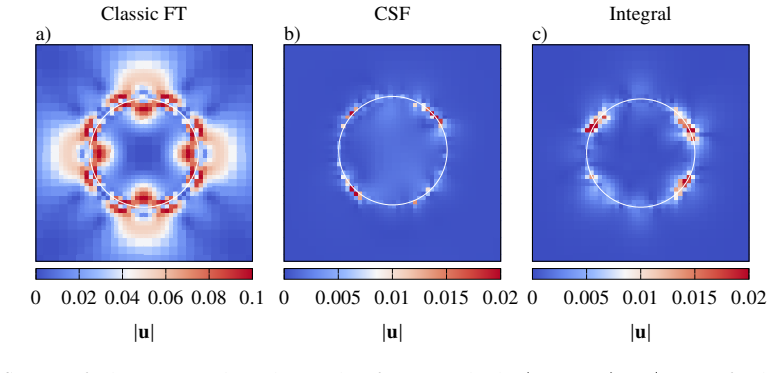
Summary. The manuscript presents the first three-dimensional integral surface-tension scheme for front-tracking frameworks, extending the 2D formulation of Popinet & Zaleski. Surface tension is evaluated as a line integral of σ m_Σ at the intersections of the Lagrangian front with Eulerian cell faces; a pressure-jump correction β (derived from face fractions γ and local curvature) is added so that the discrete pressure gradient and force remain consistent. Intersections, normals and curvatures are obtained from local weighted quadratic surface fits (Algorithm 1). The scheme is implemented in a sharp FT/PPIC solver and benchmarked against CSF and classic (kernel-smoothed) FT on static/translating Laplace spheres, Lamb oscillations (Oh = 0.05 and 0.005), Young thermocapillary migration, and three Bhaga–Weber rising-bubble cases. Spurious currents are comparable to CSF; accuracy and stability are superior on low-Oh oscillations, variable-σ flows and strongly deforming bubbles, with terminal-velocity errors reduced by factors of ~3–6 and bubble shapes closer to experiment.
Significance. A genuine 3-D integral scheme that conserves momentum by construction and treats variable surface tension without extra terms fills a gap repeatedly noted in the 2-D literature. The multi-benchmark campaign (analytic Young–Laplace, Lamb and Young solutions plus independent Bhaga–Weber experiments), second-order Ca_rms convergence, and the ability to run low-Oh oscillations and low-Mo skirted bubbles without specialised roughness smoothing constitute strong empirical support. Open Zenodo data further raise the standard of reproducibility. If the geometric reconstruction remains robust under more extreme topologies, the method should become a standard option in sharp FT codes.
major comments (2)
- Section 2.2.1 / Algorithm 1 and Eqs. (12), (16)–(18): every geometric quantity required by the scheme (φ, n_Σ, κ, l_Σ, m_Σ and therefore β) is obtained from a single local weighted least-squares quadratic fit through a fixed number of markers (24–48). The multi-test results already supply empirical evidence that these fits remain adequate under the remeshing and deformations examined, yet a short sensitivity study to N_marker or the Gaussian weight scale would make the robustness claim fully quantitative and would address the only load-bearing modelling assumption that is not itself derived from the integral principle.
- Section 3.1, paragraph after Eq. (38): the face-fraction switch γ ≽ 0.5 is replaced by the cell-centred volume-fraction switch α ≽ 0.5 “to ensure consistency of β across the three components”. While this is a pragmatic and volume-based choice, it is no longer identical to the geometric face fraction that appears in the derivation of Eqs. (9)–(12). A one-sentence quantification of the discrepancy (or a demonstration that it vanishes under grid refinement) would close the only remaining formal gap between the continuous integral statement and the discrete well-balanced source term.
minor comments (5)
- Abstract and §5: the phrase “up to an order of five” matches the factors ~3–6 reported in Table 1, but could be misread as five orders of magnitude; a parenthetical “(factor of ~5)” would remove any ambiguity.
- Figure 7: colour-bar ranges for S*_x differ between the classic/CSF panels and the integral panel, which slightly obscures the visual comparison of sharpness; a common scale (or an inset) would help.
- Eq. (54): the inertia-tensor proxy for the polar radius is elegant and removes remeshing noise; a brief remark on its accuracy for the chosen a0 = 0.025 would be useful for readers who wish to reuse it.
- Section 4.5: AMR criteria (interface + vorticity) are mentioned but not quantified; a single sentence on the refinement threshold or the resulting cell count would aid reproducibility.
- Occasional typographic inconsistencies (en-dashes in “two–phase”, missing spaces around some equation references, and the dual citation style for Saini et al.) should be cleaned in production.
Circularity Check
No significant circularity: the 3D integral scheme is fully specified from first principles and scored only against external analytics/experiments.
full rationale
The paper derives the integral force discretisation (Eqs. 1, 5–13, 38) and the pressure-correction factor β (Eqs. 9–12) directly from the Young membrane model and the Laplace jump, then obtains the required geometric quantities (ϕ, nΣ, κ, lΣ, mΣ) from an explicitly stated local quadratic fit (Algorithm 1, Eqs. 14–18). All quantitative claims—spurious Ca_max/Ca_rms, oscillation amplitude/frequency, thermocapillary terminal velocity, and rising-bubble Re and shapes—are compared exclusively to independent closed-form solutions (Young–Laplace, Lamb, Young et al. 1959) or external experiments (Bhaga & Weber 1981) and to two well-known alternative schemes (CSF, classic FT). Self-citations to the authors’ prior FT/PPIC infrastructure supply only the surrounding solver; they do not define or force the accuracy metrics being reported. No free parameter is fitted to a data subset and then re-labelled a prediction, and no uniqueness theorem or ansatz is imported from the authors’ own earlier work to close the argument. The derivation chain is therefore self-contained and non-circular.
Axiom & Free-Parameter Ledger
free parameters (3)
- N_marker for quadratic fit (24–48)
- Gaussian marker weight scale (Δ)
- Remeshing / smoothing policy
axioms (6)
- domain assumption Young membrane model: surface tension is a force per unit length σ m_Σ along ∂Σ with m_Σ = t_Σ × n_Σ.
- domain assumption Incompressible one-fluid Navier–Stokes with discontinuous ρ, μ and interfacial source S = f_σ δ_Σ.
- domain assumption Laplace pressure jump Δp = σκ can be enforced via face-fraction corrections β (Eqs. 9–12).
- ad hoc to paper Local quadratic surface fit yields usable signed distance, normal, and curvature for intersections and β.
- ad hoc to paper Replacing face-fraction condition γ ⋛ 0.5 by cell volume fraction α ⋛ 0.5 makes β consistent across directions.
- domain assumption Prior sharp FT + PPIC volume-fraction reconstruction [24] correctly supplies α and interface geometry for CSF/integral comparisons.
read the original abstract
Surface tension is central to many two-phase flows, making accurate numerical schemes essential for predicting its effects. The integral formulation introduced by Popinet and Zaleski (1999) provides a natural discretisation that conserves momentum locally and globally and extends directly to variable surface tension, including Marangoni flows. However, to the authors' knowledge, only two-dimensional formulations have been reported, mainly because robust implementation in three dimensions is challenging for interfaces with complex geometries. This work presents the first three-dimensional integral surface tension scheme, implemented within a sharp front-tracking framework. The method is tested for static and translating spherical droplets, oscillating droplets, thermocapillary motion, and rising bubbles. Results are compared with analytical solutions, experimental data, and established approaches, including the continuous surface force (CSF) and smoothing-based methods. The proposed scheme produces spurious velocities comparable to CSF, while providing greater accuracy in all other tests. The largest improvements occur for droplets oscillating at low Ohnesorge numbers, variable-surface-tension flows, and strongly deforming rising bubbles. For a thermocapillary-driven droplet, terminal-velocity errors are reduced by up to five orders of magnitude relative to smoothing-based methods. The predicted steady-state shapes of rising bubbles also agree substantially better with experiments, particularly at low Morton numbers.
Figures




Reference graph
Works this paper leans on
-
[1]
Popinet, S
S. Popinet, S. Zaleski, A front-tracking algorithm for accurate representation of surface tension, Inter- national Journal for Numerical Methods in Fluids 30 (1999) 775 – 793
1999
-
[2]
Kluytmans, B
J. Kluytmans, B. van Wachem, B. Kuster, J. Schouten, Gas Holdup in a Slurry Bubble Column: In- fluence of Electrolyte and Carbon Particles, Industrial & Engineering Chemistry Research 40 (2001) 5326–5333
2001
-
[3]
Tiedemann, J
B. Tiedemann, J. Fröhlich, Direct Numerical Simulation of collision events in flotation under the influence of gravity, International Journal of Multiphase Flow 188 (2025) 105204
2025
-
[4]
Deike, W
L. Deike, W. K. Melville, S. Popinet, Air entrainment and bubble statistics in breaking waves, Journal of Fluid Mechanics 801 (2016) 91–129
2016
-
[5]
J. C. Berg, An Introduction to Interfaces and Colloids: The Bridge to Nanoscience, WORLD SCI- ENTIFIC, 2009
2009
-
[6]
Young, An Essay on the Cohesion of Fluids, Philosophical Transactions of the Royal Society of London 95 (1805) 65–87
T. Young, An Essay on the Cohesion of Fluids, Philosophical Transactions of the Royal Society of London 95 (1805) 65–87
-
[7]
Marangoni, Ueber die Ausbreitung von Tropfen einer Fluessigkeit auf der Oberflaeche einer anderen, Annalen der Physik 219 (1871) 337–354
C. Marangoni, Ueber die Ausbreitung von Tropfen einer Fluessigkeit auf der Oberflaeche einer anderen, Annalen der Physik 219 (1871) 337–354
-
[8]
Y. Chen, K. L. Chong, H. Liu, R. Verzicco, D. Lohse, Buoyancy-driven attraction of active droplets, Journal of Fluid Mechanics 980 (2024) A54
2024
-
[9]
P. Kant, M. Souzy, N. Kim, D. Van Der Meer, D. Lohse, Autothermotaxis of volatile drops, Physical Review Fluids 9 (2024) L012001
2024
-
[10]
A. K. Jain, F. Denner, B. van Wachem, Self-sorting of bidisperse particles in evaporating sessile droplets, International Journal of Multiphase Flow 193 (2025) 105382
2025
-
[11]
A. K. Jain, F. Denner, B. van Wachem, Dispersion of particles in a sessile droplet evaporating on a heated substrate, International Journal of Multiphase Flow 180 (2024) 104956
2024
-
[12]
Brackbill, D
J. Brackbill, D. Kothe, C. Zemach, Continuum Method for Modeling Surface Tension, Journal of Computational Physics 100 (1992) 335–354
1992
-
[13]
Popinet, Numerical models of surface tension, Annual Review of Fluid Mechanics 50 (2018) 49–75
S. Popinet, Numerical models of surface tension, Annual Review of Fluid Mechanics 50 (2018) 49–75
2018
-
[14]
Popinet, An accurate adaptive solver for surface-tension-driven interfacial flows, Journal of Compu- tational Physics 228 (2009) 5838–5866
S. Popinet, An accurate adaptive solver for surface-tension-driven interfacial flows, Journal of Compu- tational Physics 228 (2009) 5838–5866
2009
-
[15]
Abadie, J
T. Abadie, J. Aubin, D. Legendre, On the combined effects of surface tension force calculation and interface advection on spurious currents within Volume of Fluid and Level Set frameworks, Journal of Computational Physics 297 (2015) 611–636
2015
-
[16]
Evrard, F
F. Evrard, F. Denner, B. van Wachem, Height-function curvature estimation with arbitrary order on non-uniform Cartesian grids, Journal of Computational Physics: X 7 (2020) 100060
2020
-
[17]
Tryggvason, B
G. Tryggvason, B. Bunner, A. Esmaeeli, D. Juric, N. Al-Rawahi, W. Tauber, J. Han, S. Nas, Y. Jan, A front-tracking method for the computations of multiphase flow, Journal of Computational Physics 169 (2001) 708–759. 27
2001
-
[18]
Gorges, F
C. Gorges, F. Evrard, B. van Wachem, F. Denner, Reducing volume and shape errors in front tracking by divergence-preserving velocity interpolation and parabolic fit vertex positioning, Journal of Compu- tational Physics 457 (2022) 111072
2022
-
[19]
S. Shin, D. Juric, Modeling Three-Dimensional Multiphase Flow Using a Level Contour Reconstruction Method forFront Tracking withoutConnectivity, Journal of Computational Physics 180(2002) 427–470
2002
-
[20]
Dijkhuizen, I
W. Dijkhuizen, I. Roghair, M. V. S. Annaland, J. Kuipers, DNS of gas bubbles behaviour using an improved 3D front tracking model—Model development, Chemical Engineering Science 65 (2010) 1427– 1437
2010
-
[21]
N. Deen, M. Van Sint Annaland, J. Kuipers, Multi-scale modeling of dispersed gas–liquid two-phase flow, Chemical Engineering Science 59 (2004) 1853–1861
2004
-
[22]
S. Shin, S. Abdel-Khalik, V. Daru, D. Juric, Accurate representation of surface tension using the level contour reconstruction method, Journal of Computational Physics 203 (2005) 493–516
2005
-
[23]
S. Shin, I. Yoon, D. Juric, The Local Front Reconstruction Method for direct simulation of two- and three-dimensional multiphase flows, Journal of Computational Physics 230 (2011) 6605–6646
2011
-
[24]
Gorges, F
C. Gorges, F. Evrard, R. Chiodi, B. van Wachem, F. Denner, Sharp front tracking with geometric interface reconstruction, Journal of Computational Physics 535 (2025) 114059
2025
-
[25]
Baltussen, J
M. Baltussen, J. Kuipers, N. Deen, A critical comparison of surface tension models for the volume of fluid method, Chemical Engineering Science 109 (2014) 65–74
2014
-
[26]
D. P. L. Thuy-Petrov, N. G. Deen, J. J. C. Remmers, G. Finotello, Volume-of-Fluid simulations of multiphase flows with high surface tension and curvature using a tensile force method with pressure jump correction, International Journal of Multiphase Flow 195 (2026) 105535
2026
-
[27]
M. O. Abu-Al-Saud, S. Popinet, H. A. Tchelepi, A conservative and well-balanced surface tension model, Journal of Computational Physics 371 (2018) 896–913
2018
-
[28]
Saini, V
M. Saini, V. Sanjay, Y. Saade, D. Lohse, S. Popinet, Implementation of integral surface tension formula- tionsinavolumeoffluidframeworkandtheirapplicationstoMarangoniflows, JournalofComputational Physics 542 (2025) 114348. Saini2025a
2025
-
[29]
Tryggvason, R
G. Tryggvason, R. Scardovelli, S. Zaleski, Direct numerical simulations of gas-liquid multiphase flows, Cambridge University Press, Cambridge ; New York, 2011
2011
-
[30]
Gorges, A
C. Gorges, A. Hodžić, F. Evrard, B. van Wachem, C. M. Velte, F. Denner, Efficient reduction of vertex clustering using front tracking with surface normal propagation restriction, Journal of Computational Physics 491 (2023) 112406
2023
-
[31]
Gennari, C
G. Gennari, C. Gorges, F. Denner, B. van Wachem, A marching cubes based method for topology changes in three-dimensional two-phase flows with front tracking, Journal of Computational Physics 540 (2025) 114284
2025
-
[32]
C. S. Peskin, The immersed boundary method, Acta Numerica 11 (2003) 479–517
2003
-
[33]
C. S. Peskin, Flow patterns around heart valves: a numerical method, Journal of Computational Physics 10 (1972) 252–271
1972
-
[34]
Denner, B
F. Denner, B. van Wachem, Fully-coupled balanced-force VOF framework for arbitrary meshes with least-squares curvature evaluation from volume fractions, Numerical Heat Transfer Part B: Fundament- als 65 (2014) 218–255
2014
-
[35]
Denner, F
F. Denner, F. Evrard, B. van Wachem, Conservative finite-volume framework and pressure-based al- gorithm for flows of incompressible, ideal-gas and real-gas fluids at all speeds, Journal of Computational Physics 409 (2020) 109348
2020
-
[36]
Bartholomew, F
P. Bartholomew, F. Denner, M. Abdol-Azis, A. Marquis, B. van Wachem, Unified formulation of the momentum-weighted interpolation for collocated variable arrangements, Journal of Computational Physics 375 (2018) 177–208. 28
2018
-
[37]
Botsch, L
M. Botsch, L. Kobbelt, M. Pauly, P. Alliez, B. Levy, Polygon Mesh Processing, A K Peters/CRC Press, New York, 2011
2011
-
[38]
de Sousa, N
F. de Sousa, N. Mangiavacchi, L. Nonato, A. Castelo, M. Tomé, V. Ferreira, J. Cuminato, S. McKee, A front-tracking/front-capturing method for the simulation of 3D multi-fluid flows with free surfaces, Journal of Computational Physics 198 (2004) 469–499
2004
-
[39]
Renardy, M
Y. Renardy, M. Renardy, PROST: A Parabolic Reconstruction of Surface Tension for the Volume-of- Fluid Method, Journal of Computational Physics 183 (2002) 400–421
2002
-
[40]
Denner, B
F. Denner, B. van Wachem, Numerical time-step restrictions as a result of capillary waves, Journal of Computational Physics 285 (2015) 24–40
2015
-
[41]
J. Liu, T. Tolle, D. Bothe, T. Marić, An unstructured finite-volume Level Set / Front Tracking method for two-phase flows with large density-ratios, Journal of Computational Physics (2023) 112426
2023
-
[42]
Aalilija, C.-A
A. Aalilija, C.-A. Gandin, E. Hachem, On the analytical and numerical simulation of an oscillating drop in zero-gravity, Computers & Fluids 197 (2020) 104362
2020
-
[43]
Lamb, Hydrodynamics, Cambridge University Press, 6th edition, 1932
H. Lamb, Hydrodynamics, Cambridge University Press, 6th edition, 1932
1932
-
[44]
Young, J
N. Young, J. Goldstein, M. Block, The motion of bubbles in a vertical temperature gradient, Journal of Fluid Mechanics 6 (1959) 350–356
1959
-
[45]
Bhaga, M
D. Bhaga, M. Weber, Bubbles in viscous liquids: shapes, wakes and velocities, Journal of Fluid Mechanics 105 (1981) 61–85
1981
-
[46]
Anjos, N
G. Anjos, N. Borhani, N. Mangiavacchi, J. Thome, A 3D moving mesh Finite Element Method for two-phase flows, Journal of Computational Physics 270 (2014) 366–377. 29
2014
discussion (0)
Sign in with ORCID, Apple, or X to comment. Anyone can read and Pith papers without signing in.