REVIEW 3 major objections 5 minor 71 references
Adaptive Compute in Latent World Models: When Depth Helps, Hurts, or Doesn't Matter
T0 review · 3 major / 5 minor · reviewed 2026-08-02 · deepseek-v4-flash
Pith's one-line read Per-step predictor depth does not reliably survive autoregressive composition in latent world models: on most tasks depth helps rollouts, on two it actively hurts, and the harm is manufactured by the very training that makes early exits rou
desk verdict A genuinely new empirical result — depth can hurt under autoregressive composition, with a causal mechanism — but the practical scope is conditional on a training-data assumption the paper honestly flags. read the letter →
The pith
A machine-rendered reading of the paper's core claim, the machinery that carries it, and where it could break.
The reading
What carries the argument
The load-bearing instrument is the shallow penalty rho: the ratio of rollout error at the shallowest exit to rollout error at full depth, computed over a fixed-horizon autoregressive rollout. One sign encodes the whole taxonomy: rho > 1 means depth helps, rho ≈ 1 means depth is moot, rho < 1 means shallow beats deep. A single training flag—deep-supervising shallow exits only at the first rollout step—isolates the per-step composition training that creates the inversion. Predictability comes from a frozen logistic classifier on the log observation and action dimensions; transfer is tested with a sampling-based planner run at fixed shallow and full depths.
What would settle it
Run the same frozen dimensionality-only classifier on a pre-registered set of, say, twenty unseen control tasks spanning observation dimensions from 2 to 500 and audit rho with eight seeds; if the predicted-intrinsic/non-intrinsic labels match at near-chance rate, or the high-dimensional extrapolation fails, the predictability claim collapses. Separately, a task with a robust inversion (rho<0.85, all seeds) whose inversion is not erased by first-step-only supervision would falsify the catch-22 mechanism's sufficiency.
Extended reading notes
Core claim
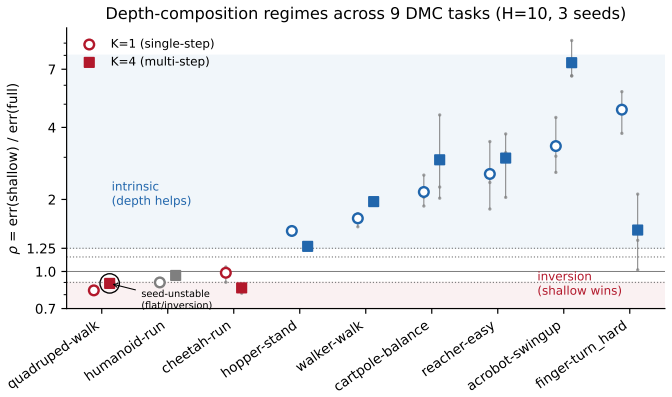
The paper's central claim: per-step depth precision in latent world models does not reliably survive multi-step composition. Using the shallow penalty—the ratio of shallowest-exit to full-depth rollout error—nine control tasks split into six where depth helps, two where shallow beats deep, and one flat. The inversion is caused by training, not dynamics: a causal ablation supervising exits only at the first step erases it. A dimensionality-only classifier predicts this regime out-of-sample, and the ratio's sign transfers to planning: shallow beats deep where the diagnostic predicts inversion.
Load-bearing premise
The predictability claim rests on an out-of-sample test of only three genuinely novel tasks, with the decisive extrapolation a single task, so chance cannot be ruled out at this sample size.
Editorial extensions
If this is right
- Before routing depth inside a world model, measure rho: if it is below one, routing deep is actively harmful rather than merely wasteful.
- The standard recipe for making a model routable—supervising every exit at every rollout step—can train shallow exits to out-roll the full stack, defeating the purpose of routing.
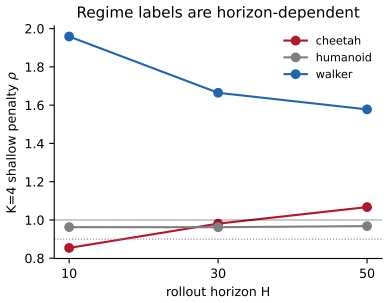
- Regime labels are configuration-specific: metric space, rollout horizon, encoder, backbone, and above all the training-data distribution can shift whether depth helps.
- On the two tasks retrained with competent-policy data, both inversions and intrinsic tradeoffs vanish with loss unchanged, so random-data measurements are not fixed task properties.
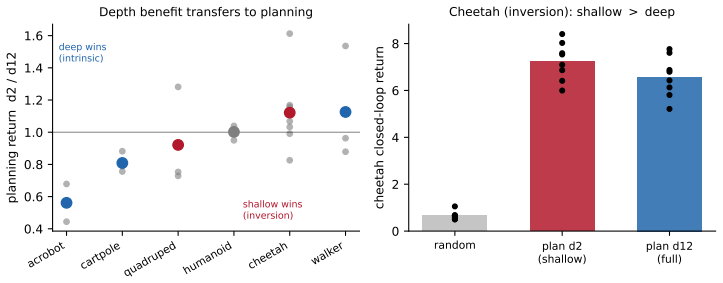
- The sign of rho transfers to closed-loop planning: on the robust inversion task, shallow planning beats deep planning, matching the open-loop diagnostic.
Reading between the lines
- If the dimensionality rule survives a larger held-out sweep, model architects could screen tasks before training and spend depth only where rollouts reward it.
- The catch-22 points to a design fix the paper does not itself propose: decouple routability training from composition training, e.g., supervise exits on single steps only, which the ablation suggests would preserve routability without manufacturing inversion.
- The horizon dependence implies adaptive routers should condition on how many steps remain in a rollout, not just per-step difficulty, since the inversion is a short-horizon effect.
- The random-data dependence predicts that the practical payoff of depth routing is largest during pretraining and early exploration and fades at convergence; this is testable by measuring rho throughout training under on-policy data.
Editorial analysis
A structured set of objections, weighed in public.
Referee Report
Summary. The paper asks whether per-step predictor depth in latent world models survives autoregressive composition, using a pre-registered shallow penalty rho = err(shallowest-exit rollout)/err(full-depth rollout). On nine DMC tasks with matched K=1 and K=4 training, eight seeds each, it reports three regimes: intrinsic (6/9, depth helps), inversion (2/9, shallow beats deep), and flat (1/9). It attributes the cheetah inversion to a causal mechanism (the routability catch-22: depth supervision at every rollout step trains shallow exits to out-roll the full stack), reports a frozen dimensionality-only classifier that predicts held-out regimes (2/3 on genuinely novel tasks), maps how the regime shifts with metric, horizon, encoder, architecture, and training data, and tests whether rho transfers to CEM planning. The paper is notable for its detailed pre-registration, mechanical gates, and candid reporting of a failed initial hypothesis.
Significance. If the core taxonomy and the catch-22 hold, the paper provides a useful diagnostic and a substantive caveat for adaptive-compute world models: depth routing is only meaningful when the depth-quality relation survives composition, and the standard recipe for making exits routable can train away the advantage. The pre-registration discipline, matched twins, non-overlapping seed distributions for Gate B, honest reporting of the failed Gate 1, and the reproducibility infrastructure are genuine strengths. However, the 'stable, predictable core' claim rests on an n=3 held-out prediction with 2/3 accuracy, the random-policy data regime is defended by argument rather than measurement, and the planning transfer reverses under a stronger planner. The paper is therefore more conditionally supportive than its abstract suggests, though the manuscript itself is unusually candid about most of these limits.
major comments (3)
- [§8, Abstract] The out-of-sample regime predictor is fit on the nine in-sample tasks (the same tasks used to build the taxonomy) with two collinear features, and the genuinely novel held-out evaluation is n=3 with 2/3 correct. Section 8 explicitly says 'we deliberately avoid partial correlations or significance claims at this sample size,' yet the abstract and the contribution list state that the classifier 'predicts held-out tasks correctly out-of-sample' and hold this up as evidence for a 'stable, predictable core.' At n=3, a random guess among three regimes has about a 26% chance of achieving 2/3 correct, so this is not a statistically defensible validation. I request either additional held-out tasks or a rephrasing of the contribution as a suggestive case study, with the 'predictable core' wording in the abstract and conclusion adjusted to match.
- [§7, §10, Abstract] The paper's largest lever is training-data distribution: retraining cheetah and cartpole on competent-policy data removes both the inversion and the intrinsic tradeoff (rho_K4: 0.87->1.06 and 3.19->1.00), while Section 10's defense of the random-data regime is explicitly 'an argument rather than a measurement.' Because the entire taxonomy and the catch-22 are measured in the random-policy regime, the practical scope of the central claim depends on an untested assumption. The abstract's statement of the catch-22 ('the per-step deep supervision ... trains them to out-roll the full stack') omits the paper's own finding that a competent-policy data distribution can erase the effect. I request that the abstract and contributions explicitly scope the taxonomy and the catch-22 to random-policy/exploratory data, and that Section 10's justification be labeled as a hypothesis with a concrete test
- [§9, Abstract] The planning validation is partial and planner-dependent. P1 holds on only 4/6 viable tasks, P2 fails at the pre-registered threshold and is only partially recovered on one intrinsic task, and under a stronger planner cheetah's shallow-beats-deep result reverses (Section 9(ii)). The abstract states 'In a CEM planner, rho predicts whether planning benefits from depth,' but this holds only for the weak-planner configuration and robust-regime tasks. The stronger-planner reversal shows that the sign transfer is not a robust planning fact; the paper interprets the reversal as 'two faces of the same fact,' but the abstract and contributions do not carry this caveat. Please qualify the planning claim by planner strength and reward-model quality, and explicitly report the P2 failure and its partial recovery in the summary of the planning results.
minor comments (5)
- [§5 vs. Table 1] The text cites 'acrobot 3.34->7.46, ... finger 4.74->1.49, hopper 1.48->1.27,' but Table 1 reports acrobot 3.54->7.98, finger 3.22->1.42, hopper 1.49->1.28. Either these are the pre-expansion three-seed values and should be labeled as such, or they are inconsistencies with Table 1.
- [Figure 2 caption] The caption says 'Flat (humanoid): depth barely matters,' but the text and Section 7 report that humanoid's curve dips to ~0.83 at intermediate depth and its label flips to inversion in observation space. The caption should reflect the borderline nature.
- [Table 2] The entries for quadruped and walker in the Delta column use the notation '-0.048/3' and '+0.118/3'; the '/3' appears to indicate n=3. This is ambiguous and should be written explicitly, e.g., 'Delta = -0.05 (n=3)'.
- [§12] The conclusion says the study spans 'fifteen DMC settings,' but the main text emphasizes nine tasks and then additional pixel/backbone/held-out campaigns. Please clarify the count, either by defining 'settings' or by listing the extra configurations.
- [§7, Figure 5] In the representation-dependence discussion, the pixel-cartpole K=4 model is described as undertrained, and the comparison is read at K=1. This is a reasonable decision, but the corresponding caveat should be repeated in the caption of Figure 5 so the reader does not misinterpret the plotted K=1 values as capturing the full design.
Circularity Check
No circular derivation: rho is an independently measured diagnostic, the out-of-sample classifier was frozen before held-out training, the catch-22 ablation changes a single training flag, and the planning transfer is tested against closed-loop returns rather than defined to match rho.
full rationale
The derivation chain is empirical and self-contained rather than definitional. rho is defined as a ratio of measured rollout errors (err(shallowest-exit rollout)/err(full-depth rollout)) and is computed by an audit script; the regime thresholds are pre-registered but explicitly not first-principles, and the paper reports raw rho so readers can apply their own thresholds. There is no equation-to-equation reduction. The out-of-sample regime predictor is fit on the nine in-sample tasks' dimensionality and labels, then frozen, and only then applied to held-out tasks; the held-out labels were not used in fitting, so this is a genuine (if very small) out-of-sample prediction, not a fitted input renamed as a prediction. The routability catch-22 ablation changes one training flag (deep_sup_first_step_only) while the full-depth objective is unchanged, and the de-inversion is measured on fresh checkpoints with non-overlapping seed distributions; it is not forced by construction. The planning validation compares rho's sign to closed-loop returns, reports misses on the tasks the taxonomy itself flagged as marginal, and therefore is not defined to match rho. The on-policy disappearance of the regime is explicitly presented as n=2 and as untested beyond two tasks; that is a scope limitation, not circularity. The only self-referential elements are the author's prior internal reduced-scale result, which is used as the failed motivating hypothesis and is explicitly superseded by the full-scale pre-registration, and the self-reported git-history pre-registration; neither is load-bearing evidence for the central claims, and self-reported pre-registration is a verifiability concern rather than a circularity. No load-bearing step reduces to its own inputs, so the circularity score is 0.
Assumptions & free parameters
free parameters (4)
- Regime thresholds (rho intrinsic lower bound, inversion upper bounds) =
1.25 / 1.15 / 0.90
- Canonical rollout horizon H =
10
- Shallowest exit depth d_min =
2 blocks
- Out-of-sample regime classifier weights =
not reported (log-odds coefficients on log obs-dim and log(act-dim+1))
assumptions (3)
- domain assumption EMA-encoded latent targets are a valid ground truth for rollout quality.
- domain assumption Random-policy pre-collected data is the right regime for measuring compute-routing diagnostics.
- domain assumption The self-reported git history honestly documents the claimed pre-registration.
Cite this review
Pith. "Pith review of Adaptive Compute in Latent World Models: When Depth Helps, Hurts, or Doesn't Matter." pith.science (2026). https://pith.science/paper/N5YIQCND
@misc{pith2026260710203,
  author       = {Pith},
  title        = {Pith review of: Adaptive Compute in Latent World Models: When Depth Helps, Hurts, or Doesn't Matter},
  year         = {2026},
  howpublished = {\url{https://pith.science/paper/N5YIQCND}},
  note         = {Machine review of arXiv:2607.10203}
}
read the original abstract
Adaptive compute for world models -- early-exit or mixture-of-depths predictors that spend variable depth per rollout step -- presumes that extra depth buys better predictions. In autoregressive rollouts, where planning actually happens, that premise requires depth's per-step precision to survive composition. We test it directly with one pre-registered instrument, the shallow penalty rho = err(shallowest-exit rollout)/err(full-depth rollout), on nine DeepMind Control tasks under matched single-step (K=1) and multi-step (K=4) training, eight seeds each. Three regimes emerge: depth helps (intrinsic, 6/9 tasks, rho up to 8x), depth actively hurts (inversion, 2/9, rho down to 0.87x), or depth barely matters (flat). The inversion is created by training, not the dynamics: supervising early exits only at the first rollout step erases it (Delta=+0.28, n=8, non-overlapping distributions) -- a routability catch-22: the per-step deep supervision that makes exits routable also trains them to out-roll the full stack. The regime is predictable: a frozen dimensionality-only classifier, committed before training, labels held-out tasks correctly out-of-sample, including an extreme extrapolation. The inversion reproduces under a transformer predictor, yet its manifestation is configuration-dependent, shifting with metric space, horizon, encoder, backbone, and -- most strongly -- training data: on the two tasks we retrained, competent-policy data removes both the inversion and the intrinsic tradeoff, loss unchanged. In a CEM planner, rho predicts whether planning benefits from depth. Every threshold and gate was committed before the corresponding compute, including a pre-registered negative for the motivating hypothesis. Whether more compute helps a world model is not a task property; it is a property of the operating configuration, with a stable, predictable, mechanism-backed core.
Figures


Figures from the paper (12 more)






Reference graph
Works this paper leans on
-
[1]
Bellemare
Rishabh Agarwal, Max Schwarzer, Pablo Samuel Castro, Aaron Courville, and Marc G. Bellemare. Deep reinforcement learning at the edge of the statistical precipice. In Advances in Neural Information Processing Systems (NeurIPS), 2021
2021
-
[2]
Self-supervised learning from images with a joint-embedding predictive architecture
Mahmoud Assran, Quentin Duval, Ishan Misra, Piotr Bojanowski, Pascal Vincent, Michael Rabbat, Yann LeCun, and Nicolas Ballas. Self-supervised learning from images with a joint-embedding predictive architecture. In IEEE Conference on Computer Vision and Pattern Recognition (CVPR), 2023
2023
-
[3]
PonderNet : Learning to ponder
Andrea Banino, Jan Balaguer, and Charles Blundell. PonderNet : Learning to ponder. arXiv preprint arXiv:2107.05407, 2021
arXiv 2021
-
[4]
VICReg : Variance-invariance-covariance regularization for self-supervised learning
Adrien Bardes, Jean Ponce, and Yann LeCun. VICReg : Variance-invariance-covariance regularization for self-supervised learning. In International Conference on Learning Representations (ICLR), 2022
2022
-
[6]
Adaptive neural networks for efficient inference
Tolga Bolukbasi, Joseph Wang, Ofer Dekel, and Venkatesh Saligrama. Adaptive neural networks for efficient inference. In International Conference on Machine Learning (ICML), 2017
2017
-
[7]
Exploring simple siamese representation learning
Xinlei Chen and Kaiming He. Exploring simple siamese representation learning. In IEEE Conference on Computer Vision and Pattern Recognition (CVPR), 2021
2021
-
[8]
Deep reinforcement learning in a handful of trials using probabilistic dynamics models
Kurtland Chua, Roberto Calandra, Rowan McAllister, and Sergey Levine. Deep reinforcement learning in a handful of trials using probabilistic dynamics models. In Advances in Neural Information Processing Systems (NeurIPS), 2018
2018
-
[9]
Universal transformers
Mostafa Dehghani, Stephan Gouws, Oriol Vinyals, Jakob Uszkoreit, and Lukasz Kaiser. Universal transformers. In International Conference on Learning Representations (ICLR), 2019
2019
Show all 71 references
-
[10]
Depth-adaptive transformer
Maha Elbayad, Jiatao Gu, Edouard Grave, and Michael Auli. Depth-adaptive transformer. In International Conference on Learning Representations (ICLR), 2020
2020
-
[11]
Switch transformers: Scaling to trillion parameter models with simple and efficient sparsity
William Fedus, Barret Zoph, and Noam Shazeer. Switch transformers: Scaling to trillion parameter models with simple and efficient sparsity. Journal of Machine Learning Research (JMLR), 23, 2022
2022
-
[12]
Collins, Yukun Zhu, Li Zhang, Jonathan Huang, Dmitry Vetrov, and Ruslan Salakhutdinov
Michael Figurnov, Maxwell D. Collins, Yukun Zhu, Li Zhang, Jonathan Huang, Dmitry Vetrov, and Ruslan Salakhutdinov. Spatially adaptive computation time for residual networks. In IEEE Conference on Computer Vision and Pattern Recognition (CVPR), 2017
2017
-
[13]
Bellemare
Carles Gelada, Saurabh Kumar, Jacob Buckman, Ofir Nachum, and Marc G. Bellemare. DeepMDP : Learning continuous latent space models for representation learning. In International Conference on Machine Learning (ICML), 2019
2019
-
[15]
Richemond, Elena Buchatskaya, Carl Doersch, Bernardo Avila Pires, Zhaohan Daniel Guo, Mohammad Gheshlaghi Azar, Bilal Piot, Koray Kavukcuoglu, R \'e mi Munos, and Michal Valko
Jean-Bastien Grill, Florian Strub, Florent Altch \'e , Corentin Tallec, Pierre H. Richemond, Elena Buchatskaya, Carl Doersch, Bernardo Avila Pires, Zhaohan Daniel Guo, Mohammad Gheshlaghi Azar, Bilal Piot, Koray Kavukcuoglu, R \'e mi Munos, and Michal Valko. Bootstrap your own...
2020
-
[16]
Recurrent world models facilitate policy evolution
David Ha and J \"u rgen Schmidhuber. Recurrent world models facilitate policy evolution. In Advances in Neural Information Processing Systems (NeurIPS), 2018
2018
-
[17]
Learning latent dynamics for planning from pixels
Danijar Hafner, Timothy Lillicrap, Ian Fischer, Ruben Villegas, David Ha, Honglak Lee, and James Davidson. Learning latent dynamics for planning from pixels. In International Conference on Machine Learning (ICML), 2019
2019
-
[18]
Dream to control: Learning behaviors by latent imagination
Danijar Hafner, Timothy Lillicrap, Jimmy Ba, and Mohammad Norouzi. Dream to control: Learning behaviors by latent imagination. In International Conference on Learning Representations (ICLR), 2020
2020
-
[20]
Dynamic neural networks: A survey
Yizeng Han, Gao Huang, Shiji Song, Le Yang, Honghui Wang, and Yulin Wang. Dynamic neural networks: A survey. IEEE Transactions on Pattern Analysis and Machine Intelligence (TPAMI), 2021
2021
-
[21]
Temporal difference learning for model predictive control
Nicklas Hansen, Xiaolong Wang, and Hao Su. Temporal difference learning for model predictive control. In International Conference on Machine Learning (ICML), 2022
2022
-
[22]
TD-MPC2 : Scalable, robust world models for continuous control
Nicklas Hansen, Hao Su, and Xiaolong Wang. TD-MPC2 : Scalable, robust world models for continuous control. In International Conference on Learning Representations (ICLR), 2024
2024
-
[23]
Deep reinforcement learning that matters
Peter Henderson, Riashat Islam, Philip Bachman, Joelle Pineau, Doina Precup, and David Meger. Deep reinforcement learning that matters. In AAAI Conference on Artificial Intelligence, 2018
2018
-
[25]
When to trust your model: Model-based policy optimization
Michael Janner, Justin Fu, Marvin Zhang, and Sergey Levine. When to trust your model: Model-based policy optimization. In Advances in Neural Information Processing Systems (NeurIPS), 2019
2019
-
[26]
Kingma and Jimmy Ba
Diederik P. Kingma and Jimmy Ba. Adam: A method for stochastic optimization. In International Conference on Learning Representations (ICLR), 2015
2015
-
[27]
A path towards autonomous machine intelligence
Yann LeCun. A path towards autonomous machine intelligence. Open Review preprint (version 0.9.2), 2022
2022
-
[28]
Deeply-supervised nets
Chen-Yu Lee, Saining Xie, Patrick Gallagher, Zhengyou Zhang, and Zhuowen Tu. Deeply-supervised nets. In Artificial Intelligence and Statistics (AISTATS), 2015
2015
-
[29]
Decoupled weight decay regularization
Ilya Loshchilov and Frank Hutter. Decoupled weight decay regularization. In International Conference on Learning Representations (ICLR), 2019
2019
-
[31]
Mastering Atari , Go , chess and shogi by planning with a learned model
Julian Schrittwieser, Ioannis Antonoglou, Thomas Hubert, Karen Simonyan, Laurent Sifre, Simon Schmitt, Arthur Guez, Edward Lockhart, Demis Hassabis, Thore Graepel, Timothy Lillicrap, and David Silver. Mastering Atari , Go , chess and shogi by planning with a learned model. Nat...
2020
-
[32]
Confident adaptive language modeling
Tal Schuster, Adam Fisch, Jai Gupta, Mostafa Dehghani, Dara Bahri, Vinh Tran, Yi Tay, and Donald Metzler. Confident adaptive language modeling. In Advances in Neural Information Processing Systems (NeurIPS), 2022
2022
-
[33]
Devon Hjelm, Aaron Courville, and Philip Bachman
Max Schwarzer, Ankesh Anand, Rishab Goel, R. Devon Hjelm, Aaron Courville, and Philip Bachman. Data-efficient reinforcement learning with self-predictive representations. In International Conference on Learning Representations (ICLR), 2021
2021
-
[34]
Outrageously large neural networks: The sparsely-gated mixture-of-experts layer
Noam Shazeer, Azalia Mirhoseini, Krzysztof Maziarz, Andy Davis, Quoc Le, Geoffrey Hinton, and Jeff Dean. Outrageously large neural networks: The sparsely-gated mixture-of-experts layer. In International Conference on Learning Representations (ICLR), 2017
2017
-
[35]
Going deeper with convolutions
Christian Szegedy, Wei Liu, Yangqing Jia, Pierre Sermanet, Scott Reed, Dragomir Anguelov, Dumitru Erhan, Vincent Vanhoucke, and Andrew Rabinovich. Going deeper with convolutions. In IEEE Conference on Computer Vision and Pattern Recognition (CVPR), 2015
2015
-
[36]
DeepMind control suite
Yuval Tassa, Yotam Doron, Alistair Muldal, Tom Erez, Yazhe Li, Diego de Las Casas, David Budden, Abbas Abdolmaleki, Josh Merel, Andrew Lefrancq, Timothy Lillicrap, and Martin Riedmiller. DeepMind control suite. arXiv preprint arXiv:1801.00690, 2018
2018 arXiv
-
[37]
Surat Teerapittayanon, Bradley McDanel, and H. T. Kung. BranchyNet : Fast inference via early exiting from deep neural networks. In International Conference on Pattern Recognition (ICPR), 2016
2016
-
[38]
MuJoCo : A physics engine for model-based control
Emanuel Todorov, Tom Erez, and Yuval Tassa. MuJoCo : A physics engine for model-based control. In IEEE/RSJ International Conference on Intelligent Robots and Systems (IROS), 2012
2012
-
[39]
arXiv preprint arXiv:1603.08983 , year=
Adaptive computation time for recurrent neural networks , author=. arXiv preprint arXiv:1603.08983 , year=
-
[40]
Teerapittayanon, Surat and McDanel, Bradley and Kung, H. T. , booktitle=
-
[41]
IEEE Conference on Computer Vision and Pattern Recognition (CVPR) , year=
Spatially adaptive computation time for residual networks , author=. IEEE Conference on Computer Vision and Pattern Recognition (CVPR) , year=
-
[42]
International Conference on Learning Representations (ICLR) , year=
Universal transformers , author=. International Conference on Learning Representations (ICLR) , year=
-
[43]
International Conference on Learning Representations (ICLR) , year=
Depth-adaptive transformer , author=. International Conference on Learning Representations (ICLR) , year=
-
[44]
Banino, Andrea and Balaguer, Jan and Blundell, Charles , journal=
-
[45]
Advances in Neural Information Processing Systems (NeurIPS) , year=
Confident adaptive language modeling , author=. Advances in Neural Information Processing Systems (NeurIPS) , year=
-
[46]
Mixture-of-
Raposo, David and Ritter, Sam and Richens, Blake and Lillicrap, Timothy and Veli. Mixture-of-. arXiv preprint arXiv:2404.02258 , year=
-
[47]
International Conference on Learning Representations (ICLR) , year=
Outrageously large neural networks: The sparsely-gated mixture-of-experts layer , author=. International Conference on Learning Representations (ICLR) , year=
-
[48]
Journal of Machine Learning Research (JMLR) , volume=
Switch transformers: Scaling to trillion parameter models with simple and efficient sparsity , author=. Journal of Machine Learning Research (JMLR) , volume=
-
[49]
IEEE Transactions on Pattern Analysis and Machine Intelligence (TPAMI) , year=
Dynamic neural networks: A survey , author=. IEEE Transactions on Pattern Analysis and Machine Intelligence (TPAMI) , year=
-
[50]
International Conference on Machine Learning (ICML) , year=
Adaptive neural networks for efficient inference , author=. International Conference on Machine Learning (ICML) , year=
-
[51]
Advances in Neural Information Processing Systems (NeurIPS) , year=
Recurrent world models facilitate policy evolution , author=. Advances in Neural Information Processing Systems (NeurIPS) , year=
-
[52]
International Conference on Machine Learning (ICML) , year=
Learning latent dynamics for planning from pixels , author=. International Conference on Machine Learning (ICML) , year=
-
[53]
International Conference on Learning Representations (ICLR) , year=
Dream to control: Learning behaviors by latent imagination , author=. International Conference on Learning Representations (ICLR) , year=
-
[54]
arXiv preprint arXiv:2301.04104 , year=
Mastering diverse domains through world models , author=. arXiv preprint arXiv:2301.04104 , year=
-
[55]
International Conference on Machine Learning (ICML) , year=
Temporal difference learning for model predictive control , author=. International Conference on Machine Learning (ICML) , year=
-
[56]
Hansen, Nicklas and Su, Hao and Wang, Xiaolong , booktitle=
-
[57]
Mastering
Schrittwieser, Julian and Antonoglou, Ioannis and Hubert, Thomas and Simonyan, Karen and Sifre, Laurent and Schmitt, Simon and Guez, Arthur and Lockhart, Edward and Hassabis, Demis and Graepel, Thore and Lillicrap, Timothy and Silver, David , journal=. Mastering
-
[58]
Advances in Neural Information Processing Systems (NeurIPS) , year=
Deep reinforcement learning in a handful of trials using probabilistic dynamics models , author=. Advances in Neural Information Processing Systems (NeurIPS) , year=
-
[59]
Advances in Neural Information Processing Systems (NeurIPS) , year=
When to trust your model: Model-based policy optimization , author=. Advances in Neural Information Processing Systems (NeurIPS) , year=
-
[60]
Open Review preprint (version 0.9.2) , year=
A path towards autonomous machine intelligence , author=. Open Review preprint (version 0.9.2) , year=
-
[61]
IEEE Conference on Computer Vision and Pattern Recognition (CVPR) , year=
Self-supervised learning from images with a joint-embedding predictive architecture , author=. IEEE Conference on Computer Vision and Pattern Recognition (CVPR) , year=
-
[62]
arXiv preprint arXiv:2404.08471 , year=
Revisiting feature prediction for learning visual representations from video , author=. arXiv preprint arXiv:2404.08471 , year=
-
[63]
Advances in Neural Information Processing Systems (NeurIPS) , year=
Bootstrap your own latent: A new approach to self-supervised learning , author=. Advances in Neural Information Processing Systems (NeurIPS) , year=
-
[64]
IEEE Conference on Computer Vision and Pattern Recognition (CVPR) , year=
Exploring simple siamese representation learning , author=. IEEE Conference on Computer Vision and Pattern Recognition (CVPR) , year=
-
[65]
Bardes, Adrien and Ponce, Jean and LeCun, Yann , booktitle=
-
[66]
International Conference on Learning Representations (ICLR) , year=
Data-efficient reinforcement learning with self-predictive representations , author=. International Conference on Learning Representations (ICLR) , year=
-
[67]
, booktitle=
Gelada, Carles and Kumar, Saurabh and Buckman, Jacob and Nachum, Ofir and Bellemare, Marc G. , booktitle=
-
[68]
Artificial Intelligence and Statistics (AISTATS) , year=
Deeply-supervised nets , author=. Artificial Intelligence and Statistics (AISTATS) , year=
-
[69]
IEEE Conference on Computer Vision and Pattern Recognition (CVPR) , year=
Going deeper with convolutions , author=. IEEE Conference on Computer Vision and Pattern Recognition (CVPR) , year=
-
[70]
arXiv preprint arXiv:1503.02531 , year=
Distilling the knowledge in a neural network , author=. arXiv preprint arXiv:1503.02531 , year=
-
[71]
Tassa, Yuval and Doron, Yotam and Muldal, Alistair and Erez, Tom and Li, Yazhe and de Las Casas, Diego and Budden, David and Abdolmaleki, Abbas and Merel, Josh and Lefrancq, Andrew and Lillicrap, Timothy and Riedmiller, Martin , journal=
-
[72]
Todorov, Emanuel and Erez, Tom and Tassa, Yuval , booktitle=
-
[73]
International Conference on Learning Representations (ICLR) , year=
Adam: A method for stochastic optimization , author=. International Conference on Learning Representations (ICLR) , year=
-
[74]
International Conference on Learning Representations (ICLR) , year=
Decoupled weight decay regularization , author=. International Conference on Learning Representations (ICLR) , year=
-
[75]
AAAI Conference on Artificial Intelligence , year=
Deep reinforcement learning that matters , author=. AAAI Conference on Artificial Intelligence , year=
-
[76]
Advances in Neural Information Processing Systems (NeurIPS) , year=
Deep reinforcement learning at the edge of the statistical precipice , author=. Advances in Neural Information Processing Systems (NeurIPS) , year=
Reviewed August 2, 2026 · model on record in the stance chip above.
Discussion (0). Sign in to comment.