REVIEW 2 major objections 5 minor 67 references
Open-vocabulary 3D Gaussian fields can be built without training and stored under a megabyte by coding only the binding to a small set of spatial anchors.
Reviewed by Pith at T0; open to challenge. T0 means a machine referee read the full paper against a public rubric. the ladder, T0–T4 →
T0 review · grok-4.5
2026-07-14 13:18 UTC pith:IB47SEAW
load-bearing objection Training-free sub-MB open-vocab 3DGS fields that actually match trained baselines by coding the binding, not the features. the 2 major comments →
CoSAG: Compact Semantic Anchor Gaussians via Training-Free Rate-Distortion Coding
The pith
A machine-rendered reading of the paper's core claim, the machinery that carries it, and where it could break.
Core claim
Storage of an open-vocabulary semantic Gaussian field is a rate-distortion problem over the per-Gaussian binding to a small, spatially grounded anchor table. Once construction is performed by a closed-form lift and multi-view denoising, that binding becomes clean and piecewise constant in space, so a predictive entropy coder (with parent-pointer sharing across hierarchy levels) drives the entire field into the sub-megabyte regime without shipping any decoder, while accuracy equals or exceeds optimization-based methods.
What carries the argument
Spatially grounded semantic anchors plus rate-distortion binding compression: each Gaussian is bound by joint spatial-semantic proximity to an anchor obtained from multi-view SAM regions; the binding is then Morton-reordered and entropy-coded, with coarser hierarchy levels recovered by parent-pointer tables.
Load-bearing premise
The method assumes that depth rendered from the frozen Gaussian scene is reliable enough to place the anchors in 3D; if the geometry is wrong, both the spatial binding and its compressibility collapse.
What would settle it
On a scene whose reconstructed depth is known to be unreliable (for example, large transparent or reflective surfaces), measure whether CoSAG's mIoU and storage both degrade relative to a method that does not back-project through that depth; a clear drop would falsify the grounding claim.
Editorial analysis
A structured set of objections, weighed in public.
Referee Report
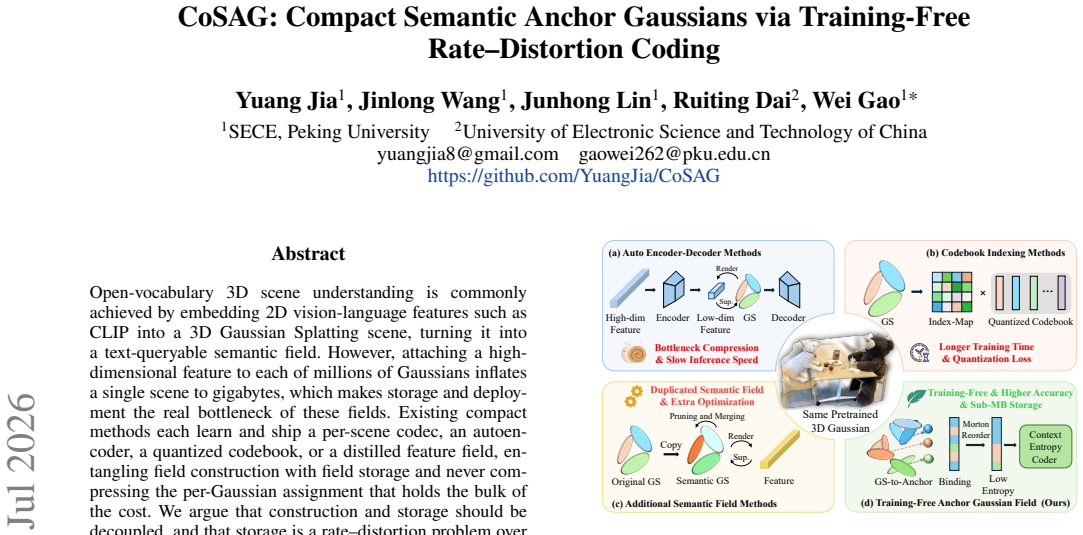
Summary. CoSAG constructs open-vocabulary semantic fields on frozen 3D Gaussian Splatting by a closed-form transmittance-weighted lift of multi-granularity SAM-CLIP features, binds Gaussians to spatially grounded anchors via joint spatial-semantic proximity, denoises anchors by multi-view averaging with contrast-based level selection, and stores the result by deterministic shared-basis projection of the anchor table plus Morton-ordered, parent-pointer entropy coding of the binding. Construction and storage are fully decoupled and training-free; no per-scene decoder is shipped. On LERF-OVS, 3D-OVS, LERF 3D-selection, and Replica LSeg, the method reports sub-megabyte fields that match or exceed recent autoencoder, codebook, and distilled-field baselines (including LangSplatV2, SCOUP, CF3, LightSplat) while reducing storage by roughly 37–76× relative to LangSplatV2, with supporting ablations of binding, multi-view averaging, coder stages, and projection dimension.
Significance. If the reported numbers hold, the paper cleanly separates field construction from field storage and shows that the per-Gaussian binding—not the high-dimensional features themselves—is the compressible object. The closed-form lift, spatially grounded anchors, and decoder-free entropy coder together yield a practical sub-MB representation that serves both 2D-rendered and 3D-selection protocols from one field, plus scene editing. Strengths include multi-protocol evaluation against strong recent baselines, fixed hyperparameters across scenes, ablations that isolate binding and coding contributions (Tables 6–7, Fig. 4), and a transfer experiment from SAM-CLIP to dense LSeg. The work is a concrete systems advance for deployable open-vocabulary 3DGS rather than a purely incremental accuracy paper.
major comments (2)
- Sec. 3.3 and Conclusion: anchors are grounded by back-projecting SAM-region pixels through depth rendered from the frozen 3DGS. The authors correctly flag this as a limitation where geometry is unreliable. The main tables (LERF-OVS, 3D-OVS, Replica) use indoor scenes with reliable pretrained 3DGS; the appendix Waymo result is qualitative only. A short quantitative stress test (e.g., controlled depth noise or a scene with known reconstruction failure) would strengthen the claim that the reported compressibility and accuracy transfer beyond the evaluated indoor setting. This does not overturn the indoor results but is load-bearing for the generality of the rate–distortion argument.
- Sec. 3.3, Eq. (3): the method minimizes a decoupled transmittance-weighted surrogate rather than the coupled rendering objective whose Gram matrix couples all Gaussians. The paper presents this as admitting a unique closed-form minimizer and reports strong empirical accuracy, but does not quantify the approximation gap (e.g., residual of the true rendering loss after the closed-form lift, or a controlled comparison against a few steps of the coupled objective). A brief residual or side-by-side check would make the sufficiency claim more rigorous; the current multi-dataset tables support practicality but leave the theoretical gap unmeasured.
minor comments (5)
- Sec. 4.1 vs. Sec. 3.3: the cosine gate is written as θ in the method and as τ=0.7 in implementation details; unify the symbol.
- Table 1 overall mAcc: CoSAG is second to SCOUP (86.1 vs 86.9) while leading mIoU; the abstract’s “matching or exceeding” is accurate but a one-sentence note in the text would avoid over-reading the mAcc column.
- Fig. 2 pipeline diagram is dense; a short caption call-out of which stages are closed-form vs. which are entropy-coded would help readers unfamiliar with the LangSplat lineage.
- Related work: concurrent LightSplat and SCOUP are discussed; ensure arXiv dates and protocol differences (single-level vs multi-granularity, uncompressed index vs coded binding) are stated clearly so the novelty claim on binding compression remains unambiguous.
- Typographical: occasional missing spaces after commas and in compound adjectives (e.g., “rate–distortion” vs “rate-distortion”) appear in the abstract and introduction; a light copy-edit pass would clean them.
Circularity Check
No circularity: empirical systems method with closed-form construction and external benchmark metrics; nothing reduces to its own inputs by definition.
full rationale
CoSAG’s load-bearing chain is (i) a closed-form transmittance-weighted lift (Eq. 3) of frozen 3DGS compositing weights against off-the-shelf SAM/CLIP (or LSeg) maps, (ii) learning-free spatial–semantic binding to anchors, (iii) multi-view scatter-mean denoising, and (iv) deterministic PCA plus Morton/LZMA/parent-pointer coding of the binding. None of these steps defines the reported quantities in terms of themselves: mIoU, mAcc, mAcc@0.25, and storage MB are measured against public LERF-OVS, 3D-OVS, and Replica annotations and compared to independent baselines. Hyperparameters (θ=0.7, κ=2000, ρ=10^{-4}, D=128/32/16) are fixed a priori across scenes rather than fitted to the reported scores and then re-presented as predictions. There is no uniqueness theorem, self-citation chain, or ansatz smuggled in as a first-principles derivation; self-citations (if any) are not load-bearing for the central claim. The depth-grounding premise is an acknowledged limitation, not a circular reduction. Score 0 is therefore appropriate.
Axiom & Free-Parameter Ledger
free parameters (5)
- cosine gate θ =
0.7
- neighborhood size κ =
2000
- singleton promotion fraction ρ =
1e-4
- per-level projection dimensions D =
128/32/16
- relevancy box size and consistency exponent γ =
29×29, γ=2
axioms (4)
- domain assumption A frozen pretrained 3DGS provides accurate enough geometry and transmittance weights for closed-form feature lift and depth-based anchor grounding.
- domain assumption Off-the-shelf SAM multi-granularity masks plus CLIP (or LSeg) region/pixel features are adequate teachers for open-vocabulary 3D semantics.
- domain assumption Spatially adjacent Gaussians on the same object almost always share one semantic anchor, so the binding has low conditional entropy after Morton reordering.
- ad hoc to paper Decoupled transmittance-weighted least-squares surrogate is a sufficient substitute for the coupled rendering objective for per-Gaussian features.
invented entities (2)
-
Spatially grounded semantic anchors with joint spatial–semantic binding
no independent evidence
-
Hierarchical parent-pointer binding coder (Morton + cross-level mode tables)
no independent evidence
read the original abstract
Open-vocabulary 3D scene understanding is commonly achieved by embedding 2D vision-language features such as CLIP into a 3D Gaussian Splatting scene, turning it into a text-queryable semantic field. However, attaching a high-dimensional feature to each of millions of Gaussians inflates a single scene to gigabytes, which makes storage and deployment the real bottleneck of these fields. Existing compact methods each learn and ship a per-scene codec, an autoencoder, a quantized codebook, or a distilled feature field, entangling field construction with field storage and never compressing the per-Gaussian assignment that holds the bulk of the cost. We argue that construction and storage should be decoupled, and that storage is a rate-distortion problem over the per-Gaussian binding to a small anchor table, a structure no prior open-vocabulary method compresses. We present CoSAG, which constructs the field without any per-scene training through a closed-form transmittance-weighted lift, spatially grounded semantic anchors, and multi-view denoising, and stores it with a spatially predictive entropy coder that ships no decoder. Because the anchors are spatially grounded, the binding is predictable and therefore highly compressible. The transmittance-weighted lift and multi-view denoising yield a clean, view-consistent assignment, so the entropy coder spends almost no rate on correcting noise and instead codes only the residual against its spatial prediction. CoSAG reaches sub-megabyte storage while matching or exceeding the state of the art across the 2D-rendered, 3D-selection, and dense-LSeg protocols, reducing field size by 37 to 76x relative to LangSplatV2 at higher accuracy.
Figures


Reference graph
Works this paper leans on
-
[1]
Proceedings of the IEEE/CVF Conference on Computer Vision and Pattern Recognition , pages=
Langsplat: 3d language gaussian splatting , author=. Proceedings of the IEEE/CVF Conference on Computer Vision and Pattern Recognition , pages=
-
[2]
Advances in Neural Information Processing Systems , volume=
Langsplatv2: High-dimensional 3d language gaussian splatting with 450+ fps , author=. Advances in Neural Information Processing Systems , volume=
-
[3]
Proceedings of the IEEE/CVF Conference on Computer Vision and Pattern Recognition , pages=
Language embedded 3d gaussians for open-vocabulary scene understanding , author=. Proceedings of the IEEE/CVF Conference on Computer Vision and Pattern Recognition , pages=
-
[4]
Proceedings of the IEEE/CVF Conference on Computer Vision and Pattern Recognition , pages=
Feature 3dgs: Supercharging 3d gaussian splatting to enable distilled feature fields , author=. Proceedings of the IEEE/CVF Conference on Computer Vision and Pattern Recognition , pages=
-
[5]
Advances in Neural Information Processing Systems , volume=
Opengaussian: Towards point-level 3d gaussian-based open vocabulary understanding , author=. Advances in Neural Information Processing Systems , volume=
-
[6]
European Conference on Computer Vision , pages=
N2f2: Hierarchical scene understanding with nested neural feature fields , author=. European Conference on Computer Vision , pages=. 2024 , organization=
2024
-
[7]
European conference on computer vision , pages=
Gaussian grouping: Segment and edit anything in 3d scenes , author=. European conference on computer vision , pages=. 2024 , organization=
2024
-
[8]
Proceedings of the IEEE/CVF Conference on Computer Vision and Pattern Recognition , pages=
LightSplat: Fast and Memory-Efficient Open-Vocabulary 3D Scene Understanding in Five Seconds , author=. Proceedings of the IEEE/CVF Conference on Computer Vision and Pattern Recognition , pages=
-
[9]
Proceedings of the IEEE/CVF conference on computer vision and pattern recognition , pages=
Scaffold-gs: Structured 3d gaussians for view-adaptive rendering , author=. Proceedings of the IEEE/CVF conference on computer vision and pattern recognition , pages=
-
[10]
European Conference on Computer Vision , pages=
Hac: Hash-grid assisted context for 3d gaussian splatting compression , author=. European Conference on Computer Vision , pages=. 2024 , organization=
2024
-
[11]
IEEE Transactions on Pattern Analysis and Machine Intelligence , year=
Hac++: Towards 100x compression of 3d gaussian splatting , author=. IEEE Transactions on Pattern Analysis and Machine Intelligence , year=
-
[12]
Advances in neural information processing systems , volume=
Contextgs: Compact 3d gaussian splatting with anchor level context model , author=. Advances in neural information processing systems , volume=
-
[13]
arXiv preprint arXiv:2603.28431 , year=
LG-HCC: Local Geometry-Aware Hierarchical Context Compression for 3D Gaussian Splatting , author=. arXiv preprint arXiv:2603.28431 , year=
-
[14]
ICASSP 2026-2026 IEEE International Conference on Acoustics, Speech and Signal Processing (ICASSP) , pages=
EntropyGS: an efficient entropy coding on 3D Gaussian splatting , author=. ICASSP 2026-2026 IEEE International Conference on Acoustics, Speech and Signal Processing (ICASSP) , pages=. 2026 , organization=
2026
-
[15]
arXiv preprint arXiv:2601.12814 , year=
CSGaussian: Progressive Rate-Distortion Compression and Segmentation for 3D Gaussian Splatting , author=. arXiv preprint arXiv:2601.12814 , year=
-
[16]
, author=
3d gaussian splatting for real-time radiance field rendering. , author=. ACM Trans. Graph. , volume=
-
[17]
International conference on machine learning , pages=
Learning transferable visual models from natural language supervision , author=. International conference on machine learning , pages=. 2021 , organization=
2021
-
[18]
Proceedings of the IEEE/CVF international conference on computer vision , pages=
Segment anything , author=. Proceedings of the IEEE/CVF international conference on computer vision , pages=
-
[19]
Proceedings of the IEEE/CVF international conference on computer vision , pages=
Lerf: Language embedded radiance fields , author=. Proceedings of the IEEE/CVF international conference on computer vision , pages=
-
[22]
Proceedings of the IEEE/CVF conference on computer vision and pattern recognition , pages=
Openscene: 3d scene understanding with open vocabularies , author=. Proceedings of the IEEE/CVF conference on computer vision and pattern recognition , pages=
-
[24]
Presence: teleoperators & virtual environments , volume=
A survey of augmented reality , author=. Presence: teleoperators & virtual environments , volume=. 1997 , publisher=
1997
-
[25]
splat: Directly referring 3d gaussian splatting via direct language embedding registration , author=
Dr. splat: Directly referring 3d gaussian splatting via direct language embedding registration , author=. Proceedings of the Computer Vision and Pattern Recognition Conference , pages=
-
[26]
Advances in Neural Information Processing Systems , volume=
Ea3d: Online open-world 3d object extraction from streaming videos , author=. Advances in Neural Information Processing Systems , volume=
-
[28]
Advances in Neural Information Processing Systems , volume=
Weakly supervised 3d open-vocabulary segmentation , author=. Advances in Neural Information Processing Systems , volume=
-
[29]
Proceedings of the Computer Vision and Pattern Recognition Conference , pages=
Efficient decoupled feature 3d gaussian splatting via hierarchical compression , author=. Proceedings of the Computer Vision and Pattern Recognition Conference , pages=
-
[31]
Proceedings of the AAAI Conference on Artificial Intelligence , number=
Gags: Granularity-aware feature distillation for language gaussian splatting , author=. Proceedings of the AAAI Conference on Artificial Intelligence , number=
-
[33]
International Journal of Computer Vision , volume=
Fmgs: Foundation model embedded 3d gaussian splatting for holistic 3d scene understanding , author=. International Journal of Computer Vision , volume=. 2025 , publisher=
2025
-
[34]
IEEE Transactions on Pattern Analysis and Machine Intelligence , year=
Langsurf: Language-embedded surface gaussians for 3d scene understanding , author=. IEEE Transactions on Pattern Analysis and Machine Intelligence , year=
-
[35]
Proceedings of the IEEE/CVF International Conference on Computer Vision , pages=
CLIP-GS: Unifying vision-language representation with 3D Gaussian splatting , author=. Proceedings of the IEEE/CVF International Conference on Computer Vision , pages=
-
[36]
Proceedings of the Computer Vision and Pattern Recognition Conference , pages=
Instancegaussian: Appearance-semantic joint gaussian representation for 3d instance-level perception , author=. Proceedings of the Computer Vision and Pattern Recognition Conference , pages=
-
[37]
Proceedings of the IEEE/CVF International Conference on Computer Vision , pages=
In-place scene labelling and understanding with implicit scene representation , author=. Proceedings of the IEEE/CVF International Conference on Computer Vision , pages=
-
[38]
Proceedings of the IEEE/CVF International Conference on Computer Vision , pages=
Ludvig: Learning-free uplifting of 2d visual features to gaussian splatting scenes , author=. Proceedings of the IEEE/CVF International Conference on Computer Vision , pages=
-
[39]
Proceedings of the IEEE/CVF conference on computer vision and pattern recognition , pages=
Scalability in perception for autonomous driving: Waymo open dataset , author=. Proceedings of the IEEE/CVF conference on computer vision and pattern recognition , pages=
-
[40]
Azuma, R. T. 1997. A survey of augmented reality. Presence: teleoperators & virtual environments, 6(4): 355--385
1997
-
[41]
Bang, J.; Kim, J.; Kim, M.; Jeong, S.; and Joo, K. 2026. LightSplat: Fast and Memory-Efficient Open-Vocabulary 3D Scene Understanding in Five Seconds. In Proceedings of the IEEE/CVF Conference on Computer Vision and Pattern Recognition, 19812--19821
2026
-
[42]
A.; Guan, Y.; Ryhner, S.; Lon c ari \'c , S.; and Vijaykumar, N
Budimir, L. A.; Guan, Y.; Ryhner, S.; Lon c ari \'c , S.; and Vijaykumar, N. 2026. Sparse Code Uplifting for Efficient 3D Language Gaussian Splatting. arXiv preprint arXiv:2605.13600
Pith/arXiv arXiv 2026
-
[43]
Chen, Y.; Wu, Q.; Lin, W.; Harandi, M.; and Cai, J. 2024. Hac: Hash-grid assisted context for 3d gaussian splatting compression. In European Conference on Computer Vision, 422--438. Springer
2024
-
[44]
Dai, Z.; Liu, T.; and Zhang, Y. 2025. Efficient decoupled feature 3d gaussian splatting via hierarchical compression. In Proceedings of the Computer Vision and Pattern Recognition Conference, 11156--11166
2025
-
[45]
Deng, T.; Chen, X.; Chen, Y.; Chen, Q.; Xu, Y.; Yang, L.; Xu, L.; Zhang, Y.; Zhang, B.; Huang, W.; et al. 2025. GaussianDWM: 3D Gaussian Driving World Model for Unified Scene Understanding and Multi-Modal Generation. arXiv preprint arXiv:2512.23180
Pith/arXiv arXiv 2025
-
[46]
Jatavallabhula, K. M.; Kuwajerwala, A.; Gu, Q.; Omama, M.; Chen, T.; Maalouf, A.; Li, S.; Iyer, G.; Saryazdi, S.; Keetha, N.; et al. 2023. Conceptfusion: Open-set multimodal 3d mapping. arXiv preprint arXiv:2302.07241
Pith/arXiv arXiv 2023
-
[47]
Jiao, S.; Dong, H.; Yin, Y.; Jie, Z.; Qian, Y.; Zhao, Y.; Shi, H.; and Wei, Y. 2025. CLIP-GS: Unifying vision-language representation with 3D Gaussian splatting. In Proceedings of the IEEE/CVF International Conference on Computer Vision, 4670--4680
2025
-
[48]
F.; Choe, J.; and Oh, T.-H
Jun-Seong, K.; Kim, G.; Yu-Ji, K.; Wang, Y.-C. F.; Choe, J.; and Oh, T.-H. 2025. Dr. splat: Directly referring 3d gaussian splatting via direct language embedding registration. In Proceedings of the Computer Vision and Pattern Recognition Conference, 14137--14146
2025
-
[49]
Kerbl, B.; Kopanas, G.; Leimk \"u hler, T.; Drettakis, G.; et al. 2023. 3d gaussian splatting for real-time radiance field rendering. ACM Trans. Graph., 42(4): 139--1
2023
-
[50]
M.; Goldberg, K.; Kanazawa, A.; and Tancik, M
Kerr, J.; Kim, C. M.; Goldberg, K.; Kanazawa, A.; and Tancik, M. 2023. Lerf: Language embedded radiance fields. In Proceedings of the IEEE/CVF international conference on computer vision, 19729--19739
2023
-
[51]
C.; Lo, W.-Y.; et al
Kirillov, A.; Mintun, E.; Ravi, N.; Mao, H.; Rolland, C.; Gustafson, L.; Xiao, T.; Whitehead, S.; Berg, A. C.; Lo, W.-Y.; et al. 2023. Segment anything. In Proceedings of the IEEE/CVF international conference on computer vision, 4015--4026
2023
-
[52]
Lee, H.; Min, J.; and Park, J. 2025. CF3: Compact and Fast 3D Feature Fields. arXiv preprint arXiv:2508.05254
Pith/arXiv arXiv 2025
-
[53]
Q.; Belongie, S.; Koltun, V.; and Ranftl, R
Li, B.; Weinberger, K. Q.; Belongie, S.; Koltun, V.; and Ranftl, R. 2022. Language-driven semantic segmentation. arXiv preprint arXiv:2201.03546
Pith/arXiv arXiv 2022
-
[54]
Li, H.; Qin, M.; Zou, Z.; He, D.; Ji, X.; Li, B.; Dai, B.; Zhang, D.; and Han, J. 2026 a . Langsurf: Language-embedded surface gaussians for 3d scene understanding. IEEE Transactions on Pattern Analysis and Machine Intelligence
2026
-
[55]
Li, H.; Wu, Y.; Meng, J.; Gao, Q.; Zhang, Z.; Wang, R.; and Zhang, J. 2025. Instancegaussian: Appearance-semantic joint gaussian representation for 3d instance-level perception. In Proceedings of the Computer Vision and Pattern Recognition Conference, 14078--14088
2025
-
[56]
Li, W.; Zhao, Y.; Qin, M.; Liu, Y.; Cai, Y.; Gan, C.; and Pfister, H. 2026 b . Langsplatv2: High-dimensional 3d language gaussian splatting with 450+ fps. Advances in Neural Information Processing Systems, 38: 174306--174330
2026
-
[57]
Liu, K.; Zhan, F.; Zhang, J.; Xu, M.; Yu, Y.; El Saddik, A.; Theobalt, C.; Xing, E.; and Lu, S. 2023. Weakly supervised 3d open-vocabulary segmentation. Advances in Neural Information Processing Systems, 36: 53433--53456
2023
-
[58]
Lu, T.; Yu, M.; Xu, L.; Xiangli, Y.; Wang, L.; Lin, D.; and Dai, B. 2024. Scaffold-gs: Structured 3d gaussians for view-adaptive rendering. In Proceedings of the IEEE/CVF conference on computer vision and pattern recognition, 20654--20664
2024
-
[59]
Marrie, J.; M \'e n \'e gaux, R.; Arbel, M.; Larlus, D.; and Mairal, J. 2025. Ludvig: Learning-free uplifting of 2d visual features to gaussian splatting scenes. In Proceedings of the IEEE/CVF International Conference on Computer Vision, 7440--7450
2025
-
[60]
Peng, S.; Genova, K.; Jiang, C.; Tagliasacchi, A.; Pollefeys, M.; Funkhouser, T.; et al. 2023. Openscene: 3d scene understanding with open vocabularies. In Proceedings of the IEEE/CVF conference on computer vision and pattern recognition, 815--824
2023
-
[61]
Peng, Y.; Wang, H.; Liu, Y.; Wen, C.; Dong, Z.; and Yang, B. 2026. Gags: Granularity-aware feature distillation for language gaussian splatting. In Proceedings of the AAAI Conference on Artificial Intelligence, 10, 8376--8384
2026
-
[62]
Qin, M.; Li, W.; Zhou, J.; Wang, H.; and Pfister, H. 2024. Langsplat: 3d language gaussian splatting. In Proceedings of the IEEE/CVF Conference on Computer Vision and Pattern Recognition, 20051--20060
2024
-
[63]
W.; Hallacy, C.; Ramesh, A.; Goh, G.; Agarwal, S.; Sastry, G.; Askell, A.; Mishkin, P.; Clark, J.; et al
Radford, A.; Kim, J. W.; Hallacy, C.; Ramesh, A.; Goh, G.; Agarwal, S.; Sastry, G.; Askell, A.; Mishkin, P.; Clark, J.; et al. 2021. Learning transferable visual models from natural language supervision. In International conference on machine learning, 8748--8763. PmLR
2021
-
[64]
Shi, J.-C.; Wang, M.; Duan, H.-B.; and Guan, S.-H. 2024. Language embedded 3d gaussians for open-vocabulary scene understanding. In Proceedings of the IEEE/CVF Conference on Computer Vision and Pattern Recognition, 5333--5343
2024
-
[65]
J.; Mur-Artal, R.; Ren, C.; Verma, S.; et al
Straub, J.; Whelan, T.; Ma, L.; Chen, Y.; Wijmans, E.; Green, S.; Engel, J. J.; Mur-Artal, R.; Ren, C.; Verma, S.; et al. 2019. The replica dataset: A digital replica of indoor spaces. arXiv preprint arXiv:1906.05797
Pith/arXiv arXiv 2019
-
[66]
Sun, P.; Kretzschmar, H.; Dotiwalla, X.; Chouard, A.; Patnaik, V.; Tsui, P.; Guo, J.; Zhou, Y.; Chai, Y.; Caine, B.; et al. 2020. Scalability in perception for autonomous driving: Waymo open dataset. In Proceedings of the IEEE/CVF conference on computer vision and pattern recognition, 2446--2454
2020
-
[67]
C.; and Wen, B
Wang, Y.; Li, Z.; Guo, L.; Yang, W.; Kot, A. C.; and Wen, B. 2024. Contextgs: Compact 3d gaussian splatting with anchor level context model. Advances in neural information processing systems, 37: 51532--51551
2024
-
[68]
Wu, Y.; Meng, J.; Li, H.; Wu, C.; Shi, Y.; Cheng, X.; Zhao, C.; Feng, H.; Ding, E.; Wang, J.; et al. 2024. Opengaussian: Towards point-level 3d gaussian-based open vocabulary understanding. Advances in Neural Information Processing Systems, 37: 19114--19138
2024
-
[69]
Ye, M.; Danelljan, M.; Yu, F.; and Ke, L. 2024. Gaussian grouping: Segment and edit anything in 3d scenes. In European conference on computer vision, 162--179. Springer
2024
-
[70]
Zhi, S.; Laidlow, T.; Leutenegger, S.; and Davison, A. J. 2021. In-place scene labelling and understanding with implicit scene representation. In Proceedings of the IEEE/CVF International Conference on Computer Vision, 15838--15847
2021
-
[71]
Zhou, S.; Chang, H.; Jiang, S.; Fan, Z.; Zhu, Z.; Xu, D.; Chari, P.; You, S.; Wang, Z.; and Kadambi, A. 2024. Feature 3dgs: Supercharging 3d gaussian splatting to enable distilled feature fields. In Proceedings of the IEEE/CVF Conference on Computer Vision and Pattern Recognition, 21676--21685
2024
-
[72]
Zhou, X.; Wang, J.; Jia, Y.; Wang, Y.; Sun, D.; and Yang, M.-H. 2026. Ea3d: Online open-world 3d object extraction from streaming videos. Advances in Neural Information Processing Systems, 38: 54805--54825
2026
-
[73]
Zuo, X.; Samangouei, P.; Zhou, Y.; Di, Y.; and Li, M. 2025. Fmgs: Foundation model embedded 3d gaussian splatting for holistic 3d scene understanding. International Journal of Computer Vision, 133(2): 611--627
2025
discussion (0)
Sign in with ORCID, Apple, or X to comment. Anyone can read and Pith papers without signing in.