REVIEW 2 major objections 5 minor 65 references
A problem-aware greedy SWAP strategy on 2D grids roughly halves QAOA circuit depth for sparse graphs, raising hardware approximation ratios by several percent up to 80 qubits.
Reviewed by Pith at T0; open to challenge. T0 means a machine referee read the full paper against a public rubric. the ladder, T0–T4 →
T0 review · grok-4.5
2026-07-14 12:59 UTC pith:B72LWQEB
load-bearing objection Solid systems paper: greedy problem-aware SWAP-layer search on grids cuts sparse QAOA cost-layer depth/CZ count ~2x vs line routing, with matching hardware AR gains up to 80 qubits. the 2 major comments →
Efficient Circuit Transpilation of Commuting Gates on 2D Grids
The pith
A machine-rendered reading of the paper's core claim, the machinery that carries it, and where it could break.
Core claim
For sparse commuting two-qubit blocks on rectangular 2-D grids, a greedy construction of problem-dependent SWAP-layer sequences drawn from a fixed hardware-native basis, interleaved with SAT remapping of the initial layout, reduces the number of SWAP layers, the two-qubit depth, and the CZ count by roughly a factor of two relative to the standard line SWAP strategy, enabling practical QAOA experiments up to 80 qubits and improving mean approximation ratios by up to 6.6 % (MaxCut) and 9.3 % (MIS).
What carries the argument
The greedy problem-dependent transpilation loop: depth-limited exhaustive search over sequences drawn from a small basis of grid-native SWAP layers (B_grid or its eight-layer extension), followed by outer-loop SAT remapping of the qubit layout, which together produce a shorter routing path that realises exactly the required interactions.
Load-bearing premise
That a small fixed set of hardware-native SWAP layers plus a shallow greedy lookahead is already enough to find near-optimal routing for the sparse graphs under study; if better non-layer or adaptive bases exist, the claimed factor-of-two gain over standard methods shrinks.
What would settle it
Transpile the same family of 3-regular MaxCut and q=0.08 Erdős–Rényi MIS instances with an unrestricted or larger-basis router and check whether the resulting SWAP-layer counts, depths and CZ counts fall well below the greedy figures reported in the paper; if they do, the factor-of-two advantage disappears.
Editorial analysis
A structured set of objections, weighed in public.
Referee Report
Summary. The manuscript develops a problem-dependent transpilation method for blocks of commuting two-qubit gates (primarily QAOA cost layers) on rectangular 2D grid coupling maps. It introduces a hybrid line-on-grid baseline and a greedy search that builds SWAP-layer sequences from a fixed hardware-native basis (B_grid or its extension) while iteratively refining the initial mapping via SAT. For sparse instances—MaxCut on 3-regular graphs and MIS on Erdős–Rényi graphs with q≈0.08—the method reduces SWAP-layer count, two-qubit depth and CZ count by roughly a factor of two relative to the standard line SWAP strategy, yields an asymptotic O(√n) improvement consistent with routing-diameter arguments, and produces measurable gains in mean approximation ratio (up to 6.62 % for MC and 9.32 % for MIS) on ibm_miami hardware for circuits up to 80 qubits.
Significance. If the reported factor-of-two resource reductions and the associated hardware approximation-ratio gains hold under broader scrutiny, the work supplies a practical, immediately usable compilation improvement for sparse QAOA and related Ising-model circuits on emerging grid-connected superconducting devices. The asymptotic analysis in Appendix C, the multi-baseline numerical comparisons (line, hybrid, fixed grid, SABRE), and the unmitigated hardware runs with fixed or carefully transferred angles constitute reproducible evidence that problem-aware routing can extend the feasible size of noisy QAOA experiments. The explicit disclosure of the restricted SWAP-layer basis and the tunable classical pre-processing cost (k_max, I) further strengthens the contribution by making the trade-offs transparent.
major comments (2)
- Sec. III.B and App. A fix k_max=5 and I=5 for all main-text benchmarks. While the hyper-parameter sweep in Fig. A1 shows that these values are reasonable, the absolute optimality claim relative to “standard methods” would be more robust if the authors quantified, for at least one representative n=80 instance, how much further the SWAP-layer count can be reduced by larger k_max or by an unrestricted (non-layer) router. Without that, the factor-of-two advantage is well-supported against the chosen baselines but remains an upper bound on the residual gap to a fully adaptive router.
- App. E derives the ~3600-CZ “feasibility” threshold from optimistic error rates (p_CZ~10^{-3}) that are lower than the median of ibm_miami. Fig. 5 then uses this threshold to delineate the region “enabled” by the greedy method. Because the hardware results themselves (Fig. 7) already demonstrate successful execution of circuits well above that optimistic budget, the threshold is not load-bearing for the experimental claims; however, the language in Sec. IVA that equates the threshold with practical reachability should be softened or recalibrated to the actual device error rates used in Sec. IVB.
minor comments (5)
- Fig. 4 caption states that Line (SABRE) results are omitted from panels (b) and (e) because they fall outside the plotted range; a brief numerical range in the caption or a log-scale inset would help the reader gauge the magnitude of the SABRE depth penalty.
- Eq. (5) uses a logical disjunction of permuted coupling maps; a short clarifying sentence that the resulting matrix is then interpreted as an adjacency matrix for the implementable edges would remove any ambiguity about the Boolean-to-graph conversion.
- In Sec. IIA the MIS penalty is fixed at M=2 with a brief justification; a one-sentence reference to the known closed-form threshold for independence constraints would make the choice fully self-contained.
- Appendix G describes the angle-transfer procedure for MIS; the explicit formula for λ (Eq. G.2) is useful, but the main text could note that the same transfer is used for all p=2 MIS hardware runs so that readers do not have to hunt for it.
- Typographical consistency: “Erdős–Rényi” appears both with and without the diacritic in figure labels; standardise throughout.
Circularity Check
Empirical methods paper with no load-bearing circularity; self-citations supply reusable tools (grid SWAP basis, SAT mapping) while factor-of-two reductions and hardware AR gains are measured against independent baselines.
full rationale
The paper proposes a greedy search over a fixed basis of hardware-native SWAP layers (B_grid / B_extended_grid) interleaved with SAT remapping of the initial layout. All central claims (O(√n) scaling for sparse graphs, ~2 imes reduction in SWAP layers / depth / CZ count versus line and fixed-grid strategies, and the resulting hardware approximation-ratio gains of up to 6.6 % / 9.3 %) are obtained by direct numerical and experimental measurement on RR and ER instances (Secs. IV A–B, Figs. 4–7, Apps. C–H). Self-citations to Weidenfeller et al. (2022) and Matsuo et al. (2023) merely furnish the reference S_grid sequence and the SAT-mapping subroutine used as components or baselines; the measured improvements do not reduce to those citations by construction. No parameter is fitted to data and then re-labeled a prediction, no uniqueness theorem is imported to forbid alternatives, and no known empirical pattern is renamed. The restricted search depth (k_max = 5) and basis size are disclosed limitations on absolute optimality, not circularities. Hence the derivation chain is self-contained against external benchmarks.
Axiom & Free-Parameter Ledger
free parameters (5)
- k_max (greedy lookahead depth) =
5
- I (outer-loop SAT remapping iterations) =
5
- k_append (partial-commit depth variant) =
k_max (default)
- CZ feasibility budget (~3600 gates) =
~3600 CZ
- MIS penalty M =
2
axioms (6)
- domain assumption QAOA cost layers are blocks of mutually commuting two-qubit RZZ (or equivalent) gates whose interaction graph is the problem graph.
- domain assumption Hardware connectivity is a rectangular 2D grid (or a longest line embedded in it) with native parallel SWAP layers drawn from a small basis B.
- domain assumption A sequence of layers from B can realize any pairwise interaction (basis-set completeness).
- domain assumption SAT solvers can find feasible initial mappings for a fixed SWAP sequence when one exists (approximate classical solvers).
- ad hoc to paper For sparse graphs (|E|=Θ(n) or qn small), circuit depth is dominated by routing diameter rather than interaction packing.
- standard math Standard combinatorial encodings of MaxCut and MIS as Ising/QUBO Hamiltonians (Lucas 2014).
invented entities (2)
-
Greedy problem-dependent SWAP strategy (S_greedy on B_grid / B_extended_grid)
no independent evidence
-
Hybrid (S_line, C_grid) strategy
no independent evidence
read the original abstract
Combinatorial optimization problems are central to many applications but can be challenging to solve. Quantum approaches such as the Quantum Approximate Optimization Algorithm (QAOA) offer new tools with which to tackle such problems. However, QAOA circuits inherit the interaction structure of the target Hamiltonian, often resulting in deep circuits when compiled onto hardware with limited connectivity. Efficient transpilation is therefore critical to their practical performance. In this work, we propose a transpilation scheme for circuits consisting of blocks of commuting two-qubit gates on two-dimensional lattices. Unlike standard approaches based on random initial mappings and fixed routing, our method alternates between constructing problem-dependent SWAP-layer sequences and updating the qubit layout. By adapting the routing to the required interactions, this yields significantly shorter circuits for graphs with few edges. We benchmark our approach on QAOA instances for Maximum Cut (MC) on Random Regular graphs and Maximum Independent Set (MIS) on Erd\H{o}s-R\'enyi graphs. Compared to standard methods, we reduce circuit depth and gate count by about a factor of two, enabling experiments with up to $80$ qubits and improving approximation ratios by up to $6.6\%$ for MC and $9.3\%$ for MIS.
Figures



Reference graph
Works this paper leans on
-
[1]
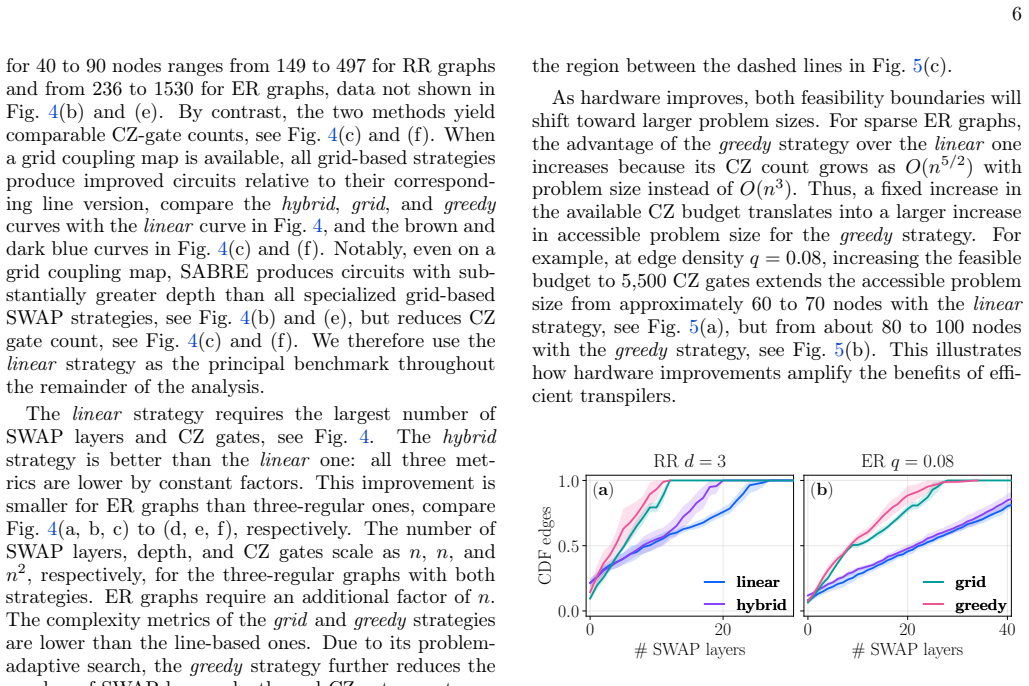
required by the linear method, see Fig. 7(g). At this size, we measured an average independent set of sizec linear ≈16. The improvement in the size of the independent set is∆c=δ¯r·c linear ≈1.5nodes. Not- ably, this corresponds to the largest MIS circuit tested, measured by gate-count, and thus the largest absolute gate reduction, see Fig. 7(h). The incre...
-
[2]
1, finds the initial mapping for a given SWAP strategySj
Algorithms The outer loop, Alg. 1, finds the initial mapping for a given SWAP strategySj. For the initial mappingπj−1 0 at iterationj, the inner loop, Alg. 2, constructs the SWAP strategyS j by exploring the tree of reachable qubit con- figurations. Inthestandardgreedymethod, thefullselectedpathis committed before the search resumes from its endpoint, i.e...
-
[3]
Computational cost and hyperparameter tuning We now investigate the trade-off between performance and computational cost of thegreedymethod. When kappend =k max, it explores a number of paths in the tree that scales as Tstandard ∼I·N subtrees · |B| ·(|B| −1) k−1.(A.1) Here,Iis the number of outer-loop iterations and Nsubtrees is the number of subtrees exp...
-
[4]
General Set-Up For a given placement of decision variables to qubits, called aqubit permutation, only a subset of the target RZZ gates can be executed without SWAPs in what we call aninteraction block. Since a qubit cannot simultan- eously participate in multiple gates, the two-qubit gate depth of such a blockDint is upper bounded by the max- imum degree ...
-
[5]
We consider a rectangular coupling map withnr rows andn c =⌈n/n r⌉ ≥n r columns, leaving only a few unused qubits
Aspect-ratio impact We study the aspect-ratio dependence of a circuit’s depth and gate-count for sparse graphs with|E|= Θ(n) edges. We consider a rectangular coupling map withnr rows andn c =⌈n/n r⌉ ≥n r columns, leaving only a few unused qubits. The average node degree of the rectangu- lar lattice with nodesVand connection edgesE, ¯d= 2|E| |V| = 2 nr(nc ...
-
[6]
(B.1) dominates the circuit depth
Sparse regime We call the target graph sparse when the routing con- tribution in Eq. (B.1) dominates the circuit depth. This occurs when the number of required qubit permutations, Nperm, remains small compared with the routing depth which depends onD(C), see Fig. C1(a).d-regular graphs Gwithd≪D(C)satisfyN perm ≪D(C). Indeed, RZZ gates can be applied in pa...
-
[7]
(B.1) dominates the circuit depth
Dense regime We call the target graph dense when the number of qubit permutationsN perm in Eq. (B.1) dominates the circuit depth. This happens when the2|E|/(n ¯d)lower bound toNperm of Sec. B2 scales asO(n)and is no longer small compared to the couplong map diameterD(C), see Fig. C1. Ref. [23] lower-bounds the two-qubit gate depth of the line-based and gr...
-
[8]
Bridging the two regimes The sparse and dense regimes correspond to different circuit complexity scalings resulting from different dom- inant contributions, see Fig. C1. In the sparse regime, Nperm is small and the routing distanceD(C)dominates the circuit depth. In the dense regime,Nperm scales as O(n). The crossover between these limits occurs once the ...
2000
-
[9]
P.TothandD.Vigo,Vehicle routing: Problems, methods, and applications(SIAM, 2014)
2014
-
[10]
Pinedo,Scheduling: Theory, algorithms, and systems (Springer, 2016)
M. Pinedo,Scheduling: Theory, algorithms, and systems (Springer, 2016)
2016
-
[11]
Katoh and T
N. Katoh and T. Ibaraki, Resource allocation problems, inHandbook of combinatorial optimization, edited by D.- Z. Du and P. M. Pardalos (Springer, Boston, MA, 1998) pp. 905–1006
1998
-
[12]
M. R. Garey and D. S. Johnson,Computers and intract- ability: A guide to the theory of NP–completeness(W. H. Freeman, 1979)
1979
-
[13]
C. H. Papadimitriou and K. Steiglitz,Combinatorial op- timization: Algorithms and complexity(Dover, 1998)
1998
-
[14]
G. L. Nemhauser and L. A. Wolsey,Integer and combin- atorial optimization(Wiley, 1988)
1988
-
[15]
D. P. Williamson and D. B. Shmoys,The design of approximation algorithms(Cambridge University Press, 2011)
2011
-
[16]
V. V. Vazirani,Approximation algorithms, Vol. 1 (Springer, 2001)
2001
-
[17]
Feige, A threshold of ln n for approximating set cover, Journal of the ACM45, 634 (1998)
U. Feige, A threshold of ln n for approximating set cover, Journal of the ACM45, 634 (1998)
1998
-
[18]
Montanaro, Quantum algorithms: an overview, npj Quantum Information2, 1 (2016)
A. Montanaro, Quantum algorithms: an overview, npj Quantum Information2, 1 (2016)
2016
-
[19]
Bharti, A
K. Bharti, A. Cervera-Lierta, T. H. Kyaw, T. Haug, S. Alperin-Lea, A. Anand, M. Degroote, H. Heimonen, J. S. Kottmann, T. Menke,et al., Noisy intermediate- scale quantum algorithms, Reviews of Modern Physics 94, 015004 (2022)
2022
-
[20]
H. Zhao, A. Zlokapa, H. Neven, R. Babbush, J. Preskill, J. R. McClean, and H.-Y. Huang, Exponential quantum advantage in processing massive classical data (2026) arXiv:2604.07639
Pith/arXiv arXiv 2026
-
[21]
Hangleiter, Has quantum advantage been achieved? (2026) arXiv:2603.09901
D. Hangleiter, Has quantum advantage been achieved? (2026) arXiv:2603.09901
arXiv 2026
-
[22]
Lucas, Ising formulations of many NP problems, Fron- tiers in Physics2, 5 (2014)
A. Lucas, Ising formulations of many NP problems, Fron- tiers in Physics2, 5 (2014)
2014
-
[23]
E. Farhi, J. Goldstone, and S. Gutmann, A quantum approximate optimization algorithm (2014) arXiv:1411.4028
Pith/arXiv arXiv 2014
-
[24]
Rajak, S
A. Rajak, S. Suzuki, A. Dutta, and B. K. Chakrabarti, Quantum annealing: an overview, Philosophical Trans- actions of the Royal Society A: Mathematical, Physical and Engineering Sciences381, 20210417 (2023)
2023
-
[25]
A. B. Finnila, M. A. Gomez, C. Sebenik, C. Stenson, and J. D. Doll, Quantum annealing: A new method for minimizing multidimensional functions, Chemical Phys- ics Letters219, 343–348 (1994)
1994
-
[26]
Drăgoi, A
S. Drăgoi, A. Baiardi, and D. J. Egger, Approximate quadratization of high-order Hamiltonians for combin- atorial quantum optimization, Physical Review Research 8, 023159 (2026)
2026
-
[27]
Z. Wang, J. Mandell, Y. Xu, and J. Shi, A depth– independent linear chain ansatz for large–scale quantum approximate optimization (2025) arXiv:2509.17296
arXiv 2025
-
[28]
H. Zou, M. Treinish, K. Hartman, A. Ivrii, and J. Lish- 19 man, LightSABRE: A lightweight and enhanced SABRE algorithm (2024) arXiv:2409.08368
Pith/arXiv arXiv 2024
-
[29]
G. Li, Y. Ding, and Y. Xie, Tackling the qubit mapping problemforNISQ–eraquantumdevices,inProceedings of the Twenty-Fourth International Conference on Architec- tural Support for Programming Languages and Operating Systems, ASPLOS ’19 (Association for Computing Ma- chinery, New York, NY, USA, 2019) p. 1001–1014
2019
-
[30]
Maslov, S
D. Maslov, S. M. Falconer, and M. Mosca, Quantum cir- cuit placement, IEEE Transactions on Computer-Aided DesignofIntegratedCircuitsandSystems27,752(2008)
2008
-
[31]
Weidenfeller, L
J. Weidenfeller, L. C. Valor, J. Gacon, C. Tornow, L. Bello, S. Woerner, and D. J. Egger, Scaling of the quantum approximate optimization algorithm on su- perconducting qubit based hardware, Quantum6, 870 (2022)
2022
-
[32]
Matsuo, S
A. Matsuo, S. Yamashita, and D. J. Egger, A SAT ap- proach to the initial mapping problem in SWAP gate insertion for commuting gates, IEICE Transactions on Fundamentals of Electronics, Communications and Com- puter Sciences106, 1424 (2023)
2023
-
[33]
Rigetti and M
C. Rigetti and M. Devoret, Fully microwave-tunable uni- versal gates in superconducting qubits with linear coup- lings and fixed transition frequencies, Physical Review B 81, 134507 (2010)
2010
-
[34]
Chamberland, G
C. Chamberland, G. Zhu, T. J. Yoder, J. B. Hertzberg, and A. W. Cross, Topological and subsystem codes on low-degree graphs with flag qubits, Physical Review X 10, 011022 (2020)
2020
-
[35]
Bravyi, A
S. Bravyi, A. W. Cross, J. M. Gambetta, D. Maslov, P. Rall, and T. J. Yoder, High–threshold and low– overhead fault–tolerant quantum memory, Nature627, 778 (2024)
2024
-
[36]
T. Koch, D. E. Bernal Neira, Y. Chen, G. Cortiana, D. J. Egger, R. Heese, N. N. Hegade, A. G. Cada- vid, R. Huang, T. Itoko,et al., Quantum optimization benchmarking library – The intractable decathlon (2025) arXiv:2504.03832
Pith/arXiv arXiv 2025
-
[37]
Zhou, S.-T
L. Zhou, S.-T. Wang, S. Choi, H. Pichler, and M. D. Lukin, Quantum approximate optimization algorithm: Performance, mechanism, and implementation on near- term devices, Physical Review X10, 021067 (2020)
2020
-
[38]
Brandhofer, D
S. Brandhofer, D. Braun, V. Dehn, G. Hellstern, M. Hüls, Y. Ji, I. Polian, A. S. Bhatia, and T. Wellens, Bench- marking the performance of portfolio optimization with QAOA, Quantum Information Processing22, 25 (2022)
2022
-
[39]
Willsch, D
M. Willsch, D. Willsch, F. Jin, H. De Raedt, and K. Michielsen, Benchmarking the quantum approxim- ate optimization algorithm, Quantum Information Pro- cessing19, 1–24 (2020)
2020
-
[40]
Alessandroni, S
E. Alessandroni, S. Ramos-Calderer, I. Roth, E. Traversi, and L. Aolita, Alleviating the quantum big-M problem, npj Quantum Information11, 125 (2025)
2025
-
[41]
Ebadi, A
S. Ebadi, A. Keesling, M. Cain, T. T. Wang, H. Lev- ine, D. Bluvstein, G. Semeghini, A. Omran, J.-G. Liu, R. Samajdar,et al., Quantum optimization of maximum independent set using Rydberg atom arrays, Science376, 1209 (2022)
2022
-
[42]
Cococcioni and L
M. Cococcioni and L. Fiaschi, The big-M method with the numerical infinite M, Optimization Letters15, 2455 (2021)
2021
-
[43]
F. G. Fuchs, K. O. Lye, H. M. Nilsen, A. J. Stasik, and G. Sartor, Constraint preserving mixers for the quantum approximate optimization algorithm, Algorithms15, 202 (2022)
2022
-
[44]
Z. He, R. Shaydulin, S. Chakrabarti, D. Herman, C. Li, Y. Sun, and M. Pistoia, Alignment between initial state and mixer improves QAOA performance for constrained optimization, npj Quantum Information9, 121 (2023)
2023
-
[45]
html, accessed: 2026-03-10
PySAT developers, SAT solvers’ API (pysat.solvers), https://pysathq.github.io/docs/html/api/solvers. html, accessed: 2026-03-10
2026
-
[46]
A. Javadi-Abhari, M. Treinish, K. Krsulich, C. J. Wood, J. Lishman, J. Gacon, S. Martiel, P. D. Nation, L. S. Bishop, A. W. Cross,et al., Quantum computing with Qiskit (2024) arXiv:2405.08810
Pith/arXiv arXiv 2024
-
[47]
Wurtz and D
J. Wurtz and D. Lykov, Fixed–angle conjectures for the quantum approximate optimization algorithm on regular MaxCut graphs, Physical Review A104, 052419 (2021)
2021
-
[48]
M. X. Goemans and D. P. Williamson, Improved approx- imation algorithms for maximum cut and satisfiability problems using semidefinite programming, Journal of the ACM42, 1115–1145 (1995)
1995
-
[49]
J. Basso, E. Farhi, K. Marwaha, B. Villalonga, and L. Zhou, The quantum approximate optimization al- gorithm at high depth for MaxCut on large-girth regular graphs and the Sherrington–Kirkpatrick model, in17th Conference on the Theory of Quantum Computation, Communication and Cryptography (TQC 2022), Leibniz International Proceedings in Informatics (LIPIc...
Pith/arXiv arXiv 2022
-
[50]
Here, large girth refers to graphs whose shortest cycles are long, implyingthatlocalneighborhoodsuptoafixedradiusare cycle-free
Lower bounds for the performance of QAOA on regular graphs with degreedhold for large-girth graphs only, which is a reasonable assumption for smalldvalues. Here, large girth refers to graphs whose shortest cycles are long, implyingthatlocalneighborhoodsuptoafixedradiusare cycle-free. In the infinite-size limit, such graphs become locally tree-like, meanin...
-
[51]
Viola, E
L. Viola, E. Knill, and S. Lloyd, Dynamical decoupling of open quantum systems, Physical Review Letters82, 2417 (1999)
1999
-
[52]
M. J. Biercuk, H. Uys, A. P. VanDevender, N. Shiga, W. M. Itano, and J. J. Bollinger, Optimized dynamical decoupling in a model quantum memory, Nature458, 996 (2009)
2009
-
[53]
Niu and A
S. Niu and A. Todri-Sanial, Effects of dynamical decoup- ling and pulse-level optimizations on ibm quantum com- puters, IEEE Transactions on Quantum Engineering3, 1 (2022)
2022
-
[54]
Pokharel, N
B. Pokharel, N. Anand, B. Fortman, and D. A. Lidar, Demonstration of fidelity improvement using dynamical decoupling with superconducting qubits, Physical Re- view Letters121, 220502 (2018)
2018
-
[55]
In particular, when two adja- centverticesarebothselected, oneofthemisremovedac- cording to a fixed ordering of the vertices, ensuring a de- terministic and reproducible outcome
Typical MIS bitstring reconstruction methods resolve conflicts by iteratively removing vertices involved in vi- olating edges until independence is restored, yielding a computationally efficient, though not necessarily op- timal, approximate value. In particular, when two adja- centverticesarebothselected, oneofthemisremovedac- cording to a fixed ordering...
-
[56]
[28]) for which Gurobi 11.0.0 did not prove optimality within the7200s time limit
Maximum Independent Set instances from the QOBLIB benchmark (Table 7 of Ref. [28]) for which Gurobi 11.0.0 did not prove optimality within the7200s time limit. graph_filename number_nodes edge_density brock400-1400 0.2516 R_500_005_1500 0.0501 C500-9500 0.0995 R_1000_005_11000 0.0494 hamming10-41024 0.1711 frb53-24-11272 0.1166 p_hat1500-31500 0.2464 frb5...
-
[57]
T. J. Yoder, E. Schoute, P. Rall, E. Pritchett, J. M. Gam- betta, A. W. Cross, M. Carroll, and M. E. Beverland, Tour de gross: A modular quantum computer based on bivariate bicycle codes (2025) arXiv:2506.03094
Pith/arXiv arXiv 2025
-
[58]
J. N. Eberhardt and V. Steffan, Logical operators and fold-transversal gates of bivariate bicycle codes, IEEE Transactions on Information Theory71, 1140 (2024)
2024
-
[59]
J.N.Eberhardt, F.R.F.Pereira,andV.Steffan,Pruning qLDPC codes: Towards bivariate bicycle codes with open boundary conditions (2024) arXiv:2412.04181
Pith/arXiv arXiv 2024
-
[60]
Dembo, A
A. Dembo, A. Montanari, and S. Sen, Extremal cuts of sparse random graphs, Annals of Probability45, 1190 (2017)
2017
-
[61]
Montanari, Optimization of the Sherrington– KirkpatrickHamiltonian,SIAMJournalonOptimization 26, 1088 (2016)
A. Montanari, Optimization of the Sherrington– KirkpatrickHamiltonian,SIAMJournalonOptimization 26, 1088 (2016)
2016
-
[62]
S. H. Sureshbabu, D. Herman, R. Shaydulin, J. Basso, S. Chakrabarti, Y. Sun, and M. Pistoia, Parameter set- ting in quantum approximate optimization of weighted problems, Quantum8, 1231 (2024)
2024
-
[63]
D. J. Egger, J. Mareček, and S. Woerner, Warm-starting quantum optimization, Quantum5, 479 (2021)
2021
-
[64]
Qiskit Community, QAOA training pipeline, https://github.com/qiskit-community/qaoa_ training_pipeline(2025), GitHub repository
2025
-
[65]
Rossmannek, J
M. Rossmannek, J. R. Garrison, and C. Johnson, Qiskit addon utils (2024)
2024
discussion (0)
Sign in with ORCID, Apple, or X to comment. Anyone can read and Pith papers without signing in.