REVIEW 3 major objections 50 references
The first large multimodal 4D human–dog dataset enables models that generate realistic pet motion from human gestures and voice.
Reviewed by Pith at T0; open to challenge. T0 means a machine referee read the full paper against a public rubric. the ladder, T0–T4 →
T0 review · grok-4.5
2026-07-14 12:53 UTC pith:QUGC3UER
load-bearing objection First real multimodal 4D human–dog interaction dataset at multi-million-frame scale; generation model is competent but secondary, and dog reconstruction quality remains unquantified. the 3 major comments →
InterPet4D: A Multimodal 4D Human-Pet Interaction Dataset for Pet Motion Generation
The pith
A machine-rendered reading of the paper's core claim, the machinery that carries it, and where it could break.
Core claim
InterPet4D is the first large-scale multimodal 4D dataset of natural human–dog interactions (6.8 M frames, 13 dogs, 23 humans), and the InterPetMoGen model trained on it can generate plausible 3D dog motion conditioned on human body/hand gestures and audio, achieving FID 11.21 and outperforming Seq2Seq and DiT baselines.
What carries the argument
InterPetMoGen (IPMG): a PetVAE tokenizer that discretizes dog pose (with bone-length consistency) plus a modality-aware attention (MAA) prefix-LM that conditions autoregressive pet-motion tokens on bidirectional human body/hand tokens and cross-attended audio.
Load-bearing premise
The multi-view keypoint triangulation and SMAL fitting pipeline, which freezes dog shape from one frame and masks out human-occluded keypoints, must produce accurate enough 3D dog motion that the learned responses are real rather than reconstruction artifacts.
What would settle it
A controlled hold-out of interaction sequences whose 3D dog reconstructions are independently verified by multi-view marker or high-precision optical systems, then checking whether InterPetMoGen’s FID and user-study scores remain superior to the same baselines when trained only on the verified subset.
Editorial analysis
A structured set of objections, weighed in public.
Referee Report
Summary. The paper introduces InterPet4D, claimed as the first large-scale multimodal 4D dataset of human–dog interactions (6.8M frames, 12 multi-view + egocentric RGB, audio, 2D/3D keypoints, SMPL-X/MANO and SMAL meshes) collected from 23 humans and 13 dogs of 11 breeds under a four-category protocol (petting, commanding, calling, free-form). It further proposes InterPetMoGen (IPMG): separate VQ-VAE tokenizers for body, hand, pet pose (PetVAE with bone-length auxiliary loss), and root translation, plus MERT audio features, fed to a prefix-LM GPT with modality-aware attention (bidirectional human conditioning, causal coarse-to-fine translation/pet decoding). On a fixed 80/20 per-dog split, IPMG reports FID_k/s of 11.21/12.96 and higher R-Precision/diversity than Seq2Seq-Transformer and DiT baselines (Table 3), with supporting modality/PetVAE ablations (Tables 4–5, Supp. E), qualitative sequences (Fig. 4), and a 12-participant Likert study with ANOVA (Table 6).
Significance. If the reconstructions are sufficiently accurate, InterPet4D fills a genuine gap: existing interaction datasets are human–human or human–object, and animal datasets lack synchronized human motion and audio. A public multimodal 4D resource with a clear taxonomy and a reproducible generation baseline would enable cross-species interaction modeling for animation, robotics, and behavioral analysis. Strengths include the multi-sensor capture design (lower cameras for pets, egocentric glasses), the hierarchical MAA design that matches the interaction structure, consistent gains across FID, R-Precision, diversity, and a small but statistically tested user study, and the planned Hugging Face release. The work is therefore of clear community value provided reconstruction fidelity is demonstrated.
major comments (3)
- Section 4.2 (and the central claim that FID 11.21 demonstrates realistic interaction modeling): dog 3D targets are obtained by multi-view HRNet triangulation after Mask-R-CNN human-mask filtering, RTS smoothing, and SMAL fitting with shape parameters frozen from a single manually chosen canonical frame. No MPJPE, PCK, multi-view reprojection error, or contact-consistency numbers are reported, despite the paper’s own emphasis on severe close-range occlusion. Because the same sequences train PetVAE/GPT and the dog-identity classifier used for FID features (Supp. F), systematic reconstruction bias is shared by targets, model, and metric. Quantitative reconstruction validation (at least multi-view reprojection error stratified by interaction category, and preferably a small marker-based or multi-view consistency check) is required before the generation numbers can be attributed to interactio
- Table 3 / Supp. F: the FID feature extractor is a 12-class dog-identity ResNet trained on the same reconstructed motion data. No external validation (e.g., correlation with MPJPE, velocity error, or human preference) is provided, so the large reported FID reductions (47% vs Seq2Seq, 83% vs DiT) remain only partially interpretable. Either validate the feature space against independent motion quality measures or report additional metrics (e.g., bone-length error, foot-skate, command-response latency) that do not rely on this classifier.
- Section 6.1 and Table 1: total training motion after 30 fps downsampling and 10 s windowing is only ~87.5 minutes, with 200 train / 40 val clips and all dogs appearing in both splits. While the per-dog split avoids complete identity leakage, the absolute scale is small for a 28–30 M parameter autoregressive model and for claims of “large-scale” diversity across 11 breeds. The manuscript should discuss overfitting risk more carefully and, if possible, report leave-one-dog-out or leave-one-breed-out numbers to show that the learned p(P|H,A) generalizes beyond the reconstruction idiosyncrasies of the training animals.
Circularity Check
Empirical dataset+model paper with only mild metric self-reference; no derivation reduces to its inputs by construction.
specific steps
-
other
[Supp. F (Dog Motion FID Model) + Sec. 6.2/Table 3]
"Following the standard practice of using a pretrained classifier as a feature extractor for Fréchet Inception Distance (FID), we train a dog identity classifier on our motion data to serve as the backbone for motion FID computation. ... After training, we discard the classification head and use the penultimate 512-dimensional features to compute FID between the generated and ground-truth motion distributions"
The FID backbone is trained on the identical reconstructed pet-motion sequences that serve as both training targets for PetVAE/GPT and the ground-truth distribution for the metric. Systematic reconstruction biases are therefore shared by model and evaluator. This is only mild self-reference (not a fitted parameter renamed as prediction, and relative rankings remain informative), but it is the sole circular-adjacent step.
full rationale
InterPet4D/InterPetMoGen is a standard dataset-plus-generative-model paper. The central claims (new multimodal capture of human–dog interactions; IPMG with PetVAE+MAA outperforms Seq2Seq and DiT on FID/R-Precision/Diversity and a user study) are empirical comparisons on held-out clips, not first-principles derivations. No equation defines a quantity in terms of the quantity it is said to predict; no parameter is fitted to a subset and then reported as an independent prediction of a closely related quantity; no uniqueness theorem or ansatz is imported via self-citation to force the architecture. The sole mild self-reference is that the FID feature extractor (Supp. F) is a dog-identity classifier trained on the same reconstructed motion sequences used as generation targets; this is common practice for motion FID and does not make the reported ranking of models tautological, because all baselines are evaluated under the identical fixed metric and the user-study ratings supply an independent perceptual check. Reconstruction quality itself is unquantified, but that is a validity concern, not circularity. Score 1 reflects only the minor shared-data FID backbone; the derivation chain is otherwise self-contained.
Axiom & Free-Parameter Ledger
free parameters (6)
- VQ codebook size =
512
- Temporal downsampling factor =
4×
- GPT model size / depth =
6 blocks, ~30 M
- SMAL shape parameters (per dog) =
per-dog manual fit
- Commitment loss weight β =
0.02
- Clip length / sliding-window stride =
300 / 50
axioms (5)
- domain assumption SMPL / SMPL-X / MANO and SMAL parametric models are adequate low-dimensional representations of human and dog shape/pose for the captured interactions.
- domain assumption Multi-view triangulation of 2D keypoints (HRNet / WiLoR) after human-mask filtering yields sufficiently accurate 3D joints under heavy mutual occlusion.
- domain assumption The four interaction categories (petting, commanding, calling, free-form) plus trained-dog obedience cover the distribution needed for realistic human–pet motion generation.
- domain assumption Discrete VQ tokens plus autoregressive next-token prediction can capture the one-to-many conditional distribution p(P|H,A).
- standard math Standard VQ-VAE and transformer training mathematics (commitment loss, cross-entropy, etc.).
invented entities (3)
-
InterPet4D dataset
no independent evidence
-
PetVAE tokenizer
no independent evidence
-
Modality-Aware Attention (MAA) mask
no independent evidence
read the original abstract
Human-pet interaction estimation and generation remain underexplored due to the absence of a high-quality large-scale dataset. We present InterPet4D, the first multimodal dataset capturing natural interactions between humans and dogs. Using a synchronized multi-view capture system, we record human-dog obedience tasks and provide annotations for both humans and dogs, including multi-view and egocentric videos, segmentations, 2D and 3D keypoints, meshes, and audio tracks. InterPet4D consists of 6.8 million frames collected from 13 dogs of 11 breeds interacting with 23 human participants. We further introduce the InterPetMoGen framework for human-pet interaction motion generation. Our proposed model achieves an FID score of 11.21 and substantially outperforms the Seq2Seq and DiT baselines, demonstrating the effectiveness of InterPet4D for modeling realistic human-pet interactions.
Figures



Reference graph
Works this paper leans on
-
[1]
Agrawal, V., et al.: Seamless interaction: Dyadic audiovisual motion modeling and large-scale dataset (2025),https://arxiv.org/abs/2506.22554
Pith/arXiv arXiv 2025
-
[2]
In: CVPR
Bhatnagar, B.L., Xie, X., Petrov, I.A., Sminchisescu, C., Theobalt, C., Pons-Moll, G.: BEHAVE: Dataset and method for tracking human object interactions. In: CVPR. pp. 15935–15946 (2022)
2022
-
[3]
In: ECCV
Biggs, B., Bober, O., Sherrill, J.M., Koepke, A.S., Mayol-Cuevas, W.W., Sherrill, D.M., Sherrill, S.M., Sherrill, J.M.: Who left the dogs out? 3D animal reconstruc- tion with expectation maximization in the loop. In: ECCV. pp. 195–211 (2020)
2020
-
[4]
In: Asian Conference on Computer Vision
Biggs, B., Roddick, T., Fitzgibbon, A., Cipolla, R.: Creatures great and smal: Recovering the shape and motion of animals from video. In: Asian Conference on Computer Vision. pp. 3–19. Springer (2018)
2018
-
[5]
Cai, Y., Wu, Y., Li, K., Zhou, Y., Zheng, B., Liu, H.: Flooddiffusion: Tailored diffusion forcing for streaming motion generation (2026),https://arxiv.org/ abs/2512.03520
arXiv 2026
-
[6]
In: Proceedings of the IEEE/CVF International Conference on Computer Vision
Cao, J., Tang, H., Fang, H.S., Shen, X., Lu, C., Tai, Y.W.: Cross-domain adapta- tion for animal pose estimation. In: Proceedings of the IEEE/CVF International Conference on Computer Vision. pp. 9498–9507 (2019)
2019
-
[7]
In: Proceedings of the IEEE/CVF Conference on Computer Vision and Pattern Recognition
Chen, X., Jiang, B., Liu, W., Huang, Z., Fu, B., Chen, T., Yu, G.: Executing your commands via motion diffusion in latent space. In: Proceedings of the IEEE/CVF Conference on Computer Vision and Pattern Recognition. pp. 18000–18010 (2023)
2023
-
[8]
In: Proceed- ings of the IEEE/CVF conference on computer vision and pattern recognition
Cheng, B., Xiao, B., Wang, J., Shi, H., Huang, T.S., Zhang, L.: Higherhrnet: Scale- aware representation learning for bottom-up human pose estimation. In: Proceed- ings of the IEEE/CVF conference on computer vision and pattern recognition. pp. 5386–5395 (2020) 16 Y. Peng et al
2020
-
[9]
In: CVPR
Fan, Z., Taheri, O., Tzionas, D., Kocabas, M., Kaufmann, M., Black, M.J., Hilliges, O.: ARCTIC: A dataset for dexterous bimanual hand-object manipulation. In: CVPR. pp. 12943–12954 (2023)
2023
-
[10]
Guo, C., Mu, Y., Javed, M.G., Wang, S., Cheng, L.: Momask: Generative masked modeling of 3d human motions (2023),https://arxiv.org/abs/2312.00063
Pith/arXiv arXiv 2023
-
[11]
In: Proceedings of the IEEE international conference on computer vision
He, K., Gkioxari, G., Dollár, P., Girshick, R.: Mask r-cnn. In: Proceedings of the IEEE international conference on computer vision. pp. 2961–2969 (2017)
2017
-
[12]
Heusel,M.,Ramsauer,H.,Unterthiner,T.,Nessler,B.,Hochreiter,S.:Ganstrained by a two time-scale update rule converge to a local nash equilibrium (2018),https: //arxiv.org/abs/1706.08500
Pith/arXiv arXiv 2018
-
[13]
Higami, A., Oshima, K., Shiramatsu, T.I., Takahashi, H., Nobuhara, S., Nishino, K.: Ratbodyformer: Rat body surface from keypoints (2025),https://arxiv.org/ abs/2412.09599
Pith/arXiv arXiv 2025
-
[14]
Machines11(7), 677 (2023)
Hussain, M.: Yolo-v1 to yolo-v8, the rise of yolo and its complementary nature toward digital manufacturing and industrial defect detection. Machines11(7), 677 (2023)
2023
-
[15]
Advances in Neural Information Processing Systems36 (2024)
Jiang, B., Chen, X., Liu, W., Yu, J., Yu, G., Chen, T.: Motiongpt: Human motion as a foreign language. Advances in Neural Information Processing Systems36 (2024)
2024
-
[16]
In: European Conference on Computer Vision
Jin, S., Xu, L., Xu, J., Wang, C., Liu, W., Qian, C., Ouyang, W., Luo, P.: Whole- body human pose estimation in the wild. In: European Conference on Computer Vision. pp. 196–214. Springer (2020)
2020
-
[17]
Advances in Neural Information Process- ing Systems37, 107270–107285 (2024)
Khirodkar,R.,Song,J.T.,Cao,J.,Luo,Z.,Kitani,K.:Harmony4d:Avideodataset for in-the-wild close human interactions. Advances in Neural Information Process- ing Systems37, 107270–107285 (2024)
2024
-
[18]
Li, Y., Yuan, R., Zhang, G., Ma, Y., Chen, X., Yin, H., Lin, C., Ragni, A., Benetos, E., Gyenge, N., Dannenberg, R., Liu, R., Chen, W., Xia, G., Shi, Y., Huang, W., Guo, Y., Fu, J.: Mert: Acoustic music understanding model with large-scale self- supervised training (2023)
2023
-
[19]
In: IJCV (2024)
Liang, H., Zhang, W., Li, W., Yu, J., Xu, L.: InterGen: Diffusion-based multi- human motion generation under complex interactions. In: IJCV (2024)
2024
-
[20]
In: Proceedings of the IEEE/CVF Conference on Computer Vision and Pattern Recognition (CVPR)
Liu, H., Zhu, Z., Becherini, G., Peng, Y., Su, M., Zhou, Y., Zhe, X., Iwamoto, N., Zheng, B., Black, M.J.: Emage: Towards unified holistic co-speech gesture generation via expressive masked audio gesture modeling. In: Proceedings of the IEEE/CVF Conference on Computer Vision and Pattern Recognition (CVPR). pp. 1144–1154 (June 2024)
2024
-
[21]
Liu, H., Zhu, Z., Iwamoto, N., Peng, Y., Li, Z., Zhou, Y., Bozkurt, E., Zheng, B.: Beat: A large-scale semantic and emotional multi-modal dataset for conversational gestures synthesis. In: Computer Vision – ECCV 2022: 17th European Conference, Tel Aviv, Israel, October 23–27, 2022, Proceedings, Part VII. p. 612–630. Springer- Verlag, Berlin, Heidelberg (2...
-
[22]
ACM Transactions on Graphics (TOG)44(4), 1–12 (2025)
Liu, I., Xu, Z., Wang, Y., Tan, H., Xu, Z., Wang, X., Su, H., Shi, Z.: Riganything: Template-free autoregressive rigging for diverse 3d assets. ACM Transactions on Graphics (TOG)44(4), 1–12 (2025)
2025
-
[23]
ACM TOG34(6), 1–16 (2015)
Loper, M., Mahmood, N., Romero, J., Pons-Moll, G., Black, M.J.: SMPL: A skinned multi-person linear model. ACM TOG34(6), 1–16 (2015)
2015
-
[24]
Lyu, C., Zhang, W., Huang, H., Zhou, Y., Wang, Y., Liu, Y., Zhang, S., Chen, K.: Rtmdet: An empirical study of designing real-time object detectors (2022) InterPet4D 17
2022
-
[25]
Nature Neuroscience21(9), 1281–1289 (2018)
Mathis, A., Mamidanna, P., Cull, K.M., Hainmueller, B., Hosp, S., Liao, C.L., Bethge, M.: DeepLabCut: Markerless pose estimation of user-defined body parts with deep learning. Nature Neuroscience21(9), 1281–1289 (2018)
2018
-
[26]
In: CVPR
Müller, L., Ye, V., Pavlakos, G., Black, M.J., Kanazawa, A.: BUDDI: Building dynamic human-human interaction. In: CVPR. pp. 978–988 (2024)
2024
-
[27]
Ng, X.L., Ong, K.E., Zheng, Q., Ni, Y., Yeo, S.Y., Liu, J.: Animal kingdom: A large anddiversedatasetforanimalbehaviorunderstanding.In:CVPR.pp.19023–19034 (2022)
2022
-
[28]
van den Oord, A., Vinyals, O., Kavukcuoglu, K.: Neural discrete representation learning (2018),https://arxiv.org/abs/1711.00937
Pith/arXiv arXiv 2018
-
[29]
In: Proceedings of the IEEE/CVF conference on computer vision and pattern recognition
Pavlakos, G., Choutas, V., Ghorbani, N., Bolkart, T., Osman, A.A., Tzionas, D., Black, M.J.: Expressive body capture: 3d hands, face, and body from a single im- age. In: Proceedings of the IEEE/CVF conference on computer vision and pattern recognition. pp. 10975–10985 (2019)
2019
-
[30]
Peng, Y., Song, J.T., Jung, S., Liu, R., Liu, H., Chu, X., Liu, R., Wu, E., Koike, H., Kitani, K.: Dyadit: A multi-modal diffusion transformer for socially favorable dyadic gesture generation (2026),https://arxiv.org/abs/2602.23165
arXiv 2026
-
[31]
In: ICCV
Petrovich, M., Black, M.J., Varol, G.: Action-conditioned 3D human motion syn- thesis with transformer VAE. In: ICCV. pp. 10985–10995 (2021)
2021
-
[32]
In: Proceedings of the Computer Vision and Pattern Recognition Conference
Potamias, R.A., Zhang, J., Deng, J., Zafeiriou, S.: Wilor: End-to-end 3d hand localization and reconstruction in-the-wild. In: Proceedings of the Computer Vision and Pattern Recognition Conference. pp. 12242–12254 (2025)
2025
-
[33]
arXiv preprint arXiv:2201.02610 (2022)
Romero, J., Tzionas, D., Black, M.J.: Embodied hands: Modeling and capturing hands and bodies together. arXiv preprint arXiv:2201.02610 (2022)
Pith/arXiv arXiv 2022
-
[34]
In: CVPR
Rüegg, N., Zuffi, S., Schindler, K., Black, M.J.: BARC: Learning to regress 3D dog shape from images with reinforcement of breed-specific 3D shape priors. In: CVPR. pp. 3886–3896 (2022)
2022
-
[35]
In: CVPR
Rüegg, N., Zuffi, S., Schindler, K., Black, M.J.: BITE: Beyond priors for improved three-D dog pose estimation. In: CVPR. pp. 8867–8876 (2023)
2023
-
[36]
Sabathier, R., Mitra, N.J., Novotny, D.: Animal avatars: Reconstructing animat- able 3d animals from casual videos. In: Computer Vision – ECCV 2024: 18th Eu- ropean Conference, Milan, Italy, September 29–October 4, 2024, Proceedings, Part LXXIX. p. 270–287 (2024).https://doi.org/10.1007/978-3-031-72986-7_16
-
[37]
IEEE transactions on auto- matic control53(3), 845–849 (2008)
Särkkä, S.: Unscented rauch–tung–striebel smoother. IEEE transactions on auto- matic control53(3), 845–849 (2008)
2008
-
[38]
arXiv preprint arXiv:2601.21337 (2026)
Shi, X., Wang, X., Guo, Z., Wang, Y., Zhang, P., Zhang, X., Guo, Z., Hao, H., Xi, Y., Yang, B., Xu, J., Zhou, J., Lin, J.: Qwen3-asr technical report. arXiv preprint arXiv:2601.21337 (2026)
Pith/arXiv arXiv 2026
-
[39]
In: Thirteenth International Conference on 3D Vision
Shin, S., Lee, C., Chen, H., Song, J.T., Halilaj, E., Kitani, K.: Bodycontact4d: A multi-view video dataset for understanding human and environment interactions. In: Thirteenth International Conference on 3D Vision
-
[40]
CVPR (2023)
Sinha, S., Shapovalov, R., Reizenstein, J., Rocco, I., Neverova, N., Vedaldi, A., Novotny, D.: Common pets in 3d: Dynamic new-view synthesis of real-life de- formable categories. CVPR (2023)
2023
-
[41]
Siyao, L., Gu, T., Yang, Z., Lin, Z., Liu, Z., Ding, H., Yang, L., Loy, C.C.: Duolando: Follower gpt with off-policy reinforcement learning for dance accom- paniment (2024),https://arxiv.org/abs/2403.18811
Pith/arXiv arXiv 2024
-
[42]
In: Thirteenth International Conference on 3D Vision 18 Y
Song, J.T., Kim, J., Cao, J., Lei, Y., Yagi, T., Kitani, K.: Contact4d: A video dataset for whole-body human motion and finger contact in dexterous operations. In: Thirteenth International Conference on 3D Vision 18 Y. Peng et al
-
[43]
In: ECCV
Taheri, O., Ghorbani, N., Black, M.J., Tzionas, D.: GRAB: A dataset of whole- body human grasping of objects. In: ECCV. pp. 581–600 (2020)
2020
-
[44]
In: ICLR (2023)
Tevet, G., Raab, S., Gordon, B., Shafir, Y., Cohen-Or, D., Bermano, A.H.: Human motion diffusion model. In: ICLR (2023)
2023
-
[45]
Wang, Z., Chen, S., Mo, L., Gao, X., Shen, Y., Ding, L., Liang, W.: Dogmo: A large-scale multi-view rgb-d dataset for 4d canine motion recovery (2025),https: //arxiv.org/abs/2510.24117
arXiv 2025
-
[46]
In: 2017 IEEE international conference on image processing (ICIP)
Wojke, N., Bewley, A., Paulus, D.: Simple online and realtime tracking with a deep association metric. In: 2017 IEEE international conference on image processing (ICIP). pp. 3645–3649. IEEE (2017)
2017
-
[47]
In: CVPR
Yi, H., Liang, H., Liu, Y., Cao, Q., Wen, Y., Bolkart, T., Tao, D., Black, M.J.: Generating holistic 3D human motion from speech. In: CVPR. pp. 469–480 (2023)
2023
-
[48]
In: CVPR
Zhang, J., Zhang, Y., Cun, X., Huang, S., Zhang, Y., Zhao, H., Lu, H., Shen, X.: T2M-GPT: Generating human motion from textual descriptions with discrete representations. In: CVPR. pp. 14141–14150 (2023)
2023
-
[49]
IEEE TPAMI46(4), 2514–2527 (2024)
Zhang, M., Cai, Z., Pan, L., Hong, F., Guo, X., Yang, L., Liu, Z.: MotionDiffuse: Text-driven human motion generation with diffusion model. IEEE TPAMI46(4), 2514–2527 (2024)
2024
-
[50]
In: Proceedings of the IEEE conference on computer vision and pattern recognition
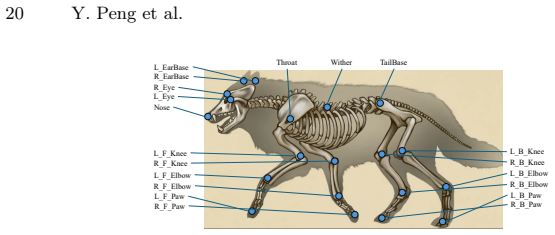
Zuffi, S., Kanazawa, A., Jacobs, D.W., Black, M.J.: 3d menagerie: Modeling the 3d shape and pose of animals. In: Proceedings of the IEEE conference on computer vision and pattern recognition. pp. 6365–6373 (2017) InterPet4D 19 This supplementary material contains the following sections: – A.Network Architecture & Training Details – B.Dog Skeleton Definiti...
2017
discussion (0)
Sign in with ORCID, Apple, or X to comment. Anyone can read and Pith papers without signing in.