REVIEW 3 major objections 5 minor 69 references
Decoupled audio-visual captions force models to listen, not just look, and close the gap on invisible sound events.
Reviewed by Pith at T0; open to challenge. T0 means a machine referee read the full paper against a public rubric. the ladder, T0–T4 →
T0 review · grok-4.5
2026-07-14 12:47 UTC pith:W237ARI7
load-bearing objection Solid data recipe for stronger audio grounding in open omni-modal LLMs: tripartite captions heavy on invisible events plus CoT QA and two-stage training give consistent gains on the Qwen2.5-Omni backbone. the 3 major comments →
Empowering Long-form Omni-modal Understanding with Robust Audio Perception
The pith
A machine-rendered reading of the paper's core claim, the machinery that carries it, and where it could break.
Core claim
The scarcity of datasets that explicitly disentangle and then recombine auditory and visual semantics is the main bottleneck for robust omni-modal understanding. By constructing AVDC (tripartite V/A/AV captions with roughly 37 percent invisible sound events) and AVDC-QA-CoT, then applying caption-generation pre-training followed by instruction tuning, the authors obtain consistent gains on captioning, omni-modal QA, and pure audio QA while preserving visual-only accuracy.
What carries the argument
The AVDC tripartite caption structure (visual-only, audio-only, joint) produced by hierarchical fusion of specialized audio models and large language models, together with the two-stage training curriculum that first aligns encoders via caption generation and then teaches reasoning via CoT QA.
Load-bearing premise
The multi-stage automatic annotation pipeline produces captions and rationales clean enough that residual model biases and errors do not systematically mislead the subsequent fine-tuning.
What would settle it
Train an identical two-stage schedule on a smaller set of the same videos that have been fully re-annotated by humans for every visible and invisible sound event; if the human-annotated version produces no further drop in invisible-sound miss rate on the held-out AVDC-test split, the automatic pipeline is sufficient; a large remaining gap falsifies the claim that the pipeline already supplies reliable supervision.
If this is right
- Models trained this way report substantially lower missing rates for both visible and invisible sound events on dense captioning benchmarks.
- Accuracy rises on omni-modal QA suites that require audio–visual alignment and temporal reasoning, reaching parity with strong proprietary systems on some tasks.
- Pure audio QA performance also improves, showing the training does not merely teach visual shortcuts.
- Visual-only video benchmarks stay essentially unchanged, indicating the audio gains do not trade away vision competence.
- The same data recipe can be reused to add controllable thinking-mode versus direct-answer inference.
Where Pith is reading between the lines
- The same tripartite decoupling could be applied to longer, multi-hour videos to test whether off-screen sound density continues to drive gains once temporal context becomes sparse.
- If invisible-sound supervision is the true lever, simply up-weighting off-screen events inside existing speech-heavy corpora might recover a fraction of the reported lift without a full new pipeline.
- The residual inter-model disagreement observed before verification suggests future work could treat annotation uncertainty as an explicit training signal rather than filtering it away.
Editorial analysis
A structured set of objections, weighed in public.
Referee Report
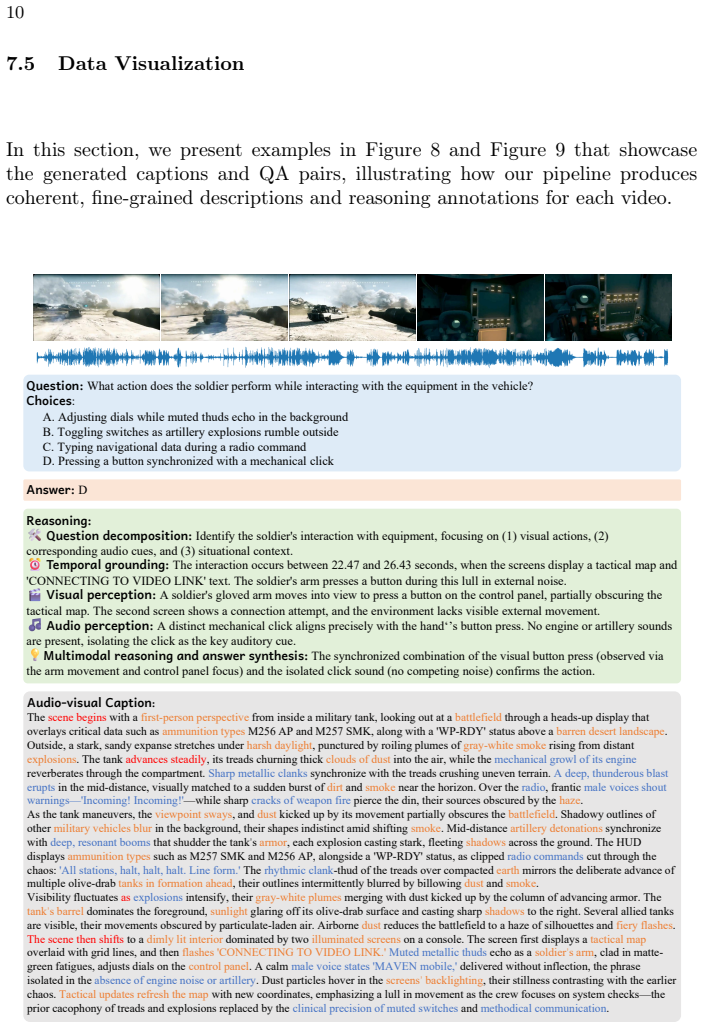
Summary. The paper addresses the visual bias of current multimodal LLMs by releasing AVDC, a 10k-video dataset of long-form (~30 s) videos annotated with tripartite (visual-only, audio-only, joint AV) captions that deliberately include a high fraction (~37 %) of invisible/off-screen sound events, together with AVDC-QA-CoT, a companion set of open-ended and multiple-choice questions equipped with four-step Chain-of-Thought rationales. An automated multi-stage pipeline (specialized audio LLMs + hierarchical LLM fusion + Gemini-2.5-Flash iterative verification) produces the annotations. Starting from Qwen2.5-Omni-7B-Thinker, the authors apply a two-stage curriculum: Stage I freezes the LLM and specializes the audio/visual encoders on global and timestamped caption generation; Stage II performs full-parameter instruction tuning on a balanced mixture of AVDC-QA-CoT, external VQA/AQA data, and controlled audio-visual misalignment examples. Empirical results on AVDC-test, Video-SALMONN-2, UGC-VideoCap, WorldSense, Daily-Omni, Omnibench, ACVUBench, MMAU, MMAR and two vision-only suites show consistent gains over the base model, especially on invisible-sound recall and pure-audio QA, without degrading visual-only accuracy.
Significance. If the reported gains are driven by the new data rather than residual teacher-model artifacts, the work supplies both a concrete resource (dense, explicitly decoupled audio-visual captions with a substantial invisible-event fraction) and a simple, reproducible training recipe that measurably narrows the audio-visual competence gap of open-source omni-modal models. The public release of code and data, the multi-benchmark evaluation suite that includes external public tests, and the ablation isolating Stage-I captions versus Stage-II mixtures constitute useful contributions to the community. The 300-sample human audit of annotation quality is a welcome transparency measure even if its scale remains modest.
major comments (3)
- Section 2.1 (Manual evaluation) reports Cohen’s κ = 0.134 between the two primary audio LLMs and per-model F1 ≈ 0.45–0.47 against 300 human-annotated events; after merging and Gemini verification the sound-event F1 rises only to 0.786–0.885. Because Stage I freezes the LLM and specializes the audio/visual encoders precisely on these captions (and Stage II further mixes the derived CoT rationales), residual systematic omissions or teacher-model biases concerning invisible events can be amplified rather than corrected. The paper needs either a larger-scale human audit of the final retained captions (especially invisible-event labels) or an ablation that quantifies how much of the Table 2–4 gains survive when the model is trained on a fully human-verified subset.
- Table 6 (ablation) and the main results tables do not isolate the contribution of the ~37 % invisible-event fraction that is repeatedly advertised as the distinctive feature of AVDC. Without a controlled comparison that holds total caption volume fixed while varying the invisible-event density, it remains unclear whether the reported Miss_inv reductions (Table 2) and audio-QA lifts (Table 4) are truly attributable to the decoupled invisible-sound supervision rather than simply to denser overall audio captions or longer training.
- Several evaluation metrics themselves rely on GPT-4o / GPT-3.5 automatic scoring (UGC-VideoCap quality scores, Video-SALMONN-2 Miss/Hall rates, AVDC-test event extraction). Given that the same model family (or close relatives) participates in the annotation pipeline, a modest human re-evaluation of a random subset of the automatic judgments would strengthen the claim that the observed gains are not partly circular.
minor comments (5)
- Abstract and §1 claim “long-form” understanding, yet the average video length is only 30.1 s (Table 1) with a hard upper bound of 60 s; the terminology should be tempered or the duration distribution clarified.
- Figure 1 and the qualitative examples highlight vision-related content in orange and audio-related content in blue, but the color legend is never stated in the caption; a short legend would improve readability.
- Table 1 reports #Visible / #Invisible averages obtained by GPT-4o on 1 000 random videos per dataset; the prompt and inter-annotator agreement for this automatic categorization should be supplied in the supplement.
- Hyper-parameter table (Table 5) lists peak learning rates and update counts but omits the precise optimizer, weight-decay, and warm-up schedule; these details matter for reproducibility of the two-stage curriculum.
- Typographical slips: “Code and dataset are related on …” (abstract), “that that capture” (§2.1), and inconsistent capitalization of model names (Qwen-2.5-Omni vs. Qwen2.5-Omni).
Circularity Check
Empirical data-centric paper with no definitional or fitted circularity; only minor shared-LLM usage in automated annotation and some GPT scoring, which does not force the external-benchmark gains.
full rationale
The paper's central claim is that the AVDC tripartite captions (generated via off-the-shelf audio LLMs + hierarchical LLM fusion + Gemini verification) plus AVDC-QA-CoT and two-stage fine-tuning of Qwen2.5-Omni yield measurable gains on external public benchmarks (WorldSense, Daily-Omni, Omnibench, AVUT, MMAU, MMAR, Video-SALMONN-2, UGC-VideoCap, Video-MME, MVBench). These benchmarks pre-exist and are not constructed from AVDC, so reported accuracy/Miss/Hall lifts are not true by construction. There are no equations defining a quantity in terms of itself, no parameters fitted to a subset then re-predicted as a related quantity, no uniqueness theorems imported from the authors, and no ansatz smuggled via self-citation. The only mild loop is the use of related LLM families (Qwen/Gemini/GPT) both to synthesize training captions/CoTs and (in places) to score captions or extract events for AVDC-test; this is standard practice in automated data pipelines and does not make the external-benchmark improvements definitional. Ablations (Table 6) further isolate contributions of Stage I/II and data mixtures without circular reduction. Score 1 reflects only that minor shared-model usage, not load-bearing circularity. Honest non-finding of significant circularity.
Axiom & Free-Parameter Ledger
free parameters (5)
- Stage-I peak learning rate =
1e-5
- Stage-II peak learning rate =
5e-6
- segment duration bounds =
[2,30] s
- dynamic sampling interval =
0.5/1 s
- quality-score retention threshold =
≥4/5
axioms (4)
- domain assumption Off-the-shelf audio LLMs (Qwen2-Audio, Audio-Flamingo 2, SALMONN, MU-LLaMA) plus LLM fusion produce sufficiently accurate raw event descriptions for downstream supervision.
- domain assumption Gemini-2.5-Flash iterative verification-correction reliably removes hallucinations and omissions while preserving correct content.
- ad hoc to paper DeepSeek-generated CoT rationales that follow the four-step template (decomposition, temporal grounding, visual/audio perception, multimodal synthesis) constitute faithful training signals for reasoning.
- domain assumption Filtering videos to those containing ≥3 environmental sound events totaling >2 s and >10 % of duration yields a representative long-form omni-modal distribution.
invented entities (2)
-
AVDC tripartite caption schema (V / A / AV with timestamps)
independent evidence
-
AVDC-QA-CoT structured four-step CoT rationales
no independent evidence
read the original abstract
Recent advances in large-scale multimodal models have drivenremarkable progress in vision-language tasks; however, comprehensiveomni-modal understanding remains under-explored, largely due to thescarcity of datasets with rich, explicitly aligned auditory cues. To bridgethis gap, we present AVDC (Audio-Visual Decoupled Captions), a large-scaledataset designed to disentangle visual and auditory semantics. Specifi-cally, we propose an automated pipeline that leverages off-the-shelf mod-els to annotate videos with tripartite captions: visual-only (V), audio-only (A), and joint audio-visual (AV). This decoupled structure explic-itly captures both modality-specific nuances and complex cross-modalinteractions. Building upon this, we introduce AVDC-QA-CoT, a Chain-of-Thought augmented question-answering dataset to foster audio-visualreasoning. To fully exploit these resources, we employ a two-stage train-ing paradigm: omni-modal caption generation pre-training on AVDC, fol-lowed by instruction tuning on AVDC-QA-CoT. Extensive experiments acrossdiverse downstream tasks, spanning video captioning, audio-centric anal-ysis, and omni-modal benchmarks, demonstrate consistent and signifi-cant performance gains, showing the efficacy of our proposed datasetsand training strategy in advancing omni-modal perception. Code anddataset are related on https://radiant0726.github.io/AVDC-web/.
Figures




Reference graph
Works this paper leans on
-
[1]
In: Proceedings of the acl workshop on intrinsic and extrinsic evaluation measures for machine translation and/or summa- rization
Banerjee, S., Lavie, A.: Meteor: An automatic metric for mt evaluation with im- proved correlation with human judgments. In: Proceedings of the acl workshop on intrinsic and extrinsic evaluation measures for machine translation and/or summa- rization. pp. 65–72 (2005)
2005
-
[2]
arXiv preprint arXiv:2402.12451 (2024)
Caffagni, D., Cocchi, F., Barsellotti, L., Moratelli, N., Sarto, S., Baraldi, L., Cornia, M., Cucchiara, R.: The revolution of multimodal large language models: a survey. arXiv preprint arXiv:2402.12451 (2024)
arXiv 2024
-
[3]
In: Proceedings of the Computer Vision and Pattern Recognition Conference
Chen, J., Zeng, Z., Lin, Y., Li, W., Ma, Z., Shou, M.Z.: Livecc: Learning video llm with streaming speech transcription at scale. In: Proceedings of the Computer Vision and Pattern Recognition Conference. pp. 29083–29095 (2025)
2025
-
[4]
Advances in Neural Information Processing Systems37, 19472–19495 (2024)
Chen, L., Wei, X., Li, J., Dong, X., Zhang, P., Zang, Y., Chen, Z., Duan, H., Tang, Z., Yuan, L., et al.: Sharegpt4video: Improving video understanding and genera- tion with better captions. Advances in Neural Information Processing Systems37, 19472–19495 (2024)
2024
-
[5]
arXiv preprint arXiv:2304.08345 (2023)
Chen, S., He, X., Guo, L., Zhu, X., Wang, W., Tang, J., Liu, J.: Valor: Vision- audio-language omni-perception pretraining model and dataset. arXiv preprint arXiv:2304.08345 (2023)
Pith/arXiv arXiv 2023
-
[6]
Advances in Neural Information Processing Systems36, 72842–72866 (2023)
Chen,S.,Li,H.,Wang,Q.,Zhao,Z.,Sun,M.,Zhu,X.,Liu,J.:Vast:Avision-audio- subtitle-text omni-modality foundation model and dataset. Advances in Neural Information Processing Systems36, 72842–72866 (2023)
2023
-
[7]
Cheng, X., Zhang, Z., Wang, Z., Fang, M., Huang, R., Zheng, S., Hu, R., Jionghao, B., Jin, T., Zhao, Z.: Avset-10m: An open large-scale audio-visual dataset with high correspondence (2024)
2024
-
[8]
arXiv preprint arXiv:2406.07476 (2024)
Cheng, Z., Leng, S., Zhang, H., Xin, Y., Li, X., Chen, G., Zhu, Y., Zhang, W., Luo, Z., Zhao, D., et al.: Videollama 2: Advancing spatial-temporal modeling and audio understanding in video-llms. arXiv preprint arXiv:2406.07476 (2024)
Pith/arXiv arXiv 2024
-
[9]
arXiv preprint arXiv:2407.20962 (2024)
Chi, X., Wang, Y., Cheng, A., Fang, P., Tian, Z., He, Y., Liu, Z., Qi, X., Pan, J., Zhang, R., et al.: Mmtrail: A multimodal trailer video dataset with language and music descriptions. arXiv preprint arXiv:2407.20962 (2024)
Pith/arXiv arXiv 2024
-
[10]
arXiv preprint arXiv:2407.10759 (2024)
Chu, Y., Xu, J., Yang, Q., Wei, H., Wei, X., Guo, Z., Leng, Y., Lv, Y., He, J., Lin, J., et al.: Qwen2-audio technical report. arXiv preprint arXiv:2407.10759 (2024)
Pith/arXiv arXiv 2024
-
[11]
arXiv preprint arXiv:2507.06261 (2025)
Comanici, G., Bieber, E., Schaekermann, M., Pasupat, I., Sachdeva, N., Dhillon, I., Blistein, M., Ram, O., Zhang, D., Rosen, E., et al.: Gemini 2.5: Pushing the frontier with advanced reasoning, multimodality, long context, and next generation agentic capabilities. arXiv preprint arXiv:2507.06261 (2025)
Pith/arXiv arXiv 2025
-
[12]
arXiv preprint arXiv:2504.18425 (2025)
Ding, D., Ju, Z., Leng, Y., Liu, S., Liu, T., Shang, Z., Shen, K., Song, W., Tan, X., Tang, H., et al.: Kimi-audio technical report. arXiv preprint arXiv:2504.18425 (2025)
Pith/arXiv arXiv 2025
-
[13]
In: Proceedings of the Computer Vision and Pattern Recognition Conference
Du, H., Li, G., Zhou, C., Zhang, C., Zhao, A., Hu, D.: Crab: A unified audio- visual scene understanding model with explicit cooperation. In: Proceedings of the Computer Vision and Pattern Recognition Conference. pp. 18804–18814 (2025)
2025
-
[14]
arXiv preprint arXiv:2503.21776 (2025)
Feng, K., Gong, K., Li, B., Guo, Z., Wang, Y., Peng, T., Wu, J., Zhang, X., Wang, B., Yue, X.: Video-r1: Reinforcing video reasoning in mllms. arXiv preprint arXiv:2503.21776 (2025)
Pith/arXiv arXiv 2025
-
[15]
In: Proceedings of the Computer Vision and Pattern Recognition Conference
Fu, C., Dai, Y., Luo, Y., Li, L., Ren, S., Zhang, R., Wang, Z., Zhou, C., Shen, Y., Zhang, M., et al.: Video-mme: The first-ever comprehensive evaluation benchmark of multi-modal llms in video analysis. In: Proceedings of the Computer Vision and Pattern Recognition Conference. pp. 24108–24118 (2025) 16
2025
-
[16]
In: Proceedings of the IEEE international conference on computer vision
Gao, J., Sun, C., Yang, Z., Nevatia, R.: Tall: Temporal activity localization via language query. In: Proceedings of the IEEE international conference on computer vision. pp. 5267–5275 (2017)
2017
-
[17]
In: 2017 IEEE international conference on acoustics, speech and signal processing (ICASSP)
Gemmeke, J.F., Ellis, D.P., Freedman, D., Jansen, A., Lawrence, W., Moore, R.C., Plakal, M., Ritter, M.: Audio set: An ontology and human-labeled dataset for audio events. In: 2017 IEEE international conference on acoustics, speech and signal processing (ICASSP). pp. 776–780. IEEE (2017)
2017
-
[18]
In: Proceedings of the IEEE/CVF Conference on Computer Vision and Pattern Recognition
Geng, T., Wang, T., Duan, J., Cong, R., Zheng, F.: Dense-localizing audio-visual events in untrimmed videos: A large-scale benchmark and baseline. In: Proceedings of the IEEE/CVF Conference on Computer Vision and Pattern Recognition. pp. 22942–22951 (2023)
2023
-
[19]
In: Proceedings of the Computer Vision and Pattern Recognition Con- ference
Geng, T., Zhang, J., Wang, Q., Wang, T., Duan, J., Zheng, F.: Longvale: Vision- audio-language-event benchmark towards time-aware omni-modal perception of long videos. In: Proceedings of the Computer Vision and Pattern Recognition Con- ference. pp. 18959–18969 (2025)
2025
-
[20]
arXiv preprint arXiv:2503.03983 (2025)
Ghosh, S., Kong, Z., Kumar, S., Sakshi, S., Kim, J., Ping, W., Valle, R., Manocha, D., Catanzaro, B.: Audio flamingo 2: An audio-language model with long-audio un- derstanding and expert reasoning abilities. arXiv preprint arXiv:2503.03983 (2025)
Pith/arXiv arXiv 2025
-
[21]
arXiv preprint arXiv:2406.11768 (2024)
Ghosh, S., Kumar, S., Seth, A., Evuru, C.K.R., Tyagi, U., Sakshi, S., Nieto, O., Duraiswami, R., Manocha, D.: Gama: A large audio-language model with advanced audio understanding and complex reasoning abilities. arXiv preprint arXiv:2406.11768 (2024)
Pith/arXiv arXiv 2024
-
[22]
arXiv preprint arXiv:2507.08128 (2025)
Goel, A., Ghosh, S., Kim, J., Kumar, S., Kong, Z., Lee, S.g., Yang, C.H.H., Duraiswami, R., Manocha, D., Valle, R., et al.: Audio flamingo 3: Advancing audio intelligence with fully open large audio language models. arXiv preprint arXiv:2507.08128 (2025)
Pith/arXiv arXiv 2025
-
[23]
arXiv preprint arXiv:2502.04326 (2025)
Hong, J., Yan, S., Cai, J., Jiang, X., Hu, Y., Xie, W.: Worldsense: Evaluat- ing real-world omnimodal understanding for multimodal llms. arXiv preprint arXiv:2502.04326 (2025)
Pith/arXiv arXiv 2025
-
[24]
arXiv preprint arXiv:2503.24164 (2025)
Huynh, N.D., Bouadjenek, M.R., Razzak, I., Hacid, H., Aryal, S.: Svla: A unified speech-vision-language assistant with multimodal reasoning and speech generation. arXiv preprint arXiv:2503.24164 (2025)
Pith/arXiv arXiv 2025
-
[25]
In: Proceedings of the IEEE/CVF International Conference on Computer Vision
Lee, S., Chung, J., Yu, Y., Kim, G., Breuel, T., Chechik, G., Song, Y.: Acav100m: Automatic curation of large-scale datasets for audio-visual video representation learning. In: Proceedings of the IEEE/CVF International Conference on Computer Vision. pp. 10274–10284 (2021)
2021
-
[26]
In: Proceedings of the IEEE/CVF conference on computer vision and pattern recognition
Li, G., Wei, Y., Tian, Y., Xu, C., Wen, J.R., Hu, D.: Learning to answer questions in dynamic audio-visual scenarios. In: Proceedings of the IEEE/CVF conference on computer vision and pattern recognition. pp. 19108–19118 (2022)
2022
-
[27]
In: Proceedings of the IEEE/CVF Conference on Computer Vision and Pattern Recognition
Li, K., Wang, Y., He, Y., Li, Y., Wang, Y., Liu, Y., Wang, Z., Xu, J., Chen, G., Luo, P., et al.: Mvbench: A comprehensive multi-modal video understanding benchmark. In: Proceedings of the IEEE/CVF Conference on Computer Vision and Pattern Recognition. pp. 22195–22206 (2024)
2024
-
[28]
In: 2023 IEEE Automatic Speech Recognition and Understanding Workshop (ASRU)
Li, X., Takamichi, S., Saeki, T., Chen, W., Shiota, S., Watanabe, S.: Yodas: Youtube-oriented dataset for audio and speech. In: 2023 IEEE Automatic Speech Recognition and Understanding Workshop (ASRU). pp. 1–8. IEEE (2023)
2023
-
[29]
arXiv preprint arXiv:2501.15368 (2025) 17
Li, Y., Liu, J., Zhang, T., Chen, S., Li, T., Li, Z., Liu, L., Ming, L., Dong, G., Pan, D., et al.: Baichuan-omni-1.5 technical report. arXiv preprint arXiv:2501.15368 (2025) 17
arXiv 2025
-
[30]
arXiv preprint arXiv:2409.15272 (2024)
Li, Y., Zhang, G., Ma, Y., Yuan, R., Zhu, K., Guo, H., Liang, Y., Liu, J., Wang, Z., Yang, J., et al.: Omnibench: Towards the future of universal omni-language models. arXiv preprint arXiv:2409.15272 (2024)
arXiv 2024
-
[31]
In: ICASSP 2024-2024 IEEE International Conference on Acoustics, Speech and Signal Pro- cessing (ICASSP)
Liu, S., Hussain, A.S., Sun, C., Shan, Y.: Music understanding llama: Advanc- ing text-to-music generation with question answering and captioning. In: ICASSP 2024-2024 IEEE International Conference on Acoustics, Speech and Signal Pro- cessing (ICASSP). pp. 286–290. IEEE (2024)
2024
-
[32]
arXiv e-prints pp
Liu, Z., Dong, Y., Wang, J., Liu, Z., Hu, W., Lu, J., Rao, Y.: Ola: Pushing the fron- tiers of omni-modal language model with progressive modality alignment. arXiv e-prints pp. arXiv–2502 (2025)
2025
-
[33]
arXiv preprint arXiv:2506.05328 (2025)
Lu, L., Chen, G., Li, Z., Liu, Y., Lu, T.: Av-reasoner: Improving and benchmarking clue-grounded audio-visual counting for mllms. arXiv preprint arXiv:2506.05328 (2025)
Pith/arXiv arXiv 2025
-
[34]
arXiv preprint arXiv:2505.13032 (2025)
Ma, Z., Ma, Y., Zhu, Y., Yang, C., Chao, Y.W., Xu, R., Chen, W., Chen, Y., Chen, Z., Cong, J., et al.: Mmar: A challenging benchmark for deep reasoning in speech, audio, music, and their mix. arXiv preprint arXiv:2505.13032 (2025)
Pith/arXiv arXiv 2025
-
[35]
arXiv preprint arXiv:2510.12720 (2025)
Ma, Z., Xu, R., Xing, Z., Chu, Y., Wang, Y., He, J., Xu, J., Heng, P.A., Yu, K., Lin, J., et al.: Omni-captioner: Data pipeline, models, and benchmark for omni detailed perception. arXiv preprint arXiv:2510.12720 (2025)
arXiv 2025
-
[36]
In: Proceedings of the 62nd Annual Meeting of the Association for Computational Linguistics (Volume 1: Long Papers)
Maaz, M., Rasheed, H., Khan, S., Khan, F.: Video-chatgpt: Towards detailed video understanding via large vision and language models. In: Proceedings of the 62nd Annual Meeting of the Association for Computational Linguistics (Volume 1: Long Papers). pp. 12585–12602 (2024)
2024
-
[37]
arXiv preprint arXiv:2405.03770 (2024)
Madan, N., Møgelmose, A., Modi, R., Rawat, Y.S., Moeslund, T.B.: Foundation models for video understanding: A survey. arXiv preprint arXiv:2405.03770 (2024)
Pith/arXiv arXiv 2024
-
[38]
Muhammad Maaz, Hanoona Rasheed, S.K., Khan, F.: Video-chatgpt: Towards de- tailed video understanding via large vision and language models. ArXiv 2306.05424 (2023)
Pith/arXiv arXiv 2023
-
[39]
In: Findings of the Association for Compu- tational Linguistics: ACL 2024
Nguyen, T., Bin, Y., Xiao, J., Qu, L., Li, Y., Wu, J.Z., Nguyen, C.D., Ng, S.K., Tuan, L.A.: Video-language understanding: A survey from model architecture, model training, and data perspectives. In: Findings of the Association for Compu- tational Linguistics: ACL 2024. pp. 3636–3657 (2024)
2024
-
[40]
ORCHESTRATION, D.B.T.: Avocado: An audiovisual video captioner driven by temporal orchestration
-
[41]
arXiv preprint arXiv:2410.19168 (2024)
Sakshi, S., Tyagi, U., Kumar, S., Seth, A., Selvakumar, R., Nieto, O., Duraiswami, R., Ghosh, S., Manocha, D.: Mmau: A massive multi-task audio understanding and reasoning benchmark. arXiv preprint arXiv:2410.19168 (2024)
Pith/arXiv arXiv 2024
-
[42]
In: ICASSP 2025-2025 IEEE International Conference on Acoustics, Speech and Signal Pro- cessing (ICASSP)
Schmid, F., Morocutti, T., Foscarin, F., Schlüter, J., Primus, P., Widmer, G.: Ef- fective pre-training of audio transformers for sound event detection. In: ICASSP 2025-2025 IEEE International Conference on Acoustics, Speech and Signal Pro- cessing (ICASSP). pp. 1–5. IEEE (2025)
2025
-
[43]
IEEE Open Journal of Signal Pro- cessing (2025)
Sudarsanam, P., Martín-Morató, I., Hakala, A., Virtanen, T.: Avcaps: An audio- visual dataset with modality-specific captions. IEEE Open Journal of Signal Pro- cessing (2025)
2025
-
[44]
arXiv preprint arXiv:2506.15220 (2025)
Tang, C., Li, Y., Yang, Y., Zhuang, J., Sun, G., Li, W., Ma, Z., Zhang, C.: video-salmonn 2: Captioning-enhanced audio-visual large language models. arXiv preprint arXiv:2506.15220 (2025)
arXiv 2025
-
[45]
arXiv preprint arXiv:2310.13289 (2023) 18
Tang, C., Yu, W., Sun, G., Chen, X., Tan, T., Li, W., Lu, L., Ma, Z., Zhang, C.: Salmonn: Towards generic hearing abilities for large language models. arXiv preprint arXiv:2310.13289 (2023) 18
Pith/arXiv arXiv 2023
-
[46]
arXiv preprint arXiv:2312.11805 (2023)
Team, G., Anil, R., Borgeaud, S., Alayrac, J.B., Yu, J., Soricut, R., Schalkwyk, J., Dai, A.M., Hauth, A., Millican, K., et al.: Gemini: a family of highly capable multimodal models. arXiv preprint arXiv:2312.11805 (2023)
Pith/arXiv arXiv 2023
-
[47]
Team, O.M.o.: Minicpm-o 2.6: A gpt-4o level mllm for vision, speech, and multi- modal live streaming on your phone (2025)
2025
-
[48]
arXiv preprint arXiv:2505.14142 (2025)
Wijngaard, G., Formisano, E., Esposito, M., Dumontier, M.: Audsemthinker: En- hancing audio-language models through reasoning over semantics of sound. arXiv preprint arXiv:2505.14142 (2025)
arXiv 2025
-
[49]
arXiv preprint arXiv:2507.11336 (2025)
Wu, P., Liu, Y., Zhu, Z., Zhou, E., Shen, J.: Ugc-videocaptioner: An omni ugc video detail caption model and new benchmarks. arXiv preprint arXiv:2507.11336 (2025)
arXiv 2025
-
[50]
In: Proc
Wu, Y., Lu, Y., Chen, Y., Song, J., Chen, W., Song, R., Watanabe, S.: Galaxy: A large-scale open-domain dataset for multimodal learning. In: Proc. Interspeech
-
[51]
Xu, J., Guo, Z., He, J., Hu, H., He, T., Bai, S., Chen, K., Wang, J., Fan, Y., Dang, K., et al.: Qwen2. 5-omni technical report. arXiv preprint arXiv:2503.20215 (2025)
Pith/arXiv arXiv 2025
-
[52]
arXiv preprint arXiv:2509.17765 (2025)
Xu, J., Guo, Z., Hu, H., Chu, Y., Wang, X., He, J., Wang, Y., Shi, X., He, T., Zhu, X., et al.: Qwen3-omni technical report. arXiv preprint arXiv:2509.17765 (2025)
Pith/arXiv arXiv 2025
-
[53]
arXiv preprint arXiv:2505.09388 (2025)
Yang, A., Li, A., Yang, B., Zhang, B., Hui, B., Zheng, B., Yu, B., Gao, C., Huang, C., Lv, C., et al.: Qwen3 technical report. arXiv preprint arXiv:2505.09388 (2025)
Pith/arXiv arXiv 2025
-
[54]
Advances in Neural Information Processing Systems37, 57240–57261 (2024)
Yang, D., Huang, S., Lu, C., Han, X., Zhang, H., Gao, Y., Hu, Y., Zhao, H.: Vript: A video is worth thousands of words. Advances in Neural Information Processing Systems37, 57240–57261 (2024)
2024
-
[55]
In: Proceedings of the 30th ACM international conference on multimedia
Yang, P., Wang, X., Duan, X., Chen, H., Hou, R., Jin, C., Zhu, W.: Avqa: A dataset for audio-visual question answering on videos. In: Proceedings of the 30th ACM international conference on multimedia. pp. 3480–3491 (2022)
2022
-
[56]
arXiv preprint arXiv:2506.21277 (2025)
Yang, Q., Yao, S., Chen, W., Fu, S., Bai, D., Zhao, J., Sun, B., Yin, B., Wei, X., Zhou, J.: Humanomniv2: From understanding to omni-modal reasoning with context. arXiv preprint arXiv:2506.21277 (2025)
Pith/arXiv arXiv 2025
-
[57]
arXiv preprint arXiv:2503.19951 (2025)
Yang, Y., Zhuang, J., Sun, G., Tang, C., Li, Y., Li, P., Jiang, Y., Li, W., Ma, Z., Zhang, C.: Acvubench: Audio-centric video understanding benchmark. arXiv preprint arXiv:2503.19951 (2025)
arXiv 2025
-
[58]
arXiv preprint arXiv:2306.02858 (2023)
Zhang, H., Li, X., Bing, L.: Video-llama: An instruction-tuned audio-visual lan- guage model for video understanding. arXiv preprint arXiv:2306.02858 (2023)
Pith/arXiv arXiv 2023
-
[59]
In: Proceedings of the Computer Vision and Pattern Recognition Conference
Zhou,Z.,Mei,K.,Lu,Y.,Wang,T.,Rao,F.:Harmonyset:Acomprehensivedataset for understanding video-music semantic alignment and temporal synchronization. In: Proceedings of the Computer Vision and Pattern Recognition Conference. pp. 3152–3162 (2025)
2025
-
[60]
arXiv preprint arXiv:2505.17862 (2025)
Zhou, Z., Wang, R., Wu, Z.: Daily-omni: Towards audio-visual reasoning with temporal alignment across modalities. arXiv preprint arXiv:2505.17862 (2025)
arXiv 2025
-
[61]
Zou, H., Luo, T., Xie, G., Lv, F., Wang, G., Chen, J., Wang, Z., Zhang, H., Zhang, H., et al.: From seconds to hours: Reviewing multimodal large language models on comprehensive long video understanding. arXiv preprint arXiv:2409.18938 (2024) 1 7 Supplementary 7.1 AVDC Dataset Statistics In this section, we conduct a systematic analysis of the proposed AV...
Pith/arXiv arXiv 2024
-
[62]
**Error list**: for each error, provide the problem type, and a brief 8 explanation
-
[63]
1/5, 2/5, ... 5/5
**Overall quality score**: a number from 1 to 5 (use “1/5, 2/5, ... 5/5”) that reflects the overall accuracy, completeness and richness of details in both audio and visual aspects of the video
-
[64]
errors": [ {
**Rewritten caption**: Produce a corrected version of the caption, **only modifying** the parts that are wrong, remove meaningless back- ground noise descriptions, and reuse all the originally correct sentences. output format: { "errors": [ { "type": "[Problem Type]", "explanation": "[Explanation]" }], "score": [Overall quality score], "rewritten caption"...
-
[65]
Question Decomposition: Break the question into smaller, manage- able sub-questions without explicitly referencing or revealing elements that appear in the correct answer
-
[66]
Track how events unfold over time and highlight when key actions or changes occur
Temporal Grounding: Identify the relevant moments (timestamps or segments) in the video for each sub-question. Track how events unfold over time and highlight when key actions or changes occur
-
[67]
Visual Perception: At the grounded moments, analyze visual through steps such as object detection, scene understanding, and action recognition
-
[68]
Audio Perception: At the grounded moments, analyze audio through steps such as sound event detection, speech understanding, and music analysis
-
[69]
question
Multimodal Reasoning and Answer Synthesis: Integrate visual and audio cues at the relevant timepoints to cross-validate observations, understand context, and derive the final answer clearly. Output format (JSON): { "question": "<your question>", "answer": "<your answer>", "reasoning": { "question decomposition": "...", "temporal grounding": "...", "visual...
discussion (0)
Sign in with ORCID, Apple, or X to comment. Anyone can read and Pith papers without signing in.