REVIEW 3 major objections 6 minor 88 references
A continuous van der Waals phase transition explodes a core-collapse supernova and yields a longer neutrino burst; the same EOS under Gibbs construction does not explode.
Reviewed by Pith at T0; open to challenge. T0 means a machine referee read the full paper against a public rubric. the ladder, T0–T4 →
T0 review · grok-4.5
2026-07-14 12:03 UTC pith:CMBFJKNT
load-bearing objection Same microscopic MEV EOS explodes with a several-ms neutrino burst under continuous van der Waals treatment but fails under Gibbs construction; the result is new and cleanly isolated, though the spinodal sound-speed floor remains an untested numerical choice. the 3 major comments →
Strongly interacting matter with criticality induced by modified excluded volume in core-collapse supernova simulations
The pith
A machine-rendered reading of the paper's core claim, the machinery that carries it, and where it could break.
Core claim
Within the DD2-MEV class, the continuous van der Waals realization of the first-order transition produces a successful core-collapse supernova explosion and a neutrino burst lasting several milliseconds, whereas the same EOS subjected to a Gibbs phase-transition construction yields only mild proto-neutron-star reconfiguration, no explosion, and eventual black-hole formation.
What carries the argument
The modified excluded-volume (MEV) functional Φ_N(T,x) that multiplies the nucleon degeneracy factors inside a density-dependent relativistic mean-field model, thereby generating continuous van der Waals softening, spinodal instability, and a critical endpoint without a two-phase construction.
Load-bearing premise
Setting the imaginary sound speed to zero inside the van der Waals spinodal region does not change the formation or propagation of the second shock that drives the explosion.
What would settle it
A multi-dimensional simulation of the same continuous DD2-MEV EOS that either fails to form an expanding second shock or produces a neutrino burst whose duration collapses back to the 1–2 ms window of earlier hybrid models would falsify the claimed sensitivity to the continuous versus Gibbs realization.
Editorial analysis
A structured set of objections, weighed in public.
Referee Report
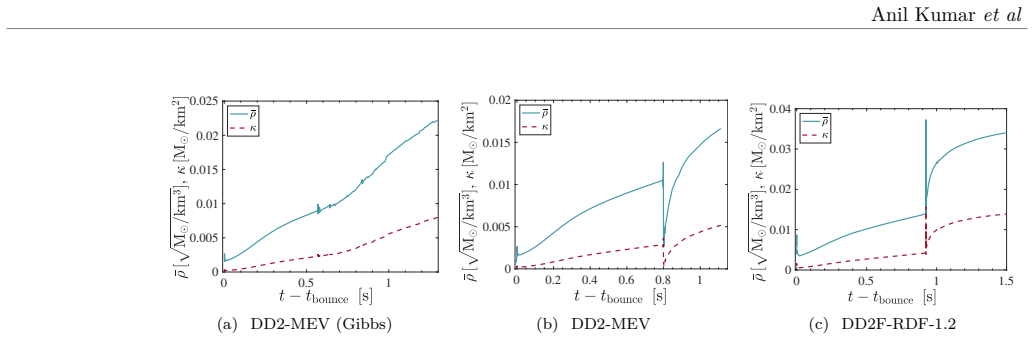
Summary. The manuscript develops a DD2-based relativistic mean-field equation of state with a medium-dependent modified excluded-volume (MEV) functional that produces van der Waals-like softening and a critical endpoint at high T. Two realizations are compared in spherical general-relativistic neutrino-radiation hydrodynamics (AGILE-BOLTZTRAN) for a 40 M⊙ progenitor: the continuous MEV EOS and the same EOS subjected to a Gibbs phase-transition construction. Only the continuous realization yields a successful explosion, accompanied by a multi-millisecond neutrino burst (longer than the 1–2 ms bursts of prior bag/RDF hybrid models) and a larger ejecta mass; the Gibbs version produces only mild PNS reconfiguration and proceeds to black-hole formation. A GREAT-based gravitational-wave mode analysis of f and 2g1 modes is presented for both runs and for a prior RDF hybrid model.
Significance. If robust, the result is significant for the QCD-driven CCSN scenario: it shows that the explosion outcome and the duration of the associated neutrino burst depend not only on the bulk density jump but on whether the EOS is realized continuously through a spinodal or via a Gibbs construction. The longer burst and the breakdown of standard f/g-mode scalings after the transition are concrete, potentially observable discriminants. Strengths include thermodynamic consistency of the MEV rearrangement terms, direct comparison of continuous versus constructed realizations of the same underlying model, and the combination of Boltzmann transport with a perturbative GW mode analysis. The work therefore supplies a useful phenomenological counterpoint to two-phase hybrid EOS studies.
major comments (3)
- Sec. 3.2 (and reuse in Sec. 5): the continuous-MEV explosion and the broadened neutrino burst rest on evolution through the van der Waals spinodal, where cs^{2}<0 is replaced by cs≡0 (practically 10^{-10}c) “to ensure numerical stability.” Because AGILE-BOLTZTRAN is Lagrangian and does not evaluate sound speed in the flux, this floor is an ad-hoc regularisation of an unphysical region. No resolution study, alternative floor, artificial viscosity, or local Maxwell construction inside the spinodal is provided to show that the subsonic perturbation (Figs. 4b, 5) and subsequent second-shock formation are insensitive to this choice. Without such a test the central continuous-versus-Gibbs dichotomy remains vulnerable to a numerical artefact.
- Sec. 3.2 and Table 1: only a single MEV parameter set (v=2 fm, S=3, T0=270 MeV, ncut=0.149 fm^{-3}) and a single progenitor (s40a28) are explored. The paper itself notes that the density jump under Gibbs construction is substantially weaker than in the RDF hybrids that previously exploded. The claim that continuous MEV “features” successful explosions while Gibbs does not is therefore demonstrated only for this one point in parameter space. At least one additional MEV parametrisation with a larger density jump (or a second progenitor) is needed before the comparative statement can be regarded as characteristic of the DD2-MEV class rather than of this particular choice.
- Sec. 5 and Table 2: the GREAT analysis sets cs=0 inside the spinodal and then reports that standard f- and 2g1-mode scalings with mean density and compactness break down after the transition. Because the same regularisation is used both for the hydrodynamics and for the mode calculation, it is unclear whether the reported mode behaviour is physical or an artefact of the floor. A short discussion of how Brunt-Väisälä and Lamb frequencies are defined when cs^{2}≤0, and a check that the eigenmode solver remains well-posed, is required for the GW conclusions to be load-bearing.
minor comments (6)
- Abstract and Introduction: the phrasing “reviews critically the core-collapse supernova explosion mechanism” overstates the scope; the paper is a targeted simulation study of one EOS class, not a review.
- Fig. 1 caption and body: “ρonset/ρend” and “ncut” units are mixed (fm^{-3} vs g cm^{-3} later); a consistent conversion note would help.
- Sec. 2.2, Eq. (13)–(15): the temperature functions g1(T) and g8(T) are introduced without a brief physical motivation for the specific Gaussian form; a sentence linking them to the desired critical temperature would improve readability.
- Fig. 6: the inlay for the continuous-MEV burst is useful but the time axis labels are hard to read; enlarging the inset or adding a vertical marker at shock–neutrinosphere crossing would clarify the 5–10 ms claim.
- Typographical: “od DD2-MEV” (p. 2), “ρonest” (Table 1 / text), “DD2-EV (Gibbs)” (Sec. 4), “valiabels” (Sec. 6), “Morerover” (Sec. 6).
- Data availability: the statement that EOS tables are available “upon reasonable request” is weaker than the later claim that they “will be made publicly available upon publication”; align the two statements.
Circularity Check
No significant circularity: fixed MEV parameters produce explosion/non-explosion dichotomy and longer neutrino burst as genuine hydrodynamical outputs, not by construction.
full rationale
The paper's central comparative claim (continuous DD2-MEV with van der Waals behaviour yields a successful CCSN explosion plus a several-ms neutrino burst, while the identical nuclear/bulk properties under Gibbs construction yield only mild PNS reconfiguration and black-hole formation) is obtained by fixing the MEV functional parameters once (Table 1: v=2, S=3, T0=270 MeV, ncut=0.149 fm^{-3}) and then evolving the radiation-hydrodynamics equations with AGILE-BOLTZTRAN. The outcomes are not algebraically forced by the EOS definition, nor are they fitted to the target observables. Self-citations to prior RDF hybrid models (e.g., Bastian 2021, Fischer et al., Khosravi Largani et al.) serve only for qualitative comparison of density jumps and burst durations; they do not supply the load-bearing premise of the new MEV results. The sound-speed regularisation (cs set to 10^{-10}c inside the spinodal) is a numerical assumption whose robustness is open to question, but it is not a circular reduction of a claimed prediction to its own inputs. The derivation chain is therefore self-contained against external benchmarks and free of the six enumerated circularity patterns.
Axiom & Free-Parameter Ledger
free parameters (4)
- excluded-volume strength S =
3
- excluded-volume scale v =
2 fm
- temperature cutoff T0 =
270 MeV
- density cutoff ncut =
0.149 fm^{-3}
axioms (3)
- domain assumption Density-dependent meson-nucleon couplings of the DD2 RMF model remain valid once the excluded-volume factor multiplies the degeneracy.
- domain assumption Spherical symmetry and the standard set of weak interaction rates in AGILE-BOLTZTRAN are sufficient to capture the explosion mechanism and neutrino burst.
- ad hoc to paper Inside the spinodal, the sound speed may be replaced by a tiny positive floor without changing the hydrodynamics of shock formation.
invented entities (1)
-
medium-dependent excluded-volume functional Φ_N(T,x) of Gaussian form
no independent evidence
read the original abstract
This article reviews critically the core-collapse supernova explosion mechanism associated with a sufficiently strong first-order phase transition from normal nuclear, in general hadronic matter to deconfined quark matter, which commonly assumes Gibbs conditions for the coexistence of phases and a phase transition construction accordingly. To this end, a novel class of multi-purpose equation of state (EOS) is developed, based on the modified excluded volume (MEV) approach employing a medium-dependent excluded-volume functional within the relativistic mean field framework with density-dependent meson-nucleon couplings. The chosen MEV parametrisation features the change in the number of degrees of freedom, mimicking the EOS softening in excess of nuclear saturation density, featuring a first-order phase transition with van der Waals like behaviour and the presence of a critical point at high temperatures. Simulations of core-collapse supernovae are performed, based on general relativistic neutrino radiation hydrodynamics in spherical symmetry, in order to explore the previously reported supernova explosion scenario within this class of phenomenological modified microscopic hadronic EOS. A burst-like neutrino signature is released, substantially longer than previously reported based on common hadron-quark hybrid model EOS with two-phase approach and Gibbs phase-transition construction, as observable signal, which is complemented by a gravitational wave mode analysis.
Figures


Reference graph
Works this paper leans on
-
[1]
Bisnovatyi-Kogan G S 1970 Astronomiceskij Zhurnal 47 813
1970
-
[2]
Bisnovatyi-Kogan G S 1993 Astronomical and Astrophysical Transactions 3 287–294 ( Preprint astro-ph/9707120)
Pith/arXiv arXiv 1993
-
[3]
Bethe H A and Wilson J R 1985 Astrophys. J. 295 14–23
1985
-
[4]
Takahara M and Sato K 1988 Progress of Theoretical Physics 80 861–867
1988
-
[5]
Fischer T, Bastian N U F, Wu M R, Baklanov P, Sorokina E, Blinnikov S, Typel S, Klähn T and Blaschke D B 2018 Nature Astronomy 2 980–986 ( Preprint 1712.08788)
Pith/arXiv arXiv 2018
-
[6]
Khosravi Largani N, Fischer T and Bastian N U F 2024 Astrophys. J. 964 143 ( Preprint 2304. 12316)
2024
-
[7]
Mezzacappa A 2005 Annual Review of Nuclear and Particle Science 55 467–515
2005
-
[8]
Janka H T, Langanke K, Marek A, Martínez-Pinedo G and Müller B 2007 Phys. Rep. 442 38–74 (Preprint arXiv:astro-ph/0612072)
Pith/arXiv arXiv 2007
-
[9]
Janka H T 2012 Annual Review of Nuclear and Particle Science 62 407–451 ( Preprint 1206. 2503)
2012
-
[10]
Janka H T 2025 Annual Review of Nuclear and Particle Science 75 425–461 ( Preprint 2502. 14836)
2025
-
[11]
Fischer T, Bastian N U, Blaschke D, Cierniak M, Hempel M, Klähn T, Martínez-Pinedo G, Newton W G, Röpke G and Typel S 2017 Publ. Astron. Soc. Aust. 34 e067 ( Preprint 1711. 07411) 19 REFERENCES Anil Kumar et al
2017
-
[12]
Fischer T, Typel S, Röpke G, Bastian N U F and Martínez-Pinedo G 2020 Phys. Rev. C 102 055807 ( Preprint 2008.13608)
Pith/arXiv arXiv 2020
-
[13]
Bazavov A, Bhattacharya T, DeTar C, Ding H T, Gottlieb S, Gupta R, Hegde P, Heller U M, Karsch F, Laermann E, Levkova L, Mukherjee S, Petreczky P, Schmidt C, Schroeder C, Soltz R A, Soeldner W, Sugar R, Wagner M, Vranas P and HotQCD Collaboration 2014 Phys. Rev. D 90 094503 ( Preprint 1407.6387)
Pith/arXiv arXiv 2014
-
[14]
Borsányi S, Fodor Z, Hoelbling C, Katz S D, Krieg S and Szabó K K 2014 Physics Letters B 730 99–104 ( Preprint 1309.5258)
Pith/arXiv arXiv 2014
-
[15]
Bazavov A, Ding H T, Hegde P, Kaczmarek O, Karsch F, Karthik N, Laermann E, Lahiri A, Larsen R, Li S T, Mukherjee S, Ohno H, Petreczky P, Sandmeyer H, Schmidt C, Sharma S, Steinbrecher P and HotQCD Collaboration 2019 Physics Letters B 795 15–21 ( Preprint 1812.08235)
Pith/arXiv arXiv 2019
-
[16]
D30 2379
Farhi E and Jaffe R 1984 Phys.Rev. D30 2379
1984
-
[17]
Sagert I, Fischer T, Hempel M, Pagliara G, Schaffner-Bielich J, Mezzacappa A, Thielemann F K and Liebendörfer M 2009 Phys. Rev. Lett. 102 081101 ( Preprint 0809.4225)
Pith/arXiv arXiv 2009
-
[18]
Klähn T and Fischer T 2015 Astrophys. J. 810 134 ( Preprint 1503.07442)
Pith/arXiv arXiv 2015
-
[19]
Klähn T, Fischer T and Hempel M 2017 Astrophys. J. 836 89 ( Preprint 1603.03679)
Pith/arXiv arXiv 2017
-
[20]
Nambu Y and Jona-Lasinio G 1961 Physical Review 122 345–358
1961
-
[21]
Klevansky S P 1992 Reviews of Modern Physics 64 649–708
1992
-
[22]
Buballa M 2005 Phys. Rep. 407 205–376 ( Preprint hep-ph/0402234)
Pith/arXiv arXiv 2005
-
[23]
Kaltenborn M A R, Bastian N U F and Blaschke D B 2017 Phys. Rev. D 96 056024 ( Preprint 1701.04400)
Pith/arXiv arXiv 2017
-
[24]
Bastian N U F 2021 Phys. Rev. D 103 023001 ( Preprint 2009.10846)
Pith/arXiv arXiv 2021
-
[25]
Goddard P, Goldstone J, Rebbi C and Thorn C B 1973 Nuclear Physics B 56 109–135
1973
-
[26]
Johnson K and Thorn C B 1976 Phys. Rev. D 13 1934–1939
1976
-
[27]
Horowitz C J, Moniz E J and Negele J W 1985 Phys. Rev. D 31 1689–1699
1985
-
[28]
Röpke G, Blaschke D and Schulz H 1986 Phys. Rev. D 34 3499–3513
1986
-
[29]
Shukla U and Lo P M 2025 arXiv e-prints arXiv:2507.06741 ( Preprint 2507.06741)
Pith/arXiv arXiv 2025
-
[30]
Shukla U and Lo P M 2025 Journal of Subatomic Particles and Cosmology 3 100058 ( Preprint 2504.01814)
Pith/arXiv arXiv 2025
-
[31]
Fonseca E, Cromartie H T, Pennucci T T, Ray P S, Kirichenko A Y, Ransom S M, Demorest P B, Stairs I H, Arzoumanian Z, Guillemot L, Parthasarathy A, Kerr M, Cognard I, Baker P T, Blumer H, Brook P R, DeCesar M, Dolch T, Dong F A, Ferrara E C, Fiore W, Garver-Daniels N, Good D C, Jennings R, Jones M L, Kaspi V M, Lam M T, Lorimer D R, Luo J, McEwen A, McKee...
Pith/arXiv arXiv 2021
-
[32]
Klähn T, Blaschke D, Typel S, van Dalen E N E, Faessler A, Fuchs C, Gaitanos T, Grigorian H, Ho A, Kolomeitsev E E, Miller M C, Röpke G, Trümper J, Voskresensky D N, Weber F and Wolter H H 2006 Phys. Rev. C 74 035802 ( Preprint nucl-th/0602038)
Pith/arXiv arXiv 2006
-
[33]
Abbott B P et al. 2017 Phys. Rev. Lett. 119 161101 ( Preprint 1710.05832)
Pith/arXiv arXiv 2017
-
[34]
De S, Finstad D, Lattimer J M, Brown D A, Berger E and Biwer C M 2018 Phys. Rev. Lett. 121 091102 ( Preprint 1804.08583) 20 REFERENCES Anil Kumar et al
Pith/arXiv arXiv 2018
-
[35]
Miller M C, Lamb F K, Dittmann A J, Bogdanov S, Arzoumanian Z, Gendreau K C, Guillot S, Harding A K, Ho W C G, Lattimer J M, Ludlam R M, Mahmoodifar S, Morsink S M, Ray P S, Strohmayer T E, Wood K S, Enoto T, Foster R, Okajima T, Prigozhin G and Soong Y 2019 Astrophys. J. Lett. 887 L24 ( Preprint 1912.05705)
Pith/arXiv arXiv 2019
-
[36]
Bilous A V, Watts A L, Harding A K, Riley T E, Arzoumanian Z, Bogdanov S, Gendreau K C, Ray P S, Guillot S, Ho W C G and Chakrabarty D 2019 Astrophys. J. Lett. 887 L23 ( Preprint 1912.05704)
Pith/arXiv arXiv 2019
-
[37]
Miller M C, Lamb F K, Dittmann A J, Bogdanov S, Arzoumanian Z, Gendreau K C, Guillot S, Ho W C G, Lattimer J M, Loewenstein M, Morsink S M, Ray P S, Wolff M T, Baker C L, Cazeau T, Manthripragada S, Markwardt C B, Okajima T, Pollard S, Cognard I, Cromartie H T, Fonseca E, Guillemot L, Kerr M, Parthasarathy A, Pennucci T T, Ransom S and Stairs I 2021 Astro...
Pith/arXiv arXiv 2021
-
[38]
Riley T E, Watts A L, Ray P S, Bogdanov S, Guillot S, Morsink S M, Bilous A V, Arzoumanian Z, Choudhury D, Deneva J S, Gendreau K C, Harding A K, Ho W C G, Lattimer J M, Loewenstein M, Ludlam R M, Markwardt C B, Okajima T, Prescod-Weinstein C, Remillard R A, Wolff M T, Fonseca E, Cromartie H T, Kerr M, Pennucci T T, Parthasarathy A, Ransom S, Stairs I, Gu...
Pith/arXiv arXiv 2021
-
[39]
Typel S and Blaschke D 2018 Universe 4 32 ( Preprint 1712.04383)
Pith/arXiv arXiv 2018
-
[40]
Thorne K S 1981 Mon. Not. Roy. Astron. Soc. 194 439–473
1981
-
[41]
Torres-Forné A, Cerdá-Durán P, Passamonti A, Obergaulinger M and Font J A 2019 Mon. Not. Roy. Astron. Soc. 482 3967–3988 ( Preprint 1806.11366)
Pith/arXiv arXiv 2019
-
[42]
Typel S and Wolter H 1999 Nuclear Physics A 656 331–364 ISSN 0375-9474 URL https: //www.sciencedirect.com/science/article/pii/S0375947499003103
1999
-
[44]
Typel S, Röpke G, Klähn T, Blaschke D and Wolter H H 2010 Phys. Rev. C 81 015803 (Preprint 0908.2344)
Pith/arXiv arXiv 2010
-
[46]
Typel S 2016 European Physical Journal A 52 16
2016
-
[47]
Benić S, Blaschke D, Alvarez-Castillo D E, Fischer T and Typel S 2015 Astronomy and Astro- physics 577 A40 ( Preprint 1411.2856)
Pith/arXiv arXiv 2015
-
[48]
Glendenning N K 1992 Physical Review D 46 1274–1287
1992
-
[49]
Glendenning N K (ed) 2000 Compact stars : nuclear physics, particle physics, and general relativity
2000
-
[50]
Typel S, Wolter H H, Röpke G and Blaschke D 2014 European Physical Journal A 50 17 (Preprint 1309.6934)
Pith/arXiv arXiv 2014
-
[51]
Hempel M, Pagliara G and Schaffner-Bielich J 2009 Phys. Rev. D 80 125014 ( Preprint 0907. 2680)
2009
-
[53]
Müller H and Serot B D 1995 Phys. Rev. C 52(4) 2072–2091 URL https://link.aps.org/ doi/10.1103/PhysRevC.52.2072
-
[54]
A vancini S S, Brito L, Chomaz P, Menezes D P and Providência C 2006 Phys. Rev. C 74(2) 024317 URL https://link.aps.org/doi/10.1103/PhysRevC.74.024317
-
[55]
Alam N, Pais H, Providência C and Agrawal B K 2017 Phys. Rev. C 95(5) 055808 URL https: //link.aps.org/doi/10.1103/PhysRevC.95.055808
-
[56]
Mezzacappa A and Bruenn S W 1993 Astrophys. J. 405 637–668 21 REFERENCES Anil Kumar et al
1993
-
[57]
Mezzacappa A and Bruenn S W 1993 Astrophys. J. 405 669–684
1993
-
[58]
Mezzacappa A and Bruenn S W 1993 Astrophys. J. 410 740–760
1993
-
[59]
Liebendörfer M, Messer O E B, Mezzacappa A, Bruenn S W, Cardall C Y and Thielemann F K 2004 Astrophys. J. Suppl. 150 263–316 ( Preprint astro-ph/0207036)
Pith/arXiv arXiv 2004
-
[60]
Fischer T, Whitehouse S C, Mezzacappa A, Thielemann F K and Liebendörfer M 2009 Astron- omy and Astrophysics 499 1–15 ( Preprint 0809.5129)
Pith/arXiv arXiv 2009
-
[61]
Fischer T, Guo G, Martínez-Pinedo G, Liebendörfer M and Mezzacappa A 2020 Phys. Rev. D 102 123001 ( Preprint 2008.13628)
Pith/arXiv arXiv 2020
-
[62]
Fischer T, Guo G, Dzhioev A A, Martínez-Pinedo G, Wu M R, Lohs A and Qian Y Z 2020 Phys. Rev. C 101 025804 ( Preprint 1804.10890)
Pith/arXiv arXiv 2020
-
[63]
Bruenn S W 1985 Astrophys. J. Suppl. 58 771–841
1985
-
[64]
Hannestad S and Raffelt G 1998 Astrophys. J. 507 339–352 ( Preprint astro-ph/9711132)
Pith/arXiv arXiv 1998
-
[65]
Fischer T 2016 Astronomy and Astrophysics 593 A103 ( Preprint 1608.05004)
Pith/arXiv arXiv 2016
-
[66]
Buras R, Janka H T, Rampp M and Kifonidis K 2006 Astronomy and Astrophysics 457 281–308 (Preprint astro-ph/0512189)
Pith/arXiv arXiv 2006
-
[67]
Hempel M, Fischer T, Schaffner-Bielich J and Liebendörfer M 2012 Astrophys. J. 748 70 (Preprint 1108.0848)
Pith/arXiv arXiv 2012
-
[68]
Hempel M and Schaffner-Bielich J 2010 Nucl. Phys. A 837 210–254 ( Preprint 0911.4073)
Pith/arXiv arXiv 2010
-
[69]
Woosley S E, Heger A and Weaver T A 2002 Reviews of Modern Physics 74 1015–1071
2002
-
[70]
Timmes F X and Arnett D 1999 Astrophys. J. Suppl. 125 277–294
1999
-
[71]
Rauscher T, Heger A, Hoffman R D and Woosley S E 2002 Astrophys. J. 576 323–348 (Preprint astro-ph/0112478)
Pith/arXiv arXiv 2002
-
[72]
Zha S, O’Connor E P, Chu M c, Lin L M and Couch S M 2020 Phys. Rev. Lett. 125 051102 (Preprint 2007.04716)
Pith/arXiv arXiv 2020
-
[73]
Fischer T, Carenza P, Fore B, Giannotti M, Mirizzi A and Reddy S 2021 Phys. Rev. D 104 103012 ( Preprint 2108.13726)
Pith/arXiv arXiv 2021
-
[74]
Jakobus P, Mueller B, Heger A, Motornenko A, Steinheimer J and Stoecker H 2022 arXiv e- prints arXiv:2204.10397 ( Preprint 2204.10397)
Pith/arXiv arXiv 2022
-
[75]
Kuroda T, Fischer T, Takiwaki T and Kotake K 2022 Astrophys. J. 924 38 ( Preprint 2109. 01508)
2022
-
[76]
Rahman N, Janka H T, Stockinger G and Woosley S E 2022 Mon. Not. Roy. Astron. Soc. 512 4503–4540 ( Preprint 2112.09707)
Pith/arXiv arXiv 2022
-
[77]
Kuroda T and Shibata M 2023 Mon. Not. Roy. Astron. Soc. 526 152–159 (Preprint 2307.06192)
Pith/arXiv arXiv 2023
-
[78]
Eggenberger Andersen O, O’Connor E, Kovalenko L, Andresen H and Couch S M 2026 arXiv e-prints arXiv:2605.01405 ( Preprint 2605.01405)
Pith/arXiv arXiv 2026
-
[79]
Fischer T, Wu M R, Wehmeyer B, Bastian N U F, Martínez-Pinedo G and Thielemann F K 2020 Astrophys. J. 894 9
2020
-
[80]
Chomaz P, Colonna M and Randrup J 2004 Phys. Rep. 389 263–440
2004
-
[81]
Fischer T, Sagert I, Pagliara G, Hempel M, Schaffner-Bielich J, Rauscher T, Thielemann F K, Käppeli R, Martínez-Pinedo G and Liebendörfer M 2011 Astrophys. J. Suppl. 194 39 ( Preprint 1011.3409)
Pith/arXiv arXiv 2011
-
[82]
Fischer T, Whitehouse S C, Mezzacappa A, Thielemann F K and Liebendörfer M 2010 Astron- omy and Astrophysics 517 A80 ( Preprint 0908.1871) 22 REFERENCES Anil Kumar et al
Pith/arXiv arXiv 2010
-
[83]
Dasgupta B, Fischer T, Horiuchi S, Liebendörfer M, Mirizzi A, Sagert I and Schaffner-Bielich J 2010 Phys. Rev. D 81 103005 ( Preprint 0912.2568)
Pith/arXiv arXiv 2010
discussion (0)
Sign in with ORCID, Apple, or X to comment. Anyone can read and Pith papers without signing in.