REVIEW 2 major objections 5 minor 91 references
Diffhalos generates cosmological lightcones of dark matter halos, subhalos, and mass assembly histories that match N-body statistics.
Reviewed by Pith at T0; open to challenge. T0 means a machine referee read the full paper against a public rubric. the ladder, T0–T4 →
T0 review · grok-4.5
2026-07-14 11:53 UTC pith:3HOLU33Z
load-bearing objection Solid, usable JAX light-cone generator that couples HMF sampling, subhalos, and DiffmahNet MAHs; the engineering is real and the soft spots are openly stated. the 2 major comments →
Diffhalos: A Generative Model of Cosmological Lightcones of Dark Matter Halos
The pith
A machine-rendered reading of the paper's core claim, the machinery that carries it, and where it could break.
Core claim
Diffhalos produces Monte Carlo and quasi-Monte Carlo lightcones of host halos, subhalos, and their mass assembly histories whose joint distributions in mass, redshift, and assembly closely approximate those measured in N-body simulations, while remaining fully differentiable with respect to cosmological parameters.
What carries the argument
A three-stage generative pipeline: inverse-transform sampling of a cumulative, differentiable halo mass function; sampling of a conditional cumulative subhalo mass function in the mass ratio µ; and DiffmahNet, a normalizing flow that maps (M_obs, t_obs) to Diffmah mass-assembly parameters.
Load-bearing premise
The model treats the conditional subhalo mass function as independent of redshift and trains the assembly-history flow on merger trees from only one cosmology.
What would settle it
Generate a Diffhalos lightcone at a cosmology and redshift range outside the training set and compare its host and subhalo mass functions and assembly-history distributions against an independent high-resolution N-body lightcone; systematic mismatches would falsify the claimed statistical fidelity.
Editorial analysis
A structured set of objections, weighed in public.
Referee Report
Summary. The paper introduces Diffhalos, a JAX-based generative pipeline for cosmological lightcones of dark matter host halos, subhalos, and their mass assembly histories (MAHs). Hosts are drawn by inverse-transform sampling of a cumulative HMF (either Halox/Tinker or a sig-slope MLP emulator of N_halo(>m,z)); subhalos are drawn from a conditional cumulative subhalo mass function N_sub(>μ|M_host) calibrated to Discovery/Bolshoi-style fits; MAHs are assigned by DiffmahNet, a normalizing flow that samples Diffmah parameters conditioned on observed mass and time. Monte Carlo and memory-efficient quasi-Monte Carlo generators are provided. Component-wise comparisons to Colossus, SMDPL, and Discovery show percent-to-10% agreement on mass functions and MAH means/variances (Figs. 1–4, 6–9), autodiff gradients of the HMF match finite differences (Fig. 2), and an example application computes cosmological derivatives of the halo and subhalo mass functions. The authors discuss intended use with galaxy–halo models (Diffsky/DiffstarPop) and list planned extensions (cosmology-dependent CSHMF/MAHs, density-field coupling).
Significance. If the claimed statistical fidelity holds for joint lightcone populations, Diffhalos supplies a practical, differentiable, and publicly available alternative to full N-body lightcones for calibrating galaxy–halo connection models and generating abundance-weighted mocks. Strengths include the autodiff implementation (enabling gradient-based inference), the dual MC/QMC generators that address memory limits, open code, and transparent component-wise validation against established libraries and public merger trees. The work is a useful proof-of-concept infrastructure paper rather than a new precision emulator; its main value is the modular pipeline that can be upgraded with existing high-accuracy HMF emulators and multi-cosmology merger-tree suites.
major comments (2)
- §6 explicitly states that the CCSHMF is taken independent of redshift (“we neglect the weak redshift dependence”) and is calibrated only versus host mass; Fig. 6 shows total host+sub mass functions at several redshifts, but the joint (M_sub, z) distribution across a full lightcone is not validated against a simulated lightcone. Because a lightcone spans z=0–5, residual redshift evolution of the unevolved subhalo mass function can bias high-z satellite abundances. A quantitative residual plot (or an explicit upper bound drawn from Jiang & van den Bosch 2016 / Discovery) of N_sub(>μ|M_host,z) versus the redshift-independent model is needed to support the Abstract claim of statistical fidelity for lightcone populations.
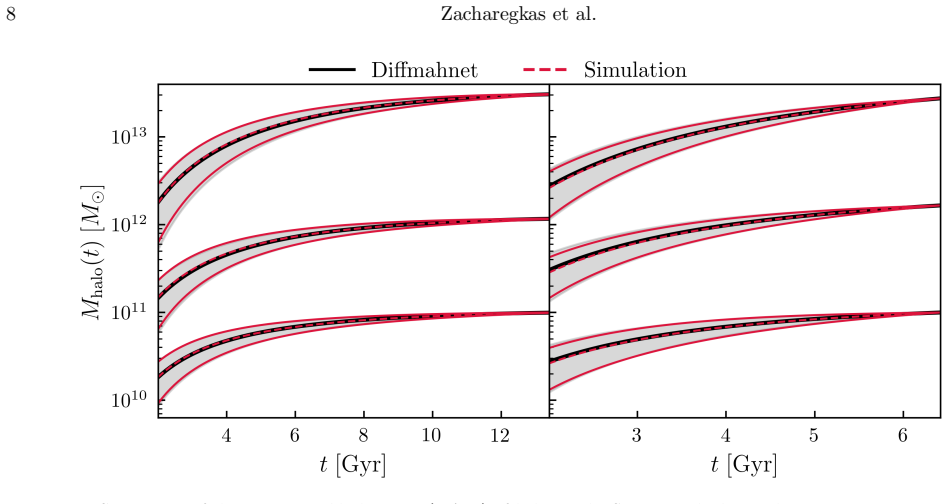
- §7 trains DiffmahNet exclusively on SMDPL (one cosmology). The Abstract and §8 advertise cosmology-dependent lightcones and gradients of the HMF/subhalo MF (Fig. 2), yet MAH diversity is frozen to the SMDPL cosmology. Piecewise recovery of SMDPL MAH means/variances (Fig. 9) does not guarantee that the joint (M,z,θ_MAH) distribution remains accurate when θ_cosmo is varied. Either restrict the cosmology-variation claims to the HMF stage alone, or supply a cross-check (even on a second public box) quantifying MAH bias under modest Ω_m/σ_8 shifts.
minor comments (5)
- Fig. 3 caption and text claim “10% or better” accuracy for the MLP emulator; the bottom residual panels show excursions approaching or exceeding 10% at the high-mass end for some redshifts. Soften the wording or quote the actual max residual.
- Notation: m_halo ≡ log10 M_halo is introduced in §2.1 but occasionally mixed with M_halo in figure labels and axis titles; a single consistent convention would improve readability.
- The updated 5-parameter Diffmah model (including t_peak) is only referenced via Alarcon et al. 2025 Appendix A; a one-sentence definition of the five parameters in §7 would make the paper self-contained.
- §5 QMC description is brief; stating the typical N_grid and the precise weight normalization used for summary statistics would aid reproducibility.
- Typos / style: “lighcone” (p. 3), “Diffhaloscan” / “Diffhalosto” spacing artifacts in the Abstract and §1, and occasional missing spaces after periods.
Circularity Check
No significant circularity: generative sampling recovers fitted analytic models and training simulations by design of inverse-transform and density estimation, with only minor non-load-bearing self-citations to prior libraries.
full rationale
The paper constructs Diffhalos as a three-stage Monte Carlo / quasi-Monte Carlo generator (host HMF via Halox or MLP emulator of cumulative N_halo, conditional subhalo mass function via sig-slope kernel, MAHs via DiffmahNet normalizing flow). Component-wise validation (Figs. 4, 6–9) shows that samples recover the analytic HMF/CSHMF by construction of inverse-transform sampling and recover the mean/variance of SMDPL MAHs by construction of a trained density estimator; these are standard checks for a generative model, not circular reductions of a claimed first-principles derivation. Calibrations of the CSHMF and DiffmahNet use external public N-body products (Discovery, SMDPL/Rockstar/ConsistentTrees, Jiang & van den Bosch fitting functions) and are reported as such. Self-citations to Diffmah (H21) and Halox supply reusable libraries whose internal accuracy is independently demonstrated against Colossus/Tinker; they do not supply a uniqueness theorem or force the central statistical-fidelity claim. Assumptions such as redshift-independent CSHMF and single-cosmology DiffmahNet training are limitations of scope, not circular steps. Score 1 reflects only the presence of ordinary co-author library citations that are not load-bearing for the result.
Axiom & Free-Parameter Ledger
free parameters (4)
- sig-slope HMF kernel parameters θ_HMF
- MLP weights mapping θ_cosmo → θ_HMF
- CCSHMF sig-slope parameters
- DiffmahNet normalizing-flow parameters
axioms (4)
- domain assumption The Tinker et al. (2008) fitting formula for f(σ) accurately describes the halo mass function to ~10–20 %.
- domain assumption The unevolved conditional subhalo mass function has negligible redshift dependence.
- domain assumption Halo mass assembly histories are well approximated by the five-parameter Diffmah functional form.
- domain assumption Standard ΛCDM linear power spectrum and spherical-collapse mass variance (Eqs. 1–2).
invented entities (2)
-
Diffhalos generative pipeline
independent evidence
-
DiffmahNet
independent evidence
read the original abstract
We present a generative model of cosmological lightcones of dark matter halos, Diffhalos. In our model, we draw Monte Carlo samples of the halo mass function in a lightcone with a JAX-based implementation of the halo model, Halox, and we generate samples of subhalos by drawing from a model for the conditional subhalo mass function. We generate mass assembly histories (MAHs) using a normalizing flow trained on merger trees in cosmological N-body simulations. We show that Diffhalos can generate samples of halos, subhalos, and their MAHs with a statistical distribution that accurately approximates populations in simulated lightcones. As an example application, we use Diffhalos to calculate gradients of the halo and subhalo mass functions with respect to cosmological parameters. We conclude with a discussion of ongoing work using Diffhalos together with models of the galaxy--halo connection to make theoretical predictions for cosmological populations of galaxies, and to generate mock galaxy catalogs.
Figures


Reference graph
Works this paper leans on
-
[1]
Alarcon, A., Hearin, A. P., Becker, M. R., et al. 2025, arXiv:2510.27604, arXiv:2510.27604, doi:10.48550/arXiv.2510.27604
-
[2]
E., Zennaro, M., Contreras, S., et al
Angulo, R. E., Zennaro, M., Contreras, S., et al. 2021, Mon. Not. Roy. Astron. Soc., 507, 5869, doi:10.1093/mnras/stab2018
-
[3]
Becker, M. R. 2015, arXiv:1507.03605, arXiv:1507.03605. https://arxiv.org/abs/1507.03605
Pith/arXiv arXiv 2015
-
[4]
Behroozi, P., Wechsler, R. H., Hearin, A. P., & Conroy, C. 2019, MNRAS, 488, 3143, doi:10.1093/mnras/stz1182
-
[5]
Behroozi, P. S., Wechsler, R. H., & Wu, H.-Y. 2013a, ApJ, 762, 109, doi:10.1088/0004-637X/762/2/109
-
[6]
Behroozi, P. S., Wechsler, R. H., Wu, H.-Y., et al. 2013b, ApJ, 763, 18, doi:10.1088/0004-637X/763/1/18
-
[7]
D., Pope, A., Alarcon, A., et al
Beltz-Mohrmann, G. D., Pope, A., Alarcon, A., et al. 2025, The Open Journal of Astrophysics, 8, 74, doi:10.33232/001c.140866
-
[8]
Benson, A. J., Nadler, E. O., Du, X., & Gluscevic, V. 2026, arXiv e-prints, arXiv:2606.12137, doi:10.48550/arXiv.2606.12137
-
[9]
A universal model for the accretion rates and formation times of dark matter halos
Bera, A., & Diemer, B. 2026, arXiv e-prints, arXiv:2606.09997, doi:10.48550/arXiv.2606.09997
work page internal anchor Pith review Pith/arXiv arXiv doi:10.48550/arxiv.2606.09997 2026
-
[10]
Blumenthal, G. R., Faber, S. M., Primack, J. R., & Rees, M. J. 1984, Nature, 311, 517, doi:10.1038/311517a0
doi:10.1038/311517a0 1984
-
[11]
Bower, R. G. 1991, MNRAS, 248, 332, doi:10.1093/mnras/248.2.332
-
[12]
Bower, R. G., Benson, A. J., Malbon, R., et al. 2006, MNRAS, 370, 645, doi:10.1111/j.1365-2966.2006.10519.x
-
[13]
Bradbury, J., Frostig, R., Hawkins, P., et al. 2018
2018
-
[14]
2025, arXiv:2508.10902, arXiv:2508.10902
Brieden, S., Beutler, F., & Pellejero-Iba˜ nez, M. 2025, arXiv:2508.10902, arXiv:2508.10902. https://arxiv.org/abs/2508.10902
arXiv 2025
-
[15]
2023, The Open Journal of Astrophysics, 6, 15, doi:10.21105/astro.2302.05163
Campagne, J.-E., Lanusse, F., Zuntz, J., et al. 2023, The Open Journal of Astrophysics, 6, 15, doi:10.21105/astro.2302.05163
-
[16]
Chaves-Montero, J., Angulo, R. E., Schaye, J., et al. 2016, MNRAS, 460, 3100, doi:10.1093/mnras/stw1225
-
[17]
Contreras, S., Angulo, R. E., & Zennaro, M. 2021, MNRAS, 508, 175, doi:10.1093/mnras/stab2560
-
[18]
2020, ApJS, 251, 17, doi:10.3847/1538-4365/abbf51 —
Diemer, B. 2020, ApJS, 251, 17, doi:10.3847/1538-4365/abbf51 —. 2022, MNRAS, 513, 573, doi:10.1093/mnras/stac878
-
[19]
O., Benson, A., & Gluscevic, V
Driskell, T., Nadler, E. O., Benson, A., & Gluscevic, V. 2024, arXiv:2410.11680, arXiv:2410.11680. https://arxiv.org/abs/2410.11680
Pith/arXiv arXiv 2024
-
[20]
Evrard, A. E., et al. 2002, Astrophys. J., 573, 7, doi:10.1086/340551
doi:10.1086/340551 2002
-
[21]
Fosalba, P., Crocce, M., Gazta˜ naga, E., & Castander, F. J. 2015, Mon. Not. Roy. Astron. Soc., 448, 2987, doi:10.1093/mnras/stv138
-
[22]
Fosalba, P., Gaztanaga, E., Castander, F., & Manera, M. 2008, Mon. Not. Roy. Astron. Soc., 391, 435, doi:10.1111/j.1365-2966.2008.13910.x
-
[23]
2022, MNRAS, 512, 4909, doi:10.1093/mnras/stac257 Garc´ ıa, R., Salazar, E., Rozo, E., et al
Garaldi, E., Kannan, R., Smith, A., et al. 2022, MNRAS, 512, 4909, doi:10.1093/mnras/stac257 Garc´ ıa, R., Salazar, E., Rozo, E., et al. 2023, MNRAS, 521, 2464, doi:10.1093/mnras/stad660
-
[24]
Ruderman, J. T. 2025, Phys. Rev. D, 112, 063531, doi:10.1103/f3tj-r882
-
[25]
2023.https://arxiv.org/abs/2305.11935
Hadzhiyska, B., et al. 2023.https://arxiv.org/abs/2305.11935
Pith/arXiv arXiv 2023
-
[26]
2025, ApJ, 982, L44, doi:10.3847/2041-8213/adbe5e
Hahn, C., & Melchior, P. 2025, ApJ, 982, L44, doi:10.3847/2041-8213/adbe5e
-
[27]
Hahn, O., List, F., & Porqueres, N. 2024, J. Cosmology Astropart. Phys., 2024, 063, doi:10.1088/1475-7516/2024/06/063
-
[28]
2023, MNRAS, 521, 1741, doi:10.1093/mnras/stad456
Benson, A. 2023, MNRAS, 521, 1741, doi:10.1093/mnras/stad456
-
[29]
P., Chaves-Montero, J., Becker, M
Hearin, A. P., Chaves-Montero, J., Becker, M. R., & Alarcon, A. 2021, The Open Journal of Astrophysics, 4, 7, doi:10.21105/astro.2105.05859
-
[30]
Hearin, A. P., & Watson, D. F. 2013, MNRAS, 435, 1313, doi:10.1093/mnras/stt1374
-
[31]
Heitmann, K., Lawrence, E., Kwan, J., Habib, S., & Higdon, D. 2014, Astrophys. J., 780, 111, doi:10.1088/0004-637X/780/1/111
-
[32]
2021, ApJS, 252, 19, doi:10.3847/1538-4365/abcc67
Heitmann, K., Frontiere, N., Rangel, E., et al. 2021, ApJS, 252, 19, doi:10.3847/1538-4365/abcc67
-
[33]
Henriques, B. M. B., White, S. D. M., Thomas, P. A., et al. 2015, MNRAS, 451, 2663, doi:10.1093/mnras/stv705
-
[34]
2019.https://arxiv.org/abs/1906.08355
Hollowed, J. 2019.https://arxiv.org/abs/1906.08355
Pith/arXiv arXiv 2019
-
[35]
2025, MNRAS, doi:10.1093/mnras/staf1785
Horowitz, B., & Luki´ c, Z. 2025, MNRAS, doi:10.1093/mnras/staf1785
-
[36]
Hunter, J. D. 2007, Computing In Science & Engineering, 9, 90, doi:10.1109/MCSE.2007.55 10 Zacharegkas et al
-
[37]
2023, Astronomy & Astrophysics, 677, A123
Izquierdo-Villalba, D., Colpi, M., Volonteri, M., et al. 2023, Astronomy & Astrophysics, 677, A123
2023
-
[38]
2021, Monthly Notices of the Royal Astronomical Society, 502, 621, doi:10.1093/mnras/staa4034
Jiang, F., Dekel, A., Freundlich, J., et al. 2021, Monthly Notices of the Royal Astronomical Society, 502, 621, doi:10.1093/mnras/staa4034
-
[39]
Jiang, F., & van den Bosch, F. C. 2016, MNRAS, 458, 2848, doi:10.1093/mnras/stw439
-
[40]
2001-2016, http://www.scipy.org
Jones, E., Oliphant, T., Peterson, P., et al. 2001-2016, http://www.scipy.org
2001
-
[41]
halox: Dark matter halo properties and large-scale structure calculations using JAX
Kannan, R., Garaldi, E., Smith, A., et al. 2022, MNRAS, 511, 4005, doi:10.1093/mnras/stab3710 K´ eruzor´ e, F., & Moreau, L. A. 2025, arXiv e-prints, arXiv:2509.22478, doi:10.48550/arXiv.2509.22478
work page internal anchor Pith review Pith/arXiv arXiv doi:10.1093/mnras/stab3710 2022
-
[42]
2016, MNRAS, 457, 4340, doi:10.1093/mnras/stw248
Klypin, A., Yepes, G., Gottl¨ ober, S., Prada, F., & Heß, S. 2016, MNRAS, 457, 4340, doi:10.1093/mnras/stw248
-
[43]
A., Trujillo-Gomez, S., & Primack, J
Klypin, A. A., Trujillo-Gomez, S., & Primack, J. 2011, ApJ, 740, 102, doi:10.1088/0004-637X/740/2/102
-
[44]
Knabenhans, M., et al. 2021, Mon. Not. Roy. Astron. Soc., 505, 2840, doi:10.1093/mnras/stab1366 Kodi Ramanah, D., Charnock, T., Villaescusa-Navarro, F., &
-
[45]
Wandelt, B. D. 2020, MNRAS, 495, 4227, doi:10.1093/mnras/staa1428
-
[46]
O., Mansfield, P., & Benson, A
Kong, D., Yu, H.-B., Nadler, E. O., Mansfield, P., & Benson, A. 2025, J. Cosmology Astropart. Phys., 2025, 074, doi:10.1088/1475-7516/2025/10/074
-
[47]
1993, MNRAS, 262, 627, doi:10.1093/mnras/262.3.627
Lacey, C., & Cole, S. 1993, MNRAS, 262, 627, doi:10.1093/mnras/262.3.627
-
[48]
Lagos, C. d. P., Tobar, R. J., Robotham, A. S. G., et al. 2018, MNRAS, 481, 3573, doi:10.1093/mnras/sty2440
-
[49]
2022, arXiv e-prints, arXiv:2211.09958, doi:10.48550/arXiv.2211.09958
Li, Y., Lu, L., Modi, C., et al. 2022, arXiv e-prints, arXiv:2211.09958, doi:10.48550/arXiv.2211.09958
-
[50]
2025, arXiv e-prints, arXiv:2510.05206, doi:10.48550/arXiv.2510.05206
List, F., Hahn, O., Fl¨ oss, T., & Winkler, L. 2025, arXiv e-prints, arXiv:2510.05206, doi:10.48550/arXiv.2510.05206
-
[51]
Lovell, C. C., Lee, M. E., Roper, W. J., et al. 2026, arXiv:2604.17981, arXiv:2604.17981. https://arxiv.org/abs/2604.17981
Pith/arXiv arXiv 2026
-
[52]
2024, ApJ, 970, 178, doi:10.3847/1538-4357/ad4e33
Mansfield, P., Darragh-Ford, E., Wang, Y., et al. 2024, ApJ, 970, 178, doi:10.3847/1538-4357/ad4e33
-
[53]
Marinacci, F., Vogelsberger, M., Pakmor, R., et al. 2018, MNRAS, 480, 5113, doi:10.1093/mnras/sty2206 Mart´ ın-Navarro, I., Vazdekis, A., Peralta de Arriba, L., et al. 2026, arXiv e-prints, arXiv:2605.24093, doi:10.48550/arXiv.2605.24093
-
[54]
I., Baugh, C
Merson, A. I., Baugh, C. M., Helly, J. C., et al. 2013, Monthly Notices of the Royal Astronomical Society, 429, 556
2013
-
[55]
R., Heitmann, K., Lawrence, E., et al
Moran, K. R., Heitmann, K., Lawrence, E., et al. 2023, Mon. Not. Roy. Astron. Soc., 520, 3443, doi:10.1093/mnras/stac3452
-
[56]
Moster, B. P., Naab, T., & White, S. D. M. 2018, MNRAS, 477, 1822, doi:10.1093/mnras/sty655
-
[57]
2019, Computational Astrophysics and Cosmology, 6, 1, doi:10.1186/s40668-019-0029-9
Mustafa, M., Bard, D., Bhimji, W., et al. 2019, Computational Astrophysics and Cosmology, 6, 1, doi:10.1186/s40668-019-0029-9
-
[58]
O., Banerjee, A., Adhikari, S., Mao, Y.-Y., & Wechsler, R
Nadler, E. O., Banerjee, A., Adhikari, S., Mao, Y.-Y., & Wechsler, R. H. 2021, ApJ, 920, L11, doi:10.3847/2041-8213/ac29c1
-
[59]
Nadler, E. O., Mao, Y.-Y., Wechsler, R. H., Garrison-Kimmel, S., & Wetzel, A. 2018, ApJ, 859, 129, doi:10.3847/1538-4357/aac266
-
[60]
O., Mansfield, P., Wang, Y., et al
Nadler, E. O., Mansfield, P., Wang, Y., et al. 2023, ApJ, 945, 159, doi:10.3847/1538-4357/acb68c
-
[61]
P., Pillepich, A., Springel, V., et al
Naiman, J. P., Pillepich, A., Springel, V., et al. 2018, MNRAS, 477, 1206, doi:10.1093/mnras/sty618
-
[62]
2018, MNRAS, 475, 624, doi:10.1093/mnras/stx3040
Nelson, D., Pillepich, A., Springel, V., et al. 2018, MNRAS, 475, 624, doi:10.1093/mnras/stx3040
-
[63]
Somerville, R. S. 2025, arXiv:2507.10652, arXiv:2507.10652. https://arxiv.org/abs/2507.10652
arXiv 2025
-
[64]
Nguyen, T., Modi, C., Yung, L. Y. A., & Somerville, R. S. 2024, MNRAS, 533, 3144, doi:10.1093/mnras/stae2001
-
[65]
Pandey, S., Salcido, J., To, C.-H., et al. 2025, Phys. Rev. D, 111, 043529, doi:10.1103/PhysRevD.111.043529
-
[66]
Pandya, V., Bryan, G. L., Makinen, T. L., et al. 2026, arXiv e-prints, arXiv:2604.06318, doi:10.48550/arXiv.2604.06318
-
[67]
2011, Journal of Machine Learning Research, 12, 2825 P´ erez, F., & Granger, B
Pedregosa, F., Varoquaux, G., Gramfort, A., et al. 2011, Journal of Machine Learning Research, 12, 2825 P´ erez, F., & Granger, B. E. 2007, Computing in Science and Engineering, 9, 21, doi:10.1109/MCSE.2007.53
-
[68]
2010, Monthly Notices of the Royal Astronomical Society, 401, 705
Pichon, C., Thi´ ebaut, E., Prunet, S., et al. 2010, Monthly Notices of the Royal Astronomical Society, 401, 705
2010
-
[69]
2018, MNRAS, 473, 4077, doi:10.1093/mnras/stx2656 Planck Collaboration, Ade, P
Pillepich, A., Springel, V., Nelson, D., et al. 2018, MNRAS, 473, 4077, doi:10.1093/mnras/stx2656 Planck Collaboration, Ade, P. A. R., Aghanim, N., et al. 2014, A&A, 571, A16, doi:10.1051/0004-6361/201321591
-
[70]
Poole, G. B., Mutch, S. J., Croton, D. J., & Wyithe, S. 2017, MNRAS, 472, 3659, doi:10.1093/mnras/stx2233
-
[71]
Press, W. H., & Schechter, P. 1974, ApJ, 187, 425, doi:10.1086/152650
doi:10.1086/152650 1974
-
[72]
2014, in American Geophysical Union Fall Meeting Abstracts, Vol
Ragan-Kelley, M., Perez, F., Granger, B., et al. 2014, in American Geophysical Union Fall Meeting Abstracts, Vol. D7
2014
-
[73]
Ramakrishnan, S., Castander, F. J., Gonzalez, E. J., et al. 2025, arXiv e-prints, arXiv:2512.13801. https://arxiv.org/abs/2512.13801
arXiv 2025
-
[74]
Reddick, R. M., Wechsler, R. H., Tinker, J. L., & Behroozi, P. S. 2013, ApJ, 771, 30, doi:10.1088/0004-637X/771/1/30
-
[75]
Richardson, T. R. G., St¨ ucker, J., & Angulo, R. E. 2026, A&A, 707, A117, doi:10.1051/0004-6361/202556846
-
[76]
Riebe, K., Partl, A. M., Enke, H., et al. 2013, Astronomische Nachrichten, 334, 691, doi:10.1002/asna.201211900
-
[77]
2026, The Open Journal of Astrophysics, 9, 55306, doi:10.33232/001c.155306
Robertson, A., & Benson, A. 2026, The Open Journal of Astrophysics, 9, 55306, doi:10.33232/001c.155306
-
[78]
2022, MNRAS, 514, 3692, doi:10.1093/mnras/stac1569
Dujovne, D. 2022, MNRAS, 514, 3692, doi:10.1093/mnras/stac1569
-
[79]
Rodriguez-Gomez, V., Genel, S., Vogelsberger, M., et al. 2015, MNRAS, 449, 49, doi:10.1093/mnras/stv264 Rodr´ ıguez-Puebla, A., Behroozi, P., Primack, J., et al. 2016, MNRAS, 462, 893, doi:10.1093/mnras/stw1705
-
[80]
2021, JCAP, 02, 047, doi:10.1088/1475-7516/2021/02/047
Sgier, R., Fluri, J., Herbel, J., et al. 2021, JCAP, 02, 047, doi:10.1088/1475-7516/2021/02/047
discussion (0)
Sign in with ORCID, Apple, or X to comment. Anyone can read and Pith papers without signing in.