REVIEW 2 major objections 5 minor 59 references
A spindle deformation of Kerr is not exactly separable for geodesics, yet at order B² null rays separate while massive particles do not, shifting ISCOs and enlarging shadows relative to Kerr.
Reviewed by Pith at T0; open to challenge. T0 means a machine referee read the full paper against a public rubric. the ladder, T0–T4 →
T0 review · grok-4.5
2026-07-14 11:00 UTC pith:BJQ7NSID
load-bearing objection Solid geodesic/shadow analysis of the new ML spindle-Kerr metric: exact non-separability, O(B^{2}) null recovery, OSCO, and ray-traced validation at fixed thermodynamic M,χ. the 2 major comments →
Geodesics and shadows of the spindle-deformed Kerr black hole
The pith
A machine-rendered reading of the paper's core claim, the machinery that carries it, and where it could break.
Core claim
In the spindle-deformed Kerr (ML) black hole the Hamilton–Jacobi equation is not exactly separable for either timelike or null geodesics; yet at leading nontrivial order O(B²) the null sector separates while the timelike sector does not. The deformation shifts both ISCO radii outward, can produce an OSCO that bounds stable circular motion from above, and increases the mean shadow radius relative to Kerr at fixed physical mass and spin. Analytic O(B²) photon-region results agree with direct ray tracing in the exact metric for small BM.
What carries the argument
The O(B²) expansion of the null Hamilton–Jacobi equation after the metric is rewritten in terms of the thermodynamically normalized mass M and spin χ; the resulting additive separation into radial and angular potentials X₁(r)+X₂(x) supplies a Carter-like constant that determines the photon region and the parametric shadow boundary.
Load-bearing premise
All comparisons with Kerr are made at fixed physical mass and spin defined by a thermodynamic normalization of the time and azimuthal coordinates, not by asymptotic flatness; a different frame choice would change the reported orbit and shadow shifts.
What would settle it
Compute the full (non-perturbative) null geodesic equations for BM ≳ 0.01 at fixed thermodynamic M and χ and check whether the analytic O(B²) shadow boundary still coincides with the ray-traced silhouette within the claimed tolerance; any systematic mismatch falsifies the claimed range of the perturbative treatment.
If this is right
- Equatorial ISCO and photon-orbit radii receive explicit O(B²) corrections that can be used as templates for thin-disk and photon-ring modelling at fixed M and χ.
- For nonzero B a finite radial interval of stable circular orbits appears, bounded by an ISCO and an OSCO that merge at a critical deformation.
- The mean shadow radius grows with BM; the fractional deviation σ is free of a linear-B term and depends on observer distance and inclination.
- Beyond O(B²) both sectors lose separability, so generic geodesic motion is expected to be nonintegrable and potentially chaotic.
Where Pith is reading between the lines
- Because the asymptotic geometry is a B-spindle rather than Minkowski space, shadow-size constraints extracted from finite-distance images may require a redefinition of the asymptotic length scale before they can be compared with Kerr-based EHT analyses.
- The selective recovery of null separability at O(B²) suggests that demagnetizing transformations can preserve a remnant of the Carter constant only for massless particles; testing whether higher-order terms reintroduce a hidden symmetry would clarify the status of the full ML geometry.
- The existence of an OSCO already at modest BM implies that thin-disk models around such objects would possess both an inner and an outer edge set by geodesic stability alone.
Editorial analysis
A structured set of objections, weighed in public.
Referee Report
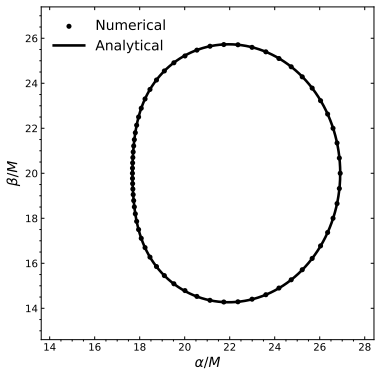
Summary. The paper analyzes geodesic motion and black-hole shadows in the Ma–Lü (ML) spindle-deformed Kerr black hole, a Ricci-flat rotating solution with an extra geometric parameter B. The central claims are that the Hamilton–Jacobi equation is not exactly separable for either timelike or null geodesics, that null (but not timelike) geodesics become separable at leading nontrivial order O(B²), that the deformation shifts the ISCO outward and can produce an OSCO, and that O(B²) analytic results for the photon region, equatorial photon orbits, and finite-distance shadow agree with full-metric ray tracing and yield a larger mean shadow radius than Kerr at fixed physical mass M and spin χ. Analytic expansions of the radial potential and of the separated null equations are given through O(B²), and numerical solutions of the unexpanded geodesic equations are used for validation and for finite-B features such as the OSCO.
Significance. This is a solid first study of strong-field geodesics and shadows for a new exact Ricci-flat rotating black hole. The selective restoration of null separability at O(B²), established by the mixed-derivative test and explicit X₁(r)+X₂(x) splitting, is a nontrivial structural result that cleanly distinguishes the ML geometry from both Kerr and its KBR seed. Closed-form O(B²) ISCO and photon-orbit corrections, together with side-by-side analytic versus full-metric numerics (Figs. 1–3), give falsifiable, reproducible predictions for how a spindle deformation deforms circular orbits and the shadow at fixed thermodynamic (M,χ). The work is of clear interest for the growing literature on non-asymptotically flat Kerr deformations and for strong-field phenomenology.
major comments (2)
- Sec. II, Eqs. (7)–(13) and the subsequent O(B²) expansions (14)–(15): all geodesic and shadow comparisons with Kerr are performed at fixed physical M and χ defined by the thermodynamic Killing-frame normalization. That choice is stated clearly and applied uniformly, but the reported O(B²) shifts of R_ISCO, R_photon, and the size deviation σ inherit it. A short robustness check—e.g., repeating the leading ISCO/photon-orbit corrections at fixed integration constants (m,a) or under an alternative asymptotic normalization if one can be motivated—would make the phenomenological claims less frame-dependent without changing the geometric separability results.
- Sec. III.B–C and Figs. 1, 3–4: the counterrotating branch has a substantially smaller perturbative window (visible deviations already near BM∼10^{-3} in Fig. 1) than the corotating branch. Shadow images and analytic boundaries are shown at BM=0.01 and χ=0.98. Although Fig. 3 shows good agreement for one near-extremal case, the manuscript should state more explicitly the residual O(B⁴) error budget for the counterrotating photon-orbit sector and for σ at the BM values used in Figs. 4–6, so that the domain of validity of the analytic shadow is quantified rather than only illustrated.
minor comments (5)
- Eqs. (25)–(26) and (56)–(57): the expanded X₁, X₂ and critical (ξ,η) expressions are very long. A short appendix collecting intermediate steps of the mixed-derivative check ∂²X/∂r∂x=0, or a machine-readable supplementary file, would help independent verification.
- Fig. 2: the critical BM values where ISCO and OSCO merge are given only in the figure labels. Stating them in the text (and, if possible, a brief scaling with χ) would make the OSCO discussion easier to cite.
- Sec. IV, Eq. (76) and Fig. 6: σ is a useful finite-distance size measure after centroid subtraction. A one-sentence remark on whether an asymptotic (ro→∞) shadow is well-defined in the non-asymptotically flat ML geometry would clarify the interpretation of the middle column of Fig. 6.
- Notation: the same symbol L is used for the metric function L(r,x) and for the conserved angular momentum; a brief local reminder when L appears in the radial potential (28) would reduce ambiguity.
- Typos/style: “Peoples Republic of China” → “People’s Republic of China”; a few long sentences in Sec. I and the abstract could be split for readability. References to the ML construction and KBR seed are appropriate and current.
Circularity Check
No significant circularity: geodesic and shadow results are derived from the fixed ML metric and cross-checked by full ray tracing; thermodynamic (M,χ) labeling is an explicit modeling convention, not a self-forcing prediction.
specific steps
-
self citation load bearing
[Sec. II, Eqs. (7)–(13) and surrounding text]
"Following Ref. [4], we fix this freedom by demanding that the conserved charges obey the first law of black-hole thermodynamics. This is implemented by the further linear transformation t' = λ_{1} t'', φ = φ'' + λ_{2} B t''. … With the thermodynamic normalization, the conserved mass and angular momentum are M = …, J = … We therefore characterize the geodesic and shadow observables in terms of the physical quantities M and J …"
Physical mass M and spin χ used for all Kerr comparisons are defined by a Killing-frame normalization taken from the authors’ prior thermodynamics paper [4]. That choice is load-bearing for the numerical size of the reported O(B^{2}) shifts, but it is an explicit modeling convention, not a derivation of separability or of the existence of OSCO/shadow deviations; the geometric claims remain independent of the particular labels.
full rationale
The paper takes the exact Ricci-flat ML metric of Ma & Lü as a fixed background, expands the Hamilton–Jacobi equation in BM, and tests separability by the mixed-derivative condition ∂^{2}X/∂r∂x = 0 (null sector at O(B^{2}) only). Timelike ISCO/OSCO radii follow from the equatorial radial potential V(r) = 0, V' = 0, V'' = 0; photon-region impact parameters and the analytic shadow boundary follow from the separated null potentials; both are independently validated by numerical integration of the unexpanded geodesic equations. Self-citations fix the metric and the thermodynamic frame that defines physical M and χ, but those citations do not force the separability statements, the existence of an OSCO, or the size of the shadow deviations. The (M,χ) matching is an explicit convention applied uniformly to both Kerr and ML, not a fit to shadow or orbit data. No prediction reduces by construction to a fitted input, and no uniqueness theorem is imported to forbid alternatives. Score 1 reflects only the minor, non-load-bearing dependence on the authors’ prior thermodynamic normalization for the Kerr-comparison labels.
Axiom & Free-Parameter Ledger
free parameters (3)
- B (spindle deformation)
- physical mass M and dimensionless spin χ
- observer radius ro and inclination θo
axioms (5)
- domain assumption Four-dimensional vacuum Einstein equations; Ricci-flat ML metric is an exact solution with parameters m,a,B.
- domain assumption Physical mass and angular momentum are those that satisfy the first law after linear redefinitions of t and φ (thermodynamic Killing-frame normalization).
- standard math Hamilton–Jacobi geodesic equation with conserved E,L from Killing vectors ∂t, ∂φ; circular orbits from V=V'=V''=0; critical photons from Ξ=Ξ'=0.
- ad hoc to paper Small-deformation expansion BM≪1 truncates analytic control at O(B²); higher orders reintroduce non-separability.
- domain assumption Locally nonrotating tetrad and central projection define the finite-distance shadow screen in a non-asymptotically flat geometry.
invented entities (2)
-
Spindle deformation parameter B as residual geometric (not electromagnetic) charge in the Ricci-flat ML metric
no independent evidence
-
Outermost stable circular orbit (OSCO) for the rotating ML black hole
no independent evidence
read the original abstract
Recently, a new exact Ricci-flat rotating black-hole solution was constructed in four-dimensional general relativity, in which an additional parameter $B$ characterizes a spindle deformation of the Kerr geometry. We study geodesic motion and black-hole shadows in this spacetime. The Hamilton-Jacobi equation is not exactly separable for either timelike or null geodesics. Remarkably, however, at the leading nontrivial order, ${\cal O}(B^2)$, null but not timelike geodesics become separable. In the timelike sector, the spindle deformation shifts the innermost stable circular orbit and can give rise to an outermost stable circular orbit. In the null sector, exploiting the perturbatively separated equations, we analytically determine the photon region, equatorial photon orbits, and black-hole shadow, and compare the resulting predictions with direct ray tracing in the exact spacetime. The numerical results validate the perturbative treatment and quantify the deviations from Kerr.
Figures




Reference graph
Works this paper leans on
-
[1]
Gravitational field of a spinning mass as an example of algebraically special metrics,
R. P. Kerr, “Gravitational field of a spinning mass as an example of algebraically special metrics,” Phys. Rev. Lett.11, 237-238 (1963)
1963
-
[2]
Exact solutions of Einstein’s field equations,
H. Stephani, D. Kramer, M. A. H. MacCallum, C. Hoenselaers and E. Herlt, “Exact solutions of Einstein’s field equations,” Cambridge Univ. Press, 2003, ISBN 978-0-521-46702-5, 978-0- 511-05917-9
2003
-
[3]
Exact Space-Times in Einstein’s General Relativity,
J. B. Griffiths and J. Podolsky, “Exact Space-Times in Einstein’s General Relativity,” Cam- bridge University Press, 2009, ISBN 978-1-139-48116-8
2009
-
[4]
Demagnetizing KBR and New Ricci-flat Rotating Metric,
L. Ma and H. Lu, “Demagnetizing KBR and New Ricci-flat Rotating Metric,” [arXiv:2605.13954 [gr-qc]]
-
[5]
Static hairy black hole in 4D general relativity,
M. Astorino, “Static hairy black hole in 4D general relativity,” Phys. Rev. D113, no.2, 024047 (2026) [arXiv:2601.16254 [gr-qc]]
arXiv 2026
-
[6]
Black holes in the external Bertotti-Robinson-Bonnor-Melvin electromagnetic field,
M. Astorino, “Black holes in the external Bertotti-Robinson-Bonnor-Melvin electromagnetic field,” Phys. Rev. D112, no.10, 104077 (2025) [arXiv:2508.12908 [gr-qc]]. 26
arXiv 2025
-
[7]
Black holes in a magnetic universe,
F. J. Ernst, “Black holes in a magnetic universe,” J. Math. Phys.17, no.1, 54-56 (1976)
1976
-
[8]
Kerr black holes in a magnetic universe,
F. J. Ernst and W. J. Wild, “Kerr black holes in a magnetic universe,” J. Math. Phys.17, no.2, 182 (1976)
1976
-
[9]
Ergoregions in Magnetised Black Hole Spacetimes,
G. W. Gibbons, A. H. Mujtaba and C. N. Pope, “Ergoregions in Magnetised Black Hole Spacetimes,” Class. Quant. Grav.30, no.12, 125008 (2013) [arXiv:1301.3927 [gr-qc]]
Pith/arXiv arXiv 2013
-
[10]
Kerr Black Hole in a Uniform Bertotti-Robinson Magnetic Field: An Exact Solution,
J. Podolsky and H. Ovcharenko, “Kerr Black Hole in a Uniform Bertotti-Robinson Magnetic Field: An Exact Solution,” Phys. Rev. Lett.135, no.18, 181401 (2025) [arXiv:2507.05199 [gr-qc]]
arXiv 2025
-
[11]
New class of rotating charged black holes with nonaligned electromagnetic field,
H. Ovcharenko and J. Podolsk´ y, “New class of rotating charged black holes with nonaligned electromagnetic field,” Phys. Rev. D112, no.6, 064076 (2025) [arXiv:2508.04850 [gr-qc]]
arXiv 2025
-
[12]
Thermodynamics of Kerr-Bertotti-Robinson black hole,
L. Hu, R. G. Cai and S. J. Wang, “Thermodynamics of Kerr-Bertotti-Robinson black hole,” [arXiv:2603.18821 [gr-qc]]
-
[13]
Vacuum, ma non troppo: hidden matter distribution in symmetry-transformed electrovacuum spacetimes,
C. A. R. Herdeiro and J. P. A. Novo, “Vacuum, ma non troppo: hidden matter distribution in symmetry-transformed electrovacuum spacetimes,” [arXiv:2605.18967 [gr-qc]]
-
[14]
L. Ma and H. Lu, “New Rotating Black Hole in Electromagnetic Fields: Cosmological Horizon without Cosmological Constant,” [arXiv:2606.23782 [gr-qc]]
-
[15]
H. Ovcharenko, “Comment on the ”New Rotating Black Hole in Electromagnetic Fields: Cosmological Horizon without Cosmological Constant”,” [arXiv:2606.30426 [gr-qc]]
-
[16]
Global Distinctions Between New Electrovacuum and Kundt Class,
L. Ma and H. Lu, “Global Distinctions Between New Electrovacuum and Kundt Class,” [arXiv:2607.02602 [gr-qc]]
-
[17]
Solar-System Bounds on Ricci-flat Spindle Deformations of Schwarzschild,
Z. X. Yu, H. D. Lyu and S. Li, “Solar-System Bounds on Ricci-flat Spindle Deformations of Schwarzschild,” [arXiv:2606.13325 [gr-qc]]
-
[18]
Foundations of Black Hole Accretion Disk Theory,
M. A. Abramowicz and P. C. Fragile, “Foundations of Black Hole Accretion Disk Theory,” Living Rev. Rel.16, 1 (2013) [arXiv:1104.5499 [astro-ph.HE]]
Pith/arXiv arXiv 2013
-
[19]
Calculating black hole shadows: Review of analytical studies,
V. Perlick and O. Y. Tsupko, “Calculating black hole shadows: Review of analytical studies,” Phys. Rept.947, 1-39 (2022) [arXiv:2105.07101 [gr-qc]]
Pith/arXiv arXiv 2022
-
[20]
Shadows and strong gravitational lensing: a brief review,
P. V. P. Cunha and C. A. R. Herdeiro, “Shadows and strong gravitational lensing: a brief review,” Gen. Rel. Grav.50, no.4, 42 (2018) [arXiv:1801.00860 [gr-qc]]
Pith/arXiv arXiv 2018
-
[21]
S. Chen, J. Jing, W. L. Qian and B. Wang, “Black hole images: A review,” Sci. China Phys. Mech. Astron.66, no.6, 260401 (2023) [arXiv:2301.00113 [astro-ph.HE]]
Pith/arXiv arXiv 2023
-
[22]
Chaotic shadows of black holes: a short review,
M. Wang, S. Chen and J. Jing, “Chaotic shadows of black holes: a short review,” Commun. 27 Theor. Phys.74, no.9, 097401 (2022) [arXiv:2205.05855 [gr-qc]]
Pith/arXiv arXiv 2022
-
[23]
First M87 Event Horizon Telescope Re- sults. I. The Shadow of the Supermassive Black Hole,
K. Akiyamaet al.[Event Horizon Telescope], “First M87 Event Horizon Telescope Re- sults. I. The Shadow of the Supermassive Black Hole,” Astrophys. J. Lett.875, L1 (2019) [arXiv:1906.11238 [astro-ph.GA]]
Pith/arXiv arXiv 2019
-
[24]
K. Akiyamaet al.[Event Horizon Telescope], “First Sagittarius A* Event Horizon Telescope Results. I. The Shadow of the Supermassive Black Hole in the Center of the Milky Way,” Astrophys. J. Lett.930, no.2, L12 (2022) [arXiv:2311.08680 [astro-ph.HE]]
Pith/arXiv arXiv 2022
-
[25]
Testing General Relativity with the Shadow Size of Sgr A*,
T. Johannsen, A. E. Broderick, P. M. Plewa, S. Chatzopoulos, S. S. Doeleman, F. Eisenhauer, V. L. Fish, R. Genzel, O. Gerhard and M. D. Johnson, “Testing General Relativity with the Shadow Size of Sgr A*,” Phys. Rev. Lett.116, no.3, 031101 (2016) [arXiv:1512.02640 [astro-ph.GA]]
Pith/arXiv arXiv 2016
-
[26]
The mathematical theory of black holes,
S. Chandrasekhar, “The mathematical theory of black holes,” (Oxford University Press, Ox- ford, 1983)
1983
-
[27]
Global structure of the Kerr family of gravitational fields,
B. Carter, “Global structure of the Kerr family of gravitational fields,” Phys. Rev.174, 1559- 1571 (1968)
1968
-
[28]
Geodesics and shadows in the Kerr- Bertotti-Robinson black hole spacetime,
X. Wang, Y. Hou, X. Wan, M. Guo and B. Chen, “Geodesics and shadows in the Kerr- Bertotti-Robinson black hole spacetime,” JCAP02, 050 (2026) [arXiv:2507.22494 [gr-qc]]
arXiv 2026
-
[29]
Optical characteristics of the Kerr–Bertotti–Robinson black hole,
X. X. Zeng, C. Y. Yang and H. Yu, “Optical characteristics of the Kerr–Bertotti–Robinson black hole,” Eur. Phys. J. C85, no.11, 1242 (2025) [arXiv:2508.03020 [gr-qc]]
Pith/arXiv arXiv 2025
-
[30]
T. Wang, “Innermost stable circular orbit of Kerr-Bertotti-Robinson black holes and inspirals from it: Exact solutions,” [arXiv:2508.04684 [gr-qc]]
-
[31]
Effects of magnetic fields on spinning test particles orbiting Kerr- Bertotti-Robinson black holes,
Y. K. Zhang and S. W. Wei, “Effects of magnetic fields on spinning test particles orbiting Kerr- Bertotti-Robinson black holes,” Phys. Rev. D113, no.10, 104024 (2026) [arXiv:2510.07914 [gr-qc]]
arXiv 2026
-
[32]
F. Gray, D. Kubiznak, H. Ovcharenko and J. Podolsky, “Hidden symmetries and separability structures of Ovcharenko-Podolsk´ y and conformal-to-Carter spacetimes,” Phys. Rev. D113, no.4, 044050 (2026) [arXiv:2511.21538 [gr-qc]]
arXiv 2026
-
[33]
Conserved quantities and integrability for massless spinning particles in general relativity,
L. Andersson, F. Gray and M. A. Oancea, “Conserved quantities and integrability for massless spinning particles in general relativity,” Phys. Rev. D113, no.6, 064061 (2026) [arXiv:2512.07677 [gr-qc]]
arXiv 2026
-
[34]
T. Xamidov, S. Shaymatov, Q. Wu and T. Zhu, “Gravitational wave signatures from periodic 28 orbits around a Schwarzschild-Bertotti-Robinson black hole,” [arXiv:2602.09453 [gr-qc]]
-
[35]
Critical Behavior of Photon Rings in Kerr-Bertotti-Robinson Spacetime,
X. Wan, Z. Zhang, F. S. Wei, Y. Hou and B. Chen, “Critical Behavior of Photon Rings in Kerr-Bertotti-Robinson Spacetime,” [arXiv:2603.25049 [gr-qc]]
-
[36]
W. Li, Y. Q. Lei and X. H. Ge, “Chaotic motion of particles around a Schwarzschild black hole in a swirling electromagnetic background,” [arXiv:2605.25094 [gr-qc]]
-
[37]
Revisiting black holes and their thermodynamics in Einstein-Kalb-Ramond gravity,
Z. X. Yu, H. D. Lyu, M. Huhe and S. Li, “Revisiting black holes and their thermodynamics in Einstein-Kalb-Ramond gravity,” Phys. Lett. B878, 140574 (2026) [arXiv:2511.19926 [gr-qc]]
Pith/arXiv arXiv 2026
-
[38]
Black holes and neutron stars in massive Hellings-Nordtvedt theory,
Z. Luo, L. Liang, Z. X. Yu, H. D. Lyu, S. Li and H. Yu, “Black holes and neutron stars in massive Hellings-Nordtvedt theory,” [arXiv:2605.14711 [gr-qc]]
-
[39]
Walker and R
M. Walker and R. Penrose, “On quadratic first integrals of the geodesic equations for type
-
[40]
spacetimes,” Commun. Math. Phys.18, 265-274 (1970)
1970
-
[41]
Bound Geodesics in the Kerr Metric,
D. C. Wilkins, “Bound Geodesics in the Kerr Metric,” Phys. Rev. D5, 814-822 (1972)
1972
-
[42]
Rotating black holes: Locally nonrotating frames, energy extraction, and scalar synchrotron radiation,
J. M. Bardeen, W. H. Press and S. A. Teukolsky, “Rotating black holes: Locally nonrotating frames, energy extraction, and scalar synchrotron radiation,” Astrophys. J.178, 347 (1972)
1972
-
[43]
Spherical Photon Orbits Around a Kerr Black Hole,
E. Teo, “Spherical Photon Orbits Around a Kerr Black Hole,” Gen. Rel. Grav.35, no.11, 1909-1926 (2003)
1909
-
[44]
Null geodesics of the Kerr exterior,
S. E. Gralla and A. Lupsasca, “Null geodesics of the Kerr exterior,” Phys. Rev. D101, no.4, 044032 (2020) [arXiv:1910.12881 [gr-qc]]
Pith/arXiv arXiv 2020
-
[45]
Timelike and null geodesics in the Kerr metric,
J. M. Bardeen, “Timelike and null geodesics in the Kerr metric,” Proceedings, Ecole d’Et´ e de Physique Th´ eorique: Les Astres Occlus : Les Houches, France, August, 1972, 215-240, 215-240 (1973)
1972
-
[46]
Photon Rings around Kerr and Kerr-like Black Holes,
T. Johannsen, “Photon Rings around Kerr and Kerr-like Black Holes,” Astrophys. J.777, 170 (2013) [arXiv:1501.02814 [astro-ph.HE]]
Pith/arXiv arXiv 2013
-
[47]
Classification of radial Kerr geodesic motion,
G. Comp` ere, Y. Liu and J. Long, “Classification of radial Kerr geodesic motion,” Phys. Rev. D105, no.2, 024075 (2022) [arXiv:2106.03141 [gr-qc]]
Pith/arXiv arXiv 2022
-
[48]
Analytical solutions of equatorial geodesic motion in Kerr spacetime*,
Y. Liu and B. Sun, “Analytical solutions of equatorial geodesic motion in Kerr spacetime*,” Chin. Phys. C48, no.4, 045107 (2024) [arXiv:2305.11045 [gr-qc]]
Pith/arXiv arXiv 2024
-
[49]
Kerr geodesics in terms of Weierstrass elliptic func- tions,
A. Cie´ slik, E. Hackmann and P. Mach, “Kerr geodesics in terms of Weierstrass elliptic func- tions,” Phys. Rev. D108, no.2, 024056 (2023) [arXiv:2305.07771 [gr-qc]]
Pith/arXiv arXiv 2023
-
[50]
Image of a Kerr-Melvin black hole with a thin accretion disk,
Y. Hou, Z. Zhang, H. Yan, M. Guo and B. Chen, “Image of a Kerr-Melvin black hole with a thin accretion disk,” Phys. Rev. D106, no.6, 064058 (2022) [arXiv:2206.13744 [gr-qc]]. 29
Pith/arXiv arXiv 2022
-
[51]
Innermost and outermost stable circular orbits in the presence of a positive cosmological constant,
P. Boonserm, T. Ngampitipan, A. Simpson and M. Visser, “Innermost and outermost stable circular orbits in the presence of a positive cosmological constant,” Phys. Rev. D101, no.2, 024050 (2020) [arXiv:1909.06755 [gr-qc]]
arXiv 2020
-
[52]
Perturbative approach to an orbital evolution around a supermassive black hole,
Y. Mino, “Perturbative approach to an orbital evolution around a supermassive black hole,” Phys. Rev. D67, 084027 (2003) [arXiv:gr-qc/0302075 [gr-qc]]
Pith/arXiv arXiv 2003
-
[53]
Fractal basins and chaotic trajectories in multi - black hole space-times,
C. P. Dettmann, N. E. Frankel and N. J. Cornish, “Fractal basins and chaotic trajectories in multi - black hole space-times,” Phys. Rev. D50, R618-R621 (1994) [arXiv:gr-qc/9402027 [gr-qc]]
Pith/arXiv arXiv 1994
-
[54]
Chaos around a black hole,
L. Bombelli and E. Calzetta, “Chaos around a black hole,” Class. Quant. Grav.9, 2573-2599 (1992)
1992
-
[55]
Chaos in static axisymmetric space-times. 1: Vacuum case,
Y. Sota, S. Suzuki and K. i. Maeda, “Chaos in static axisymmetric space-times. 1: Vacuum case,” Class. Quant. Grav.13, 1241-1260 (1996) [arXiv:gr-qc/9505036 [gr-qc]]
Pith/arXiv arXiv 1996
-
[56]
Chaotic motion of particles in the accelerating and rotating black holes spacetime,
S. Chen, M. Wang and J. Jing, “Chaotic motion of particles in the accelerating and rotating black holes spacetime,” JHEP09, 082 (2016) [arXiv:1604.02785 [gr-qc]]
Pith/arXiv arXiv 2016
-
[57]
M. Wang, S. Chen and J. Jing, “Chaos in the motion of a test scalar particle coupling to the Einstein tensor in Schwarzschild–Melvin black hole spacetime,” Eur. Phys. J. C77, no.4, 208 (2017) [arXiv:1605.09506 [gr-qc]]
Pith/arXiv arXiv 2017
-
[58]
Shadows of Bonnor black dihole by chaotic lensing,
M. Wang, S. Chen and J. Jing, “Shadows of Bonnor black dihole by chaotic lensing,” Phys. Rev. D97, no.6, 064029 (2018) [arXiv:1710.07172 [gr-qc]]
Pith/arXiv arXiv 2018
-
[59]
Chaotic shadow of a non-Kerr rotating compact object with quadrupole mass moment,
M. Wang, S. Chen and J. Jing, “Chaotic shadow of a non-Kerr rotating compact object with quadrupole mass moment,” Phys. Rev. D98, no.10, 104040 (2018) [arXiv:1801.02118 [gr-qc]]. 30
Pith/arXiv arXiv 2018
discussion (0)
Sign in with ORCID, Apple, or X to comment. Anyone can read and Pith papers without signing in.