REVIEW 3 major objections 5 minor 54 references
LLM-guided PDE discovery works when noise-robust derivatives and residual filters give the language model a clean fitness signal.
Reviewed by Pith at T0; open to challenge. T0 means a machine referee read the full paper against a public rubric. the ladder, T0–T4 →
T0 review · grok-4.5
2026-07-14 10:54 UTC pith:NYWCVHTS
load-bearing objection Solid integration of LLM skeletons with spline/SWR evaluation that beats the usual baselines on noise and anti-memorization PDEs; “structural recovery” sometimes means a good effective surrogate, and the paper is mostly honest about that. the 3 major comments →
LLM-PDESR: Robust PDE Discovery via Subdomain Weighted Residuals and LLM-Guided Symbolic Hypothesis Generation
The pith
A machine-rendered reading of the paper's core claim, the machinery that carries it, and where it could break.
Core claim
The central claim is that LLM-PDESR—an end-to-end loop that lets a language model propose executable equation skeletons while evaluating them with quintic-spline differentiation and subdomain weighted residuals, then selecting via a Pareto accuracy-complexity front—recovers true governing PDE structures from noisy data more reliably than existing methods and yields a transferable 1D atmospheric surrogate directly from reanalysis observations.
What carries the argument
Subdomain weighted residual (SWR) evaluation on C4 quintic B-splines: the residual of a candidate PDE is integrated against compact smooth test functions over local windows, producing a low-pass-filtered loss whose BFGS optimization supplies the LLM with non-deceptive fitness scores and a Pareto front that prunes bloat.
Load-bearing premise
That the spline-plus-SWR fitness landscape is faithful enough for the language-model proposals to match the true governing operators rather than merely effective residual-minimizing surrogates, especially for nested high-order terms and the multi-parameter atmospheric skeleton.
What would settle it
On the Forced Quintic Swift-Hohenberg or Traffic-Flow novel systems, or under 20 percent noise on the high-order benchmark suite, show that the recovered skeleton either systematically omits essential nonlinear or nested terms while still achieving low SWR loss, or fails to transfer when the structural skeleton is frozen and only coefficients are re-optimized on a held-out spatiotemporal domain.
If this is right
- Noise-robust continuous evaluation lets language-model search scale to free-form PDEs without hand-crafted dictionaries.
- Pareto feedback systematically suppresses equation bloat that plagues genetic and neural symbolic regression.
- The same skeleton can be re-parameterized for new geographic or seasonal regimes once the structure is frozen.
- Novel out-of-distribution equations become a practical test that distinguishes genuine discovery from corpus memorization.
Where Pith is reading between the lines
- If the SWR low-pass property is the dominant reason for success, the same evaluation core could be swapped under non-LLM generators such as genetic programming or reinforcement-learning controllers.
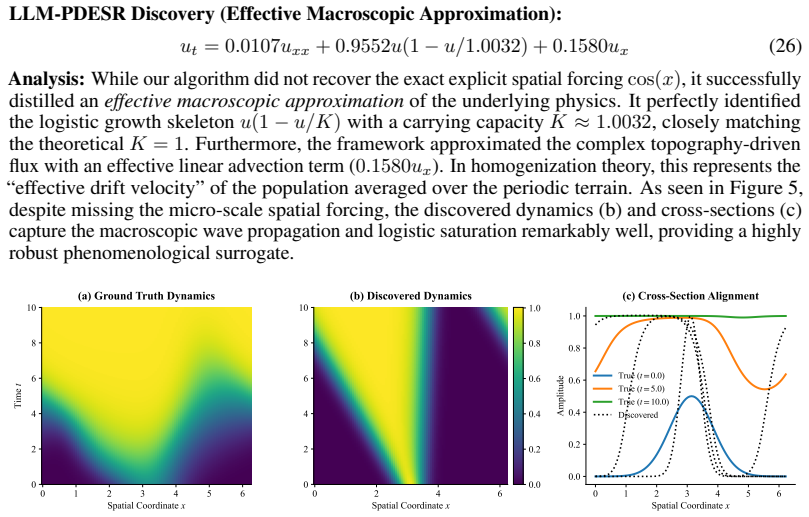
- The partial recoveries on topography-constrained chemotaxis and forced Swift-Hohenberg suggest the method may systematically prefer effective homogenized operators over exact micro-scale forcings.
- Extending the quintic-spline/SWR pipeline to unstructured 2-D/3-D grids would be the natural next stress test for real multi-physics discovery.
Editorial analysis
A structured set of objections, weighed in public.
Referee Report
Summary. The manuscript proposes LLM-PDESR, a closed-loop PDE discovery framework that couples LLM-generated symbolic skeletons with a noise-robust numerical evaluator: C^4 quintic B-spline spatial derivatives, subdomain weighted residual (SWR) fitness as a low-pass filter, BFGS coefficient identification, and a Pareto front with a 10 imes MSE_min parsimony gate for feedback and final selection. It reports near-perfect structural recovery on 23 canonical 1D PDEs under 0–20% additive noise, exact or partial recovery on five synthetically designed novel systems (including a coupled predator–prey PDE), and extraction of a 14-parameter 1D coupled atmospheric circulation skeleton (1D-CACE) from ERA5 winds with spatiotemporal OOD coefficient re-optimization. Ablations isolate spline, SWR, and Pareto contributions; Appendix B supplies error bounds and variance-reduction arguments for the evaluator.
Significance. If the claims hold, the work is a meaningful advance for scientific machine learning: it pairs free-form LLM hypothesis generation with a mathematically motivated continuous evaluator that addresses the well-known finite-difference noise amplification problem, and it supplies both a memorization-resistant novel-PDE suite and a real reanalysis case study. Strengths include multi-baseline comparisons (Fig. 2, Table 1), component ablations (Fig. 4), transparent failure on the traffic-shock system (App. E.5), algebraic-equivalence discussion for Michaelis–Menten recovery, and theoretical support for spline/SWR error and variance reduction (App. B). These elements make the contribution more than an LLM wrapper and of clear interest to the PDE-discovery and SciML communities.
major comments (3)
- [§4.3, Table 1, App. E.2–E.4] §4.3, Table 1, and App. E.2/E.4: The central claim of “true discovery” / “structural recovery” on the five novel PDEs is only partially secured by the SWR+Pareto landscape. Topography-Constrained Chemotaxis recovers an effective logistic + linear advection surrogate that entirely misses the nested (u(1−u)cos(x))_x term; Forced Quintic Swift–Hohenberg recovers u_xxxx but replaces −u³+u⁵ and the multiplicative Gaussian pump by a free cubic plus additive Gaussian. Both partial skeletons achieve low SWR-MSE and pass the 10×MSE_min gate, yet are not the true operators. The paper labels these “≈” and discusses them in the appendix, but the abstract and §1 still frame the suite as validating genuine symbolic discovery. Please either (i) tighten claims to distinguish exact skeleton recovery from low-MSE phenomenological surrogates, or (ii) add controlled experiments showing when/whether the true
- [§4.4, Eq. (5), Table 2] §4.4, Eq. (5), Table 2: OOD validation of 1D-CACE freezes the 14-term skeleton and re-optimizes all coefficients θ1…θ14 in each regime (R² ≈ 58–76%). The paper itself interprets xv/xu as first-order spatial closures rather than fundamental physics. Without controls—e.g., random or dictionary-generated multi-term skeletons of comparable complexity re-fit the same way, or coefficient transfer with only a subset free—it is hard to separate “invariant dynamical mechanisms” from flexibility of a rich ansatz. A short control table or null-model comparison is needed to support the OOD generalization claim as stated.
- [Algorithm 1, §3.3] Algorithm 1 (lines 12–13) and §3.3: Final selection uses the fixed heuristic MSE(F) ≤ 10 × MSE_min then min complexity. This gate is load-bearing for “avoidance of equation bloat,” yet no sensitivity to the factor 10 (or alternatives such as knee-point / AIC-style criteria) is reported. Given that partial novel recoveries and the 14-parameter 1D-CACE both survive this gate, a brief sensitivity or alternative-selection analysis would strengthen the claim that the recovered skeletons are preferred for structural reasons rather than gate choice.
minor comments (5)
- [Figure 2] Fig. 2 axis labels and some appendix figures appear as Unicode glyph dumps in the preprint PDF; ensure vector fonts render correctly in the camera-ready version.
- [Appendix D] Appendix D: DeepSeek-V3 is accessed via a closed API with a temperature schedule “every 30,000 tokens.” For reproducibility, state model snapshot/date if available, and report variance over multiple independent runs (seeds) on at least the novel suite.
- [§3.2, Algorithm 2] K = 10 subdomains and ω = 2 L_domain/K are fixed throughout; a one-paragraph sensitivity note (or reference to App. B scaling) would help readers port the method.
- [§2.2] Related work: briefly position against concurrent LLM-SR / LLM-guided discovery lines (e.g., LLM-SR, FunSearch-style program search) beyond EqGPT, so the Pareto-feedback + continuous evaluator distinction is sharper.
- [§3, Eq. (1)] Eq. (1) and multivariate prompts: notation for D > 1 is introduced early but most of the numerical pipeline is written for scalar u; a short remark that SWR is applied componentwise (or jointly) would clarify the predator–prey and 1D-CACE cases.
Circularity Check
No significant circularity: structural recovery is scored against independent synthetic ground truth and external ERA5 fields; OOD transfer freezes the discovered skeleton and only re-optimizes coefficients.
full rationale
LLM-PDESR is an empirical discovery pipeline, not a first-principles derivation that could collapse into its inputs. Candidate skeletons are proposed by an LLM, then scored by an independent numerical evaluator (C4 quintic B-splines + subdomain weighted residuals + BFGS; Eqs. 2–4, Alg. 2, App. B). Success is defined by exact or partial match to held-out ground-truth operators on 23 canonical and five author-constructed novel PDEs (Table 1, App. E), plus OOD R² after freezing structure and re-fitting only numeric coefficients on ERA5 (Table 2, Eq. 5). The 10×MSE_min Pareto gate (Alg. 1) is a selection heuristic, not a definition of the target operator. Partial recoveries (Topography Chemotaxis effective advection; Forced Swift-Hohenberg missing quintic) are reported as partial and analyzed as phenomenological surrogates, not re-labeled as exact recovery. Appendix B error bounds are classical approximation/spectral arguments, not self-citations of uniqueness theorems. No load-bearing step reduces a claimed prediction to a fitted input or to an author-only uniqueness claim by construction. LLM pretraining exposure to canonical PDEs is a contamination risk mitigated by the novel suite, not circularity of the derivation chain.
Axiom & Free-Parameter Ledger
free parameters (7)
- Number of SWR subdomains K
- SWR window width ω = 2 L_domain/K
- Parsimony gate: MSE ≤ 10 × MSE_min
- LLM sampling temperature schedule and population size (4 candidates/iteration, top-3 feedback)
- BFGS initialization θ0 = 1 and 30s evaluation timeout
- 1D-CACE coefficients θ1…θ14
- Noise model γ ∈ {0.05,0.10,0.20} and additive Gaussian corruption
axioms (5)
- standard math Quintic B-spline smoothing of noisy spatial fields yields derivative error bounds superior in practice to finite differences for n≤4 (Theorem 1 / App. B.1).
- standard math Integrating residuals against compact sin^4 test functions attenuates white-noise variance by ~O(1/N_ω) relative to pointwise MSE (Theorem 2).
- domain assumption Occam’s razor via AST-node complexity on a Pareto front yields the true physical skeleton when MSE is within one order of magnitude of the best fit.
- domain assumption LLM pretraining plus constrained prompts can propose physically plausible free-form PDE skeletons without requiring a fixed dictionary.
- ad hoc to paper Freezing a multi-term 1D skeleton and re-fitting coefficients across regions tests invariant dynamics rather than mere flexibility of the ansatz.
invented entities (2)
-
1D-CACE structural skeleton (coupled ut, vt with 14 parametric terms including xv, xu closures)
no independent evidence
-
Five structurally novel benchmark PDEs (topography chemotaxis, Michaelis–Menten morphogenesis, forced quintic Swift–Hohenberg, traffic bottleneck, cross-chemotactic predator–prey)
no independent evidence
read the original abstract
Discovering governing partial differential equations (PDEs) from noisy observational data is a fundamental challenge in scientific machine learning. Traditional symbolic regression (SR) methods often struggle to identify accurate equations within vast combinatorial search spaces, largely due to their inability to incorporate essential domain-specific prior knowledge. Furthermore, reliance on pointwise evaluations and discrete finite differences inherently amplifies high-frequency noise, creating deceptive fitness landscapes that derail the optimization process. To resolve these bottlenecks, we propose LLM-PDESR, a framework that integrates the structural hypothesis generation of Large Language Models (LLMs) with a mathematically rigorous evaluation environment. By employing C^4-continuous quintic splines for robust differentiation and subdomain weighted residuals as natural low-pass filters, our approach effectively mitigates the fitness landscape distortion that plagues existing methods. A Pareto-driven feedback loop then enables the LLM to iteratively refine candidate equations, balancing predictive accuracy with structural parsimony. We evaluate LLM-PDESR on 23 canonical PDEs and five structurally novel equations (including a multivariate system) specifically designed to preclude dataset memorization and test true discovery capabilities. Demonstrating real-world applicability, the framework successfully extracts a consistent structural skeleton for an interpretable 1D dynamical surrogate (1D-CACE) directly from noisy ERA5 reanalysis data. Extensive experiments and out-of-distribution testing confirm that LLM-PDESR significantly outperforms state-of-the-art methodologies in structural recovery, noise resilience, and the avoidance of spurious complexity and equation bloat.
Figures




Reference graph
Works this paper leans on
-
[1]
Data-driven discovery of partial differential equations.Science advances, 3(4):e1602614, 2017
Samuel H Rudy, Steven L Brunton, Joshua L Proctor, and J Nathan Kutz. Data-driven discovery of partial differential equations.Science advances, 3(4):e1602614, 2017
2017
-
[2]
Pde-net: Learning pdes from data
Zichao Long, Yiping Lu, Xianzhong Ma, and Bin Dong. Pde-net: Learning pdes from data. InInternational conference on machine learning, pages 3208–3216. PMLR, 2018
2018
-
[3]
Maziar Raissi, Paris Perdikaris, and George E Karniadakis. Physics-informed neural networks: A deep learning framework for solving forward and inverse problems involving nonlinear partial differential equations.Journal of Computational physics, 378:686–707, 2019
2019
-
[4]
Deepmod: Deep learning for model discovery in noisy data.Journal of Computational Physics, 428:109985, 2021
Gert-Jan Both, Subham Choudhury, Pierre Sens, and Remy Kusters. Deepmod: Deep learning for model discovery in noisy data.Journal of Computational Physics, 428:109985, 2021
2021
-
[5]
Physics-informed machine learning.Nature Reviews Physics, 3(6):422–440, 2021
George Em Karniadakis, Ioannis G Kevrekidis, Lu Lu, Paris Perdikaris, Sifan Wang, and Liu Yang. Physics-informed machine learning.Nature Reviews Physics, 3(6):422–440, 2021
2021
-
[6]
Recent advances in symbolic regression.ACM Computing Surveys, 57 (11):1–37, 2025
Junlan Dong and Jinghui Zhong. Recent advances in symbolic regression.ACM Computing Surveys, 57 (11):1–37, 2025
2025
-
[7]
Transformer-based planning for symbolic regression.Advances in Neural Information Processing Systems, 36:45907–45919, 2023
Parshin Shojaee, Kazem Meidani, Amir Barati Farimani, and Chandan Reddy. Transformer-based planning for symbolic regression.Advances in Neural Information Processing Systems, 36:45907–45919, 2023
2023
-
[8]
Graph-based symbolic regression with invariance and constraint encoding
Ziyu Xiang, Kenna Ashen, Xiaofeng Qian, and Xiaoning Qian. Graph-based symbolic regression with invariance and constraint encoding. InThe Thirty-ninth Annual Conference on Neural Information Processing Systems, 2025
2025
-
[9]
Discovering governing equations from data by sparse identification of nonlinear dynamical systems.Proceedings of the national academy of sciences, 113(15):3932–3937, 2016
Steven L Brunton, Joshua L Proctor, and J Nathan Kutz. Discovering governing equations from data by sparse identification of nonlinear dynamical systems.Proceedings of the national academy of sciences, 113(15):3932–3937, 2016
2016
-
[10]
Sparse regression for large data sets with outliers
Lea Bottmer, Christophe Croux, and Ines Wilms. Sparse regression for large data sets with outliers. European Journal of Operational Research, 297(2):782–794, 2022
2022
-
[11]
Multifactorial genetic programming for symbolic regression problems.IEEE transactions on systems, man, and cybernetics: systems, 50(11): 4492–4505, 2018
Jinghui Zhong, Liang Feng, Wentong Cai, and Yew-Soon Ong. Multifactorial genetic programming for symbolic regression problems.IEEE transactions on systems, man, and cybernetics: systems, 50(11): 4492–4505, 2018
2018
-
[12]
Deep recognition of partial differential equations based on reinforcement learning and genetic algorithm.The Journal of Supercomputing, 81(5): 740, 2025
Jinyang Du, Renyun Liu, Du Cheng, Qingliang Li, and Fanhua Yu. Deep recognition of partial differential equations based on reinforcement learning and genetic algorithm.The Journal of Supercomputing, 81(5): 740, 2025
2025
-
[13]
Explainable artificial intelligence by genetic programming: A survey.IEEE Transactions on Evolutionary Computation, 27(3):621–641, 2022
Yi Mei, Qi Chen, Andrew Lensen, Bing Xue, and Mengjie Zhang. Explainable artificial intelligence by genetic programming: A survey.IEEE Transactions on Evolutionary Computation, 27(3):621–641, 2022. 10
2022
-
[14]
Interpretable scientific discovery with symbolic regression: a review
Nour Makke and Sanjay Chawla. Interpretable scientific discovery with symbolic regression: a review. Artificial Intelligence Review, 57(1):2, 2024
2024
-
[15]
Mathematical discoveries from program search with large language models.Nature, 625(7995):468–475, 2024
Bernardino Romera-Paredes, Mohammadamin Barekatain, Alexander Novikov, Matej Balog, M Pawan Kumar, Emilien Dupont, Francisco JR Ruiz, Jordan S Ellenberg, Pengming Wang, Omar Fawzi, et al. Mathematical discoveries from program search with large language models.Nature, 625(7995):468–475, 2024
2024
-
[16]
Rl-gpt: Integrating reinforcement learning and code-as-policy.Advances in Neural Information Processing Systems, 37:28430–28459, 2024
Shaoteng Liu, Haoqi Yuan, Minda Hu, Yanwei Li, Yukang Chen, Shu Liu, Zongqing Lu, and Jiaya Jia. Rl-gpt: Integrating reinforcement learning and code-as-policy.Advances in Neural Information Processing Systems, 37:28430–28459, 2024
2024
-
[17]
Scientific discovery in the age of artificial intelligence.Nature, 620(7972):47–60, 2023
Hanchen Wang, Tianfan Fu, Yuanqi Du, Wenhao Gao, Kexin Huang, Ziming Liu, Payal Chandak, Shengchao Liu, Peter Van Katwyk, Andreea Deac, et al. Scientific discovery in the age of artificial intelligence.Nature, 620(7972):47–60, 2023
2023
-
[18]
Microsoft Research AI4Science and Microsoft Azure Quantum. The impact of large language models on scientific discovery: a preliminary study using gpt-4.arXiv preprint arXiv:2311.07361, 2023
Pith/arXiv arXiv 2023
-
[19]
Scimon: Scientific inspiration machines optimized for novelty
Qingyun Wang, Doug Downey, Heng Ji, and Tom Hope. Scimon: Scientific inspiration machines optimized for novelty. InProceedings of the 62nd Annual Meeting of the Association for Computational Linguistics (Volume 1: Long Papers), pages 279–299, 2024
2024
-
[20]
Parshin Shojaee, Kazem Meidani, Shashank Gupta, Amir Barati Farimani, and Chandan K Reddy. Llm-sr: Scientific equation discovery via programming with large language models.arXiv preprint arXiv:2404.18400, 2024
Pith/arXiv arXiv 2024
-
[21]
Finite-difference time-domain methods.Nature Reviews Methods Primers, 3(1):75, 2023
FL Teixeira, C Sarris, Y Zhang, D-Y Na, J-P Berenger, Y Su, M Okoniewski, WC Chew, V Backman, and Jamesina J Simpson. Finite-difference time-domain methods.Nature Reviews Methods Primers, 3(1):75, 2023
2023
-
[22]
Finite difference methods for differential equations.Draft version for use in AMath, 585(6):112, 1998
Randall J LeVeque. Finite difference methods for differential equations.Draft version for use in AMath, 585(6):112, 1998
1998
-
[23]
On the use of nonstandard finite difference methods.Journal of Difference Equations and Applications, 11(8):735–758, 2005
Kailash C Patidar. On the use of nonstandard finite difference methods.Journal of Difference Equations and Applications, 11(8):735–758, 2005
2005
-
[24]
Survey on algebraic numerical differentiation: historical developments, parametrization, examples, and applications.International Journal of Systems Science, 53(9):1848–1887, 2022
Amine Othmane, Lothar Kiltz, and Joachim Rudolph. Survey on algebraic numerical differentiation: historical developments, parametrization, examples, and applications.International Journal of Systems Science, 53(9):1848–1887, 2022
2022
-
[25]
Kadierdan Kaheman, Steven L Brunton, and J Nathan Kutz. Automatic differentiation to simultaneously identify nonlinear dynamics and extract noise probability distributions from data.Machine Learning: Science and Technology, 3(1):015031, 2022
2022
-
[26]
Mohammad Prawesh Alam, Arshad Khan, and Pradip Roul. High-resolution numerical method for the time-fractional fourth-order diffusion problems via improved quintic b-spline function.Journal of Applied Mathematics and Computing, 71(1):133–171, 2025
2025
-
[27]
Quintic spline interpolation with minimal feed fluctuation.J
Kaan Erkorkmaz and Yusuf Altintas. Quintic spline interpolation with minimal feed fluctuation.J. Manuf. Sci. Eng., 127(2):339–349, 2005
2005
-
[28]
Asymptotic consistency of the wsindy algorithm in the limit of continuum data.IMA Journal of Numerical Analysis, 45(6):3264–3312, 2025
Daniel A Messenger and David M Bortz. Asymptotic consistency of the wsindy algorithm in the limit of continuum data.IMA Journal of Numerical Analysis, 45(6):3264–3312, 2025
2025
-
[29]
A pareto front grid guided multi-objective evolutionary algorithm.Applied Soft Computing, 136:110095, 2023
Ying Xu, Huan Zhang, Lei Huang, Rong Qu, and Yusuke Nojima. A pareto front grid guided multi-objective evolutionary algorithm.Applied Soft Computing, 136:110095, 2023
2023
-
[30]
Pareto set learning for multi-objective reinforcement learning
Erlong Liu, Yu-Chang Wu, Xiaobin Huang, Chengrui Gao, Ren-Jian Wang, Ke Xue, and Chao Qian. Pareto set learning for multi-objective reinforcement learning. InProceedings of the AAAI Conference on Artificial Intelligence, volume 39, pages 18789–18797, 2025
2025
-
[31]
The era5 global reanalysis.Quarterly journal of the royal meteorological society, 146(730):1999–2049, 2020
Hans Hersbach, Bill Bell, Paul Berrisford, Shoji Hirahara, András Horányi, Joaquín Muñoz-Sabater, Julien Nicolas, Carole Peubey, Raluca Radu, Dinand Schepers, et al. The era5 global reanalysis.Quarterly journal of the royal meteorological society, 146(730):1999–2049, 2020
1999
-
[32]
Symbolic genetic algorithm for discovering open-form partial differential equations (sga-pde).Physical Review Research, 4(2):023174, 2022
Yuntian Chen, Yingtao Luo, Qiang Liu, Hao Xu, and Dongxiao Zhang. Symbolic genetic algorithm for discovering open-form partial differential equations (sga-pde).Physical Review Research, 4(2):023174, 2022. 11
2022
-
[33]
Discover: Deep identification of symbolically concise open-form partial differential equations via enhanced reinforcement learning.Physical Review Research, 6 (1):013182, 2024
Mengge Du, Yuntian Chen, and Dongxiao Zhang. Discover: Deep identification of symbolically concise open-form partial differential equations via enhanced reinforcement learning.Physical Review Research, 6 (1):013182, 2024
2024
-
[34]
Weak sindy for partial differential equations.Journal of Computational Physics, 443:110525, 2021
Daniel A Messenger and David M Bortz. Weak sindy for partial differential equations.Journal of Computational Physics, 443:110525, 2021
2021
-
[35]
Generative discovery of partial differential equations by learning from math handbooks.Nature Communications, 16(1):10255, 2025
Hao Xu, Yuntian Chen, Rui Cao, Tianning Tang, Mengge Du, Jian Li, Adrian H Callaghan, and Dongxiao Zhang. Generative discovery of partial differential equations by learning from math handbooks.Nature Communications, 16(1):10255, 2025
2025
-
[36]
Zongyi Li, Nikola Kovachki, Kamyar Azizzadenesheli, Burigede Liu, Kaushik Bhattacharya, Andrew Stuart, and Anima Anandkumar. Fourier neural operator for parametric partial differential equations.arXiv preprint arXiv:2010.08895, 2020
Pith/arXiv arXiv 2010
-
[37]
Learning nonlinear operators via deeponet based on the universal approximation theorem of operators.Nature machine intelligence, 3(3):218–229, 2021
Lu Lu, Pengzhan Jin, Guofei Pang, Zhongqiang Zhang, and George Em Karniadakis. Learning nonlinear operators via deeponet based on the universal approximation theorem of operators.Nature machine intelligence, 3(3):218–229, 2021
2021
-
[38]
Distilling free-form natural laws from experimental data.science, 324 (5923):81–85, 2009
Michael Schmidt and Hod Lipson. Distilling free-form natural laws from experimental data.science, 324 (5923):81–85, 2009
2009
-
[39]
Interpretable machine learning for science with pysr and symbolicregression
Miles Cranmer. Interpretable machine learning for science with pysr and symbolicregression. jl.arXiv preprint arXiv:2305.01582, 2023
Pith/arXiv arXiv 2023
-
[40]
Partial differential equations discovery with epde framework: Application for real and synthetic data.Journal of Computational Science, 53: 101345, 2021
Mikhail Maslyaev, Alexander Hvatov, and Anna V Kalyuzhnaya. Partial differential equations discovery with epde framework: Application for real and synthetic data.Journal of Computational Science, 53: 101345, 2021
2021
-
[41]
Brenden K Petersen, Mikel Landajuela, T Nathan Mundhenk, Claudio P Santiago, Soo K Kim, and Joanne T Kim. Deep symbolic regression: Recovering mathematical expressions from data via risk-seeking policy gradients.arXiv preprint arXiv:1912.04871, 2019
Pith/arXiv arXiv 1912
-
[42]
Morl4pdes: Data-driven discovery of pdes based on multi-objective optimization and reinforcement learning.Chaos, Solitons & Fractals, 180: 114536, 2024
Xiaoxia Zhang, Junsheng Guan, Yanjun Liu, and Guoyin Wang. Morl4pdes: Data-driven discovery of pdes based on multi-objective optimization and reinforcement learning.Chaos, Solitons & Fractals, 180: 114536, 2024
2024
-
[43]
The coefficient of determination r-squared is more informative than smape, mae, mape, mse and rmse in regression analysis evaluation.Peerj computer science, 7:e623, 2021
Davide Chicco, Matthijs J Warrens, and Giuseppe Jurman. The coefficient of determination r-squared is more informative than smape, mae, mape, mse and rmse in regression analysis evaluation.Peerj computer science, 7:e623, 2021
2021
-
[44]
Hybrid cnn-transformer network with a weighted mse loss for global sea surface wind speed retrieval from gnss-r data.IEEE Transactions on Geoscience and Remote Sensing, 2025
Xin Qiao, Qingyun Yan, and Weimin Huang. Hybrid cnn-transformer network with a weighted mse loss for global sea surface wind speed retrieval from gnss-r data.IEEE Transactions on Geoscience and Remote Sensing, 2025
2025
-
[45]
SIAM, 2007
Randall J LeVeque.Finite difference methods for ordinary and partial differential equations: steady-state and time-dependent problems. SIAM, 2007
2007
-
[46]
Springer, 2006
Jorge Nocedal and Stephen J Wright.Numerical optimization. Springer, 2006
2006
-
[47]
A structured l-bfgs method and its application to inverse problems.Inverse Problems, 40(4):045022, 2024
Florian Mannel, Hari Om Aggrawal, and Jan Modersitzki. A structured l-bfgs method and its application to inverse problems.Inverse Problems, 40(4):045022, 2024
2024
-
[48]
Era5- land: A state-of-the-art global reanalysis dataset for land applications.Earth system science data, 13(9): 4349–4383, 2021
Joaquín Muñoz-Sabater, Emanuel Dutra, Anna Agustí-Panareda, Clément Albergel, Gabriele Arduini, Gianpaolo Balsamo, Souhail Boussetta, Margarita Choulga, Shaun Harrigan, Hans Hersbach, et al. Era5- land: A state-of-the-art global reanalysis dataset for land applications.Earth system science data, 13(9): 4349–4383, 2021
2021
-
[49]
An evaluation of era5 precipitation for climate monitoring.Quarterly Journal of the Royal Meteorological Society, 148(748):3152–3165, 2022
David A Lavers, Adrian Simmons, Freja Vamborg, and Mark J Rodwell. An evaluation of era5 precipitation for climate monitoring.Quarterly Journal of the Royal Meteorological Society, 148(748):3152–3165, 2022
2022
-
[50]
The era5 global reanalysis from 1940 to 2022
Cornel Soci, Hans Hersbach, Adrian Simmons, Paul Poli, Bill Bell, Paul Berrisford, András Horányi, Joaquín Muñoz-Sabater, Julien Nicolas, Raluca Radu, et al. The era5 global reanalysis from 1940 to 2022. Quarterly Journal of the Royal Meteorological Society, 150(764):4014–4048, 2024. 12 A Prompt design and numerical evaluation pipeline This section detail...
1940
-
[51]
For functions, use ONLYnp.sin,np.cos,np.tanh, andnp.exp
Spatial Derivatives & Math:Use ONLY the provided d_dx(u, order) (max order=4). For functions, use ONLYnp.sin,np.cos,np.tanh, andnp.exp
-
[52]
Do not use hard-coded numbers
Numeric Coefficients:You must use the params array for all physical constants (e.g., u_t_pred = params[0] * d_dx(u, 2) ). Do not use hard-coded numbers
-
[53]
Output Format:Assign the formula to u_t_pred and end with return u_t_pred
-
[54]
• Forced Quintic Swift-Hohenberg:
Pareto Evolution:Focus on core physical mechanisms. Evolve step-by-step to the simplest structure. Bloated or physically incorrect terms will be removed by the Pareto Frontier. Optimization Strategy:{PARETO_FRONTIER_PLACEHOLDER} 13 The specific task contexts supplied for the remaining five novel systems are detailed below: • Morphogenesis with Michaelis-M...
2080
discussion (0)
Sign in with ORCID, Apple, or X to comment. Anyone can read and Pith papers without signing in.