REVIEW 3 major objections 5 minor 37 references
Learned normalization routing fails on stationary vision tasks because early Gumbel noise drowns the signal; freezing the gates after a short warm-up restores competitive performance and yields clear gains on language tasks.
Reviewed by Pith at T0; open to challenge. T0 means a machine referee read the full paper against a public rubric. the ladder, T0–T4 →
T0 review · grok-4.5
2026-07-14 10:35 UTC pith:UX2UWJ2S
load-bearing objection Solid empirical diagnosis of a real Gumbel-gating pathology plus a cheap freeze fix; useful for people already playing with DyT/SwitchNorm, but the stationarity story is still informal and the models are small. the 3 major comments →
AutoNorm: Understanding Adaptive Normalization in Transformers through Differentiable Gating
The pith
A machine-rendered reading of the paper's core claim, the machinery that carries it, and where it could break.
Core claim
On stationary vision tasks the high gradient variance of Gumbel-Softmax gating creates a stabilization bottleneck that makes learned normalization gates underperform simple random selection; on non-stationary language tasks sustained gating entropy allows the same mechanism to learn effective layer-wise LN/DyT policies; a uniform gate-freezing schedule after warm-up removes the bottleneck and produces competitive vision accuracy together with clear NLP gains.
What carries the argument
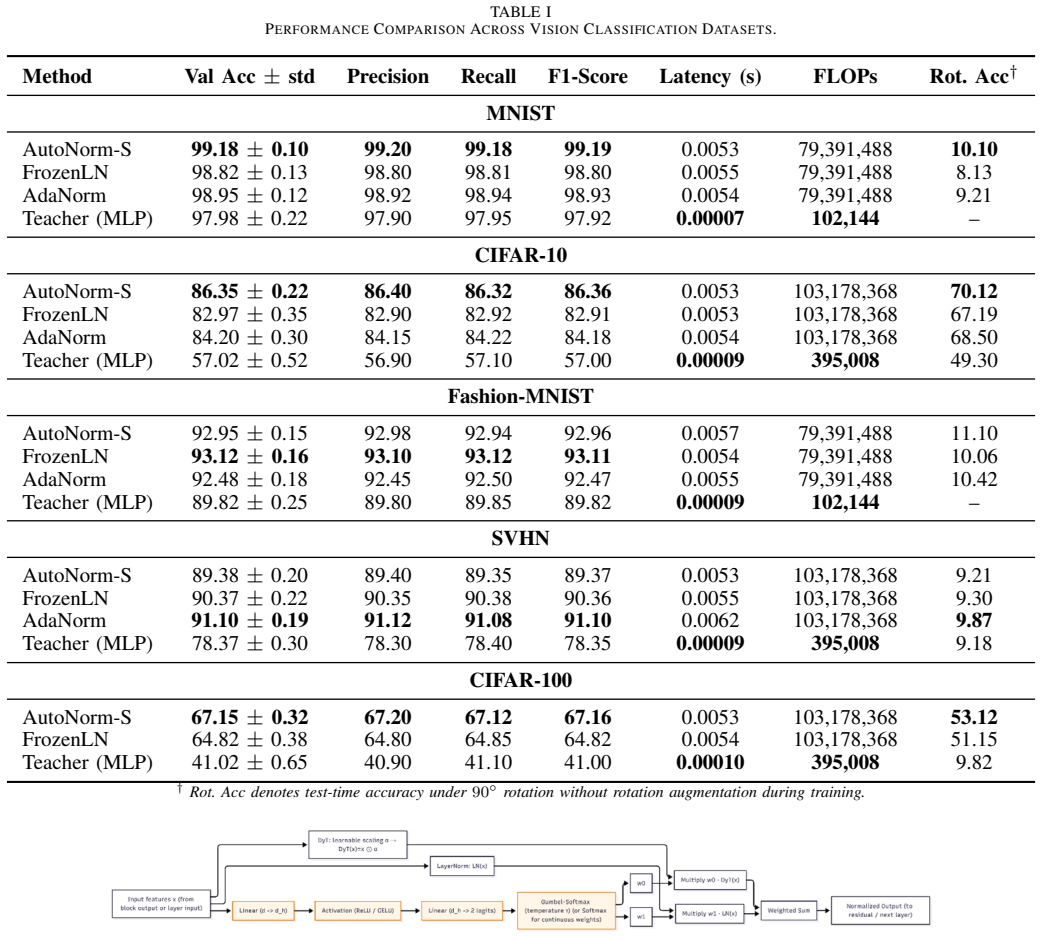
AutoNorm-S: a NormSelector MLP that produces Gumbel-Softmax weights blending LayerNorm and Dynamic Tanh, combined with a one-time gate-freezing schedule (T_freeze = 10 epochs, entropy threshold 0.1) applied uniformly to all vision datasets once the selector’s entropy collapses.
Load-bearing premise
A single fixed freeze-epoch and entropy threshold, plus an informal notion of “stationarity” measured by how fast gating entropy collapses, is enough to diagnose and correct the bottleneck on every vision dataset without per-dataset retuning.
What would settle it
Train the identical architecture on CIFAR-10 and PTB both with and without the freeze schedule; if the unfrozen selector still matches or exceeds the frozen AutoNorm-S accuracy on CIFAR-10 while the language gains disappear, the claimed stationarity-dependent bottleneck is false.
If this is right
- When input statistics are stable, any early-stage differentiable router should be frozen or heavily annealed; free exploration is useful only when features keep evolving.
- Layer-wise normalization policy can be treated as a learnable inductive bias rather than a fixed hyper-parameter, provided the selector is protected from early noise.
- The same freeze-after-warm-up pattern is predicted to improve other Gumbel-style architectural choices (attention routing, expert selection) on stationary data.
- Robustness under distribution shift improves when the model retains the ability to re-weight normalization once training has stabilized.
Where Pith is reading between the lines
- The same entropy-collapse diagnostic could serve as an automatic detector of whether a new dataset needs free or frozen routing, removing the need for the authors’ manual vision-versus-NLP distinction.
- If the principle generalizes, mixture-of-experts and dynamic-depth Transformers may also benefit from an early freeze phase rather than continuous soft routing throughout training.
- A formal non-stationarity measure based on activation-statistic variance would turn the current empirical schedule into a theoretically justified adaptive rule.
Editorial analysis
A structured set of objections, weighed in public.
Referee Report
Summary. The paper studies differentiable selection between Layer Normalization (LN) and Dynamic Tanh (DyT) inside Transformer residual blocks via a lightweight NormSelector trained with Gumbel–Softmax (AutoNorm). Empirically, on relatively stationary vision benchmarks the learned gates often underperform a RandomSelector, which the authors attribute to high early gradient variance of the Gumbel estimator (a “stabilization bottleneck”); on PTB POS tagging and SST-2, sustained gating entropy yields layer-wise LN/DyT policies that improve accuracy and perplexity. AutoNorm-S freezes the selector after a short warm-up (T_freeze=10 or entropy H<0.1 on vision; no freeze on NLP) and reports competitive vision results, a +1.1% freeze-gate lift on CIFAR-10, statistically significant gains on PTB/SST-2 and CIFAR-10-C, plus ablations on temperature, selector capacity, and hard vs. soft selection, with five-seed means, standard deviations, and paired t-tests.
Significance. If the stationarity–gating interaction and the freeze schedule hold under stronger controls, the work supplies a simple, low-overhead training recipe and a transferable design principle for when adaptive architectural selection is useful in Transformers. Credit is due for multi-seed evaluation with significance tests, the freeze-gate intervention, temperature/capacity/hard–soft ablations, and the mechanistic entropy and layer-wise weight analyses (Figs. 3–4). The contribution is primarily empirical and methodological rather than theoretical; relative to SwitchNorm and related conditional normalizations, the distinctive claim is the optimization diagnosis and the freeze schedule, not the mixture idea itself. That claim is interesting for adaptive modules more broadly (routing, MoE) if the causal link to Gumbel variance is tightened.
major comments (3)
- §III-A defines input-distribution stationarity only informally via “variance of activation statistics” and speed of gating-entropy collapse, with no quantitative non-stationarity statistic, threshold, or pre-training diagnostic. The central design principle (§IV-G) and the decision when to freeze (§III-D) rest on this notion; without a measurable criterion the principle remains a post-hoc narrative rather than a falsifiable rule that can be applied to a new dataset before training.
- §III-D and §IV-F present the freeze-gate schedule as the fix for Gumbel-induced early variance, but the only controlled number given is a +1.1% accuracy lift on CIFAR-10 for freezing the learned selector after 10 epochs. There is no parallel freeze applied to RandomSelector or to a non-Gumbel soft-blend baseline, nor an isolation of Gumbel estimator variance from concurrent early-training factors (fixed τ=0.5, MixUp/CutMix, LayerScale, cosine schedule). If freezing improves those controls by a similar margin, the causal attribution to Gumbel noise is not established and the design principle reduces to an empirical heuristic.
- Table I and §IV-A: on Fashion-MNIST and SVHN, AutoNorm-S is matched or beaten by FrozenLN or AdaNorm, which the text treats as theory-consistent with stationarity. Because the same fixed (T_freeze, ε_H) pair is applied uniformly to all vision sets without reporting per-dataset entropy trajectories or a RandomSelector+freeze control, it remains unclear whether the schedule is correctly diagnosing the bottleneck or simply regularizing some datasets. A small controlled table (entropy at epoch 10, frozen vs. unfrozen learned gate, frozen RandomSelector) across MNIST/CIFAR-10/Fashion/SVHN would make the claim load-bearing rather than selective.
minor comments (5)
- Abstract and §I refer to “language modeling,” but the NLP experiments are PTB POS tagging and SST-2 classification; §IV-C correctly notes that the reported PTB perplexity is over tag sequences and not LM-comparable. Align the abstract wording with the actual tasks.
- Eq. (1) writes w_DyT(X)·DyT(X) + w_LN(X)·LN(X) while Eq. (3) uses w0/w1; keep a single notation throughout.
- Related work (§II-A.7) contrasts AutoNorm with SwitchNorm but does not report a same-backbone SwitchNorm (or LN+RMSNorm+DyT) baseline in the main tables; even a short appendix comparison would sharpen the novelty claim.
- Fig. 4 caption and §IV-F: state the exact entropy threshold and freeze epoch used in the plotted AutoNorm-S curve so the figure is reproducible from the text alone.
- §III-E claims <1% parameters and <0.1% FLOPs; Table I latency/FLOPs are essentially identical across methods—briefly note whether the selector is disabled or hard-argmaxed at inference in those measurements.
Circularity Check
No significant circularity: claims are empirical comparisons against external held-out baselines, not quantities forced by definition or self-citation.
full rationale
AutoNorm-S is an empirical training intervention (Gumbel-Softmax blend of LN and DyT, plus a gate-freezing schedule). Its load-bearing claims are measured against independent external metrics—validation accuracy, POS accuracy, PTB tag-sequence perplexity, SST-2 accuracy, CIFAR-10-C mean accuracy—and against independent baselines (FrozenLN, RandomSelector, AdaNorm, FiLM, Teacher MLP) over multiple seeds with reported significance tests. Nothing in Eqs. (1)–(4) or the freeze rule equates a fitted parameter to the reported target by construction: freezing after T_freeze=10 / H<0.1 is an intervention whose effect is measured (e.g., +1.1% on CIFAR-10), not a quantity defined to equal accuracy or perplexity. Stationarity is defined informally via activation-statistic variance and gating-entropy collapse (III-A), and that same entropy is used as a freeze trigger; this is methodological under-specification of the causal story, not a circular derivation that forces the performance numbers. There is no self-citation chain, uniqueness theorem imported from the authors, ansatz smuggled via prior self-work, or renaming of a known result as a first-principles prediction. The paper is self-contained against external benchmarks; score 0 is the honest finding.
Axiom & Free-Parameter Ledger
free parameters (3)
- T_freeze =
10
- epsilon_H =
0.1
- Gumbel-Softmax temperature tau =
0.5
axioms (3)
- domain assumption Gumbel-Softmax provides an unbiased enough continuous relaxation for discrete normalization selection.
- ad hoc to paper Input-distribution stationarity can be diagnosed by variance of activation statistics and speed of gating-entropy collapse.
- ad hoc to paper A single freeze schedule hyper-parameter pair generalizes across the listed vision datasets.
invented entities (2)
-
NormSelector module
no independent evidence
-
stabilization bottleneck
no independent evidence
Cite this review
Pith. "Pith review of AutoNorm: Understanding Adaptive Normalization in Transformers through Differentiable Gating." pith.science (2026). https://pith.science/paper/UX2UWJ2S
@misc{pith2026260710593,
  author       = {Pith},
  title        = {Pith review of: AutoNorm: Understanding Adaptive Normalization in Transformers through Differentiable Gating},
  year         = {2026},
  howpublished = {\url{https://pith.science/paper/UX2UWJ2S}},
  note         = {Machine review of arXiv:2607.10593}
}
read the original abstract
Normalization is a critical component for stabilizing Transformer training, yet the choice between static strategies such as Layer Normalization (LN) and adaptive alternatives remains largely task-dependent. In this paper, we investigate a key optimization challenge in differentiable normalization gating. Our experiments show that, on relatively stationary vision tasks, the high gradient variance introduced by Gumbel-Softmax gating can hinder convergence of the routing mechanism, causing learned gates to underperform simple random selection. In contrast, on non-stationary language modeling and classification tasks, sustained gating diversity enables the model to learn more effective layer-wise normalization policies. Motivated by these observations, we propose AutoNorm-S (Stabilized), a training strategy that mitigates optimization instability through a gate-freezing schedule. AutoNorm-S achieves competitive or improved performance across multiple benchmarks, outperforming adaptive normalization baselines on NLP datasets, including PTB and SST-2, while remaining competitive on standard vision benchmarks. These results suggest that decoupling normalization selection from optimization noise provides a practical and principled approach for adaptive normalization in Transformer architectures.
Figures


Reference graph
Works this paper leans on
-
[1]
Batch normalization: Accelerating deep network training by reducing internal covariate shift,
S. Ioffe and C. Szegedy, “Batch normalization: Accelerating deep network training by reducing internal covariate shift,” inProc. ICML, 2015
2015
-
[2]
J. L. Ba, J. R. Kiros, and G. E. Hinton, “Layer normalization,”arXiv preprint arXiv:1607.06450, 2016
Pith/arXiv arXiv 2016
-
[3]
Attention is all you need,
A. Vaswani et al., “Attention is all you need,” inProc. NeurIPS, 2017
2017
-
[4]
Categorical reparameterization with Gumbel-Softmax,
E. Jang, S. Gu, and B. Poole, “Categorical reparameterization with Gumbel-Softmax,” inProc. ICLR, 2017
2017
-
[5]
Adam: A method for stochastic optimization,
D. P. Kingma and J. Ba, “Adam: A method for stochastic optimization,” inProc. ICLR, 2015
2015
-
[6]
Decoupled weight decay regularization,
I. Loshchilov and F. Hutter, “Decoupled weight decay regularization,” inProc. ICLR, 2019
2019
-
[7]
On layer normalization in the transformer architecture,
R. Xiong et al., “On layer normalization in the transformer architecture,” inProc. ICML, 2020
2020
-
[8]
Benchmarking neural network robust- ness to common corruptions and perturbations,
D. Hendrycks and T. Dietterich, “Benchmarking neural network robust- ness to common corruptions and perturbations,” inProc. ICLR, 2019
2019
-
[9]
Fixup initialization: Residual learning without normal- ization,
H. Zhang et al., “Fixup initialization: Residual learning without normal- ization,” inProc. ICLR, 2019
2019
-
[10]
In search of lost domain generalization,
I. Gulrajani and D. Lopez-Paz, “In search of lost domain generalization,” inProc. ICLR, 2021
2021
-
[11]
DARTS: Differentiable architecture search,
H. Liu, K. Simonyan, and Y . Yang, “DARTS: Differentiable architecture search,” inProc. ICLR, 2019
2019
-
[12]
Neural architecture search with reinforcement learning,
B. Zoph and Q. V . Le, “Neural architecture search with reinforcement learning,” inProc. ICLR, 2017
2017
-
[13]
Instance normalization: The missing ingredient for fast stylization,
D. Ulyanov, A. Vedaldi, and V . Lempitsky, “Instance normalization: The missing ingredient for fast stylization,”arXiv preprint arXiv:1607.08022, 2016
Pith/arXiv arXiv 2016
-
[14]
Group normalization,
Y . Wu and K. He, “Group normalization,” inProc. ECCV, 2018
2018
-
[15]
Adaptive batch normalization for practical domain adapta- tion,
Y . Li et al., “Adaptive batch normalization for practical domain adapta- tion,”Pattern Recognition, vol. 80, pp. 106–116, 2018
2018
-
[16]
DeepNet: Scaling transformers to 1,000 layers,
H. Wang et al., “DeepNet: Scaling transformers to 1,000 layers,”arXiv preprint arXiv:2203.00555, 2022
Pith/arXiv arXiv 2022
-
[17]
Delving deep into rectifiers: Surpassing human-level performance on ImageNet classification,
K. He et al., “Delving deep into rectifiers: Surpassing human-level performance on ImageNet classification,” inProc. ICCV, 2015
2015
-
[18]
Searching for activation functions,
P. Ramachandran, B. Zoph, and Q. V . Le, “Searching for activation functions,”arXiv preprint arXiv:1710.05941, 2017
Pith/arXiv arXiv 2017
-
[19]
Activate or not: Learning customized activation,
N. Ma et al., “Activate or not: Learning customized activation,” inProc. CVPR, 2021
2021
-
[20]
Squeeze-and-excitation networks,
J. Hu, L. Shen, and G. Sun, “Squeeze-and-excitation networks,” inProc. CVPR, 2018
2018
-
[21]
Dynamic convolution: Attention over convolution kernels,
Y . Chen et al., “Dynamic convolution: Attention over convolution kernels,” inProc. CVPR, 2020
2020
-
[22]
Adaptive subgradient methods for online learning and stochastic optimization,
J. Duchi, E. Hazan, and Y . Singer, “Adaptive subgradient methods for online learning and stochastic optimization,”JMLR, vol. 12, pp. 2121– 2159, 2011
2011
-
[23]
AdaBelief optimizer: Adapting stepsizes by the belief in observed gradients,
J. Zhuang et al., “AdaBelief optimizer: Adapting stepsizes by the belief in observed gradients,” inProc. NeurIPS, 2020
2020
-
[24]
Root mean square layer normalization,
B. Zhang and R. Sennrich, “Root mean square layer normalization,” in Proc. NeurIPS, 2019
2019
-
[25]
ReZero is all you need: Fast convergence at large depth,
T. Bachlechner et al., “ReZero is all you need: Fast convergence at large depth,” inProc. UAI, 2021
2021
-
[26]
Mixup: Beyond empirical risk minimization,
H. Zhang et al., “Mixup: Beyond empirical risk minimization,” inProc. ICLR, 2018
2018
-
[27]
CutMix: Regularization strategy to train strong classifiers with localizable features,
S. Yun et al., “CutMix: Regularization strategy to train strong classifiers with localizable features,” inProc. ICCV, 2019
2019
-
[28]
Distilling the knowledge in a neural network,
G. Hinton, O. Vinyals, and J. Dean, “Distilling the knowledge in a neural network,”arXiv preprint arXiv:1503.02531, 2015
Pith/arXiv arXiv 2015
-
[29]
Outrageously large neural networks: The mixture-of- experts layer,
N. Shazeer et al., “Outrageously large neural networks: The mixture-of- experts layer,” inProc. ICLR, 2017
2017
-
[30]
Transformers without normalization,
L. Zhu et al., “Transformers without normalization,” inProc. CVPR, 2025
2025
-
[31]
FiLM: Visual reasoning with a general conditioning layer,
E. Perez et al., “FiLM: Visual reasoning with a general conditioning layer,” inProc. AAAI, 2018
2018
-
[32]
Escaping the big data paradigm with compact transformers,
A. Hassani et al., “Escaping the big data paradigm with compact transformers,”arXiv preprint arXiv:2104.05704, 2021
Pith/arXiv arXiv 2021
-
[33]
Building a large annotated corpus of English: The Penn Treebank,
M. P. Marcus, M. A. Marcinkiewicz, and B. Santorini, “Building a large annotated corpus of English: The Penn Treebank,”Computational Linguistics, vol. 19, no. 2, pp. 313–330, 1993
1993
-
[34]
Differentiable learning- to-normalize via switchable normalization,
P. Luo, J. Ren, Z. Peng, R. Zhang, and J. Li, “Differentiable learning- to-normalize via switchable normalization,” inProc. ICLR, 2019
2019
-
[35]
Deep networks with stochastic depth,
G. Huang, Y . Sun, Z. Liu, D. Sedra, and K. Q. Weinberger, “Deep networks with stochastic depth,” inProc. ECCV, 2016
2016
-
[36]
Going deeper with image transformers,
H. Touvron, M. Cord, A. Sablayrolles, G. Synnaeve, and H. J ´egou, “Going deeper with image transformers,” inProc. ICCV, 2021
2021
-
[37]
Transformer-XL: Attentive language models beyond a fixed-length context,
Z. Dai et al., “Transformer-XL: Attentive language models beyond a fixed-length context,” inProc. ACL, 2019
2019
discussion (0)
Sign in with ORCID, Apple, or X to comment. Anyone can read and Pith papers without signing in.