REVIEW 3 major objections 5 minor 20 references
Deleting 88.9% of a vision-language model's visual tokens can cost only 4.4 points of accuracy if saliency is diffused over a token graph, coverage is enforced per region, and dropped tokens are summarized rather than discarded.
Reviewed by Pith at T0; open to challenge. T0 means a machine referee read the full paper against a public rubric. the ladder, T0–T4 →
T0 review · deepseek-v4-flash
2026-08-02 07:09 UTC pith:RYODIUAX
load-bearing objection Solid, well-engineered token condensation paper with a real fairness bug in the token-budget accounting that needs fixing before the SOTA claims can be trusted. the 3 major comments →
Spectral Heat Flow for Conservative Token Condensation in Vision-Language Models
The pith
A machine-rendered reading of the paper's core claim, the machinery that carries it, and where it could break.
Core claim
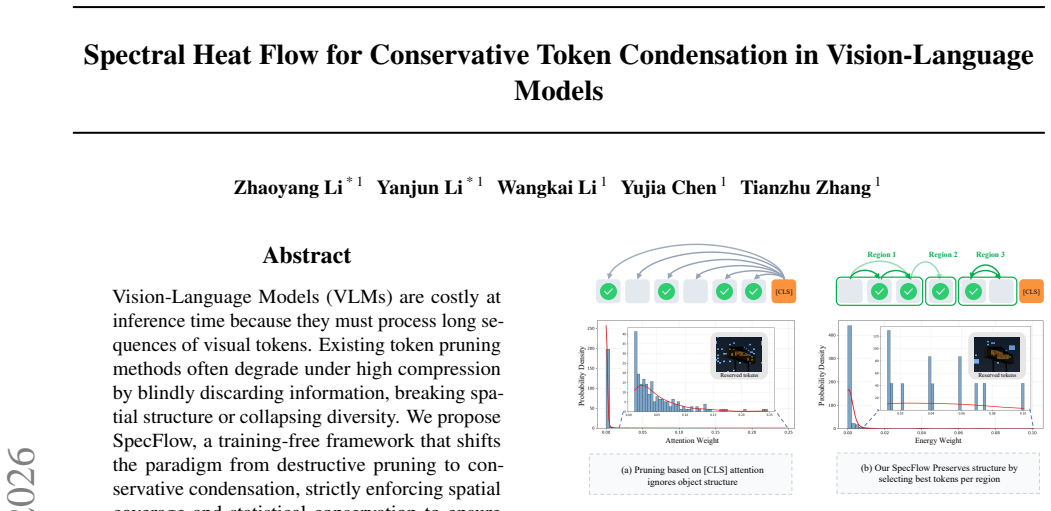
SpecFlow's claim is that token importance for pruning should be a smoothed, structure-aware field, not a per-token score. It seeds saliency from the vision encoder's [CLS] attention (the global summary token) and propagates it by restart diffusion on a kNN graph built from token-feature cosine similarity — deliberately not raw self-attention, which the authors argue carries anomaly-token artifacts and region-inconsistent links. Proposition 3.1 shows the diffused field is the unique minimizer of a convex objective trading seed fidelity against graph smoothness, so the smoothing is principled rather than heuristic. Pruning then applies quadtree partitioning with energy-proportional quotas so e
What carries the argument
The load-bearing object is a sparse k-nearest-neighbor graph over visual-token embeddings with a row-stochastic softmax transition matrix (Eq. 5). The paper runs 'restart diffusion' (Eq. 2) on it, seeded by CLS attention: each token's energy is repeatedly mixed with its graph neighbors and pulled back toward the seed. The fixed point is the unique minimizer of a convex objective balancing seed fidelity against Dirichlet energy on the graph (Prop. 3.1), so the resulting spectral-heat-flow importance field is the smoothest field that stays faithful to the CLS cue. Two secondary mechanisms carry the conservation claim: quadtree splitting with energy-proportional quotas — a proportional-fairness
Load-bearing premise
The load-bearing premise is that the kNN graph built on token-feature similarity is a faithful structural substrate; if token features do not track semantic or spatial regions — anomaly tokens, feature homogenization — the diffused energy propagates misleading saliency into every region, and neither the coverage budget nor the sink tokens can recover the lost signal.
What would settle it
Reproduce the paper's own operator ablation: diffuse on raw self-attention instead of the kNN graph at 88.9% pruning and measure GQA and TextVQA; the paper reports a roughly 5-point gap (about 55.3 vs 49.6 on GQA, 54.9 vs 50.3 on TextVQA). If the two operators perform nearly identically, the structural-coherence story collapses. A second, sharper test: feed images with heavy repetitive texture, where token-feature neighborhoods are semantically flat, and check whether SpecFlow's high-compression accuracy falls back to plain CLS-attention Top-K.
If this is right
- Prefill cost, which scales quadratically with visual-token count, drops superlinearly: at pruning ratio R the saving approaches 2R − R² when attention dominates — about 99% of the quadratic attention term at 88.9% pruning.
- Aggressive budgets stop being catastrophic: the paper reports about 95.6% of unpruned accuracy at 88.9% compression on LLaVA-1.5, the best average among compared baselines, with graceful degradation as the budget shrinks.
- The method is drop-in: no fine-tuning, plug-and-play with FlashAttention, and a pruning overhead measured at roughly 1% of end-to-end latency.
- Structure-aware condensation transfers across architectures and modalities in the paper's experiments: LLaVA-NeXT at 88.9% pruning, video QA with 455 of 2,048 tokens kept, and Qwen2.5-VL all show the same pattern.
Where Pith is reading between the lines
- Editorial inference: the mechanism predicts that SpecFlow's advantage over Top-K pruning grows as attention gets spikier, since diffusion and coverage budgeting specifically counteract spike concentration; a test that sharpens the CLS seed (fewer heads, higher temperature) should widen the gap.
- Editorial inference: the method's premise cuts the other way on feature-homogenized inputs — heavy repetitive texture, dense small objects, or uniform backgrounds — where kNN neighborhoods carry little region structure; the paper's own limitation appendix names fine-grained evidence (small objects, dense text, counting) as the risk zone where mean-plus-residual sinks may be too thin.
- Editorial inference: the measured decoding constant suggests that after aggressive prefill pruning the next bottleneck is decoding, which shrinks only linearly with token count; further end-to-end gains would need KV-cache or decode-side compression, which this paper does not address.
- Editorial inference: the recipe — diffuse importance, enforce coverage, sink the rest — is generic for any transformer consuming spatially arranged tokens, so it could port to high-resolution OCR or long-video inputs, with the caveat that coverage partitioning would need to become spatiotemporal.
Editorial analysis
A structured set of objections, weighed in public.
Referee Report
Summary. The paper proposes SpecFlow, a training-free visual token condensation method for vision-language models. It constructs a kNN graph over visual token embeddings, diffuses CLS-attention-derived importance via restart diffusion (spectral heat flow), selects tokens with a quadtree-based energy-proportional allocation to enforce spatial coverage, and appends two 'sink' tokens (mean and residual of pruned tokens) to preserve summary statistics. The method is evaluated on nine image understanding benchmarks with LLaVA-1.5, on LLaVA-NeXT, on two video QA benchmarks, and on Qwen2.5-VL, claiming state-of-the-art average relative performance at 66.7%, 77.8%, and 88.9% token reductions. The appendix provides proofs of diffusion contraction/mass preservation, the Dirichlet interpretation, proportional allocation optimality, and sink-token properties, along with wall-clock, memory, and FLOPs measurements.
Significance. If the empirical claims hold, SpecFlow provides a useful training-free alternative to existing token pruning methods, with a clear conceptual shift from point-wise ranking to graph-diffused importance plus spatial coverage. The mathematical lemmas in Appendices A.1–A.3 (contraction, mass preservation, Dirichlet view, proportional fairness, sink optimality) are standard but correctly proven and clearly presented. The paper also includes welcome engineering details: wall-clock breakdown, GPU memory, and FLOPs comparisons. However, the empirical comparison is not yet fully convincing because of a token-budget accounting inconsistency, a mismatched table caption, and the absence of code, error bars, or significance tests. The central 'outperforms SOTA' claim is proportionate only if the budget comparison is fair and the reported margins are statistically supported.
major comments (3)
- [§4.3 (Eq. 16) and Tables 1–4, 7] The token-budget accounting is internally inconsistent. Eq. (16) appends u_mean and u_res to the selected set, so the decoder processes K+2 tokens, yet the tables and abstract report budgets of 192/128/64 and pruning ratios 66.7%/77.8%/88.9% as if exactly K tokens were fed. At K=64, the true pruning ratio is 1−66/576 ≈ 88.5%, not 88.9%, and attention FLOPs scale by (66/64)^2 ≈ 6%. The reported SOTA margins at 88.9% are small (0.7 pp vs. HoloV in Table 1; 0.2 pp in Table 2), so the comparison may not be fair. Appendix E concedes that budget accounting is not yet standardized. The authors must count the sinks in the budget or give the same sinks to all baselines and recompute ratios, relative performance, and FLOPs.
- [Table 2 and §5.2] Table 2's caption says 'Video QA benchmarks', but the table reports LLaVA-NeXT image-understanding results on GQA, MMB, etc., with an upper bound of 2880 tokens. This mismatch obscures which experiments support the video claim; the actual video results are in Table 3. Correct the caption and align §5.2 with the table contents.
- [§5.1–5.2 and Tables 1–4] The empirical claims are reported without error bars, significance tests, or multiple seeds. The headline claim of 'outperforming SOTA' rests on average margins as small as 0.2–0.7 percentage points (e.g., 98.7% vs 98.5% in Table 1; 95.8% vs 95.6% in Table 2). Without variance estimates or a reproducible code release, the reader cannot distinguish real improvement from noise. Provide per-seed results, significance tests, and a working code link (the URL is not verifiable from the preprint).
minor comments (5)
- [§5.3] The text says 'As illustrated in Figure 3' for the diffusion-operator ablation, but Figure 3 is the pruning-strategy ablation; the diffusion ablation is Figure 2. Please fix the cross-reference.
- [Table 1] The average column for ToMe at 192 tokens reports 88.5% despite missing MMB-CN and VizWiz entries (shown as '–'). The averaging procedure over missing entries should be stated, or the missing values should be obtained and reported for consistency.
- [Table 4] The Average row mixes MME (a raw score, 2304) with percentage metrics (86.1, 84.7, 84.8) and then reports 100.0%. This normalization is unclear; MME scores are typically hundreds, not percentages. Please clarify the normalization and state it explicitly in the caption.
- [Appendix B.2] Only the number of diffusion steps (2) and minimum crop size (4) are given. The diffusion strength α, kNN temperature τ, neighbor count k, CLS head set H, quadtree variance threshold δ, and sink-token count are listed as free parameters but their values and sensitivity are not reported. Please provide a full hyperparameter table and, ideally, a sensitivity analysis.
- [Throughout] Several typos and formatting issues appear: 'LLaV A' with a space instead of 'LLaVA' (e.g., in Tables and text), 'V on Luxburg' should be 'Von Luxburg', and the abstract/table text uses inconsistent spacing. These should be corrected.
Circularity Check
No significant circularity; SpecFlow's benchmark outcomes are empirical and not encoded in its construction.
full rationale
SpecFlow's claimed outputs are benchmark accuracies. The selection procedure (kNN graph Eq. 5, diffusion Eq. 2, quadtree allocation Eqs. 8-14, sink construction Eq. 15) is parameterized by hyperparameters (k, tau, alpha, T_diff, delta, m) and by the seed e^(0)=CLS attention; no parameter is fitted to the nine benchmark scores in Tables 1-4. The method is training-free, and the reported numbers come from external evaluation, so the 'predictions' are not equivalent to the construction by definition. The mathematical claims (Prop. 3.1: diffusion equals Dirichlet-regularized smoothing; Prop. 4.1: energy-proportional allocation equals Kelly fairness; Lemmas A.5-A.6: mean sink optimality and residual radius) are standard results that the paper proves rather than assumes, and they do not carry the empirical claim. The self-citations (Li et al. 2025b,c) appear only as examples of recent VLM/vision work in the introduction and are not load-bearing for the pruning mechanism. The skeptic's point about the two appended sink tokens making the effective decoder sequence K+2 at K=64 is a legitimate fairness/accounting issue for the SOTA comparison, and Appendix E explicitly notes the authors 'plan to standardize token-budget accounting (including any appended sinks)'; however, this affects whether the reported pruning ratio and FLOPs are comparable to baselines, not whether any derivation reduces to its inputs. Thus no circular step meets the quoted-reduction standard required for a positive circularity finding.
Axiom & Free-Parameter Ledger
free parameters (8)
- diffusion strength α
- kNN softmax temperature τ
- kNN neighbor count k
- CLS attention head set H
- quadtree variance threshold δ
- minimum crop size m =
4
- diffusion steps T_diff =
2
- sink token count =
2
axioms (6)
- domain assumption A kNN graph built from CLIP token feature similarity reflects semantic region structure.
- domain assumption CLS attention is a reliable seed of visual token importance.
- standard math Energy-proportional budget allocation is an optimal fairness objective.
- standard math Restart diffusion converges to a unique fixed point and preserves mass.
- domain assumption Mean + residual sink tokens sufficiently preserve pruned information.
- domain assumption Benchmark suites measure the intended VLM capabilities.
invented entities (1)
-
Coreset sink tokens (mean and residual)
no independent evidence
read the original abstract
Vision-Language Models (VLMs) are costly at inference time because they must process long sequences of visual tokens. Existing token pruning methods often degrade under high compression by blindly discarding information, breaking spatial structure or collapsing diversity. We propose SpecFlow, a training-free framework that shifts the paradigm from destructive pruning to conservative condensation, strictly enforcing spatial coverage and statistical conservation to ensure stability. Treating visual tokens as nodes in a $k$NN graph, SpecFlow (i) computes a stable importance field via spectral heat flow to preserve structural coherence, (ii) allocates budgets via adaptive spatial partitioning to guarantee coverage, and (iii) aggregates discarded information into coreset sinks to maintain statistical conservation. The method is plug-and-play, requires no fine-tuning, and is compatible with FlashAttention. Experiments confirm that our SpecFlow outperforms SOTA methods across tasks, VLM architectures, and pruning ratios. Notably, LLaVA-1.5 with SpecFlow retains 95.6% of original performance despite pruning 88.9% of visual tokens, offering an exceptional efficiency-accuracy balance. Code is available at https://github.com/Lzy-dot/SpecFlow
Figures


Reference graph
Works this paper leans on
-
[1]
Therefore, ∥T(e)− T(e′)∥1 =α∥W ⊤(e−e ′)∥1 ≤α∥W ⊤∥1∥e−e ′∥1 =α∥e−e ′∥1, proving Eq. (23). By Banach’s fixed-point theorem (Kreyszig, 1991), T has a unique fixed point e⋆. The fixed-point equationT(e ⋆) =e ⋆ is equivalent to Eq. (24). The linear convergence bound follows directly from contraction. A.2 Mass preservation (justifies optional renormalization). ...
1991
-
[8]
Li, Y ., Du, Y ., Zhou, K., Wang, J., Zhao, W. X., and Wen, J.-R. Evaluating object hallucination in large vision- language models.arXiv:2305.10355,
-
[10]
M., Hauth, A., Millican, K., et al
Team, G., Anil, R., Borgeaud, S., Alayrac, J.-B., Yu, J., Sori- cut, R., Schalkwyk, J., Dai, A. M., Hauth, A., Millican, K., et al. Gemini: a family of highly capable multimodal models.arXiv preprint arXiv:2312.11805,
-
[12]
Xing, L., Huang, Q., Dong, X., Lu, J., Zhang, P., Zang, Y ., Cao, Y ., He, C., Wang, J., Wu, F., et al. Pyramid- drop: Accelerating your large vision-language models via pyramid visual redundancy reduction.arXiv preprint arXiv:2410.17247,
-
[13]
Zhang, Y ., Fan, C.-K., Ma, J., Zheng, W., Huang, T., Cheng, K., Gudovskiy, D., Okuno, T., Nakata, Y ., Keutzer, K., et al. Sparsevlm: Visual token sparsification for effi- cient vision-language model inference.arXiv preprint arXiv:2410.04417, 2024b. Zhao, H. H., Zhou, P., Gao, D., Bai, Z., and Shou, M. Z. Lova3: Learning to visual question answering, ask...
-
[15]
Additional Theoretical Details A.1
12 Spectral Heat Flow for Conservative Token Condensation in Vision-Language Models A. Additional Theoretical Details A.1. HeatFlow Diffusion: Fixed Point, Mass Preservation, and Dirichlet View This appendix provides proofs and auxiliary lemmas for Proposition 3.1. Throughout, W∈R N×N is the nonnegative row-stochastic transition matrix in Eq. (5) (i.e.,W1...
2012
-
[17]
A.3 Dirichlet view under symmetrized affinity (proof of Prop
Since it holds att= 0, it holds for allt. A.3 Dirichlet view under symmetrized affinity (proof of Prop. 3.1).Proposition 3.1 additionally assumes that W is obtained by row-normalizing a symmetric affinity matrix. Concretely, defineS∈R N×N andD= diag(S1)such that S=S ⊤ ≥0, D ii >0, W=D −1S.(26) This holds, for instance, when we use a symmetrized KNN edge s...
2004
-
[18]
Finally, sinceW ⊤ = (D−1S)⊤ =SD −1, we obtain (I−αW ⊤)e= (1−α)e (0), which matches the fixed-point equation
Substitutingf=D −1eandf 0 =D −1e(0) gives (D−αS)D −1e= (1−α)e (0) ⇐ ⇒(I−αSD −1)e= (1−α)e (0). Finally, sinceW ⊤ = (D−1S)⊤ =SD −1, we obtain (I−αW ⊤)e= (1−α)e (0), which matches the fixed-point equation. By uniqueness of the minimizer, the optimizer ofJ(e)is exactlye ⋆. A.2. Quota Allocation and Integer Rounding for Quadtree Pruning This appendix provides ...
1998
-
[19]
descendingM(c)
Then the resulting integer quotas satisfy X c∈C qc =K,0≤q c ≤ |c| ∀c∈ C.(30) In particular, the “descendingM(c)” filling strategy in Sec. 4.2 is feasible. Proof. By construction, 0≤q (0) c ≤ |c|and P c q(0) c ≤ P c ˆqc =K , hence R≥0 . The total remaining capacity after the initial step is X c (|c| −q(0) c )≥ X c |c| − X c q(0) c =N− X c q(0) c ≥K− X c q(...
2019
-
[20]
Beyond the raw images, the dataset provides object-level information such as locations and attributes
GQA is a compositional visual question answering benchmark built around three core elements: images, structured scene annotations (scene graphs), and questions. Beyond the raw images, the dataset provides object-level information such as locations and attributes. Its questions are designed to probe not only visual recognition but also relational and compo...
2023
-
[416]
Wen, Z., Gao, Y ., Wang, S., Zhang, J., Zhang, Q., Li, W., He, C., and Zhang, L
Springer, 2024b. Wen, Z., Gao, Y ., Wang, S., Zhang, J., Zhang, Q., Li, W., He, C., and Zhang, L. Stop looking for important tokens in multimodal language models: Duplication matters more. arXiv preprint arXiv:2502.11494,
-
[1998]
Videopoet: A large language model for zero- shot video generation.arXiv preprint arXiv:2312.14125,
Kondratyuk, D., Yu, L., Gu, X., Lezama, J., Huang, J., Schindler, G., Hornung, R., Birodkar, V ., Yan, J., Chiu, M.-C., et al. Videopoet: A large language model for zero- shot video generation.arXiv preprint arXiv:2312.14125,
-
[2003]
Zou, X., Lu, D., Wang, Y ., Yan, Y ., Lyu, Y ., Zheng, X., Zhang, L., and Hu, X. Don’t just chase” highlighted tokens” in mllms: Revisiting visual holistic context reten- tion.arXiv preprint arXiv:2510.02912,
-
[2006]
Dao, T. Flashattention-2: Faster attention with bet- ter parallelism and work partitioning.arXiv preprint arXiv:2307.08691,
-
[2010]
Token merging: Your vit but faster.arXiv preprint arXiv:2210.09461,
Bolya, D., Fu, C.-Y ., Dai, X., Zhang, P., Feichtenhofer, C., and Hoffman, J. Token merging: Your vit but faster.arXiv preprint arXiv:2210.09461,
-
[2011]
MME: A comprehen- sive evaluation benchmark for multimodal large language models.arXiv:2306.13394,
Fu, C., Chen, P., Shen, Y ., Qin, Y ., Zhang, M., Lin, X., Yang, J., Zheng, X., Li, K., Sun, X., et al. MME: A comprehen- sive evaluation benchmark for multimodal large language models.arXiv:2306.13394,
-
[2019]
Huynh, N. D., Bouadjenek, M. R., Aryal, S., Razzak, I., and Hacid, H. Visual question answering: from early developments to recent advances–a survey.arXiv preprint arXiv:2501.03939,
-
[2022]
Dosovitskiy, A. An image is worth 16x16 words: Trans- formers for image recognition at scale.arXiv preprint arXiv:2010.11929,
Pith/arXiv arXiv 2010
-
[2024]
Li, Y ., Zhang, Y ., Wang, C., Zhong, Z., Chen, Y ., Chu, R., Liu, S., and Jia, J. Mini-gemini: Mining the potential of multi-modality vision language models.IEEE Trans- actions on Pattern Analysis and Machine Intelligence, 2025a. Li, Z., Qian, D., Su, K., Diao, Q., Xia, X., Liu, C., Yang, W., Zhang, T., and Yuan, Z. Bindweave: Subject-consistent video ge...
arXiv 2024
-
[2025]
Bai, J., Bai, S., Yang, S., Wang, S., Tan, S., Wang, P., Lin, J., Zhou, C., and Zhou, J. Qwen-vl: A frontier large vision- language model with versatile abilities.arXiv preprint arXiv:2308.12966,
discussion (0)
Sign in with ORCID, Apple, or X to comment. Anyone can read and Pith papers without signing in.