REVIEW 4 major objections 6 minor 46 references
How an AI agent is wired changes what news it gathers, filters, and shows—architecture itself is a gatekeeping level.
Reviewed by Pith at T0; open to challenge. T0 means a machine referee read the full paper against a public rubric. the ladder, T0–T4 →
T0 review · grok-4.5
2026-07-14 09:37 UTC pith:EZTC3BPM
load-bearing objection Clean controlled isolation of agent architecture on journalism tasks; duration and Claude’s 71.7% rejection funnel are solid, but the accuracy ranking and newsroom guidance over-claim a non-significant result. the 4 major comments →
Robo-Reporters: Evaluating Autonomous AI Agents as Algorithmic Gatekeepers in Computational Journalism
The pith
A machine-rendered reading of the paper's core claim, the machinery that carries it, and where it could break.
Core claim
Holding the base model and tools fixed, agent architecture is a structural gatekeeping level: it produces large, statistically significant differences in task duration and computational strategy, a measurable multistage source-rejection pattern in the monolithic design, architecture-specific transparency profiles, and practical specializations—chain-based for speed, multi-agent for accuracy, monolithic for versatility, iterative for auditability.
What carries the argument
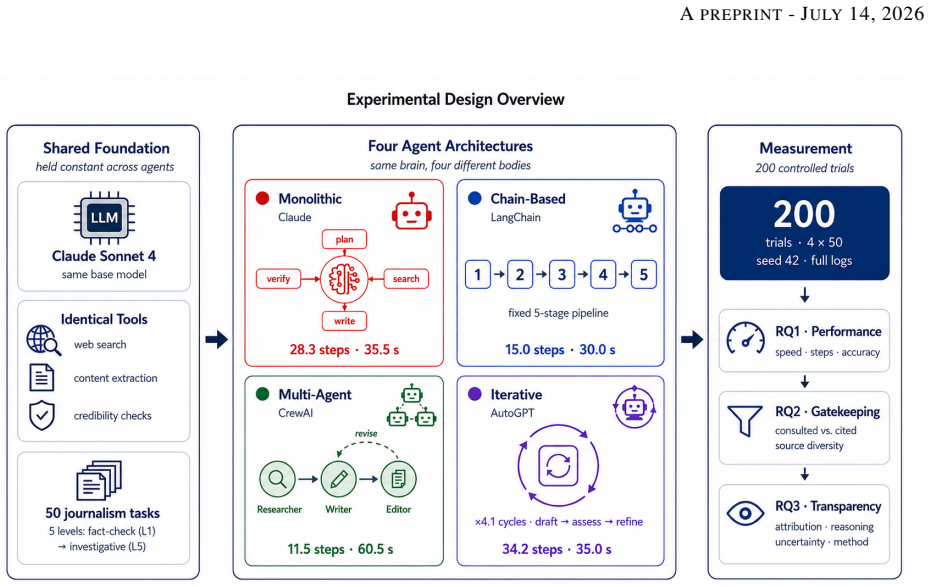
Controlled isolation of architecture: four agent designs (monolithic, chain-based, multi-agent collaborative, autonomous iterative) run the same model and identical tools on the same 50 journalism tasks, so differences are attributed to design pattern rather than model or tool capability; gatekeeping is measured via consultation-to-citation filtering and multistage attrition where logging allows.
Load-bearing premise
That step counts and automated similarity to author-built ground truth fairly measure real processing behavior and journalistic quality rather than partly reflecting fixed pipelines and keyword-friendly scoring.
What would settle it
Rerun the same four-architecture battery with a different base model and with expert journalists scoring narrative quality and source judgment; if architecture effects on duration, filtering, accuracy ranking, and transparency profiles shrink or reverse, the claim that architecture is a robust structural gatekeeping level fails.
Editorial analysis
A structured set of objections, weighed in public.
Referee Report
Summary. This paper reports a controlled comparison of four LLM agent architectures (monolithic Claude, LangChain chain, CrewAI multi-agent, AutoGPT iterative) on 50 journalism tasks (200 trials), holding the base model and tools fixed. Drawing on gatekeeping theory, it claims architecture is a structural level of editorial filtering that drives large differences in task duration (η²=.27) and computational steps (η²=.82), a 71.7% source-rejection rate in the monolithic design, architecture-dependent transparency profiles, and newsroom guidance mapping chain designs to speed, multi-agent to accuracy, monolithic to versatility, and iterative to auditability.
Significance. If the architectural effects hold under stronger outcome measures, the work would be a useful bridge between agent-systems research and mass-communication gatekeeping theory: same-model, same-tool isolation of architecture is rare in journalism studies, the Claude multistage consult–cite funnel (71.7% rejection) is a concrete quantitative parallel to classic human gatekeeping, and the transparency-dimension split (frameworks better at structured attribution; monolithic/iterative better at methodological logs) is practically actionable. The experimental control, full trial completion, ANOVA with effect sizes and Bonferroni tests, and explicit logging design are real strengths. The contribution is currently limited by non-significant accuracy differences being packaged as a primary result and by step-count effects that are partly fixed by pipeline design.
major comments (4)
- [§4.1 Output accuracy; Abstract; Conclusion] Abstract, §4.1 (Output accuracy), Table 2, and Conclusion: the paper leads with multi-agent “highest accuracy (84.7%)” and maps CrewAI to accuracy in newsroom guidance, but the accuracy ANOVA is non-significant under the paper’s own α=.05 (F(3,196)=2.43, p=.066, η²=.04). Descriptive ranking of non-significant means cannot support the central “multi-agent for accuracy” claim or the architecture-to-use-case guidance as currently written. Either reframe accuracy as exploratory/descriptive, report power and confidence intervals, or strengthen the outcome measure before treating accuracy as a discovery.
- [§3.2–3.4 Evaluation Metrics; §5.3 Limitations] §3.2–3.4 and §5.3: accuracy is defined via author-researched ground truth plus automated similarity/keyword matching. The manuscript itself notes that this does not assess narrative quality, style, or engagement. That metric is load-bearing for the accuracy half of the strongest claim and for the practical guidance. Without human expert evaluation (or a validated journalistic quality rubric), the ranking of architectures on “accuracy” remains weakly grounded even if means differ descriptively.
- [§4.1 Computational efficiency; Figure 3] §4.1 Computational efficiency and Figure 3: architecture is said to explain 82% of variance in “processing behavior” (F(3,196)=305.63, η²=.82). LangChain is reported as exactly 15.0 steps with SD=0.0, and CrewAI’s step count is tightly constrained by fixed roles (M=11.5, SD=0.7). A large share of the headline η² is therefore by construction of the pipelines rather than an independent behavioral discovery. The claim should be restated as differences in designed control flow / step budgets, with duration and source-selection outcomes treated as the primary free measures.
- [§4.2 RQ2; Figure 4] §4.2 RQ2 and Figure 4: multistage gatekeeping (consultation → evaluation → selection → citation) and the 71.7% rejection rate are only measurable for Claude; framework agents expose only final citations. The paper correctly notes this as a finding about opacity, but then still compares “gatekeeping patterns across agent architectures” as if selectivity were observed for all four. Cross-architecture gatekeeping claims should be limited to what is observed (citation counts, domain diversity, Gini) and the multistage funnel presented as monolithic-only evidence, not as a general architectural comparison.
minor comments (6)
- [§3.4 Eq. (1)] Transparency composite (Eq. 1) uses fixed weights (0.30/0.25/0.20/0.25) justified only as “relative importance.” A short sensitivity check (equal weights or leave-one-out) would show whether architecture orderings are weight-stable.
- [§3.3 Experimental Procedures] Only one trial per architecture–task pair (4×50×1). Report whether non-determinism of tool use / sampling was controlled (temperature, seeds) and consider at least a small multi-run subset for variance on duration and accuracy.
- [Table 1; §4.1] Table 1 and duration text: CrewAI is ~2× slower; effect sizes for pairwise duration contrasts are reported (d≈1.17–1.52)—good—but confidence intervals on means would help readers judge practical significance for newsroom SLAs.
- [§1 Introduction; §4 Results] H1/H2 are stated in the Introduction but not mapped explicitly to tests in Results (e.g., which contrast tests “multi-stage higher selectivity”). Align hypotheses with reported statistics.
- [Throughout; §3.3] Minor presentation: “ANOV A” spacing appears repeatedly; “LangChain ´s” / “Claude ´s” have stray accents; arXiv-style preprint date “July 14, 2026” and “January 2026” experiments should be checked for consistency before journal submission.
- [Figures 2–4; Methodology] Figure 2/3 captions are informative; ensure raw logs or a data/code availability statement accompany any revision so the Claude consult–cite funnel and step counts are reproducible.
Circularity Check
η²=.82 on computational steps is partly by construction of fixed pipelines; duration, Claude’s 71.7% funnel, and transparency remain independent empirical content.
specific steps
-
self definitional
[§3.1 Agent Implementations; §4.1 Computational efficiency; Abstract]
"The chain-based agent averaged 15.0 steps per task with zero variance, reflecting its fixed pipeline. ... CrewAI completed tasks in an average of 11.5 steps (SD=0.7) ... One-way ANOVA revealed extraordinarily strong effects, F(3,196)=305.63, p<.001, η²=.82, indicating architecture accounted for 82.4% of variance ... with architecture explaining 82% of the variance in processing behavior."
Architecture is operationalized as fixed processing patterns (LangChain’s five sequential stages; CrewAI’s three specialized roles). Step count is then used as the DV for “computational strategy/processing behavior.” For LangChain, steps=15 with SD=0 by design of the pipeline, not as free empirical response; CrewAI’s near-zero variance likewise reflects role-fixed structure. The η²=.82 result therefore largely rediscovers that differently defined pipelines take different fixed numbers of steps—X (architecture) is defined in terms of the processing structure that Y (steps) measures—so the strongest “strategy” effect is partly tautological rather than an independent prediction.
full rationale
This is an empirical architecture comparison, not a first-principles derivation paper. Duration, accuracy (vs author ground truth), Claude’s consult-to-cite rejection rate, source diversity, and transparency dimensions are measured against external task outcomes and logs and do not reduce to their inputs by definition. There is no load-bearing self-citation uniqueness theorem, no fitted parameter renamed as a prediction of the same quantity, and no ansatz smuggled in via prior author work. The one clear circularity-adjacent step is treating computational step counts as an independent discovery about “processing behavior”/“computational strategy” when, for the chain-based and multi-agent designs, step structure is largely fixed by the architectural definition itself (LangChain exactly 15.0 steps, SD=0.0; CrewAI ~11.5, SD=0.7). The headline claim that architecture explains 82% of variance in processing behavior therefore partly restates design constraints rather than free behavioral response. That weakens one of the two lead statistical results but does not collapse the paper’s broader gatekeeping and duration findings. Score 4: partial by-construction content on steps; central empirical claims still have independent measured content. Accuracy ranking despite non-significant ANOVA is an overclaim/validity issue, not circularity under this rubric.
Axiom & Free-Parameter Ledger
free parameters (4)
- Transparency dimension weights (attribution 0.30, reasoning 0.25, uncertainty 0.20, methodological 0.25)
- Task difficulty tier definitions and n=10 tasks per level
- Timeout limits (5 min simple / 10 min complex)
- Accuracy scoring via automated similarity and keyword matching
axioms (5)
- domain assumption Holding base LLM and tool APIs fixed isolates architectural effects from capability differences.
- domain assumption Gatekeeping theory (selection/filtering from sources to audiences) extends to autonomous content-producing agents.
- ad hoc to paper Author-researched ground truth plus automated similarity is an adequate benchmark for journalistic accuracy.
- standard math Standard ANOVA/effect-size inference applies to these architecture comparisons at α=.05.
- domain assumption Diakopoulos-style transparency dimensions can be operationalized as 0–1 scores and linearly combined.
invented entities (1)
-
Architecture as a structural level of gatekeeping
no independent evidence
read the original abstract
Artificial intelligence agents increasingly perform journalism tasks autonomously, searching for sources, evaluating credibility, and producing news content with minimal human oversight. Yet research has largely treated AI as a monolithic category, leaving the effects of architectural design unexamined. Drawing on gatekeeping theory, this study presents the first systematic comparison of four agent architectures, monolithic (Claude), chain-based (LangChain), multi-agent collaborative (CrewAI), and autonomous iterative (AutoGPT), across 200 controlled experiments spanning 50 journalism tasks of graduated difficulty. All architectures used the same underlying language model and identical tools, isolating architectural effects. Results revealed significant effects on task duration (F(3, 196) = 24.54, p < .001, eta-squared = .27) and computational strategy (F(3, 196) = 305.63, p < .001, eta-squared = .82), with architecture explaining 82% of the variance in processing behavior. Multi-agent collaboration achieved the highest accuracy (84.7%) at roughly twice the time cost of other designs. Multistage analysis of the monolithic architecture documented a 71.7% source rejection rate, a quantitative parallel to classic human gatekeeping, while framework-based systems obscured their filtering inside abstraction layers. Transparency emerged as an architectural choice: framework designs excelled at structured attribution, whereas monolithic and iterative designs produced superior methodological documentation. Findings position architecture as a new structural level of gatekeeping and offer evidence-based guidance for newsrooms: chain-based designs for speed, multi-agent for accuracy, monolithic for versatility, and iterative for auditability.
Figures


Reference graph
Works this paper leans on
-
[1]
Dörr, K. N. (2016). Mapping the field of algorithmic journalism.Digital Journalism, 4(6), 700-722. < https: //doi.org/10.1080/21670811.2015.1096748>
work page internal anchor Pith review Pith/arXiv arXiv doi:10.1080/21670811.2015.1096748 2016
-
[2]
Carlson, M. (2015). The robotic reporter: Automated journalism and the redefinition of labor, compositional forms, and journalistic authority.Digital Journalism, 3(3), 416-431. < https://doi.org/10.1080/21670811. 2014.976412>
doi:10.1080/21670811 2015
-
[3]
(2019).New powers, new responsibilities: A global survey of journalism and artificial intelligence
Beckett, C. (2019).New powers, new responsibilities: A global survey of journalism and artificial intelligence. Polis, London School of Economics and Political Science
2019
-
[4]
(2019).Automating the news: How algorithms are rewriting the media
Diakopoulos, N. (2019).Automating the news: How algorithms are rewriting the media. Harvard University Press
2019
-
[5]
R., Yao, S., Narasimhan, K., & Griffiths, T
Sumers, T. R., Yao, S., Narasimhan, K., & Griffiths, T. L. (2024). Cognitive architectures for language agents. Transactions of the Association for Computational Linguistics, 12, 1116-1132. <https://doi.org/10.1162/ tacl_a_00680> 10 APREPRINT- JULY14, 2026
2024
-
[6]
Wang, L., Ma, C., Feng, X., Zhang, Z., Yang, H., Zhang, J., Chen, Z., Tang, J., Chen, X., Lin, Y ., Zhao, W. X., Wei, Z., & Wen, J. R. (2024). A survey on large language model based autonomous agents.Frontiers of Computer Science, 18(6), 186345. <https://doi.org/10.1007/s11704-024-40231-1>
-
[7]
Parasol, M., Chen, B., Liu, S., & Huang, J. (2024). Evaluating large language model agent architectures for code generation. InProceedings of the 2024 ACM Conference on Software Engineering(pp. 234-248). ACM
2024
-
[8]
Li, G., Hammoud, H. A. A. K., Itani, H., Khizbullin, D., & Ghanem, B. (2024). CAMEL: Communicative agents for ’mind’ exploration of large language model society. InAdvances in Neural Information Processing Systems 36 (pp. 51991-52008)
2024
-
[9]
R., Qin, Y ., Liu, Z., & Ji, H
Qian, C., Han, C., Fung, Y . R., Qin, Y ., Liu, Z., & Ji, H. (2024). Communicative agents for software development. InProceedings of the 62nd Annual Meeting of the Association for Computational Linguistics(pp. 15174-15186). Association for Computational Linguistics
2024
-
[10]
L., Abebe, R., Dupagne, M., & Chuan, C
Broussard, M., Diakopoulos, N., Guzman, A. L., Abebe, R., Dupagne, M., & Chuan, C. H. (2019). Artificial intelligence and journalism.Journalism & Mass Communication Quarterly, 96(3), 673-695. < https://doi. org/10.1177/1077699019859901>
-
[11]
(2018).Artificial unintelligence: How computers misunderstand the world
Broussard, M. (2018).Artificial unintelligence: How computers misunderstand the world. MIT Press
2018
-
[12]
J., & V os, T
Shoemaker, P. J., & V os, T. P. (2009).Gatekeeping theory. Routledge
2009
-
[13]
Singer, J. B. (2014). User-generated visibility: Secondary gatekeeping in a shared media space.New Media & Society, 16(1), 55-73. <https://doi.org/10.1177/1461444813477833>
-
[14]
White, D. M. (1950). The ’gate keeper’: A case study in the selection of news.Journalism Quarterly, 27(4), 383-390. <https://doi.org/10.1177/107769905002700403>
-
[15]
Breed, W. (1955). Social control in the newsroom: A functional analysis.Social Forces, 33(4), 326-335. < https: //doi.org/10.2307/2573002>
doi:10.2307/2573002 1955
-
[16]
Napoli, P. M. (2014). Automated media: An institutional theory perspective on algorithmic media production and consumption.Communication Theory, 24(3), 340-360. <https://doi.org/10.1111/comt.12039>
-
[17]
Thurman, N., Moeller, J., Helberger, N., & Trilling, D. (2019). My friends, editors, algorithms, and I: Exam- ining audience attitudes to news selection.Digital Journalism, 7(4), 447-469. < https://doi.org/10.1080/ 21670811.2018.1493936>
Pith/arXiv arXiv 2019
-
[18]
Diakopoulos, N. (2015). Algorithmic accountability: Journalistic investigation of computational power structures. Digital Journalism, 3(3), 398-415. <https://doi.org/10.1080/21670811.2014.976411>
-
[19]
Waddell, T. F. (2019). Can an algorithm reduce the perceived bias of news? Testing the effect of machine attribution on news readers’ evaluations of bias, anthropomorphism, and credibility.Journalism & Mass Communication Quarterly, 96(1), 82-100. <https://doi.org/10.1177/1077699018815891>
-
[20]
Thurman, N., Dörr, K., & Kroeger, J. (2017). When reporters get hands-on with robo-writing.Journalism Practice, 11(1), 67–80. <https://doi.org/10.1080/17512786.2015.1023815>
-
[21]
Clerwall, C. (2014). Enter the robot journalist: Users’ perceptions of automated content.Journalism Practice, 8(5), 519-531. <https://doi.org/10.1080/17512786.2014.883116>
-
[22]
Linden, C. G. (2017). Decades of automation in the newsroom.Journalism Practice,11(10), 1320–1338. < https: //doi.org/10.1080/17512786.2017.1279978>
-
[23]
van der Kaa, H., & Krahmer, E. (2014). Journalist versus news consumer: The perceived credibility of machine written news. InProceedings of the Computation + Journalism Symposium. Columbia University
2014
-
[24]
Jung, J., Song, H., Kim, Y ., Im, H., & Oh, S. (2017). Intrusion of software robots into journalism: The public’s and journalists’ perceptions of news written by algorithms and human journalists.Computers in Human Behavior, 71, 291-298. <https://doi.org/10.1016/j.chb.2017.02.022>
-
[25]
Graefe, A., Haim, M., Haarmann, B., & Brosius, H. B. (2018). Readers’ perception of computer-generated news: Credibility, expertise, and readability.Journalism, 19(5), 595-610. < https://doi.org/10.1177/ 1464884916641269>
2018
-
[26]
Wölker, A., & Powell, T. E. (2021). Algorithms in the newsroom? News readers’ perceived credibility and selection of automated journalism.Journalism, 22(1), 86-103. <https://doi.org/10.1177/1464884918757072>
-
[27]
Anderson, C. W. (2013). Towards a sociology of computational and algorithmic journalism.New Media & Society, 15(7), 1005-1021. <https://doi.org/10.1177/1461444812465137> 11 APREPRINT- JULY14, 2026
-
[28]
Lewis, S. C., & Westlund, O. (2015). Actors, actants, audiences, and activities in cross-media news work: A matrix and a research agenda.Digital Journalism, 3(1), 19-37. < https://doi.org/10.1080/21670811.2014. 927986>
-
[29]
Deuze, M. (2019). What journalism is (not).Social Media + Society, 5(3), 1-3. < https://doi.org/10.1177/ 2056305119857202>
2019
-
[30]
(2021).Artificial intelligence: A modern approach (4th ed.)
Russell, S., & Norvig, P. (2021).Artificial intelligence: A modern approach (4th ed.). Pearson
2021
-
[31]
Anthropic. (2024). Claude AI assistant [Computer software]. <https://www.anthropic.com>
2024
-
[32]
Chase, H. (2022). LangChain [Computer software]. <https://github.com/langchain-ai/langchain>
2022
-
[33]
Chase, H. (2024). LangChain: Building applications with LLMs through composability. In Proceedings of the 2024 Conference on Empirical Methods in Natural Language Processing: System Demonstrations (pp. 102-115). Association for Computational Linguistics
2024
-
[34]
Significant Gravitas. (2024). AutoGPT: An experimental open-source application [Computer software]. <https: //github.com/Significant-Gravitas/AutoGPT>
2024
-
[35]
Gans, H. J. (1979).Deciding what’s news: A study of CBS Evening News, NBC Nightly News, Newsweek, and Time. Northwestern University Press
1979
-
[36]
Shoemaker, P. J. (1991).Gatekeeping. SAGE Publications
1991
-
[37]
Bakshy, E., Messing, S., & Adamic, L. A. (2015). Exposure to ideologically diverse news and opinion on Facebook. Science, 348(6239), 1130-1132. <https://doi.org/10.1126/science.aaa1160>
-
[38]
Gillespie, T. (2014). The relevance of algorithms. In T. Gillespie, P. J. Boczkowski, & K. A. Foot (Eds.), Media technologies: Essays on communication, materiality, and society (pp. 167-194). MIT Press
2014
-
[39]
Nechushtai, E., & Lewis, S. C. (2019). What kind of news gatekeepers do we want machines to be? Filter bubbles, fragmentation, and the normative dimensions of algorithmic recommendations.Computers in Human Behavior, 90, 298-307. <https://doi.org/10.1016/j.chb.2018.07.043>
-
[40]
Karlsson, M. (2011). The immediacy of online news, the visibility of journalistic processes and a restructuring of journalistic authority.Journalism, 12(3), 279-295. <https://doi.org/10.1177/1464884910388223>
-
[41]
T., Singh, S., & Guestrin, C
Ribeiro, M. T., Singh, S., & Guestrin, C. (2016). ’Why should I trust you?’ Explaining the predictions of any classifier. InProceedings of the 22nd ACM SIGKDD International Conference on Knowledge Discovery and Data Mining(pp. 1135-1144). ACM
2016
-
[42]
Arrieta, A. B., Díaz-Rodríguez, N., Del Ser, J., Bennetot, A., Tabik, S., Barbado, A., García, S., Gil-López, S., Molina, D., Benjamins, R., Chatila, R., & Herrera, F. (2020). Explainable artificial intelligence (XAI): Concepts, taxonomies, opportunities and challenges toward responsible AI.Information Fusion, 58, 82-115. <https://doi.org/10.1016/j.inffus...
-
[43]
V ., Unsworth, K., Sahuguet, A., Venkatasubramanian, S., Wilson, C., Yu, C., & Zevenbergen, B
Diakopoulos, N., Friedler, S., Arenas, M., Barocas, S., Hay, M., Howe, B., Jagadish, H. V ., Unsworth, K., Sahuguet, A., Venkatasubramanian, S., Wilson, C., Yu, C., & Zevenbergen, B. (2018). Principles for accountable algorithms and a social impact statement for algorithms.Communications of the ACM, 61(4), 12-13. < https: //doi.org/10.1145/3174580>
-
[44]
Filak, V . F. (2019).Dynamics of news reporting and writing: Foundational skills for a digital age (2nd ed.). SAGE Publications
2019
-
[45]
Deuze, M. (2005). What is journalism? Professional identity and ideology of journalists reconsidered.Journalism, 6(4), 442–464. <https://doi.org/10.1177/1464884905056815>
-
[46]
(1988).Statistical power analysis for the behavioral sciences (2nd ed.)
Cohen, J. (1988).Statistical power analysis for the behavioral sciences (2nd ed.). Lawrence Erlbaum Associates. 12
1988
discussion (0)
Sign in with ORCID, Apple, or X to comment. Anyone can read and Pith papers without signing in.