REVIEW 4 minor 72 references
A delay-free higher-order model of time-delayed Kuramoto oscillators predicts and controls synchronization, including bistability and intermediate states, better than pairwise phase-lag approximations.
Reviewed by Pith at T0; open to challenge. T0 means a machine referee read the full paper against a public rubric. the ladder, T0–T4 →
T0 review · grok-4.5
2026-07-14 09:27 UTC pith:E2CFQBMY
load-bearing objection Clean, usable control design that turns delay-induced bistability into a delay-free higher-order ODE and actually works on the original delayed system for small ετ.
Higher-order interactions for controlling time-delayed Kuramoto model
The pith
A machine-rendered reading of the paper's core claim, the machinery that carries it, and where it could break.
Core claim
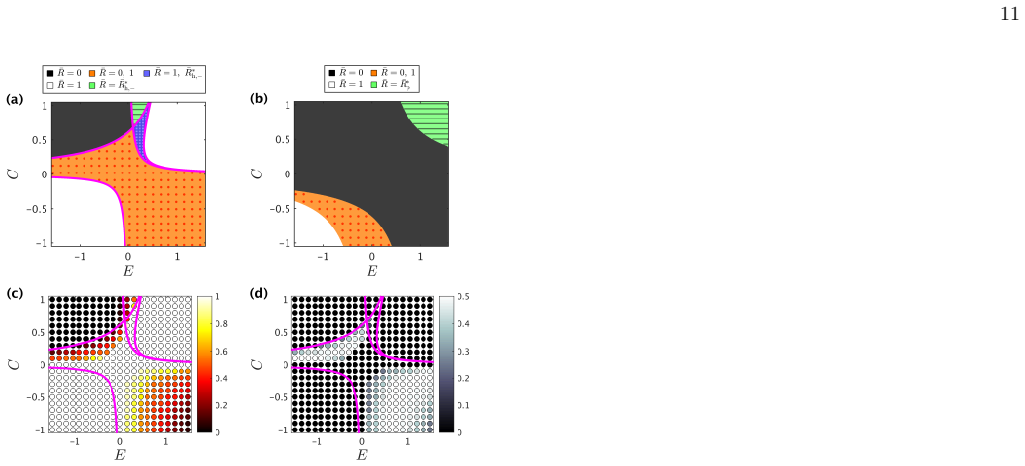
Time-delayed pairwise coupling in the Kuramoto model can be replaced, to second order in coupling strength times delay, by delay-free higher-order interactions. The resulting higher-order model, reduced by the Ott–Antonsen ansatz and second-order averaging, yields a one-dimensional equation for the order parameter whose stability diagram correctly predicts monostable, intermediate, and bistable synchronization states of the original delayed network—states that the conventional pairwise phase-lag approximation cannot capture—and supplies the feedback gains that realize those states in direct simulations.
What carries the argument
The averaged higher-order reduced equation for the order parameter (Eq. 10), obtained by expanding delayed pairwise interactions into effective three-body terms, applying the Ott–Antonsen ansatz, and performing second-order averaging; its fixed-point stability conditions design the linear and nonlinear mean-field feedbacks.
Load-bearing premise
The expansion that turns delays into higher-order couplings stays accurate only when the product of coupling strength and delay is small enough that neglected higher-order terms remain tiny.
What would settle it
Choose feedback gains C and E from the higher-order formula so that an intermediate order-parameter value R_ref is predicted stable; if direct integration of the original delayed Kuramoto equations at moderate ϵτ fails to converge to that R_ref (or fails to show the predicted bistability with full synchrony), the claim is refuted.
If this is right
- Linear mean-field feedback designed from the higher-order reduction creates a bistable window between full synchrony and incoherence that the pairwise reduction never produces.
- Nonlinear feedback of the form CR(R−E)cosΨ can stabilize any chosen intermediate synchronization level by solving the higher-order reduced equation for C and E.
- Global prediction error against direct delayed simulations is substantially lower for the higher-order reduced equation than for the pairwise equation across the tested delays.
- The same gains transfer from the one-dimensional surrogate to the original infinite-dimensional delayed network, realizing the predicted monostable and bistable states.
- Analysis and controller design for delayed oscillator networks can be performed entirely on a finite-dimensional ordinary differential equation.
Where Pith is reading between the lines
- The same delay-to-higher-order substitution could turn other delayed network models (neural masses, power-grid swing equations) into ordinary systems that admit low-dimensional control design.
- When delay is not small the error concentrates at the edges of bistable regions, suggesting that an adaptive or next-order expansion would restore accuracy for larger ϵτ.
- Because the surrogate is one-dimensional, real-time optimal or model-predictive control of delayed oscillator ensembles becomes computationally realistic.
- Observed three-body correlations in real delayed networks may partly be signatures of propagation lag rather than genuine multi-body coupling.
Editorial analysis
A structured set of objections, weighed in public.
Referee Report
Summary. The paper develops a delay-free control framework for the time-delayed Kuramoto model by approximating delayed pairwise interactions as effective higher-order (three-body) interactions for small ετ. After the higher-order expansion (Eq. 2), the Ott–Antonsen ansatz yields a closed equation for the complex order parameter (Eq. 3); second-order averaging then produces a one-dimensional ODE for the averaged order parameter R̄ (Eq. 10). Two mean-field feedback laws are designed from this reduced equation: linear feedback u = CR cos Ψ that stabilizes the incoherent and fully synchronized states (and their bistability), and nonlinear feedback u = CR(R-E) cos Ψ that can stabilize arbitrary intermediate R_ref. Stability diagrams and Global RMSE comparisons against the conventional pairwise (Sakaguchi–Kuramoto) reduction (Eq. 14) are given, and direct simulations of the original delayed system (Eq. 1) confirm that the higher-order design realizes monostable, intermediate, and bistable targets more accurately than the pairwise baseline.
Significance. If the reductions remain faithful, the work supplies a practical, finite-dimensional route to control delayed oscillator networks without solving infinite-dimensional delay equations. The explicit comparison with the pairwise baseline (Tables I–II, Figs. 1–2, 5–6) and the successful realization of intermediate and bistable states that the first-order phase-lag model cannot produce are concrete advances. The derivation chain (higher-order expansion o OA manifold o second-order averaging) is fully written out in Appendix A, and the control constructions follow directly from elementary linearization of the reduced fixed points. The limitation to small ετ is quantified rather than hidden, which strengthens rather than weakens the contribution for the regime in which the method is intended to apply.
minor comments (4)
- In Sec. II the control term is written without delay while the interactions carry delay τ; a brief remark on why control delay is neglected (or how it could be included) would clarify the modeling assumptions.
- Appendix B and Figs. 5–6 already document the degradation for larger τ; a short sentence in the main text (e.g., near Tables I–II) stating the practical range of ετ for which Global RMSE remains below a chosen threshold would help readers apply the method.
- Notation for the averaged variables (R̄, Ψ̄) versus the original (R, Ψ) is introduced carefully in Sec. III but occasionally slips in the figure captions; consistent use would improve readability.
- The phase distributions in Figs. 3–4 are informative; adding the corresponding theoretical OA density (or a brief note that it is not available after averaging) would complete the comparison.
Circularity Check
Minor self-citation of the higher-order delay approximation from overlapping authors’ prior arXiv; control design, fixed-point analysis, and validation against direct delayed simulations remain independent.
specific steps
-
self citation load bearing
[Sec. II, paragraph introducing Eq. (2)]
"As shown in Ref. 55, the time-delayed interactions in Eq. (1) can be approximated by higher-order interactions for small coupling strength ϵ, yielding the following delay-free Kuramoto model with higher-order interactions…"
The entire delay-free control framework rests on the higher-order interaction expansion of Ref. 55 (arXiv:2512.16193), whose author list overlaps with the present paper (Fujii, Nakao). While the subsequent OA + averaging reductions and the numerical validation against the original delayed system are independent, the foundational approximation itself is imported by self-citation rather than re-derived here.
full rationale
The paper’s derivation chain begins from the time-delayed Kuramoto model (Eq. 1), replaces the delay by a higher-order interaction expansion taken from Ref. 55 (overlapping authors Fujii & Nakao), then applies the standard Ott–Antonsen ansatz followed by second-order averaging to obtain the closed 1-D order-parameter ODE (Eq. 10). Fixed points and stability boundaries are obtained by elementary algebraic analysis of that ODE; control gains C and E are chosen so that the desired R_ref is a stable fixed point of the reduced equation; the resulting predictions are tested by direct numerical integration of the original infinite-dimensional delayed system and compared with the conventional pairwise (Sakaguchi–Kuramoto) reduction on identical trajectories. No free parameters are fitted to the delayed data and then re-used as “predictions.” The only self-citation that is load-bearing for the framework is the higher-order expansion itself; once that expansion is granted, every subsequent step (OA reduction, averaging, fixed-point design, RMSE comparison) is self-contained and externally falsifiable by simulation of Eq. 1. This matches the pattern of ordinary scientific reuse of prior asymptotic results rather than circular self-definition or fitted-input-as-prediction. Hence a low circularity score of 2 is appropriate.
Axiom & Free-Parameter Ledger
free parameters (3)
- coupling strength ϵ =
0.1
- time delay τ =
2.9 / 6.8
- control gains C, E
axioms (4)
- domain assumption Ott–Antonsen ansatz closes the infinite hierarchy of Fourier modes for Lorentzian (and, by limit, identical) frequency distributions.
- standard math Second-order averaging eliminates the fast phase Ψ while retaining O(ϵ²) accuracy.
- ad hoc to paper The product ϵτ is small enough that O(ϵ³τ²) terms may be neglected and the higher-order expansion (2) remains quantitatively accurate.
- domain assumption Natural frequencies are identical (or Lorentzian with γ→0⁺) and coupling is global all-to-all.
read the original abstract
We propose a framework for controlling the collective dynamics of the time-delayed Kuramoto model based on a delay-free, higher-order approximation of the delayed interactions. By applying the Ott--Antonsen ansatz and the second-order averaging method to the resulting higher-order Kuramoto model, we obtain a one-dimensional reduced equation for the order parameter dynamics. Numerical simulations demonstrate that the higher-order approximation predicts the dynamics of the original delayed system more accurately than the conventional pairwise approximation and enables the realization of bistability and intermediate synchronization states. Our results demonstrate the effectiveness of higher-order interpretations of time delays for the control of oscillator networks with time-delayed interactions.
Figures



Reference graph
Works this paper leans on
-
[1]
Arthur T. Winfree. The Geometry of Biological Time . Springer-Verlag, Berlin, Germany, 1980
1980
-
[2]
From clocks to chaos: The rhythms of life
Leon Glass and Michael C Mackey. From clocks to chaos: The rhythms of life . Princeton University Press, 1988
1988
-
[3]
Strogatz and Ian Stewart
Steven H. Strogatz and Ian Stewart. Coupled oscillators and biological synchronization. Scientific American , 269(6):102--109, 1993
1993
-
[4]
Physics of the human cardiovascular system
Aneta Stefanovska. Physics of the human cardiovascular system. Contemporary Physics , 40(1):31--55, 1999
1999
-
[5]
Synchronization: A Universal Concept in Nonlinear Sciences
Arkady Pikovsky, Michael Rosenblum, and Jürgen Kurths. Synchronization: A Universal Concept in Nonlinear Sciences . Cambridge Nonlinear Science Series. Cambridge University Press, 2001
2001
-
[6]
Chemical oscillations, waves, and turbulence
Yoshiki Kuramoto. Chemical oscillations, waves, and turbulence . Chemistry Series. Dover Publications, 2003. originally published: Springer Berlin, New York, Heidelberg, 1984
2003
-
[7]
Arenas, A
A. Arenas, A. D \' i az-Guilera, J. Kurths, Y. Moreno, and C. Zhou. Synchronization in complex networks . Phys. Rep. , 469(3):93--153, 2008
2008
-
[8]
Bard Ermentrout and David H
G. Bard Ermentrout and David H. Terman. Mathematical Foundations of Neuroscience . Springer, New York, 2010
2010
-
[9]
Golombek and Ruth E
Diego A. Golombek and Ruth E. Rosenstein. Physiology of circadian entrainment. Physiological Reviews , 90(3):1063--1102, 2010. PMID: 20664079
2010
-
[10]
Physics of cardiac arrhythmogenesis
Alain Karma. Physics of cardiac arrhythmogenesis. Annual Review of Condensed Matter Physics , 4(Volume 4, 2013):313--337, 2013
2013
-
[11]
Self-organized synchronization in decentralized power grids
Martin Rohden, Andreas Sorge, Marc Timme, and Dirk Witthaut. Self-organized synchronization in decentralized power grids. Phys. Rev. Lett. , 109:064101, Aug 2012
2012
-
[12]
Synchronization in complex oscillator networks and smart grids
Florian Dörfler, Michael Chertkov, and Francesco Bullo. Synchronization in complex oscillator networks and smart grids. Proceedings of the National Academy of Sciences , 110(6):2005--2010, 2013
2005
-
[13]
From fireflies to fault-tolerant swarms of robots
Anders Lyhne Christensen, Rehan OGrady, and Marco Dorigo. From fireflies to fault-tolerant swarms of robots. IEEE Transactions on Evolutionary Computation , 13(4):754--766, 2009
2009
-
[14]
Canards for a reduction of the H odgkin- H uxley equations
Jeff Moehlis. Canards for a reduction of the H odgkin- H uxley equations. Journal of Mathematical Biology , 52:141--153, 2006
2006
-
[15]
Optimal inputs for phase models of spiking neurons
Jeff Moehlis, Eric Shea-Brown, and Herschel Rabitz. Optimal inputs for phase models of spiking neurons. Journal of Computational and Nonlinear Dynamics , 1(4):358--367, 06 2006
2006
-
[16]
Desynchronization and inhibition of kuramoto oscillators by scalar mean-field feedback
Alessio Franci, Antoine Chaillet, Elena Panteley, and Fran c oise Lamnabhi-Lagarrigue. Desynchronization and inhibition of kuramoto oscillators by scalar mean-field feedback. Mathematics of Control, Signals, and Systems , 24(1):169--217, 2012
2012
-
[17]
Optimal waveform for fast entrainment of weakly forced nonlinear oscillators
Anatoly Zlotnik, Yifei Chen, Istv \'a n Z Kiss, Hisa-Aki Tanaka, and Jr-Shin Li. Optimal waveform for fast entrainment of weakly forced nonlinear oscillators. Phys. Rev. Lett. , 111(2):024102, 2013
2013
-
[18]
Phase-selective entrainment of nonlinear oscillator ensembles
Anatoly Zlotnik, Raphael Nagao, István Kiss, and Jr-Shin Li. Phase-selective entrainment of nonlinear oscillator ensembles. Nature Communications , 7:10788, 03 2016
2016
-
[19]
Optimal weighted networks of phase oscillators for synchronization
Takuma Tanaka and Toshio Aoyagi. Optimal weighted networks of phase oscillators for synchronization. Phys. Rev. E , 78:046210, Oct 2008
2008
-
[20]
Collective phase sensitivity
Yoji Kawamura, Hiroya Nakao, Kensuke Arai, Hiroshi Kori, and Yoshiki Kuramoto. Collective phase sensitivity. Phys. Rev. Lett. , 101:024101, Jul 2008
2008
-
[21]
Omel'chenko, and Matthias Wolfrum
Jan Sieber, Oleh E. Omel'chenko, and Matthias Wolfrum. Controlling unstable chaos: Stabilizing chimera states by feedback. Phys. Rev. Lett. , 112:054102, Feb 2014
2014
-
[22]
Control of coupled oscillator networks with application to microgrid technologies
Per Sebastian Skardal and Alex Arenas. Control of coupled oscillator networks with application to microgrid technologies. Science Advances , 1(7):e1500339, 2015
2015
-
[23]
Phase reduction and phase-based optimal control for biological systems: a tutorial
Bharat Monga, Dan Wilson, Tim Matchen, and Jeff Moehlis. Phase reduction and phase-based optimal control for biological systems: a tutorial. Biol. Cybern , 113(1-2):11--46, Apr 2019
2019
-
[24]
Fast optimal entrainment of limit-cycle oscillators by strong periodic inputs via phase-amplitude reduction and floquet theory
Shohei Takata, Yuzuru Kato, and Hiroya Nakao. Fast optimal entrainment of limit-cycle oscillators by strong periodic inputs via phase-amplitude reduction and floquet theory. Chaos: An Interdisciplinary Journal of Nonlinear Science , 31(9):093124, 09 2021
2021
-
[25]
Optimization of periodic input waveforms for global entrainment of weakly forced limit-cycle oscillators
Yuzuru Kato, Anatoly Zlotnik, Jr-Shin Li, and Hiroya Nakao. Optimization of periodic input waveforms for global entrainment of weakly forced limit-cycle oscillators. Nonlinear Dynamics , 105(3):2247--2263, 2021
2021
-
[26]
Feedback-induced desynchronization and oscillation quenching in a population of globally coupled oscillators
Ayumi Ozawa and Hiroshi Kori. Feedback-induced desynchronization and oscillation quenching in a population of globally coupled oscillators. Phys. Rev. E , 103:062217, Jun 2021
2021
-
[27]
Optimal control of velocity and nonlocal interactions in the mean-field kuramoto model
Carlo Sinigaglia, Francesco Braghin, and Spring Berman. Optimal control of velocity and nonlocal interactions in the mean-field kuramoto model. In 2022 American Control Conference (ACC) , pages 290--295, 2022
2022
-
[28]
Phase-amplitude reduction and optimal phase locking of collectively oscillating networks
Petar Mircheski, Jinjie Zhu, and Hiroya Nakao. Phase-amplitude reduction and optimal phase locking of collectively oscillating networks. Chaos: An Interdisciplinary Journal of Nonlinear Science , 33(10):103111, 10 2023
2023
-
[29]
Phase autoencoder for limit-cycle oscillators
Koichiro Yawata, Kai Fukami, Kunihiko Taira, and Hiroya Nakao. Phase autoencoder for limit-cycle oscillators. Chaos: An Interdisciplinary Journal of Nonlinear Science , 34(6):063111, 06 2024
2024
-
[30]
Optimal phase-based control of strongly perturbed limit cycle oscillators using phase reduction techniques
Adharaa Neelim Dewanjee and Dan Wilson. Optimal phase-based control of strongly perturbed limit cycle oscillators using phase reduction techniques. Phys. Rev. E , 109:024223, Feb 2024
2024
-
[31]
Optimal coupling functions for fast and global synchronization of weakly coupled limit-cycle oscillators
Norihisa Namura and Hiroya Nakao. Optimal coupling functions for fast and global synchronization of weakly coupled limit-cycle oscillators. Chaos, Solitons & Fractals , 185:115080, 2024
2024
-
[32]
Optimal phase control of limit-cycle oscillators with strong inputs through phase-amplitude reduction
Norihisa Namura and Hiroya Nakao. Optimal phase control of limit-cycle oscillators with strong inputs through phase-amplitude reduction. In 2024 IEEE 63rd Conference on Decision and Control (CDC) , pages 4003--4009, 2024
2024
-
[33]
Hamiltonian control to desynchronize kuramoto oscillators with higher-order interactions
Martin Moriam\'e, Maxime Lucas, and Timoteo Carletti. Hamiltonian control to desynchronize kuramoto oscillators with higher-order interactions. Phys. Rev. E , 111:044307, Apr 2025
2025
-
[34]
G. B. Ermentrout and N. Kopell. Fine structure of neural spiking and synchronization in the presence of conduction delays. Proceedings of the National Academy of Sciences , 95(3):1259--1264, 1998
1998
-
[35]
Tilmann Heil, Ingo Fischer, Wolfgang Els\"asser, Josep Mulet, and Claudio R. Mirasso. Chaos synchronization and spontaneous symmetry-breaking in symmetrically delay-coupled semiconductor lasers. Phys. Rev. Lett. , 86:795--798, Jan 2001
2001
-
[36]
Izhikevich
Eugene M. Izhikevich. Polychronization: Computation with spikes. Neural Comput. , 18(2):245–282, February 2006
2006
-
[37]
H. G. Schuster and P. Wagner. Mutual entrainment of two limit cycle oscillators with time delayed coupling. Progress of Theoretical Physics , 81(5):939--945, 05 1989
1989
-
[38]
Schuster, and Daniel M
Ernst Niebur, Heinz G. Schuster, and Daniel M. Kammen. Collective frequencies and metastability in networks of limit-cycle oscillators with time delay. Phys. Rev. Lett. , 67:2753--2756, Nov 1991
1991
-
[39]
Collective synchronization of pulse-coupled oscillators and excitable units
Yoshiki Kuramoto. Collective synchronization of pulse-coupled oscillators and excitable units. Physica D: Nonlinear Phenomena , 50(1):15--30, 1991
1991
-
[40]
M. K. Stephen Yeung and Steven H. Strogatz. Time delay in the K uramoto model of coupled oscillators. Phys. Rev. Lett. , 82:648--651, Jan 1999
1999
-
[41]
M. Y. Choi, H. J. Kim, D. Kim, and H. Hong. Synchronization in a system of globally coupled oscillators with time delay. Phys. Rev. E , 61:371--381, Jan 2000
2000
-
[42]
Earl and Steven H
Matthew G. Earl and Steven H. Strogatz. Synchronization in oscillator networks with delayed coupling: A stability criterion. Phys. Rev. E , 67:036204, Mar 2003
2003
-
[43]
Acebr\'on, L
Juan A. Acebr\'on, L. L. Bonilla, Conrad J. P\'erez-Vicente, F\'elix Ritort, and Renato Spigler. The K uramoto model: A simple paradigm for synchronization phenomena. Rev. Mod. Phys. , 77:137--185, Apr 2005
2005
-
[44]
Exact explosive synchronization transitions in kuramoto oscillators with time-delayed coupling
Hui Wu, Ling Kang, Zonghua Liu, and Mukesh Dhamala. Exact explosive synchronization transitions in kuramoto oscillators with time-delayed coupling. Scientific Reports , 8(1):15521, 2018
2018
-
[45]
Bard Ermentrout
Kiyoshi Kotani, Ikuhiro Yamaguchi, Yutaro Ogawa, Yasuhiko Jimbo, Hiroya Nakao, and G. Bard Ermentrout. Adjoint method provides phase response functions for delay-induced oscillations. Phys. Rev. Lett. , 109:044101, Jul 2012
2012
-
[46]
Nonlinear phase-amplitude reduction of delay-induced oscillations
Kiyoshi Kotani, Yutaro Ogawa, Sho Shirasaka, Akihiko Akao, Yasuhiko Jimbo, and Hiroya Nakao. Nonlinear phase-amplitude reduction of delay-induced oscillations. Phys. Rev. Res. , 2:033106, Jul 2020
2020
-
[47]
A. Ross, S. N. Kyrychko, K. B. Blyuss, and Y. N. Kyrychko. Dynamics of coupled kuramoto oscillators with distributed delays. Chaos: An Interdisciplinary Journal of Nonlinear Science , 31(10):103107, 10 2021
2021
-
[48]
Time-delayed kuramoto model in the watts–strogatz small-world networks
Sara Ameli, Maryam Karimian, and Farhad Shahbazi. Time-delayed kuramoto model in the watts–strogatz small-world networks. Chaos: An Interdisciplinary Journal of Nonlinear Science , 31(11):113125, 11 2021
2021
-
[49]
A soluble active rotater model showing phase transitions via mutual entertainment
Hidetsugu Sakaguchi and Yoshiki Kuramoto. A soluble active rotater model showing phase transitions via mutual entertainment. Progress of Theoretical Physics , 76(3):576--581, 09 1986
1986
-
[50]
Laing, and Erik A
Christian Bick, Marc Goodfellow, Carlo R. Laing, and Erik A. Martens. Understanding the dynamics of biological and neural oscillator networks through exact mean-field reductions: a review. The Journal of Mathematical Neuroscience , 10(1):9, 2020
2020
-
[51]
Smirnov and Arkady Pikovsky
Lev A. Smirnov and Arkady Pikovsky. Dynamics of oscillator populations globally coupled with distributed phase shifts. Phys. Rev. Lett. , 132:107401, Mar 2024
2024
-
[52]
Slow switching in globally coupled oscillators: robustness and occurrence through delayed coupling
Hiroshi Kori and Yoshiki Kuramoto. Slow switching in globally coupled oscillators: robustness and occurrence through delayed coupling. Phys. Rev. E , 63:046214, Mar 2001
2001
-
[53]
M.A. Lohe. Synchronization control in networks with uniform and distributed phase lag. Automatica , 54:114--123, 2015
2015
-
[54]
Christian Bick, Bob Rink, and Babette A. J. de Wolff. When time delays and phase lags are not the same: higher-order phase reduction unravels delay-induced synchronization in oscillator networks, 2024
2024
-
[55]
Emergence of higher-order interactions in systems of coupled kuramoto oscillators with time delay
Narumi Fujii, Keisuke Taga, Riccardo Muolo, Bob Rink, and Hiroya Nakao. Emergence of higher-order interactions in systems of coupled kuramoto oscillators with time delay. arXiv preprint arXiv:2512.16193 , 2025
Pith/arXiv arXiv 2025
-
[56]
L. A. Smirnov, V. O. Munyayev, M. I. Bolotov, and I. Belykh. From delay to inertia and triadic interactions: A predictive model for time-delayed oscillator networks, 2026
2026
-
[57]
Battiston, G
F. Battiston, G. Cencetti, I. Iacopini, V. Latora, M. Lucas, A. Patania, J.-G. Young, and G. Petri. Networks beyond pairwise interactions: structure and dynamics. Phys. Rep. , 874:1--92, 2020
2020
-
[58]
Carletti, D
T. Carletti, D. Fanelli, and S. Nicoletti. Dynamical systems on hypergraphs. J. Phys. Complex. , 1(3):035006, 2020
2020
-
[59]
Bianconi
G. Bianconi. Higher- O rder N etworks: A n introduction to simplicial complexes . Cambridge U niversity P ress, 2021
2021
-
[60]
Battiston, E
F. Battiston, E. Amico, A. Barrat, G. Bianconi, G.F. de Arruda, B. Franceschiello, I. Iacopini, S. Kéfi, V. Latora, Y. Moreno, M.M. Murray, T.P. Peixoto, F. Vaccarino, and G. Petri. The physics of higher-order interactions in complex systems. Nat. Phys. , 17:1093--1098, 2021
2021
-
[61]
Majhi, M
S. Majhi, M. Perc, and D. Ghosh. Dynamics on higher-order networks: a review. Journal of The Royal Society Interface , 19(188):20220043, 2022
2022
-
[62]
Bick, Elizabeth Gross, Heather A Harrington, and Michael T Schaub
C. Bick, Elizabeth Gross, Heather A Harrington, and Michael T Schaub. What are higher-order networks? SIAM Rev. , 65(3):686--731, 2023
2023
-
[63]
Boccaletti, P
S. Boccaletti, P. De Lellis, C.I. Del Genio, K. Alfaro-Bittner, R. Criado, S. Jalan, and M. Romance. The structure and dynamics of networks with higher order interactions. Phys. Rep. , 1018:1--64, 2023
2023
-
[64]
Muolo, L
R. Muolo, L. Giambagli, H. Nakao, D. Fanelli, and T. Carletti. Turing patterns on discrete topologies: from networks to higher-order structures. Proceedings of the Royal Society A , 480(2302):20240235, 2024
2024
-
[65]
Deeper but smaller: Higher-order interactions increase linear stability but shrink basins
Yuanzhao Zhang, Per Sebastian Skardal, Federico Battiston, Giovanni Petri, and Maxime Lucas. Deeper but smaller: Higher-order interactions increase linear stability but shrink basins. Science Advances , 10(40):eado8049, 2024
2024
-
[66]
Mill \'a n, H
A.P. Mill \'a n, H. Sun, L. Giambagli, R. Muolo, T. Carletti, J.J. Torres, F. Radicchi, J. Kurths, and G. Bianconi. Topology shapes dynamics of higher-order networks. Nature Physics , 21:353--361, 2025
2025
-
[67]
F. Battiston, C. Bick, M. Lucas, A.P. Mill \'a n, P.S. Skardal, and Y. Zhang. Collective dynamics on higher-order networks. arXiv preprint arXiv:2510.05253 , 2025
arXiv 2025
-
[68]
Ott and T.M
E. Ott and T.M. Antonsen. Low dimensional behavior of large systems of globally coupled oscillators. Chaos: An Interdisciplinary Journal of Nonlinear Science , 18(3), September 2008
2008
-
[69]
Sanders, Ferdinand Verhulst, and James Murdock
Jan A. Sanders, Ferdinand Verhulst, and James Murdock. Averaging Methods in Nonlinear Dynamical Systems , volume 59 of Applied Mathematical Sciences . Springer, New York, 2 edition, 2007
2007
-
[70]
H. Nakao. Phase reduction approach to synchronisation of nonlinear oscillators. Contemporary Physics , 57(2):188--214, 2016
2016
-
[71]
Antonsen
Wai Shing Lee, Edward Ott, and Thomas M. Antonsen. Large coupled oscillator systems with heterogeneous interaction delays. Phys. Rev. Lett. , 103:044101, Jul 2009
2009
-
[72]
Existence and robustness of phase-locking in coupled K uramoto oscillators under mean-field feedback
Alessio Franci, Antoine Chaillet, and William Pasillas-L \'e pine. Existence and robustness of phase-locking in coupled K uramoto oscillators under mean-field feedback. Automatica , 47(6):1193--1202, 2011
2011
discussion (0)
Sign in with ORCID, Apple, or X to comment. Anyone can read and Pith papers without signing in.