REVIEW 4 major objections 6 minor 60 references
A source-only module improves eye-disease classification on unseen populations by damping edge shortcuts and scoring disease by angle, not activation strength.
Reviewed by Pith at T0; open to challenge. T0 means a machine referee read the full paper against a public rubric. the ladder, T0–T4 →
T0 review · grok-4.5
2026-07-14 09:19 UTC pith:ABN5GWTG
load-bearing objection Solid source-only plug-in with consistent external F1 gains on a strict White-only FairVision protocol; compositional novelty, modest absolute numbers, and an under-checked edge prior, but still worth a referee. the 4 major comments →
RED-Sphere: Hyperspherical Residual Edge Debiasing for Cross-Population Fundus Disease Domain Generalization
The pith
A machine-rendered reading of the paper's core claim, the machinery that carries it, and where it could break.
Core claim
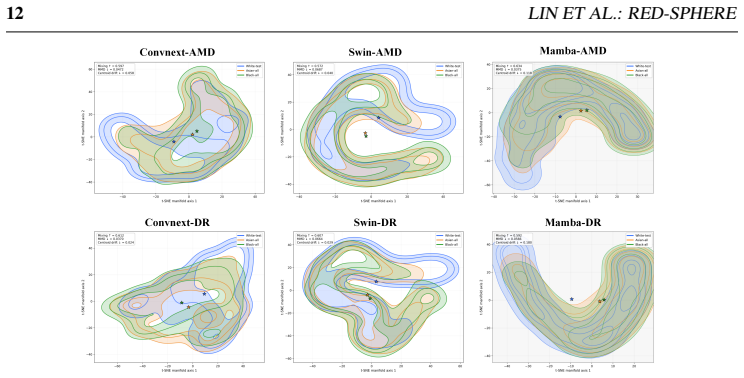
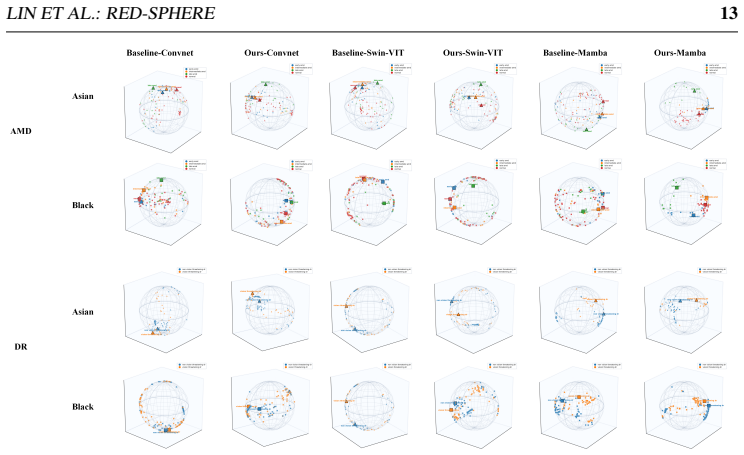
Under a strict White-only Harvard-FairVision 2D SLO protocol—external Asian and Black cohorts unseen for optimization, validation, scheduling, hyperparameters, and model selection—attaching RED-Sphere to a visual backbone improves held-out macro-F1 across all 20 task–backbone comparisons (average +1.28 F1 on AMD, +2.98 on DR), with gains in AUC and PR-AUC and visual evidence of stronger source–external semantic overlap and more coherent angular disease geometry.
What carries the argument
RED-Sphere: residual soft gating of an edge-and-feature-energy nuisance mask (preserving a direct residual path), counterfactual-inspired consistency and separation losses on the masked nuisance view during training only, and spherical prototype classification by cosine similarity of normalized embeddings, so prediction favors angular disease semantics over population-correlated activation magnitude.
Load-bearing premise
The method assumes that a Sobel edge map plus local feature-energy map, softly gated with a residual path, can damp population-linked appearance shortcuts without systematically erasing the same low-level edge structure that carries diagnostic lesions.
What would settle it
If, under the same White-only selection rule and matched backbones, RED-Sphere fails to raise held-out Asian/Black macro-F1 (and AUC/PR-AUC) relative to the base classifier on AMD or DR, or if lesion-bearing edges are visibly suppressed in the semantic stream while external disease ranking collapses, the central claim fails.
Editorial analysis
A structured set of objections, weighed in public.
Referee Report
Summary. The paper proposes RED-Sphere, a plug-and-play module for source-only cross-population medical image classification. It estimates shortcut-sensitive responses via a Sobel edge map and local feature-energy prior, attenuates them with residual soft gating, regularizes a masked nuisance feature view with KL consistency and directional separation losses, and classifies with class-aware spherical prototypes. Under a strict White-only Harvard-FairVision 2D SLO protocol (Asian/Black cohorts fully held out from optimization, validation, scheduling, and model selection), the method is reported to improve held-out macro-F1 in all 20 task–backbone comparisons (average +1.28 F1 on AMD, +2.98 on DR), with supporting AUC/PR-AUC gains, ablations, sensitivity analyses, and semantic-manifold/sphere/margin visualizations.
Significance. Source-only cross-population robustness is a practically important and under-served setting in medical imaging, where target demographics are often unavailable before deployment. The experimental protocol is carefully designed and stronger than many fairness/DG evaluations: matched Base vs Ours comparisons across ten architectural families, three seeds, and fully held-out external cohorts. If the gains are real and the residual edge mechanism is doing what is claimed, RED-Sphere is a useful, backbone-agnostic robustness layer and a clear template for modality-specific nuisance priors. The combination of residual gating, feature-space nuisance regularization, and angular prototypes is incremental rather than foundational, but the controlled multi-backbone evidence and strict selection discipline are genuine strengths of the submission.
major comments (4)
- §3.3 (mask M=σ(h_φ([E;Q])) and residual gate eF=F⊙(1+ρ−αM)) and the abstract/conclusion claim that the method “preserves lesion structure” while attenuating population-correlated edges/textures: the paper itself states that lesions and shortcuts share edge/texture structure, yet there is no quantitative check that high-M regions are predominantly non-lesion, or that F_sem retains lesion-local evidence on Asian/Black images (e.g., lesion-mask overlap, expert-annotated ROI activation, or controlled lesion-edge retention metrics). Without this, the uniform Table 2 gains and Figure 4–6 diagnostics could largely reflect spherical prototypes, adaptive margins, and consistency losses rather than safe residual shortcut isolation. Either add such evidence or substantially soften the lesion-preservation and “modality-specific nuisance prior” transfer claims.
- §4.3 / Table 2: the only controlled comparison is matched Base vs RED-Sphere on the same backbone. Under the same White-only protocol, the paper does not report other source-only robustness/DG baselines (e.g., strong augmentation/MixStyle-style feature perturbation, RSC, SWAD, spherical prototypes alone, or simple magnitude normalization). Given that Table 3 shows non-trivial drops when removing the spherical classifier or adaptive margin, it is currently unclear how much of the all-20 F1 claim is due to residual edge debiasing versus angular geometry and training regularization. At least a small set of competitive source-only alternatives on the same splits is needed for the central methodological claim.
- Table 3 and §4.5–4.6: ablations remove the counterfactual branch, adaptive margin, and spherical classifier, and sensitivity varies ρ and α0, but there is no ablation of the edge–energy prior itself (edge-only, energy-only, random/uniform mask, or learned mask without E/Q conditioning). This is load-bearing for the paper’s distinctive mechanism. If a random residual gate plus spherical classification recovers most of the gain, the interpretation of RED-Sphere as residual edge debiasing is not supported. Please add this control on the same three representative backbones.
- Table 2 absolute levels and mixed ranking metrics: external AMD macro-F1 remains roughly 23–29% on a four-class task, and DR ConvNeXt-Tiny gains +5.68 F1 while AUC and PR-AUC decrease. The manuscript treats macro-F1 as primary and notes class imbalance, but does not adequately discuss clinical meaningfulness of ~1–3 average F1 points, calibration/operating-point shifts, or when ranking metrics disagree with F1. A short analysis of per-class external F1 (especially rare AMD grades / VTDR) and explicit discussion of these tradeoffs is needed before the “stronger external semantic alignment” claim can be accepted at face value.
minor comments (6)
- Inconsistent hyphenation and spacing throughout (e.g., “source only” vs “source-only”, “plug and play”, “T yne”, “T echnology”, “Y an Lin”). Normalize terminology and clean author/affiliation formatting.
- Figure 2 is described as a teaser of all 20 comparisons, but the main text does not state whether points are seed-averaged or best-seed; clarify and match Table 2 reporting.
- §3.5 margin formula uses source class counts n_c; state explicitly that this uses only White training counts and does not leak external prevalence.
- Implementation details defer full hyperparameters to supplementary material; for reproducibility, list λ_cf, λ_orth, λ_mask, α_min/α_max, m_min/m_max, and D in the main text or a compact table.
- Related work cites several fairness/DG methods; a short table contrasting required supervision (group labels, target data, image synthesis) would make the source-only positioning clearer.
- Figures 4–6 are informative but dense; define Mix/MMD/centroid-drift formulas in the caption or appendix and ensure color/marker legends remain readable in grayscale.
Circularity Check
No significant circularity: empirical plug-and-play module whose external F1/AUC gains are measured on cohorts excluded from every selection stage.
full rationale
RED-Sphere is an engineering framework (edge+energy prior M=σ(h_φ([E;Q])), residual gate eF=F⊙(1+ρ−αM), KL consistency + orthogonality on nuisance views, spherical prototypes with class-aware margin) whose central claim is empirical improvement under a strict source-only protocol. Asian and Black cohorts are never used for optimization, validation, scheduling, hyperparameter selection or model selection (§4.1, Table 1); White validation macro-F1 alone controls all selection. Table 2 therefore reports genuine held-out numbers, not quantities fitted to the reported external metrics. Ablations (Table 3) and sensitivity checks (§4.6) vary components or ρ/α0 and report signed changes; they do not redefine the target F1 by construction. Hyperparameters are ordinary White-validation tuning, not self-definitional fits that force the external scores. No uniqueness theorem, load-bearing self-citation chain, or ansatz-smuggled derivation appears; related-work citations supply background, not the result. The residual-gate and spherical-classifier equations are design choices, not reductions of a claimed first-principles prediction to its own inputs. Hence the derivation chain contains none of the enumerated circular patterns.
Axiom & Free-Parameter Ledger
free parameters (5)
- residual preservation coefficient ρ =
0.50
- initial suppression coefficient α0 (and clip bounds) =
0.20
- nuisance loss weights λ_cf, λ_orth, λ_mask =
fixed (values in supplementary)
- hyperspherical temperature s and class margins m_min/m_max =
s=16; m from source class counts
- semantic embedding dimension D =
256
axioms (5)
- domain assumption Retinal images encode population-correlated information via pigmentation, luminance, color, vessel maps, and edge/texture strength that can act as disease shortcuts.
- domain assumption Disease evidence (drusen, hemorrhages, exudates, lesion boundaries) shares edge/texture structure with those shortcuts, so hard removal is unsafe and residual gating is required.
- domain assumption Angular similarity on normalized embeddings is less sensitive to illumination/contrast/population-correlated magnitude than raw feature norms.
- ad hoc to paper Feature-space masked nuisance views with KL consistency and directional separation are a safe substitute for image-level demographic counterfactuals under source-only constraints.
- standard math Standard deep learning optimization (AdamW, focal loss, ImageNet-normalized 224 inputs) yields comparable Base vs Ours comparisons when only the RED-Sphere module differs.
invented entities (3)
-
Edge–feature-energy shortcut mask M = σ(h_φ([E;Q]))
no independent evidence
-
Residual soft-gated semantic stream F_sem with refiners r_φ, c_φ
no independent evidence
-
Feature-space counterfactual-inspired nuisance view F_nuis with L_cf and L_orth
no independent evidence
read the original abstract
Medical image classifiers are often trained within one source population, yet clinical deployment requires robustness to patients whose appearance, acquisition style, and disease prevalence differ from the source cohort. Existing fairness and robustness methods often require group supervision or treat appearance variation as an undifferentiated nuisance, which is insufficient when population-correlated low-level cues and lesion evidence share edge and texture structure. We study a strict source-only cross-population setting, where external populations are unseen during optimization, validation, scheduling, hyperparameter and model selection. We propose RED-Sphere, a plug-and-play robustness framework for image classification under unseen population shifts. It estimates shortcut-sensitive nuisance responses with an edge and feature energy prior, attenuates dominant responses through residual soft gating, regularizes masked nuisance views with counterfactual-inspired consistency and separation losses, and predicts labels with normalized spherical prototypes. It favours angular semantic evidence over source-correlated activation magnitude while preserving lesion structure. Although demonstrated on 2D Scanning Laser Ophthalmoscopy (SLO) fundus classification for Age-Related Macular Degeneration (AMD) and Diabetic Retinopathy (DR), RED-Sphere is not tied to retinal anatomy: the same principle can be adapted with modality-specific nuisance priors wherever appearance shortcuts and semantic evidence are entangled. Under a strict White-only Harvard-FairVision protocol, RED-Sphere improves held-out macro-F1 across all 20 task and backbone comparisons, with average gains of 1.28 and 2.98 F1 points on AMD and DR. Gains in AUC and PR-AUC, visual diagnostics, ablations, and sensitivity analyses further support stronger external semantic alignment and more stable angular disease geometry.
Figures



Reference graph
Works this paper leans on
-
[1]
Distribution matching losses can hallucinate features in medical image translation
Joseph Paul Cohen, Margaux Luck, and Sina Honari. Distribution matching losses can hallucinate features in medical image translation. In Alejandro F. Frangi, Ju- lia A. Schnabel, Christos Davatzikos, Carlos Alberola-López, and Gabor Fichtinger, editors,Medical Image Computing and Computer Assisted Intervention - MICCAI 2018 - 21st International Conference...
2018
-
[2]
doi: 10.1007/978-3-030-00928-1\_60. URLhttps://doi.org/10. 1007/978-3-030-00928-1_60
-
[3]
Association of biomarker-based artificial intelligence with risk of racial bias in retinal images.JAMA ophthalmology, 141(6):543–552, 2023
Aaron S Coyner, Praveer Singh, James M Brown, Susan Ostmo, RV Paul Chan, Michael F Chiang, Jayashree Kalpathy-Cramer, and J Peter Campbell. Association of biomarker-based artificial intelligence with risk of racial bias in retinal images.JAMA ophthalmology, 141(6):543–552, 2023
2023
-
[4]
Arcface: Additive angular margin loss for deep face recognition.IEEE Trans
Jiankang Deng, Jia Guo, Jing Yang, Niannan Xue, Irene Kotsia, and Stefanos Zafeiriou. Arcface: Additive angular margin loss for deep face recognition.IEEE Trans. Pattern Anal. Mach. Intell., 44(10):5962–5979, 2022. doi: 10.1109/TPAMI.2021.3087709. URLhttps://doi.org/10.1109/TPAMI.2021.3087709
-
[5]
An image is worth 16x16 words: Trans- formers for image recognition at scale
Alexey Dosovitskiy, Lucas Beyer, Alexander Kolesnikov, Dirk Weissenborn, Xiaohua Zhai, Thomas Unterthiner, Mostafa Dehghani, Matthias Minderer, Georg Heigold, Syl- vain Gelly, Jakob Uszkoreit, and Neil Houlsby. An image is worth 16x16 words: Trans- formers for image recognition at scale. In9th International Conference on Learning Representations, ICLR 202...
2021
-
[6]
URLhttps://openreview.net/forum?id=YicbFdNTTy
-
[7]
Tsaftaris, and Timothy M
Raman Dutt, Ondrej Bohdal, Sotirios A. Tsaftaris, and Timothy M. Hospedales. Fair- tune: Optimizing parameter efficient fine tuning for fairness in medical image anal- ysis. InThe Twelfth International Conference on Learning Representations, ICLR 2024, Vienna, Austria, May 7-11, 2024. OpenReview.net, 2024. URLhttps: //openreview.net/forum?id=ArpwmicoYW
2024
-
[8]
Wich- mann, and Wieland Brendel
Robert Geirhos, Patricia Rubisch, Claudio Michaelis, Matthias Bethge, Felix A. Wich- mann, and Wieland Brendel. Imagenet-trained cnns are biased towards texture; in- creasing shape bias improves accuracy and robustness. In7th International Con- ference on Learning Representations, ICLR 2019, New Orleans, LA, USA, May 6-9,
2019
-
[9]
URLhttps://openreview.net/forum?id= Bygh9j09KX
OpenReview.net, 2019. URLhttps://openreview.net/forum?id= Bygh9j09KX. 16LIN ET AL.: RED-SPHERE
2019
-
[10]
Ai recognition of patient race in medical imaging: a modelling study.The Lancet Digital Health, 4(6):e406–e414, 2022
Judy Wawira Gichoya, Imon Banerjee, Ananth Reddy Bhimireddy, John L Burns, Leo Anthony Celi, Li-Ching Chen, Ramon Correa, Natalie Dullerud, Marzyeh Ghas- semi, Shih-Cheng Huang, et al. Ai recognition of patient race in medical imaging: a modelling study.The Lancet Digital Health, 4(6):e406–e414, 2022
2022
-
[11]
Algorith- mic encoding of protected characteristics in chest x-ray disease detection models
Ben Glocker, Charles Jones, Mélanie Bernhardt, and Stefan Winzeck. Algorith- mic encoding of protected characteristics in chest x-ray disease detection models. EBioMedicine, 89, 2023
2023
-
[12]
In search of lost domain generalization
Ishaan Gulrajani and David Lopez-Paz. In search of lost domain generalization. In 9th International Conference on Learning Representations, ICLR 2021, Virtual Event, Austria, May 3-7, 2021. OpenReview.net, 2021. URLhttps://openreview. net/forum?id=lQdXeXDoWtI
2021
-
[14]
Equality of opportunity in super- vised learning
Moritz Hardt, Eric Price, and Nati Srebro. Equality of opportunity in super- vised learning. In Daniel D. Lee, Masashi Sugiyama, Ulrike von Luxburg, Isabelle Guyon, and Roman Garnett, editors,Advances in Neural Information Processing Systems 29: Annual Conference on Neural Information Process- ing Systems 2016, December 5-10, 2016, Barcelona, Spain, pages...
2016
-
[15]
URLhttps://proceedings.neurips.cc/paper/2016/hash/ 9d2682367c3935defcb1f9e247a97c0d-Abstract.html
2016
-
[16]
Mambavision: A hybrid mamba-transformer vision backbone
Ali Hatamizadeh and Jan Kautz. Mambavision: A hybrid mamba-transformer vision backbone. InIEEE/CVF Conference on Computer Vision and Pattern Recognition, CVPR 2025, Nashville, TN, USA, June 11-15, 2025, pages 25261–25270. Com- puter Vision Foundation / IEEE, 2025. doi: 10.1109/CVPR52734.2025.02352. URLhttps://openaccess.thecvf.com/content/CVPR2025/ html/H...
-
[17]
Haibo He and Edwardo A. Garcia. Learning from imbalanced data.IEEE Trans. Knowl. Data Eng., 21(9):1263–1284, 2009. doi: 10.1109/TKDE.2008.239. URLhttps: //doi.org/10.1109/TKDE.2008.239
-
[18]
Deep residual learning for image recognition
Kaiming He, Xiangyu Zhang, Shaoqing Ren, and Jian Sun. Deep residual learning for image recognition. In2016 IEEE Conference on Computer Vision and Pattern Recognition, CVPR 2016, Las Vegas, NV , USA, June 27-30, 2016, pages 770–778. IEEE Computer Society, 2016. doi: 10.1109/CVPR.2016.90. URLhttps://doi. org/10.1109/CVPR.2016.90
-
[19]
Weinberger
Gao Huang, Zhuang Liu, Laurens van der Maaten, and Kilian Q. Weinberger. Densely connected convolutional networks. In2017 IEEE Conference on Computer Vision and LIN ET AL.: RED-SPHERE17 Pattern Recognition, CVPR 2017, Honolulu, HI, USA, July 21-26, 2017, pages 2261–
2017
-
[20]
IEEE Computer Society, 2017. doi: 10.1109/CVPR.2017.243. URLhttps: //doi.org/10.1109/CVPR.2017.243
-
[21]
Eojin Jang, Myeongkyun Kang, Soopil Kim, Min Sagong, and Sang Hyun Park. Re- visiting masked image modeling with standardized color space for domain generalized fundus photography classification. In James C. Gee, Daniel C. Alexander, Jaesung Hong, Juan Eugenio Iglesias, Carole H. Sudre, Archana Venkataraman, Polina Gol- land, Jong Hyo Kim, and Jinah Park,...
-
[22]
Kevin Zhou, and Xiaoxiao Li
Ruinan Jin, Zikang Xu, Yuan Zhong, Qingsong Yao, Qi Dou, S. Kevin Zhou, and Xiaoxiao Li. Fairmedfm: Fairness benchmarking for medical imaging foundation models. In Amir Globersons, Lester Mackey, Danielle Belgrave, Angela Fan, Ulrich Paquet, Jakub M. Tomczak, and Cheng Zhang, editors,Advances in Neural Information Processing Systems 37: Annual Conference ...
2024
-
[23]
Amar Kumar, Anita Kriz, Mohammad Havaei, and Tal Arbel. PRISM: high-resolution & precise counterfactual medical image generation using language-guided stable dif- fusion.CoRR, abs/2503.00196, 2025. doi: 10.48550/ARXIV .2503.00196. URL https://doi.org/10.48550/arXiv.2503.00196
work page internal anchor Pith review Pith/arXiv arXiv doi:10.48550/arxiv 2025
-
[24]
Kusner, Joshua R
Matt J. Kusner, Joshua R. Loftus, Chris Russell, and Ricardo Silva. Counterfactual fairness. In Isabelle Guyon, Ulrike von Luxburg, Samy Bengio, Hanna M. Wal- lach, Rob Fergus, S. V . N. Vishwanathan, and Roman Garnett, editors,Advances in Neural Information Processing Systems 30: Annual Conference on Neural In- formation Processing Systems 2017, December...
2017
-
[25]
Let samples speak: Mitigating spurious correlation by exploiting the clusterness of samples
Weiwei Li, Junzhuo Liu, Yuanyuan Ren, Yuchen Zheng, Yahao Liu, and Wen Li. Let samples speak: Mitigating spurious correlation by exploiting the clusterness of samples. InIEEE/CVF Conference on Computer Vision and Pattern Recog- nition, CVPR 2025, Nashville, TN, USA, June 11-15, 2025, pages 15486–15496. Computer Vision Foundation / IEEE, 2025. doi: 10.1109...
-
[26]
Un- certainty modeling for out-of-distribution generalization
Xiaotong Li, Yongxing Dai, Yixiao Ge, Jun Liu, Ying Shan, and Lingyu Duan. Un- certainty modeling for out-of-distribution generalization. InThe Tenth International Conference on Learning Representations, ICLR 2022, Virtual Event, April 25-29, 18LIN ET AL.: RED-SPHERE
2022
-
[27]
URLhttps://openreview.net/forum?id= 6HN7LHyzGgC
OpenReview.net, 2022. URLhttps://openreview.net/forum?id= 6HN7LHyzGgC
2022
-
[28]
Incomplete modality disentangled representa- tion for ophthalmic disease grading and diagnosis
Chengzhi Liu, Zile Huang, Zhe Chen, Feilong Tang, Yu Tian, Zhongxing Xu, Zihong Luo, Yalin Zheng, and Yanda Meng. Incomplete modality disentangled representa- tion for ophthalmic disease grading and diagnosis. In Toby Walsh, Julie Shah, and Zico Kolter, editors,Thirty-Ninth AAAI Conference on Artificial Intelligence, Thirty- Seventh Conference on Innovati...
-
[29]
Sphereface revived: Unifying hyperspherical face recognition.IEEE Trans
Weiyang Liu, Yandong Wen, Bhiksha Raj, Rita Singh, and Adrian Weller. Sphereface revived: Unifying hyperspherical face recognition.IEEE Trans. Pattern Anal. Mach. Intell., 45(2):2458–2474, 2023. doi: 10.1109/TPAMI.2022.3159732. URLhttps: //doi.org/10.1109/TPAMI.2022.3159732
-
[30]
Swin transformer: Hierarchical vision transformer using shifted windows
Ze Liu, Yutong Lin, Yue Cao, Han Hu, Yixuan Wei, Zheng Zhang, Stephen Lin, and Baining Guo. Swin transformer: Hierarchical vision transformer using shifted windows. In2021 IEEE/CVF International Conference on Computer Vision, ICCV 2021, Montreal, QC, Canada, October 10-17, 2021, pages 9992–10002. IEEE,
2021
-
[31]
doi: 10.1109/ICCV48922.2021.00986. URLhttps://doi.org/10. 1109/ICCV48922.2021.00986
-
[32]
Zhuang Liu, Hanzi Mao, Chao-Yuan Wu, Christoph Feichtenhofer, Trevor Darrell, and Saining Xie. A convnet for the 2020s. InIEEE/CVF Conference on Computer Vision and Pattern Recognition, CVPR 2022, New Orleans, LA, USA, June 18-24, 2022, pages 11966–11976. IEEE, 2022. doi: 10.1109/CVPR52688.2022.01167. URLhttps: //doi.org/10.1109/CVPR52688.2022.01167
-
[33]
Fairvision: Equitable deep learning for eye disease screening via fair identity scaling, 2024
Yan Luo, Muhammad Osama Khan, Yu Tian, Min Shi, Zehao Dou, Tobias Elze, Yi Fang, and Mengyu Wang. Fairvision: Equitable deep learning for eye disease screening via fair identity scaling, 2024. URLhttps://arxiv.org/abs/2310. 02492
2024
-
[34]
Fairclip: Harnessing fairness in vision-language learning
Yan Luo, Min Shi, Muhammad Osama Khan, Muhammad Muneeb Afzal, Hao Huang, Shuaihang Yuan, Yu Tian, Luo Song, Ava Kouhana, Tobias Elze, Yi Fang, and Mengyu Wang. Fairclip: Harnessing fairness in vision-language learning. InIEEE/CVF Confer- ence on Computer Vision and Pattern Recognition, CVPR 2024, Seattle, WA, USA, June 16-22, 2024, pages 12289–12301. IEEE...
-
[35]
Shufflenet V2: prac- tical guidelines for efficient CNN architecture design
Ningning Ma, Xiangyu Zhang, Hai-Tao Zheng, and Jian Sun. Shufflenet V2: prac- tical guidelines for efficient CNN architecture design. In Vittorio Ferrari, Martial Hebert, Cristian Sminchisescu, and Yair Weiss, editors,Computer Vision - ECCV 2018 - 15th European Conference, Munich, Germany, September 8-14, 2018, Pro- ceedings, Part XIV, Lecture Notes in Co...
2018
-
[36]
URLhttps://doi.org/10.1007/ 978-3-030-01264-9_8
doi: 10.1007/978-3-030-01264-9\_8. URLhttps://doi.org/10.1007/ 978-3-030-01264-9_8. LIN ET AL.: RED-SPHERE19
-
[37]
Hyperspherical prototype net- works
Pascal Mettes, Elise van der Pol, and Cees Snoek. Hyperspherical prototype net- works. In Hanna M. Wallach, Hugo Larochelle, Alina Beygelzimer, Florence d’Alché- Buc, Emily B. Fox, and Roman Garnett, editors,Advances in Neural Informa- tion Processing Systems 32: Annual Conference on Neural Information Process- ing Systems 2019, NeurIPS 2019, December 8-1...
2019
-
[38]
Vincent Olesen, Nina Weng, Aasa Feragen, and Eike Petersen. Slicing through bias: Explaining performance gaps in medical image analysis using slice discovery meth- ods. In Esther Puyol-Antón, Ghada Zamzmi, Aasa Feragen, Andrew P. King, Veronika Cheplygina, Melanie Ganz-Benjaminsen, Enzo Ferrante, Ben Glocker, Eike Petersen, John S. H. Baxter, Islem Rekik,...
-
[39]
Vardan Papyan, X. Y . Han, and David L. Donoho. Prevalence of neural collapse during the terminal phase of deep learning training.CoRR, abs/2008.08186, 2020. URL https://arxiv.org/abs/2008.08186
Pith/arXiv arXiv 2008
-
[40]
Girshick, Kaiming He, and Piotr Dollár
Ilija Radosavovic, Raj Prateek Kosaraju, Ross B. Girshick, Kaiming He, and Piotr Dollár. Designing network design spaces. In2020 IEEE/CVF Conference on Computer Vision and Pattern Recognition, CVPR 2020, Seattle, WA, USA, June 13-19, 2020, pages 10425–10433. Computer Vision Foundation / IEEE, 2020. doi: 10.1109/CVPR42600.2020.01044. URLhttps://openaccess....
-
[41]
Anand E Rajesh, Abraham Olvera-Barrios, Alasdair N Warwick, Yue Wu, Kelsey V Stuart, Mahantesh I Biradar, Chuin Ying Ung, Anthony P Khawaja, Robert Luben, Paul J Foster, et al. Machine learning derived retinal pigment score from ophthalmic imaging shows ethnicity is not biology.Nature communications, 16(1):60, 2025. doi: 10.1038/s41467-024-55198-7
-
[42]
Shiori Sagawa, Pang Wei Koh, Tatsunori B. Hashimoto, and Percy Liang. Distri- butionally robust neural networks for group shifts: On the importance of regular- ization for worst-case generalization.CoRR, abs/1911.08731, 2019. URLhttp: //arxiv.org/abs/1911.08731
Pith/arXiv arXiv 1911
-
[43]
The precision-recall plot is more informative than the roc plot when evaluating binary classifiers on imbalanced datasets.PloS one, 10 (3):e0118432, 2015
Takaya Saito and Marc Rehmsmeier. The precision-recall plot is more informative than the roc plot when evaluating binary classifiers on imbalanced datasets.PloS one, 10 (3):e0118432, 2015
2015
-
[44]
vmfcoop: Towards equilibrium on a unified hyperspherical manifold for prompt- ing biomedical vlms
Minye Shao, Sihan Guo, Xinrun Li, Xingyu Miao, Haoran Duan, and Yang Long. vmfcoop: Towards equilibrium on a unified hyperspherical manifold for prompt- ing biomedical vlms. In Sven Koenig, Chad Jenkins, and Matthew E. Taylor, ed- itors,Fortieth AAAI Conference on Artificial Intelligence, Thirty-Eighth Conference 20LIN ET AL.: RED-SPHERE on Innovative App...
-
[45]
A 3x3 isotropic gradient operator for image process- ing.a talk at the Stanford Artificial Project in, 1968:271–272, 1968
Irwin Sobel, Gary Feldman, et al. A 3x3 isotropic gradient operator for image process- ing.a talk at the Stanford Artificial Project in, 1968:271–272, 1968
1968
-
[46]
Mingxing Tan and Quoc V . Le. Efficientnet: Rethinking model scaling for convolu- tional neural networks. In Kamalika Chaudhuri and Ruslan Salakhutdinov, editors, Proceedings of the 36th International Conference on Machine Learning, ICML 2019, 9-15 June 2019, Long Beach, California, USA, Proceedings of Machine Learning Research, pages 6105–6114. PMLR, 201...
2019
-
[47]
Fairdomain: Achiev- ing fairness in cross-domain medical image segmentation and classification
Yu Tian, Congcong Wen, Min Shi, Muhammad Muneeb Afzal, Hao Huang, Muham- mad Osama Khan, Yan Luo, Yi Fang, and Mengyu Wang. Fairdomain: Achiev- ing fairness in cross-domain medical image segmentation and classification. In Ales Leonardis, Elisa Ricci, Stefan Roth, Olga Russakovsky, Torsten Sattler, and Gül Varol, editors,Computer Vision - ECCV 2024 - 18th...
-
[48]
Zhengzhong Tu, Hossein Talebi, Han Zhang, Feng Yang, Peyman Milanfar, Alan C. Bovik, and Yinxiao Li. Maxvit: Multi-axis vision transformer. In Shai Avidan, Gabriel J. Brostow, Moustapha Cissé, Giovanni Maria Farinella, and Tal Hassner, editors,Computer Vision - ECCV 2022: 17th European Conference, Tel Aviv, Is- rael, October 23-27, 2022, Proceedings, Part...
-
[49]
Gilligan-Lee
Athanasios Vlontzos, Bernhard Kainz, and Ciarán M. Gilligan-Lee. Estimating cat- egorical counterfactuals via deep twin networks.Nat. Mac. Intell., 5(2):159–168,
-
[50]
URLhttps://doi.org/10.1038/ s42256-023-00611-x
doi: 10.1038/S42256-023-00611-X. URLhttps://doi.org/10.1038/ s42256-023-00611-x
-
[51]
Cosface: Large margin cosine loss for deep face recog- nition
Hao Wang, Yitong Wang, Zheng Zhou, Xing Ji, Dihong Gong, Jingchao Zhou, Zhifeng Li, and Wei Liu. Cosface: Large margin cosine loss for deep face recog- nition. In2018 IEEE Conference on Computer Vision and Pattern Recognition, CVPR 2018, Salt Lake City, UT, USA, June 18-22, 2018, pages 5265–5274. Com- puter Vision Foundation / IEEE Computer Society, 2018....
-
[52]
Navigate beyond shortcuts: Debiased learning through the lens of neural collapse
Yining Wang, Junjie Sun, Chenyue Wang, Mi Zhang, and Min Yang. Navigate beyond shortcuts: Debiased learning through the lens of neural collapse. InIEEE/CVF Confer- ence on Computer Vision and Pattern Recognition, CVPR 2024, Seattle, WA, USA, June 16-22, 2024, pages 12322–12331. IEEE, 2024. doi: 10.1109/CVPR52733.2024.01171. URLhttps://doi.org/10.1109/CVPR...
-
[53]
Fast diffusion-based counterfactuals for shortcut removal and generation
Nina Weng, Paraskevas Pegios, Eike Petersen, Aasa Feragen, and Siavash Arjomand Bigdeli. Fast diffusion-based counterfactuals for shortcut removal and generation. In Ales Leonardis, Elisa Ricci, Stefan Roth, Olga Russakovsky, Torsten Sattler, and Gül Varol, editors,Computer Vision - ECCV 2024 - 18th European Conference, Milan, Italy, September 29-October ...
-
[54]
Generalizing to unseen domains in diabetic retinopa- thy with disentangled representations
Peng Xia, Ming Hu, Feilong Tang, Wenxue Li, Wenhao Zheng, Lie Ju, Peibo Duan, Huaxiu Yao, and Zongyuan Ge. Generalizing to unseen domains in diabetic retinopa- thy with disentangled representations. In Marius George Linguraru, Qi Dou, Aasa Feragen, Stamatia Giannarou, Ben Glocker, Karim Lekadir, and Julia A. Schnabel, editors,Medical Image Computing and C...
2024
-
[55]
doi: 10.1007/978-3-031-72117-5\_40. URLhttps://doi.org/10. 1007/978-3-031-72117-5_40
-
[56]
The limits of fair medical imaging ai in real-world generalization.Nature medicine, 30 (10):2838–2848, 2024
Yuzhe Yang, Haoran Zhang, Judy W Gichoya, Dina Katabi, and Marzyeh Ghassemi. The limits of fair medical imaging ai in real-world generalization.Nature medicine, 30 (10):2838–2848, 2024
2024
-
[57]
Mitigating unwanted bi- ases with adversarial learning
Brian Hu Zhang, Blake Lemoine, and Margaret Mitchell. Mitigating unwanted bi- ases with adversarial learning. In Jason Furman, Gary E. Marchant, Huw Price, and Francesca Rossi, editors,Proceedings of the 2018 AAAI/ACM Conference on AI, Ethics, and Society, AIES 2018, New Orleans, LA, USA, February 02-03, 2018, pages 335–
2018
-
[58]
ACM, 2018. doi: 10.1145/3278721.3278779. URLhttps://doi.org/10. 1145/3278721.3278779
-
[59]
Exact feature distri- bution matching for arbitrary style transfer and domain generalization
Yabin Zhang, Minghan Li, Ruihuang Li, Kui Jia, and Lei Zhang. Exact feature distri- bution matching for arbitrary style transfer and domain generalization. InIEEE/CVF Conference on Computer Vision and Pattern Recognition, CVPR 2022, New Orleans, LA, USA, June 18-24, 2022, pages 8025–8035. IEEE, 2022. doi: 10.1109/CVPR52688. 2022.00787. URLhttps://doi.org/...
-
[60]
Yumin Zhang, Hongliu Li, Yajun Gao, Haoran Duan, Yawen Huang, and Yefeng Zheng. Prototype correlation matching and class- relation reasoning for few-shot medi- cal image segmentation.IEEE Trans. Medical Imaging, 43(11):4041–4054, 2024. doi: 10.1109/TMI.2024.3412420. URLhttps://doi.org/10.1109/TMI.2024. 3412420
-
[61]
Discover and mit- igate multiple biased subgroups in image classifiers
Zeliang Zhang, Mingqian Feng, Zhiheng Li, and Chenliang Xu. Discover and mit- igate multiple biased subgroups in image classifiers. InIEEE/CVF Conference on Computer Vision and Pattern Recognition, CVPR 2024, Seattle, WA, USA, June 16- 22, 2024, pages 10906–10915. IEEE, 2024. doi: 10.1109/CVPR52733.2024.01037. URLhttps://doi.org/10.1109/CVPR52733.2024.01037
discussion (0)
Sign in with ORCID, Apple, or X to comment. Anyone can read and Pith papers without signing in.