REVIEW 3 major objections 123 references
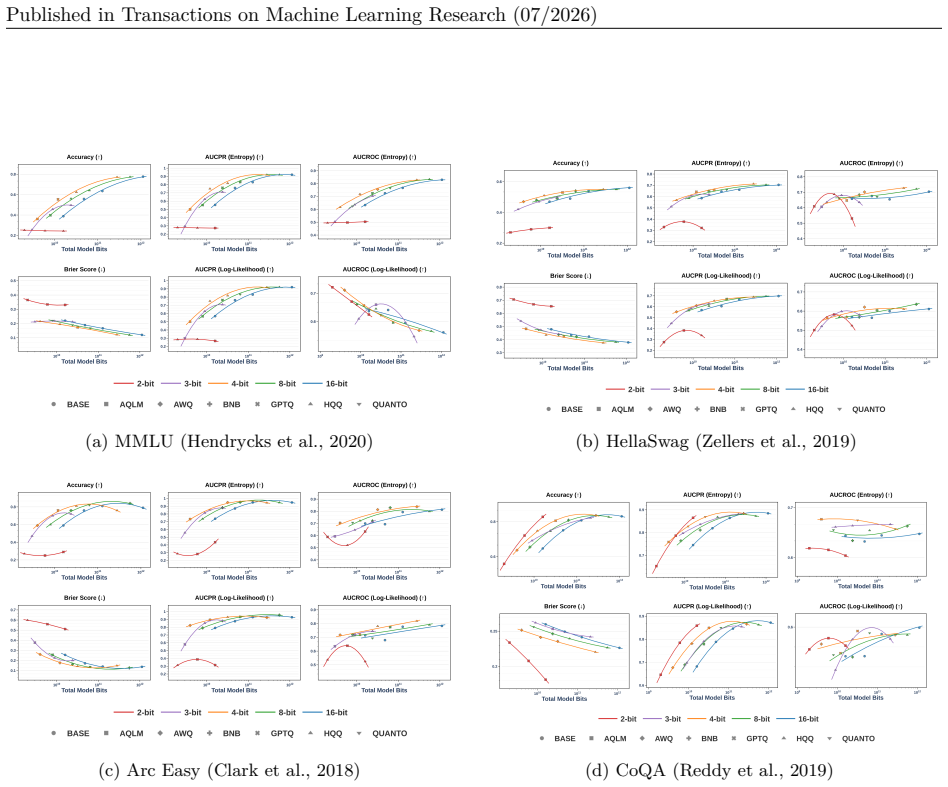
Reliability of quantized LLMs peaks at 4 bits, even though raw accuracy keeps rising with total model bits.
Reviewed by Pith at T0; open to challenge. T0 means a machine referee read the full paper against a public rubric. the ladder, T0–T4 →
T0 review · grok-4.5
2026-07-14 08:45 UTC pith:4ASEU4LS
load-bearing objection Solid empirical map of reliability vs total bits that cleanly shows a 4-bit peak; the envelope-plotting and incomplete efficiency axis are real but do not erase the main result. the 3 major comments →
Reliability Scaling Laws for Quantized Large Language Models
The pith
A machine-rendered reading of the paper's core claim, the machinery that carries it, and where it could break.
Core claim
While downstream task performance of quantized LLMs scales monotonically with total model bits B = (#parameters) × (bitwidth), reliability metrics (entropy-based AUCROC, calibration scores, and accuracy under 15 natural input perturbations) are nonlinear and reach a clear peak for 4-bit quantized models; thus moderately sized 4-bit models give the best reliability-efficiency trade-off, and quantization can improve robustness over the full-precision base.
What carries the argument
Bit-level scaling: every model is located on the single horizontal axis of total bits B, and log-quadratic curves are fitted to accuracy and reliability metrics so that the 4-bit reliability peak becomes visible across families and methods.
Load-bearing premise
That total model bits alone is a fair enough efficiency axis that the observed reliability peak at 4 bits would survive if real serving costs such as activation precision, KV-cache size or hardware latency were measured instead.
What would settle it
Re-plot the same reliability metrics against measured inference latency or peak memory on a production GPU for matched total-bit budgets; if the 4-bit models no longer sit at the reliability maximum, the claimed sweet spot is an artifact of the bit-count axis.
If this is right
- For a fixed memory or storage budget, practitioners should prefer a larger 4-bit model over a smaller 8- or 16-bit model when reliability under natural noise matters.
- Extreme 2-bit and 3-bit post-training quantization remains unreliable except when model scale is large or when quantization-aware training is used.
- Natural, non-adversarial input noise (typos, slang, emojis) is a useful stress test that reveals reliability gains from quantization that standard clean benchmarks miss.
- Pruning does not produce the same reliability peak that 4-bit quantization does, so the two compression families are not interchangeable for trustworthy deployment.
Where Pith is reading between the lines
- If the 4-bit peak is driven by a sweet-spot KL divergence to the full-precision teacher, then methods that further reduce that divergence (better calibration data, rotation, or QAT) should push the reliability optimum toward still lower bit-widths.
- Serving systems that keep activations and KV cache at higher precision may erase part of the 4-bit advantage; the paper's bit-count ranking therefore needs re-validation under end-to-end memory footprints.
- The same nonlinear reliability curve may appear for other compression axes (sparsity patterns, distillation) once they are plotted against an analogous resource unit.
Editorial analysis
A structured set of objections, weighed in public.
Referee Report
Summary. The paper evaluates reliability of post-training quantized LLMs (uncertainty via token entropy and log-likelihood, calibration via Brier score, and robustness under 15 character- and word-level natural perturbations) across LLaMA-3/3.2, OPT, and Qwen3 families, six PTQ methods, and bitwidths 2–16. It reports bit-level scaling with total model bits B = (#parameters)×(bitwidth), fitting log-quadratic curves L(B)=a(log B)^2+b log B+c. Accuracy and perplexity improve roughly monotonically with B and favor 4-bit models for a fixed budget; reliability metrics (AUCROC of entropy, calibration, robust accuracy) are nonlinear and peak at 4-bit. A KL analysis of token-distribution shift relative to the full-precision base is offered as an explanation, and pruning is shown not to yield comparable reliability gains. The authors conclude that moderately sized 4-bit models give the best reliability–efficiency trade-off and that quantization can improve robustness to natural input noise.
Significance. If the 4-bit reliability peak is robust, the work supplies a practical, previously missing design rule for deploying trustworthy quantized LLMs under a fixed bit budget, and it expands the evaluation of compression beyond accuracy/perplexity to uncertainty, calibration, and natural (non-adversarial) robustness. Strengths include breadth (multiple families, six PTQ methods, 15 perturbations at two intensities, KL behavioral-shift analysis, pruning and limited QAT ablations) and the explicit separation of performance scaling from reliability scaling. The empirical regularities are descriptive rather than derived laws, but they are falsifiable and immediately actionable for practitioners choosing bitwidth versus model size.
major comments (3)
- Appendix A.1 and Tables 6–7 state that only the best-performing method is plotted for each bitwidth. Consequently the 4-bit curves are upper envelopes (AWQ/HQQ/GPTQ) while 2-/3-bit curves are lower envelopes of weaker methods. The claimed nonlinear reliability peak at 4 bits (Abstract, Fig. 1, §5.2) may therefore be an artifact of method selection rather than of bitwidth. Either plot all methods (or method-averaged curves with error bars) or demonstrate that the peak survives when the same method is held fixed across bitwidths.
- Section 4 and Table 1 define the efficiency axis solely as weight storage bits B. Activation precision, KV-cache cost, and hardware-supported latency/throughput are acknowledged in §C but not measured for the reliability rankings. Because real serving cost can reorder models of equal B, the claim that “moderately sized 4-bit models offer the best reliability-efficiency trade-off” is only partially supported. At minimum, report latency/throughput (or a proxy that includes activations) for the same model pairs used in the reliability plots, or qualify the claim as storage-bit efficiency only.
- Generation is truncated to 20 tokens and evaluation uses 1000 randomly sampled prompts (A.2). While Fig. 9 shows accuracy is stable under this subsample, reliability metrics (AUCROC of entropy, Brier) are more sensitive to sequence length and sample size; the limited ablation in Fig. 14 does not fully close the gap. Confirm that the 4-bit peak persists for longer generations and full-dataset evaluation on at least one primary benchmark.
Circularity Check
No circularity: purely observational empirical study; log-quadratic fits are descriptive summaries of measured points, not predictions derived from the same coefficients.
full rationale
The paper's central claims are empirical regularities measured on concrete models (LLaMA/OPT/Qwen families, six PTQ methods, 2–16 bits) under fixed reliability metrics (token entropy, Brier, AUCROC, accuracy under 15 natural perturbations). Section 4 explicitly states that the authors 'do not propose a formal predictive law in the classical sense' and adopt only the same empirical methodology used by prior bit-level scaling papers: they fit L(B)=a(log B)^2+b log B+c after the fact to summarize observed points. No coefficient fitted on one subset is then used to 'predict' a closely related quantity; no uniqueness theorem or self-citation is load-bearing for the 4-bit peak; the peak is simply the location of the highest measured reliability points among the evaluated configurations. Method selection (reporting only the best method per bit-width) and the incompleteness of the total-bits axis are methodological choices that may affect external validity, but they do not make any reported number equal to its own input by construction. The derivation chain therefore contains no self-definitional, fitted-as-prediction, or self-citation-forced steps.
Axiom & Free-Parameter Ledger
free parameters (3)
- log-quadratic coefficients a,b,c per metric and bitwidth =
per-curve least-squares (values not tabulated)
- perturbation intensity levels {4,16} =
4 and 16
- generation length cap (20 tokens) and temperature (0.7) =
20 tokens, T=0.7
axioms (4)
- domain assumption Sequence-level reliability equals the average of token-level entropy / Brier / log-likelihood over the generated tokens.
- domain assumption Total model bits B = (#parameters)×(weight bitwidth) is a sufficient efficiency axis for ranking reliability–efficiency trade-offs.
- domain assumption The 15 character- and word-level edits preserve semantics sufficiently to serve as realistic robustness tests.
- domain assumption Post-training quantization methods can be compared fairly by loading public or library implementations without re-tuning calibration data.
invented entities (1)
-
15-type natural perturbation suite (emoji, leetspeak, slang, multi-language word translation, etc.)
no independent evidence
read the original abstract
Quantization is a powerful strategy to build capable and resource-efficient large language models (LLMs) by reducing the bitwidth of the parameters. While quantized LLMs achieve state-of-the-art performance on unperturbed inputs using standard predictive metrics, their performance on perturbed inputs, measured using reliability metrics, remains underexplored, despite its importance for reliable deployment. To address this gap, we first conduct a comprehensive reliability evaluation of quantized LLMs consisting of three key components: (1) Uncertainty: We assess the trustworthiness of LLMs quantized to 2, 3, 4, and 8 bits using six different quantization methods, employing established uncertainty metrics. (2) Calibration: We assess how well-calibrated the uncertainty estimates of quantized models are across model scales and bit precisions. (3) Robustness: We design character-level and word-level input perturbations to evaluate the reliability of quantized models under semantically-preserving variations in the inputs that arise in real-world applications. Second, we characterize how reliability scales with the total number of model bits. Our study reveals that while the performance scales monotonically with the total number of bits, the reliability scalings are nonlinear. A reliability peak occurs for 4-bit quantized models, indicating that quantizing moderately sized models offers the best reliability-efficiency trade-off. Additionally, our empirical findings reveal that quantization enhances the robustness of LLMs to natural input perturbations.
Figures




Reference graph
Works this paper leans on
-
[2]
Croci, Bo Li, Pashmina Cameron, Martin Jaggi, Dan Alistarh, Torsten Hoefler, and James Hensman
Saleh Ashkboos, Amirkeivan Mohtashami, Maximilian L. Croci, Bo Li, Pashmina Cameron, Martin Jaggi, Dan Alistarh, Torsten Hoefler, and James Hensman. Quarot: Outlier-free 4-bit inference in rotated LLM s. In The Thirty-eighth Annual Conference on Neural Information Processing Systems, 2024. URL https://openreview.net/forum?id=dfqsW38v1X
2024
-
[3]
Half- Quadratic Quantization of Large Machine Learning Models , November 2023
Hicham Badri and Appu Shaji. Half- Quadratic Quantization of Large Machine Learning Models , November 2023. URL https://mobiusml.github.io/hqq_blog/
2023
-
[4]
Towards 1-bit Machine Learning Models , March 2024
Hicham Badri and Appu Shaji. Towards 1-bit Machine Learning Models , March 2024. URL https://mobiusml.github.io/1bit_blog/
2024
-
[5]
Piqa: Reasoning about physical commonsense in natural language
Yonatan Bisk, Rowan Zellers, Jianfeng Gao, Yejin Choi, et al. Piqa: Reasoning about physical commonsense in natural language. In Proceedings of the AAAI conference on artificial intelligence, pp.\ 7432--7439, 2020
2020
-
[6]
Verification of forecasts expressed in terms of probability
Glenn W Brier. Verification of forecasts expressed in terms of probability. Monthly weather review, 78 0 (1): 0 1--3, 1950
1950
-
[7]
Efficientqat: Efficient quantization-aware training for large language models
Mengzhao Chen, Wenqi Shao, Peng Xu, Jiahao Wang, Peng Gao, Kaipeng Zhang, and Ping Luo. Efficientqat: Efficient quantization-aware training for large language models. In Proceedings of the 63rd Annual Meeting of the Association for Computational Linguistics (Volume 1: Long Papers), pp.\ 10081--10100, 2025
2025
-
[9]
The case for 4-bit precision: k-bit inference scaling laws
Tim Dettmers and Luke Zettlemoyer. The case for 4-bit precision: k-bit inference scaling laws. In International Conference on Machine Learning, pp.\ 7750--7774. PMLR, 2023
2023
-
[10]
bitsandbytes: Efficient CUDA Primitives for 8-bit and 4-bit Neural Network Quantization
Tim Dettmers, Artidoro Pagnoni, Alexander Borzunov, and Mike Lewis. bitsandbytes: Efficient CUDA Primitives for 8-bit and 4-bit Neural Network Quantization . https://github.com/bitsandbytes-foundation/bitsandbytes, 2022. Accessed: March 2025
2022
-
[13]
Patterns of misspellings in l2 and l1 english: A view from the ets spelling corpus
M Flor, Y Futagi, M Lopez, and M Mulholland. Patterns of misspellings in l2 and l1 english: A view from the ets spelling corpus. bergen language and linguistics studies, 6, 107--132, 2015
2015
-
[14]
Unsupervised quality estimation for neural machine translation
Marina Fomicheva, Shuo Sun, Lisa Yankovskaya, Fr \'e d \'e ric Blain, Francisco Guzm \'a n, Mark Fishel, Nikolaos Aletras, Vishrav Chaudhary, and Lucia Specia. Unsupervised quality estimation for neural machine translation. Transactions of the Association for Computational Linguistics, 8: 0 539--555, 2020
2020
-
[15]
Sparsegpt: Massive language models can be accurately pruned in one-shot
Elias Frantar and Dan Alistarh. Sparsegpt: Massive language models can be accurately pruned in one-shot. In International Conference on Machine Learning, pp.\ 10323--10337. PMLR, 2023
2023
-
[20]
Interactions between text content and emoji types determine perceptions of both messages and senders
Christopher J Hand, Kassandra Burd, Alex Oliver, and Christopher M Robus. Interactions between text content and emoji types determine perceptions of both messages and senders. Computers in human behavior reports, 8: 0 100242, 2022
2022
-
[26]
C-eval: A multi-level multi-discipline chinese evaluation suite for foundation models
Yuzhen Huang, Yuzhuo Bai, Zhihao Zhu, Junlei Zhang, Jinghan Zhang, Tangjun Su, Junteng Liu, Chuancheng Lv, Yikai Zhang, Yao Fu, et al. C-eval: A multi-level multi-discipline chinese evaluation suite for foundation models. Advances in Neural Information Processing Systems, 36: 0 62991--63010, 2023
2023
-
[28]
How can we know when language models know? on the calibration of language models for question answering
Zhengbao Jiang, Jun Araki, Haibo Ding, and Graham Neubig. How can we know when language models know? on the calibration of language models for question answering. Transactions of the Association for Computational Linguistics, 9: 0 962--977, 2021
2021
-
[32]
Calibration-tuning: Teaching large language models to know what they don’t know
Sanyam Kapoor, Nate Gruver, Manley Roberts, Arka Pal, Samuel Dooley, Micah Goldblum, and Andrew Wilson. Calibration-tuning: Teaching large language models to know what they don’t know. In Proceedings of the 1st Workshop on Uncertainty-Aware NLP (UncertaiNLP 2024), pp.\ 1--14, 2024
2024
-
[37]
Less is more: Task-aware layer-wise distillation for language model compression
Chen Liang, Simiao Zuo, Qingru Zhang, Pengcheng He, Weizhu Chen, and Tuo Zhao. Less is more: Task-aware layer-wise distillation for language model compression. In International Conference on Machine Learning, pp.\ 20852--20867. PMLR, 2023
2023
-
[38]
Automatic evaluation of machine translation quality using longest common subsequence and skip-bigram statistics
Chin-Yew Lin and Franz Josef Och. Automatic evaluation of machine translation quality using longest common subsequence and skip-bigram statistics. In Proceedings of the 42nd annual meeting of the association for computational linguistics (ACL-04), pp.\ 605--612, 2004
2004
-
[39]
Awq: Activation-aware weight quantization for on-device llm compression and acceleration
Ji Lin, Jiaming Tang, Haotian Tang, Shang Yang, Wei-Ming Chen, Wei-Chen Wang, Guangxuan Xiao, Xingyu Dang, Chuang Gan, and Song Han. Awq: Activation-aware weight quantization for on-device llm compression and acceleration. Proceedings of Machine Learning and Systems, 6: 0 87--100, 2024 a
2024
-
[40]
QServe : W4A8KV4 Quantization and System Co -design for Efficient LLM Serving , May 2024 b
Yujun Lin, Haotian Tang, Shang Yang, Zhekai Zhang, Guangxuan Xiao, Chuang Gan, and Song Han. QServe : W4A8KV4 Quantization and System Co -design for Efficient LLM Serving , May 2024 b . URL http://arxiv.org/abs/2405.04532. arXiv:2405.04532 [cs]
Pith/arXiv arXiv 2024
-
[43]
Llm-qat: Data-free quantization aware training for large language models
Zechun Liu, Barlas Oguz, Changsheng Zhao, Ernie Chang, Pierre Stock, Yashar Mehdad, Yangyang Shi, Raghuraman Krishnamoorthi, and Vikas Chandra. Llm-qat: Data-free quantization aware training for large language models. In Findings of the Association for Computational Linguistics: ACL 2024, pp.\ 467--484, 2024
2024
-
[46]
PV -tuning: Beyond straight-through estimation for extreme LLM compression
Vladimir Malinovskii, Denis Mazur, Ivan Ilin, Denis Kuznedelev, Konstantin Pavlovich Burlachenko, Kai Yi, Dan Alistarh, and Peter Richt \'a rik. PV -tuning: Beyond straight-through estimation for extreme LLM compression. In The Thirty-eighth Annual Conference on Neural Information Processing Systems, 2024. URL https://openreview.net/forum?id=YvA8UF0I37
2024
-
[47]
Building a large annotated corpus of english: The penn treebank
Mitch Marcus, Beatrice Santorini, and Mary Ann Marcinkiewicz. Building a large annotated corpus of english: The penn treebank. Computational linguistics, 19 0 (2): 0 313--330, 1993
1993
-
[50]
Exploring the limits of transfer learning with a unified text-to-text transformer
Colin Raffel, Noam Shazeer, Adam Roberts, Katherine Lee, Sharan Narang, Michael Matena, Yanqi Zhou, Wei Li, and Peter J Liu. Exploring the limits of transfer learning with a unified text-to-text transformer. Journal of machine learning research, 21 0 (140): 0 1--67, 2020
2020
-
[51]
Coqa: A conversational question answering challenge
Siva Reddy, Danqi Chen, and Christopher D Manning. Coqa: A conversational question answering challenge. Transactions of the Association for Computational Linguistics, 7: 0 249--266, 2019
2019
-
[52]
Beyond neural scaling laws: beating power law scaling via data pruning
Ben Sorscher, Robert Geirhos, Shashank Shekhar, Surya Ganguli, and Ari Morcos. Beyond neural scaling laws: beating power law scaling via data pruning. Advances in Neural Information Processing Systems, 35: 0 19523--19536, 2022
2022
-
[53]
Colloquail, slang and transformational language: comperative study
Suhardianto Suhardianto et al. Colloquail, slang and transformational language: comperative study. Jurnal Basis, 6 0 (1): 0 105--118, 2019
2019
-
[57]
Optimum quanto: A pytorch quantization backend for optimum
Hugging Face Team. Optimum quanto: A pytorch quantization backend for optimum. https://huggingface.co/docs/optimum/quanto/index, 2023. Accessed: March 2025
2023
-
[59]
Are large language models really robust to word-level perturbations? Submitted to Transactions on Machine Learning Research, 2024
Haoyu Wang, Guozheng Ma, Cong Yu, Ning Gui, Linrui Zhang, Zhiqi Huang, Suwei Ma, Yongzhe Chang, Sen Zhang, Li Shen, Xueqian Wang, Peilin Zhao, and Dacheng Tao. Are large language models really robust to word-level perturbations? Submitted to Transactions on Machine Learning Research, 2024. URL https://openreview.net/forum?id=BMKJEGNMcZ. Rejected
2024
-
[62]
Onebit: Towards extremely low-bit large language models
Yuzhuang Xu, Xu Han, Zonghan Yang, Shuo Wang, Qingfu Zhu, Zhiyuan Liu, Weidong Liu, and Wanxiang Che. Onebit: Towards extremely low-bit large language models. Advances in Neural Information Processing Systems, 37: 0 66357--66382, 2024 a
2024
-
[65]
Benchmarking llms via uncertainty quantification
Fanghua Ye, Mingming Yang, Jianhui Pang, Longyue Wang, Derek Wong, Emine Yilmaz, Shuming Shi, and Zhaopeng Tu. Benchmarking llms via uncertainty quantification. Advances in Neural Information Processing Systems, 37: 0 15356--15385, 2024
2024
-
[69]
Proceedings of the 42nd annual meeting of the association for computational linguistics (ACL-04) , pages=
Automatic evaluation of machine translation quality using longest common subsequence and skip-bigram statistics , author=. Proceedings of the 42nd annual meeting of the association for computational linguistics (ACL-04) , pages=
-
[70]
Text summarization branches out , pages=
Rouge: A package for automatic evaluation of summaries , author=. Text summarization branches out , pages=
-
[71]
arXiv preprint arXiv:2403.15447 , year=
Decoding compressed trust: Scrutinizing the trustworthiness of efficient llms under compression , author=. arXiv preprint arXiv:2403.15447 , year=
-
[72]
arXiv preprint arXiv:2407.04965 , year=
Beyond perplexity: Multi-dimensional safety evaluation of llm compression , author=. arXiv preprint arXiv:2407.04965 , year=
-
[73]
arXiv preprint arXiv:2310.01382 , year=
Compressing llms: The truth is rarely pure and never simple , author=. arXiv preprint arXiv:2310.01382 , year=
-
[74]
arXiv preprint arXiv:2407.09141 , year=
Accuracy is not all you need , author=. arXiv preprint arXiv:2407.09141 , year=
-
[75]
Proceedings of the 40th annual meeting of the Association for Computational Linguistics , pages=
Bleu: a method for automatic evaluation of machine translation , author=. Proceedings of the 40th annual meeting of the Association for Computational Linguistics , pages=
-
[76]
arXiv preprint arXiv:2002.07650 , year=
Uncertainty estimation in autoregressive structured prediction , author=. arXiv preprint arXiv:2002.07650 , year=
Pith/arXiv arXiv 2002
-
[77]
arXiv preprint arXiv:2305.19187 , year=
Generating with confidence: Uncertainty quantification for black-box large language models , author=. arXiv preprint arXiv:2305.19187 , year=
-
[78]
arXiv preprint arXiv:1705.03551 , year=
Triviaqa: A large scale distantly supervised challenge dataset for reading comprehension , author=. arXiv preprint arXiv:1705.03551 , year=
-
[79]
Transactions of the Association for Computational Linguistics , volume=
Coqa: A conversational question answering challenge , author=. Transactions of the Association for Computational Linguistics , volume=. 2019 , publisher=
2019
-
[80]
arXiv preprint arXiv:1609.07843 , year=
Pointer sentinel mixture models , author=. arXiv preprint arXiv:1609.07843 , year=
-
[81]
Computational linguistics , volume=
Building a large annotated corpus of English: The Penn Treebank , author=. Computational linguistics , volume=
-
[82]
Journal of machine learning research , volume=
Exploring the limits of transfer learning with a unified text-to-text transformer , author=. Journal of machine learning research , volume=
-
[83]
Low-power computer vision , pages=
A survey of quantization methods for efficient neural network inference , author=. Low-power computer vision , pages=. 2022 , publisher=
2022
-
[84]
int8 (): 8-bit matrix multiplication for transformers at scale , author=
Gpt3. int8 (): 8-bit matrix multiplication for transformers at scale , author=. Advances in neural information processing systems , volume=
-
[85]
arXiv preprint arXiv:2210.17323 , year=
Gptq: Accurate post-training quantization for generative pre-trained transformers , author=. arXiv preprint arXiv:2210.17323 , year=
-
[86]
Proceedings of Machine Learning and Systems , volume=
Awq: Activation-aware weight quantization for on-device llm compression and acceleration , author=. Proceedings of Machine Learning and Systems , volume=
-
[87]
arXiv preprint arXiv:2401.06118 , year=
Extreme compression of large language models via additive quantization , author=. arXiv preprint arXiv:2401.06118 , year=
-
[88]
arXiv preprint arXiv:2306.03078 , year=
Spqr: A sparse-quantized representation for near-lossless llm weight compression , author=. arXiv preprint arXiv:2306.03078 , year=
-
[89]
Advances in Neural Information Processing Systems , volume=
Optimal brain compression: A framework for accurate post-training quantization and pruning , author=. Advances in Neural Information Processing Systems , volume=
-
[90]
arXiv preprint arXiv:2305.17888 , year=
Llm-qat: Data-free quantization aware training for large language models , author=. arXiv preprint arXiv:2305.17888 , year=
-
[91]
arXiv preprint arXiv:2402.10631 , year=
Bitdistiller: Unleashing the potential of sub-4-bit llms via self-distillation , author=. arXiv preprint arXiv:2402.10631 , year=
-
[92]
arXiv preprint arXiv:2108.12237 , year=
Evaluating the robustness of neural language models to input perturbations , author=. arXiv preprint arXiv:2108.12237 , year=
-
[93]
arXiv preprint arXiv:2302.09664 , year=
Semantic uncertainty: Linguistic invariances for uncertainty estimation in natural language generation , author=. arXiv preprint arXiv:2302.09664 , year=
-
[94]
Transactions of the Association for Computational Linguistics , volume=
Unsupervised quality estimation for neural machine translation , author=. Transactions of the Association for Computational Linguistics , volume=. 2020 , publisher=
2020
-
[95]
Advances in Neural Information Processing Systems , volume=
Benchmarking llms via uncertainty quantification , author=. Advances in Neural Information Processing Systems , volume=
-
[96]
Transactions of the Association for Computational Linguistics , volume=
How can we know when language models know? on the calibration of language models for question answering , author=. Transactions of the Association for Computational Linguistics , volume=. 2021 , publisher=
2021
-
[97]
Proceedings of the 1st Workshop on Uncertainty-Aware NLP (UncertaiNLP 2024) , pages=
Calibration-tuning: Teaching large language models to know what they don’t know , author=. Proceedings of the 1st Workshop on Uncertainty-Aware NLP (UncertaiNLP 2024) , pages=
2024
-
[98]
Monthly weather review , volume=
Verification of forecasts expressed in terms of probability , author=. Monthly weather review , volume=
-
[99]
arXiv preprint arXiv:2407.11282 , year=
Uncertainty is fragile: Manipulating uncertainty in large language models , author=. arXiv preprint arXiv:2407.11282 , year=
-
[100]
arXiv preprint arXiv:2207.05221 , year=
Language models (mostly) know what they know , author=. arXiv preprint arXiv:2207.05221 , year=
-
[101]
arXiv preprint arXiv:2309.03882 , year=
Large language models are not robust multiple choice selectors , author=. arXiv preprint arXiv:2309.03882 , year=
-
[102]
arXiv preprint arXiv:1704.04441 , year=
How robust are character-based word embeddings in tagging and MT against wrod scramlbing or randdm nouse? , author=. arXiv preprint arXiv:1704.04441 , year=
-
[103]
ACM Transactions on Intelligent Systems and Technology (TIST) , volume=
Adversarial attacks on deep-learning models in natural language processing: A survey , author=. ACM Transactions on Intelligent Systems and Technology (TIST) , volume=. 2020 , publisher=
2020
-
[104]
arXiv preprint arXiv:2412.02904 , year=
Enhancing Trust in Large Language Models with Uncertainty-Aware Fine-Tuning , author=. arXiv preprint arXiv:2412.02904 , year=
-
[105]
arXiv preprint arXiv:2502.16440 , year=
Compression Scaling Laws: Unifying Sparsity and Quantization , author=. arXiv preprint arXiv:2502.16440 , year=
-
[106]
International Conference on Machine Learning , pages=
The case for 4-bit precision: k-bit inference scaling laws , author=. International Conference on Machine Learning , pages=. 2023 , organization=
2023
-
[107]
A Novel Metric for Measuring the Robustness of Large Language Models in Non-adversarial Scenarios
Ackerman, Samuel and Rabinovich, Ella and Farchi, Eitan and Anaby Tavor, Ateret. A Novel Metric for Measuring the Robustness of Large Language Models in Non-adversarial Scenarios. Findings of the Association for Computational Linguistics: EMNLP 2024. 2024. doi:10.18653/v1/2024.findings-emnlp.158
-
[108]
Submitted to Transactions on Machine Learning Research , year=
Are Large Language Models Really Robust to Word-Level Perturbations? , author=. Submitted to Transactions on Machine Learning Research , year=
-
[109]
arXiv preprint arXiv:2407.21783 , year=
The llama 3 herd of models , author=. arXiv preprint arXiv:2407.21783 , year=
-
[110]
Badri, Hicham and Shaji, Appu , month =. Half-
-
[111]
Towards 1-bit
Badri, Hicham and Shaji, Appu , month =. Towards 1-bit
-
[112]
GitHub repository , howpublished =
Dettmers, Tim and Pagnoni, Artidoro and Borzunov, Alexander and Lewis, Mike , title =. GitHub repository , howpublished =. 2022 , publisher =
2022
-
[113]
2023 , publisher =
Optimum Quanto: A PyTorch Quantization Backend for Optimum , author =. 2023 , publisher =
2023
-
[114]
doi:10.48550/arXiv.2405.04532 , urldate =
Lin, Yujun and Tang, Haotian and Yang, Shang and Zhang, Zhekai and Xiao, Guangxuan and Gan, Chuang and Han, Song , month = may, year =. doi:10.48550/arXiv.2405.04532 , urldate =
-
[115]
The Thirty-eighth Annual Conference on Neural Information Processing Systems , year=
Vladimir Malinovskii and Denis Mazur and Ivan Ilin and Denis Kuznedelev and Konstantin Pavlovich Burlachenko and Kai Yi and Dan Alistarh and Peter Richt. The Thirty-eighth Annual Conference on Neural Information Processing Systems , year=
-
[116]
Croci and Bo Li and Pashmina Cameron and Martin Jaggi and Dan Alistarh and Torsten Hoefler and James Hensman , booktitle=
Saleh Ashkboos and Amirkeivan Mohtashami and Maximilian L. Croci and Bo Li and Pashmina Cameron and Martin Jaggi and Dan Alistarh and Torsten Hoefler and James Hensman , booktitle=. QuaRot: Outlier-Free 4-Bit Inference in Rotated. 2024 , url=
2024
-
[117]
AWQ: Activation-aware Weight Quantization for On-Device LLM Compression and Acceleration , url =
Lin, Ji and Tang, Jiaming and Tang, Haotian and Yang, Shang and Chen, Wei-Ming and Wang, Wei-Chen and Xiao, Guangxuan and Dang, Xingyu and Gan, Chuang and Han, Song , booktitle =. AWQ: Activation-aware Weight Quantization for On-Device LLM Compression and Acceleration , url =
-
[118]
doi:10.48550/arXiv.2210.17323 , urldate =
Frantar, Elias and Ashkboos, Saleh and Hoefler, Torsten and Alistarh, Dan , month = mar, year =. doi:10.48550/arXiv.2210.17323 , urldate =
discussion (0)
Sign in with ORCID, Apple, or X to comment. Anyone can read and Pith papers without signing in.