REVIEW 3 major objections 6 minor 12 references
For small-data geopolymer inverse design, topology-aware constraints beat pure surrogate optima by keeping candidates near the learned feasible manifold.
Reviewed by Pith at T0; open to challenge. T0 means a machine referee read the full paper against a public rubric. the ladder, T0–T4 →
Topology-aware, physics-constrained inverse design with INCRT prototypes yields geopolymer candidates that trade small strength error for lower carbon, physical validity, and data-manifold support.
T0 review reviewed 2026-07-14 challenge →
load-bearing objection Solid small-data inverse-design methods paper: honest hybrid pipeline and three-strategy comparison on a public GPC set; INCRT is mostly a prototype OOD layer and Φman remains an unvalidated screening heuristic. the 3 major comments →
Incremental Transformer for Surrogate-Based Inverse Design of Geopolymer Mixtures
The pith
A machine-rendered reading of the paper's core claim, the machinery that carries it, and where it could break.
The reading
Core claim
On the Pham FA/GGBFS geopolymer benchmark, unconstrained surrogate inverse design can hit target compressive strength yet produce physically invalid or off-manifold recipes; physics-only constraints remove explicit violations but still allow unsupported or high-carbon solutions; adding an INCRT-derived manifold-support term yields candidates that jointly satisfy target compliance, carbon reduction, physical admissibility, and data support, especially around 50–60 MPa.
What carries the argument
The topology-aware objective Jtop, which adds a manifold-support penalty Φman(x) = min distance-squared from a candidate to an INCRT prototype regime to the usual strength-error, carbon, and physics-penalty terms, thereby filtering optimiser outputs toward the learned feasible manifold.
Load-bearing premise
The claim that distance to the learned prototype regimes is a reliable proxy for whether a new mixture is experimentally credible, even though no laboratory tests of the generated candidates are reported.
What would settle it
Laboratory preparation and 28-day strength/CO2 testing of the Strategy-C candidates for the 50 MPa and 60 MPa targets; if they systematically fail physical performance or show no carbon advantage over physics-only candidates, the value of the manifold term collapses.
Editorial analysis
A structured set of objections, weighed in public.
Referee Report
Summary. The paper proposes a topology-aware surrogate framework for small-data inverse design of fly-ash/GGBFS geopolymer mixtures. It combines intrinsic-dimensionality analysis of a 19-variable, 274-sample public benchmark, hybrid forward surrogates (ExtraTrees for compressive strength; ElasticNet for carbon emission), and an INCRT-derived prototype layer that supplies a manifold-support score Φman. Three inverse strategies are compared: unconstrained surrogate optimisation (A), physics-constrained optimisation (B), and topology-aware physics-constrained optimisation (C). The central claim is that Strategy C yields candidates that better balance target strength, carbon reduction, physical admissibility, and proximity to the learned feasible manifold (Table 8; §§6.3–8), while remaining a screening tool rather than a substitute for laboratory validation.
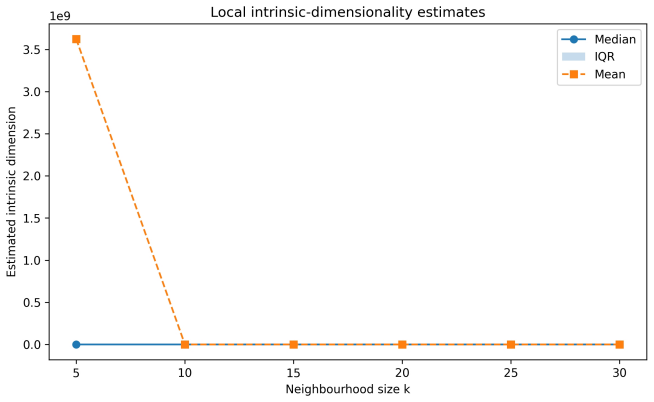
Significance. If the framework holds as a decision-support method, it addresses a genuine gap between accurate forward prediction and credible inverse design on small, mixed, physically constrained engineering tables. Strengths include a careful separation of prediction accuracy from design support, coherent forward results (ExtraTrees R²≈0.951 for strength vs ElasticNet R²≈0.9999 for CO2), LOCO evidence that regime-shift error jumps sharply (~2.48→14.20 MPa), and transparent topology diagnostics (d90=5, dPR=3.17, local ID ~2–3). The layered filter view (prediction / physics / manifold / engineering trade-off) is transferable beyond geopolymers. The work does not ship laboratory validation of generated recipes or a fully specified, independently reimplementable INCRT architecture; its value is methodological screening rather than certified mixture discovery.
major comments (3)
- [§5, §6.3, Eqs. (8)–(9)] §5 (INCRT-based rationalisation) and §6.3: The load-bearing object Φman (Eq. 8) and the preference for Strategy C rest on INCRT prototypes, yet INCRT is cited only as “unpublished results” and is reduced operationally to centroids/regimes. Without a self-contained algorithm (growth rule, stopping criterion, how heads map to {pk}, sensitivity of K, and code or pseudocode sufficient for reimplementation), the topology layer is not reproducible. Either fully specify the reduced INCRT procedure used here, or replace it with a standard, fully documented prototype method (e.g., k-medoids/GMM on the same mixed distance) and show that Table 8 rankings are unchanged.
- [§6.3, Table 8, Eq. (20)] §6.3 and Table 8: Inverse-design results are single-point candidates with no optimiser named, no multi-start or seed statistics, no search-budget report, and no sensitivity of rankings to λman, λphys, α, β, or the Q95/Q99 cutoffs (Eq. 20). Strategy C’s claimed balance over A/B is therefore not shown to be robust. Please report the optimiser, constraints handling, multi-start summary (mean/std of error, CO2, Φman, violation count), and at least a one-at-a-time or grid sensitivity on λman and the manifold thresholds for the 50 and 60 MPa cases that drive the narrative.
- [§6.3–§8, §7] §6.3–§8 and §7: The paper correctly states that Φman is a data-driven OOD filter and does not prove experimental feasibility. The abstract and conclusion still rank Strategy C as producing more “credible” candidates. That ranking is only demonstrated against the paper’s own four computational filters, not against experimental success. Soften claims of credibility to “computationally supported / on-manifold under the learned prototypes,” and add an explicit statement that superiority of C over B is unvalidated experimentally. If possible, include a leave-one-cluster or held-out-recipe recovery test: optimise with prototypes built without a held-out regime and check whether low-Φman recovers near-feasible held-out recipes better than physics-only screening.
minor comments (6)
- [§6 figures] Figure 2–7 are referenced but not rendered in the text dump; ensure all panels have readable axis labels, units (MPa, CO2 units), and captions that stand alone.
- [Table 8, §5] Table 8 “Phys. viol.” is binary/count without defining the exact constraint list and units of Φphys; cross-reference the full constraint set from §5.
- [Eqs. (7), (18)] Notation: dmix scales αc, αd, αb (Eq. 7) and soft-membership temperature τ (Eq. 18) are introduced but not given numerical values used in experiments.
- [References] INCRT arXiv link (2604.10703) is listed as unpublished; update status or provide a stable citation once available.
- [Throughout] Minor typos/spacing: “T able” headers, “V alidation”, “T opology”; standardise table/figure caption capitalisation.
- [§4, §6.2] Clarify whether carbon emission is measured or computed from emission factors in the Pham (2023) source; this affects interpretation of ElasticNet near-perfect fit.
Circularity Check
Mild self-citation of unpublished INCRT and by-construction manifold scores; central multi-objective inverse-design comparison is not definitionally circular.
specific steps
-
self citation load bearing
[§1 Introduction; §5 INCRT-based rationalisation; References (Cirrincione arXiv:2604.10703)]
"INCRT (Incremental Transformer) is a self-organising architecture that determines its own structure during training, originally introduced by Cirrincione (unpublished results). In the present paper, INCRT is used in a reduced operational form: the prototype set produced by the architecture is exploited to organise mixtures into prototype-supported regimes and to provide a manifold-support score."
The title and framing centre on INCRT, but the only citation for the architecture is the same author’s unpublished preprint. In this paper the method is reduced to regime centroids and Φman = min dmix(x,pk)²—objects obtainable from ordinary clustering—so the distinctive INCRT claim is not independently verified here. The self-citation is load-bearing for the paper’s identity, not for a uniqueness theorem that forces the inverse-design ranking.
-
self definitional
[§3 eqs. (8)–(9); §6.3 Table 8 and Q95/Q99 thresholds]
"The manifold-support score is defined as Φman(x)=min_pk∈P dmix(x,pk)². ... With a non-negative manifold weight λman, the final topology-aware objective is Jtop(x)=α(fstr(x)−y⋆)²+βfCO2(x)+λphysΦphys(x)+λmanΦman(x). ... Strategy C denotes topology-aware physics-constrained optimisation. ... The topology-aware strategy produces candidate mixtures balancing target compliance, carbon reduction, physical admissibility, and proximity to the learned feasible manifold."
Strategy C is defined as optimising an objective that already penalises Φman; reporting that C has better manifold proximity than A/B is therefore partly tautological for that column of Table 8. The circularity is limited to the support metric itself: strength/CO2 surrogates and physical penalties are independent terms, so the multi-objective balance claim is not fully reduced to the definition of Φman.
full rationale
The paper’s load-bearing engineering claim is comparative and multi-criteria (Table 8): Strategy C balances predicted strength error, predicted CO2, physical violations, and manifold proximity better than unconstrained or physics-only optimisation. Surrogates are trained and scored with repeated stratified CV, nested selection, and LOCO on held-out regimes; those metrics are independent of the inverse-design objectives and are not re-labelled as first-principles predictions. Φman is intentionally a data-driven OOD filter built from training prototypes (eqs. 8–9, Q95/Q99 in §6.3); reporting that Strategy C has lower Φman is partly by construction because Jtop includes λman Φman, but the non-tautological content is the joint improvement in CO2 and physical admissibility under small strength tolerance—not a fake prediction of an independent physical constant. INCRT is cited only as Cirrincione (unpublished/arXiv:2604.10703) and is immediately reduced to prototype centroids and a distance score; the topology diagnostics themselves use standard PCA, participation ratio, Levina–Bickel ID, and silhouette clustering. That self-citation is branding-heavy and under-specified, but it is not a uniqueness theorem that forces the result, nor does the derivation reduce to the self-citation alone. No fitted parameter is renamed as an independent physical prediction. Score 2 reflects one non-load-bearing self-citation chain plus a minor by-construction reporting of the manifold term, not a circular derivation of the main claim.
Axiom & Free-Parameter Ledger
free parameters (7)
- λman (manifold penalty weight)
- λphys (physics penalty weight)
- α, β (strength-error and CO2 weights)
- τ (soft-membership temperature)
- Q95=6.51, Q99=11.38 manifold cutoffs
- Prototype count K / cluster K=3 and 6-D PCA manifold
- αc, αd, αb mixed-distance scales
axioms (5)
- domain assumption Observed GPC mixtures occupy a lower-dimensional feasible manifold; ambient 19-D box optimization without support control is risky.
- ad hoc to paper Simplified physical penalties (bounds, ratio consistency, discrete curing projection) suffice to reject obviously invalid recipes without a full geopolymerization simulator.
- domain assumption Carbon emission is essentially composition-driven and well modeled by regularized linear regression on this benchmark.
- ad hoc to paper INCRT prototype partition from the authors' unpublished architecture is an adequate operational definition of mixture regimes for Φman.
- standard math Standard supervised learning and PCA/clustering mathematics (eigenvalue spectra, Levina-Bickel ID, silhouette) apply after train-only standardization.
invented entities (2)
-
INCRT (Incremental Transformer) prototype layer for tabular mixtures
no independent evidence
-
Manifold-support score Φman and topology-aware objective Jtop
no independent evidence
Cite this review
Pith. "Pith review of Incremental Transformer for Surrogate-Based Inverse Design of Geopolymer Mixtures." pith.science (2026). https://pith.science/paper/T57YUG2Y
@misc{pith2026260710896,
  author       = {Pith},
  title        = {Pith review of: Incremental Transformer for Surrogate-Based Inverse Design of Geopolymer Mixtures},
  year         = {2026},
  howpublished = {\url{https://pith.science/paper/T57YUG2Y}},
  note         = {Machine review of arXiv:2607.10896}
}
read the original abstract
Small-data inverse design is challenging in engineering informatics when observations are heterogeneous, mixed-type, and constrained by physical relations among design variables. This work proposes a topology-aware surrogate framework guided by an Incremental Transformer (INCRT) for physics-constrained inverse design, applied to geopolymer mixture design. The method integrates intrinsic-dimensionality analysis, mixed-variable design-space representation, tabular surrogate prediction, INCRT-based manifold rationalisation, and constrained inverse optimisation. Using a public benchmark of fly-ash and slag-based geopolymer concrete mixtures with compressive-strength and carbon-emission targets, the high-dimensional design space proves strongly redundant, organising around fewer effective mixture regimes. Compressive strength requires nonlinear tabular surrogates, while carbon emission is largely determined by composition and well recovered by regularised linear models. INCRT thus acts not as a replacement for tabular predictors but as a rationalisation layer providing prototype regimes and a manifold-support score for inverse design. Three strategies are compared: unconstrained surrogate optimisation, physics-constrained optimisation, and topology-aware physics-constrained optimisation. Unconstrained optimisation can match target strength but may yield physically invalid or off-manifold candidates; physics-only constraints do not always ensure data support. The topology-aware strategy yields candidates balancing target compliance, carbon reduction, physical admissibility, and proximity to the learned feasible manifold. The framework aims not to replace experimental validation but to support screening of credible candidate mixtures from small, mixed, physically constrained engineering datasets.
Figures




Reference graph
Works this paper leans on
-
[1]
Tianqi Chen and Carlos Guestrin
doi: 10.1023/A:1010933404324. Tianqi Chen and Carlos Guestrin. XGBoost: A scalable tree boosting system. InProceedings of the 17 22nd ACM SIGKDD International Conference on Knowledge Discovery and Data Mining, pages 785–794. ACM,
-
[2]
doi: 10.1145/2939672.2939785. Giansalvo Cirrincione. INCRT: An incremental transformer that determines its own architecture. arXiv preprint arXiv:2604.10703, unpublished results. URL https://arxiv.org/abs/2604. 10703. Corinna Cortes and Vladimir Vapnik. Support-vector networks.Machine Learning, 20:273–297,
-
[3]
Joseph Davidovits.Geopolymer Chemistry and Applications
doi: 10.1007/BF00994018. Joseph Davidovits.Geopolymer Chemistry and Applications. Geopolymer Institute, Saint-Quentin, France, 4 edition,
-
[4]
Pierre Geurts, Damien Ernst, and Louis Wehenkel
doi: 10.1214/aos/1013203451. Pierre Geurts, Damien Ernst, and Louis Wehenkel. Extremely randomized trees.Machine Learning, 63:3–42,
-
[5]
doi: 10.1007/s10994-006-6226-1. Ian T. Jolliffe.Principal Component Analysis. Springer, New York, 2 edition,
-
[6]
Ho Anh Thu Nguyen, Duy Hoang Pham, Yonghan Ahn, Bee Lan Oo, and Benson Teck Heng Lim
doi: 10.1016/j.rinma.2025.100791. Ho Anh Thu Nguyen, Duy Hoang Pham, Yonghan Ahn, Bee Lan Oo, and Benson Teck Heng Lim. Machine learning and sustainable geopolymer materials: A systematic review.Materials Today Sustainability, 30:101095,
-
[7]
doi: 10.1016/j.mtsust.2025.101095. Fabian Pedregosa, Gael Varoquaux, Alexandre Gramfort, Vincent Michel, Bertrand Thirion, Olivier Grisel, Mathieu Blondel, Peter Prettenhofer, Ron Weiss, Vincent Dubourg, Jake Vanderplas, Alexandre Passos, David Cournapeau, Matthieu Brucher, Matthieu Perrot, and Édouard Duch- esnay. Scikit-learn: Machine learning in python...
-
[8]
Van-Ngoc Pham and Van-Quang Nguyen
Dataset, doi: 10.17632/36m95n7294.1. Van-Ngoc Pham and Van-Quang Nguyen. Effects of alkaline activators and other factors on the properties of geopolymer concrete using industrial wastes based on gep-based models.European Journal of Environmental and Civil Engineering, 28(16):3770–3792,
-
[9]
doi: 10.1080/19648189. 2024.2357677. John L. Provis and Jannie S. J. van Deventer, editors.Geopolymers: Structures, Processing, Properties and Industrial Applications. Woodhead Publishing, Cambridge, UK,
-
[10]
doi: 10.1016/j.micromeso.2016.07.005. Peter J. Rousseeuw. Silhouettes: A graphical aid to the interpretation and validation of cluster analysis.Journal of Computational and Applied Mathematics, 20:53–65,
-
[11]
doi: 10.1016/j.jclepro.2023.138221. Hui Zou and Trevor Hastie. Regularization and variable selection via the elastic net.Journal of the Royal Statistical Society: Series B, 67(2):301–320,
-
[12]
doi: 10.1111/j.1467-9868.2005.00503.x. 19
This paper was first reviewed by grok-4.5 on July 14, 2026.
discussion (0)
Sign in with ORCID, Apple, or X to comment. Anyone can read and Pith papers without signing in.