REVIEW 2 major objections 5 minor 61 references
Model-independent gamma-ray and galaxy-shape cross-correlations are null, excluding thermal annihilation for 7-40 GeV dark matter under large substructure boost and enhanced wino cross sections at 2-3 TeV under modest boost.
Reviewed by Pith at T0; open to challenge. T0 means a machine referee read the full paper against a public rubric. the ladder, T0–T4 →
T0 review · grok-4.5
2026-07-14 07:55 UTC pith:PQLBIRXL
load-bearing objection Solid Fourier-space null over 12 000 deg^{2} that cleanly excludes thermal and wino parameter space once a boost is chosen; the ~3σ templates are secondary and transparent. the 2 major comments →
Constraints on Annihilating Dark Matter from Gamma-Ray Background-Galaxy Shape Correlations: Model-independent Null Results and Moderate Template-based Signals
The pith
A machine-rendered reading of the paper's core claim, the machinery that carries it, and where it could break.
Core claim
When the gamma-ray-cosmic-shear cross-power spectra are analyzed with a model-independent chi-squared test they are consistent with zero; the same null measurements exclude the thermal annihilation cross section for 7-40 GeV particles annihilating into b-bbar or tau+tau- under a substructure boost of order 100, and exclude the enhanced wino cross section at 2-3 TeV under a boost of order 30.
What carries the argument
The Fourier-space (pseudo-C_ell) estimator of the gamma-ray E-mode cross-power spectrum C_gamma E, combined with a multivariate-Gaussian likelihood that treats the full set of energy- and redshift-binned spectra as a single data vector; the theoretical prediction for annihilating dark matter is the halo-model power spectrum P_delta,delta^2 scaled by three discrete substructure boost factors.
Load-bearing premise
The three discrete substructure-boost models that rescale the one-halo term; every exclusion contour scales directly with this poorly known boost factor.
What would settle it
A future cross-correlation measurement whose model-independent chi-squared remains null while the boost factor is independently constrained to be below about 30 would falsify the present exclusion of thermal and wino-like scenarios.
If this is right
- Thermal WIMPs annihilating to b-bbar or tau pairs in the 7-40 GeV window are ruled out once the substructure boost reaches ~100.
- Wino-like dark matter of mass 2-3 TeV is excluded for boost factors greater than or equal to ~30.
- Decaying dark matter must live longer than roughly 10^26-10^27 s in the channels considered.
- Any astrophysical component that produces a power-law gamma-ray-shear cross-correlation is preferred over a log-parabola model at the ~4-sigma level in the present data.
Where Pith is reading between the lines
- Because the exclusion strength is almost linear in the boost factor, independent measurements of the subhalo mass function will immediately tighten or loosen the particle-physics bounds without new gamma-ray data.
- The mild high-energy deviation from mean-intensity scaling near 100 GeV may already hint at a second, harder population of sources that future multi-tracer analyses could isolate.
- Joint analyses with galaxy clustering or other large-scale-structure tracers can break the degeneracy between astrophysical and dark-matter contributions that still limits the present template fits.
Editorial analysis
A structured set of objections, weighed in public.
Referee Report
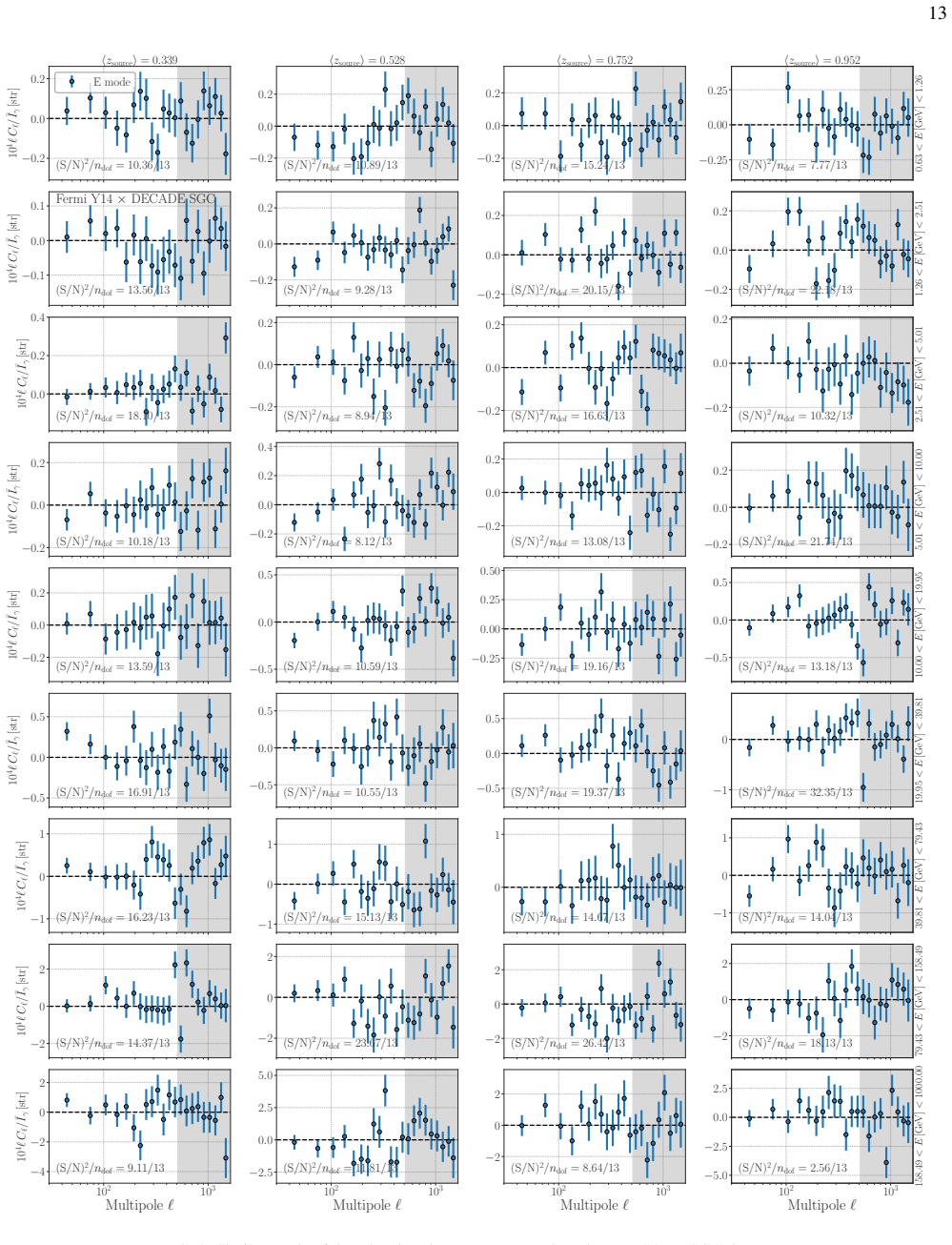
Summary. The paper measures Fourier-space cross-power spectra between the unresolved extragalactic γ-ray background (14 yr Fermi-LAT Pass 8, nine energy bins) and cosmic shear (DES Y3 + DECADE, four tomographic bins) over a common ~12 000 deg^{2} footprint. A model-independent χ^{2} test finds the stacked E-mode spectra consistent with null (S/N^{2}/ndof ≈ 10–22/13; B-modes likewise null). These null measurements are converted, via a Gaussian likelihood and a standard halo-model prediction for P_{δ,δ^{2}}, into 95 % upper limits on the WIMP annihilation cross section for four channels (b b-bar, τ^{+}τ^{-}, μ^{+}μ^{-}, W^{+}W^{-}), with and without inverse-Compton secondaries and for three discrete substructure boost models (HIGH/MID/LOW). The limits exclude the Sommerfeld-enhanced wino cross section at 2–3 TeV for boost ≳ 30 and the thermal relic value for 7–40 GeV particles annihilating to b b-bar or τ^{+}τ^{-} under boost ~100. Separate one-parameter template fits recover a ~3.9σ amplitude for the power-law phenomenological model of Thakore et al. (2025) and a matched-filter (S/N)^{2} = 58.6 (p ~ 0.01). Decaying-DM lifetime limits of ~10^{26}–10^{27} s are also reported.
Significance. The work supplies the largest-area Fourier-space measurement of the γ-ray–cosmic-shear cross-correlation to date and places competitive cosmological limits on annihilating and decaying dark matter that are complementary to local probes (dSphs, Galactic Center). The model-independent null result is cleanly documented, B-modes and individual energy/redshift bins are shown to be consistent with noise, and the boost-factor uncertainty is bracketed rather than hidden. The transparent separation between the conservative null-based limits and the moderate template-based signals is a methodological strength that clarifies the status of earlier real-space claims. The analysis is therefore a solid, incremental but useful contribution to indirect dark-matter searches with large-scale structure.
major comments (2)
- Section III B and Figure 3: the exclusion contours scale linearly with the substructure boost b_sh. While the three discrete models (HIGH ~100, MID ~30, LOW ~3) are standard and transparently shown, the paper never quantifies how the limits degrade if the boost is allowed to vary continuously with halo mass or redshift (e.g., via a free amplitude times the MID model). A one-parameter continuous boost (or a simple power-law mass dependence) would make the robustness of the wino and thermal exclusions more quantitative without changing the analysis framework.
- Section IV C, Eqs. (28)–(32): the matched-filter (S/N)^{2} = 58.6 is obtained by fitting independent amplitudes A_αβ in each of the 36 energy–redshift bins to a pure ℓ^{-1} template. Because the covariance among the A_αβ is retained, the p-value ~0.01 is formally correct, yet the paper does not test whether residual Galactic-foreground leakage or energy-dependent mask incompleteness could produce a coherent ℓ^{-1}-like residual. A short null test that randomizes the γ-ray energy bins (or replaces the data with pure photon-noise maps) would strengthen the claim that the moderate template signal is not an artifact.
minor comments (5)
- Table I: the sky fraction f_sky jumps from 0.019 (lowest energy bin) to ~0.3; a brief sentence explaining that the energy-dependent source mask is responsible would help the reader.
- Figure 2 caption and Section II C: the hybrid multipole binning (Δℓ = 30 for ℓ < 240, then logarithmic) is stated, but the precise band-power edges used for the 13 bins are not listed; a short table or supplementary file would aid reproducibility.
- Section III C: the angular templates ξ_1h(θ) and ξ_2h(θ) are digitized from Thakore et al. (2025). Explicitly stating that the digitization uncertainty is negligible compared with the statistical errors would close a minor reproducibility concern.
- Appendix B, Figure 9: the decaying-DM limits are quoted as 2σ lower bounds on lifetime in the abstract but shown as 95 % upper bounds on Γ_d in the figure; consistent language would avoid confusion.
- Typographical: “anlyses” (p. 3), “aknowledge” (acknowledgments), and a few missing spaces around units (e.g., “13.7,GeV”) should be corrected.
Circularity Check
No significant circularity: null detection and DM limits derived from independent public datasets and standard halo-model ingredients; phenomenological templates used only for consistency checks with free amplitudes.
full rationale
The paper's central results rest on new Fourier-space measurements of C_γE(ℓ) from 14-year Fermi-LAT residual maps cross-correlated with DES Y3 + DECADE shear catalogs over ~12 000 deg^{2} (Section II, Eq. 1, NaMaster pseudo-C_ℓ). Model-independent stacked (S/N)^{2}/ndof values (10–22/13) and per-bin spectra (Appendix A) are consistent with null, converted to 95 % ⟨σv⟩ limits via a Gaussian likelihood (Eqs. 26–27) that scales the standard one-halo + two-halo P_δ,δ^{2} (halo mass function/bias of Tinker et al., NFW, concentration of Prada et al.) by three literature boost factors (HIGH/MID/LOW). These boosts are external citations, not fitted to the present data, and the paper brackets them transparently (Fig. 3). Phenomenological power-law/log-parabola templates are taken from Thakore+25 solely for a one-parameter amplitude fit (Eq. 28) that tests consistency; the fitted q is free and does not force the null or the DM exclusions. No equation reduces by construction to its own inputs, no uniqueness theorem is imported from the authors, and no ansatz is smuggled via self-citation. Minor self-citations appear only for methodological continuity (earlier Shirasaki et al. papers on the same observable), which is normal and non-load-bearing. The derivation is therefore self-contained against external benchmarks.
Axiom & Free-Parameter Ledger
free parameters (3)
- substructure boost factor b_sh (HIGH/MID/LOW) =
HIGH~100, MID~30, LOW~3
- template amplitude q (power-law and log-parabola) =
0.62±0.16 (power-law)
- matched-filter amplitudes A_αβ
axioms (5)
- domain assumption Flat ΛCDM cosmology with fixed parameters h=0.68, Ω_m0=0.315, σ8=0.83
- domain assumption Limber approximation for the projected cross-power spectrum C_γE(ℓ)
- domain assumption Halo-model decomposition of P_δ,δ^{2} with NFW profiles, Tinker mass function/bias and Prada concentration
- domain assumption No correlation between γ-ray noise and intrinsic alignments; Gaussian covariance sufficient
- domain assumption Primary and secondary (IC) photons share the same spatial distribution
read the original abstract
We revisit the cross-correlation between the unresolved $\gamma$-ray background and galaxy shapes to constrain the annihilation cross section of particle dark matter. Our analysis uses $\gamma$-ray photons from 14 years of observations with the Fermi Large Area Telescope (LAT), together with galaxy shape catalogs from the Dark Energy Survey Year 3 (DES Y3) and the Dark Energy Camera All Data Everywhere (DECADE) project, enabling us to probe cosmological large-scale signals over a common sky area of $\sim 12{,}000\,\mathrm{deg}^2$ shared by the $\gamma$-ray and galaxy data sets. In order to better access signals from large-scale structure, we employ a Fourier-space estimator for the cross-correlation in contrast to the previous DES Y3 analysis. We find that our measurements are consistent with a null detection in a model-independent $\chi^2$ test, while template-based analyses yield signals at the $\sim 3\sigma$ level. Our null results exclude an enhanced annihilation cross section for wino-like dark matter with a mass of $2-3$ TeV under a modest substructure boost factor of $\sim 30$ in Milky Way-sized halos. For larger boost factors of $\sim 100$, the constraints become significantly stronger and exclude the canonical thermal annihilation cross section $\langle \sigma v \rangle = 3 \times 10^{-26}\,\mathrm{cm}^3/\mathrm{s}$ for a $7-40$ GeV dark matter particle annihilating into $b\bar{b}$ or $\tau^{+}\tau^{-}$. The template-based analysis favors a power-law $\gamma$-ray energy dependence of the cross-correlation, but also indicates deviations from that expected based on the mean intensity of the unresolved $\gamma$-ray background around 100 GeV. We further consider decaying dark matter scenarios and derive $2\sigma$ lower limits on the particle lifetime of $\sim 10^{26}-10^{27}\,\mathrm{s}$, depending on the decay channel.
Figures



Reference graph
Works this paper leans on
-
[1]
G. Jungman, M. Kamionkowski, and K. Griest, Supersym- metric dark matter, Phys. Rept.267, 195 (1996), arXiv:hep- ph/9506380
arXiv 1996
-
[2]
N. Fornengo and M. Regis, Particle dark matter searches in the anisotropic sky, Front. Physics2, 6 (2014), arXiv:1312.4835 [astro-ph.CO]
Pith/arXiv arXiv 2014
-
[3]
M. Fornasa and M. A. S ´anchez-Conde, The nature of the Diffuse Gamma-Ray Background, Phys. Rept.598, 1 (2015), arXiv:1502.02866 [astro-ph.CO]
Pith/arXiv arXiv 2015
-
[4]
S. Camera, M. Fornasa, N. Fornengo, and M. Regis, Tomographic-spectral approach for dark matter detection in the cross-correlation between cosmic shear and diffuseγ-ray emis- sion, JCAP06, 029, arXiv:1411.4651 [astro-ph.CO]
-
[5]
S. Camera, M. Fornasa, N. Fornengo, and M. Regis, A Novel Approach in the Weakly Interacting Massive Particle Quest: Cross-correlation of Gamma-Ray Anisotropies and Cosmic Shear, Astrophys. J. Lett.771, L5 (2013), arXiv:1212.5018 [astro-ph.CO]
Pith/arXiv arXiv 2013
-
[6]
M. Shirasaki, S. Horiuchi, and N. Yoshida, Cross-Correlation of Cosmic Shear and Extragalactic Gamma-ray Background: Con- straints on the Dark Matter Annihilation Cross-Section, Phys. Rev. D90, 063502 (2014), arXiv:1404.5503 [astro-ph.CO]
Pith/arXiv arXiv 2014
-
[7]
M. Shirasaki, O. Macias, S. Horiuchi, S. Shirai, and N. Yoshida, Cosmological constraints on dark matter annihilation and de- cay: Cross-correlation analysis of the extragalacticγ-ray back- ground and cosmic shear, Phys. Rev. D94, 063522 (2016), arXiv:1607.02187 [astro-ph.CO]
Pith/arXiv arXiv 2016
-
[8]
T. Tr ¨osteret al., Cross-correlation of weak lensing and gamma rays: implications for the nature of dark matter, Mon. Not. Roy. Astron. Soc.467, 2706 (2017), arXiv:1611.03554 [astro- ph.CO]
Pith/arXiv arXiv 2017
-
[9]
M. Shirasaki, O. Macias, S. Horiuchi, N. Yoshida, C.-H. Lee, and A. J. Nishizawa, Correlation of extragalacticγrays with cosmic matter density distributions from weak gravitational lensing, Phys. Rev. D97, 123015 (2018), arXiv:1802.10257 [astro-ph.CO]
Pith/arXiv arXiv 2018
-
[10]
Ammazzalorsoet al.(DES), Detection of Cross-Correlation between Gravitational Lensing andγRays, Phys
S. Ammazzalorsoet al.(DES), Detection of Cross-Correlation between Gravitational Lensing andγRays, Phys. Rev. Lett. 124, 101102 (2020), arXiv:1907.13484 [astro-ph.CO]
Pith/arXiv arXiv 2020
-
[11]
B. Thakoreet al.(DES, FERMI-LAT), High-Significance De- tection of Correlation Between the Unresolved Gamma-Ray Background and the Large Scale Cosmic Structure, JCAP06, 037, arXiv:2501.10506 [astro-ph.CO]
-
[12]
S. Zhanget al., KiDS-Legacy: WIMP dark matter con- straints from the cross-correlation of weak lensing and Fermi- LAT gamma rays, Astron. Astrophys.710, A80 (2026), arXiv:2601.11223 [astro-ph.CO]
Pith/arXiv arXiv 2026
-
[13]
Gattiet al.(DES), Dark energy survey year 3 results: weak lensing shape catalogue, Mon
M. Gattiet al.(DES), Dark energy survey year 3 results: weak lensing shape catalogue, Mon. Not. Roy. Astron. Soc.504, 4312 (2021), arXiv:2011.03408 [astro-ph.CO]
Pith/arXiv arXiv 2021
-
[14]
D. Anbajaganeet al., The DECADE cosmic shear project IV: cosmological constraints from 107 million galaxies across 5,400 deg 2 of the sky, Open J. Astrophys.8, 146161 (2025), arXiv:2502.17677 [astro-ph.CO]
arXiv 2025
-
[15]
D. Anbajaganeet al., The Dark Energy Camera All Data Every- where cosmic shear project V: Constraints on cosmology and astrophysics from 270 million galaxies across 13,000 deg 2 of the sky, arXiv:2509.03582 [astro-ph.CO] (2025), unpublished. 11 −0.2 0.0 0.2 104ℓ Cℓ/ ¯Iγ [str] (S/N)2/ndof = 6.63/13 ⟨zsource⟩= 0.339 E mode −0.2 0.0 0.2 (S/N)2/ndof = 14.13/1...
arXiv 2025
-
[16]
D. Anbajaganeet al., The DECADE cosmic shear project I: A new weak lensing shape catalog of 107 million galaxies, 12 −0.2 0.0 104ℓ Cℓ/ ¯Iγ [str] (S/N)2/ndof = 19.63/13 ⟨zsource⟩= 0.339 E mode 0.0 0.2 (S/N)2/ndof = 13.50/13 ⟨zsource⟩= 0.528 −0.2 0.0 0.2 (S/N)2/ndof = 16.85/13 ⟨zsource⟩= 0.752 −0.2 0.0 0.2 (S/N)2/ndof = 21.38/13 ⟨zsource⟩= 0.952 0.63 < E [G...
arXiv 2025
-
[17]
E. Huff and R. Mandelbaum, Metacalibration: Direct Self- Calibration of Biases in Shear Measurement, arXiv:1702.02600 14 102 103 10410−28 10−27 10−26 10−25 10−24 □d [s−1] Primary γ ray (dashed), Primary + Secondary (solid) b¯b channel Fermi 14-year × (DESY3, DECADE) 102 103 104 Primary γ ray (dashed), Primary + Secondary (solid) τ +τ − channel Fermi 14-ye...
Pith/arXiv arXiv 2017
-
[18]
E. S. Sheldon and E. M. Huff, Practical Weak Lensing Shear Measurement with Metacalibration, Astrophys. J.841, 24 (2017), arXiv:1702.02601 [astro-ph.CO]
Pith/arXiv arXiv 2017
-
[19]
J. Myleset al.(DES), Dark Energy Survey Year 3 results: red- shift calibration of the weak lensing source galaxies, Mon. Not. Roy. Astron. Soc.505, 4249 (2021), arXiv:2012.08566 [astro- ph.CO]
Pith/arXiv arXiv 2021
-
[20]
D. Anbajaganeet al., The DECADE cosmic shear project II: photometric redshift calibration of the source galaxy sample, Open J. Astrophys.8, 146159 (2025), arXiv:2502.17675 [astro- ph.CO]
arXiv 2025
-
[21]
K. M. G ´orski, E. Hivon, A. J. Banday, B. D. Wandelt, F. K. Hansen, M. Reinecke, and M. Bartelmann, HEALPix - A Framework for high resolution discretization, and fast analysis of data distributed on the sphere, Astrophys. J.622, 759 (2005), arXiv:astro-ph/0409513
Pith/arXiv arXiv 2005
-
[22]
E. Hivon, K. M. Gorski, C. B. Netterfield, B. P. Crill, S. Prunet, and F. Hansen, Master of the cosmic microwave background anisotropy power spectrum: a fast method for statistical anal- ysis of large and complex cosmic microwave background data sets, Astrophys. J.567, 2 (2002), arXiv:astro-ph/0105302
Pith/arXiv arXiv 2002
-
[23]
D. Alonso, J. Sanchez, and A. Slosar (LSST Dark Energy Sci- ence), A unified pseudo-Cℓ framework, Mon. Not. Roy. Astron. Soc.484, 4127 (2019), arXiv:1809.09603 [astro-ph.CO]
Pith/arXiv arXiv 2019
-
[24]
A. Nicola, C. Garc ´ıa-Garc´ıa, D. Alonso, J. Dunkley, P. G. Fer- reira, A. Slosar, and D. N. Spergel, Cosmic shear power spectra in practice, JCAP03, 067, arXiv:2010.09717 [astro-ph.CO]
Pith/arXiv arXiv 2010
-
[25]
C. Garc ´ıa-Garc´ıa, D. Alonso, and E. Bellini, Disconnected pseudo-Cℓ covariances for projected large-scale structure data, JCAP11, 043, arXiv:1906.11765 [astro-ph.CO]
Pith/arXiv arXiv 1906
-
[26]
A. La Posta, D. Alonso, N. E. Chisari, T. Ferreira, and C. Garc ´ıa-Garc´ıa, Insights on gas thermodynamics from the combination of x-ray and thermal Sunyaev-Zel’dovich data cross correlated with cosmic shear, Phys. Rev. D112, 043525 (2025), arXiv:2412.12081 [astro-ph.CO]
arXiv 2025
-
[27]
R. C. Gilmore, R. S. Somerville, J. R. Primack, and A. Dominguez, Semi-analytic modeling of the EBL and con- sequences for extragalactic gamma-ray spectra, Mon. Not. Roy. Astron. Soc.422, 3189 (2012), arXiv:1104.0671 [astro-ph.CO]
Pith/arXiv arXiv 2012
-
[28]
M. Bartelmann and P. Schneider, Weak gravitational lensing, Phys. Rept.340, 291 (2001), arXiv:astro-ph/9912508
Pith/arXiv arXiv 2001
-
[29]
D. N. Limber, The Analysis of Counts of the Extragalactic Neb- ulae in Terms of a Fluctuating Density Field. II, Astrophys. J. 119, 655 (1954)
1954
-
[30]
K. Ishiwata, S. Matsumoto, and T. Moroi, Cosmic Gamma- ray from Inverse Compton Process in Unstable Dark Matter Scenario, Phys. Lett. B679, 1 (2009), arXiv:0905.4593 [astro- ph.CO]
Pith/arXiv arXiv 2009
-
[31]
G. Brunetti and T. W. Jones, Cosmic rays in galaxy clusters and their nonthermal emission, Int. J. Mod. Phys. D23, 1430007 (2014), arXiv:1401.7519 [astro-ph.CO]
Pith/arXiv arXiv 2014
-
[32]
M. Cirelli, G. Corcella, A. Hektor, G. Hutsi, M. Kadastik, P. Panci, M. Raidal, F. Sala, and A. Strumia, PPPC 4 DM ID: A Poor Particle Physicist Cookbook for Dark Matter Indirect Detection, JCAP03, 051, [Erratum: JCAP 10, E01 (2012)], arXiv:1012.4515 [hep-ph]
Pith/arXiv arXiv 2012
-
[33]
S. Ando and K. Ishiwata, Constraints on decaying dark matter from the extragalactic gamma-ray background, JCAP05, 024, arXiv:1502.02007 [astro-ph.CO]. 15
-
[34]
S. Ando and K. Ishiwata, Constraining particle dark matter us- ing local galaxy distribution, JCAP06, 045, arXiv:1604.02263 [hep-ph]
-
[35]
J. L. Tinker, A. V . Kravtsov, A. Klypin, K. Abazajian, M. S. Warren, G. Yepes, S. Gottlober, and D. E. Holz, Toward a halo mass function for precision cosmology: The Limits of univer- sality, Astrophys. J.688, 709 (2008), arXiv:0803.2706 [astro- ph]
Pith/arXiv arXiv 2008
-
[36]
J. L. Tinker, B. E. Robertson, A. V . Kravtsov, A. Klypin, M. S. Warren, G. Yepes, and S. Gottlober, The Large Scale Bias of Dark Matter Halos: Numerical Calibration and Model Tests, Astrophys. J.724, 878 (2010), arXiv:1001.3162 [astro-ph.CO]
Pith/arXiv arXiv 2010
-
[37]
J. F. Navarro, C. S. Frenk, and S. D. M. White, A Universal density profile from hierarchical clustering, Astrophys. J.490, 493 (1997), arXiv:astro-ph/9611107
Pith/arXiv arXiv 1997
-
[38]
F. Prada, A. A. Klypin, A. J. Cuesta, J. E. Betancort-Rijo, and J. Primack, Halo concentrations in the standard LCDM cosmology, Mon. Not. Roy. Astron. Soc.423, 3018 (2012), arXiv:1104.5130 [astro-ph.CO]
Pith/arXiv arXiv 2012
-
[39]
L. Gao, C. S. Frenk, A. Jenkins, V . Springel, and S. D. M. White, Where will supersymmetric dark matter first be seen?, Mon. Not. Roy. Astron. Soc.419, 1721 (2012), arXiv:1107.1916 [astro-ph.CO]
Pith/arXiv arXiv 2012
-
[40]
´A. Molin ´e, M. A. S ´anchez-Conde, S. Palomares-Ruiz, and F. Prada, Characterization of subhalo structural properties and implications for dark matter annihilation signals, Mon. Not. Roy. Astron. Soc.466, 4974 (2017), arXiv:1603.04057 [astro- ph.CO]
Pith/arXiv arXiv 2017
-
[41]
S. Ando, T. Ishiyama, and N. Hiroshima, Halo Substructure Boosts to the Signatures of Dark Matter Annihilation, Galax- ies7, 68 (2019), arXiv:1903.11427 [astro-ph.CO]
Pith/arXiv arXiv 2019
-
[42]
G. Steigman, B. Dasgupta, and J. F. Beacom, Precise Relic WIMP Abundance and its Impact on Searches for Dark Matter Annihilation, Phys. Rev. D86, 023506 (2012), arXiv:1204.3622 [hep-ph]
Pith/arXiv arXiv 2012
-
[43]
A. Hryczuk and R. Iengo, The one-loop and Sommerfeld elec- troweak corrections to the Wino dark matter annihilation, JHEP 01, 163, [Erratum: JHEP 06, 137 (2012)], arXiv:1111.2916 [hep-ph]
Pith/arXiv arXiv 2012
-
[44]
L. Randall and R. Sundrum, Out of this world supersymmetry breaking, Nucl. Phys. B557, 79 (1999), arXiv:hep-th/9810155
Pith/arXiv arXiv 1999
-
[45]
G. F. Giudice, M. A. Luty, H. Murayama, and R. Rattazzi, Gaugino mass without singlets, JHEP12, 027, arXiv:hep- ph/9810442
-
[46]
G. Aadet al.(ATLAS), Observation of a new particle in the search for the Standard Model Higgs boson with the ATLAS de- tector at the LHC, Phys. Lett. B716, 1 (2012), arXiv:1207.7214 [hep-ex]
Pith/arXiv arXiv 2012
-
[47]
S. Chatrchyanet al.(CMS), Observation of a New Boson at a Mass of 125 GeV with the CMS Experiment at the LHC, Phys. Lett. B716, 30 (2012), arXiv:1207.7235 [hep-ex]
Pith/arXiv arXiv 2012
-
[48]
Okada, M
Y . Okada, M. Yamaguchi, and T. Yanagida, Upper bound of the lightest Higgs boson mass in the minimal supersymmetric standard model, Prog. Theor. Phys.85, 1 (1991)
1991
-
[49]
J. R. Ellis, G. Ridolfi, and F. Zwirner, Radiative corrections to the masses of supersymmetric Higgs bosons, Phys. Lett. B257, 83 (1991)
1991
-
[50]
H. E. Haber and R. Hempfling, Can the mass of the lightest Higgs boson of the minimal supersymmetric model be larger than m(Z)?, Phys. Rev. Lett.66, 1815 (1991)
1991
-
[51]
J. R. Ellis, G. Ridolfi, and F. Zwirner, On radiative corrections to supersymmetric Higgs boson masses and their implications for LEP searches, Phys. Lett. B262, 477 (1991)
1991
-
[52]
J. Hisano, S. Matsumoto, M. Nagai, O. Saito, and M. Senami, Non-perturbative effect on thermal relic abundance of dark mat- ter, Phys. Lett. B646, 34 (2007), arXiv:hep-ph/0610249
Pith/arXiv arXiv 2007
-
[53]
S. Abdollahiet al.(Fermi-LAT, HAWC, H.E.S.S., MAGIC, VERITAS), Combined dark matter search towards dwarf spheroidal galaxies with Fermi-LAT, HAWC, H.E.S.S., MAGIC, and VERITAS, JCAP03, 035, arXiv:2508.20229 [astro-ph.HE]
- [54]
-
[55]
A. Paopiamsap, D. Alonso, D. J. Bartlett, and M. Bilicki, Constraints on dark matter and astrophysics from tomographic γ-ray cross-correlations, Phys. Rev. D109, 103517 (2024), arXiv:2307.14881 [astro-ph.CO]
Pith/arXiv arXiv 2024
-
[56]
M. Di Mauro and M. W. Winkler, Multimessenger con- straints on the dark matter interpretation of the Fermi-LAT Galactic center excess, Phys. Rev. D103, 123005 (2021), arXiv:2101.11027 [astro-ph.HE]
Pith/arXiv arXiv 2021
-
[57]
T. Totani, 20 GeV halo-like excess of the Galactic diffuse emis- sion and implications for dark matter annihilation, JCAP11, 080, arXiv:2507.07209 [astro-ph.HE]
-
[58]
A. Rubiola, S. Camera, and N. Fornengo, Wiener filtering and multi-tracer techniques for dark matter cross-correlations be- tween gamma-ray emission and galaxy catalogs, JCAP10, 115, arXiv:2508.02160 [astro-ph.CO]
-
[59]
B. Thakore, M. Regis, M. Negro, S. Camera, D. Gruen, N. For- nengo, and A. Roodman, Multi-Tracer Cross-Correlations of the Unresolvedγ-Ray Sky, arXiv:2601.13312 [astro-ph.CO] (2026)
Pith/arXiv arXiv 2026
-
[60]
R. Takahashi, M. Sato, T. Nishimichi, A. Taruya, and M. Oguri, Revising the Halofit Model for the Nonlinear Matter Power Spectrum, Astrophys. J.761, 152 (2012), arXiv:1208.2701 [astro-ph.CO]
Pith/arXiv arXiv 2012
-
[61]
A. Ibarra, D. Tran, and C. Weniger, Indirect Searches for De- caying Dark Matter, Int. J. Mod. Phys. A28, 1330040 (2013), arXiv:1307.6434 [hep-ph]
Pith/arXiv arXiv 2013
discussion (0)
Sign in with ORCID, Apple, or X to comment. Anyone can read and Pith papers without signing in.