REVIEW 2 major objections 5 minor 29 references
One shared graph model can generate ready-to-run grasps for robot hands that differ in fingers, joints, and command spaces.
Reviewed by Pith at T0; open to challenge. T0 means a machine referee read the full paper against a public rubric. the ladder, T0–T4 →
T0 review · grok-4.5
2026-07-14 07:31 UTC pith:77JLGUFM
load-bearing objection Solid multi-hand grasp systems paper: URDF graphs + dynamic world edges + executable-state flow matching beat DRO/TRO on success and latency, with real topology transfer; nearest-target training is a real but not fatal caveat. the 2 major comments →
GraspGraphNet: Graph-Structured Multi-Embodiment Dexterous Grasp Generation
The pith
A machine-rendered reading of the paper's core claim, the machinery that carries it, and where it could break.
Core claim
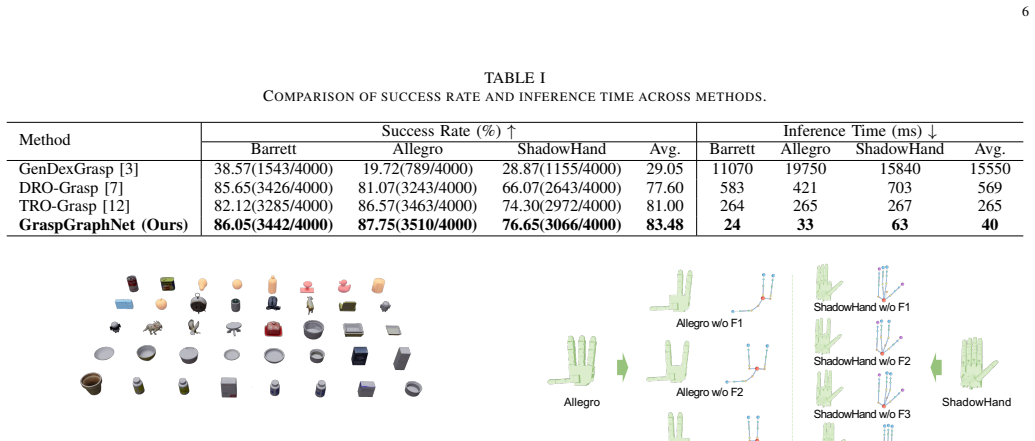
A single shared GraspGraphNet, trained jointly on Barrett, Allegro, and Shadow hands, can generate executable palm poses and joint configurations that achieve 83.48 percent average success at roughly 40 ms per grasp on a 40-object Isaac Gym benchmark, and the same model, without retraining, still achieves 72.70 percent success on controlled finger-removal topology variants. The paper therefore claims that URDF-derived kinematic graphs with dynamic world-edge message passing and conditional flow matching in native grasp-state space are sufficient to support multi-embodiment dexterous grasp generation.
What carries the argument
GraspGraphNet: a URDF-derived kinematic graph of the hand (link nodes, joint edges) together with dynamic world-frame edges to nearby object surface points, on which conditional flow matching directly predicts palm-pose and joint velocities that are integrated into executable commands.
Load-bearing premise
The reported success rates rest on the claim that keeping object displacement under 2 cm under six simulated pushes, using grasps whose training targets were the nearest annotated open-hand-compatible examples, is a fair and unbiased measure of real multi-hand grasp quality and topology robustness.
What would settle it
Train and evaluate the identical architecture on the same three hands and 40 objects, but replace the nearest-target selection rule and the 2 cm six-direction Isaac Gym criterion with a stricter force-closure or real-robot drop test; if average success falls well below the claimed 83 percent / 72 percent figures, the central multi-embodiment claim is overstated.
Editorial analysis
A structured set of objections, weighed in public.
Referee Report
Summary. GraspGraphNet is a multi-embodiment dexterous grasp generator that represents each robot hand as a URDF-derived kinematic graph (link nodes, joint edges) and directly predicts executable palm pose and actuated joint configuration via conditional flow matching. Hierarchical object surface features are fused with state-conditioned robot embeddings through coarse cross-attention and dynamic world-edge message passing that rebuilds kNN robot–object edges from differentiable FK at every flow step. A single shared model is trained on Barrett, Allegro, and Shadow hands from filtered CMapDataset and evaluated on a 40-object Isaac Gym benchmark (10 held-out CMap + 30 Google Scanned Objects), reporting 83.48% average success at 40 ms per grasp, outperforming GenDexGrasp, DRO-Grasp, and TRO-Grasp. Without retraining the same weights achieve 72.70% on controlled finger-removal topology variants; real-world Leap Hand trials after fine-tuning reach 91%. Ablations support dynamic edges, fusion modules, flow matching over direct regression, and K=3 Euler steps.
Significance. If the results hold under the stated protocol, the work is a clear advance for multi-embodiment dexterous grasping: a single parameter-sharing graph model produces native executable commands without contact-map optimization, IK, or retargeting, while remaining robust to modest topology edits. The combination of URDF graphs, dynamic world edges, and executable-state flow matching is technically coherent and yields both higher success and substantially lower latency than recent interaction-centric baselines on an expanded object set. Strengths include systematic ablations (Tables III–VI), a shared evaluation protocol with prior work, and a real-robot demonstration. These contributions are of practical interest to the robotics community even if absolute success numbers are protocol-dependent.
major comments (2)
- Sec. III-E.2 and the training objective: for each sampled open-hand initial x0 the target x1 is chosen as the nearest annotated CMapDataset grasp (palm translation + 0.5·rotation cost). This systematically trains short, easy trajectories rather than the full multi-modal distribution. At inference (same section) initials are sphere-uniform with no target available. Tables I–II therefore report success only on the modes the model actually reaches; if those modes are biased toward the preferentially paired easy targets, both the 83.48% multi-hand average and the 72.70% finger-removal figure overstate capability under a uniform or harder initial-state distribution. A controlled experiment that either (a) trains without nearest-target selection or (b) evaluates success stratified by initial-to-nearest-GT distance is needed to substantiate the central multi-embodiment and topology-robustness c
- Sec. IV-A success criterion and Sec. IV-C topology evaluation: success is defined solely as object displacement <2 cm under six directional perturbations in Isaac Gym. While this matches DRO/TRO protocol, it does not report contact quality, force closure, or joint-limit / collision feasibility of the final states. For finger-ablated hands (Fig. 6, Table II) the same criterion can credit grasps that succeed only because fewer fingers reduce the chance of self-collision or because the remaining fingers still realize an easy mode learned under nearest-target pairing. Adding at least one secondary metric (e.g., contact count, penetration depth, or success under a stricter force-closure check) would make the topology-robustness claim load-bearing rather than protocol-specific.
minor comments (5)
- Eq. (1) and Sec. III-A: the continuous 6D palm orientation is said to live in a “robot-independent canonical palm frame,” but the conversion back to robot-native wrist pose (Sec. III-F) is only described textually; a short equation or diagram would clarify the fixed palm-to-wrist offset.
- Fig. 2 overview is dense; the distinction between coarse cross-attention and dynamic world-edge MPNN is easier to follow once the reader reaches Sec. III-D, but a one-sentence caption note would help.
- Table I inference times: GenDexGrasp’s multi-second numbers are expected for particle optimization, yet a brief note on whether all methods were timed on identical hardware (stated only for GraspGraphNet) would strengthen the 6–14× speed-up claim.
- Real-world section (IV-D): fine-tuning on Leap Hand data from TRO-Grasp is acknowledged, but the number of fine-tuning epochs / data volume is not reported; a single sentence would improve reproducibility.
- Typographical consistency: “x (0)” / “x(k)” spacing and the occasional “T(r,o)” vs “TRO-Grasp” notation vary across sections; a light pass would clean presentation.
Circularity Check
No circularity: empirical multi-hand grasp model trained on public annotations and evaluated by independent Isaac Gym physics, not by construction from its inputs.
full rationale
GraspGraphNet’s central claims are architectural and empirical, not a first-principles derivation that reduces to its own definitions. The grasp state (Eq. 1), linear conditional path and velocity target (Eq. 4), MSE flow-matching loss (Eq. 5), and Euler integration (Eq. 6) are standard conditional flow matching applied to palm pose and joint angles; the learned velocity field is not algebraically identical to the training targets. Training uses filtered CMapDataset annotations with nearest-target pairing (Sec. III-E.2) as a sampling heuristic; evaluation is on held-out objects (10 CMap holdouts + 30 Google Scanned Objects), an external Isaac Gym success criterion (object displacement <2 cm under six perturbations), and finger-ablated URDFs never seen in training, with direct comparison to GenDexGrasp, DRO-Grasp, and TRO-Grasp under a shared protocol. No load-bearing uniqueness theorem, self-citation chain, or fitted constant is renamed as a prediction. Nearest-target pairing may bias which modes are learned (a correctness/evaluation concern), but it does not make reported success rates true by construction. Score 0 is therefore appropriate.
Axiom & Free-Parameter Ledger
free parameters (6)
- Euler integration steps K =
3
- joint velocity loss weight λ_q =
1
- world-edge kNN size k / K_W =
8
- initial palm approach cone angle =
30 degrees
- hidden dimension / model capacity =
128
- object hierarchy point counts =
1024,256,64,32
axioms (5)
- domain assumption A robot hand URDF can be faithfully represented as a link-node / joint-edge kinematic graph for message passing across embodiments.
- domain assumption Linear conditional flow matching in continuous 6D palm orientation and joint-limit-normalized joint space is an adequate generative model for multi-modal grasps.
- domain assumption Isaac Gym success = object displacement <2 cm under six directional perturbations is a valid comparative measure of grasp quality.
- ad hoc to paper Nearest-ground-truth target selection given a sampled open-hand initial yields an unbiased training signal for inference-time sphere-sampled approaches.
- domain assumption Message-passing neural networks with shared joint heads generalize across variable graph sizes and actuation dimensions.
invented entities (3)
-
GraspGraphNet (URDF-graph + dynamic world-edge MPNN + executable-state CFM pipeline)
no independent evidence
-
Dynamic world-edge robot–object interaction graph E^t_W
no independent evidence
-
Palm-hub node (highest out-degree link for palm velocity head)
no independent evidence
read the original abstract
Dexterous grasp generation across robot hands is challenging because hands differ in kinematic topology, actuation dimensions, and native command spaces. We introduce GraspGraphNet, a topology-aware grasp generation framework that represents each hand as a URDF-derived kinematic graph and directly generates executable palm poses and joint configurations. GraspGraphNet combines hierarchical object surface encoding, differentiable forward kinematics, and dynamic world-edge message passing to model evolving robot-object interactions. It applies conditional flow matching directly in executable palm-pose and joint-state space, avoiding post-processing optimization, inverse kinematics, and retargeting. Using a shared model trained on Barrett Hand, Allegro Hand, and Shadow Hand, GraspGraphNet achieves an average success rate of 83.48% with 40ms inference time per grasp on a 40-object benchmark. Without retraining, the same model achieves 72.70% success on controlled finger-removal variants, demonstrating robustness to hand-topology variations. These results suggest that graph-structured hand representations can effectively support dexterous grasp generation across robot hands with different kinematic structures. Project: https://lysees.github.io/graspgraphnet-page
Figures




Reference graph
Works this paper leans on
-
[1]
An overview of learning- based dexterous grasping: recent advances and future directions,
X. Song, Y . Li, Y . Zhang, Y . Liu, and L. Jiang, “An overview of learning- based dexterous grasping: recent advances and future directions,”Arti- ficial Intelligence Review, vol. 58, no. 10, p. 300, 2025
2025
-
[2]
Dexgraspnet: A large-scale robotic dexterous grasp dataset for general objects based on simulation,
R. Wang, J. Zhang, J. Chen, Y . Xu, P. Li, T. Liu, and H. Wang, “Dexgraspnet: A large-scale robotic dexterous grasp dataset for general objects based on simulation,”arXiv preprint arXiv:2210.02697, 2022
Pith/arXiv arXiv 2022
-
[3]
Gendexgrasp: Generalizable dexterous grasping,
P. Li, T. Liu, Y . Li, Y . Geng, Y . Zhu, Y . Yang, and S. Huang, “Gendexgrasp: Generalizable dexterous grasping,” inICRA. IEEE, 2023
2023
-
[4]
Dexgraspnet 2.0: Learning generative dexterous grasping in large-scale synthetic cluttered scenes,
J. Zhang, H. Liu, D. Li, X. Yu, H. Geng, Y . Ding, J. Chen, and H. Wang, “Dexgraspnet 2.0: Learning generative dexterous grasping in large-scale synthetic cluttered scenes,” inCoRL, 2024
2024
-
[5]
Manifoundation model for general-purpose robotic manipulation of contact synthesis with arbitrary objects and robots,
Z. Xu, C. Gao, Z. Liu, G. Yang, C. Tie, H. Zheng, H. Zhou, W. Peng, D. Wang, T. Huet al., “Manifoundation model for general-purpose robotic manipulation of contact synthesis with arbitrary objects and robots,” inIROS. IEEE, 2024
2024
-
[6]
Contactgrasp: Func- tional multi-finger grasp synthesis from contact,
S. Brahmbhatt, A. Handa, J. Hays, and D. Fox, “Contactgrasp: Func- tional multi-finger grasp synthesis from contact,” inIROS. IEEE, 2019
2019
-
[7]
D(R,O)grasp: A unified representation of robot and object interaction for cross-embodiment dexterous grasping,
Z. Wei, Z. Xu, J. Guo, Y . Hou, C. Gao, Z. Cai, J. Luo, and L. Shao, “D(R,O)grasp: A unified representation of robot and object interaction for cross-embodiment dexterous grasping,” inICRA, 2025
2025
-
[8]
Contact transfer: A direct, user-driven method for human to robot transfer of grasps and manipulations,
A. Lakshmipathy, D. Bauer, C. Bauer, and N. S. Pollard, “Contact transfer: A direct, user-driven method for human to robot transfer of grasps and manipulations,” inICRA. IEEE, 2022
2022
-
[9]
Anydex- grasp: General dexterous grasping for different hands with human-level learning efficiency,
H.-S. Fang, H. Yan, Z. Tang, H. Fang, C. Wang, and C. Lu, “Anydex- grasp: General dexterous grasping for different hands with human-level learning efficiency,”arXiv preprint arXiv:2502.16420, 2025
Pith/arXiv arXiv 2025
-
[10]
Cedex: Cross-embodiment dexterous grasp generation at scale from human-like contact representations,
Z. Wu, R. A. Potamias, X. Zhang, Z. Zhang, J. Deng, and S. Luo, “Cedex: Cross-embodiment dexterous grasp generation at scale from human-like contact representations,”arXiv preprint arXiv:2509.24661, 2025
arXiv 2025
-
[11]
Robotfinger- print: Unified gripper coordinate space for multi-gripper grasp synthesis and transfer,
N. Khargonkar, L. F. Casas, B. Prabhakaran, and Y . Xiang, “Robotfinger- print: Unified gripper coordinate space for multi-gripper grasp synthesis and transfer,” inIROS. IEEE, 2025
2025
-
[12]
T(r,o) grasp: Effi- cient graph diffusion of robot-object spatial transformation for cross- embodiment dexterous grasping,
X. Fei, Z. Xu, H. Fang, T. Zhang, and L. Shao, “T(r,o) grasp: Effi- cient graph diffusion of robot-object spatial transformation for cross- embodiment dexterous grasping,” 2025
2025
-
[13]
Understanding urdf: A dataset and analysis,
D. Tola and P. Corke, “Understanding urdf: A dataset and analysis,” RA-L, 2024
2024
-
[14]
Relational inductive biases, deep learning, and graph networks,
P. W. Battaglia, J. B. Hamrick, V . Bapst, A. Sanchez-Gonzalez, V . Zam- baldi, M. Malinowski, A. Tacchetti, D. Raposo, A. Santoro, R. Faulkner et al., “Relational inductive biases, deep learning, and graph networks,” arXiv preprint arXiv:1806.01261, 2018
Pith/arXiv arXiv 2018
-
[15]
Nervenet: Learning structured policy with graph neural networks,
T. Wang, R. Liao, J. Ba, and S. Fidler, “Nervenet: Learning structured policy with graph neural networks,” inICLR, 2018
2018
-
[16]
Get-zero: Graph embodiment transformer for zero-shot embodiment generalization,
A. Patel and S. Song, “Get-zero: Graph embodiment transformer for zero-shot embodiment generalization,” inICRA. IEEE, 2025
2025
-
[17]
Denoising diffusion probabilistic models,
J. Ho, A. Jain, and P. Abbeel, “Denoising diffusion probabilistic models,” NeurIPS, 2020
2020
-
[18]
Flow matching for generative modeling,
Y . Lipman, R. T. Chen, H. Ben-Hamu, M. Nickel, and M. Le, “Flow matching for generative modeling,”arXiv preprint arXiv:2210.02747, 2022
Pith/arXiv arXiv 2022
-
[19]
Google scanned objects: A high- quality dataset of 3d scanned household items,
L. Downs, A. Francis, N. Koenig, B. Kinman, R. Hickman, K. Reymann, T. B. McHugh, and V . Vanhoucke, “Google scanned objects: A high- quality dataset of 3d scanned household items,” inICRA. IEEE, 2022
2022
-
[20]
Synthesizing diverse and physically stable grasps with arbitrary hand structures using differ- entiable force closure estimator,
T. Liu, Z. Liu, Z. Jiao, Y . Zhu, and S.-C. Zhu, “Synthesizing diverse and physically stable grasps with arbitrary hand structures using differ- entiable force closure estimator,”RA-L, 2021
2021
-
[21]
Graspit! a versatile simulator for robotic grasping,
A. T. Miller and P. K. Allen, “Graspit! a versatile simulator for robotic grasping,”IEEE Robotics & Automation Magazine, vol. 11, no. 4, pp. 110–122, 2004
2004
-
[22]
Unidexgrasp: Universal robotic dexterous grasping via learning diverse proposal generation and goal-conditioned policy,
Y . Xu, W. Wan, J. Zhang, H. Liu, Z. Shan, H. Shen, R. Wang, H. Geng, Y . Weng, J. Chenet al., “Unidexgrasp: Universal robotic dexterous grasping via learning diverse proposal generation and goal-conditioned policy,” inCVPR, 2023
2023
-
[23]
Unidexgrasp++: Improving dexterous grasping policy learning via geometry-aware curriculum and iterative generalist-specialist learning,
W. Wan, H. Geng, Y . Liu, Z. Shan, Y . Yang, L. Yi, and H. Wang, “Unidexgrasp++: Improving dexterous grasping policy learning via geometry-aware curriculum and iterative generalist-specialist learning,” inICCV, 2023. 9
2023
-
[24]
Dex1b: Learning with 1b demonstrations for dexterous manipulation,
J. Ye, K. Wang, C. Yuan, R. Yang, Y . Li, J. Zhu, Y . Qin, X. Zou, and X. Wang, “Dex1b: Learning with 1b demonstrations for dexterous manipulation,” inRSS, 2025
2025
-
[25]
Dexrepnet: Learning dexterous robotic grasping network with geomet- ric and spatial hand-object representations,
Q. Liu, Y . Cui, Q. Ye, Z. Sun, H. Li, G. Li, L. Shao, and J. Chen, “Dexrepnet: Learning dexterous robotic grasping network with geomet- ric and spatial hand-object representations,” inIROS. IEEE, 2023
2023
-
[26]
Unigrasp: Learning a unified model to grasp with multifingered robotic hands,
L. Shao, F. Ferreira, M. Jorda, V . Nambiar, J. Luo, E. Solowjow, J. A. Ojea, O. Khatib, and J. Bohg, “Unigrasp: Learning a unified model to grasp with multifingered robotic hands,”RA-L, 2020
2020
-
[27]
Geometry matching for multi-embodiment grasping,
M. Attarian, M. A. Asif, J. Liu, R. Hari, A. Garg, I. Gilitschenski, and J. Tompson, “Geometry matching for multi-embodiment grasping,” in CoRL. PMLR, 2023
2023
-
[28]
Pointnet++: Deep hierarchical feature learning on point sets in a metric space,
C. R. Qi, L. Yi, H. Su, and L. J. Guibas, “Pointnet++: Deep hierarchical feature learning on point sets in a metric space,”NeurIPS, 2017
2017
-
[29]
Leap hand: Low-cost, efficient, and anthropomorphic hand for robot learning,
K. Shaw, A. Agarwal, and D. Pathak, “Leap hand: Low-cost, efficient, and anthropomorphic hand for robot learning,”RSS, 2023
2023
discussion (0)
Sign in with ORCID, Apple, or X to comment. Anyone can read and Pith papers without signing in.