REVIEW 3 major objections 109 references
Multimodal models can internalize visual tools and self-regulate when to use them, matching external-tool methods on fine-grained perception while cutting inference latency by up to ~86%.
Reviewed by Pith at T0; open to challenge. T0 means a machine referee read the full paper against a public rubric. the ladder, T0–T4 →
T0 review · grok-4.5
2026-07-14 07:00 UTC pith:ASW5BTKQ
load-bearing objection Practical Pareto win: discrete implicit tool tokens + NTG/MC-Reward cut TwI latency ~86% at 8K while beating larger models on high-res perception; self-reg proxy is hand-tuned but numbers hold. the 3 major comments →
Beyond the Eye: Efficient Multimodal Reasoning via Self-Regulated Implicit Visual Tools
The pith
A machine-rendered reading of the paper's core claim, the machinery that carries it, and where it could break.
Core claim
BEE shows that visual tool invocation can be trained as an implicit, self-regulated behavior inside an MLLM: formalized CoT supervision activates tool slots and adaptive switching, and a self-regulated reward (guided by Net Tool Gain) teaches the model to invoke those slots only when group rollout accuracy indicates the task exceeds its current capability, yielding high fine-grained perception performance with far lower inference latency than external-tool Thinking-with-Images systems.
What carries the argument
Self-regulated implicit visual tools (IvT) plus MC-Reward: discrete tool-slot tokens stand in for operations such as zoom or crop; Net Tool Gain measures effective versus redundant tool use; MC-Reward uses online group-average accuracy p against a threshold τ to encourage tools on hard queries and penalize them on easy ones.
Load-bearing premise
That the average accuracy of a small group of sampled rollouts is a trustworthy live signal of whether a problem is inside or outside the model’s capability, so a fixed threshold cleanly tells the model when tools help and when they waste effort.
What would settle it
On a held-out high-resolution perception set, disable the self-regulated reward (or fix tool use always-on / always-off) and check whether Net Tool Gain and end-to-end accuracy-plus-latency still improve together relative to the SFT-only model and to an external-tool baseline; if accuracy rises only when tools fire on problems the base model already solves, the boundary-calibration claim fails.
If this is right
- Fine-grained perception at high resolution can be served in a single forward pass without sandbox APIs or repeated image re-encoding.
- Redundant tool calls can be measured (Net Tool Gain) and trained down, lowering cost per sample while preserving or improving accuracy.
- Implicit tool slots of modest length (even a handful of discrete tokens) can substitute for explicit zoom/crop/rotation pipelines on the evaluated benchmarks.
- The same self-regulated routing can keep general reasoning competitive rather than trading it away for perception gains.
- Deployment simplifies to a standard instruct MLLM stack, with reported throughput and cost advantages over multi-turn agentic tool systems.
Where Pith is reading between the lines
- If group-rollout accuracy is a good boundary signal, similar self-regulated gating could apply to other latent or tool-augmented modalities (search, code execution) without hard-coding budgets.
- The largest reported gains on monitoring and driving-style subtasks suggest the paradigm is most valuable where base models under-perceive dense or distant objects rather than where OCR is already strong.
- Failure modes on multi-object scenes and sparse logical CoT imply that data coverage, not only the reward shape, still bounds when self-regulation helps versus when the model skips needed tools or steps.
- A natural next test is whether NTG-style rewards remain stable as base models get stronger and the easy/hard mix of a fixed benchmark drifts.
Editorial analysis
A structured set of objections, weighed in public.
Referee Report
Summary. The paper proposes BEE, a two-stage training paradigm that internalizes visual tool operations (zoom, crop, rotate, etc.) as discrete implicit tool-slot tokens rather than external API calls with image re-encoding. Stage 1 uses formalized CoT SFT on a 320K mixture of tool and no-tool trajectories to activate tool-slot generation and basic adaptive switching. Stage 2 applies DAPO with a composite reward that includes MC-Reward, which shapes tool propensity from the online group-average accuracy p relative to a fixed threshold τ (default 2/3), so tools are encouraged only when internal knowledge appears insufficient. The authors introduce Net Tool Gain (NTG) to diagnose redundant tool use after SFT+simple RL, then show that MC-Reward raises NTG from 6.2% to 66% while cutting easy-problem tool rates to ~0.2%. Empirically, BEE-4B/7B/8B improve fine-grained perception (V*, HRBench, MME-RealWorld) over strong open-source and several closed-source baselines, stay competitive on general/OOD reasoning, and report large inference-speed gains (up to ~86.2% vs DeepEyes at 8K) with lower deployment cost.
Significance. If the results hold under broader scrutiny, BEE is a practically important step for multimodal reasoning: it shows that much of the accuracy benefit of “Thinking with Images” can be retained without the I/O and re-encoding tax of explicit tool agents, while adding an explicit self-regulation objective rather than a fixed latent budget. The combination of formalized tool-slot CoT, the NTG diagnostic, system-level latency/throughput/cost tables, multi-backbone scaling (4B/7B/8B), and controlled ablations on slot format, token length, and MC-Reward is stronger engineering evidence than many concurrent latent-reasoning papers. The work is therefore significant for efficient MLLM deployment and for research on capability-aware tool routing, even if the metacognitive interpretation of p is only partially validated.
major comments (3)
- Section 3.3.1 and the definition of p: the central “self-regulated knowledge routing” claim rests on treating group-average accuracy over G rollouts as an online capability boundary, then gating tool advantage via fixed τ=2/3 and the hand-specified continuous reward in Eq. (10). The paper shows that easy-problem tool rates fall and NTG rises (Fig. 8, Table 7), but does not independently test whether p is a reliable metacognitive signal versus a noisy co-evolving statistic that mainly induces a global tool-frequency prior. A load-bearing addition would be (i) held-out calibration of p against true difficulty (e.g., frozen-base accuracy or human difficulty bins), (ii) an ablation that replaces p with a non-capability signal (random or length-based) while keeping the same reward shape, and/or (iii) reporting tool-use conditional accuracy stratified by p at evaluation time. Without this, the
- Eqs. (9)–(10) and Appendix A.1: MC-Reward coefficients (α1,β1,α2,β2,γ,μ) and the cosine buffer are hand-chosen after a theoretical admissible-region argument. Table 17 varies τ but does not report a comparable sensitivity study for the reward coefficients or for G. Because Stage-2 policy updates are driven by this shaped advantage, the manuscript should either (a) show that nearby coefficient choices yield the same qualitative routing and NTG gains, or (b) describe a selection protocol (grid search on a validation split, automatic calibration) so the result is not tied to one opaque reward surface. This is especially important given the claim that continuous shaping is necessary to avoid collapse of tool use.
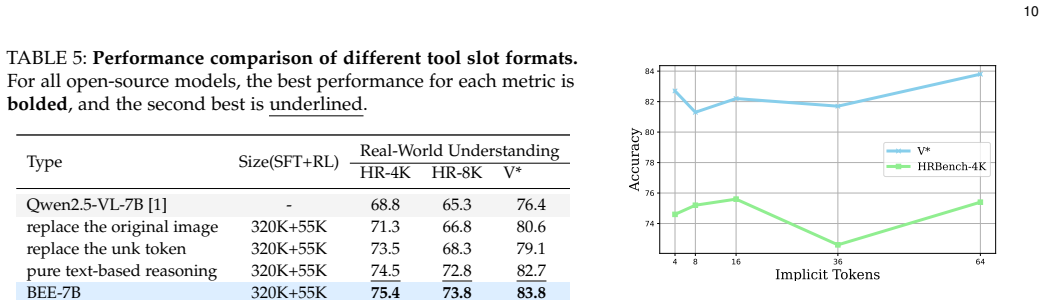
- Tables 1–2 and the efficiency protocol (Sec. 4.1, Table 4, Fig. 5): the Pareto claim versus agentic TwI methods is central, yet several comparisons mix different codebases, tool sandboxes, and (for Thyme) a non-vLLM stack. The paper already standardizes hardware and BF16 batch-1 settings, which is good, but it should also report (i) matched maximum generation length / decoding hyperparameters for all agentic baselines, (ii) tool-call count and re-encode count per sample, and (iii) at least mean±std over multiple seeds or evaluation shuffles for the main BEE numbers. Without variance and fully matched agentic budgets, the ~86.2% acceleration figure and some accuracy margins could be partly protocol-dependent.
Circularity Check
No load-bearing circularity: NTG is a post-hoc diagnostic, MC-Reward is a hand-designed online shaping signal, and final claims rest on external public-benchmark measurements rather than self-fitted quantities.
full rationale
BEE is an empirical two-stage training method (formalized CoT SFT on constructed trajectories + DAPO RL with composite rewards). The central performance and efficiency claims (Tables 1–2, Fig. 1, 86.2 % acceleration) are measured on held-out public benchmarks (V*, HRBench, MME-RealWorld, LogicVista, POPE) against external baselines, using rule-based or independent judge models (Qwen3-VL). NTG (Eq. 1) is defined from a base-vs-tool comparison on a test set solely to diagnose redundant tool use after Stage 1 (NTG = 6.2 % for BEE-Static); it is never fitted as a target and is only re-measured post-hoc after MC-Reward (NTG = 66 %). MC-Reward itself (Sec. 3.3, Eqs. 4–10) uses the online group-average accuracy p over G rollouts as a dynamic capability proxy against a fixed threshold τ = 2/3, with continuous linear+cosine coefficients chosen analytically in the appendix to satisfy the desired sign conditions of Eq. 5; the coefficients are not optimized against the final reported benchmark numbers, and the paper notes that any similar-trend parameters work. Tool-call-rate trajectories (Fig. 8) and ablations (Tables 5–10, 17–18) are likewise observational. Residual citations of the authors’ own prior latent-reasoning work (EVA) appear only as related-work baselines, not as uniqueness theorems or premises that force the present results. Consequently the derivation chain does not reduce by construction to its inputs; the only residual is ordinary non-load-bearing self-citation of prior latent methods, warranting a score of 1 rather than 0.
Axiom & Free-Parameter Ledger
free parameters (4)
- capability threshold τ =
2/3
- MC-Reward coefficients (α1,β1,α2,β2,γ,μ) =
α1=0.3, β1=-0.2, α2=-0.5, β2=0.3, γ=0.3, μ=0.15
- number of implicit tokens K =
typically 4–16
- rollout group size G =
8
axioms (4)
- domain assumption Group-average accuracy p over G rollouts is a faithful online estimate of the model’s current capability boundary.
- domain assumption Discrete semantic tokens produced by a VQ-style tokenizer adequately simulate the information gained from real visual tool operations (crop, zoom, rotate, etc.).
- domain assumption Mixed formalized CoT trajectories (with and without tool slots) are sufficient to activate both tool representations and adaptive switching.
- standard math Standard DAPO / GRPO-style policy gradient with the composite reward converges to a useful self-regulated policy.
invented entities (3)
-
Implicit visual tool (IvT) / tool slot tokens
independent evidence
-
Net Tool Gain (NTG) metric
independent evidence
-
MC-Reward (self-regulated confidence calibration)
independent evidence
read the original abstract
Recent multimodal large language models (MLLMs) have made remarkable progress on fine-grained perception tasks under the "Thinking with Images" (TwI) paradigm by iteratively performing various visual tool operations. However, this paradigm relies heavily on frequent external tool calls and repeated image re-encoding, which leads to substantial computational overhead and inference latency. To address these issues, we propose Beyond the Eye (BEE), a novel implicit visual tool paradigm centered on self-regulated capability. BEE directly incorporates visual tool invocation behaviors into the training objective and encourages the model to develop a self-regulated invocation mechanism. This design enables the model to adaptively balance internal knowledge and implicit tools, avoiding redundant tool usage while substantially reducing inference latency. Specifically, BEE involves a two-stage training process: (1) Formalized Chain-of-Thought (CoT) Supervised Fine-tuning (SFT). We construct CoT trajectories with structured tool slots and mixed invocation states. This stage activates the model's implicit tool representations and adaptive switching capability. (2) Self-regulated Reward-Driven Alignment. To address redundant tool usage caused by ambiguous cognitive boundaries, we first introduce the Net Tool Gain (NTG) metric to quantify this phenomenon. Based on this observation, we further propose a self-regulated reward mechanism. This mechanism penalizes ineffective tool dependency and encourages the model to perform knowledge routing, ensuring that implicit tools are invoked only when the model's internal knowledge is insufficient. BEE achieves state-of-the-art performance in fine-grained visual perception while remaining competitive in general reasoning tasks and achieving substantial gains in inference efficiency.
Figures






Reference graph
Works this paper leans on
-
[1]
S. Bai, K. Chen, X. Liu, J. Wang, W. Ge, S. Song, K. Dang, P . Wang, S. Wang, J. Tanget al., “Qwen2.5-vl technical report,”arXiv preprint arXiv:2502.13923, 2025
Pith/arXiv arXiv 2025
-
[2]
S. Bai, Y. Cai, R. Chen, K. Chen, X. Chen, Z. Cheng, L. Deng, W. Ding, C. Gao, C. Geet al., “Qwen3-vl technical report,”arXiv preprint arXiv:2511.21631, 2025
Pith/arXiv arXiv 2025
-
[3]
Minigpt-4: Enhancing vision-language understanding with advanced large language models,
D. Zhu, J. Chen, X. Shen, X. Li, and M. Elhoseiny, “Minigpt-4: Enhancing vision-language understanding with advanced large language models,” inProceedings of the International Conference on Learning Representations (ICLR), 2024
2024
-
[4]
A. Hurst, A. Lerer, A. P . Goucher, A. Perelman, A. Ramesh, A. Clark, A. Ostrow, A. Welihinda, A. Hayes, A. Radfordet al., “Gpt-4o system card,”arXiv preprint arXiv:2410.21276, 2024
Pith/arXiv arXiv 2024
-
[5]
Visual instruc- tion tuning,
H. Liu, C. Li, Q. Wu, and Y. J. Lee, “Visual instruc- tion tuning,” inProceedings of the Advances in Neural Information Processing Systems (NeurIPS), 2023
2023
-
[6]
Blip- 2: Bootstrapping language-image pre-training with frozen image encoders and large language models,
J. Li, D. Li, S. Savarese, and S. C. H. Hoi, “Blip- 2: Bootstrapping language-image pre-training with frozen image encoders and large language models,” inProceedings of the International Conference on Learning Representations (ICLR), 2023
2023
-
[7]
Instructblip: Towards general-purpose vision-language models with instruction tuning,
W. Dai, J. Li, D. Li, A. M. H. Tiong, J. Zhao, W. Wang, B. A. Li, P . Fung, and S. C. H. Hoi, “Instructblip: Towards general-purpose vision-language models with instruction tuning,” inProceedings of the Advances in Neural Information Processing Systems (NeurIPS), 2023
2023
-
[8]
G. Comanici, E. Bieber, M. Schaekermann, I. Pasupat, N. Sachdeva, I. Dhillon, M. Blistein, O. Ram, D. Zhang, E. Rosenet al., “Gemini 2.5: Pushing the frontier with advanced reasoning, multimodality, long context, and next generation agentic capabilities,”arXiv preprint arXiv:2507.06261, 2025
Pith/arXiv arXiv 2025
-
[9]
From system 1 to system 2: A survey of reasoning large language models,
Z.-Z. Li, D. Zhang, M.-L. Zhang, J. Zhang, Z. Liu, Y. Yao, H. Xu, J. Zheng, P .-J. Wang, X. Chen, Y. Zhang, F. Yin, J. Dong, Z. Guo, L. Song, and C.-L. Liu, “From system 1 to system 2: A survey of reasoning large language models,”IEEE Transactions on Pattern Analysis and Machine Intelligence (TP AMI), vol. 48, pp. 3335–3354, 2025
2025
-
[10]
Multimodal chain-of-thought rea- soning: A comprehensive survey,
Y. Wang, S. Wu, Y. Zhang, S. Yan, Z. Liu, J. Luo, and H. Fei, “Multimodal chain-of-thought rea- soning: A comprehensive survey,”arXiv preprint arXiv:2503.12605, 2025
Pith/arXiv arXiv 2025
-
[11]
Improve vision language model chain-of-thought reasoning,
R. Zhang, B. Zhang, Y. Li, H. Zhang, Z. Sun, Z. Gan, Y. Yang, R. Pang, and Y. Yang, “Improve vision language model chain-of-thought reasoning,” inPro- ceedings of the Annual Meeting of the Association for Computational Linguistics (ACL), 2024
2024
-
[12]
Insight-v: Exploring long-chain visual reasoning with multimodal large language models,
Y. Dong, Z. Liu, H.-L. Sun, J. Yang, W. Hu, Y. Rao, and Z. Liu, “Insight-v: Exploring long-chain visual reasoning with multimodal large language models,” in Proceedings of the IEEE Conference on Computer Vision and Pattern Recognition (CVPR), 2025
2025
-
[13]
Multimodal chain-of-thought reasoning in language models,
Z. Zhang, A. Zhang, M. Li, H. Zhao, G. Karypis, and A. J. Smola, “Multimodal chain-of-thought reasoning in language models,”Transactions on Machine Learning Research (TMLR), 2023
2023
-
[14]
H. Zhou, X. Li, R. Wang, M. Cheng, T. Zhou, and C.-J. Hsieh, “R1-zero’s ”aha moment” in visual reasoning on a 2b non-sft model,”arXiv preprint arXiv:2503.05132, 2025
Pith/arXiv arXiv 2025
-
[15]
R1-vl: Learning to reason with multimodal large language models via step-wise group relative policy optimization,
J. Zhang, J. Huang, H. Yao, S. Liu, X. Zhang, S. Lu, and D. Tao, “R1-vl: Learning to reason with multimodal large language models via step-wise group relative policy optimization,” inProceedings of the IEEE Interna- tional Conference on Computer Vision (ICCV), 2025
2025
-
[16]
R1- onevision: Advancing generalized multimodal reason- ing through cross-modal formalization,
Y. Yang, X. He, H. Pan, X. Jiang, Y. Deng, X. Yang, H. Lu, D. Yin, F. Rao, M. Zhu, B. Zhang, and W. Chen, “R1- onevision: Advancing generalized multimodal reason- ing through cross-modal formalization,” inProceedings of the IEEE International Conference on Computer Vision (ICCV), 2025
2025
-
[17]
Grit: Teaching mllms to think with images,
Y. Fan, X. He, D. Yang, K. Zheng, C.-C. Kuo, Y. Zheng, S. J. Narayanaraju, X. Guan, and X. E. Wang, “Grit: Teaching mllms to think with images,” inProceedings of the Advances in Neural Information Processing Systems (NeurIPS), 2025
2025
-
[18]
Retool: Reinforcement learning for strategic tool use in llms,
J. Feng, S. Huang, X. Qu, G. Zhang, Y. Qin, B. Zhong, C. Jiang, J. Chi, and W. Zhong, “Retool: Reinforcement learning for strategic tool use in llms,” inProceedings of the International Conference on Learning Representations (ICLR), 2026
2026
-
[19]
Thyme: Think beyond images,
Y.-F. Zhang, X. Lu, S. Yin, C. Fu, W. Chen, X. Hu, B. Wen, K. Jiang, C. Liu, T. Zhanget al., “Thyme: Think beyond images,” inProceedings of the International Conference on Learning Representations (ICLR), 2026
2026
-
[20]
Mini-o3: Scaling up reasoning patterns and interaction turns for visual search,
X. Lai, J. Li, W. Li, T. Liu, T. Li, and H. Zhao, “Mini-o3: Scaling up reasoning patterns and interaction turns for visual search,” inProceedings of the International Conference on Learning Representations (ICLR), 2026
2026
-
[21]
Deepeyes: Incentivizing
Z. Zheng, M. Yang, J. Hong, C. Zhao, G. Xu, L. Yang, C. Shen, and X. Yu, “Deepeyes: Incentivizing” think- ing with images” via reinforcement learning,” in Proceedings of the International Conference on Learning Representations (ICLR), 2026
2026
-
[22]
Chain-of-focus: Adaptive visual search and zooming for multimodal reasoning via rl,
X. Zhang, Z. Gao, B. Zhang, P . Li, X. Zhang, Y. Liu, T. Yuan, Y. Wu, Y. Jia, S.-C. Zhuet al., “Chain-of-focus: Adaptive visual search and zooming for multimodal reasoning via rl,” inProceedings of the International Conference on Learning Representations (ICLR), 2025
2025
-
[23]
Visual sketchpad: Sketching as a visual chain of thought for multimodal language models,
Y. Hu, W. Shi, X. Fu, D. Roth, M. Ostendorf, L. Zettle- moyer, N. A. Smith, and R. Krishna, “Visual sketchpad: Sketching as a visual chain of thought for multimodal language models,” inProceedings of the Advances in Neural Information Processing Systems (NeurIPS), 2024
2024
-
[24]
Reason- ing beyond language: A comprehensive survey on latent chain-of-thought reasoning,
X. Chen, A. Zhao, H. Xia, X. Lu, H. Wang, Y. Chen, W. Zhang, J. Wang, W. Li, and X. Shen, “Reason- ing beyond language: A comprehensive survey on latent chain-of-thought reasoning,”arXiv preprint 14 arXiv:2505.16782, 2025
arXiv 2025
-
[25]
The latent space: Founda- tion, evolution, mechanism, ability, and outlook,
X. Yu, Z. Chen, Y. Heet al., “The latent space: Founda- tion, evolution, mechanism, ability, and outlook,”arXiv preprint arXiv:2604.02029, 2026
Pith/arXiv arXiv 2026
-
[26]
Monet: Reasoning in latent vi- sual space beyond image and language,
Q. Wang, Y. Shi, Y. Wang, Y. Zhang, P . Wan, K. Gai, X. Ying, and Y. Wang, “Monet: Reasoning in latent vi- sual space beyond image and language,” inProceedings of the IEEE Conference on Computer Vision and Pattern Recognition (CVPR), 2026
2026
-
[27]
Latent visual states for efficient multimodal reasoning,
X. Chen, W. Hu, Y. Wang, Z. Chen, L. Zhang, K. Xiang, J. Han, H.-L. Zhen, J. Zou, H. Xuet al., “Latent visual states for efficient multimodal reasoning,”arXiv preprint arXiv:2606.24233, 2026
Pith/arXiv arXiv 2026
-
[28]
Dapo: An open-source llm reinforcement learning system at scale,
Q. Yu, Z. Zhang, R. Zhu, Y. Yuan, X. Zuo, Y. Yue, T. Fan, G. Liuet al., “Dapo: An open-source llm reinforcement learning system at scale,” inProceedings of the Advances in Neural Information Processing Systems (NeurIPS), 2025
2025
-
[29]
Divide, conquer and combine: A training-free framework for high-resolution image perception in multimodal large language models,
W. Wang, L. Ding, M. Zeng, X. Zhou, L. Shen, Y. Luo, W. Yu, and D. Tao, “Divide, conquer and combine: A training-free framework for high-resolution image perception in multimodal large language models,” in Proceedings of the AAAI Conference on Artificial Intelli- gence (AAAI), 2025
2025
-
[30]
Mme- realworld: Could your multimodal llm challenge high- resolution real-world scenarios that are difficult for humans?
Y.-F. Zhang, H. Zhang, H. Tian, C. Fu, S. Zhang, J. Wu, F. Li, K. Wang, Q. Wen, Z. Zhanget al., “Mme- realworld: Could your multimodal llm challenge high- resolution real-world scenarios that are difficult for humans?” inProceedings of the International Conference on Learning Representations (ICLR), 2025
2025
-
[31]
Kimi k2. 5: Visual agentic intelligence,
K. Team, T. Bai, Y. Bai, Y. Bao, S. Cai, Y. Cao, Y. Charles, H. Che, C. Chen, G. Chenet al., “Kimi k2. 5: Visual agentic intelligence,”arXiv preprint arXiv:2602.02276, 2026
Pith/arXiv arXiv 2026
-
[32]
A. Jaech, A. Kalai, A. Lerer, A. Richardson, A. El- Kishky, A. Low, A. Helyar, A. Madry, A. Beutel, A. Carneyet al., “Openai o1 system card,”arXiv preprint arXiv:2412.16720, 2024
Pith/arXiv arXiv 2024
-
[33]
Intern vl: Scaling up vision foundation models and aligning for generic visual- linguistic tasks,
Z. Chen, J. Wu, W. Wang, W. Su, G. Chen, S. Xing, Z. Muyan, Q. Zhang, X. Zhu, L. Lu, B. Li, P . Luo, T. Lu, Y. Qiao, and J. Dai, “Intern vl: Scaling up vision foundation models and aligning for generic visual- linguistic tasks,” inProceedings of the IEEE Conference on Computer Vision and Pattern Recognition (CVPR), 2024
2024
-
[34]
Llava-onevision: Easy visual task transfer,
B. Li, Y. Zhang, D. Guo, R. Zhang, F. Li, H. Zhang, K. Zhang, Y. Li, Z. Liu, and C. Li, “Llava-onevision: Easy visual task transfer,”Transactions on Machine Learning Research (TMLR), 2025
2025
-
[35]
Mm-llms: Recent advances in multimodal large language models,
D. Zhang, Y. Yu, J. Dong, C. Li, D. Su, C. Chu, and D. Yu, “Mm-llms: Recent advances in multimodal large language models,” inProceedings of the Annual Meeting of the Association for Computational Linguistics (ACL), 2024
2024
-
[36]
Moe-llava: Mixture of experts for large vision-language models,
B. Lin, Z. Tang, Y. Ye, J. Huang, J. Zhang, Y. Pang, P . Jin, M. Ning, J. Luo, and L. Yuan, “Moe-llava: Mixture of experts for large vision-language models,”IEEE Transactions on Multimedia (TMM), vol. 28, pp. 4408– 4419, 2026
2026
-
[37]
Efficient multimodal large language models: a survey,
Y. Jin, J. Li, Y. Liu, T. Gu, K. Wu, Z. Jiang, M. He, B. Zhao, X. Tan, Z. Gan, Y. Wang, C. Wang, and L. Ma, “Efficient multimodal large language models: a survey,” Visual Intelligence, vol. 3, 2024
2024
-
[38]
Llava-cot: Let vision language models reason step-by- step,
G. Xu, P . Jin, Z. Wu, H. Li, Y. Song, L. Sun, and L. Yuan, “Llava-cot: Let vision language models reason step-by- step,” inProceedings of the IEEE International Conference on Computer Vision (ICCV), 2025
2025
-
[39]
Atomthink: Multimodal slow thinking with atomic step reasoning,
K. Xiang, Z. Liu, T. J. Zhang, Y. Huang, Y. Nie, K. Cai, Y. Yin, R. Huang, H. Li, Y. Zeng, Y.-J. Yuan, J. Han, L. Hong, H. Xu, and X. Liang, “Atomthink: Multimodal slow thinking with atomic step reasoning,”IEEE Transactions on Pattern Analysis and Machine Intelligence (TP AMI), vol. 48, no. 05, pp. 5725–5741, 2026
2026
-
[40]
Llama-berry: Pairwise optimization for o1-like olympiad-level mathematical reasoning,
D. Zhang, J. Wu, J. Lei, T. Che, J. Li, T. Xie, X. Huang, S. Zhang, M. Pavone, Y. Li, W. Ouyang, and D. Zhou, “Llama-berry: Pairwise optimization for o1-like olympiad-level mathematical reasoning,” in Proceedings of the Conference of the Nations of the Americas Chapter of the Association for Computational Linguistics (NAACL), 2025
2025
-
[41]
We-math: Does your large multimodal model achieve human-like mathematical reasoning?
R. Qiao, Q. Tan, G. Dong, M. MinhuiWu, C. Sun, X. Song, J. Wang, Z. GongQue, S. Lei, Y. Zhang, Z. Wei, M. Zhang, R. Qiao, X. Zong, Y. Xu, P . Yang, Z. Bao, M. Diao, C. Li, and H. Zhang, “We-math: Does your large multimodal model achieve human-like mathematical reasoning?” inProceedings of the Annual Meeting of the Association for Computational Linguistics...
2025
-
[42]
Lmm-r1: Empowering 3b lmms with strong reasoning abili- ties through two-stage rule-based rl,
Y. Peng, G. Zhang, M. Zhang, Z. You, J. Liu, Q. Zhu, K. Yang, X. Xu, X. Geng, and X. Yang, “Lmm-r1: Empowering 3b lmms with strong reasoning abili- ties through two-stage rule-based rl,”arXiv preprint arXiv:2503.07536, 2025
Pith/arXiv arXiv 2025
-
[43]
Deepseek-r1 incentivizes reasoning in llms through reinforcement learning,
D. Guo, D. Yang, H. Zhang, J. Song, P . Wang, Q. Zhu, R. Xu, R. Zhanget al., “Deepseek-r1 incentivizes reasoning in llms through reinforcement learning,” Nature, vol. 645, pp. 633–638, 2025
2025
-
[44]
Does reinforcement learning really incentivize reasoning capacity in llms beyond the base model?
Y. Yue, Z. Chen, R. Lu, A. Zhao, Z. Wang, S. Song, and G. Huang, “Does reinforcement learning really incentivize reasoning capacity in llms beyond the base model?” inProceedings of the Advances in Neural Information Processing Systems (NeurIPS), 2025
2025
-
[45]
Visual-rft: Visual reinforcement fine-tuning,
Z. Liu, Z. Sun, Y. Zang, X. wen Dong, Y. Cao, H. Duan, D. Lin, and J. Wang, “Visual-rft: Visual reinforcement fine-tuning,” inProceedings of the IEEE International Conference on Computer Vision (ICCV), 2025
2025
-
[46]
Open-reasoner-zero: An open source approach to scaling up reinforcement learning on the base model,
J. Hu, Y. Zhang, Q. Han, D. Jiang, X. Zhang, and H. yeung Shum, “Open-reasoner-zero: An open source approach to scaling up reinforcement learning on the base model,” inProceedings of the Advances in Neural Information Processing Systems (NeurIPS), 2025
2025
-
[47]
Vl-rethinker: Incentivizing self-reflection of vision-language models with reinforcement learning,
H. Wang, C. Qu, Z. Huang, W. Chu, F. Lin, and W. Chen, “Vl-rethinker: Incentivizing self-reflection of vision-language models with reinforcement learning,” inProceedings of the Advances in Neural Information Processing Systems (NeurIPS), 2025
2025
-
[48]
Group-in-group policy optimization for llm agent training,
L. Feng, Z. Xue, T. Liu, and B. An, “Group-in-group policy optimization for llm agent training,” inProceed- ings of the Advances in Neural Information Processing Systems (NeurIPS), 2025
2025
-
[49]
Ttrl: Test-time reinforcement learning,
Y. Zuo, K. Zhang, S. Qu, L. Sheng, X. Zhu, Y. Zhang, B. Qi, Y. Sun, G. Cui, N. Ding, and B. Zhou, “Ttrl: Test-time reinforcement learning,” inProceedings of the Advances in Neural Information Processing Systems 15 (NeurIPS), 2025
2025
-
[50]
Mmr1: Enhancing multi- modal reasoning with variance-aware sampling and open resources,
S. Leng, J. Wang, J. Li, H. Zhang, Z. Hu, B. Zhang, Y. Jiang, H. Zhang, X. Li, L. Bing, D. Zhao, W. Lu, Y. Rong, A. Sun, and S. Lu, “Mmr1: Enhancing multi- modal reasoning with variance-aware sampling and open resources,” inIEEE Conference on Computer Vision and Pattern Recognition (CVPR) Findings, 2026
2026
-
[51]
Vision-r1: Incentivizing reasoning capability in multimodal large language models,
W. Huang, B. Jia, Z. Zhai, S. Cao, Z. Ye, F. Zhao, Z. Xu, Y. Hu, and S. Lin, “Vision-r1: Incentivizing reasoning capability in multimodal large language models,” in Proceedings of the International Conference on Learning Representations (ICLR), 2026
2026
-
[52]
Mm-eureka: Exploring the frontiers of multimodal reasoning with rule-based rein- forcement learning,
F. Meng, L. Du, Z. Liu, Z. Zhou, Q. Lu, D. Fu, T. Han, B. Shi, W. Wang, J. Heet al., “Mm-eureka: Exploring the frontiers of multimodal reasoning with rule-based rein- forcement learning,”Transactions on Machine Learning Research (TMLR), 2026
2026
-
[53]
X. L.-C. T. Z. Yue, Z. Lin, Y.-H. Song, W. Wang, S.- Q. Ren, S. Gu, S. Liet al., “Mimo-vl technical report,” arXiv preprint arXiv:2506.03569, 2025
Pith/arXiv arXiv 2025
-
[54]
Kimi k2: Open agentic intelligence,
K. Team, Y. Bai, Y. Bao, G. Chen, J. Chen, N. Chen, R. Chen, Y. Chen, Y. Chen, Y. Chenet al., “Kimi k2: Open agentic intelligence,”arXiv preprint arXiv:2507.20534, 2025
Pith/arXiv arXiv 2025
-
[55]
Webwatcher: Breaking new frontier of vision-language deep research agent,
X. Geng, P . Xia, Z. Zhang, X. Wang, Q. Wang, R. Ding, C. Wang, J. Wu, Y. Zhao, K. Liet al., “Webwatcher: Breaking new frontier of vision-language deep research agent,” inProceedings of the International Conference on Learning Representations (ICLR), 2026
2026
-
[56]
Agent rl scaling law: Agent rl with spontaneous code execution for mathematical problem solving,
X. Mai, H. Xu, Z.-Z. Li, W. Wang, J. Hu, Y. Zhang, W. Zhanget al., “Agent rl scaling law: Agent rl with spontaneous code execution for mathematical problem solving,” inProceedings of the Advances in Neural Information Processing Systems (NeurIPS), 2025
2025
-
[57]
Webshaper: Agentically data synthesizing via information-seeking formalization,
Z. Tao, J. Wu, W. Yin, J. Zhang, B. Li, H. Shen, K. Li, L. Zhang, X. Wang, Y. Jianget al., “Webshaper: Agentically data synthesizing via information-seeking formalization,” inProceedings of the International Confer- ence on Learning Representations (ICLR), 2026
2026
-
[58]
Simpletir: End-to-end reinforcement learning for multi-turn tool-integrated reasoning,
Z. Xue, L. Zheng, Q. Liu, Y. Li, X. Zheng, Z. Ma, and B. An, “Simpletir: End-to-end reinforcement learning for multi-turn tool-integrated reasoning,” inProceed- ings of the International Conference on Learning Represen- tations (ICLR), 2026
2026
-
[59]
Codev: Code with images for faithful visual reasoning via tool-aware policy optimization,
X. Hou, S. Xu, M. Biyani, M. Li, J. Liu, T. C. Hollon, and B. Wang, “Codev: Code with images for faithful visual reasoning via tool-aware policy optimization,” inProceedings of the IEEE Conference on Computer Vision and Pattern Recognition (CVPR), 2026
2026
-
[60]
Reinforced visual perception with tools,
Z. Zhou, D. Chen, Z. Ma, Z. Hu, M. Fu, S. Wang, Y. Wan, Z. Zhao, and R. Krishna, “Reinforced visual perception with tools,”arXiv preprint arXiv:2509.01656, 2025
Pith/arXiv arXiv 2025
-
[61]
Pyvision: Agentic vision with dynamic tool- ing,
S. Zhao, H. Zhang, S. Lin, M. Li, Q. Wu, K. Zhang, and C. Wei, “Pyvision: Agentic vision with dynamic tool- ing,” inProceedings of the Advances in Neural Information Processing Systems (NeurIPS) Workshop, 2025
2025
-
[62]
Vtool-r1: Vlms learn to think with images via reinforcement learning on multimodal tool use,
M. Wu, J. Yang, J. Jiang, M. Li, K. Yan, H. Yu, M. Zhang, C. Zhai, and K. Nahrstedt, “Vtool-r1: Vlms learn to think with images via reinforcement learning on multimodal tool use,” inProceedings of the International Conference on Learning Representations (ICLR), 2026
2026
-
[63]
Sensenova-mars: Empowering multimodal agentic reasoning and search via reinforcement learning,
Y. X. Chng, T. Hu, W. Tong, X. Li, J. Chen, H. Yu, J. Lu, H. Guo, H. Deng, X. Chen, G. Huang, D. Lin, and L. Lu, “Sensenova-mars: Empowering multimodal agentic reasoning and search via reinforcement learning,” in Proceedings of the IEEE Conference on Computer Vision and Pattern Recognition (CVPR), 2026
2026
-
[64]
Pixel reasoner: Incentivizing pixel-space reasoning with curiosity-driven reinforcement learning,
A. Su, H. Wang, W. Ren, F. Lin, and W. Chen, “Pixel reasoner: Incentivizing pixel-space reasoning with curiosity-driven reinforcement learning,” inProceedings of the Advances in Neural Information Processing Systems (NeurIPS), 2025
2025
-
[65]
Active-o3: Empowering multimodal large language models with active perception via grpo,
M. Zhu, H. Zhong, C. Zhao, Z. Du, Z. Huang, M. Liu, H. Chen, C. Zou, J. Chen, M. Yanget al., “Active-o3: Empowering multimodal large language models with active perception via grpo,” inInternational Conference on Machine Learning (ICML), 2026
2026
-
[66]
High-resolution visual reasoning via multi- turn grounding-based reinforcement learning,
X. Huang, Y. Dong, W. Tian, B. Li, R. Feng, and Z. Liu, “High-resolution visual reasoning via multi- turn grounding-based reinforcement learning,” inPro- ceedings of the Annual Meeting of the Association for Computational Linguistics (ACL) Findings, 2026
2026
-
[67]
Syncloop: A multimodal dual-loop frame- work for self-improving mathematical reasoning,
X. Chen, W. Hu, H. Li, J. Zhou, Z. Chen, M. Cao, Y. Zeng, K. Zhang, Y.-J. Yuan, J. Han, H. Xu, and X. Liang, “Syncloop: A multimodal dual-loop frame- work for self-improving mathematical reasoning,” in Proceedings of the European Conference on Computer Vision (ECCV), 2026
2026
-
[68]
Deepeyesv2: Toward agentic multimodal model,
J. Hong, C. Zhao, C. Zhu, W. Lu, G. Xu, and X. Yu, “Deepeyesv2: Toward agentic multimodal model,” in Proceedings of the International Conference on Learning Representations (ICLR), 2026
2026
-
[69]
Y. Zhang, L. Hu, H. Sun, P . Wang, Y. Wei, S. Yin, J. Pei, W. Shen, P . Xia, Y. Penget al., “Skywork-r1v4: Toward agentic multimodal intelligence through interleaved thinking with images and deepresearch,”arXiv preprint arXiv:2512.02395, 2025
arXiv 2025
-
[70]
Training large language models to reason in a continuous latent space,
S. Hao, S. Sukhbaatar, D. Su, X. Li, Z. Hu, J. Weston, and Y. Tian, “Training large language models to reason in a continuous latent space,” inProceedings of the Conference on Language Modeling (COLM), 2025
2025
-
[71]
Seek in the dark: Reasoning via test-time instance-level policy gradient in latent space,
H. Li, C. Li, T. Wu, X. Zhu, Y. Wang, Z. Yu, E. H. Jiang, S.-C. Zhu, Z. Jia, Y. N. Wuet al., “Seek in the dark: Reasoning via test-time instance-level policy gradient in latent space,”arXiv preprint arXiv:2505.13308, 2025
arXiv 2025
-
[72]
Mint-cot: Enabling interleaved visual tokens in mathematical chain-of-thought reasoning,
X. Chen, R. Zhang, D. Jiang, A. Zhou, S. Yan, W. Lin, and H. Li, “Mint-cot: Enabling interleaved visual tokens in mathematical chain-of-thought reasoning,” inProceedings of the Advances in Neural Information Processing Systems (NeurIPS), 2025
2025
-
[73]
Latent visual reasoning,
B. Li, X. Sun, J. Liu, Z. Wang, J. Wu, X. Yu, H. Chen, E. Barsoum, M. Chen, and Z. Liu, “Latent visual reasoning,” inProceedings of the International Conference on Learning Representations (ICLR), 2026
2026
-
[74]
Perception tokens enhance visual reasoning in multimodal language models,
M. Bigverdi, Z. Luo, C.-Y. Hsieh, E. Shen, D. Chen, L. G. Shapiro, and R. Krishna, “Perception tokens enhance visual reasoning in multimodal language models,” in Proceedings of the IEEE Conference on Computer Vision and Pattern Recognition (CVPR), 2025
2025
-
[75]
Chain-of-visual-thought: Teaching vlms to see and think better with continuous visual tokens,
Y. Qin, B. Wei, J. Ge, K. Kallidromitis, S. Fu, T. Darrell, and X. Wang, “Chain-of-visual-thought: Teaching vlms to see and think better with continuous visual tokens,” 16 arXiv preprint arXiv:2511.19418, 2025
arXiv 2025
-
[76]
Latent sketchpad: Sketching visual thoughts to elicit multimodal reasoning in mllms,
H. Zhang, W. Wu, C. Li, N. Shang, Y. Xia, Y. Huang, Y. Zhang, L. Dong, Z. Zhang, L. Wang, T.-P . Tan, and F. Wei, “Latent sketchpad: Sketching visual thoughts to elicit multimodal reasoning in mllms,”arXiv preprint arXiv:2510.24514, 2025
arXiv 2025
-
[77]
Open vision reasoner: Transferring linguistic cognitive behavior for visual reasoning,
Y. Wei, L. Zhao, J. Sun, K. Lin, J. Yin, J. Hu, Y. Zhang, E. Yu, H. Lv, Z. Weng, J. Wang, C. Han, Y. Peng, Q. Han, Z. Ge, X. Zhang, D. Jiang, and V . M. Patel, “Open vision reasoner: Transferring linguistic cognitive behavior for visual reasoning,” inProceedings of the Advances in Neural Information Processing Systems (NeurIPS), 2025
2025
-
[78]
Thinkmorph: Emergent properties in multimodal interleaved chain-of-thought reasoning,
J. Gu, Y. Hao, H. W. Wang, L. Li, M. Shieh, Y. Choi, R. Krishna, and Y. Cheng, “Thinkmorph: Emergent properties in multimodal interleaved chain-of-thought reasoning,” inProceedings of the International Conference on Learning Representations (ICLR), 2026
2026
-
[79]
Reasoning within the mind: Dynamic multimodal interleaving in latent space,
C. Liu, Y. Yang, Y. Yang, Y. Fan, Q. Wei, S. Liu, and X. E. Wang, “Reasoning within the mind: Dynamic multimodal interleaving in latent space,” inIEEE Conference on Computer Vision and Pattern Recognition (CVPR) Findings, 2026
2026
-
[80]
Interleaved latent visual reasoning with selective perceptual modeling,
S. Dong, S. Wang, X. Liu, C. Li, H. Hou, and Z. Wei, “Interleaved latent visual reasoning with selective perceptual modeling,” inProceedings of the Annual Meeting of the Association for Computational Linguistics (ACL), 2026
2026
discussion (0)
Sign in with ORCID, Apple, or X to comment. Anyone can read and Pith papers without signing in.