REVIEW 3 major objections 6 minor 41 references
Classical neural weights can be turned into quantum subspace circuits without any quantum training, with reconstruction error controlled by truncation and non-unitarity, while confining gradients to a small active register.
Reviewed by Pith at T0; open to challenge. T0 means a machine referee read the full paper against a public rubric. the ladder, T0–T4 →
T0 review · grok-4.5
2026-07-14 06:28 UTC pith:36T6CRYP
load-bearing objection Clean analytical compiler from residual classical weights to subspace PQCs, with a real two-term error theorem and hardware gradients that stay alive to 128 qubits. the 3 major comments →
Lie-Algebraic Subspace Quantization for Zero-Shot Quantum Learning and Barren-Plateau Mitigation
The pith
A machine-rendered reading of the paper's core claim, the machinery that carries it, and where it could break.
Core claim
An exact analytical parameter-transfer map converts a square classical weight into a hybrid subspace operator O(Q,H)=Q exp(-iH) Q† whose Frobenius reconstruction error is bounded by the sum of geometric truncation and exact non-unitarity of the retained block; when the classical prior is residual (near-identity), that non-unitarity is second-order and the same construction supplies a warm-start whose gradient variance is polynomial in the subspace dimension k and independent of ambient qubit number n.
What carries the argument
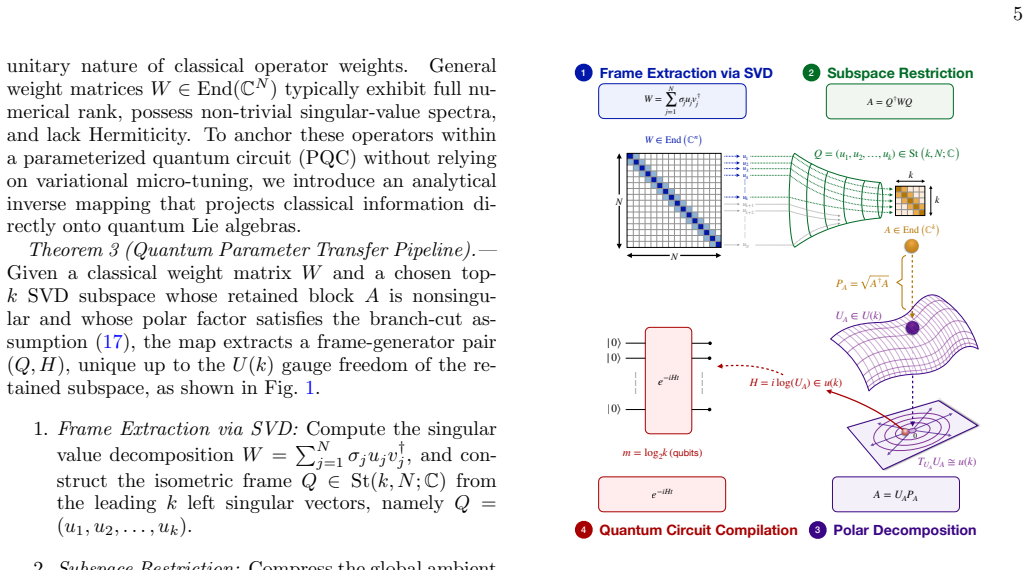
The Subspace Quantization Theorem (Theorem 4) together with the four-step transfer map T: SVD frame extraction, subspace restriction A=Q† W Q, nearest-unitary polar factor UA, and principal logarithm H=i log(UA). It partitions reconstruction error into truncation plus singular-value deviation and supplies the generators used both for zero-shot deployment and for covering-frame model merging.
Load-bearing premise
The classical residual weights must stay close enough to unitary that the retained block remains near the identity of the unitary group; otherwise the non-unitarity error becomes first-order and the claimed faithful zero-shot transfer collapses.
What would settle it
Train a non-residual dense layer far from the identity, apply the same transfer map at moderate rank k, and check whether the measured reconstruction error still collapses onto the non-unitarity floor predicted by Theorem 4 and whether the zero-shot accuracy gap remains of order 1 percent; a large first-order gap would falsify the practical claim.
If this is right
- Pre-trained residual cores can be deployed as quantum subspace circuits with no quantum-side gradient steps, converting classical layers into compact NISQ-executable unitaries.
- Gradient variance at initialization is set by the classical hyperparameter k rather than ambient qubit number, so warm-start trainability is retained even when the physical register is large.
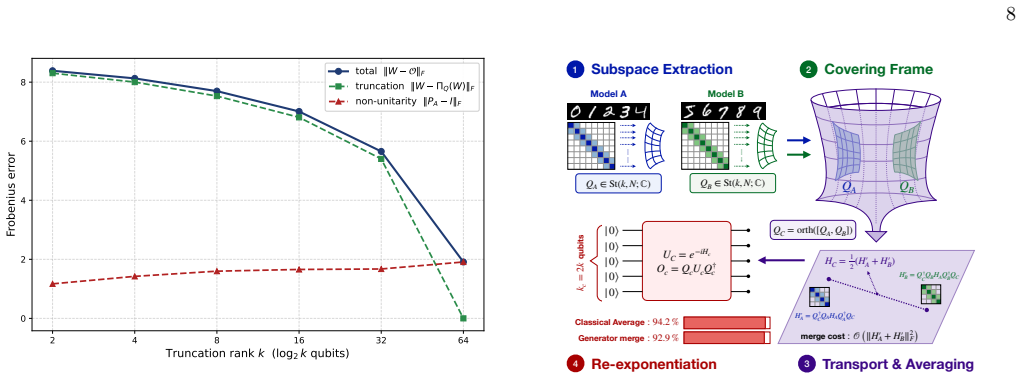
- Multiple specialized models can be merged by transporting their generators onto a covering Stiefel frame and averaging in the common Lie algebra, with an explicit second-order separation cost.
- The same map supplies both a high-fidelity forward circuit and a resolvable subspace gradient signal on present-day hardware up to at least 128 qubits.
Where Pith is reading between the lines
- If residual priors are the practical enabler, future hybrid compilers may deliberately regularize classical layers toward the unitary manifold rather than treating near-unitarity as an accidental property of residual nets.
- The covering-frame merge construction suggests a route to classical multi-task distillation that produces a single quantum circuit without ever evaluating a joint quantum loss.
- Once the discarded polar scaling component can be retained on an auxiliary register, the method could extend beyond square residual cores to general rectangular or strongly non-unitary layers.
Editorial analysis
A structured set of objections, weighed in public.
Referee Report
Summary. The manuscript develops an analytical classical-to-quantum parameter transfer map that converts a square neural weight into a subspace hybrid operator O(Q,H)=Q e^{-iH} Q† via Stiefel SVD frame selection, polar nearest-unitary projection, and principal matrix logarithm. The Subspace Quantization Theorem (Theorem 4) bounds the Frobenius reconstruction error by geometric truncation plus exact non-unitarity ||P_A−I_k||_F (Lemma 2 / Fan–Hoffman), with a second-order rate under a near-unitary pure-rotation condition. Identity-centered residual priors keep generators near the identity, avoiding the log branch cut and seeding a warm-start whose active dynamics live in U(k); Theorem 2 then gives a Weingarten variance floor Ω(1/k) independent of ambient qubit number n at initialization. The same Lie-algebraic construction yields a covering-frame generator merge with an explicit second-order separation penalty. Minimal-model error budgets, MiniViT/Mini-DiT zero-shot transfers, and IBM ibm_kobe runs (Hellinger fidelity 0.987 at k=8; subspace gradients resolvable to 128 qubits) support the claims within the residual near-unitary regime.
Significance. If the stated scope is accepted, the work supplies a rare fully analytical, variational-free bridge from classical residual layers to subspace PQCs, with machine-checkable algebraic proofs (Appendices A–D), an exact two-term error identity rather than a loose inequality, and hardware evidence that subspace-restricted gradients remain above shot noise at 128 qubits while a global HEA does not. The explicit separation of truncation vs non-unitarity, the gauge-invariant hybrid operator on the associated Stiefel bundle, and the Fisher effective-dimension comparison under matched two-qubit budgets are concrete contributions. Code release further strengthens reproducibility. The main practical hinge—near-unitary residual priors—is a genuine scope limit rather than a circularity, so the theorems remain useful as stated for residual cores and as a warm-start recipe more generally.
major comments (3)
- [Abstract / Theorem 4 / Appendix D.3] Abstract and Theorem 4: The abstract states that non-unitarity becomes “second order in the near-unitary regime,” but Appendix D.3 shows the quadratic rate requires the additional pure-rotation (asymptotically skew-Hermitian) condition A−I_k ≈ −iH + O(||H||²_F). For generic near-unitary A the term remains first-order O(ε√k). The main-text theorem statement and abstract should state this condition explicitly so the second-order claim is not over-read.
- [Sec. V.B, Experiment II] Sec. V.B (Experiment II): The authors note that damped residual coupling makes the quantum cores carry only a “modest fraction” of each block’s transformation, so the diffusion demonstration is conservative. That admission is important: the generative zero-shot claim is then only partially load-bearing. Either report a stronger residual-coupling ablation (larger core contribution) or rephrase the generative claim to match the modest-fraction regime actually tested.
- [Sec. III.B / Abstract / Conclusion] Sec. III.B and practical zero-shot claim: Theorem 4 and Lemma 2 hold for arbitrary W, but faithful zero-shot fidelity without quantum-side training requires the residual near-unitary prior (W≈I+δW) so that ||P_A−I_k||_F is small and the spectrum stays away from the branch cut (17). This necessary condition should be stated as such in the abstract and conclusion, not only as a “natural” property of residual nets, so readers do not expect the same fidelity for generic dense layers.
minor comments (6)
- [Fig. 3 / Sec. IV.B] Fig. 3 caption and Sec. IV.B: Clarify that the double-sided truncation ||W−Π_Q(W)||_F coincides with the Eckart–Young tail only under the near-normal residual regime; otherwise it is measured directly and need not equal the single-sided minimum.
- [Sec. II.F / Sec. III.A] Eq. (12) vs zero-shot operator: Distinguish more sharply in the main text between the partial isometry O(Q,H) used for zero-shot compilation and the full unitary U(θ) that adds I−QQ† for the trainable warm-start; both are used but the unitarity status differs.
- [Fig. 7 / Abstract] Fig. 7 / Sec. V.C: Annotate or discuss that at k=16 the 187 CX count already drives Hellinger fidelity to 0.845; the strong NISQ claim is clearest for k≤8, which the text largely acknowledges but the abstract headline (0.987 at k=8) could note the k=16 drop for balance.
- [Appendix E] Notation: N is used both for ambient Hilbert dimension and (implicitly) for sample size in Appendix E; disambiguate n_data vs N.
- [Abstract / throughout] Typos / consistency: “ibm kobe” / “ibm_kobe” / “IBMibm kobe” appear in several forms; standardize. Also “ak-dimensional” → “a k-dimensional” (abstract).
- [Introduction / Sec. II.F] Related work: A short comparison to other Lie-algebraic / DLA barren-plateau analyses (e.g. Ragone et al., Nat. Commun. 2024, already cited) on how subspace restriction differs from full DLA dimension control would help place Theorem 2.
Circularity Check
No significant circularity: Subspace Quantization and subspace gradient floor are self-contained linear-algebra / Weingarten results; residual priors are explicit scope, not definitional loops.
full rationale
The load-bearing claims do not reduce to their inputs by construction. Theorem 4 follows from the triangle inequality plus Lemma 2 (nearest unitary = left polar factor, residual exactly ||P_A - I_k||_F), which is standard Fan–Hoffman / polar-decomposition geometry and holds for arbitrary W with no near-identity assumption (Appendix D.2). The second-order non-unitarity claim is stated only under an additional pure-rotation hypothesis (Appendix D.3), not smuggled into the general bound. Theorem 2 is a Weingarten 2-design calculation on U(k) after exact subspace reduction (Appendix C); the variance floor Ω(1/k) is independent of ambient n once dynamics are confined to the Stiefel frame, and is not fitted to the hardware or MNIST curves. The parameter transfer map (SVD → restriction → polar → principal log) is an analytical compiler, not a fit of quantum parameters to classical accuracy. Residual / identity-centered priors and branch-cut assumption (17) are explicit modeling conditions that scope when the non-unitarity term is small and the log is smooth; they are not used to define the error they are said to control. Self-citations [19–21] supply background on barren plateaus and do not underwrite uniqueness of the transfer map or the two-term bound. Experiments measure truncation, non-unitarity, and total error separately (Fig. 3) and report hardware fidelity / gradient variance as validation, not as fitted predictions of the theorems. Score 1 only for ordinary non-load-bearing self-citation of prior BP work; central derivation is independent.
Axiom & Free-Parameter Ledger
free parameters (2)
- subspace rank k =
operating points k=8,16 (and sweeps 2..64)
- soft identity anchor strength (residual prior)
axioms (5)
- standard math Principal matrix logarithm is well-defined and analytic when σ(U_A) avoids the branch cut (-∞,0], equivalently eigenvalue -1 is excluded (Eq. 17).
- standard math Nearest unitary to A in Frobenius norm is the polar unitary factor U_A, with residual ||P_A-I_k||_F (Lemma 2 / Fan–Hoffman).
- standard math Under a unitary 2-design on U(k), gradient variance of a subspace-supported cost is ||[O~,V_j]||_F^2/(k+1) (Weingarten calculus).
- domain assumption Classical residual / identity-centered architectures produce weights W≈I+δW so that retained blocks stay near unitary and spectra cluster near +1.
- domain assumption Active dynamics of the warm-start ansatz remain confined to the chosen k-dimensional Stiefel subspace (idle qubits stay |0>).
invented entities (3)
-
Hybrid operator O(Q,H)=Q e^{-iH} Q†
independent evidence
-
Parameter transfer map T (SVD + polar + principal log)
independent evidence
-
Covering-frame generator-space merge
independent evidence
Cite this review
Pith. "Pith review of Lie-Algebraic Subspace Quantization for Zero-Shot Quantum Learning and Barren-Plateau Mitigation." pith.science (2026). https://pith.science/paper/36T6CRYP
@misc{pith2026260711174,
  author       = {Pith},
  title        = {Pith review of: Lie-Algebraic Subspace Quantization for Zero-Shot Quantum Learning and Barren-Plateau Mitigation},
  year         = {2026},
  howpublished = {\url{https://pith.science/paper/36T6CRYP}},
  note         = {Machine review of arXiv:2607.11174}
}
read the original abstract
The barren plateau phenomenon severely limits the scalability of parameterized quantum circuits (PQCs). We present an analytical framework for zero-shot classical-to-quantum parameter transfer and manifold-based model merging without quantum-side optimization. Our parameter transfer map converts classical neural-network weights into low-dimensional quantum evolutions using Stiefel subspace selection, nearest-unitary polar projection, and logarithmic generator extraction. We prove a Subspace Quantization Theorem that bounds the reconstruction error by geometric truncation and exact non-unitarity, with the latter becoming second order in the near-unitary regime. Identity-centered architectures naturally produce generators near the identity, avoiding logarithm branch-cut singularities and mitigating initialization-time gradient concentration. We further derive an explicit error bound for manifold-based model merging and show that the same construction provides a warm-start initialization whose active dynamics remain confined to a k-dimensional subspace. Experiments on IBM ibm_kobe demonstrate Hellinger fidelity of 0.987 at k=8, while subspace gradients remain resolvable up to 128 physical qubits.
Figures



Reference graph
Works this paper leans on
-
[1]
S. Endo, Z. Cai, S. C. Benjamin, and X. Yuan, Hybrid quantum-classical algorithms and quantum error mitiga- tion, Journal of the Physical Society of Japan90, 032001 (2021)
2021
-
[2]
Bharti, A
K. Bharti, A. Cervera-Lierta, T. H. Kyaw, T. Haug, S. Alperin-Lea, A. Anand, M. Degroote, H. Heimonen, J. S. Kottmann, T. Menke,et al., Noisy intermediate- scale quantum algorithms, Reviews of Modern Physics 94, 015004 (2022)
2022
-
[3]
Kjaergaard, M
M. Kjaergaard, M. E. Schwartz, J. Braum¨ uller, P. Krantz, J. I.-J. Wang, S. Gustavsson, and W. D. Oliver, Superconducting qubits: Current state of play, Annual Review of Condensed Matter Physics11, 369 (2020)
2020
-
[4]
W. Cai, Y. Ma, W. Wang, C.-L. Zou, and L. Sun, Bosonic quantum error correction codes in superconducting quan- tum circuits, Fundamental Research1, 50 (2021)
2021
-
[5]
Z. Cai, R. Babbush, S. C. Benjamin, S. Endo, W. J. Huggins, Y. Li, J. R. McClean, and T. E. O’Brien, Quantum error mitigation, Reviews of Modern Physics 95, 045005 (2023)
2023
-
[6]
Bergli, Y
J. Bergli, Y. M. Galperin, and B. Altshuler, Decoher- ence in qubits due to low-frequency noise, New Journal of Physics11, 025002 (2009)
2009
-
[7]
M. H. Devoret, A. Wallraff, and J. M. Martinis, Super- conducting qubits: A short review, arXiv preprint cond- mat/0411174 (2004)
arXiv 2004
-
[8]
J. R. McClean, S. Boixo, V. N. Smelyanskiy, R. Bab- bush, and H. Neven, Barren plateaus in quantum neural network training landscapes, Nature Communications9, 4812 (2018)
2018
-
[9]
Y. Du, Z. Tu, X. Yuan, and D. Tao, Efficient measure for the expressivity of variational quantum algorithms, Physical Review Letters128, 080506 (2022)
2022
-
[10]
Cerezo, G
M. Cerezo, G. Verdon, H.-Y. Huang, L. Cincio, and P. J. Coles, Challenges and opportunities in quantum machine learning, Nature Computational Science2, 567 (2022)
2022
-
[11]
T. L. Patti, K. Najafi, X. Gao, and S. F. Yelin, Entangle- ment devised barren plateau mitigation, Physical Review Research3, 033090 (2021)
2021
-
[12]
H. Shen, P. Zhang, Y.-Z. You, and H. Zhai, Information scrambling in quantum neural networks, Physical Review Letters124, 200504 (2020)
2020
-
[13]
Wiersema, C
R. Wiersema, C. Zhou, Y. de Sereville, J. F. Carrasquilla, Y. B. Kim, and H. Yuen, Exploring entanglement and optimization within the hamiltonian variational ansatz, PRX Quantum1, 020319 (2020)
2020
-
[14]
Tilly, H
J. Tilly, H. Chen, S. Cao, D. Picozzi, K. Setia, Y. Li, E. Grant, L. Wossnig, I. Rungger, G. H. Booth,et al., The variational quantum eigensolver: a review of meth- ods and best practices, Physics Reports986, 1 (2022)
2022
-
[15]
Cerezo, A
M. Cerezo, A. Arrasmith, R. Babbush, S. C. Benjamin, S. Endo, K. Fujii, J. R. McClean, K. Mitarai, X. Yuan, L. Cincio,et al., Variational quantum algorithms, Nature Reviews Physics3, 625 (2021)
2021
-
[16]
Ortiz Marrero, M
C. Ortiz Marrero, M. Kieferov´ a, and N. Wiebe, Entanglement-induced barren plateaus, PRX Quantum 2, 040316 (2021)
2021
-
[17]
E. Grant, L. Wossnig, M. Ostaszewski, and M. Benedetti, An initialization strategy for addressing barren plateaus in parametrized quantum circuits, Quantum3, 214 (2019), arXiv:1903.05076v3
Pith/arXiv arXiv 2019
-
[18]
Cerezo, A
M. Cerezo, A. Sone, T. Volkoff, L. Cincio, and P. J. Coles, Cost function dependent barren plateaus in shal- low parametrized quantum circuits, Nature Communica- tions12, 1791 (2021)
2021
-
[19]
Yao and Y
Y. Yao and Y. Hasegawa, Avoiding barren plateaus with entanglement, Phys. Rev. A111, 022426 (2025)
2025
-
[20]
Yao and Y
Y. Yao and Y. Hasegawa, Linking barren plateaus to ef- fective parameters in deep rotation-gate-based param- eterized quantum circuits, Phys. Rev. A112, 062443 (2025)
2025
- [21]
-
[22]
M. L. Goh, M. Larocca, L. Cincio, M. Cerezo, and F. Sauvage, Lie-algebraic classical simulations for quan- tum computing, Phys. Rev. Res.7, 033266 (2025)
2025
-
[23]
Qvarfort and I
S. Qvarfort and I. Pikovski, Solving quantum dynamics with a lie-algebra decoupling method, PRX Quantum6, 010201 (2025)
2025
- [24]
-
[25]
Ragone, B
M. Ragone, B. N. Bakalov, F. Sauvage, A. F. Kemper, C. Ortiz Marrero, M. Larocca, and M. Cerezo, A lie al- gebraic theory of barren plateaus for deep parameterized quantum circuits, Nat. Commun.15, 7172 (2024)
2024
-
[26]
Wiersema, E
R. Wiersema, E. K¨ okc¨ u, A. F. Kemper, and B. N. Bakalov, Classification of dynamical lie algebras of 2- local spin systems on linear, circular and fully connected topologies, npj Quantum Inf.10, 110 (2024)
2024
-
[27]
Eckart and G
C. Eckart and G. Young, The approximation of one ma- trix by another of lower rank, Psychometrika1, 211 (1936)
1936
-
[28]
Mirsky, Symmetric gauge functions and unitarily in- variant norms, The Quarterly Journal of Mathematics 11, 50 (1960)
L. Mirsky, Symmetric gauge functions and unitarily in- variant norms, The Quarterly Journal of Mathematics 11, 50 (1960)
1960
-
[29]
Holmes, K
Z. Holmes, K. Sharma, M. Cerezo, and P. J. Coles, Con- necting ansatz expressibility to gradient magnitudes and barren plateaus, PRX Quantum3, 010313 (2022)
2022
-
[30]
Abbas, D
A. Abbas, D. Sutter, C. Zoufal, A. Lucchi, A. Figalli, and S. Woerner, The power of quantum neural networks, 14 Nature Computational Science1, 403 (2021)
2021
-
[31]
Yao, Simulation & Experiment Code (2026)
Y. Yao, Simulation & Experiment Code (2026). Appendix A: Proofs of Subspace Properties and Operator Representations In this appendix, we present the explicit derivations for the algebraic properties of the hybrid operator introduced in Sec. II D. To prove the subspace unitarity stated in Eq. (8), letv∈span(Q) be an arbitrary vector in the subspace. There ...
2026
-
[32]
Phase I: Subspace Reduction of Ambient Dynamics Expanding the evolved quantum state|Ψ(θ)⟩=U(θ)|Ψ 0⟩using the definitions in Sec. II F and invoking the frame orthonormalityQ †Q=I k, we compress the ambient dynamics as follows: U(θ)|Ψ 0⟩= h Qe−i(H0+P j θj Vj)Q† + IN −QQ † i Q|x⟩ =Qe −i(H0+P j θj Vj)(Q†Q)|x⟩+ Q−Q(Q †Q) |x⟩ =Qe −i(H0+P j θj Vj)|x⟩=Q ˜U(θ)|x⟩,...
-
[33]
Phase II: Gradient Operator Representation Using matrix calculus, the partial derivative with respect toθ j is evaluated as: ∂jL:= ∂L ∂θj =⟨x| ˜U † i[Vj, ˜O] ˜U|x⟩.(C3) . Defining the local Hermitian commutator matrixC j :=i[V j, ˜O], the gradient can be compactly expressed via the trace operation: ∂jL= Tr ˜U|x⟩⟨x| ˜U †Cj = Tr ˜U ρ˜U †Cj ,(C4) whereρ:=|x⟩...
-
[34]
Phase III: Weingarten Integration and Variance Evaluation Under the assumption that ˜U(θ) forms a unitary 2-design overU(k), the statistical variance is defined by the Haar-measure expectation values: Var[∂jL] = Z U(k) (∂jL)2dµ( ˜U)− Z U(k) ∂jLdµ( ˜U) !2 .(C5) First, we evaluate the first moment. Utilizing the fundamental first-order Haar integration iden...
-
[35]
Proof of Lemma 2 LetA=XΣ AY † be a singular value decomposition, so that the left polar factor isU A =XY † andP A =YΣ AY †, with singular valuesσ j(A) = (ΣA)jj. For anyU∈U(k), ∥A−U∥ 2 F =∥A∥ 2 F +k−2 Re Tr(U †A).(D1) SettingZ:=Y †U †X∈U(k), we have Re Tr(U †A) = Re Tr(ZΣA) =P j σj(A) Re(Zjj)≤ P j σj(A), since|Z jj | ≤1; equality holds iffZ=I k, i.e.U=XY †...
-
[36]
For the second term, substitute Π Q(W) =QAQ † andO(Q, H) = QUAQ†: ∥ΠQ(W)− O(Q, H)∥ F =∥Q(A−U A)Q†∥F .(D4) BecauseQ †Q=I k, one has∥QM Q †∥2 F = Tr(M†M Q †Q) =∥M∥ 2 F , so Eq
Proof of Theorem 4 By the triangle inequality, ∥W− O(Q, H)∥ F ≤ ∥W−Π Q(W)∥ F +∥Π Q(W)− O(Q, H)∥ F ,(D3) where the first term is the truncation baseline. For the second term, substitute Π Q(W) =QAQ † andO(Q, H) = QUAQ†: ∥ΠQ(W)− O(Q, H)∥ F =∥Q(A−U A)Q†∥F .(D4) BecauseQ †Q=I k, one has∥QM Q †∥2 F = Tr(M†M Q †Q) =∥M∥ 2 F , so Eq. (D4) equals∥A−U A∥F , which b...
-
[37]
For the quadratic rate, assume the deviationA−I k is asymptotically skew-Hermitian, i.e.A=I k −iH+δwith the Hermitian part ofδof order O(∥H∥ 2 F )
Derivation of the Near-Unitary Scaling Ifσ j(A) = 1 +O(ε) then∥P A −I k∥F = (P j(σj −1) 2)1/2 =O(ε √ k) directly. For the quadratic rate, assume the deviationA−I k is asymptotically skew-Hermitian, i.e.A=I k −iH+δwith the Hermitian part ofδof order O(∥H∥ 2 F ). ThenP 2 A =A †A=I k +H 2 +O(∥H∥ 3 F ), and the matrix square root √Ik +X=I k + 1 2 X+O(∥X∥ 2) g...
-
[38]
Second-Order Expansion of Generator-Space Merging LetXandYdenote the transported Hermitian generators. In the identity neighborhood, their exponential maps satisfy e−i(X+Y)/2 =I− i 2(X+Y)− 1 8(X+Y) 2 +O (∥X∥+∥Y∥) 3 ,(D6) 1 2 e−iX +e −iY =I− i 2(X+Y)− 1 4(X 2 +Y 2) +O (∥X∥+∥Y∥) 3 .(D7) Subtracting these expansions gives e−i(X+Y)/2 − 1 2 e−iX +e −iY = 1 8(X...
-
[39]
Effective Dimension and Information Volume Following the statistical information geometry framework proposed by Abbas et al. [30], we use the finite-sample effective dimension computed from the normalized Fisher information matrix to quantify the usable statistical capacity of a parameterized quantum circuit model family. This quantity is defined from the...
-
[40]
Instead, they are confined within a restricted, lower-dimensional dynamical Lie algebra
Algebraic Saturation via Lie-Algebraic Constraints The hardware-efficient ansatz consists of interleaving parameterized single-qubitR y(θ) rotations and fixed unpa- rameterized CZ entangling operations: U(θ) = LY l=1 nO q=1 Ry(θl,q)·CZ ring ! .(E2) From a Lie-algebraic perspective, repetitive applications of theR y and CZ generator sets do not generate th...
-
[41]
Spectral Origin of the Effective-Dimension Ceiling In our simulation, atL= 12 (P= 52), the plain PQC exhibits a high participation-ratio effective rank (eff rank≈ 49.3). This should not be interpreted as an algebraic rank, but as a measure of how broadly the Fisher spectrum is distributed: eff rank = PP i=1 λi 2 PP i=1 λ2 i .(E3) Thus, eff rank can remain...
discussion (0)
Sign in with ORCID, Apple, or X to comment. Anyone can read and Pith papers without signing in.