REVIEW 2 major objections 5 minor
Vision-language models assemble visual evidence in a middle-layer relay window whose timing decides whether answers stay grounded.
Reviewed by Pith at T0; open to challenge. T0 means a machine referee read the full paper against a public rubric. the ladder, T0–T4 →
T0 review · grok-4.5
2026-07-14 05:36 UTC pith:SBEKSNTK
load-bearing objection Solid mechanistic story plus a working inference-time controller; the VRW geometry is real enough to use, even if the causal isolation is incomplete. the 2 major comments →
The Ebb and Flow of Multimodal Focus: Scheduling Visual Relay Windows for Grounded VLM Reasoning
The pith
A machine-rendered reading of the paper's core claim, the machinery that carries it, and where it could break.
Core claim
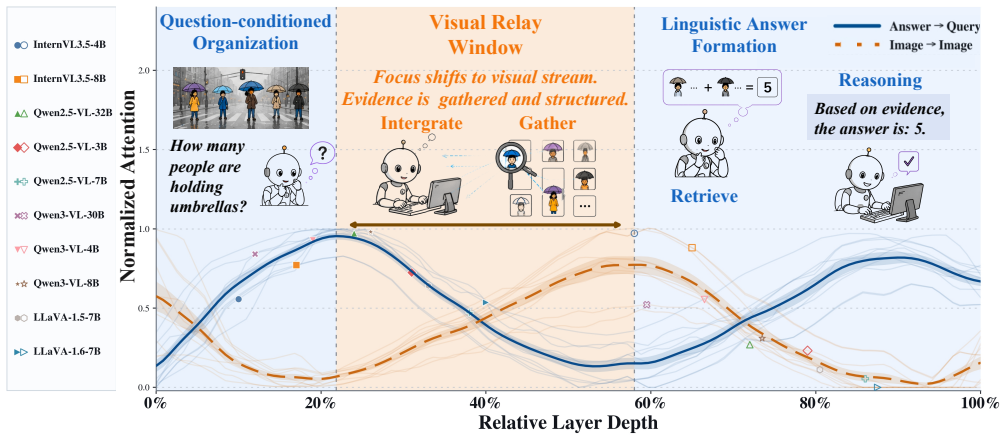
Open vision-language models share a depth-wise three-stage redistribution of multimodal focus—early question-conditioned organization, a middle visual-dominant Visual Relay Window, and late answer formation—whose width and termination depth adapt to task demand and are causally linked to whether generation remains grounded. Controlling that window at inference time therefore strengthens evidence-grounded multimodal reasoning under a single mechanism.
What carries the argument
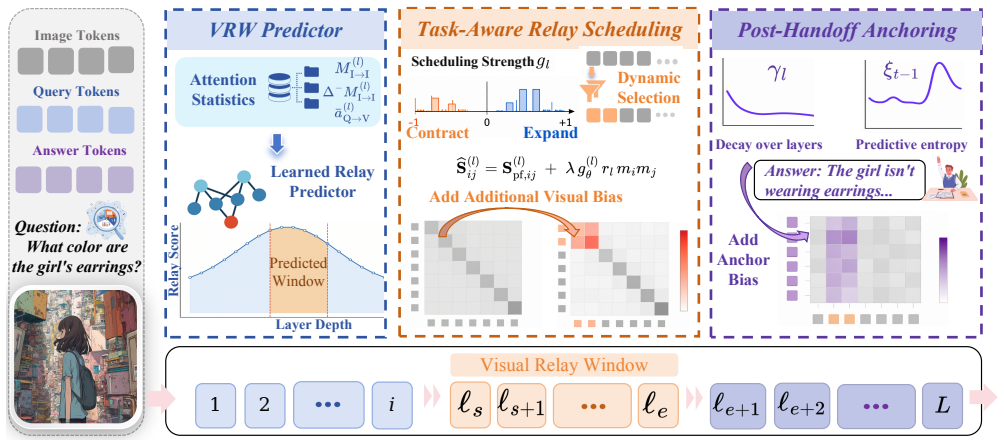
Visual Relay Window (VRW): the operational middle-layer interval where jointly normalized Image→Image attention dominates Answer→Query attention; TRACE predicts it from prefill statistics, expands or contracts visual-to-visual bias inside it, then depth-decays answer-to-visual anchoring after handoff.
Load-bearing premise
The claim rests on treating two normalized attention-mass probes and a fixed middle-depth search band as a sufficient definition of the functionally critical evidence-assembly interval that should be predicted and controlled.
What would settle it
If patching residual activations inside the estimated VRW no longer recovers grounded answers more often than same-width patches just outside it, or if TRACE’s measured width/end shifts reverse the claimed direction (broader/later for grounding tasks, shorter/earlier for reasoning) while still producing the reported gains, the central claim fails.
Editorial analysis
A structured set of objections, weighed in public.
Referee Report
Summary. The paper argues that VLMs exhibit a stable three-stage depth-wise redistribution of multimodal attention—early question-conditioned organization, a middle visual-dominant Visual Relay Window (VRW), and late answer formation—and that this middle interval is task-dependent and causally linked to grounded generation. VRW is operationalized from jointly normalized Answer→Query and Image→Image attention mass (Eqs. 2–8). Causal support comes from residual patching of visual-token activations inside the estimated window (Table 2: 41.4% recovery of unsupported branches vs ~9–11% outside and ~28% for same-width shifts). Building on this, TRACE uses a lightweight learned predictor, task-aware prefill V→V scheduling, and post-handoff answer→visual anchoring. Across four open-weight backbones and seven benchmarks, TRACE improves grounding-sensitive settings by 4.33 points on average (up to 6.6) and also improves reasoning-heavy tasks, with ablations and mechanism analyses (Fig. 6, Tables 6–8) supporting the intended relay reshaping.
Significance. If the result holds, the paper offers a unified mechanistic account of when visual evidence is assembled and handed off in VLMs, and converts that account into a practical inference-time controller. Strengths include multi-legged support (cross-model curves, task ANOVA, grounded/unsupported contrasts, controlled residual patching, Thinking-variant comparison), a capacity-matched generic-controller baseline (Table 6), component ablations, hyperparameter sensitivity, and public code. The contribution is relevant both to hallucination mitigation and to reasoning-oriented multimodal control, and is more structure-aware than purely decoding-stage contrastive or steering methods.
major comments (2)
- [§3.5, Table 2; §3.8] §3.5 and Table 2 establish that patching visual-token residual activations inside the estimated VRW recovers grounded answers more often than pre/post ranges or same-width shifts. That is strong evidence that the interval matters, but it does not yet show that the attention-mass geometry used to define VRW (Eqs. 4–8) is the operative mechanism rather than co-varying middle-layer pathways (MLP updates, non-visual sinks, cross-group residual streams). Because TRACE’s predictor is trained on pseudo-labels from the same rule-based estimator (§3.8, Eqs. 12–14), the claim that gains come from “scheduling the visual relay rhythm” remains partly under-determined. Please either (i) add at least one non-attention or alternative-probe control (e.g., patching non-visual residuals in the same layers, or defining a window from other probe pairs in Table 1), or (ii) clearly demote the mechanistic wordi
- [§3.3, Table 1, Table 9] Table 9 only varies normalization, search band, and δ for the same two probes. Given that the weakest load-bearing assumption is that Answer→Query vs Image→Image with ρ∈[0.2,0.8], δ=0.1 is a sufficient operational definition of the critical assembly interval (§3.3), the paper should report at least one alternative operationalization (e.g., Answer→Query/Answer→Image from Table 1, or a peak-only single-layer target) and show whether TRACE’s external gains and the grounded/unsupported separation remain directionally intact. Without that, the “stable three-stage relay” story risks being tied too tightly to one probe construction.
minor comments (5)
- [Figure 1] Figure 1 caption/label has “Intergrate”; fix spelling.
- [Table 4] Table 4 repeatedly prints “A verage” with a space; normalize to “Average”.
- [§3.2 vs §4.1] Clarify early that Fig. 1 uses ten models for the descriptive pattern while TRACE is evaluated on four backbones, so readers do not expect intervention results on all ten.
- [§3.9–3.10] Eq. (19) and surrounding text use bS / eS notation that is easy to misread in plain text; consider a clearer accent or boldface convention in the camera-ready version.
- [§3.1, §5] The conclusion correctly notes single-image and attention-probe limits; a short forward pointer in §3.1 would help set expectations earlier.
Circularity Check
Mild self-definitional loop only in mechanism verification (intervene on V→V mass, then report VRW shifts); core causal and benchmark claims remain external and non-circular.
specific steps
-
self definitional
[§3.3 Eqs. 4–8; §3.9 Eq. 19; §4.3 / Fig. 6]
"R(l) = M(l)_I→I − M(l)_A→Q. ... During prefill, the scheduler directly reshapes visual-to-visual interactions in relay layers: bS(l)_ij = S(l)_pf,ij + λ g(l)_θ r_l m(l)_i m(l)_j , i, j ∈ V. ... Beyond benchmark gains, we ask whether the intervention reshapes computation in the intended way. Figure 6 shows a clear task dependence. ... TRACE improves performance by reshaping the same relay redistribution pattern identified in analysis"
VRW geometry is defined from the signed dominance of Image→Image vs Answer→Query attention mass. TRACE’s prefill control adds a gated bias exactly to visual-to-visual logits inside the predicted window, which by construction changes M_I→I and therefore R(l), VRW-Width, and VRW-End. Reporting that those VRW statistics shift as intended is therefore partly a restatement that the intervention acted on its defining coordinates, not an independent measurement of a separate latent pathway. This tautology is limited to the mechanism-verification claim; external accuracy and residual-patching recovery are not forced by it.
full rationale
This is an empirical VLM-control paper, not a first-principles derivation. The three-stage pattern and VRW are operational constructs from attention probes (Eqs. 2–8), not claimed mathematical necessities. Causal support (Table 2 residual patching of visual tokens; grounded vs unsupported geometry in Fig. 4) and all main results (Table 4 accuracy on seven held-out benchmarks vs independent baselines) are external to the VRW definition and are not forced by construction. Training Dϕ on pseudo-labels from the offline VRW rule (Eqs. 13–14) is ordinary supervised recovery of an operational target, not a fitted quantity renamed as a prediction of a related scientific observable. There is no load-bearing self-citation uniqueness theorem, no ansatz smuggled via author-prior work, and no renaming of a known closed-form result. The only mild circularity is local to the mechanism-check in §4.3: TRACE’s prefill bias (Eq. 19) directly modulates the same Image→Image mass that enters R(l) and thus VRW-Width/End, so reporting that those statistics move in the intended direction partly verifies that the intervention fired rather than independently discovering a new internal rhythm. That does not collapse the performance or causal claims. Score 2 is proportionate.
Axiom & Free-Parameter Ledger
free parameters (8)
- VRW middle search band ρl ∈ [0.2, 0.8]
- VRW tolerance δ = 0.1
- support ratio p = 0.3
- relay-exit threshold τr = 0.7
- anchoring loss weight λanchor = 0.05
- prefill scheduling scale λ = 0.6
- gate sharpness/operating point α=13, β=0.5
- relevance EMA μ=0.15; Anchor hinge η=0.7; decode bias γ0=0.4, κ=2.0
axioms (4)
- domain assumption Layerwise Answer→Query and Image→Image attention mass are adequate proxies for question-conditioned organization vs visual consolidation.
- ad hoc to paper A contiguous middle interval where R(l)=M_I→I−M_A→Q is near its peak and preserves the handoff trend is the functionally critical evidence-assembly stage.
- domain assumption Self-attention residual patching of visual-token activations at aligned decode steps is a valid causal test of whether a layer range supports grounded generation.
- domain assumption Lightweight modules trained with frozen backbone weights and next-token plus hinge anchoring losses can reshape relay without destroying general capabilities.
invented entities (2)
-
Visual Relay Window (VRW)
no independent evidence
-
TRACE controller (predictor + task-aware scheduler + post-handoff anchoring)
independent evidence
read the original abstract
Vision-language models increasingly succeed on multimodal reasoning benchmarks, yet their visual evidence often becomes unstable once it enters the language stack, weakening evidence-grounded reasoning. To understand this fragility, we examine the internal dynamics of VLMs through a mechanistic lens and uncover a stable three-stage redistribution of multimodal attention focus across depth: an early question-conditioned organization, a critical middle visual-dominant relay, and a late return to answer formation. We operationalize the middle phase as the Visual Relay Window (VRW), and show that its geometry varies with task demand, is causally tied to grounded generation, and distinguishes unsupported answers from stronger reasoning trajectories. Guided by this internal rhythm, we propose TRACE, a task-adaptive inference-time control framework with lightweight trained modules. It reshapes relay allocation during prefill and preserves assembled visual support after handoff during decoding. Across four open-weight VLM backbones and seven benchmarks, TRACE delivers large gains on grounding-sensitive settings, improving them by 4.33 points on average and by up to 6.6 points, while also improving reasoning-heavy tasks. These results show that explicitly controlling multimodal focus across depth offers a unified and effective mechanism for strengthening evidence-grounded multimodal reasoning.
Figures



discussion (0)
Sign in with ORCID, Apple, or X to comment. Anyone can read and Pith papers without signing in.