REVIEW 2 major objections 5 minor 58 references
Robot-centric pointmaps close the frame gap between camera views and robot actions in vision-language-action models.
Reviewed by Pith at T0; open to challenge. T0 means a machine referee read the full paper against a public rubric. the ladder, T0–T4 →
T0 review · grok-4.5
2026-07-14 05:10 UTC pith:YS7JRFGQ
load-bearing objection Clean geometric fix for VLA viewpoint mismatch: robot-frame EE-centered pointmaps fuse into pretrained 2D VLAs and the gains hold in sim and real, with the main limit being calibration dependence they already state. the 2 major comments →
See like a Robot: Robot-Centric Pointmaps for Vision-Language-Action Models
The pith
A machine-rendered reading of the paper's core claim, the machinery that carries it, and where it could break.
Core claim
Expressing each observed scene point as a robot-frame, image-form pointmap—especially one re-centered on the current end effector—and fusing it by element-wise addition of a separate visual encoder’s tokens onto RGB tokens improves pretrained vision-language-action models under camera viewpoint variation. Pre-computing the camera-to-robot transform, preserving the H×W grid, and end-effector centering are the design choices that drive the gain over leaving the mapping for the policy to learn or using sparse point clouds.
What carries the argument
Robot-centric pointmaps: dense H×W images whose pixels store 3D scene coordinates in the robot (or end-effector-centered) frame, encoded by a separate visual tower initialized from the RGB encoder and added element-wise to RGB tokens so the pretrained 2D pathway absorbs robot-frame geometry without a point-cloud encoder or extra tokens.
Load-bearing premise
Accurate camera calibration and usable depth must be available at both training and test time so every pixel can be lifted into the robot frame.
What would settle it
Corrupt camera extrinsics or replace depth with noise while keeping the same backbone and training recipe; if the pointmap variant then loses its success-rate edge over RGB and other 3D baselines under viewpoint shift, the central claim fails.
If this is right
- Multi-institution robot datasets with mixed camera setups become easier for VLAs to use once observations are converted to robot-centric pointmaps.
- At deployment, a held-out camera placement hurts an RGB-only policy more than a pointmap policy.
- Conditioning on camera parameters or attaching a separate point-cloud module is less effective than pre-computing robot-frame geometry on the image grid.
- End-effector centering makes the same grasp motion look similar across distant workspace locations, aiding multi-task learning.
Where Pith is reading between the lines
- As foundation robot models absorb more cross-lab data, standardized robot-frame geometry inputs may matter as much as standardized action spaces.
- The same construction could aid cross-embodiment transfer if each robot’s base frame is used consistently when building the pointmap.
- Where hardware calibration is unavailable, monocular geometry estimators could be substituted, but that would reintroduce the very camera-to-robot inference burden the method removes.
Editorial analysis
A structured set of objections, weighed in public.
Referee Report
Summary. The paper addresses the observation-to-action frame mismatch in vision-language-action (VLA) models: actions are defined in the robot base frame while observations are typically camera-frame RGB (or depth). Under multi-view training data this mismatch forces the policy to learn a viewpoint-dependent mapping. The authors propose robot-centric pointmaps—dense H imes W images whose pixels store 3D coordinates of the corresponding scene points after the camera-to-robot transform (Eqs. 1–2), optionally re-centered at the current end-effector (Eq. 3). A separate visual tower, initialized from the RGB encoder, encodes the pointmap; its tokens are added element-wise to the RGB tokens (Eq. 4), preserving the pretrained 2D pathway with no extra tokens or point-cloud encoder. Controlled ablations on a fixed π-style backbone isolate pre-computation of robot-frame geometry versus Plücker+depth cues (Table 1), image-form pointmaps with add fusion versus point clouds (Table 2), base versus EE origin (Table 3), and robustness to increasing training-time camera jitter (Fig. 6). Full fine-tunes of π0.5 and SmolVLA on RoboCasa improve 24-task averages by +7.6 and +4.2 points over RGB-only and outperform reimplemented camera-aware and 3D-augmented baselines (Table 4). Real-robot Franka experiments show the margin over RGB widening from +5.0 at a seen external-camera placement to +11.7 at a held-out placement (Table 5).
Significance. If the results hold, the work supplies a simple, architecture-light way to inject metric robot-frame geometry into pretrained 2D VLAs precisely when large multi-institution datasets introduce viewpoint diversity. The controlled RQ studies cleanly separate pre-computation of the camera-to-robot transform, preservation of the image grid with element-wise fusion, and end-effector centering; the main tables show consistent gains on two backbones of different scale and a real Franka setup whose advantage grows at an unseen camera. The method reuses existing visual towers, requires no generative view synthesis or dedicated 3D expert at inference, and is therefore immediately usable by practitioners who already have calibrated RGB-D. The explicit limitation that calibration and depth must be available at train and test time is stated in §6 and does not undermine the internal claims. The contribution is therefore a practical, well-isolated design principle rather than a new foundation model.
major comments (2)
- §5.1 / Appendix B.4: The camera-aware and 3D-augmented baselines (KYC, OC-VLA, GeoVLA, PointVLA) are reimplemented on π0.5 because official code is unavailable. While the authors describe the reimplementations carefully, the paper should report a short validation that the reimplemented versions recover the qualitative behavior claimed in the original works (or at least match published numbers on a shared subset) so that the ranking in Table 4 can be trusted as a fair comparison rather than an artifact of reimplementation choices.
- §4.2 / Table 2: The point-cloud baselines use a fixed sampling budget (1024 points for the MLP, and an unspecified but fixed budget for PTv3). The authors note in §6 that a larger budget could narrow the gap. Because the central claim is that image-form pointmaps are preferable to point clouds for pretrained VLAs, a sensitivity sweep over point count (or a denser voxel/grid baseline) is needed to confirm that the 34.7 vs 32.8 gap is not an artifact of under-sampling the point cloud.
minor comments (5)
- Fig. 1 caption and surrounding text: the three-column comparison (Depth / Pointcloud / Pointmap) is clear, but the figure itself would benefit from an explicit legend indicating which cells are robot-centric versus camera-centric.
- Eq. (3) and §4.3: the end-effector-centered pointmap is well motivated, yet the text never states whether the orientation of the end-effector is also used or only its translation t_EE; a one-sentence clarification would prevent mis-implementation.
- Table 5: success rates are reported from 15 rollouts per task per camera condition. Adding binomial standard errors or a simple significance test would help readers judge the +11.7 unseen margin.
- Appendix B.3: the real-robot pointmap is built from RealSense stereo depth and a one-time hand-eye calibration; a short quantitative note on typical depth noise or calibration residual would make the sim-to-real gap more transparent.
- Related Work §2.2: recent concurrent pointmap diffusion-policy papers [45,46] are cited; a sentence distinguishing the present contribution (pretrained VLA + robot-frame + EE centering) from those from-scratch policies would sharpen novelty.
Circularity Check
No circularity: geometric construction plus external task-success evaluation; nothing reduces to a fitted free parameter or self-citation chain.
full rationale
This is an empirical robotics method paper. The load-bearing chain is: (i) define robot-centric (optionally EE-centered) pointmaps by the fixed camera-to-robot lifts in Eqs. 1–3; (ii) fuse them into pretrained VLAs by element-wise addition of a separate image-encoder stream; (iii) measure success rates on RoboCasa atomic tasks and real Franka rollouts under seen/unseen cameras. Success is an external binary/task criterion, not a quantity recovered from a fit. Controlled ablations (Tables 1–3, Fig. 6) change only how 3D is supplied while holding backbone and recipe fixed; main results (Tables 4–5) compare against reimplemented baselines on the same data. Pointmaps are a standard 3D-vision representation cited from external work; the paper does not invoke a self-authored uniqueness theorem, does not fit a free parameter and rename it a prediction, and does not define the reported metric in terms of the input construction. Calibration dependence (§6) is a scope limitation, not circularity. Score 0 is therefore appropriate.
Axiom & Free-Parameter Ledger
free parameters (2)
- Training schedule (steps, LR, batch size) =
π0.5: 20k steps; SmolVLA: 60k; controlled: 30k
- Point-cloud sampling budget in ablations =
1024 / 4096 points
axioms (4)
- domain assumption Robot actions are defined in the robot base / end-effector task space, so robot-frame geometry is the natural action coordinate system.
- domain assumption Per-pixel depth and camera extrinsics/intrinsics are available so Eqs. 1–3 can be evaluated.
- ad hoc to paper A vision encoder of the same architecture as the RGB tower can usefully encode XYZ images when initialized from RGB weights.
- ad hoc to paper Element-wise addition of pointmap tokens to RGB tokens preserves spatial correspondence better than concatenation for this task.
invented entities (1)
-
Robot-centric (end-effector-centered) pointmap as VLA visual input
independent evidence
read the original abstract
Vision-language-action (VLA) models predict robot actions from visual observations and language instructions. These actions are defined in the robot's own 3D coordinate frame, yet most VLAs observe the scene in the camera frame, creating a frame mismatch between where the scene is observed and where actions are defined. The mismatch is benign under a fixed viewpoint, where the policy can memorize a single observation-to-action mapping, but grows harder as large-scale datasets aggregate demonstrations across diverse camera setups and the policy must generalize this mapping across viewpoints. We address this mismatch with robot-centric pointmaps, images whose pixels store the 3D coordinates of scene points in the robot frame. Pointmaps provide robot-frame 3D geometry while preserving the dense H x W grid expected by pretrained 2D VLAs, so they integrate into existing VLAs with minimal architectural change. On RoboCasa, pointmaps improve both pi0.5 and SmolVLA and outperform representative camera-viewpoint and 3D-aware baselines. In real-robot experiments, their advantage over an RGB-only policy widens when the camera is moved to a placement unseen during training.
Figures



Reference graph
Works this paper leans on
-
[1]
Zitkovich et al
B. Zitkovich et al. Rt-2: Vision-language-action models transfer web knowledge to robotic control. InCoRL, 2023. 1
2023
-
[2]
M. J. Kim et al. Openvla: An open-source vision-language-action model. InCoRL, 2024
2024
-
[3]
K. Black et al.π 0 : A vision-language-action flow model for general robot control.arXiv preprint arXiv:2410.24164, 2024. 4
Pith/arXiv arXiv 2024
-
[4]
Black, N
K. Black, N. Brown, et al. pi0.5: a vision-language-action model with open-world generaliza- tion. InCoRL, 2025. 8, 9, 15, 20
2025
-
[5]
J. Bjorck et al. GR00T N1: An open foundation model for generalist humanoid robots.arXiv preprint arXiv:2503.14734, 2025. 1
Pith/arXiv arXiv 2025
-
[6]
O’Neill et al
A. O’Neill et al. Open x-embodiment: Robotic learning datasets and rt-x models: Open x- embodiment collaboration. InICRA, 2024. 1, 3
2024
-
[7]
Bu et al
Q. Bu et al. Agibot world colosseo: A large-scale manipulation platform for scalable and in- telligent embodied systems. In2025 IEEE/RSJ International Conference on Intelligent Robots and Systems (IROS). IEEE, 2025
2025
-
[8]
A. Khazatsky et al. DROID: A large-scale in-the-wild robot manipulation dataset.arXiv preprint arXiv:2403.12945, 2024. 1, 3
Pith/arXiv arXiv 2024
-
[9]
Nasiriany, A
S. Nasiriany, A. Maddukuri, L. Zhang, A. Parikh, A. Lo, A. Joshi, A. Mandlekar, and Y . Zhu. Robocasa: Large-scale simulation of everyday tasks for generalist robots. InRobotics: Science and Systems (RSS), 2024. 2, 4, 16
2024
-
[10]
S. Fei, S. Wang, J. Shi, Z. Dai, J. Cai, P. Qian, L. Ji, X. He, S. Zhang, Z. Fei, J. Fu, J. Gong, and X. Qiu. Libero-plus: In-depth robustness analysis of vision-language-action models.arXiv preprint arXiv:2510.13626, 2025. 2
Pith/arXiv arXiv 2025
-
[11]
Z. Wang, Z. Zhou, J. Song, Y . Huang, Z. Shu, and L. Ma. Vlatest: Testing and evaluating vision-language-action models for robotic manipulation.Proc. ACM Softw. Eng., 2(FSE), June
-
[12]
URLhttps://doi.org/10.1145/3729343
doi:10.1145/3729343. URLhttps://doi.org/10.1145/3729343. 2
-
[13]
Walke, K
H. Walke, K. Black, A. Lee, M. J. Kim, M. Du, C. Zheng, T. Zhao, P. Hansen-Estruch, Q. Vuong, A. He, V . Myers, K. Fang, C. Finn, and S. Levine. Bridgedata v2: A dataset for robot learning at scale. InConference on Robot Learning (CoRL), 2023. 3
2023
-
[14]
A. Xie, L. Lee, T. Xiao, and C. Finn. Decomposing the generalization gap in imitation learning for visual robotic manipulation. InIEEE International Conference on Robotics and Automation (ICRA), 2024. 3
2024
-
[15]
J. Morgan, P. Vijay, H. Oh, J. Song, A. Arora, A. Du, G. Sukhatme, J. Thomason, and I. Singh. Colosseum v2: Benchmarking generalization for vision language action models.arXiv preprint arXiv:2605.27759, 2026. 3
Pith/arXiv arXiv 2026
-
[16]
H. Lin, H. Yu, J. Huang, H. Zhang, Y . Ling, P. Tan, X. Xue, and Y . Fu. Universal pose pre- training for generalizable vision-language-action policies. InRobotics: Science and Systems (RSS), 2026. 3
2026
-
[17]
Jiang, J
T. Jiang, J. Ji, X. Tan, J. Fang, A. Bhattad, V . Guizilini, and M. R. Walter. Do you know where your camera is? View-invariant policy learning with camera conditioning. InIEEE International Conference on Robotics and Automation (ICRA), 2026. 8, 18, 20
2026
-
[18]
Zhang, Y
J. Zhang, Y . Chen, Y . Xu, Z. Huang, Y . Zhou, Y .-J. Yuan, X. Cai, G. Huang, X. Quan, H. Xu, and L. Zhang. 4d-VLA: Spatiotemporal vision-language-action pretraining with cross-scene calibration. InProc. the Advances in Neural Information Processing Systems (NeurIPS), 2025. 11
2025
-
[19]
D. Qu, H. Song, Q. Chen, Y . Yao, X. Ye, Y . Ding, Z. Wang, J. Gu, B. Zhao, D. Wang, et al. Spatialvla: Exploring spatial representations for visual-language-action model.arXiv preprint arXiv:2501.15830, 2025. 3
Pith/arXiv arXiv 2025
-
[20]
Zhang, H
T. Zhang, H. Duan, H. Hao, Y . Qiao, J. Dai, and Z. Hou. Grounding actions in camera space: Observation-centric vision-language-action policy. InProc. the AAAI Conference on Artificial Intelligence (AAAI), 2026. 3, 8, 18, 20
2026
-
[21]
S. Tian, B. Wulfe, K. Sargent, K. Liu, S. Zakharov, V . C. Guizilini, and J. Wu. View-invariant policy learning via zero-shot novel view synthesis. InConference on Robot Learning (CoRL),
-
[22]
L. Y . Chen, C. Xu, K. Dharmarajan, R. Cheng, K. Keutzer, M. Tomizuka, Q. Vuong, and K. Goldberg. Rovi-aug: Robot and viewpoint augmentation for cross-embodiment robot learn- ing. InConference on Robot Learning (CoRL), 2024. 3
2024
-
[23]
L. Y . Chen, K. Hari, K. Dharmarajan, C. Xu, Q. Vuong, and K. Goldberg. Mirage: Cross- embodiment zero-shot policy transfer with cross-painting. InRobotics: Science and Systems (RSS), 2024. 3
2024
-
[24]
H. Heo, S. Woo, S. M. Kim, J. Kim, J. Lee, Y . Lee, and Y . M. Kim. Anycamvla: Zero-shot camera adaptation for viewpoint robust vision-language-action models, 2026. 3
2026
-
[25]
F. Liu, F. Yan, L. Zheng, Y . Huang, C. Feng, and L. Ma. Robouniview: Visual-language model with unified view representation for robotic manipulation.arXiv preprint arXiv:2406.18977,
-
[26]
Wilcox, M
A. Wilcox, M. Ghanem, M. Moghani, P. Barroso, B. Joffe, and A. Garg. Adapt3r: Adaptive 3d scene representation for domain transfer in imitation learning. InConference on Robot Learning (CoRL), 2025. 3
2025
-
[27]
L. Sun, B. Xie, Y . Liu, H. Shi, T. Wang, and J. Cao. Geovla: Empowering 3d representations in vision-language-action models. InarXiv preprint arXiv:2508.09071, 2025. 3, 8, 17, 20
Pith/arXiv arXiv 2025
-
[28]
C. Li, J. Wen, Y . Peng, Y . Peng, F. Feng, and Y . Zhu. Pointvla: Injecting the 3d world into vision-language-action models.IEEE Robotics and Automation Letters, 11(3):2506–2513,
-
[29]
V . Bhat, Y .-H. Lan, P. Krishnamurthy, R. Karri, and F. Khorrami. 3d cavla: Leveraging depth and 3d context to generalize vision language action models for unseen tasks. InarXiv preprint arXiv:2505.05800, 2025
arXiv 2025
-
[30]
T. Yuan, Y . Liu, C. Lu, Z. Chen, T. Jiang, and H. Zhao. Depthvla: Enhancing vision-language- action models with depth-aware spatial reasoning. InarXiv preprint arXiv:2510.13375, 2025
arXiv 2025
-
[31]
X. Fan, S. Deng, X. Wu, Y . Lu, Z. Li, M. Yan, Y . Zhang, Z. Zhang, H. Wang, and H. Zhao. Any3d-vla: Enhancing vla robustness via diverse point clouds.arXiv preprint arXiv:2602.00807, 2026
Pith/arXiv arXiv 2026
-
[32]
S. Chen, P. Pacaud, and C. Schmid. Pointact: Vision-language-action models with multi-scale point-action interaction, 2026. URLhttps://arxiv.org/abs/2605.21414. 3
Pith/arXiv arXiv 2026
-
[33]
P. Li, Y . Chen, H. Wu, X. Ma, X. Wu, Y . Huang, L. Wang, T. Kong, and T. Tan. Bridgevla: Input-output alignment for efficient 3d manipulation learning with vision-language models. In Proc. the Advances in Neural Information Processing Systems (NeurIPS), 2025. 3
2025
- [34]
-
[35]
H. Zhen, X. Qiu, P. Chen, J. Yang, X. Yan, Y . Du, Y . Hong, and C. Gan. 3d-vla: 3d vision- language-action generative world model.Proc. the International Conference on Machine Learning (ICML), 2024. 3
2024
-
[36]
T. Lin, G. Li, Y . Zhong, Y . Zou, and B. Zhao. Evo-0: Vision-language-action model with implicit spatial understanding.arXiv preprint arXiv:2507.00416, 2025. 3
arXiv 2025
-
[37]
F. Li, W. Song, H. Zhao, J. Wang, P. Ding, D. Wang, L. Zeng, and H. Li. Spatial forc- ing: Implicit spatial representation alignment for vision-language-action model. InProc. the International Conference on Learning Representations (ICLR), 2026. URLhttps: //openreview.net/forum?id=euMVC1DO4k. 3
2026
-
[38]
S. Wang, V . Leroy, Y . Cabon, B. Chidlovskii, and J. Revaud. Dust3r: Geometric 3d vision made easy. InProc. of the IEEE conference on computer vision and pattern recognition (CVPR), pages 20697–20709, June 2024. 3
2024
-
[39]
Leroy, Y
V . Leroy, Y . Cabon, and J. Revaud. Grounding image matching in 3d with mast3r. InProc. of the European Conference on Computer Vision (ECCV), 2024
2024
-
[40]
J. Wang, M. Chen, N. Karaev, A. Vedaldi, C. Rupprecht, and D. Novotny. Vggt: Visual geom- etry grounded transformer. InProc. of the IEEE conference on computer vision and pattern recognition (CVPR), pages 5294–5306, June 2025
2025
-
[41]
R. Wang, S. Xu, C. Dai, J. Xiang, Y . Deng, X. Tong, and J. Yang. Moge: Unlocking accurate monocular geometry estimation for open-domain images with optimal training supervision. InProc. of the IEEE conference on computer vision and pattern recognition (CVPR), pages 5261–5271, 2025
2025
-
[42]
R. Wang, S. Xu, Y . Dong, Y . Deng, J. Xiang, Z. Lv, G. Sun, X. Tong, and J. Yang. Moge-2: Accurate monocular geometry with metric scale and sharp details. InProc. the Advances in Neural Information Processing Systems (NeurIPS), 2025
2025
-
[43]
Wang*, Y
Q. Wang*, Y . Zhang*, A. Holynski, A. A. Efros, and A. Kanazawa. Continuous 3d perception model with persistent state. InProc. of the IEEE conference on computer vision and pattern recognition (CVPR), 2025
2025
-
[44]
J. Yang, A. Sax, K. J. Liang, M. Henaff, H. Tang, A. Cao, J. Chai, F. Meier, and M. Feiszli. Fast3r: Towards 3d reconstruction of 1000+ images in one forward pass. InProc. of the IEEE conference on computer vision and pattern recognition (CVPR), June 2025
2025
-
[45]
Y . Wang, J. Zhou, H. Zhu, W. Chang, Y . Zhou, Z. Li, J. Chen, J. Pang, C. Shen, and T. He. $\pi^3$: Permutation-equivariant visual geometry learning. InProc. the International Confer- ence on Learning Representations (ICLR), 2026. 3
2026
-
[46]
X. Jia, Q. Wang, A. Wang, H. A. Wang, B. Gyenes, E. Gospodinov, X. Jiang, G. Li, H. Zhou, W. Liao, X. Huang, M. Beck, M. Reuss, R. Lioutikov, and G. Neumann. Pointmappolicy: Structured point cloud processing for multi-modal imitation learning. InProc. the Advances in Neural Information Processing Systems (NeurIPS), 2025. 3
2025
-
[47]
X. Yang, R. Wu, J. Liu, and X. Li. Remap-dp: Reprojected multi-view aligned pointmaps for diffusion policy, 2026. 3
2026
-
[48]
L. Beyer et al. Paligemma: A versatile 3b vlm for transfer.arXiv preprint arXiv:2407.07726,
-
[49]
X. Wu, L. Jiang, P.-S. Wang, Z. Liu, X. Liu, Y . Qiao, W. Ouyang, T. He, and H. Zhao. Point transformer v3: Simpler, faster, stronger. InProc. of the IEEE conference on computer vision and pattern recognition (CVPR), 2024. 6, 19 13
2024
-
[50]
M. Liu, X. Li, Z. Ling, Y . Li, and H. Su. Frame mining: a free lunch for learning robotic manipulation from 3d point clouds. InConference on Robot Learning (CoRL), 2022. 6
2022
-
[51]
L. Ke, J. Wang, T. Bhattacharjee, B. Boots, and S. Srinivasa. Grasping with chopsticks: Com- bating covariate shift in model-free imitation learning for fine manipulation. InIEEE Interna- tional Conference on Robotics and Automation (ICRA), page 6185–6191. IEEE Press, 2021. doi:10.1109/ICRA48506.2021.9561662. URLhttps://doi.org/10.1109/ICRA48506. 2021.9561662
-
[52]
K. Rana, J. Abou-Chakra, S. Garg, R. Lee, I. Reid, and N. Suenderhauf. Learning from 10 demos: Generalisable and sample-efficient policy learning with oriented affordance frames. In Conference on Robot Learning (CoRL), 2025. URLhttps://openreview.net/forum?id= 1K3kjo91Q1
2025
- [53]
-
[54]
M. Shukor, D. Aubakirova, F. Capuano, P. Kooijmans, S. Palma, A. Zouitine, M. Aractingi, C. Pascal, M. Russi, A. Marafioti, et al. Smolvla: A vision-language-action model for afford- able and efficient robotics.arXiv preprint arXiv:2506.01844, 2025. 8, 15, 20
Pith/arXiv arXiv 2025
-
[55]
R. Yang, G. Chen, C. Wen, and Y . Gao. Fp3: A 3d foundation policy for robotic manipulation,
- [56]
-
[57]
Y . Ze, G. Zhang, K. Zhang, C. Hu, M. Wang, and H. Xu. 3d diffusion policy: Generalizable visuomotor policy learning via simple 3d representations. InRobotics: Science and Systems (RSS), 2024. 9, 19
2024
-
[58]
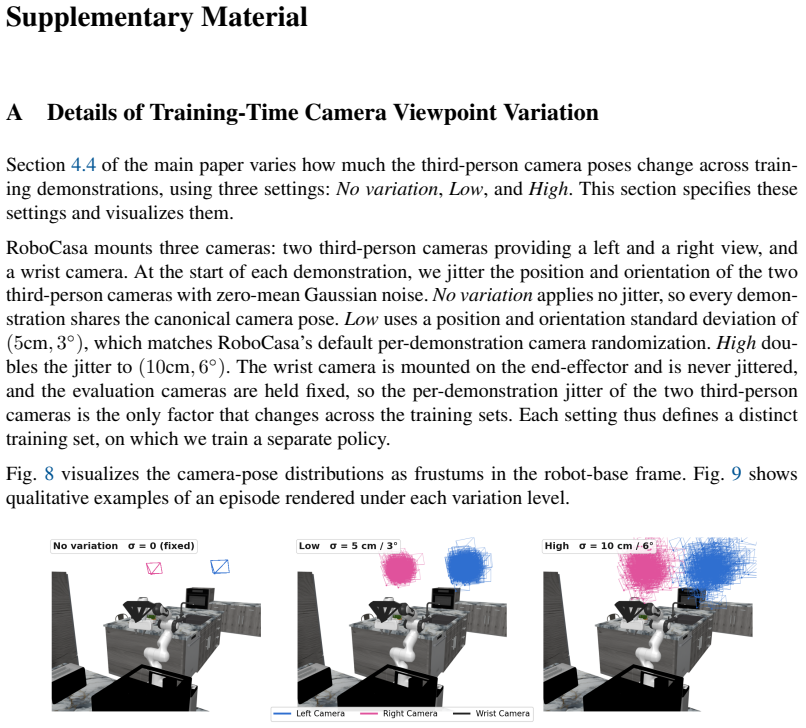
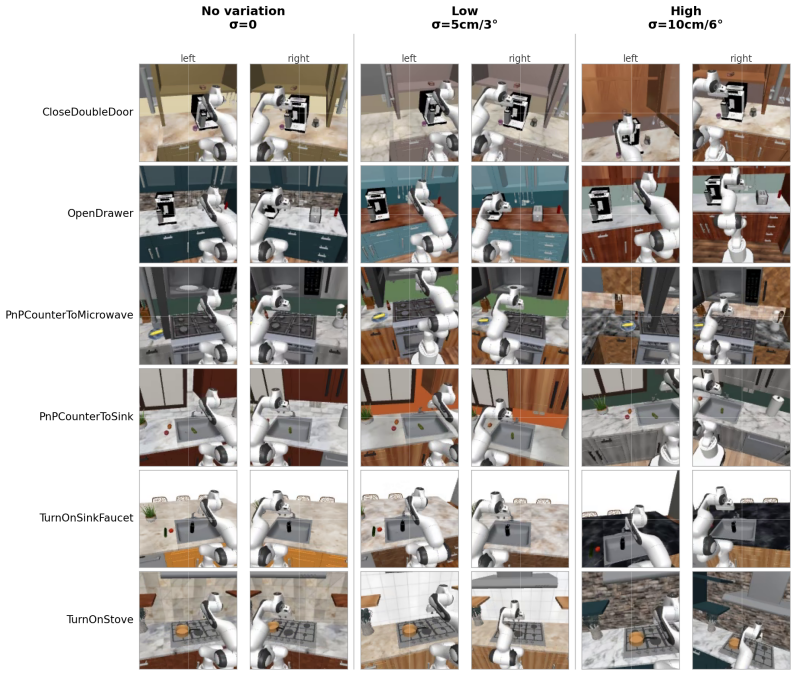
X. Zhai, B. Mustafa, A. Kolesnikov, and L. Beyer. Sigmoid loss for language image pre- training. InProceedings of the IEEE/CVF international conference on computer vision, pages 11975–11986, 2023. 17 14 Supplementary Material A Details of Training-Time Camera Viewpoint Variation Section 4.4 of the main paper varies how much the third-person camera poses c...
2023
discussion (0)
Sign in with ORCID, Apple, or X to comment. Anyone can read and Pith papers without signing in.