REVIEW 3 major objections 5 minor 80 references
A multimodal model can jointly train region captioning and localization with only masks, by scoring its own captions through how well it re-localizes them.
Reviewed by Pith at T0; open to challenge. T0 means a machine referee read the full paper against a public rubric. the ladder, T0–T4 →
T0 review · grok-4.5
2026-07-14 04:36 UTC pith:GXNAT3E7
load-bearing objection Clean dual-task RL loop that actually removes the text-mask annotation bottleneck and shows multi-benchmark gains; the reward-faithfulness assumption is the soft spot but the ablations already check it. the 3 major comments →
Actor as Its Own Critic: Unifying Region Understanding and Localization via CycleGRPO
The pith
A machine-rendered reading of the paper's core claim, the machinery that carries it, and where it could break.
Core claim
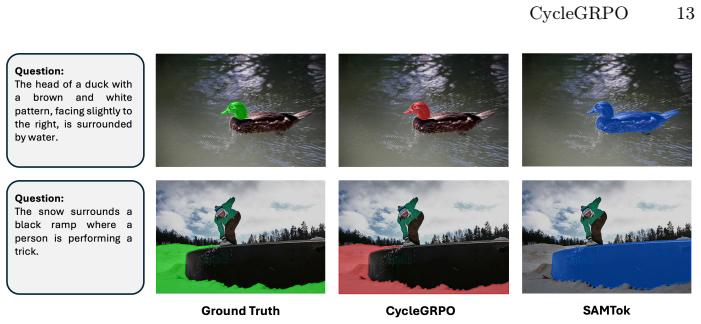
CycleGRPO jointly bootstraps region understanding and localization by maximizing a cycle-consistency reward: a single MLLM acts as actor to sample captions for a region, then as its own critic to localize those captions back into masks or boxes. Average reconstructive IoU across localization rollouts measures caption quality and weights the grounding trajectories, so the policy is optimized under group-relative policy optimization without text labels, external judges, or separate task heads. Empirically this raises performance across captioning, VQA, interleaved text–mask generation, and referring segmentation in a zero-shot evaluation setting.
What carries the argument
CycleGRPO (“Actor as Its Own Critic”): for each region the policy samples G captions, then K localization rollouts per caption; reconstructive IoU supplies a quality-aware cycle reward (caption reward = mean IoU; localization reward = that mean times per-rollout IoU) that trains both mappings in one GRPO update.
Load-bearing premise
The paper assumes that average reconstructive localization accuracy is a faithful proxy for how discriminative and correct a generated caption is.
What would settle it
After CycleGRPO training, check whether captions with high average reconstructive IoU also win on independent caption quality (human ratings or a held-out judge on attribute correctness and discriminability). If high-IoU captions remain vague or wrong on details that barely change mask overlap, the cycle reward is not measuring semantic quality.
If this is right
- Pixel-level MLLM post-training can scale from image–mask (or box) data alone instead of costly region–caption corpora.
- Separate captioning and grounding RL pipelines can be replaced by one closed loop that improves both capabilities together.
- The same cycle applies to discrete mask tokens and continuous bounding-box formats across model sizes.
- Zero-shot gains on region captioning, region VQA, grounded dialogue, and referring segmentation follow without per-benchmark fine-tuning.
- Captions that fail to reconstruct the original region are penalized, which the paper links to fewer hallucinations and stronger target rejection.
Where Pith is reading between the lines
- The same duality could extend to video or 3D regions wherever a reconstructible spatial token or box representation exists.
- Because mask reconstruction rewards attributes more than relations, the cycle may systematically under-train spatial-relation language unless the localization metric is enriched.
- If localization saturates while captions stay shallow, an auxiliary diversity or coverage term would be a natural next control the paper does not introduce.
Editorial analysis
A structured set of objections, weighed in public.
Referee Report
Summary. The paper proposes CycleGRPO, a GRPO-based RL framework that jointly optimizes region understanding and localization in MLLMs by exploiting their duality as a closed loop “region → text → region.” A single model first samples candidate region captions (actor), then grounds each caption back into spatial masks via K localization rollouts (critic). A cycle-consistency reward—defined in the main text as reconstructive IoU, and in the appendix as hierarchical token grading—supervises both phases without textual ground truths. Built on SAMTok (Qwen3-VL-4B) and trained on ~20k DenseWorld masks plus 1k GRES no-target expressions, the method reports consistent zero-shot gains on DLC-Bench, GAR-Bench-VQA, GCG, GRES, and GroundingSuite, with ablations on per-task GRPO, G/K, bbox vs. mask formats, and data scale, plus code release.
Significance. If the results hold under clean evaluation, the work is a solid systems contribution: it removes the need for expensive region–caption pairs for joint fine-grained post-training and shows that a single self-evaluating loop can improve both captioning and grounding. Strengths include multi-benchmark zero-shot evaluation, explicit Cap-only / Loc-only / CycleGRPO controls (Table 6), transfer to continuous bbox formats on vanilla Qwen backbones (Table 8), G/K and data-scaling ablations, training-dynamics plots, and public code. The “Actor-as-Own-Critic” framing is clear and practically useful for pixel-level MLLM post-training.
major comments (3)
- [Sec. 4 Implementation; Table 5] Sec. 4 (Implementation) states training uses “1k no-target expressions from GRES [28]” while Table 5 reports a large GRES N-acc jump (58.7% → 92.1%) as a main result under “no task-specific fine-tuning.” Because N-acc is precisely the no-target rejection metric, this is partial in-domain supervision for the most dramatic GRES number. Please either (i) retrain without any GRES expressions and re-report Table 5, or (ii) clearly mark GRES N-acc as in-domain / semi-supervised and lead with the non-GRES localization gains (GroundingSuite, GCG).
- [Sec. 3 Cycle Reward; Appendix A] Sec. 3 defines the cycle score as mask IoU, s_i,k = IoU(M, M̂_i,k), and builds R_cap and R_loc on that quantity. Appendix A instead replaces pixel IoU with hierarchical token grading (exact match 1.0 / prefix 0.8 / partial 0.4) for efficiency. This is not a minor implementation detail: it changes the reward geometry and is the actual training signal. Please (i) state the implemented reward in the main method section, (ii) report a small controlled comparison of true IoU vs. hierarchical token grading on DLC-Bench and GroundingSuite, and (iii) clarify whether reported gains depend on the discrete SAMTok codebook structure.
- [Sec. 3 Cycle Reward; Tables 6–8] The load-bearing assumption is that average reconstructive accuracy of K localization rollouts is a faithful, non-degenerate proxy for caption semantic discriminability (Sec. 3, Phase 2 and Cycle Reward). Tables 6–8 and the GRES N-acc behavior provide useful checks against pure collapse, but the paper still lacks a direct analysis of failure modes: e.g., rate of high-reward captions that remain vague or partially hallucinated under human or LLM inspection, and correlation between R_cap and external caption metrics (CIDEr / LLM-judge) on held-out regions. A short quantitative study (even on a few hundred samples) would substantially strengthen the claim that the cycle reward drives genuine understanding rather than tokenizer-friendly phrasing.
minor comments (5)
- [Table 3; Sec. 4.1 Region VQA] Table 3: Position (−3.2%) and Relation (−1.0%) drop under CycleGRPO; the text attributes this to attribute-biased reconstruction. Consider a short qualitative example or a relation-focused reward variant discussion so readers can judge the trade-off.
- [Fig. 6; Appendix E] Fig. 1 and Fig. 2 are conceptually clear; ensure axis labels / legend in Fig. 6 (training dynamics) remain readable in print and that solid vs. dashed CycleGRPO reward curves are defined in the caption.
- [Sec. 3; Eq. (1)] Notation: R_total = R_cap + R_loc is introduced without specifying whether advantages A_cap and A_loc are standardized jointly or per phase; a one-line clarification near Eq. (1) would help reimplementation.
- [Sec. 5] Related Work could briefly contrast CapRL and other caption-via-QA RL methods with the pure spatial cycle signal to sharpen novelty.
- [Fig. 1; throughout] Minor typos / polish: “SAMToK” vs “SAMTok” inconsistency early on; “unscalablehigh-quality” missing space in Fig. 1 caption; arXiv IDs and venue formatting in references should be checked for consistency.
Circularity Check
No circularity: cycle-IoU is an intentional training proxy; all reported gains are on held-out external benchmarks never used in the reward.
full rationale
CycleGRPO is an empirical RL methods paper, not a first-principles derivation. The training objective is deliberately self-referential (R_cap = mean IoU of K localization rollouts of the model's own captions; R_loc weighted by that score; App. A hierarchical token match as a cheap proxy). That design choice does not make the scientific claims circular: every headline number (DLC-Bench Avg, GroundingSuite All, GRES gIoU/N-acc, GCG CIDEr/Recall, GAR-Bench-VQA Overall) is measured on held-out benchmarks that never enter the reward and that receive no task-specific fine-tuning. No free parameter is fitted to a subset of those metrics and then re-reported as a prediction; no uniqueness theorem is imported from overlapping-author work to forbid alternatives; SAMTok is used only as a discrete-mask substrate and is shown to be non-essential by the bbox transfer on vanilla Qwen2.5/3-VL (Tab. 8). Cap-only vs Loc-only vs CycleGRPO (Tab. 6) further shows mutual benefit rather than a tautological collapse. The derivation chain therefore does not reduce any claimed result to its own inputs by construction.
Axiom & Free-Parameter Ledger
free parameters (3)
- caption group size G and localization rollout count K =
G=K=6
- learning rate and weight decay =
1e-6 / 1e-2
- hierarchical token-grading scores (1.0 / 0.8 / 0.4) =
1.0 exact, 0.8 prefix, 0.4 boundary
axioms (3)
- domain assumption Region captioning and referring localization are dual maps whose cycle reconstruction error (IoU) is a valid intrinsic measure of caption discriminability.
- domain assumption SAMTok (or standard bbox tokens) provides a unified discrete vocabulary in which both text and spatial outputs can be generated by the same autoregressive policy.
- standard math GRPO group-relative advantages plus KL penalty yield stable policy updates for the joint cycle objective.
invented entities (2)
-
CycleGRPO (Actor-as-Own-Critic loop)
no independent evidence
-
quality-aware token-level cycle-consistency reward (R_cap + R_loc)
no independent evidence
read the original abstract
This paper introduces Actor as Its Own Critic, a unified reinforcement learning framework, Cycle Group Relative Policy Optimization (CycleGRPO), that jointly optimizes region understanding and localization for Multimodal Large Language Models (MLLMs). Unlike existing separate pipelines, we leverage the inherent duality between the two tasks to construct a self-evaluating reinforcement learning paradigm: "region $\to$ text $\to$ region''. Specifically, a single MLLM first acts as the actor to generate region captions, then immediately transitions to a critic to ground its generated text back in the spatial domain. Therefore, CycleGRPO requires only region inputs, e.g., masks or bounding boxes, entirely bypassing the need for textual ground truths. A quality-aware token-level cycle-consistency reward is employed to assess the semantic discriminability of text captions via their physical localization accuracy. Empirically, built upon SAMTok, our CycleGRPO framework successfully bootstraps both capabilities simultaneously. Without any task-specific fine-tuning, the framework yields consistent performance gains across a wide range of benchmarks, including region captioning, region VQA, grounded dialogue, and referring segmentation. Overall, CycleGRPO offers a straightforward and scalable way to advance pixel-level capabilities in MLLMs. Code and models are released at https://github.com/devinxzhang/CycleGRPO.
Figures




Reference graph
Works this paper leans on
-
[1]
In: ECCV (2024)
Ai, Y., Qi, Y., Wang, B., Chen, Y., Wang, X., Tan, R.T.: Domain-adaptive 2d human pose estimation via dual teachers in extremely low-light conditions. In: ECCV (2024)
2024
-
[2]
arXiv preprint arXiv:2511.21631 (2025)
Bai, S., Cai, Y., Chen, R., Chen, K., Chen, X., Cheng, Z., Deng, L., Ding, W., Gao, C., Ge, C., et al.: Qwen3-vl technical report. arXiv preprint arXiv:2511.21631 (2025)
Pith/arXiv arXiv 2025
-
[3]
arXiv preprint arXiv:2502.13923 (2025)
Bai, S., Chen, K., Liu, X., Wang, J., Ge, W., Song, S., Dang, K., Wang, P., Wang, S., Tang, J., Zhong, H., Zhu, Y., Yang, M., Li, Z., Wan, J., Wang, P., Ding, W., CycleGRPO 25 Fu, Z., Xu, Y., Ye, J., Zhang, X., Xie, T., Cheng, Z., Zhang, H., Yang, Z., Xu, H., Lin, J.: Qwen2.5-vl technical report. arXiv preprint arXiv:2502.13923 (2025)
Pith/arXiv arXiv 2025
-
[4]
arXiv preprint arXiv:2505.14231 (2025)
Bai, S., Li, M., Liu, Y., Tang, J., Zhang, H., Sun, L., Chu, X., Tang, Y.: Univg-r1: Reasoning guided universal visual grounding with reinforcement learning. arXiv preprint arXiv:2505.14231 (2025)
Pith/arXiv arXiv 2025
-
[5]
arXiv preprint arXiv:2505.20272 (2025)
Cao, M., Zhao, H., Zhang, C., Chang, X., Reid, I., Liang, X.: Ground-r1: In- centivizing grounded visual reasoning via reinforcement learning. arXiv preprint arXiv:2505.20272 (2025)
arXiv 2025
-
[6]
Advances in Neural Information Processing Systems38, 156647–156667 (2026)
Cao, X., Lin, B., Wang, B., Huang, Z., Tan, R.: 3dot: Texture transfer for 3dgs objects from a single reference image. Advances in Neural Information Processing Systems38, 156647–156667 (2026)
2026
-
[7]
In: Proceedings of the IEEE/CVF Conference on Computer Vision and Pattern Recognition
Chen, H., Ai, Y., Kim, K., Tan, R.T., Chen, Y., Wang, B.: Udapose: Unsupervised domain adaptation for low-light human pose estimation. In: Proceedings of the IEEE/CVF Conference on Computer Vision and Pattern Recognition. pp. 13781– 13792 (2026)
2026
-
[8]
arXiv preprint arXiv:2502.15224 (2025)
Chen, T., Anumasa, S., Lin, B., Shah, V., Goyal, A., Liu, D.: Auto-bench: An auto- mated benchmark for scientific discovery in llms. arXiv preprint arXiv:2502.15224 (2025)
Pith/arXiv arXiv 2025
-
[9]
arXiv preprint arXiv:2510.15614 (2025)
Chen, T., Lin, B., Yuan, Z., Zou, Q., He, H., Goyal, A., Ong, Y.S., Liu, D.: Hy- pospace: Evaluating llm creativity as set-valued hypothesis generators under un- derdetermination. arXiv preprint arXiv:2510.15614 (2025)
Pith/arXiv arXiv 2025
-
[10]
In: ECCV (2024)
Chen, Y.C., Li, W.H., Sun, C., Wang, Y.C.F., Chen, C.S.: Sam4mllm: Enhance multi-modal large language model for referring expression segmentation. In: ECCV (2024)
2024
-
[11]
DeepMind, G.: Gemini-2.5-pro.https://deepmind.google/models/gemini/pro/ (2025)
2025
-
[12]
arXiv preprint arXiv:2603.17680 (2026)
Du, W., Yuan, Z., Chen, T., Ke, F., Lin, B., Zhang, S.: Weatherreasonseg: A benchmark for weather-aware reasoning segmentation in visual language models. arXiv preprint arXiv:2603.17680 (2026)
arXiv 2026
-
[13]
In: CVPR
Guo, Q., De Mello, S., Yin, H., Byeon, W., Cheung, K.C., Yu, Y., Luo, P., Liu, S.: Regiongpt: Towards region understanding vision language model. In: CVPR. pp. 13796–13806 (2024)
2024
-
[14]
arXiv preprint arXiv:2408.16500 (2024)
Hong, W., Wang, W., Ding, M., Yu, W., Lv, Q., Wang, Y., Cheng, Y., Huang, S., Ji, J., Xue, Z., et al.: Cogvlm2: Visual language models for image and video understanding. arXiv preprint arXiv:2408.16500 (2024)
Pith/arXiv arXiv 2024
-
[15]
arXiv preprint arXiv:2503.10596 (2025)
Hu, R., Zhu, L., Zhang, Y., Cheng, T., Liu, L., Liu, H., Ran, L., Chen, X., Liu, W.,Wang,X.:Groundingsuite:Measuringcomplexmulti-granularpixelgrounding. arXiv preprint arXiv:2503.10596 (2025)
Pith/arXiv arXiv 2025
-
[16]
arXiv preprint arXiv:2601.09668 (2026)
Huang, A., Yao, C., Han, C., Wan, F., Guo, H., Lv, H., Zhou, H., Wang, J., Zhou, J., Sun, J., et al.: Step3-vl-10b technical report. arXiv preprint arXiv:2601.09668 (2026)
arXiv 2026
-
[17]
arXiv preprint arXiv:2410.21276 (2024)
Hurst, A., Lerer, A., Goucher, A.P., Perelman, A., Ramesh, A., Clark, A., Os- trow, A., Welihinda, A., Hayes, A., Radford, A., et al.: Gpt-4o system card. arXiv preprint arXiv:2410.21276 (2024)
Pith/arXiv arXiv 2024
-
[18]
In: CVPR (2024)
Lai, X., Tian, Z., Chen, Y., Li, Y., Yuan, Y., Liu, S., Jia, J.: Lisa: Reasoning segmentation via large language model. In: CVPR (2024)
2024
-
[19]
ICLR (2025)
Lan, M., Chen, C., Zhou, Y., Xu, J., Ke, Y., Wang, X., Feng, L., Zhang, W.: Text4seg: Reimagining image segmentation as text generation. ICLR (2025)
2025
-
[20]
In: The Thirty-eighth Annual Conference on Neural Information Processing Systems (2024) 26 X
Lei, Q., Wang, B., Robby T., T.: Ez-hoi: Vlm adaptation via guided prompt learn- ing for zero-shot hoi detection. In: The Thirty-eighth Annual Conference on Neural Information Processing Systems (2024) 26 X. Zhang et al
2024
-
[21]
In: Proceedings of the IEEE/CVF International Conference on Computer Vision
Lei, Q., Wang, B., Tan, R.T.: Hola: Zero-shot hoi detection with low-rank decom- posed vlm feature adaptation. In: Proceedings of the IEEE/CVF International Conference on Computer Vision. pp. 1825–1835 (2025)
2025
-
[22]
arXiv preprint arXiv:2512.17495 (2025)
Li, R., Li, L., Ren, S., Tian, H., Gu, S., Li, S., Yue, Z., Wang, Y., Ma, W., Yang, Z., et al.: Groundingme: Exposing the visual grounding gap in mllms through multi-dimensional evaluation. arXiv preprint arXiv:2512.17495 (2025)
arXiv 2025
-
[23]
In: Proceedings of the AAAI Conference on Artificial Intelligence
Li, S., Tan, L., Tan, R.T.: Bridging day and night: Target-class hallucination sup- pression in unpaired image translation. In: Proceedings of the AAAI Conference on Artificial Intelligence. vol. 40, pp. 6424–6432 (2026)
2026
-
[24]
In: Proceedings of the IEEE/CVF Confer- ence on Computer Vision and Pattern Recognition (CVPR)
Li, S., Tan, L., Tan, R.T.: White-balance first, adjust later: Cross-camera color con- stancy via vision-language evaluation. In: Proceedings of the IEEE/CVF Confer- ence on Computer Vision and Pattern Recognition (CVPR). pp. 1331–1341 (June 2026)
2026
-
[25]
arXiv preprint arXiv:2506.24102 (2025)
Li, X., Zhang, T., Li, Y., Yuan, H., Chen, S., Zhou, Y., Meng, J., Sun, Y., Xu, S., Qi, L., et al.: Denseworld-1m: Towards detailed dense grounded caption in the real world. arXiv preprint arXiv:2506.24102 (2025)
Pith/arXiv arXiv 2025
-
[26]
arXiv preprint arXiv:2504.16072 (2025)
Lian, L., Ding, Y., Ge, Y., Liu, S., Mao, H., Li, B., Pavone, M., Liu, M.Y., Dar- rell, T., Yala, A., et al.: Describe anything: Detailed localized image and video captioning. arXiv preprint arXiv:2504.16072 (2025)
Pith/arXiv arXiv 2025
-
[27]
arXiv preprint arXiv:2403.20271 (2024)
Lin, W., Wei, X., An, R., Gao, P., Zou, B., Luo, Y., Huang, S., Zhang, S., Li, H.: Draw-and-understand: Leveraging visual prompts to enable mllms to comprehend what you want. arXiv preprint arXiv:2403.20271 (2024)
Pith/arXiv arXiv 2024
-
[28]
In: CVPR (2023)
Liu, C., Ding, H., Jiang, X.: Gres: Generalized referring expression segmentation. In: CVPR (2023)
2023
-
[29]
In: NeurIPS (2023)
Liu, H., Li, C., Wu, Q., Lee, Y.J.: Visual instruction tuning. In: NeurIPS (2023)
2023
-
[30]
arXiv preprint arXiv:2602.09609 (2026)
Liu, J., Li, T., Cao, X., Ma, Y., Shang, G., Huang, H., Zhang, C., Chang, X., Huang, Z., Hu, J., et al.: Tele-omni: a unified multimodal framework for video generation and editing. arXiv preprint arXiv:2602.09609 (2026)
arXiv 2026
-
[31]
arXiv preprint arXiv:2503.06520 (2025)
Liu, Y., Peng, B., Zhong, Z., Yue, Z., Lu, F., Yu, B., Jia, J.: Seg-zero: Reasoning-chain guided segmentation via cognitive reinforcement. arXiv preprint arXiv:2503.06520 (2025)
Pith/arXiv arXiv 2025
-
[32]
com / index / introducing - o3 - and - o4 - mini/(2025)
OpenAI: Openai-o3.https : / / openai . com / index / introducing - o3 - and - o4 - mini/(2025)
2025
-
[33]
Medical & Biological Engineering & Computing62(6), 1821–1836 (2024)
Qian, Z., Wang, Z., Zhang, X., Wei, B., Lai, M., Shou, J., Fan, Y., Xu, Y.: Msnseg- net: attention-based multi-shape nuclei instance segmentation in histopathology images. Medical & Biological Engineering & Computing62(6), 1821–1836 (2024)
2024
-
[34]
In: CVPR (2024)
Rasheed, H., Maaz, M., Shaji, S., Shaker, A., Khan, S., Cholakkal, H., Anwer, R.M., Xing, E., Yang, M.H., Khan, F.S.: Glamm: Pixel grounding large multimodal model. In: CVPR (2024)
2024
-
[35]
arXiv preprint arXiv:2505.23678 (2025)
Sarch, G., Saha, S., Khandelwal, N., Jain, A., Tarr, M.J., Kumar, A., Fragki- adaki, K.: Grounded reinforcement learning for visual reasoning. arXiv preprint arXiv:2505.23678 (2025)
Pith/arXiv arXiv 2025
-
[36]
arXiv preprint arXiv:2402.03300 (2024)
Shao, Z., Wang, P., Zhu, Q., Xu, R., Song, J., Bi, X., Zhang, H., Zhang, M., Li, Y., Wu, Y., et al.: Deepseekmath: Pushing the limits of mathematical reasoning in open language models. arXiv preprint arXiv:2402.03300 (2024)
Pith/arXiv arXiv 2024
-
[37]
arXiv preprint arXiv:2510.01954 (2025)
Su, Y., Zhang, H., Li, S., Liu, N., Liao, J., Pan, J., Liu, Y., Xing, X., Sun, C., Li, C., et al.: Patch-as-decodable-token: Towards unified multi-modal vision tasks in mllms. arXiv preprint arXiv:2510.01954 (2025)
arXiv 2025
-
[38]
arXiv preprint arXiv:2606.19534 (2026), https://arxiv.org/abs/2606.19534
Sun, Y., Wang, Y., Li, J., Tian, Y., Zhang, T., Mai, J., Wang, Y., Wang, H., Bai, J., Yang, L., Tong, Y.: Perceptiondlm: Parallel region perception with CycleGRPO 27 multimodal diffusion language models. arXiv preprint arXiv:2606.19534 (2026), https://arxiv.org/abs/2606.19534
Pith/arXiv arXiv 2026
-
[39]
International Journal of Computer Vision134(2), 72 (2026)
Tan, L., Li, W., Dai, P., Chen, J., Cao, L., Ji, R.: Knowing where to focus: Attention-guided alignment for text-based person search. International Journal of Computer Vision134(2), 72 (2026)
2026
-
[40]
In: Proceedings of the AAAI conference on artificial intelligence
Tan, L., Xia, J., Liu, W., Dai, P., Wu, Y., Cao, L.: Occluded person re-identification via saliency-guided patch transfer. In: Proceedings of the AAAI conference on artificial intelligence. vol. 38, pp. 5070–5078 (2024)
2024
-
[41]
In: Advances in Neural Information Processing Systems
Tan, L., Zhang, Y., Han, K., Dai, P., Zhang, Y., WU, Y., Ji, R.: Rle: A unified perspective of data augmentation for cross-spectral re-identification. In: Advances in Neural Information Processing Systems. vol. 37, pp. 126977–126996 (2024)
2024
-
[42]
arXiv preprint arXiv:2312.11805 (2023)
Team, G., Anil, R., Borgeaud, S., Alayrac, J.B., Yu, J., Soricut, R., Schalkwyk, J., Dai, A.M., Hauth, A., Millican, K., et al.: Gemini: a family of highly capable multimodal models. arXiv preprint arXiv:2312.11805 (2023)
Pith/arXiv arXiv 2023
-
[43]
arXiv preprint arXiv:2507.01006 (2024)
Team, V., Hong, W., Yu, W., Gu, X., Wang, G., Gan, G., Tang, H., Cheng, J., Qi, J., Ji, J., Pan, L., Duan, S., Wang, W., Wang, Y., Cheng, Y., He, Z., Su, Z., Yang, Z., Pan, Z., Zeng, A., Wang, B., Chen, B., Shi, B., Pang, C., Zhang, C., Yin, D., Yang, F., Chen, G., Xu, J., Zhu, J., Chen, J., Chen, J., Chen, J., Lin, J., Wang, J., Chen, J., Lei, L., Gong, ...
Pith/arXiv arXiv 2024
-
[44]
ICLR (2026)
Wang, H., Li, X., Huang, Z., Wang, A., Wang, J., Zhang, T., Zheng, J., Bai, S., Kang, Z., Feng, J., et al.: Traceable evidence enhanced visual grounded reasoning: Evaluation and methodology. ICLR (2026)
2026
-
[45]
ICLR (2026)
Wang, H., Wang, Y., Zhang, T., Zhou, Y., Li, Y., Wang, J., Tian, Y., Meng, J., Huang, Z., Mai, G., Wang, A., Tong, Y., Wang, Z., Li, X., Zhang, Z.: Grasp any region: Towards precise, contextual pixel understanding for multimodal llms. ICLR (2026)
2026
-
[46]
arXiv preprint arXiv:2510.18876 (2025)
Wang, H., Wang, Y., Zhang, T., Zhou, Y., Li, Y., Wang, J., Tian, Y., Meng, J., Huang, Z., Mai, G., et al.: Grasp any region: Towards precise, contextual pixel understanding for multimodal llms. arXiv preprint arXiv:2510.18876 (2025)
arXiv 2025
-
[47]
In: Proceedings of the IEEE/CVF International Conference on Computer Vision
Wang, H., Zhao, Y., Wang, T., Fan, H., Zhang, X., Zhang, Z.: Ross3d: Reconstruc- tive visual instruction tuning with 3d-awareness. In: Proceedings of the IEEE/CVF International Conference on Computer Vision. pp. 9275–9286 (2025)
2025
-
[48]
In: ICLR (2025)
Wang, H., Zheng, A., Zhao, Y., Wang, T., Ge, Z., Zhang, X., Zhang, Z.: Recon- structive visual instruction tuning. In: ICLR (2025)
2025
-
[49]
arXiv preprint arXiv:2506.11991 (2025)
Wang, J., Kang, Z., Wang, H., Jiang, H., Li, J., Wu, B., Wang, Y., Ran, J., Liang, X., Feng, C., et al.: Vgr: Visual grounded reasoning. arXiv preprint arXiv:2506.11991 (2025)
Pith/arXiv arXiv 2025
-
[50]
arXiv preprint arXiv:2508.04107 (2025)
Wang, J., Wu, Z., Huang, D., Zheng, Y., Wang, H.: Unlocking the potential of mllms in referring expression segmentation via a light-weight mask decoder. arXiv preprint arXiv:2508.04107 (2025)
Pith/arXiv arXiv 2025
-
[51]
arXiv preprint arXiv:2505.16495 (2025) 28 X
Wang, L., Lin, H., Chen, S., Wang, T., Cheng, C., Zhong, Y., Zheng, D., Zhao, W.: Alto: Adaptive-length tokenizer for autoregressive mask generation. arXiv preprint arXiv:2505.16495 (2025) 28 X. Zhang et al
arXiv 2025
-
[52]
In: ICCV (2025)
Wang, T., Cheng, C., Wang, L., Chen, S., Zhao, W.: Himtok: Learning hierarchical mask tokens for image segmentation with large multimodal model. In: ICCV (2025)
2025
-
[53]
arXiv preprint arXiv:2508.18265 (2025)
Wang, W., Gao, Z., Gu, L., Pu, H., Cui, L., Wei, X., Liu, Z., Jing, L., Ye, S., Shao, J., et al.: Internvl3.5: Advancing open-source multimodal models in versatility, reasoning, and efficiency. arXiv preprint arXiv:2508.18265 (2025)
Pith/arXiv arXiv 2025
-
[54]
NeurIPS (2023)
Wang, W., Chen, Z., Chen, X., Wu, J., Zhu, X., Zeng, G., Luo, P., Lu, T., Zhou, J., Qiao, Y., et al.: Visionllm: Large language model is also an open-ended decoder for vision-centric tasks. NeurIPS (2023)
2023
-
[55]
In: NeurIPS (2025)
Wang, X., Ru, L., Huang, Z., Ji, K., Zheng, D., Chen, J., Zhou, J.: Argenseg: Image segmentation with autoregressive image generation model. In: NeurIPS (2025)
2025
-
[56]
In: ICCV
Wei, C., Zhong, Y., Tan, H., Zeng, Y., Liu, Y., Wang, H., Yang, Y.: Instructseg: Unifying instructed visual segmentation with multi-modal large language models. In: ICCV. pp. 20193–20203 (2025)
2025
-
[57]
arXiv preprint arXiv:2412.10302 (2024)
Wu,Z.,Chen,X.,Pan,Z.,Liu,X.,Liu,W.,Dai,D.,Gao,H.,Ma,Y.,Wu,C.,Wang, B., et al.: Deepseek-vl2: Mixture-of-experts vision-language models for advanced multimodal understanding. arXiv preprint arXiv:2412.10302 (2024)
Pith/arXiv arXiv 2024
-
[58]
arXiv preprint arXiv:2509.22647 (2025)
Xing, L., Dong, X., Zang, Y., Cao, Y., Liang, J., Huang, Q., Wang, J., Wu, F., Lin, D.: Caprl: Stimulating dense image caption capabilities via reinforcement learning. arXiv preprint arXiv:2509.22647 (2025)
arXiv 2025
-
[59]
In: Proceedings of the IEEE/CVF Conference on Computer Vision and Pattern Recognition (CVPR)
Yan, W., Li, H., Xu, H., Ye, N., Ai, Y., Liu, S., Hu, J.: Las-comp: Zero-shot 3d completion with latent-spatial consistency. In: Proceedings of the IEEE/CVF Conference on Computer Vision and Pattern Recognition (CVPR). pp. 7588–7599 (June 2026)
2026
-
[60]
In: Proceedings of the Computer Vision and Pattern Recognition Conference (CVPR)
Yan,W.,Li,M.,Li,H.,Shao,S.,Tan,R.T.:Synthetic-to-realself-supervisedrobust depth estimation via learning with motion and structure priors. In: Proceedings of the Computer Vision and Pattern Recognition Conference (CVPR). pp. 21880– 21890 (June 2025)
2025
-
[61]
arXiv preprint arXiv:2509.00665 (2025)
Yan, W., Zhang, X., Tan, R.T.: Er-lora: Effective-rank guided adaptation for weather-generalized depth estimation. arXiv preprint arXiv:2509.00665 (2025)
Pith/arXiv arXiv 2025
-
[62]
In: Proceedings of the AAAI Con- ference on Artificial Intelligence
Yang, X., Zhang, X., Wang, X.: Erf: A benchmark dataset for robust semantic segmentation under extreme rainfall conditions. In: Proceedings of the AAAI Con- ference on Artificial Intelligence. vol. 39, pp. 9301–9309 (2025)
2025
-
[63]
arXiv preprint arXiv:2506.22624 (2025)
You, Z., Wu, Z.: Seg-r1: Segmentation can be surprisingly simple with reinforce- ment learning. arXiv preprint arXiv:2506.22624 (2025)
Pith/arXiv arXiv 2025
-
[64]
arXiv preprint arXiv:2501.04001 (2025)
Yuan, H., Li, X., Zhang, T., Huang, Z., Xu, S., Ji, S., Tong, Y., Qi, L., Feng, J., Yang, M.H.: Sa2va: Marrying sam2 with llava for dense grounded understanding of images and videos. arXiv preprint arXiv:2501.04001 (2025)
Pith/arXiv arXiv 2025
-
[65]
In: CVPR (2024)
Yuan, Y., Li, W., Liu, J., Tang, D., Luo, X., Qin, C., Zhang, L., Zhu, J.: Osprey: Pixel understanding with visual instruction tuning. In: CVPR (2024)
2024
-
[66]
In: CVPR (2025)
Yuan, Y., Zhang, H., Li, W., Cheng, Z., Zhang, B., Li, L., Li, X., Zhao, D., Zhang, W., Zhuang, Y., et al.: Videorefer suite: Advancing spatial-temporal object under- standing with video llm. In: CVPR (2025)
2025
-
[67]
arXiv preprint arXiv:2510.23603 (2025)
Yuan, Y., Zhang, W., Li, X., Wang, S., Li, K., Li, W., Xiao, J., Zhang, L., Ooi, B.C.: Pixelrefer: A unified framework for spatio-temporal object referring with arbitrary granularity. arXiv preprint arXiv:2510.23603 (2025)
arXiv 2025
-
[68]
arXiv preprint arXiv:2404.07973 (2024)
Zhang, H., You, H., Dufter, P., Zhang, B., Chen, C., Chen, H.Y., Fu, T.J., Wang, W.Y., Chang, S.F., Gan, Z., et al.: Ferret-v2: An improved baseline for referring and grounding with large language models. arXiv preprint arXiv:2404.07973 (2024)
Pith/arXiv arXiv 2024
-
[69]
NeurIPS (2024) CycleGRPO 29
Zhang, T., Li, X., Fei, H., Yuan, H., Wu, S., Ji, S., Loy, C.C., Yan, S.: Omg- llava: Bridging image-level, object-level, pixel-level reasoning and understanding. NeurIPS (2024) CycleGRPO 29
2024
-
[70]
arXiv preprint arXiv:2504.10465 (2025)
Zhang, T., Li, X., Huang, Z., Li, Y., Lei, W., Deng, X., Chen, S., Ji, S., Feng, J.: Pixel-sail: Single transformer for pixel-grounded understanding. arXiv preprint arXiv:2504.10465 (2025)
Pith/arXiv arXiv 2025
-
[71]
arXiv preprint arXiv:2507.04664 (2025)
Zhang, T., Wei, S., Chen, S., Yu, W., Luo, M., Ji, S.: Vectorllm: Human-like extraction of structured building contours vis multimodal llms. arXiv preprint arXiv:2507.04664 (2025)
Pith/arXiv arXiv 2025
-
[72]
IEEE Transactions on Image Processing32, 4247–4258 (2023)
Zhang, X., Chen, Y.C.: Adaptive domain generalization via online disagreement minimization. IEEE Transactions on Image Processing32, 4247–4258 (2023)
2023
-
[73]
Zhang, X., Tan, R.T.: Mamba as a bridge: Where vision foundation models meet visionlanguagemodelsfordomain-generalizedsemanticsegmentation.In:Proceed- ings of the IEEE/CVF Conference on Computer Vision and Pattern Recognition. pp. 14527–14537 (2025)
2025
-
[74]
In: Proceedings of the AAAI Conference on Artificial Intelligence
Zhang, X., Xie, J., Yuan, Y., Mi, M.B., Tan, R.T.: Heap: unsupervised object discovery and localization with contrastive grouping. In: Proceedings of the AAAI Conference on Artificial Intelligence. vol. 38, pp. 7323–7331 (2024)
2024
-
[75]
arXiv preprint arXiv:2602.03890 (2026)
Zhang, X., Yan, W., Shi, Y., Qiu, X., He, T., Li, Y., Li, M., Fan, H.: 4dpc2hat: To- wards dynamic point cloud understanding with failure-aware bootstrapping. arXiv preprint arXiv:2602.03890 (2026)
Pith/arXiv arXiv 2026
-
[76]
arXiv preprint arXiv:2406.20076 (2024)
Zhang, Y., Cheng, T., Zhu, L., Hu, R., Liu, L., Liu, H., Ran, L., Chen, X., Liu, W., Wang, X.: Evf-sam: Early vision-language fusion for text-prompted segment anything model. arXiv preprint arXiv:2406.20076 (2024)
Pith/arXiv arXiv 2024
-
[77]
arXiv preprint arXiv:2601.16093 (2026)
Zhou, Y., Zhang, T., Gong, D., Wu, Y., Tian, Y., Wang, H., Yuan, H., Wang, J., Qi, L., Fei, H., et al.: Samtok: Representing any mask with two words. arXiv preprint arXiv:2601.16093 (2026)
arXiv 2026
-
[78]
arXiv preprint arXiv:2505.15810 (2025)
Zhou, Y., Dai, S., Wang, S., Zhou, K., Jia, Q., Xu, J.: Gui-g1: Understand- ing r1-zero-like training for visual grounding in gui agents. arXiv preprint arXiv:2505.15810 (2025)
Pith/arXiv arXiv 2025
-
[79]
arXiv preprint arXiv:2504.10479 (2025)
Zhu, J., Wang, W., Chen, Z., Liu, Z., Ye, S., Gu, L., Tian, H., Duan, Y., Su, W., Shao, J., et al.: Internvl3: Exploring advanced training and test-time recipes for open-source multimodal models. arXiv preprint arXiv:2504.10479 (2025)
Pith/arXiv arXiv 2025
-
[80]
arXiv preprint arXiv:2508.14153 (2025)
Zhu, L., Ouyang, B., Zhang, Y., Cheng, T., Hu, R., Shen, H., Ran, L., Chen, X., Yu, L., Liu, W., et al.: Lens: Learning to segment anything with unified reinforced reasoning. arXiv preprint arXiv:2508.14153 (2025)
arXiv 2025
discussion (0)
Sign in with ORCID, Apple, or X to comment. Anyone can read and Pith papers without signing in.