REVIEW 3 major objections 3 minor
A two-stage model turns relative monocular geometry into metric 3D point maps by learning pixel-wise scale and ray-correction fields, plus multi-focal synthetic data.
Reviewed by Pith at T0; open to challenge. T0 means a machine referee read the full paper against a public rubric. the ladder, T0–T4 →
T0 review · grok-4.5
2026-07-15 08:47 UTC pith:QWPLM7OX
load-bearing objection Plausible two-stage monocular metric geometry with a useful focal-coverage diagnosis; the 5.2% claim and causal story are uncheckable from the abstract alone. the 3 major comments →
FoundationGeo: Learning Spatial Pixel-Wise Fields for Monocular Metric Geometry
The pith
A machine-rendered reading of the paper's core claim, the machinery that carries it, and where it could break.
Core claim
Zero-shot monocular metric geometry is limited by focal-length distribution mismatch; a two-stage pipeline that first learns strong affine-invariant geometry from DINOv3 and 10.2 M multi-domain images, then applies pixel-wise scale and ray-direction correction fields trained with multi-focal Blender synthesis, produces metrically consistent point maps that generalize robustly across domains.
What carries the argument
Pixel-wise calibration fields: a spatially varying scale field for local metric alignment and a ray-direction correction field that removes directional bias, together converting affine-invariant geometry into metric 3D point maps; supported by Blender multi-focal synthesis that repairs under-covered camera-intrinsic regimes.
Load-bearing premise
That camera-intrinsic coverage, especially focal-length mismatch between train and test, is the decisive bottleneck for zero-shot metric generalization, and that synthetic multi-focal Blender data is enough to close the gap so the pixel-wise fields transfer metrically.
What would settle it
Train and evaluate the identical architecture without the multi-focal Blender data on a held-out test set whose focal lengths deliberately lie far outside the original training distribution; if metric error does not rise sharply, or if adding the synthetic data yields no clear gain, the central causal claim fails.
Editorial analysis
A structured set of objections, weighed in public.
Referee Report
Summary. FoundationGeo is a two-stage monocular metric-geometry framework. Stage 1 initializes from DINOv3 and trains an affine-invariant geometry model on a curated 10.2M multi-domain corpus with complementary local-detail supervision. Stage 2 replaces global scale with lightweight pixel-wise calibration fields—a spatially varying scale field and a ray-direction correction field—to produce metrically consistent 3D point maps. The authors identify focal-length distribution mismatch between train and test as a primary bottleneck for zero-shot metric generalization and address it by synthesizing multi-focal training data with a Blender-based engine. The abstract reports best overall zero-shot performance across seven benchmarks, with >5.2% average gains over heavier baselines and improved cross-domain robustness.
Significance. If the full evidence supports the claims, the work would be a meaningful contribution to monocular metric geometry: combining large multi-domain pretraining, explicit pixel-wise metric calibration (beyond global scale), and a principled multi-focal synthetic data engine is a coherent and practically relevant design. Strong, consistent zero-shot results without sharp domain drops would be valuable for downstream 3D perception. Credit is due for the clear diagnosis of intrinsic coverage as a failure mode and for the explicit two-stage relative-to-metric bridge; these are falsifiable design choices rather than pure scaling. Assessment of significance remains provisional because only the abstract is available.
major comments (3)
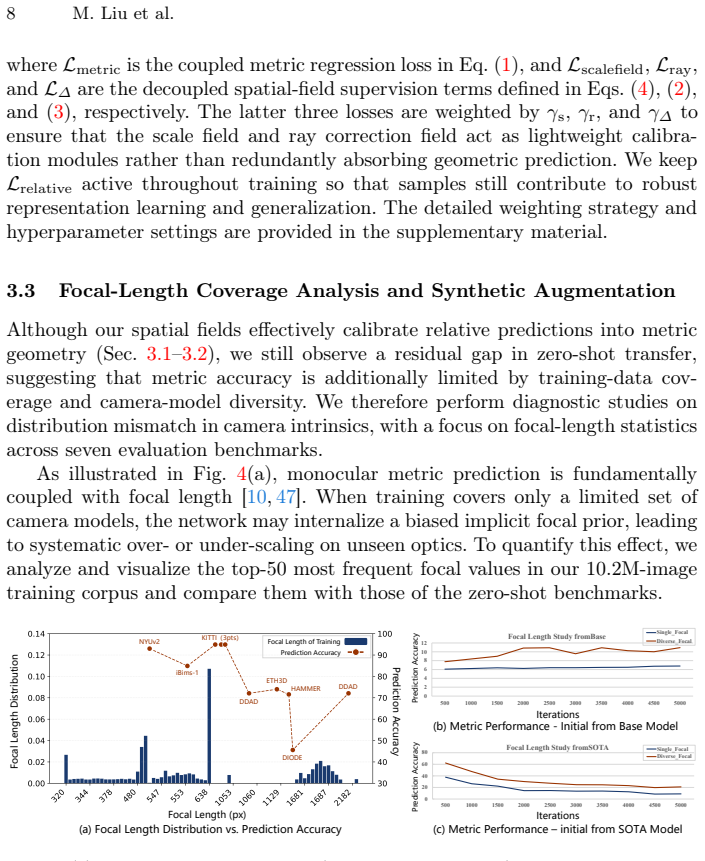
- [Abstract] Abstract (central data-design claim): The load-bearing causal diagnosis—that focal-length distribution mismatch is a key bottleneck for zero-shot metric generalization, and that Blender multi-focal synthesis repairs under-covered regimes—is asserted without supporting evidence in the available text (no train/test focal histograms, no ablation isolating multi-focal synthesis from Stage-1 pretraining or the calibration fields). Without that evidence the claimed mechanism and the data-engine contribution cannot be verified.
- [Abstract] Abstract (quantitative superiority claim): The statement that FoundationGeo achieves the best overall zero-shot performance and surpasses heavier baselines by over 5.2% on average across seven benchmarks is central, yet the abstract supplies no definition of the averaged metric, no per-benchmark or per-domain table, no named baselines, and no error bars or variance. The superiority claim is therefore unanchored and cannot be assessed for robustness or fairness of comparison.
- [Abstract] Abstract (Stage-2 architectural claim): Pixel-wise scale and ray-direction correction fields are presented as sufficient to produce metrically consistent point maps beyond global scaling. No equations, field definitions, loss formulations, or ablations of each field’s contribution appear in the available text, so the claim that these fields (rather than data scale or Stage-1 quality alone) drive metric consistency remains untestable.
minor comments (3)
- [Abstract] The abstract should name the seven benchmarks and the primary evaluation metrics (e.g., AbsRel, δ thresholds, point-map or depth metrics) so readers can interpret the >5.2% figure.
- [Abstract] Clarify what “complementary local-detail supervision” consists of (losses, targets, or datasets) in one phrase; the term is currently opaque.
- [Abstract] State model capacity or parameter counts relative to the “heavier baselines” to make the efficiency claim concrete.
Circularity Check
Abstract-only review shows ordinary supervised two-stage design with no self-definitional or fitted-as-prediction circularity visible.
full rationale
Only the abstract is available; no equations, training objectives, uniqueness theorems, or self-citations of prior author theorems appear. Stage 1 trains affine-invariant geometry from DINOv3 plus a 10.2M multi-domain corpus; Stage 2 learns pixel-wise scale and ray-direction correction fields for metric point maps. These are standard supervised mappings from images (and synthetic multi-focal Blender data) to geometric targets. Metric consistency is the training objective, not a redefinition of the inputs, and the multi-focal synthesis is presented as an empirical data-coverage fix rather than a tautological construction. No fitted parameter is renamed a prediction, no uniqueness is imported from the authors, and no known empirical pattern is merely renamed. The abstract therefore exhibits no circular derivation chain under the stated criteria. Score 0 is the honest non-finding for an abstract-only review of ordinary supervised learning.
Axiom & Free-Parameter Ledger
free parameters (3)
- pixel-wise scale field parameters
- ray-direction correction field parameters
- focal-length sampling distribution for Blender synthesis
axioms (4)
- domain assumption DINOv3 features provide a suitable initialization for high-fidelity affine-invariant monocular geometry.
- ad hoc to paper Affine-invariant geometry plus pixel-wise scale and ray-direction fields is sufficient for metrically consistent point maps without global scale alone.
- ad hoc to paper Focal-length distribution mismatch is a primary cause of zero-shot metric failure, repairable by synthetic multi-focal Blender data.
- domain assumption A curated 10.2M multi-domain corpus with complementary local-detail supervision yields sharp boundaries and cross-domain generalization.
invented entities (3)
-
pixel-wise scale field
no independent evidence
-
ray-direction correction field
no independent evidence
-
Blender-based multi-focal data engine
no independent evidence
read the original abstract
We present FoundationGeo, a two-stage framework that explicitly bridges relative and metric prediction via spatial calibration and principled data design. Stage 1 learns a high-fidelity, affine-invariant geometry model by initializing with DINOv3 and training on a curated 10.2M-sample multi-domain corpus with complementary local-detail supervision, yielding sharp boundaries and strong cross-domain generalization. Stage 2 moves beyond global scaling by introducing lightweight pixel-wise calibration fields for metric estimation: a scale field for spatially varying metric alignment and a ray-direction correction field that mitigates directional bias in point-map geometry, together producing metrically consistent 3D point maps. Beyond model design, we identify camera intrinsic coverage, especially focal length distribution mismatch between training and test data, as a key bottleneck for zero-shot metric generalization: performance drops sharply when test intrinsics fall outside the training distribution. To address this, we synthesize additional training data across diverse focal lengths using a Blender-based data engine, repairing under-covered focal regimes and improving robustness under intrinsic shift. Extensive zero-shot evaluations across seven benchmarks show that FoundationGeo significantly strengthens cross-domain robustness, staying near the top across diverse domains while avoiding the sharp cross-domain performance drops observed in other methods. This consistency translates into the best overall performance, surpassing heavier baselines by over 5.2% on average.
Figures




discussion (0)
Sign in with ORCID, Apple, or X to comment. Anyone can read and Pith papers without signing in.