REVIEW 4 major objections 2 minor
City-scale outdoor navigation works by grounding commercial directions as discrete grids on a single ego image, then recovering via CoT.
Reviewed by Pith at T0; open to challenge. T0 means a machine referee read the full paper against a public rubric. the ladder, T0–T4 →
T0 review · grok-4.5
2026-07-15 08:45 UTC pith:6EFZJPQS
load-bearing objection Abstract-only systems paper with a coherent packaging idea for map-free outdoor VLN; claims are interesting but currently uncheckable. the 4 major comments →
DA-Nav: Direction-Aware City-Scale Vision-Language Navigation
The pith
A machine-rendered reading of the paper's core claim, the machinery that carries it, and where it could break.
Core claim
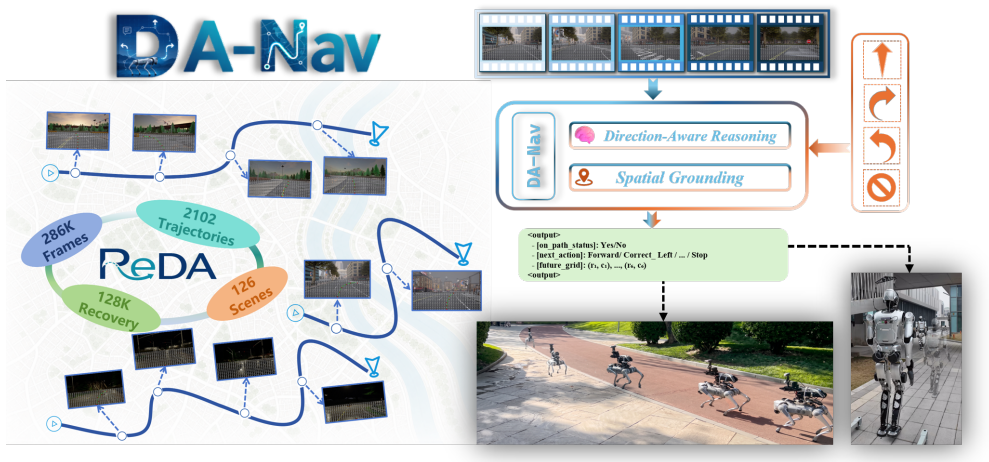
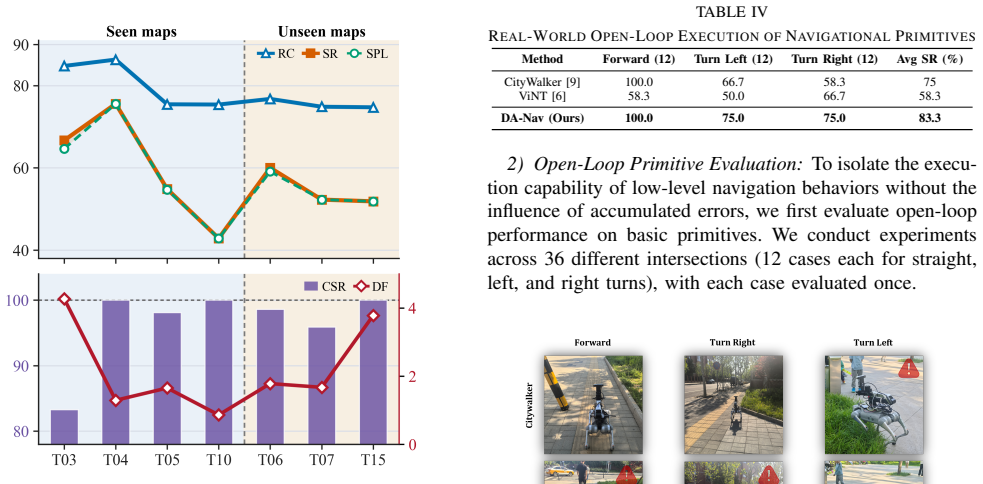
DA-Nav reformulates city-scale outdoor vision-language navigation as discrete spatial grounding on the egocentric 2D image plane, then recovers long-horizon drift with a three-step Chain-of-Thought (deviation assessment, action prediction, target-grid selection) trained on the new ReDA dataset, achieving 56.16 percent success in unseen CARLA cities and transferring zero-shot to real quadruped and humanoid platforms for stable kilometer-scale navigation.
What carries the argument
Direction-aware CoT recovery: a three-stage reasoning loop (deviation assessment → action prediction → target grid selection) that turns commercial directional text into a discrete grid cell on the current ego image, trained on the ReDA direction-and-recovery corpus.
Load-bearing premise
That commercial directional instructions plus discrete grid selection on a single front-camera image are rich enough, and the CoT recovery loop robust enough, to keep a robot on a multi-kilometer path without dense maps or continuous localization.
What would settle it
Run the identical untrained DA-Nav policy on a real urban route longer than one kilometer under ordinary GPS noise and dynamic traffic; if success rate falls below 30 percent or recovery fails after two successive deviations, the claim does not hold.
If this is right
- Commercial map apps become a free, city-scale instruction source for outdoor robots.
- Dense metric maps and continuous localization can be omitted for many kilometer-scale outdoor tasks.
- The same weights transfer zero-shot from CARLA to real quadruped and humanoid platforms.
- Long-horizon error is mitigated by explicit CoT recovery rather than by tighter low-level control.
Where Pith is reading between the lines
- The same image-plane grid + CoT pattern could be applied to indoor VLN when only floor-plan arrows are available.
- ReDA-style recovery trajectories may become a standard pre-training objective for any long-horizon outdoor policy.
- If grid resolution is made adaptive to distance, the same method might support finer sidewalk-level maneuvers.
Editorial analysis
A structured set of objections, weighed in public.
Referee Report
Summary. The manuscript proposes DA-Nav, a direction-aware vision-language navigation framework for city-scale outdoor settings that avoids dense maps and costly navigation supervision. It reformulates navigation as discrete spatial grounding on the egocentric 2D image plane and uses a Chain-of-Thought process (deviation assessment, action prediction, target grid selection) for trajectory recovery, trained on a new ReDA dataset of direction-aware instructions and recovery trajectories derived from commercial navigation tools. The abstract reports 56.16% success in unseen CARLA urban environments, outperforming SoTA with stronger recovery, and claims zero-shot kilometer-scale closed-loop outdoor navigation on real quadruped and humanoid robots without fine-tuning.
Significance. If the claims hold under full evaluation, the work would be significant for map-free outdoor VLN: commercial directional instructions plus image-plane discrete grounding and CoT recovery could reduce dependence on dense maps and continuous localization, with potential sim-to-real transfer to heterogeneous platforms. The introduction of ReDA and an explicit recovery-oriented CoT pipeline would be useful community resources. However, significance cannot be assessed from the abstract alone; the headline success rate, SoTA comparison, recovery capability, and real-robot kilometer-scale claims remain unexamined assertions without methods, protocols, ablations, or quantitative real-world metrics.
major comments (4)
- [Abstract] Only the abstract is available for review. The central claim—that discrete target-grid selection on a single egocentric 2D image plane plus CoT recovery (deviation assessment → action prediction → target grid) suffices for long-horizon city-scale map-free VLN and sim-to-real transfer—cannot be evaluated without the problem formalization, grid projection/selection under viewpoint change, CoT training objective, and free parameters (grid resolution, deviation thresholds). The manuscript as provided does not supply this apparatus.
- [Abstract] The reported 56.16% success rate in unseen CARLA environments is a single headline number without route-length distribution, failure modes, error bars, statistical significance, baseline definitions, or ablations of the three CoT stages. Without these, the claim of outperforming SoTA and of 'substantially stronger recovery capability' is not load-bearing evidence and cannot support acceptance.
- [Abstract] ReDA is introduced as the dataset enabling direction-aware instructions and recovery trajectories, yet no construction protocol, scale, statistics, train/test split, or relation to commercial-instruction pipelines used at test time is given. Mild circularity risk (shared instruction generation between training and evaluation) cannot be ruled out or confirmed from the abstract.
- [Abstract] The zero-shot real-robot claim—stable kilometer-scale closed-loop outdoor navigation on quadruped and humanoid platforms without fine-tuning—is stated qualitatively only. No success metrics, distance distributions, failure modes, localization assumptions, or logs are provided. This is a load-bearing transfer claim and requires quantitative evidence before it can be accepted.
minor comments (2)
- [Abstract] The abstract packs multiple strong claims (SoTA outperformance, recovery capability, kilometer-scale real-robot transfer) into one paragraph without pointers to supporting tables or figures; once the full manuscript is available, the abstract should be tightened to match what is actually measured.
- [Abstract] Terminology such as 'discrete spatial grounding,' 'target grid selection,' and 'direction-aware' should be defined with notation and a figure of the image-plane grid interface when the full text is supplied.
Circularity Check
Abstract-only review: no derivation chain, equations, or self-citation load-bearing steps available to inspect; empirical claims cannot be reduced to inputs by construction.
full rationale
Only the abstract is available; the full paper text, methods, equations, ReDA construction details, training objectives, evaluation protocols, and citations are not present. Circularity analysis requires quoting specific text and exhibiting a reduction (e.g., Eq. X = Eq. Y by construction, fitted parameter renamed as prediction, or load-bearing uniqueness theorem from overlapping authors). The abstract describes an empirical pipeline—reformulating city-scale VLN as discrete spatial grounding on the egocentric image plane, CoT recovery (deviation assessment, action prediction, target grid selection), training on the introduced ReDA dataset, and reporting 56.16% success in unseen CARLA environments plus zero-shot real-robot transfer—without any equations, parameter fits, uniqueness claims, or self-citations that could force the result by definition. No self-definitional loop, fitted-input-as-prediction, or ansatz-smuggling step can be exhibited. Per the hard rules, absence of inspectable derivation yields score 0 with empty steps; any mild risk about ReDA/test-route overlap is unconfirmable speculation and does not constitute circularity.
Axiom & Free-Parameter Ledger
free parameters (2)
- discrete grid resolution / target-grid discretization
- CoT recovery thresholds / deviation assessment criteria
axioms (3)
- domain assumption Commercial navigation instructions (e.g., Google Maps style) contain enough spatial information to drive city-scale robot navigation when grounded on egocentric images.
- ad hoc to paper Discrete target-grid selection on a single 2D egocentric image plane is a sufficient action interface for long-horizon outdoor navigation and recovery.
- domain assumption CARLA urban simulation is a valid proxy for the claimed real-world kilometer-scale outdoor performance.
invented entities (1)
-
ReDA dataset
no independent evidence
Cite this review
Pith. "Pith review of DA-Nav: Direction-Aware City-Scale Vision-Language Navigation." pith.science (2026). https://pith.science/paper/6EFZJPQS
@misc{pith2026260711638,
  author       = {Pith},
  title        = {Pith review of: DA-Nav: Direction-Aware City-Scale Vision-Language Navigation},
  year         = {2026},
  howpublished = {\url{https://pith.science/paper/6EFZJPQS}},
  note         = {Machine review of arXiv:2607.11638}
}
read the original abstract
City-scale outdoor navigation is currently hindered by the heavy reliance on dense maps or costly navigation supervision. In this work, we introduce a novel paradigm for leveraging directional instructions from commercial navigation tools (e.g., Google Maps). To bridge the gap between commercial instructions and executable navigation actions, while mitigating long-horizon error accumulation through robust trajectory recovery, we propose DA-Nav, a Direction-Aware vision-language Navigation framework that reformulates navigation as a discrete spatial grounding problem on the egocentric 2D image plane. To achieve trajectory recovery, DA-Nav employs a Chain-of-Thought (CoT) reasoning process encompassing deviation assessment, action prediction, and target grid selection. We further introduce ReDA, a dataset that provides direction-aware instructions and recovery trajectories to enhance spatial grounding and support CoT recovery reasoning. Extensive experiments in CARLA demonstrate that DA-Nav achieves a high success rate of 56.16% in unseen urban environments, outperforming existing State-of-The-Art (SoTA) methods while maintaining a substantially stronger recovery capability. Furthermore, without fine-tuning, DA-Nav seamlessly adapts to both quadruped and humanoid robots, enabling stable kilometer-scale closed-loop outdoor navigation in complex real world environments.
Figures




discussion (0)
Sign in with ORCID, Apple, or X to comment. Anyone can read and Pith papers without signing in.