REVIEW 2 major objections 5 minor 43 references
Auditors can continuously bet on their own features to prove that black-box quantile forecasts are miscalibrated, with anytime-valid evidence that grows against feature-aligned failures.
Reviewed by Pith at T0; open to challenge. T0 means a machine referee read the full paper against a public rubric. the ladder, T0–T4 →
T0 review · grok-4.5
2026-07-14 04:05 UTC pith:OOUG4CE5
load-bearing objection Solid anytime-valid, feature-aware quantile audit with a real information hierarchy and non-i.i.d. regret-to-power; soft spots are scope and experiment hygiene, not the core math. the 2 major comments →
Bet on Features: Anytime-Valid and Feature-Aware Auditing of Conditional Quantile Forecasters
The pith
A machine-rendered reading of the paper's core claim, the machinery that carries it, and where it could break.
Core claim
Conditional quantile calibration is indexed by the auditor's monitoring information, and coarser valid audits can be powerless against richer violations. When full-feature miscalibration has a persistent linear predictable edge, any online learner with a pathwise regret bound produces an anytime-valid wealth process that detects the violation in finite time and yields explicit stopping-time bounds, without independence or stationarity assumptions.
What carries the argument
Contextual betting over a predictable feature dictionary: the auditor forms linear stakes λ_t(θ) = ⟨θ, φ_t⟩ inside a no-bankruptcy interval and updates θ online; under the monitoring null the product wealth is a test martingale (hence an e-process), and a regret-to-power theorem converts any pathwise OCO bound into finite-time detection against linear full-feature edge alternatives.
Load-bearing premise
Finite-time detection is guaranteed only when miscalibration has a lasting linear edge along some fixed direction in the auditor's chosen feature dictionary; if the true failure is intermittent, nonlinear, or invisible in those features, the power bounds do not apply.
What would settle it
On a stream where the true conditional hit probability equals α given the auditor's features, check whether the feature-aware wealth process still exceeds the Ville threshold 1/γ with frequency higher than γ; or, under a known linear edge of size κ, check whether empirical detection times exceed the paper's certification bound n^ctx_γ(r).
If this is right
- Continuous monitoring of deployed quantile models can keep Type-I control under optional stopping while still detecting feature-specific failures.
- An external auditor who sees only coarse aggregates may correctly fail to reject, even when an internal auditor with promotions or calendar flags rejects quickly.
- Learned betting weights serve as diagnostics that name which features expose the forecaster's conditional bias.
- Any online convex optimizer with sublinear regret can be plugged in as a contextual skeptic and inherits the finite-time power guarantee against linear-edge alternatives.
- The same betting construction extends, in principle, to other elicitable functionals once a bounded identification function and a no-bankruptcy stake interval are available.
Where Pith is reading between the lines
- If the feature dictionary is incomplete relative to the true drivers of error, the audit remains valid yet silent; practitioners may therefore treat non-rejection as 'no evidence under this view' rather than 'the forecaster is calibrated'.
- Nonlinear or kernelized betting classes would be the natural next step for high-dimensional or interaction-driven miscalibration while keeping the same martingale validity argument.
- Head-to-head comparison of two forecasters could be cast as a relative betting game on the same hit stream, reusing the same anytime-valid machinery.
Editorial analysis
A structured set of objections, weighed in public.
Referee Report
Summary. The paper develops an anytime-valid, distribution-free framework for auditing black-box conditional quantile forecasters under non-i.i.d. streams. Calibration nulls are indexed by the auditor’s monitoring information H, yielding a hierarchy P^ϕ_0 ⊆ P^w_0 ⊆ P^marg_0. Predictable no-bankruptcy bets produce test martingales / e-processes for P0(H) (Thm. 2.5, Cor. 2.6–2.7). Validity transfers from coarser to richer nulls, while coarser audits can be powerless against richer violations (Prop. 2.8). For power, the authors introduce contextual linear bets λ_t(θ)=⟨θ,ϕ_t⟩ learned by OCO over a predictable feature dictionary, and prove finite-time detection and stopping-time bounds against linear full-feature predictable-edge alternatives (Def. 3.1, Thm. 3.2; cumulative-edge extension Thm. C.8). Experiments show Type-I control under a Negative-Binomial oracle and feature-specific rejections for Chronos-2 on synthetic and Rossmann data that marginal audits miss.
Significance. The contribution is timely and useful: continuous monitoring of black-box quantile forecasts under asymmetric costs is a real operational need, and making the auditor’s information set explicit cleanly separates validity from power. The technical core is solid and standard in the right way—bounded MDS + Ville for validity, pathwise OCO regret + Hoeffding–Azuma for power—without i.i.d. assumptions. Strengths include an explicit null hierarchy, interpretable feature-level evidence, a cumulative-edge generalization in the appendix, and careful Type-I checks under a correctly specified oracle. If accepted, the paper would give practitioners a practical, anytime-valid audit toolkit and give theorists a clean information-indexed formulation of conditional quantile calibration.
major comments (2)
- The finite-time power claim (Thm. 3.2) is proved only for the linear full-feature predictable-edge class (Def. 3.1 / cumulative version Def. C.7): a fixed comparator θ* ∈ K with quadratic edge b^Q_t(θ*) ≥ κ a.s. for all t ≥ t0 (or cumulative envelope D_T). This is a genuine scope limitation, not a hidden flaw—the paper already flags it (Rem. 3.4, conclusion)—but the abstract and introduction state “finite-time detection guarantees for such alternatives” without always foregrounding that “such” means linear feature-aligned edge. Please state the alternative class explicitly in the abstract/intro and, if space allows, add one synthetic experiment with intermittent or nonlinear miscalibration to illustrate when the guarantee does and does not apply.
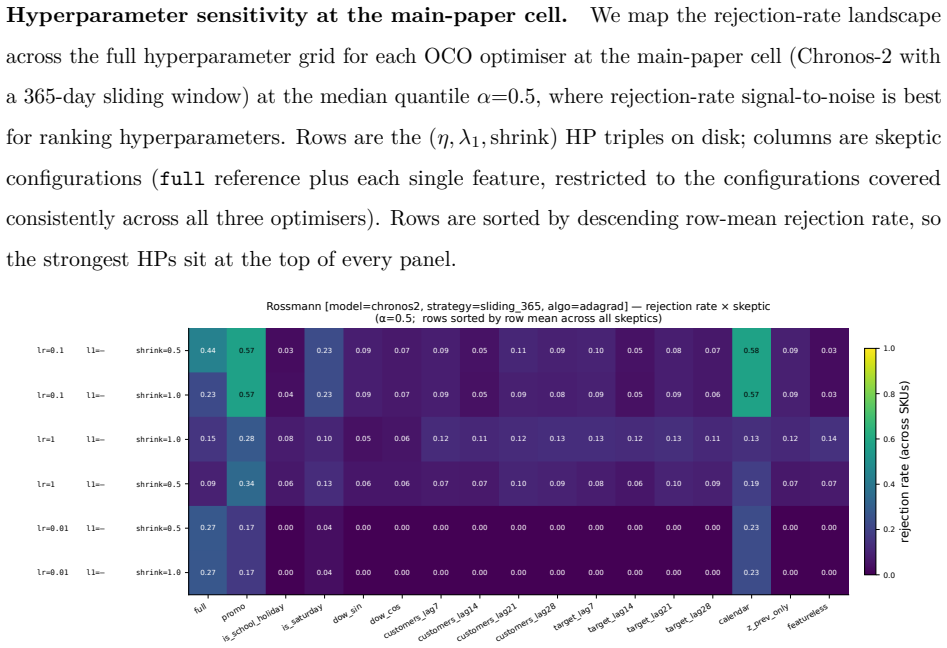
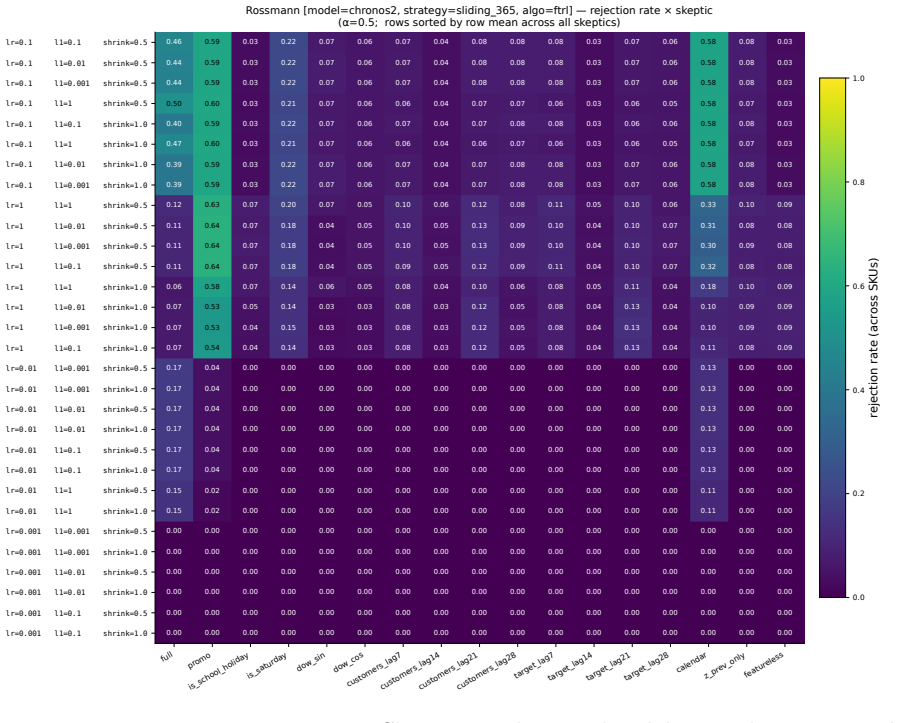
- Empirical power claims for Chronos-2 (Fig. 5 and App. D figures) rest on hyperparameter choices (lr, l1, shrink) and sliding-window context lengths that are selected by mean rejection on the full skeptic (App. D). While Type-I validity under the oracle is clean (Fig. 4), the real-data rejections could be sensitive to this selection. Please report a fixed-hyperparameter or pre-specified protocol (or a sensitivity summary) so that the feature-aware advantage over marginal audits is not confounded by post-hoc tuning.
minor comments (5)
- Typo: “Corrolary 2.6” in the contributions list (p. 4) should be “Corollary 2.6”.
- Figure 1 caption and body text refer to “promotion- and Saturday-aware audits”; ensure the corresponding feature names (promo, is_saturday) are consistent across Fig. 5 and the appendix panels.
- Notation: Z_t is defined as the centered hit, but some places write “hit process” for B_t and Z_t interchangeably; a one-sentence clarification early in §2 would help.
- Table B.1 and the OCO regret rates are useful; a short pointer in the main text to which algorithm is used in each main figure would improve readability.
- Related work is thorough; a brief sentence distinguishing the present information-indexed null from the full-filtration setting of Casgrain et al. (2024) and Wang et al. (2025) already appears but could be moved earlier for readers coming from the e-backtesting literature.
Circularity Check
No significant circularity: validity follows from MDS of centered hits under the defined nulls, and power is an implication from explicitly defined linear/cumulative edge alternatives plus pathwise OCO regret, not a tautology or fitted prediction.
full rationale
The paper's load-bearing chain is self-contained and non-circular. Nulls P0(H) are defined by the conditional hit probability equaling alpha (Def. 2.1); the centered hits Zt form a bounded MDS under those nulls by direct calculation (Prop. C.3). Predictable no-bankruptcy bets then yield test martingales/e-processes by the product construction and conditional mean-1 multipliers (Thm. 2.5, Cor. 2.6), with the hierarchy and validity-transfer following from the tower property (Prop. 2.2, Cor. 2.7) and the powerlessness of coarser bets under richer violations following from the same martingale property (Prop. 2.8). Finite-time power (Thm. 3.2) is proved only against the explicitly defined alternative class Q^{phi,lin}_{kappa,t0} (Def. 3.1) that assumes a fixed comparator with uniform quadratic edge; the proof converts any pathwise regret bound into log-wealth growth via the elementary inequality log(1+x) >= x - x^2 on the no-bankruptcy domain, then applies a conditional Hoeffding/Azuma bound (Lem. C.2, Thm. C.8). This is a standard implication, not a reduction of the conclusion to its inputs. Empirical Type-I checks use an oracle whose quantiles match the true conditional law by construction, so rejections are genuine false alarms; Chronos-2 results are observational detections, not parameters fitted to force a theoretical claim. Related-work citations (Casgrain et al., Wang et al., standard OCO) are external and not load-bearing uniqueness/ansatz imports. No self-definitional loop, fitted-input-as-prediction, or self-citation chain forces the central claims.
Axiom & Free-Parameter Ledger
free parameters (4)
- OCO hyperparameters (learning rate, l1, shrink)
- Feature radius R and feasible set K = {θ : ||θ||₂ ≤ 1/(2R)}
- Test level γ_test = 0.05 and horizon T
- Auditor feature dictionary Φ
axioms (5)
- standard math Ville’s inequality for nonnegative supermartingales
- domain assumption Under H-conditional quantile calibration, the centered hits Z_t form a bounded martingale-difference sequence w.r.t. H
- standard math Pathwise sublinear regret bounds for projected OGD, Euclidean FTRL, and ONS on the exp-concave betting losses
- standard math Tower property for nested monitoring filtrations H^marg ⊆ H^w ⊆ H^ϕ
- ad hoc to paper Linear full-feature predictable-edge alternative (uniform or cumulative edge along some θ* in K)
invented entities (2)
-
Information-indexed calibration nulls P0(H)
no independent evidence
-
Contextual betting wealth process M^ctx and linear predictable-edge alternative class
no independent evidence
read the original abstract
Black-box conditional quantile forecasts are widely used for sequential decisions under asymmetric costs, such as inventory planning in supply chain management. Once deployed, such forecasters must be monitored continuously as data streams drift and regimes change; this invalidates standard, fixed-horizon backtests for calibration. Further, existing backtests do not take into account that the notion of calibration is, in fact, information-dependent: forecasts can look calibrated to an auditor with coarse information while being miscalibrated to an auditor with richer information. We develop a distribution-free and game-theoretic testing framework for continuously auditing black-box conditional quantile forecasters with non-i.i.d. losses, such that the resulting evidence process is powerful against predictably chosen alternatives specified by the features available to the auditor. We first formalize notions of conditional quantile calibration when different sets of features are available to the auditor, establishing that the coarseness of the auditor's information set determines the hardness of the testing problem. We then identify the sets of alternatives for which the auditor can achieve power, and focusing on contextual bets linear in the features, we derive finite-time detection guarantees for such alternatives, all without an i.i.d. assumption. The resulting evidence processes are interpretable at the feature level, as they quantify fine-grained, "feature-aware" evidence for miscalibration. We empirically validate these methods on simulated and real data, finding that a popular time series forecaster (Chronos-2) is highly miscalibrated w.r.t. multiple relevant features.
Figures





Reference graph
Works this paper leans on
-
[1]
Angelopoulos and Stephen Bates
Anastasios N. Angelopoulos and Stephen Bates. Conformal prediction: A gentle introduction. Foundations and Trends in Machine Learning, 16 0 (4): 0 494--591, 2023. doi:10.1561/2200000101
-
[2]
Chronos-2: From univariate to universal forecasting
Abdul Fatir Ansari, Oleksandr Shchur, Jaris K \"u ken, Andreas Auer, Boran Han, Pedro Mercado, Syama Sundar Rangapuram, Huibin Shen, Lorenzo Stella, Xiyuan Zhang, et al. Chronos-2: From univariate to universal forecasting. arXiv preprint arXiv:2510.15821, 2025
Pith/arXiv arXiv 2025
-
[3]
Sebastian Arnold, Alexander Henzi, and Johanna F. Ziegel. Sequentially valid tests for forecast calibration. The Annals of Applied Statistics, 17 0 (3): 0 1909--1935, 2023. doi:10.1214/22-AOAS1697
-
[4]
Quantile forecasting and data-driven inventory management under nonstationary demand
Ying Cao and Zuo-Jun Max Shen. Quantile forecasting and data-driven inventory management under nonstationary demand. Operations Research Letters, 47 0 (6): 0 465--472, 2019
2019
-
[5]
Philippe Casgrain, Martin Larsson, and Johanna F. Ziegel. Sequential testing for elicitable functionals via supermartingales. Bernoulli, 30 0 (2): 0 1347--1374, 2024. doi:10.3150/23-BEJ1634
-
[6]
Backtesting value-at-risk: A duration-based approach
Peter Christoffersen and Denis Pelletier. Backtesting value-at-risk: A duration-based approach. Journal of Financial Econometrics, 2 0 (1): 0 84--108, 2004
2004
-
[7]
Peter F. Christoffersen. Evaluating interval forecasts. International Economic Review, 39 0 (4): 0 841--862, 1998. doi:10.2307/2527341
-
[8]
Cover and Joy A
Thomas M. Cover and Joy A. Thomas. Elements of Information Theory. Wiley-Interscience, 2 edition, 2006. ISBN 978-0-471-24195-9
2006
-
[9]
Rossmann store sales, 2015
Will Cukierski. Rossmann store sales, 2015. URL https://www.kaggle.com/c/rossmann-store-sales. Licensed under the Open Data Commons Open Database License (ODbL) v1.0
2015
-
[10]
A. Philip Dawid and Vladimir G. Vovk. Prequential probability: Principles and properties. Bernoulli, 5 0 (1): 0 125--162, 1999. ISSN 13507265. URL http://www.jstor.org/stable/3318616
arXiv 1999
-
[11]
Francis X. Diebold, Todd A. Gunther, and Anthony S. Tay. Evaluating density forecasts with applications to financial risk management. International Economic Review, 39 0 (4): 0 863--883, 1998. doi:10.2307/2527342
doi:10.2307/2527342 1998
-
[12]
Assessing the use of influenza forecasts and epidemiological modeling in public health decision making in the united states
Colin Doms, Sarah C Kramer, and Jeffrey Shaman. Assessing the use of influenza forecasts and epidemiological modeling in public health decision making in the united states. Scientific reports, 8 0 (1): 0 12406, 2018
2018
-
[13]
Caviar: Conditional autoregressive value at risk by regression quantiles
Robert F Engle and Simone Manganelli. Caviar: Conditional autoregressive value at risk by regression quantiles. Journal of business & economic statistics, 22 0 (4): 0 367--381, 2004
2004
-
[14]
Higher order elicitability and O sband's principle
Tobias Fissler and Johanna F Ziegel. Higher order elicitability and O sband's principle. Annals of Statistics, 44 0 (4): 0 1680--1707, 2016
2016
-
[15]
Cand \`e s
Isaac Gibbs and Emmanuel J. Cand \`e s. Adaptive conformal inference under distribution shift. In Advances in Neural Information Processing Systems, volume 34, 2021
2021
-
[16]
Making and evaluating point forecasts
Tilmann Gneiting. Making and evaluating point forecasts. Journal of the American Statistical Association, 106 0 (494): 0 746--762, 2011
2011
-
[17]
Tilmann Gneiting, Fadoua Balabdaoui, and Adrian E. Raftery. Probabilistic forecasts, calibration and sharpness. Journal of the Royal Statistical Society: Series B (Statistical Methodology), 69 0 (2): 0 243--268, 2007. doi:10.1111/j.1467-9868.2007.00587.x
-
[18]
Peter Gr \"u nwald, Rianne de Heide, and Wouter Koolen. Safe testing. Journal of the Royal Statistical Society Series B: Statistical Methodology, 86 0 (5): 0 1091--1128, 11 2024. ISSN 1369-7412. doi:10.1093/jrsssb/qkae011. URL https://doi.org/10.1093/jrsssb/qkae011
-
[19]
Logarithmic regret algorithms for online convex optimization
Elad Hazan, Amit Agarwal, and Satyen Kale. Logarithmic regret algorithms for online convex optimization. Machine Learning, 69 0 (2): 0 169--192, 2007
2007
-
[20]
Monitoring value-at-risk and expected shortfall forecasts
Yannick Hoga and Matei Demetrescu. Monitoring value-at-risk and expected shortfall forecasts. Management Science, 69 0 (5): 0 2954--2971, 2023
2023
-
[21]
Steven R. Howard and Aaditya Ramdas. Sequential estimation of quantiles with applications to A/B testing and best-arm identification. Bernoulli, 28 0 (3): 0 1704--1728, 2022. doi:10.3150/21-BEJ1388
-
[22]
Regression quantiles
Roger Koenker and Gilbert Bassett Jr. Regression quantiles. Econometrica: journal of the Econometric Society, pages 33--50, 1978
1978
-
[23]
S. Kullback and R. A. Leibler. On information and sufficiency. The Annals of Mathematical Statistics, 22 0 (1): 0 79--86, 1951. doi:10.1214/aoms/1177729694
-
[24]
Moirai 2.0: When less is more for time series forecasting
Chenghao Liu, Taha Aksu, Juncheng Liu, Xu Liu, Hanshu Yan, Quang Pham, Silvio Savarese, Doyen Sahoo, Caiming Xiong, and Junnan Li. Moirai 2.0: When less is more for time series forecasting. arXiv preprint arXiv:2511.11698, 2025
arXiv 2025
-
[25]
Time-uniform confidence bands for the CDF under nonstationarity
Paul Mineiro and Steven Howard. Time-uniform confidence bands for the CDF under nonstationarity. In Advances in Neural Information Processing Systems, volume 36, 2023
2023
-
[26]
River: machine learning for streaming data in python
Jacob Montiel, Max Halford, Saulo Martiello Mastelini, Geoffrey Bolmier, Raphael Sourty, Robin Vaysse, Adil Zouitine, Heitor Murilo Gomes, Jesse Read, Talel Abdessalem, et al. River: machine learning for streaming data in python. 2021
2021
-
[27]
Coin betting and parameter-free online learning
Francesco Orabona and D \'a vid P \'a l. Coin betting and parameter-free online learning. Advances in Neural Information Processing Systems, 29, 2016
2016
-
[28]
Hypothesis testing with e-values
Aaditya Ramdas and Ruodu Wang. Hypothesis testing with e-values. Foundations and Trends® in Statistics, 1 0 (1-2): 0 1--390, 2025. ISSN 2978-4212. doi:10.1561/3600000002
-
[29]
Aaditya Ramdas, Johannes Ruf, Martin Larsson, and Wouter M. Koolen. Testing exchangeability: Fork-convexity, supermartingales and e-processes. International Journal of Approximate Reasoning, 141: 0 83--109, 2022. doi:10.1016/j.ijar.2021.06.017
-
[30]
Game-theoretic statistics and safe anytime-valid inference
Aaditya Ramdas, Peter Gr \"u nwald, Vladimir Vovk, and Glenn Shafer. Game-theoretic statistics and safe anytime-valid inference. Statistical Science, 38 0 (4): 0 576--601, 2023. doi:10.1214/23-STS894
-
[31]
Cand \`e s
Yaniv Romano, Evan Patterson, and Emmanuel J. Cand \`e s. Conformalized quantile regression. In Advances in Neural Information Processing Systems, volume 32, 2019
2019
-
[32]
Testing by betting: A strategy for statistical and scientific communication
Glenn Shafer. Testing by betting: A strategy for statistical and scientific communication. Journal of the Royal Statistical Society: Series A, 184 0 (2): 0 407--431, 2021
2021
-
[33]
Game-theoretic foundations for probability and finance
Glenn Shafer and Vladimir Vovk. Game-theoretic foundations for probability and finance. John Wiley & Sons, 2019
2019
-
[34]
Test martingales, bayes factors and p-values
Glenn Shafer, Alexander Shen, Nikolai Vereshchagin, and Vladimir Vovk. Test martingales, bayes factors and p-values. Statistical Science, 26 0 (1): 0 84--101, 2011. doi:10.1214/10-STS347
-
[35]
Online learning and online convex optimization
Shai Shalev-Shwartz. Online learning and online convex optimization. Foundations and Trends in Machine Learning, 4 0 (2): 0 107--194, 2012. doi:10.1561/2200000018
-
[36]
\'E tude Critique de la Notion de Collectif
Jean Ville. \'E tude Critique de la Notion de Collectif . Gauthier-Villars, Paris, 1939
1939
-
[37]
E-values: Calibration, combination, and applications
Vladimir Vovk and Ruodu Wang. E-values: Calibration, combination, and applications. The Annals of Statistics, 49 0 (3): 0 1736--1754, 2021. doi:10.1214/20-AOS2020
-
[38]
Algorithmic Learning in a Random World
Vladimir Vovk, Alexander Gammerman, and Glenn Shafer. Algorithmic Learning in a Random World. Springer, New York, 2005
2005
-
[39]
Sequential tests of statistical hypotheses
Abraham Wald. Sequential tests of statistical hypotheses. The Annals of Mathematical Statistics, 16 0 (2): 0 117--186, 1945. doi:10.1214/aoms/1177731118
-
[40]
Qiuqi Wang, Ruodu Wang, and Johanna F. Ziegel. E-backtesting. Management Science, 2025. doi:10.1287/mnsc.2023.01659
-
[41]
Estimating means of bounded random variables by betting
Ian Waudby-Smith and Aaditya Ramdas. Estimating means of bounded random variables by betting. Journal of the Royal Statistical Society Series B: Statistical Methodology, 86 0 (1): 0 1--27, 2024. doi:10.1093/jrsssb/qkad009
-
[42]
Llm-as-a-prophet: Understanding predictive intelligence with prophet arena
Qingchuan Yang, Simon Mahns, Sida Li, Anri Gu, Jibang Wu, and Haifeng Xu. Llm-as-a-prophet: Understanding predictive intelligence with prophet arena. arXiv preprint arXiv:2510.17638, 2025
arXiv 2025
-
[43]
Online convex programming and generalized infinitesimal gradient ascent
Martin Zinkevich. Online convex programming and generalized infinitesimal gradient ascent. In Proceedings of the 20th international conference on machine learning (icml-03), pages 928--936, 2003
2003
discussion (0)
Sign in with ORCID, Apple, or X to comment. Anyone can read and Pith papers without signing in.