REVIEW 4 major objections 7 minor 44 references
Human speech, gestures, and GUI inputs to UAVs must be treated as bounded maneuver requests—not direct commands—and mediated through a safety-checked pipeline before execution.
Reviewed by Pith at T0; open to challenge. T0 means a machine referee read the full paper against a public rubric. the ladder, T0–T4 →
Operator multi-modal inputs are mediated as constrained motion primitives via a request-evaluate-execute pipeline with preconditions, invariants, and runtime monitors.
T0 review reviewed 2026-07-14 challenge →
load-bearing objection Clear architectural fix for a real multimodal-UAV safety gap, scoped honestly as initial work, but the load-bearing safety predicates are still untested under the uncertainties the authors themselves list. the 4 major comments →
A Model for Mediating Multi-Modal Human Intent into Safe Maneuvers for UAVs
The pith
A machine-rendered reading of the paper's core claim, the machinery that carries it, and where it could break.
The reading
Core claim
Multi-modal human intent for autonomous UAVs can be made safe by mediating it through a requirements-governed maneuver-response model: operator inputs are mapped to constrained motion primitives, passed through a request–evaluate–execute pipeline that validates confidence and four families of safety constraints, and formalized with preconditions, invariants, guard conditions, and postconditions that govern admissibility, execution, and emergency handling.
What carries the argument
The Multi-Modal Maneuver Request (M3R) model—a request–evaluate–execute pipeline that maps multi-modal inputs to bounded motion primitives and admits them only when TerrainSafe ∧ SeparationSafe ∧ EnvelopeSafe ∧ ConfidenceAdequate hold—together with per-maneuver contracts of preconditions, invariants, and postconditions.
Load-bearing premise
The central claim assumes that checking terrain, separation, envelope, and confidence constraints plus continuous monitoring is enough to keep maneuvers safe once real wind, GPS drift, latency, and degraded sensing appear—conditions the paper has only tested in controlled lab and simulated settings.
What would settle it
Fly physical UAVs outdoors near real terrain and other aircraft, issue deliberately unsafe voice or gesture commands under measured wind and GPS error, and check whether any accepted or partially constrained maneuver still produces a terrain or separation violation; any such violation falsifies the mediation claim.
If this is right
- Commands that would breach terrain, separation, workspace, or envelope limits are automatically shortened or rejected instead of flown.
- Runtime monitors can abort an in-progress maneuver into an EmergencyHold state the moment a safety invariant is predicted to fail.
- The same maneuver contracts can later feed reactive synthesis of correct-by-construction controllers.
- Voice, gesture, and GUI become interchangeable once reduced to the same bounded-request abstraction and operator-relative frame.
- Pairing establishes a local anchor workspace so subsequent moves stay near a known safe point and directions stay operator-relative.
Where Pith is reading between the lines
- The same request-versus-command mediation could transfer to other human-on-the-loop robots whose intent recognizers are noisy.
- Explicit contracts make it practical to bolt the layer onto existing terrain digital twins and airspace-leasing systems without rewriting the speech or gesture stack.
- Usability will hinge on whether confidence and freshness thresholds can be set tight enough for safety without making the system reject too many legitimate requests.
- A requirements-first mediation layer can be audited and certified independently of whichever recognizer is used underneath.
Editorial analysis
A structured set of objections, weighed in public.
Referee Report
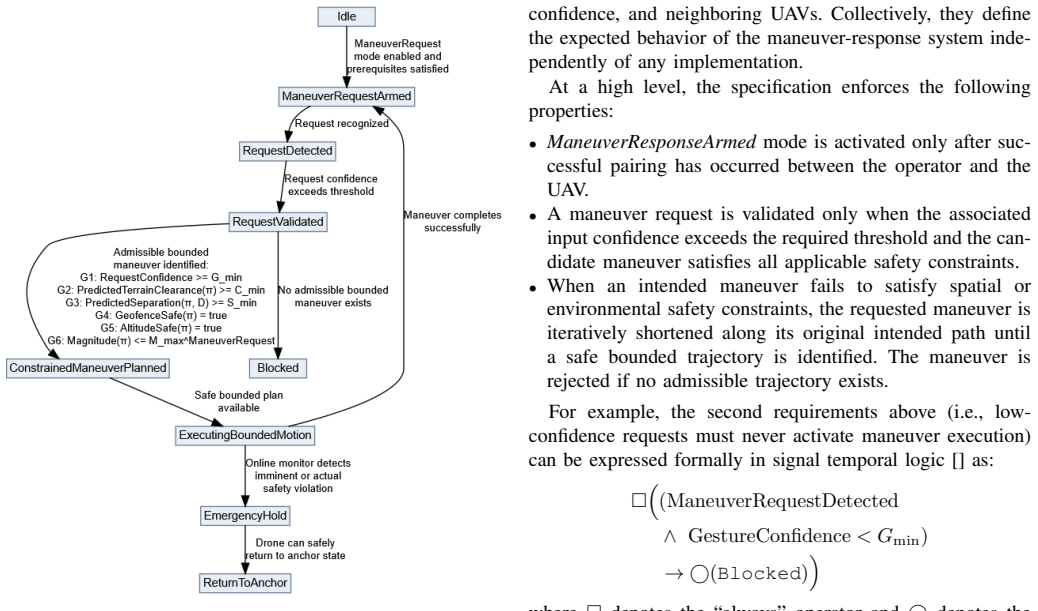
Summary. The paper proposes a Multi-Modal Maneuver Request (M3R) model that mediates speech, gesture, and GUI inputs into safe UAV motion by treating operator inputs as bounded maneuver requests rather than direct commands. Requests are mapped to constrained motion primitives and processed through a request–evaluate–execute pipeline with confidence thresholds, terrain/separation/workspace/flight-envelope checks, and continuous runtime monitoring. The approach is formalized via high-level safety properties, a state machine (Fig. 1), maneuver contracts (e.g., GOFORWARD), and EARS requirements; an initial lab prototype with a simulated drone and voice/GUI (and VLLM-based gesture) interfaces is reported as qualitative evidence that constrained requests can be interpreted and executed safely under controlled conditions.
Significance. If the mediation architecture is sound and the safety predicates remain admissible under realistic sensing and prediction error, the work would provide a useful requirements-governed interface layer between multi-modal HRI and runtime assurance for small UAVs—addressing a gap that prior gesture/speech control work largely leaves open. Strengths include a clear separation of intent recognition from safety enforcement, an explicit Safe(π_cand) decision structure, complementary operationalizations (state machine + contracts + EARS), and an unusually candid Threats section. The contribution is primarily architectural and requirements-oriented rather than a closed-form safety proof or large-scale field evaluation; its value for a journal audience therefore hinges on whether claims about reliable safe execution are scoped and evidenced proportionally to the prototype.
major comments (4)
- [Abstract; §V; Fig. 4] Abstract and §V claim that voice- and GUI-based inputs “can be reliably interpreted and safely executed as constrained maneuver requests,” but the reported validation is a qualitative lab prototype with a simulated drone, idealized Environmental Digital Twin, and air-leasing that “guarantees unique airspace under nominal conditions.” No quantitative metrics (recognition accuracy, false-accept/false-reject rates for the Safety Supervisor, constraint-violation rates under injected obstacles, latency, or residual clearance margins) are given. For a journal claim of reliable safe mediation, either add controlled quantitative experiments with clear success/failure criteria or substantially narrow the empirical wording to “feasibility of the pipeline under idealized simulation.”
- [§III.E–F; §VI] The load-bearing safety claim rests on Safe(π_cand,x,T,D,C) := TerrainSafe ∧ SeparationSafe ∧ EnvelopeSafe ∧ ConfidenceAdequate (§III.E–F) plus continuous monitoring. These predicates are defined over predicted paths and models T,D,C, yet §VI explicitly lists wind, GPS drift, communication latency, and degraded sensing as unmodeled. There are no residual-error bounds, no analysis of when a predicate can return true while the true future state violates clearance/separation, and no false-negative characterization of the Runtime Monitor. Without at least a threat model and a soundness argument (or simulation stress tests with localization/terrain-model error), the architectural claim that the pipeline yields admissible maneuvers under operational uncertainty remains unestablished.
- [§III.A; Table I; §V.C.1; §VI] Gesture support is central to the multi-modal framing (Table I; §V.C.1), but recognition uses a general-purpose VLLM (GPT 5.o) under close-range ideal conditions, with field CV deferred to future NOMAD-trained models. Turn left/right are also left largely unimplemented because operator-relative framing after yaw is unresolved. As written, the multi-modal mediation claim is only partially instantiated; either restrict the validated modalities to voice+GUI with explicit scope, or provide a minimal quantitative gesture evaluation that matches the distances/orientations assumed by the operator-facing design (§III.A).
- [§IV; §V opening; §VII] The paper positions the requirements model as supporting “future reactive synthesis” and runtime verification (§IV; Conclusions), but only a manually designed prototype is implemented. That is acceptable if synthesis is clearly future work; however, several passages read as if analyzability for synthesis is already demonstrated. Please separate (i) what is currently executable and checked against EARS requirements from (ii) what would be required for synthesis (assumptions, guarantees, plant model), so the contribution boundary is unambiguous.
minor comments (7)
- [Title; Abstract] Title and body inconsistently space “UA V” / “UAV”; abstract also has “UA Vs.” Normalize to “UAV/UAVs” throughout.
- [§II–IV headings] Section header “MULTI-MODALMANEUVERREQUESTMODEL” and similar concatenated headings (e.g., RELATEDWORK, REQUIREMENTS-GUIDEDOPERATIONALIZATION) appear to be missing spaces/hyphens from PDF extraction or formatting; fix for readability.
- [Table I; §III.E] Table I uses placeholder bounds such as “velocity < x m/s” and “0.5x m/s”; define the symbols or give concrete default values consistent with the free parameters listed in the text (X_step, V_nudger_max, etc.).
- [§IV.A] Signal temporal logic example in §IV.A uses □ and ○ but cites “[]” without a proper STL reference; add a standard citation and define the signal alphabet briefly.
- [§III; Fig. 1; §V.A] Fig. 1 is described as operationalizing the model, but transition names in the text (e.g., ManeuverRequestArmed vs. ManeuverResponseArmed in §III) are not fully consistent; align mode names across §III, Fig. 1, and the EARS list.
- [§V.C.1; §VI] “GPT 5.o” / “VLMM” vs “VLLM” appear inconsistently; correct the model name and acronym.
- [§II.D] Related work on runtime assurance / Simplex-style mediation and formal HRI safety could be tightened with a few canonical citations so the novelty of requirements-governed maneuver contracts is clearer against existing runtime assurance literature.
Circularity Check
No significant circularity: requirements/design paper whose mediation claim is proposed rather than derived from fitted inputs or self-citation uniqueness; self-cites supply infrastructure only.
full rationale
The paper proposes a request–evaluate–execute mediation pipeline (Section III) that maps multi-modal inputs to bounded motion primitives, then filters them with an explicit safety decision function Safe(π_cand, x, T, D, C) := TerrainSafe ∧ SeparationSafe ∧ EnvelopeSafe ∧ ConfidenceAdequate, plus continuous monitoring and contracts (Section IV). This is a design/requirements contribution, not a derivation that fits parameters to data and then “predicts” them, nor a uniqueness theorem imported from prior author work. Self-citations ([39] NOMAD, [40] terrain twin, [41] air-leasing, [43] MOMUX, [1] MAPE-K extension) appear only as supporting infrastructure for the prototype and future integration; they do not force the mediation claim by construction, and the paper itself scopes validation as “initial lab-based” while listing unmodeled real-world uncertainties (Section VI). No equation reduces to its own input, no fitted quantity is relabeled a prediction, and no load-bearing uniqueness is smuggled via self-citation. Circularity burden is therefore negligible (score 1 for ordinary self-citation of infrastructure).
Axiom & Free-Parameter Ledger
free parameters (4)
- R_max (local workspace radius) =
example 5 m
- confidence thresholds (cf, G_min, C_min^(m), L_min, T_min)
- maneuver bounds (X_step, Y_step, Z_step, V_nudger_max, Omega_nudger_max, duration) =
e.g. ≤1 m, ≤0.5 m
- MinAGL, C_min, S_min, tau_max
axioms (5)
- domain assumption Operator multi-modal inputs are uncertain and may be unsafe if executed as direct commands (terrain, separation, envelope conflicts).
- ad hoc to paper Safe(π_cand) := TerrainSafe ∧ SeparationSafe ∧ EnvelopeSafe ∧ ConfidenceAdequate is an adequate admissibility predicate for bounded maneuvers.
- domain assumption Pairing establishes operator-facing orientation so directional commands are interpreted in the operator frame.
- domain assumption Maneuver primitives can be associated with preconditions, invariants, guards, and postconditions that support runtime verification and future reactive synthesis.
- standard math Standard UAV kinematics and local ENU-style coordinates suffice for planning short bounded primitives.
invented entities (3)
-
M3R (Multi-Modal Maneuver Request) model
no independent evidence
-
request-evaluate-execute pipeline with Safety Supervisor and Runtime Monitor
no independent evidence
-
maneuver-specific behavioral contracts (e.g., GOFORWARD)
no independent evidence
Cite this review
Pith. "Pith review of A Model for Mediating Multi-Modal Human Intent into Safe Maneuvers for UAVs." pith.science (2026). https://pith.science/paper/6CTT2P7Q
@misc{pith2026260711654,
  author       = {Pith},
  title        = {Pith review of: A Model for Mediating Multi-Modal Human Intent into Safe Maneuvers for UAVs},
  year         = {2026},
  howpublished = {\url{https://pith.science/paper/6CTT2P7Q}},
  note         = {Machine review of arXiv:2607.11654}
}
read the original abstract
Direct human interaction with autonomous UAV systems can be enabled through modalities such as speech, gestures, and graphical interfaces. However, interpreting such inputs as directly executable commands introduces safety risks in dynamic environments. Operator requests may conflict with terrain constraints, inter-UAV separation requirements, or flight-envelope limitations. In this paper, we present a requirements-governed maneuver-response model that mediates multi-modal human intent into safe UAV maneuvers by treating operator inputs as bounded maneuver requests rather than direct commands. Requested maneuvers are mapped to constrained motion primitives and processed through a structured request-evaluate-execute pipeline. Each request is interpreted with associated confidence, validated against terrain, separation, workspace, and flight-envelope constraints, and either constrained, rejected, or executed under continuous runtime monitoring. We further formalize the approach as a requirements-based specification model in which maneuver primitives are associated with explicit preconditions, invariants, guard conditions, and postconditions governing admissibility, execution safety, and emergency handling. These requirements support runtime verification and future reactive synthesis approaches. We present an initial lab-based validation demonstrating that voice and GUI-based inputs can be reliably interpreted and safely executed as constrained maneuver requests.
Figures


Reference graph
Works this paper leans on
-
[1]
Extending MAPE-K to support human-machine teaming,
J. Cleland-Huang, A. Agrawal, M. Vierhauser, M. Murphy, and M. Prieto, “Extending MAPE-K to support human-machine teaming,” in International Symposium on Software Engineering for Adaptive and Self-Managing Systems, SEAMS 2022, Pittsburgh, PA, USA, May 22-24, 2022, B. R. Schmerl, M. Maggio, and J. C ´amara, Eds. ACM/IEEE, 2022, pp. 120–131. [Online]. Avail...
-
[2]
Motion estimation and hand gesture recognition-based human–UA V interaction approach in real time,
M. Yoo, Y . Na, H. Song, G. Kim, J. Yun, S. Kim, C. Moon, and K. Jo, “Motion estimation and hand gesture recognition-based human–UA V interaction approach in real time,” Sensors, vol. 22, no. 7, 2022. [Online]. Available: https://www.mdpi.com/1424-8220/22/7/2513
2022
-
[3]
Deep learning based hand gesture recognition and UA V flight controls,
B. Hu and J. Wang, “Deep learning based hand gesture recognition and UA V flight controls,” International Journal of Automation and Computing, vol. 17, 09 2019
2019
-
[4]
UA V control with vision-based hand gesture recognition over edge-computing,
S. Abdalla and S. Baidya, “UA V control with vision-based hand gesture recognition over edge-computing,” 05 2025, pp. 481–488
2025
-
[5]
M. Hu, J. Li, R. Jin, C. Shi, L. Xu, and R. Liu, “Hgic: A hand gesture based interactive control system for efficient and scalable multi- UA V operations,” 2024. [Online]. Available: https://arxiv.org/abs/2403.05478
Pith/arXiv arXiv 2024
-
[6]
A real-time hand gesture control of a quadcopter swarm implemented in the gazebo simulation environment,
R. S. Wijaya, S. Prayoga, R. A. Fatekha, and M. T. Mubarak, “A real-time hand gesture control of a quadcopter swarm implemented in the gazebo simulation environment,” Journal of Applied Informatics and Computing, vol. 9, no. 3, p. 979–988, Jun. 2025. [Online]. Available: https://jurnal.polibatam.ac.id/index.php/JAIC/article/view/9578
2025
-
[7]
Using gesture and speech communication modalities for safe human-drone interaction in construction,
Z. Zhu, J.-Y . Cheng, I. Jeelani, and M. Gheisari, “Using gesture and speech communication modalities for safe human-drone interaction in construction,” Advanced Engineering Informatics, vol. 62, p. 102827, 2024. [Online]. Available: https://www.sciencedirect.com/ science/article/pii/S1474034624004750
2024
-
[8]
“you two! take off!
S. Pourmehr, V . M. Monajjemi, R. Vaughan, and G. Mori, ““you two! take off!”: Creating, modifying and commanding groups of robots using face engagement and indirect speech in voice commands,” in 2013 IEEE/RSJ International Conference on Intelligent Robots and Systems, 2013, pp. 137–142
2013
-
[9]
Multimodal speech and visual gesture control interface technique for small unmanned multirotor aircraft,
A. Abioye, “Multimodal speech and visual gesture control interface technique for small unmanned multirotor aircraft,” Ph.D. dissertation, University of Southampton, July 2023. [Online]. Available: https: //eprints.soton.ac.uk/479472/
2023
-
[10]
Multimodal fusion of voice and gesture data for UA V control,
X. Xiaojia, Q. Tan, H. Zhou, D. Tang, and J. Lai, “Multimodal fusion of voice and gesture data for UA V control,” Drones, vol. 6, p. 201, 08 2022
2022
-
[11]
The chalearn gesture dataset (cgd 2011),
I. Guyon, V . Athitsos, P. Jangyodsuk, and H. J. Escalante, “The chalearn gesture dataset (cgd 2011),” Mach. Vision Appl., vol. 25, no. 8, p. 1929–1951, Nov. 2014. [Online]. Available: https://doi.org/10.1007/s00138-014-0596-3
-
[12]
Integrated UA V swarm and human-machine interaction platform for real-time mobile training and evaluation,
J. Hu, “Integrated UA V swarm and human-machine interaction platform for real-time mobile training and evaluation,” International Journal of Interactive Mobile Technologies (iJIM), vol. 19, pp. 83–97, 12 2025
2025
-
[13]
Design and implementation of voice- command controller for fixed-wing unmanned aerial vehicles using au- tomatic speech recognition and natural language processing techniques,
C. Villame and S. Guirnaldo, “Design and implementation of voice- command controller for fixed-wing unmanned aerial vehicles using au- tomatic speech recognition and natural language processing techniques,” Sustainable Engineering and Innovation, vol. 6, pp. 199–212, 10 2024
2024
-
[14]
A. Zhou, L. Han, and Y . Meng, Multimodal Control of UA VBased on Gesture, Eye Movement and V oiceInteraction, 01 2023, pp. 3765–3774
2023
-
[15]
Unmanned aerial vehicle control through domain-based automatic speech recognition,
R. Contreras, A. Ayala, and F. Cruz, “Unmanned aerial vehicle control through domain-based automatic speech recognition,”Computers, vol. 9, no. 3, 2020. [Online]. Available: https://www.mdpi.com/2073-431X/9/ 3/75
2020
-
[16]
In-vehicle speech recognition for voice- driven UA V control in a collaborative environment of MA V and UA V,
J.-S. Park and N. Geng, “In-vehicle speech recognition for voice- driven UA V control in a collaborative environment of MA V and UA V,” Aerospace, vol. 10, no. 10, 2023. [Online]. Available: https://www.mdpi.com/2226-4310/10/10/841
2023
-
[17]
Leveraging large language models for real-time UA V control,
K. Choutri, S. Fadloun, A. Khettabi, M. Lagha, S. Meshoul, and R. Fareh, “Leveraging large language models for real-time UA V control,” Electronics, vol. 14, no. 21, 2025. [Online]. Available: https://www.mdpi.com/2079-9292/14/21/4312
2025
-
[18]
Visual recognition of american sign language using hidden markov models,
T. Starner and M. Group, “Visual recognition of american sign language using hidden markov models,” 05 1995
1995
-
[19]
Deep vision-based real-time hand gesture recognition: a review,
C. Cui, M. S. Sunar, and G. Su, “Deep vision-based real-time hand gesture recognition: a review,” PeerJ Computer Science, vol. 11, p. e2921, 06 2025
2025
-
[20]
Deep learning model for dynamic hand gesture recognition for natural human-machine interface on end devices,
T.-P. Chang, H.-M. Chen, S.-Y . Chen, and W.-C. Lin, “Deep learning model for dynamic hand gesture recognition for natural human-machine interface on end devices,” International Journal of Information System Modeling and Design, vol. 13, no. 10, 2022. [Online]. Available: https://www.sciencedirect.com/science/article/pii/S1947818622000503
2022
-
[21]
Real-time human pose recognition in parts from single depth images,
J. Shotton, A. Fitzgibbon, M. Cook, T. Sharp, M. Finocchio, R. Moore, A. Kipman, and A. Blake, “Real-time human pose recognition in parts from single depth images,” in CVPR 2011, 2011, pp. 1297–1304
2011
-
[22]
Robust part-based hand gesture recognition using kinect sensor,
Z. Ren, J. Yuan, J. Meng, and Z. Zhang, “Robust part-based hand gesture recognition using kinect sensor,” Multimedia, IEEE Transactions on, vol. 15, pp. 1110–1120, 08 2013
2013
-
[23]
Real time hand pose estimation using depth sensors,
C. Keskin, F. Kırac ¸, Y . Kara, and L. Akarun, “Real time hand pose estimation using depth sensors,” 11 2011, pp. 1228–1234
2011
-
[24]
Hand gesture recogni- tion with 3d convolutional neural networks,
P. Molchanov, S. Gupta, K. Kim, and J. Kautz, “Hand gesture recogni- tion with 3d convolutional neural networks,” 06 2015, pp. 1–7
2015
-
[25]
Motion fused frames: Data level fusion strategy for hand gesture recognition,
O. K ¨op¨ukl¨u, N. K ¨ose, and G. Rigoll, “Motion fused frames: Data level fusion strategy for hand gesture recognition,” 2018. [Online]. Available: https://arxiv.org/abs/1804.07187
Pith/arXiv arXiv 2018
-
[26]
Spatio-temporal lstm with trust gates for 3d human action recognition,
J. Liu, A. Shahroudy, D. Xu, and G. Wang, “Spatio-temporal lstm with trust gates for 3d human action recognition,” 2016. [Online]. Available: https://arxiv.org/abs/1607.07043
Pith/arXiv arXiv 2016
-
[27]
Vision-based hand- gesture applications,
J. P. Wachs, M. K ¨olsch, H. Stern, and Y . Edan, “Vision-based hand- gesture applications,” Commun. ACM, vol. 54, no. 2, p. 60–71, Feb
-
[28]
Available: https://doi.org/10.1145/1897816.1897838
[Online]. Available: https://doi.org/10.1145/1897816.1897838
-
[29]
Robust 3d action recognition with random occupancy patterns,
J. Wang, Z. Liu, J. Chorowski, Z. Chen, and Y . Wu, “Robust 3d action recognition with random occupancy patterns,” inComputer Vision – ECCV 2012, A. Fitzgibbon, S. Lazebnik, P. Perona, Y . Sato, and C. Schmid, Eds. Berlin, Heidelberg: Springer Berlin Heidelberg, 2012, pp. 872–885
2012
-
[30]
Real-time face gesture-based robot control using ghostnet in a unity simulation environment,
Yaseen, “Real-time face gesture-based robot control using ghostnet in a unity simulation environment,” Sensors, vol. 25, p. 6090, 10 2025
2025
-
[31]
Aerokinesis: An iot-based vision-driven gesture control system for quadcopter navigation using deep learning and ros2,
S. Kondratev, Y . Dyrchenkova, G. Nikitin, L. V oskov, V . Pikalov, and V . Meshcheryakov, “Aerokinesis: An iot-based vision-driven gesture control system for quadcopter navigation using deep learning and ros2,” Technologies, vol. 14, no. 1, 2026. [Online]. Available: https://www.mdpi.com/2227-7080/14/1/69
2026
-
[32]
Gesture based control technology for drones: Challenges and solutions,
J. Wang, “Gesture based control technology for drones: Challenges and solutions,” Applied and Computational Engineering, vol. 109, pp. 173– 178, 11 2024
2024
-
[33]
How would you gesture navigate a drone?: a user-centered approach to control a drone,
M. Obaid, F. Kistler, G. Kasparaviciute, E. Yantac, and M. Fjeld, “How would you gesture navigate a drone?: a user-centered approach to control a drone,” 10 2016, pp. 113–121
2016
-
[34]
Emotion encoding in human-drone interaction,
J. Cauchard, K. Zhai, M. Spadafora, and J. Landay, “Emotion encoding in human-drone interaction,” 03 2016, pp. 263–270
2016
-
[35]
Somatic safety: An embodied approach towards safe human-robot interaction,
S. Benford, E. Schneiders, J. P. M. Avila, P. Caleb-Solly, P. R. Brundell, S. Castle-Green, F. Zhou, R. Garrett, K. H ¨o¨ok, S. Whatley, K. Marsh, and P. Tennent, “Somatic safety: An embodied approach towards safe human-robot interaction,” 2025. [Online]. Available: https://arxiv.org/abs/2503.16960
Pith/arXiv arXiv 2025
-
[36]
A survey of methods for safe human-robot interaction,
P. A. Lasota, T. Fong, and J. A. Shah, “A survey of methods for safe human-robot interaction,” Foundations and Trends® in Robotics, vol. 5, no. 4, pp. 261–349, 2017. [Online]. Available: https://doi.org/10.1561/2300000052
-
[37]
Safety assurances for human-robot interaction via confidence-aware game- theoretic human models,
R. Tian, L. Sun, A. Bajcsy, M. Tomizuka, and A. D. Dragan, “Safety assurances for human-robot interaction via confidence-aware game- theoretic human models,” in 2022 International Conference on Robotics and Automation (ICRA), 2022, pp. 11 229–11 235
2022
-
[38]
Hazard analysis for human-on-the-loop interactions in suas systems,
M. Vierhauser, M. N. A. Islam, A. Agrawal, J. Cleland-Huang, and J. Mason, “Hazard analysis for human-on-the-loop interactions in suas systems,” in ESEC/FSE ’21: 29th ACM Joint European Software Engineering Conference and Symposium on the Foundations of Software Engineering, Athens, Greece, August 23-28, 2021, D. Spinellis, G. Gousios, M. Chechik, and M. ...
-
[39]
Easy ap- proach to requirements syntax (ears),
A. Mavin, P. Wilkinson, A. Harwood, and M. Novak, “Easy ap- proach to requirements syntax (ears),” in 2009 17th IEEE International Requirements Engineering Conference, 2009, pp. 317–322
2009
-
[40]
NOMAD: A natural, occluded, multi-scale aerial dataset, for emergency response scenarios,
A. M. R. Bernal, W. J. Scheirer, and J. Cleland-Huang, “NOMAD: A natural, occluded, multi-scale aerial dataset, for emergency response scenarios,” in IEEE/CVF Winter Conference on Applications of Computer Vision, W ACV 2024, Waikoloa, HI, USA, January 3-8, 2024. IEEE, 2024, pp. 8569–8580. [Online]. Available: https://doi.org/10.1109/W ACV57701.2024.00839
doi:10.1109/w 2024
-
[41]
Validating terrain models in digital twins for trustworthy suas operations,
A. M. R. Bernal, M. Petterson, P. A. Granadeno, M. Murphy, J. Mason, and J. Cleland-Huang, “Validating terrain models in digital twins for trustworthy suas operations,” in 28th ACM/IEEE International Conference on Model Driven Engineering Languages and Systems, MODELS 2025 - Companion, Grand Rapids, MI, USA, October 5-10, 2025. IEEE, 2025, pp. 289–299. [O...
-
[42]
Automated on-entry decision-making for utm zones based on reputations and certifications,
T. P. Chambers, P. Granadeno, U. Gohar, M. C. Hunter, A. M. R. Bernal, W. Tang, M. N. A. Islam, M. Cohen, T. Jung, R. Lutz, and J. Cleland-Huang, “Automated on-entry decision-making for utm zones based on reputations and certifications,” in AIAA A VIATIONFORUM AND ASCEND 2025, 2025, p. 3567
2025
-
[43]
An environmentally complex requirement for safe separation distance between uavs,
P. A. Granadeno, A. M. R. Bernal, M. N. A. Islam, and J. Cleland- Huang, “An environmentally complex requirement for safe separation distance between uavs,” in 32nd IEEE International Requirements Engineering Conference, RE 2024 - Workshops, Reykjavik, Iceland, June 24-25, 2024. IEEE, 2024, pp. 166–175. [Online]. Available: https://doi.org/10.1109/REW6169...
-
[44]
Momux: A catalyst for discovering situational awareness and team coordination requirements for human-autonomy teaming,
J. Olesk, A. M. R. Bernal, and J. Cleland-Huang, “Momux: A catalyst for discovering situational awareness and team coordination requirements for human-autonomy teaming,” in IEEE International Requirements Engineering Conference (RE), Montreal, Canada, 2026
2026
This paper was first reviewed by grok-4.5 on July 14, 2026.
discussion (0)
Sign in with ORCID, Apple, or X to comment. Anyone can read and Pith papers without signing in.