REVIEW 3 major objections 6 minor 32 references
A single learned distribution over goal-aligned local paths can navigate cluttered scenes and transfer from wheeled robots to quadrupeds without retraining.
Reviewed by Pith at T0; open to challenge. T0 means a machine referee read the full paper against a public rubric. the ladder, T0–T4 →
T0 review · grok-4.5
2026-07-14 03:30 UTC pith:I7KSPYB4
load-bearing objection Solid hybrid navigation system with real SR gains and a useful no-demo prior; transfer claim is interesting but still optimizer-dependent. the 3 major comments →
AutoPath: Learning Transferable Goal-Conditioned Stochastic Path Prior for Safe Navigation Without Human Demonstrations
The pith
A machine-rendered reading of the paper's core claim, the machinery that carries it, and where it could break.
Core claim
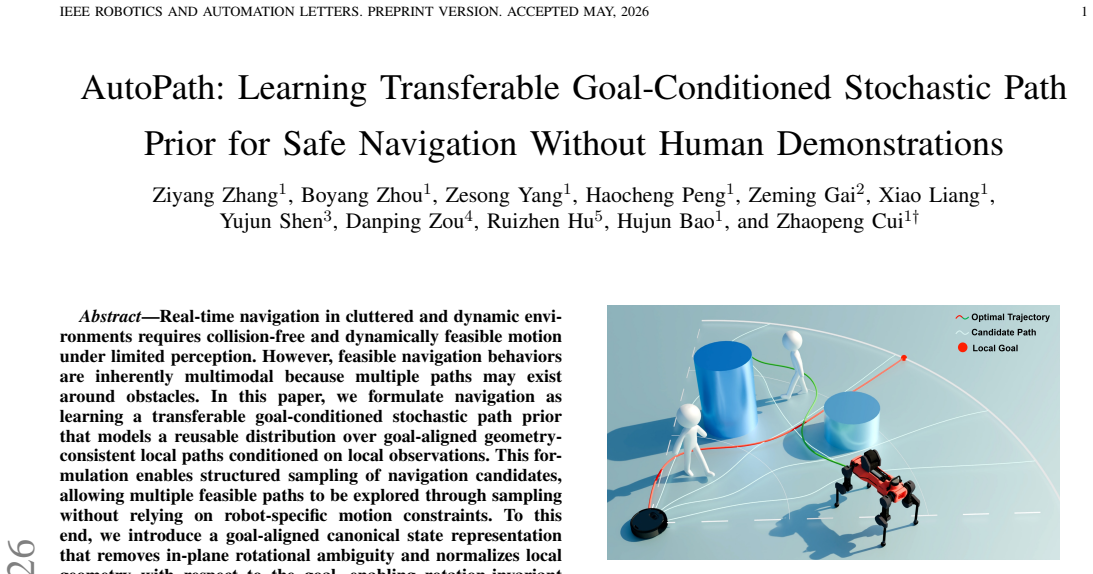
Navigation can be formulated as learning a transferable goal-conditioned stochastic path prior: a distribution over goal-aligned, geometry-consistent local paths conditioned only on local observations. Because the prior lives in path-distribution space rather than low-level controls, multiple feasible modes can be sampled and later refined under hard, platform-dependent constraints, enabling multimodal planning and cross-platform reuse without human demonstrations.
What carries the argument
The goal-aligned canonical state representation: local geometry and the goal are rotated so the goal always lies on the positive x-axis, yielding a rotation-invariant signed-distance field plus goal range. Paths are then parameters on a geometry-aware polar action manifold of radially ordered control points, so the learned Gaussian prior samples structured local paths that stay embodiment-agnostic until a separate refinement stage.
Load-bearing premise
Local path shapes that look good on a wheeled robot’s two-dimensional map stay usable on a quadruped once only speed, acceleration, and footprint limits are rewritten in the final optimizer.
What would settle it
Train the prior solely on a differential-drive robot, freeze every weight, then run the identical prior on a real quadruped through the same dense static and pedestrian layouts used in the paper with only the refinement constraint set updated; a large drop in success rate relative to the wheeled platform would falsify the no-retraining transfer claim.
If this is right
- A path prior trained on one wheeled platform can be deployed on a quadruped without new data or fine-tuning.
- Multimodal obstacle avoidance can be handled by sampling the prior under several provisional goals instead of predicting a single control.
- Physics-informed planner trajectories can replace human demonstrations for learning reusable geometric path distributions.
- Safety and smoothness can be shaped during training with risk-sensitive utilities while hard kinematic constraints remain in a separate optimizer.
- Provisional goals can be chosen freely at test time because observations are always re-canonicalized to the current goal direction.
Where Pith is reading between the lines
- Separating geometric proposals from kinematic refinement may extend to other morphologies whenever local free space is still well captured by a two-dimensional distance field.
- The same canonicalization could support mid-life sensor or footprint changes if only the constraint set is swapped.
- Multi-agent interaction, left as future work, would likely require the prior to condition on predicted neighbor motion rather than a static distance field alone.
- If free space is strongly non-radial, the ordered polar manifold may need hybrid action spaces while keeping the goal-aligned frame.
Editorial analysis
A structured set of objections, weighed in public.
Referee Report
Summary. AutoPath formulates real-time navigation as learning a transferable goal-conditioned stochastic path prior π_θ(a|s) over geometry-consistent local paths, conditioned on a goal-aligned canonical state (SDF, goal range, previous action) rather than platform-specific controls. Local paths are parameterized on a radially ordered polar control-point manifold, decoded by cubic splines, and trained in two stages: offline MLE on >10^6 PC-Planner trajectories (no human demos) followed by single-step PPO refinement with a risk-sensitive utility (CVaR clearance, length, curvature/segment variation, temporal consistency). At inference, circle-based multi-goal sampling produces candidate paths that are refined by platform-dependent constrained optimization (Priest). Experiments on TurtleBot2 in Gazebo/Isaac Sim report high success rates in dense static (SR=1.0) and dynamic pedestrian scenes (SR ≈ 0.88–0.95), with ablations supporting GACSR, the prior, utility terms, and multi-goal sampling; the same prior is deployed without retraining on real TurtleBot4, Go2, and simulated ANYmal-D.
Significance. If the separation between an embodiment-agnostic geometric path prior and platform-specific refinement holds, the work offers a practical route to reusable multimodal local planning without human demonstrations and with reduced platform-specific policy training. Strengths include: (i) a clear problem reformulation that keeps the prior in path-distribution space (Eqs. 1–3); (ii) a rotation-invariant goal-aligned state that enables multi-goal querying of one prior; (iii) large-scale planner-generated supervision that avoids teleop demos; (iv) consistent SR gains over DRL-VO, PathRL, and CrowdSurfer in Table II, especially in dense static and Freiburg-55; and (v) ablations (Tables III–VI) that isolate GACSR, two-stage training, utility terms, and multi-goal sampling. These are concrete, falsifiable engineering contributions for hybrid learning-based navigation.
major comments (3)
- The central transfer claim (abstract; §I contributions; §III.A Eq. 3; §III.E; §IV.D) asserts that a single prior learned on differential-drive PC-Planner paths transfers to quadrupeds without retraining because only the refinement constraint set K changes. Support is limited to qualitative real Go2 runs (Fig. 4), a single 96% SR on enlarged Random for ANYmal-D, and real deployment that already reduces multi-goal sampling to one provisional goal and 50 paths. There are no seed-feasibility rates, pre-refinement clearance statistics, fraction of seeds rejected/salvaged by Priest, or failure-mode breakdowns by platform. Without these, it remains unclear whether transfer is carried by the prior or by optimizer rescue of poorly aligned polar modes (Eqs. 6–8). Please add quantitative seed-quality and refinement-success metrics across platforms, or temper the no-retraining transfer claim accordi
- Table II reports point success rates (e.g., 0.88 Freiburg-55, 1.0 dense static) from four trials over 25 waypoints without error bars, confidence intervals, or per-trial variance. Given stochastic multi-goal sampling (K=20, M=110 in sim) and dynamic pedestrians, these SRs are load-bearing for the superiority claim over CrowdSurfer/DRL-VO/PathRL. Please report trial-level variance or bootstrap CIs so that the large margins (e.g., +0.20 vs CrowdSurfer in Freiburg-55) can be assessed for stability.
- §III.D Stage II and Table I define a heavily hand-shaped utility with many free parameters (λ_j, (α,β) per term, η=0.10, c_clr=0.6 m, etc.). Ablations in Tables V–VI show each term matters when the mean prior is executed without optimization, but there is no sensitivity analysis under the full sample-and-refine pipeline used at test time. Because the paper markets the prior as reusable and transferable, please show that the reported SR gains are not brittle to modest reweighting of U, or document the tuning procedure more fully.
minor comments (6)
- Fig. 1 and Fig. 2 captions are informative, but the polar manifold radial-ordering constraints (Eq. 7) and the tanh-to-manifold map (Eq. 8) would benefit from a small schematic of admissible (r_i, θ_i) regions.
- Table II marks Average only when all environments are valid; DRL-VO/PathRL are blank for dense static. A short note in the caption explaining why those baselines fail (as later stated in §IV.B.2) would help readers interpret the Average row.
- §III.B: the SDF is described as H×W with optional clipping/normalization, but exact H, W, clipping bounds, and normalization used in training vs. the 105×105 inference grid (§IV.A.1) should be stated once for reproducibility.
- Notation: a is used both for polar control points and for latent/normalized actions before/after tanh; a short clarification near Eq. (8) would reduce ambiguity.
- Real-world timing breakdown (§IV.D, 48.25 ms) is useful; please also report wall-clock rates for the full sim setting (K=20, M=110) so efficiency claims in Table II can be contextualized.
- Related work correctly contrasts with CrowdSurfer on human demos; a brief note on how PC-Planner [27] distribution coverage compares to teleop data would strengthen the “without human demonstrations” claim.
Circularity Check
No circular derivation: prior is trained on external planner trajectories and interaction utilities, then evaluated by independent navigation success on held-out scenes and real robots.
full rationale
The paper’s chain is engineering plus empirical ML, not a closed algebraic loop. The goal-aligned state (Eq. 4–5), polar manifold (Eq. 6–8), and prior π_θ (Eq. 1–2) are design choices; Stage I fits that prior by MLE to PC-Planner-generated paths and Stage II reshapes sampling preference with a risk-sensitive utility via PPO. Evaluation metrics (SR, length, time, velocity on Autolab/Cumberland/Freiburg/Random and real TurtleBot4/Go2) are not the training objective by construction and are measured on held-out environments and platforms. PC-Planner and Priest appear as data-generation and refinement tools, not as uniqueness theorems that force the transfer or success claims. Cross-platform transfer is reported as an empirical outcome (same prior, platform-specific K in Eq. 3), not as a quantity algebraically implied by the training fit. No fitted parameter is renamed as a prediction of a closely related quantity, and no self-citation uniqueness result forbids alternatives. Therefore there is no significant circularity.
Axiom & Free-Parameter Ledger
free parameters (6)
- utility weights λ_safe, λ_len, λ_curv_var, λ_len_var, λ_temp
- utility squashing parameters (α,β) per term
- CVaR level η and clearance c_clr
- polar manifold bounds r_max, θ_min, θ_max and control-point count n
- multi-goal sampling counts K and M
- platform-dependent optimizer parameters in K (horizon, velocity/accel limits, inflation)
axioms (5)
- domain assumption Local 2D LiDAR geometry plus goal range in a goal-aligned frame is a sufficient state for learning transferable local path distributions.
- domain assumption Platform-specific feasibility can be deferred to a separate constrained optimizer O(ξ̂;K) without needing to retrain the geometric prior.
- domain assumption Physics-informed planner trajectories (PC-Planner) provide adequate supervision for a generalizable path prior without human demonstrations.
- ad hoc to paper Gaussian policy over tanh-squashed polar control points with radial ordering is an expressive enough family for multimodal local navigation.
- ad hoc to paper Single-step contextual-bandit PPO updates with the hand-shaped utility improve sampling preference without multi-step credit assignment.
invented entities (3)
-
goal-aligned canonical state representation (GACSR)
no independent evidence
-
geometry-aware polar action manifold
no independent evidence
-
transferable goal-conditioned stochastic path prior π_θ(a|s)
no independent evidence
read the original abstract
Real-time navigation in cluttered and dynamic environments requires collision-free and dynamically feasible motion under limited perception. However, feasible navigation behaviors are inherently multimodal because multiple paths may exist around obstacles. In this paper, we formulate navigation as learning a transferable goal-conditioned stochastic path prior that models a reusable distribution over goal-aligned geometry-consistent local paths conditioned on local observations. This formulation enables structured sampling of navigation candidates, allowing multiple feasible paths to be explored through sampling without relying on robot-specific motion constraints. To this end, we introduce a goal-aligned canonical state representation that removes in-plane rotational ambiguity and normalizes local geometry with respect to the goal, enabling rotation-invariant path distribution learning. We further develop a structured prior learning framework that parameterizes local paths using a geometry-aware polar action manifold and incorporates risk-sensitive utility shaping with multi-goal distributional rollouts for stable and safety-aware planning. Extensive experiments in dense static environments and dynamic pedestrian scenarios demonstrate that the proposed method achieves consistently high success rates with competitive efficiency while enabling cross-platform transfer of a single path prior learned on differential-drive robots to quadruped platforms without retraining.
Figures


Reference graph
Works this paper leans on
-
[1]
Drl-vo: Learning to navigate through crowded dy- namic scenes using velocity obstacles,
Z. Xie and P. Dames, “Drl-vo: Learning to navigate through crowded dy- namic scenes using velocity obstacles,”IEEE Transactions on Robotics, vol. 39, no. 4, pp. 2700–2719, 2023
2023
-
[2]
Intention aware robot crowd navigation with attention-based interaction graph,
S. Liu, P. Chang, Z. Huang, N. Chakraborty, K. Hong, W. Liang, D. L. McPherson, J. Geng, and K. Driggs-Campbell, “Intention aware robot crowd navigation with attention-based interaction graph,” in2023 IEEE International Conference on Robotics and Automation (ICRA). IEEE, 2023, pp. 12 015–12 021
2023
-
[3]
Ldp: A local diffusion planner for efficient robot navigation and collision avoidance,
W. Yu, J. Peng, H. Yang, J. Zhang, Y . Duan, J. Ji, and Y . Zhang, “Ldp: A local diffusion planner for efficient robot navigation and collision avoidance,” in2024 IEEE/RSJ International Conference on Intelligent Robots and Systems (IROS). IEEE, 2024, pp. 5466–5472
2024
-
[4]
Crowdsurfer: Sampling optimization augmented with vector-quantized variational autoencoder for dense crowd navigation,
N. Kumar, A. Singha, L. Nanwani, D. Potdar, F. Rastgar, S. Idoko, A. K. Singh, K. M. Krishnaet al., “Crowdsurfer: Sampling optimization augmented with vector-quantized variational autoencoder for dense crowd navigation,” in2025 IEEE International Conference on Robotics and Automation (ICRA). IEEE, 2025, pp. 16 854–16 860
2025
-
[5]
Pathrl: An end-to-end path generation method for collision avoidance via deep reinforcement learning,
W. Yu, J. Peng, Q. Qiu, H. Wang, L. Zhang, and J. Ji, “Pathrl: An end-to-end path generation method for collision avoidance via deep reinforcement learning,” in2024 IEEE International Conference on Robotics and Automation (ICRA). IEEE, 2024, pp. 9278–9284
2024
-
[6]
Path planning on robot based on d* lite algorithm,
D. Belanov ´a, M. Mach, P. Sin ˇc´ak, and K. Yoshida, “Path planning on robot based on d* lite algorithm,” in2018 World Symposium on Digital Intelligence for Systems and Machines (DISA). IEEE, 2018, pp. 125– 130
2018
-
[7]
Online graph pruning for pathfinding on grid maps,
D. Harabor and A. Grastien, “Online graph pruning for pathfinding on grid maps,” inProceedings of the AAAI conference on artificial intelligence, vol. 25, no. 1, 2011, pp. 1114–1119
2011
-
[8]
Asynchronous multithreading reinforcement-learning-based path planning and tracking for unmanned underwater vehicle,
Z. He, L. Dong, C. Sun, and J. Wang, “Asynchronous multithreading reinforcement-learning-based path planning and tracking for unmanned underwater vehicle,”IEEE Transactions on Systems, Man, and Cyber- netics: Systems, vol. 52, no. 5, pp. 2757–2769, 2021
2021
-
[9]
Rapidly-exploring random trees: Progress and prospects: Steven m. lavalle, iowa state university, a james j. kuffner, jr., university of tokyo, tokyo, japan,
S. M. LaValle and J. J. Kuffner, “Rapidly-exploring random trees: Progress and prospects: Steven m. lavalle, iowa state university, a james j. kuffner, jr., university of tokyo, tokyo, japan,”Algorithmic and computational robotics, pp. 303–307, 2001
2001
-
[10]
Local path planning of mobile robot based on artificial potential field,
W. Di, L. Caihong, G. Na, S. Yong, G. Tengteng, and L. Guoming, “Local path planning of mobile robot based on artificial potential field,” in2020 39th Chinese Control Conference (CCC). IEEE, 2020, pp. 3677–3682
2020
-
[11]
Dynamic window based approach to mobile robot motion control in the presence of moving obstacles,
M. Seder and I. Petrovic, “Dynamic window based approach to mobile robot motion control in the presence of moving obstacles,” inProceed- ings 2007 IEEE International Conference on Robotics and Automation. IEEE, 2007, pp. 1986–1991
2007
-
[12]
Minimum snap trajectory generation and control for quadrotors,
D. Mellinger and V . Kumar, “Minimum snap trajectory generation and control for quadrotors,” in2011 IEEE international conference on robotics and automation. IEEE, 2011, pp. 2520–2525
2011
-
[13]
Polynomial trajectory planning for aggressive quadrotor flight in dense indoor environments,
C. Richter, A. Bry, and N. Roy, “Polynomial trajectory planning for aggressive quadrotor flight in dense indoor environments,” inRobotics Research: The 16th International Symposium ISRR. Springer, 2016, pp. 649–666
2016
-
[14]
Online generation of collision-free trajectories for quadrotor flight in unknown cluttered environments,
J. Chen, T. Liu, and S. Shen, “Online generation of collision-free trajectories for quadrotor flight in unknown cluttered environments,” in 2016 IEEE international conference on robotics and automation (ICRA). IEEE, 2016, pp. 1476–1483
2016
-
[15]
Learning model predictive controllers with real-time attention for real-world navigation,
X. Xiao, T. Zhang, K. Choromanski, E. Lee, A. Francis, J. Varley, S. Tu, S. Singh, P. Xu, F. Xiaet al., “Learning model predictive controllers with real-time attention for real-world navigation,”arXiv preprint arXiv:2209.10780, 2022
Pith/arXiv arXiv 2022
-
[16]
How to guide your learner: Imitation learning with active adaptive expert involvement,
X.-H. Liu, F. Xu, X. Zhang, T. Liu, S. Jiang, R. Chen, Z. Zhang, and Y . Yu, “How to guide your learner: Imitation learning with active adaptive expert involvement,”arXiv preprint arXiv:2303.02073, 2023
Pith/arXiv arXiv 2023
-
[17]
Learning from all vehicles,
D. Chen and P. Kr ¨ahenb¨uhl, “Learning from all vehicles,” inProceedings of the IEEE/CVF Conference on Computer Vision and Pattern Recogni- tion, 2022, pp. 17 222–17 231
2022
-
[18]
Imitation learning by reinforcement learning,
K. Ciosek, “Imitation learning by reinforcement learning,”arXiv preprint arXiv:2108.04763, 2021
Pith/arXiv arXiv 2021
-
[19]
Dd-ppo: Learning near-perfect pointgoal navigators from 2.5 billion frames,
E. Wijmans, A. Kadian, A. Morcos, S. Lee, I. Essa, D. Parikh, M. Savva, and D. Batra, “Dd-ppo: Learning near-perfect pointgoal navigators from 2.5 billion frames,”arXiv preprint arXiv:1911.00357, 2019
Pith/arXiv arXiv 1911
-
[20]
Efficient reinforcement learning for autonomous driving with parameterized skills and priors,
L. Wang, J. Liu, H. Shao, W. Wang, R. Chen, Y . Liu, and S. L. Waslander, “Efficient reinforcement learning for autonomous driving with parameterized skills and priors,”arXiv preprint arXiv:2305.04412, 2023
Pith/arXiv arXiv 2023
-
[21]
Trajectory planning with deep reinforcement learning in high-level action spaces,
K. R. Williams, R. Schlossman, D. Whitten, J. Ingram, S. Musuvathy, J. Pagan, K. A. Williams, S. Green, A. Patel, A. Mazumdaret al., “Trajectory planning with deep reinforcement learning in high-level action spaces,”IEEE Transactions on Aerospace and Electronic Systems, vol. 59, no. 3, pp. 2513–2529, 2022
2022
-
[22]
Robot navigation with reinforcement learned path generation and fine-tuned motion control,
L. Zhang, Z. Hou, J. Wang, Z. Liu, and W. Li, “Robot navigation with reinforcement learned path generation and fine-tuned motion control,” IEEE Robotics and Automation Letters, vol. 8, no. 8, pp. 4489–4496, 2023
2023
-
[23]
Where to go next: Learning a subgoal recommendation policy for navigation in dynamic environments,
B. Brito, M. Everett, J. P. How, and J. Alonso-Mora, “Where to go next: Learning a subgoal recommendation policy for navigation in dynamic environments,”IEEE Robotics and Automation Letters, vol. 6, no. 3, pp. 4616–4623, 2021
2021
-
[24]
Actor-critic model predictive control,
A. Romero, Y . Song, and D. Scaramuzza, “Actor-critic model predictive control,” in2024 IEEE International Conference on Robotics and Automation (ICRA). IEEE, 2024, pp. 14 777–14 784
2024
-
[25]
Ntfields: Neural time fields for physics- informed robot motion planning,
R. Ni and A. H. Qureshi, “Ntfields: Neural time fields for physics- informed robot motion planning,”arXiv preprint arXiv:2210.00120, 2022
Pith/arXiv arXiv 2022
-
[26]
Progressive learning for physics-informed neural motion plan- ning,
——, “Progressive learning for physics-informed neural motion plan- ning,”arXiv preprint arXiv:2306.00616, 2023
Pith/arXiv arXiv 2023
-
[27]
Pc- planner: Physics-constrained self-supervised learning for robust neural motion planning with shape-aware distance function,
X. Shen, H. Peng, Z. Yang, J. Xu, H. Bao, R. Hu, and Z. Cui, “Pc- planner: Physics-constrained self-supervised learning for robust neural motion planning with shape-aware distance function,” inSIGGRAPH Asia 2024 Conference Papers, 2024, pp. 1–11
2024
-
[28]
Conditional value-at-risk for general loss distributions,
R. T. Rockafellar and S. Uryasev, “Conditional value-at-risk for general loss distributions,”Journal of banking & finance, vol. 26, no. 7, pp. 1443–1471, 2002
2002
-
[29]
Prox- imal policy optimization algorithms,
J. Schulman, F. Wolski, P. Dhariwal, A. Radford, and O. Klimov, “Prox- imal policy optimization algorithms,”arXiv preprint arXiv:1707.06347, 2017
Pith/arXiv arXiv 2017
-
[30]
Priest: Projection guided sampling-based optimization for au- tonomous navigation,
F. Rastgar, H. Masnavi, B. Sharma, A. Aabloo, J. Swevers, and A. K. Singh, “Priest: Projection guided sampling-based optimization for au- tonomous navigation,”IEEE Robotics and Automation Letters, vol. 9, no. 3, pp. 2630–2637, 2024
2024
-
[31]
Social force model for pedestrian dynamics,
D. Helbing and P. Molnar, “Social force model for pedestrian dynamics,” Physical review E, vol. 51, no. 5, p. 4282, 1995
1995
-
[32]
Pedsim: Pedestrian crowd simulation,
C. Gloor, “Pedsim: Pedestrian crowd simulation,” http://pedsim.silmaril. org, 2016, accessed: 2025-09-11
2016
discussion (0)
Sign in with ORCID, Apple, or X to comment. Anyone can read and Pith papers without signing in.