REVIEW 3 major objections 6 minor 63 references
Candidate cell links, not cells, are the right tokens for lineage tracking: geometry-biased edge attention beats node embeddings and graph topology.
Reviewed by Pith at T0; open to challenge. T0 means a machine referee read the full paper against a public rubric. the ladder, T0–T4 →
An edge-centric Transformer with line-to-line geometric attention achieves SOTA cell lineage tracking without pretrained image encoders and fine-tunes far more efficiently than node-embedding baselines.
T0 review reviewed 2026-07-14 challenge →
load-bearing objection Solid edge-centric cell tracker that actually measures why node/GNN methods fail and then beats them on CTC and a cheap correction loop. the 3 major comments →
Higher-Order Cell Tracking Transformer
The pith
A machine-rendered reading of the paper's core claim, the machinery that carries it, and where it could break.
The reading
Core claim
The right representation for cell lineage reconstruction is the candidate edge itself. Once each possible parent-to-daughter link is an independent token that attends under inter-link geometry rather than under candidate-graph topology, both the connected-manifold problem at divisions and the near-zero label agreement among co-incident edges disappear, and state-of-the-art tracking becomes possible from simple geometric features alone.
What carries the argument
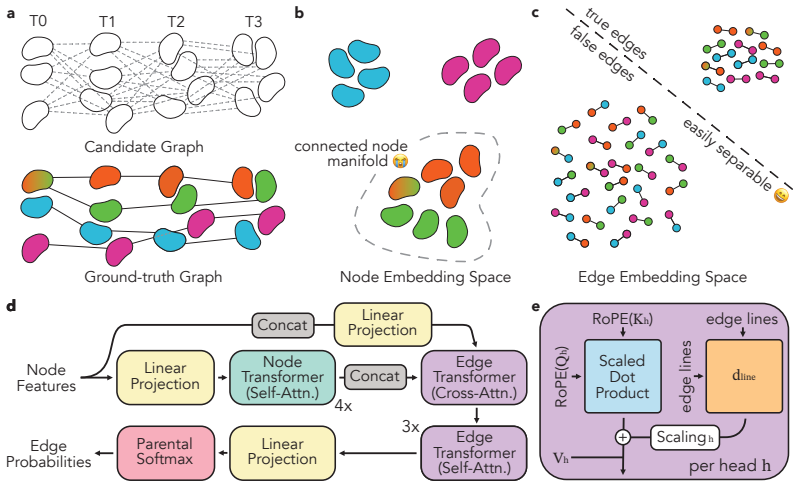
Higher-Order Cell Tracking Transformer (HOCT): edge tokens built by concatenating contextualized node features, refined by self-attention whose logits are biased by the analytic 3D line-to-line distance between edge segments (attractive and repulsive heads), then normalized by a multi-frame parental softmax and decoded by a two-pass tracklet ILP.
Load-bearing premise
Every true association is assumed to already sit inside a spatially thresholded candidate graph built from given segmentations; the model can only re-weight existing candidates, not invent missing detections or links that fall outside that construction.
What would settle it
On a Cell Tracking Challenge or bacteria sequence, deliberately drop true links beyond the spatial threshold (or remove detections at divisions) and check whether HOCT's CLB/AOGM collapses relative to methods that can re-detect or search more freely; if performance holds, the candidate-graph premise is not load-bearing.
If this is right
- Edge-centric attention with geometric biases can replace node-similarity association for any tracking domain whose candidate graphs are non-homophilic.
- A frozen edge-feature backbone plus a cheap logistic head is enough for rapid human-in-the-loop correction, reducing the need for full LoRA or end-to-end fine-tuning.
- Variable appearance costs derived from parental-softmax residuals give ILP solvers a data-driven alternative to fixed appearance penalties.
- Simple hand-crafted geometric features can match or beat large pretrained visual encoders once the association architecture itself is correctly structured.
Where Pith is reading between the lines
- The same line-to-line bias may help multi-object tracking of pedestrians or vehicles whenever identity swaps occur at near-collisions rather than at true interactions.
- Because the method already works from 19-dimensional mask features, it is a natural drop-in for any existing segmentation pipeline that currently relies on hand-tuned association costs.
- The O(|E|²) cost, even after k-NN sparsification, suggests hybrid designs that keep edge attention only near divisions or crowded regions while using cheaper node matching elsewhere.
Editorial analysis
A structured set of objections, weighed in public.
Referee Report
Summary. The paper proposes HOCT, a two-stage edge-centric Transformer for tracking-by-detection cell lineage reconstruction. Node features are refined with 3D RoPE self-attention; candidate links become tokens that attend under RoPE plus a learnable line-to-line distance bias (attractive/repulsive heads). A multi-frame parental softmax and a two-pass tracklet ILP with variable appearance costs produce the final tracks. Motivation is quantified via near-zero adjusted homophily on the candidate line graph. On CTC hidden tests a single joint model ranks first by official generalizability (CLB 0.930 / LNK 0.985 / BIO 0.875) without deep image encoders; on a bacteria-division benchmark it matches or beats Trackastra variants that use SAM2.1/DinoV2. A frozen-backbone logistic head on edge embeddings reduces AOGM by up to 59% with 400 annotations, versus at most 6.75% for LoRA fine-tuning of a Trackastra/Attrackt baseline.
Significance. If the results hold, this is a clear methodological advance for cell tracking: it identifies two structural failures of node-embedding and topology-driven GNN trackers (division-induced connected manifolds; non-homophilic candidate graphs with Hadj≈0), and shows that edge-centric attention with geometric inter-link bias addresses them. Competitive CTC generalizability and bacteria AOGM without foundation-model image encoders is practically valuable. The quantified heterophily analysis, ILP and aggregator ablations (Tables 1–2), organizer-provided hidden-test scores, and detailed appendices (architecture, ILP, correction protocol) strengthen credibility. The human-in-the-loop result, if interpreted carefully, also suggests that explicit edge representations are more annotation-efficient than node-similarity models.
major comments (3)
- Sec. 4.5 / Table 5 / Fig. 2: The headline fine-tuning claim (59% AOGM reduction vs 6.75% for LoRA+unsup) is load-bearing in the abstract but rests on uneven protocols. HOCT starts at AOGM 1418 vs Trackastra 4951, annotates edges rather than nodes, and only refits a logistic head on frozen features, while the strongest baseline updates LoRA adapters for 2000 steps/round after extra autoencoder pretraining on the validation sequences. Relative curves help, but the comparative claim that “edge-level representation quality dominates more complex approaches” needs either (i) a matched starting checkpoint / annotation budget in edge-equivalent units, or (ii) softer wording that emphasizes HOCT’s absolute correction efficiency rather than a direct superiority percentage.
- Table 2 and Sec. 3.2: Edge-Transformer (global edge self-attention without RoPE or line-to-line bias) reaches CLB 0.922±0.002 vs HOCT 0.926±0.007—within or near the reported variability—while GAT/FAGCN on L(GC) lag more clearly. The abstract and Sec. 1 attribute resolution of both structural obstacles to “attention … under a 3D geometric prior.” The ablation better supports that the edge-centric design (vs topology-restricted aggregation) is the main fix; the geometric bias is a smaller incremental gain. Please rebalance the claim so that “higher-order / edge tokens” and “line-to-line bias” are not conflated, and report whether the HOCT–Edge-Transformer gap is significant across seeds or only the two CV splits.
- Table 3 / Appendix E: Official CTC ranks and scores were “provided … directly” by organizers because the public leaderboard was not refreshed as of 2026-05-01. For a SOTA generalizability claim this is acceptable only with a clear verification path (e.g., organizer confirmation letter, submission ID, or commitment to update once the board is public). Please state how readers can independently verify the hidden-test numbers after publication.
minor comments (6)
- Fig. 1 caption and panel (e): “edge lines” / “dline” notation is dense; a short callout that d_line is the segment–segment distance of Eq. (2) would help non-specialists.
- Eq. (3): softplus(α_h) with α_h init −5 is sensible; state units of d_line after per-dataset standardization so the scale of the bias is interpretable.
- Sec. 4.1: “16 datasets … 32 sequences” and later “28 non-degenerate CTC sequences” for heterophily—briefly list which four were excluded as trivial so the Hadj statistic is reproducible.
- Table 4: “Original (greedy/ILP) [16]” rows lack ±std while other Trackastra rows have them; note whether those are single-run numbers from the source paper.
- Limitations: O(|E|²) and k-NN mitigation are clear; a rough peak-memory or wall-clock comparison vs Trackastra on one dense CTC sequence would make the cost trade-off concrete.
- Typos / polish: “dubbed this approachHigher-Order” (missing space); “Parental Softmax + Concat Scaling h” in Fig. 1 is hard to parse; checklist says Appendix D LoRA ~35 min while body text says ~40–55 min—align the numbers.
Circularity Check
No significant circularity: empirical architecture paper evaluated on external public benchmarks with independent ablations.
full rationale
HOCT is an empirical ML methods paper. Its central claims (SOTA CTC generalizability CLB/LNK/BIO on hidden tests; best bacteria AOGM with hand-crafted features; 59% AOGM reduction via frozen-edge logistic head vs LoRA) are measured against external public benchmarks (CTC organizers' hidden sequences; bacteria set from prior independent work) and do not reduce by construction to fitted inputs or self-definitions. The non-homophily measurement (Hadj≈0 on line graphs of candidate graphs) is a diagnostic of the input topology that motivates the edge-centric design; it is not used as a circular proof of tracking accuracy. Architecture equations (edge tokens Eq. 1, line-to-line bias Eq. 3, parental softmax Eq. 4, variable appearance Eq. 6, ILP) define a model that is then trained and scored; they do not equate the reported metrics to the inputs. Hyperparameters and ILP weights are tuned on held-out CTC splits. Self-citations (e.g. Ultrack) are ordinary prior work and not load-bearing uniqueness theorems. No fitted-parameter-as-prediction, ansatz-via-self-citation, or renaming-of-known-result steps appear. The paper is self-contained against external benchmarks.
Axiom & Free-Parameter Ledger
free parameters (6)
- Hidden dim C, heads H, node/edge depth Ln/Le
- Candidate spatial threshold τ / k-NN
- ILP costs (λ, appearance/disappearance/division/node weights)
- Focal loss γ and division edge weight
- Line-to-line bias init α_h and attractive/repulsive signs σ_h
- Optimizer and schedule (Muon/Adam lrs, EMA, 50k steps)
axioms (5)
- domain assumption Each cell has at most one parent and at most two daughters; solution is a binary forest in the candidate graph.
- domain assumption Spatially local candidate edges (distance ≤ τ, optional multi-frame Δt) contain the true associations given the input segmentations.
- domain assumption Candidate tracking graphs are non-homophilic on the line graph (near-random label agreement among co-incident edges).
- standard math Standard Transformer attention, 3D RoPE with learnable frequencies/reflections, focal loss, and ILP solvers behave as in the cited literature.
- ad hoc to paper Hand-crafted 19-D geometric/intensity features per detection are sufficient inputs for competitive association without deep image encoders.
invented entities (4)
-
HOCT edge-centric two-stage Transformer
independent evidence
-
Line-to-line distance attention bias (attractive/repulsive heads)
independent evidence
-
Multi-frame parental softmax with implicit no-parent and variable appearance cost
independent evidence
-
Two-pass tracklet ILP solver
independent evidence
Cite this review
Pith. "Pith review of Higher-Order Cell Tracking Transformer." pith.science (2026). https://pith.science/paper/NSPXAA4D
@misc{pith2026260711754,
  author       = {Pith},
  title        = {Pith review of: Higher-Order Cell Tracking Transformer},
  year         = {2026},
  howpublished = {\url{https://pith.science/paper/NSPXAA4D}},
  note         = {Machine review of arXiv:2607.11754}
}
read the original abstract
Reconstructing lineages from live-imaging microscopy requires linking cell detections across time, including through cell divisions. A common approach is to construct a candidate graph and associate cell segmentations (nodes) across frames. However, these and other existing methods overlook two structural obstacles in candidate tracking graphs: (i) cell divisions entangle distinct lineage paths in the node embedding space, and (ii) edges sharing a node have near-random label agreement, so the candidate-graph topology carries no useful information for graph neural networks to aggregate. We propose the \textbf{Higher-Order Cell Tracking Transformer} (HOCT), an edge-centric architecture in which candidate cell links attend to one another under a 3D geometric prior, resolving both issues. Evaluated on the Cell Tracking Challenge and a bacteria division benchmark, HOCT achieves state-of-the-art results without deep pre-trained image encoders. Moreover, the proposed approach is easier to fine-tune, quickly reducing tracking errors by 59% with 400 annotations in a human-in-the-loop setting, outperforming LoRA fine-tuning of competing transformer baselines (6.75% improvement).
Figures


Reference graph
Works this paper leans on
-
[1]
Leveraging learned object features for transformer-based cell tracking in mi- croscopy
Cyril Achard. Leveraging learned object features for transformer-based cell tracking in mi- croscopy. Master’s thesis, École Polytechnique Fédérale de Lausanne, 2025
2025
-
[2]
Graph neural network for cell tracking in microscopy videos
Tal Ben-Haim and Tammy Riklin Raviv. Graph neural network for cell tracking in microscopy videos. InEuropean Conference on Computer Vision, pages 610–626. Springer, 2022
2022
-
[3]
Tracking without bells and whistles
Philipp Bergmann, Tim Meinhardt, and Laura Leal-Taixe. Tracking without bells and whistles. InIEEE International Conference on Computer Vision, pages 941–951, 2019
2019
-
[4]
Simple online and realtime tracking
Alex Bewley, Zongyuan Ge, Lionel Ott, Fabio Ramos, and Ben Upcroft. Simple online and realtime tracking. InIEEE International Conference on Image Processing, pages 3464–3468. IEEE, 2016
2016
-
[5]
Beyond low-frequency information in graph convolutional networks
Deyu Bo, Xiao Wang, Chuan Shi, and Huawei Shen. Beyond low-frequency information in graph convolutional networks. InAAAI Conference on Artificial Intelligence, volume 35, pages 3950–3957, 2021
2021
-
[6]
Swept confocally- aligned planar excitation (SCAPE) microscopy for high-speed volumetric imaging of behaving organisms.Nature Photonics, 9(2):113–119, 2015
Matthew B Bouchard, Venkatakaushik V oleti, César S Mendes, Clay Lacefield, Wesley B Grueber, Richard S Mann, Randy M Bruno, and Elizabeth MC Hillman. Swept confocally- aligned planar excitation (SCAPE) microscopy for high-speed volumetric imaging of behaving organisms.Nature Photonics, 9(2):113–119, 2015
2015
-
[7]
Large-scale multi-hypotheses cell tracking using ultrametric contours maps
Jordão Bragantini, Merlin Lange, and Loïc Royer. Large-scale multi-hypotheses cell tracking using ultrametric contours maps. InEuropean Conference on Computer Vision, 2024
2024
-
[8]
Ultrack: pushing the limits of cell tracking across biological scales.Nature Methods, pages 1–14, 2025
Jordão Bragantini, Ilan Theodoro, Xiang Zhao, Teun APM Huijben, Eduardo Hirata-Miyasaki, Shruthi VijayKumar, Akilandeswari Balasubramanian, Tiger Lao, Richa Agrawal, Sheng Xiao, et al. Ultrack: pushing the limits of cell tracking across biological scales.Nature Methods, pages 1–14, 2025
2025
-
[9]
Learning a neural solver for multiple object tracking
Guillem Braso and Laura Leal-Taixe. Learning a neural solver for multiple object tracking. In IEEE Conference on Computer Vision and Pattern Recognition, pages 6246–6256. IEEE, 2020. doi: 10.1109/cvpr42600.2020.00628
-
[10]
End-to-end object detection with transformers
Nicolas Carion, Francisco Massa, Gabriel Synnaeve, Nicolas Usunier, Alexander Kirillov, and Sergey Zagoruyko. End-to-end object detection with transformers. InEuropean Conference on Computer Vision, pages 213–229. Springer, 2020
2020
-
[11]
Long-term live imaging, cell identifica- tion and cell tracking in regenerating crustacean legs.eLife, 14:RP107534, 2025
Ça˘grı Çevrim, Béryl Laplace-Builhé, Ko Sugawara, Maria Lorenza Rusciano, Nicolas Labert, Jacques Brocard, Alba Almazán, and Michalis Averof. Long-term live imaging, cell identifica- tion and cell tracking in regenerating crustacean legs.eLife, 14:RP107534, 2025
2025
-
[12]
Lattice light-sheet microscopy: imaging molecules to embryos at high spatiotemporal resolution.Science, 346 (6208):1257998, 2014
Bi-Chang Chen, Wesley R Legant, Kai Wang, Lin Shao, Daniel E Milkie, Michael W Davidson, Chris Janetopoulos, Xufeng S Wu, John A Hammer III, Zhe Liu, et al. Lattice light-sheet microscopy: imaging molecules to embryos at high spatiotemporal resolution.Science, 346 (6208):1257998, 2014
2014
-
[13]
Mot20: A benchmark for multi object tracking in crowded scenes.arXiv preprint arXiv:2003.09003, 2020
Patrick Dendorfer, Hamid Rezatofighi, Anton Milan, Javen Shi, Daniel Cremers, Ian Reid, Stefan Roth, Konrad Schindler, and Laura Leal-Taixé. Mot20: A benchmark for multi object tracking in crowded scenes.arXiv preprint arXiv:2003.09003, 2020
Pith/arXiv arXiv 2003
-
[14]
TrackTour, 2025
Draga Doncila Pop. TrackTour, 2025. URL https://github.com/DragaDoncila/ tracktour
2025
-
[15]
Optical pooled screens in human cells
David Feldman, Avtar Singh, Jonathan L Schmid-Burgk, Rebecca J Carlson, Anja Mezger, Anthony J Garrity, Feng Zhang, and Paul C Blainey. Optical pooled screens in human cells. Cell, 179(3):787–799, 2019
2019
-
[16]
Trackastra: Transformer-based cell tracking for live-cell microscopy
Benjamin Gallusser and Martin Weigert. Trackastra: Transformer-based cell tracking for live-cell microscopy. InEuropean Conference on Computer Vision, 2024
2024
-
[17]
Trackastra: code and pretrained weights, 2024
Benjamin Gallusser and Martin Weigert. Trackastra: code and pretrained weights, 2024. URL https://github.com/weigertlab/trackastra. 10
2024
-
[18]
ASCENT: Annotation-free self-supervised contrastive embeddings for 3d neuron tracking in fluorescence microscopy
Haejun Han and Hang Lu. ASCENT: Annotation-free self-supervised contrastive embeddings for 3d neuron tracking in fluorescence microscopy. InIEEE International Conference on Computer Vision, pages 14676–14687, 2025
2025
-
[19]
Mpm: Joint representation of motion and position map for cell tracking
Junya Hayashida, Kazuya Nishimura, and Ryoma Bise. Mpm: Joint representation of motion and position map for cell tracking. InIEEE Conference on Computer Vision and Pattern Recognition, pages 3823–3832, 2020
2020
-
[20]
Rotary position embedding for vision transformer
Byeongho Heo, Song Park, Dongyoon Han, and Sangdoo Yun. Rotary position embedding for vision transformer. InEuropean Conference on Computer Vision, pages 289–305. Springer, 2024
2024
-
[21]
Micrographia
Robert Hooke. Micrographia. InLiterature and Science, 1660-1834, Part II vol 5, pages 1–14. Routledge, 1665
-
[22]
LoRA: Low-rank adaptation of large language models
Edward J Hu, Yelong Shen, Phillip Wallis, Zeyuan Allen-Zhu, Yuanzhi Li, Shean Wang, Lu Wang, and Weizhu Chen. LoRA: Low-rank adaptation of large language models. In International Conference on Learning Representations, 2022
2022
-
[23]
Robust single-particle tracking in live-cell time-lapse sequences
Khuloud Jaqaman, Dinah Loerke, Marcel Mettlen, Hirotaka Kuwata, Sergio Grinstein, Sandra L Schmid, and Gaudenz Danuser. Robust single-particle tracking in live-cell time-lapse sequences. Nature Methods, 5(8):695–702, 2008
2008
-
[24]
Muon: An optimizer for hidden layers in neural networks, 2024
Keller Jordan, Yuchen Jin, Vlado Boza, Jiacheng You, Franz Cesista, Laker Newhouse, and Jeremy Bernstein. Muon: An optimizer for hidden layers in neural networks, 2024. URL https://kellerjordan.github.io/posts/muon/
2024
-
[25]
Cell tracking according to biolog- ical needs-strong mitosis-aware multi-hypothesis tracker with aleatoric uncertainty.IEEE Transactions on Medical Imaging, 2025
Timo Kaiser, Maximilian Schier, and Bodo Rosenhahn. Cell tracking according to biolog- ical needs-strong mitosis-aware multi-hypothesis tracker with aleatoric uncertainty.IEEE Transactions on Medical Imaging, 2025
2025
-
[26]
Reconstruction of zebrafish early embryonic development by scanned light sheet microscopy.Science, 322 (5904):1065–1069, 2008
Philipp J Keller, Annette D Schmidt, Joachim Wittbrodt, and Ernst HK Stelzer. Reconstruction of zebrafish early embryonic development by scanned light sheet microscopy.Science, 322 (5904):1065–1069, 2008
2008
-
[27]
The hungarian method for the assignment problem.Naval research logistics quarterly, 2(1-2):83–97, 1955
Harold W Kuhn. The hungarian method for the assignment problem.Naval research logistics quarterly, 2(1-2):83–97, 1955
1955
-
[28]
Attrackt, 2025
Manan Lalit and Jan Funke. Attrackt, 2025. URL https://github.com/funkelab/ attrackt
2025
-
[29]
Attrackt experiments, 2025
Manan Lalit and Jan Funke. Attrackt experiments, 2025. URL https://github.com/ funkelab/attrackt_experiments
2025
-
[30]
An investigation of unsupervised cell tracking and interactive fine- tuning
Manan Lalit and Jan Funke. An investigation of unsupervised cell tracking and interactive fine- tuning. InIEEE International Conference on Computer Vision Workshops, pages 5792–5800, 2025
2025
-
[31]
A multimodal zebrafish developmental atlas reveals the state-transition dynamics of late-vertebrate pluripotent axial progenitors.Cell, 187(23):6742–6759, 2024
Merlin Lange, Alejandro Granados, Shruthi VijayKumar, Jordão Bragantini, Sarah Ancheta, Yang-Joon Kim, Sreejith Santhosh, Michael Borja, Hirofumi Kobayashi, Erin McGeever, et al. A multimodal zebrafish developmental atlas reveals the state-transition dynamics of late-vertebrate pluripotent axial progenitors.Cell, 187(23):6742–6759, 2024
2024
-
[32]
Focal loss for dense object detection
Tsung-Yi Lin, Priya Goyal, Ross Girshick, Kaiming He, and Piotr Dollár. Focal loss for dense object detection. InIEEE International Conference on Computer Vision, pages 2980–2988, 2017
2017
-
[33]
Rethinking rope: A mathematical blueprint for n-dimensional positional embedding
Haiping Liu, Lijing Lin, Jingyuan Sun, Zhegong Shangguan, Mauricio A Alvarez, and Hong- peng Zhou. Rethinking rope: A mathematical blueprint for n-dimensional positional embedding. arXiv preprint arXiv:2504.06308, 2025
Pith/arXiv arXiv 2025
-
[34]
PhD thesis, KTH Royal Institute of Technology, 2016
Klas EG Magnusson.Segmentation and tracking of cells and particles in time-lapse microscopy. PhD thesis, KTH Royal Institute of Technology, 2016. 11
2016
-
[35]
Automated reconstruction of whole-embryo cell lineages by learning from sparse annotations.Nature Biotechnology, pages 1–6, 2022
Caroline Malin-Mayor, Peter Hirsch, Leo Guignard, Katie McDole, Yinan Wan, William C Lemon, Dagmar Kainmueller, Philipp J Keller, Stephan Preibisch, and Jan Funke. Automated reconstruction of whole-embryo cell lineages by learning from sparse annotations.Nature Biotechnology, pages 1–6, 2022
2022
-
[36]
The cell tracking challenge: 10 years of objective benchmarking.Nature Methods, pages 1–11, 2023
Martin Maška, Vladimír Ulman, Pablo Delgado-Rodriguez, Estibaliz Gómez-de Mariscal, Tereza Neˇcasová, Fidel A Guerrero Peña, Tsang Ing Ren, Elliot M Meyerowitz, Tim Scherr, Katharina Löffler, et al. The cell tracking challenge: 10 years of objective benchmarking.Nature Methods, pages 1–11, 2023
2023
-
[37]
Cell tracking accuracy measurement based on comparison of acyclic oriented graphs.PloS one, 10(12):e0144959, 2015
Pavel Matula, Martin Maška, Dmitry V Sorokin, Petr Matula, Carlos Ortiz-de Solórzano, and Michal Kozubek. Cell tracking accuracy measurement based on comparison of acyclic oriented graphs.PloS one, 10(12):e0144959, 2015
2015
-
[38]
Track- former: Multi-object tracking with transformers
Tim Meinhardt, Alexander Kirillov, Laura Leal-Taixe, and Christoph Feichtenhofer. Track- former: Multi-object tracking with transformers. InIEEE Conference on Computer Vision and Pattern Recognition, pages 8844–8854, 2022
2022
-
[39]
Quasi- dense similarity learning for multiple object tracking
Jiangmiao Pang, Linlu Qiu, Xia Li, Haofeng Chen, Qi Li, Trevor Darrell, and Fisher Yu. Quasi- dense similarity learning for multiple object tracking. InIEEE Conference on Computer Vision and Pattern Recognition, pages 164–173, 2021
2021
-
[40]
Geometric deep learning reveals the spatiotemporal features of microscopic motion
Jesús Pineda, Benjamin Midtvedt, Harshith Bachimanchi, Sergio Noé, Daniel Midtvedt, Gio- vanni V olpe, and Carlo Manzo. Geometric deep learning reveals the spatiotemporal features of microscopic motion. 5(1):71–82, 2023
2023
-
[41]
A critical look at the evaluation of GNNs under heterophily: Are we re- ally making progress? InInternational Conference on Learning Representations, 2023
Oleg Platonov, Denis Kuznedelev, Michael Diskin, Artem Babenko, and Liudmila Prokhorenkova. A critical look at the evaluation of GNNs under heterophily: Are we re- ally making progress? InInternational Conference on Learning Representations, 2023
2023
-
[42]
Needles in the haystack-rapid error detection for cell tracking solutions
Draga Doncila Pop, Pierre Le Bodic, and Juan Nunez-Iglesias. Needles in the haystack-rapid error detection for cell tracking solutions. InInt. Symposium on Biomedical Imaging (ISBI), pages 1–4. IEEE, 2025
2025
-
[43]
Zihan Qiu, Zekun Wang, Bo Zheng, Zeyu Huang, Kaiyue Wen, Songlin Yang, Rui Men, Le Yu, Fei Huang, Suozhi Huang, et al. Gated attention for large language models: Non-linearity, sparsity, and attention-sink-free.arXiv preprint arXiv:2505.06708, 2025
Pith/arXiv arXiv 2025
-
[44]
Particle tracking in biological images with optical-flow enhanced kalman filtering
Raphael Reme, Alasdair Newson, Elsa Angelini, Jean-Christophe Olivo-Marin, and Thibault Lagache. Particle tracking in biological images with optical-flow enhanced kalman filtering. In Int. Symposium on Biomedical Imaging (ISBI), pages 1–5. IEEE, 2024
2024
-
[45]
Pathfinder discovery networks for neural message passing
Benedek Rozemberczki, Peter Englert, Amol Kapoor, Martin Blais, and Bryan Perozzi. Pathfinder discovery networks for neural message passing. InProceedings of the Web Confer- ence 2021, pages 2547–2558, 2021
2021
-
[46]
Conservation tracking
Martin Schiegg, Philipp Hanslovsky, Bernhard X Kausler, Lars Hufnagel, and Fred A Hamprecht. Conservation tracking. InIEEE Conference on Computer Vision and Pattern Recognition, pages 2928–2935, 2013
2013
-
[47]
Smart lattice light-sheet microscopy for imaging rare and complex cellular events.Nature Methods, pages 1–10, 2024
Yu Shi, Jimmy S Tabet, Daniel E Milkie, Timothy A Daugird, Chelsea Q Yang, Alex T Ritter, Andrea Giovannucci, and Wesley R Legant. Smart lattice light-sheet microscopy for imaging rare and complex cellular events.Nature Methods, pages 1–10, 2024
2024
-
[48]
Roformer: Enhanced transformer with rotary position embedding.Neurocomputing, 568:127063, 2024
Jianlin Su, Murtadha Ahmed, Yu Lu, Shengfeng Pan, Wen Bo, and Yunfeng Liu. Roformer: Enhanced transformer with rotary position embedding.Neurocomputing, 568:127063, 2024
2024
-
[49]
Tracking cell lineages in 3d by incremental deep learning.eLife, 11:e69380, 2022
Ko Sugawara, Ça˘grı Çevrim, and Michalis Averof. Tracking cell lineages in 3d by incremental deep learning.eLife, 11:e69380, 2022
2022
-
[50]
Network flow integer programming to track elliptical cells in time-lapse sequences.IEEE Transactions on Medical Imaging, 36(4):942–951, 2016
Engin Türetken, Xinchao Wang, Carlos J Becker, Carsten Haubold, and Pascal Fua. Network flow integer programming to track elliptical cells in time-lapse sequences.IEEE Transactions on Medical Imaging, 36(4):942–951, 2016. 12
2016
-
[51]
An objective comparison of cell-tracking algorithms.Nature Methods, 14(12):1141–1152, 2017
Vladimír Ulman, Martin Maška, Klas EG Magnusson, Olaf Ronneberger, Carsten Haubold, Nathalie Harder, Pavel Matula, Petr Matula, David Svoboda, Miroslav Radojevic, et al. An objective comparison of cell-tracking algorithms.Nature Methods, 14(12):1141–1152, 2017
2017
-
[52]
Attention is all you need.Advances in Neural Information Processing Systems, 30, 2017
Ashish Vaswani, Noam Shazeer, Niki Parmar, Jakob Uszkoreit, Llion Jones, Aidan N Gomez, Łukasz Kaiser, and Illia Polosukhin. Attention is all you need.Advances in Neural Information Processing Systems, 30, 2017
2017
-
[53]
Graph attention networks
Petar Veliˇckovi´c, Guillem Cucurull, Arantxa Casanova, Adriana Romero, Pietro Lio, and Yoshua Bengio. Graph attention networks. InInternational Conference on Learning Representations, 2018
2018
-
[54]
Sam-med3d: a vision foundation model for general-purpose segmentation on volumetric medical images.IEEE Transactions on Neural Networks and Learning Systems, 2025
Haoyu Wang, Sizheng Guo, Jin Ye, Zhongying Deng, Junlong Cheng, Tianbin Li, Jianpin Chen, Yanzhou Su, Ziyan Huang, Yiqing Shen, et al. Sam-med3d: a vision foundation model for general-purpose segmentation on volumetric medical images.IEEE Transactions on Neural Networks and Learning Systems, 2025
2025
-
[55]
Simple online and realtime tracking with a deep association metric
Nicolai Wojke, Alex Bewley, and Dietrich Paulus. Simple online and realtime tracking with a deep association metric. InIEEE International Conference on Image Processing, pages 3645–3649. IEEE, 2017
2017
-
[56]
Daxi—high-resolution, large imaging volume and multi-view single-objective light-sheet mi- croscopy.Nature Methods, 19(4):461–469, 2022
Bin Yang, Merlin Lange, Alfred Millett-Sikking, Xiang Zhao, Jordão Bragantini, Shruthi Vi- jay Kumar, Mason Kamb, Rafael Gómez-Sjöberg, Ahmet Can Solak, Wanpeng Wang, et al. Daxi—high-resolution, large imaging volume and multi-view single-objective light-sheet mi- croscopy.Nature Methods, 19(4):461–469, 2022
2022
-
[57]
Global data association for multi-object tracking using network flows
Li Zhang, Yuan Li, and Ramakant Nevatia. Global data association for multi-object tracking using network flows. InIEEE Conference on Computer Vision and Pattern Recognition, pages 1–8. IEEE, 2008
2008
-
[58]
ByteTrack: Multi-object tracking by associating every detection box
Yifu Zhang, Peize Sun, Yi Jiang, Dongdong Yu, Fucheng Weng, Zehuan Yuan, Ping Luo, Wenyu Liu, and Xinggang Wang. ByteTrack: Multi-object tracking by associating every detection box. InEuropean Conference on Computer Vision, pages 1–21. Springer, 2022
2022
-
[59]
Graph neural networks for graphs with heterophily: A survey.arXiv preprint arXiv:2202.07082, 2022
Xin Zheng, Yi Wang, Yixin Liu, Ming Li, Miao Zhang, Di Jin, Philip S Yu, and Shirui Pan. Graph neural networks for graphs with heterophily: A survey.arXiv preprint arXiv:2202.07082, 2022
Pith/arXiv arXiv 2022
-
[60]
CELLECT: contrastive embedding learning for large-scale efficient cell tracking.Nature Methods, pages 1–12, 2025
Hongyu Zhou, Seonghoon Kim, Zhifeng Zhao, Jiaqi Fan, Wen Huang, Xinghua Sui, Lizhi Shao, Haoran An, Jing-Ren Zhang, Jiamin Wu, et al. CELLECT: contrastive embedding learning for large-scale efficient cell tracking.Nature Methods, pages 1–12, 2025
2025
-
[61]
Jiayuan Zhu, Abdullah Hamdi, Yunli Qi, Yueming Jin, and Junde Wu. Medical sam 2: Segment medical images as video via segment anything model 2.arXiv preprint arXiv:2408.00874, 2024
Pith/arXiv arXiv 2024
-
[62]
MLP_E”/“MLP_D
Zi Lab. zTrack4CTC, 2024. URLhttps://github.com/Zi-Lab/zTrack4CTC. A Implementation details Architecture.The full architecture specifications are: input dimension d=19, hidden dimension C=288, H=4 attention heads (head dimension D=72), MLP expansion factor 2 (hidden MLP dimension 576), attention dropout 0.05, MLP dropout 0.0, gated attention [43] in all l...
2024
-
[63]
Guidelines: • The answer [N/A] means that the paper does not involve crowdsourcing nor research with human subjects
Institutional review board (IRB) approvals or equivalent for research with human subjects Question: Does the paper describe potential risks incurred by study participants, whether such risks were disclosed to the subjects, and whether Institutional Review Board (IRB) approvals (or an equivalent approval/review based on the requirements of your country or ...
This paper was first reviewed by grok-4.5 on July 14, 2026.
discussion (0)
Sign in with ORCID, Apple, or X to comment. Anyone can read and Pith papers without signing in.